Accounts receivable automation is most useful when it targets a measurable workflow instead of treating an occupation as one automatable unit. Accounts receivable teams can automate invoice creation support, account updates, payment posting, statement delivery, and exception routing. Disputes, credit changes, write-offs, and customer-sensitive collection decisions need accountable review. Arsum’s task-level model scores this work at 66.5/100, with a 72.7/100 capability scenario for 2029 and a modeled planning range of 15-25 hours/week.
Accounts Receivable Automation: 28 Tasks
Accounts receivable automation: compare 28 O*NET tasks, the 66.5/100 score, 2029 capability, human controls, task capacity, and a practical first pilot.
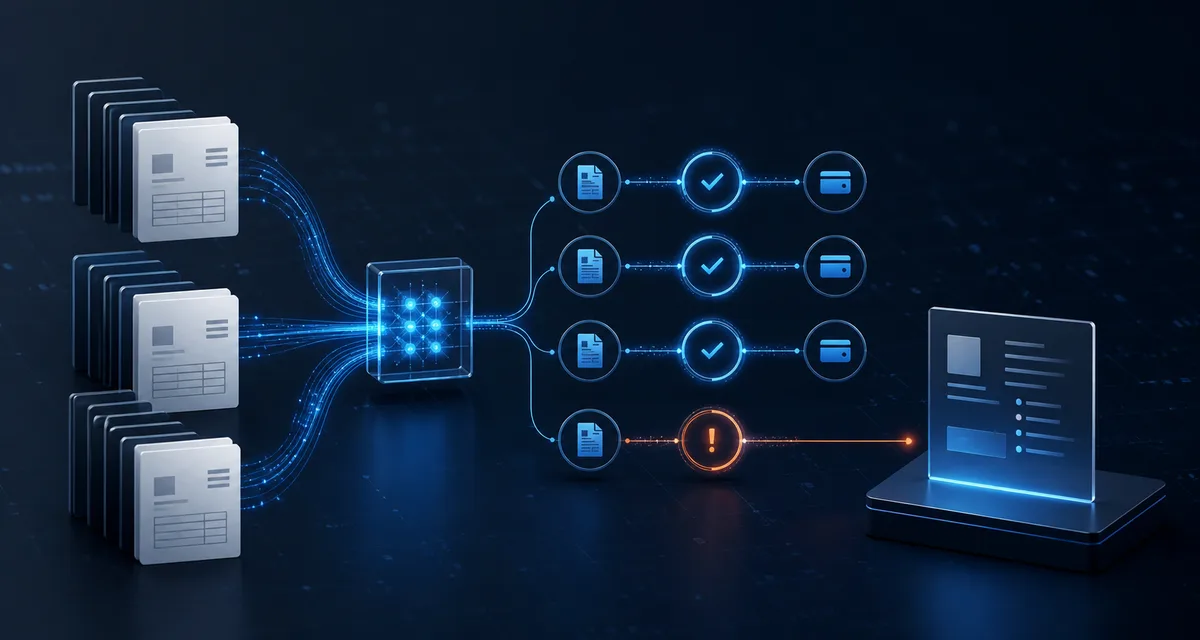
Table of Contents
- Accounts receivable automation opportunity
- How the accounts receivable score is calculated
- Top accounts receivable tasks for automation support
- Accounts receivable tasks that should remain human-led
- Accounts receivable capability from 2026 to 2029
- Modeled hours and wage capacity for accounts receivable
- A controlled 30/60/90-day accounts receivable pilot
- What most accounts receivable automation guides miss
- Social listening: accounts receivable implementation questions
- Official control context for accounts receivable
- Accounts receivable pilot evidence before expansion
- What the 66.5/100 accounts receivable score means
- First pilot: Cash application matching and billing exception routing
- Accounts receivable pilot requirements and success measures
- Human review rules for accounts receivable
- Why the 2029 accounts receivable scenario reaches 72.7/100
- How to measure ROI from cash application matching and billing exception routing
- Compare accounts receivable with adjacent finance workflows
- Accounts receivable automation FAQ
- What is the current automation score for accounts receivable?
- How much accounts receivable task capacity is modeled?
- Which accounts receivable workflow should be automated first?
- What does the 2029 accounts receivable capability scenario mean?
- When does custom accounts receivable automation make sense?
- Ready to Automate Your Business?
Arsum Automation Opportunity Index · 2026-08-12
Accounts receivable automation opportunity
Accounts receivable teams can automate invoice creation support, account updates, payment posting, statement delivery, and exception routing. Disputes, credit changes, write-offs, and customer-sensitive collection decisions need accountable review.
Current score
66.5/100
Strong assisted-automation opportunity
Modeled task capacity
15-25 hours/week
P25-P75 planning range
2029 capability scenario
72.7/100
+6.2 points, not an adoption forecast
Recommended first pilot
cash application matching and billing exception routing
Start narrow, measure, then expand
Decision: Start with cash application and billing exceptions before automating collection judgment or customer commitments.
How the accounts receivable score is calculated
For accounts receivable, Arsum assessed 28 of 28 O*NET tasks from Billing and Posting Clerks (43-3021.00). The 66.5/100 result weights each task's current automation share by O*NET importance, relevance, and frequency. It measures technical workflow opportunity—not the percentage of accounts receivable jobs that disappear and not the share of a team that should be removed.
Keep people responsible for disputed invoices, credit terms, write-offs, payment plans, material adjustments, and escalation of strategic accounts. The weighted supervision estimate is 44.2%, which is why the practical design is an exception-and-approval system rather than unsupervised autonomy.
Top accounts receivable tasks for automation support
O*NET task 23238
Verify accuracy of billing data and revise any errors.
65/100
Hybrid
AI assists; review exceptions and material outputs
O*NET task 23239
Verify signatures and required information on checks.
70/100
Hybrid
AI assists; review exceptions and material outputs
O*NET task 23240
Prepare itemized statements, bills, or invoices and record amounts due for items purchased or services rendered.
90/100
Traditional Software
AI assists; review exceptions and material outputs
O*NET task 23241
Perform bookkeeping work, including posting data or keeping other records concerning costs of goods or services or the shipment of goods.
75/100
Hybrid
AI assists; review exceptions and material outputs
O*NET task 23243
Resolve discrepancies in accounting records.
75/100
Hybrid
AI assists; review exceptions and material outputs
O*NET task 23245
Review documents, such as purchase orders, sales tickets, charge slips, or hospital records, to compute fees or charges due.
90/100
Traditional Software
AI assists; review exceptions and material outputs
O*NET task 23246
Keep records of invoices and support documents.
75/100
Hybrid
AI assists; review exceptions and material outputs
These are ranked for practical opportunity: task exposure and current capability are discounted when implementation is complex, supervision is heavy, or live human interaction dominates. The recommended pilot above is an editorial choice among these signals, not simply the highest raw percentage.
Accounts receivable tasks that should remain human-led
- 45/100 current capability: Operate typing, adding, calculating, or billing machines. AI assists; review exceptions and material outputs.
- 65/100 current capability: Verify accuracy of billing data and revise any errors. AI assists; review exceptions and material outputs.
- 50/100 current capability: Consult sources, such as rate books, manuals, or insurance company representatives, to determine specific charges or information such as rules, regulations, or government tax and tariff information. Decision support only; human owns the conclusion.
- 50/100 current capability: Contact customers to obtain or relay account information. AI assists; review exceptions and material outputs.
Accounts receivable capability from 2026 to 2029
2026 current
66.5/100
66.5/100
2028 midpoint
70.6/100
70.6/100
2029 scenario
72.7/100
72.7/100
The scenario adds 6.2 score points by 2029-08-12 under the same task mix. It assumes better reliability and integration in the tasks already identified as technically assistable. It does not assume that employers deploy those systems, that every normal case becomes autonomous, or that employment changes by the same amount.
The largest weighted capability gains come from:
- O*NET task 23242, Operate typing, adding, calculating, or billing machines. 45→55.
- O*NET task 23244, Contact customers to obtain or relay account information. 50→60.
- O*NET task 23238, Verify accuracy of billing data and revise any errors. 65→70.
Modeled hours and wage capacity for accounts receivable
The accounts receivable model assigns 30 hours of a reference 40-hour week across rated tasks and leaves 10 hours unmodeled. On that explicit assumption, current automation capability represents 15-25 hours/week. At the May 2025 BLS national mean wage of $25/hour, the gross accounts receivable planning range is $19,109-$31,849/year per worker.
BLS national employment404,060
Mean annual wage$51,070
Tasks with full score inputs23/28
Assessment coverage100%
Gross wage capacity is not net savings. A business case must subtract implementation, software and model usage, review time, exception handling, maintenance, and risk reserves. BLS employment excludes self-employed workers.
A controlled 30/60/90-day accounts receivable pilot
- Days 0-30: baseline cash application matching and billing exception routing. Capture volume, handling time, rework, error rate, source systems, permissions, and the exception owner before changing the workflow.
- Days 31-60: run in review mode. Let the system prepare or route work, keep logs, and require human approval at the boundary described above. Measure accepted outputs and review cost, not generated volume.
- Days 61-90: expand only after evidence. Increase scope when accuracy, cycle time, exception rate, and net capacity beat the baseline without weakening customer, employee, financial, legal, or operational controls.
Sources, formula, and limitations
Occupation and task facts come from O*NET O*NET 30.3. Employment and wage inputs come from BLS OEWS May 2025 national estimates. Arsum adds the task-level current capability, supervision, implementation, time-allocation, and 2029 scenario assessments.
The occupation score is the exposure-weighted mean of task automation shares. Exposure combines normalized O*NET importance, relevance, and a log-scaled transformation of frequency. The time range applies a ±25% planning band around the modeled task capacity. Read the full Automation Opportunity Index methodology for formulas, QA gates, version history, and reproducible queries.
- The task inventory comes from O*NET 30.3; Arsum supplies the automation assessment and transformation.
- The time model allocates 30 hours of a reference 40-hour week across rated O*NET tasks, leaving 10 hours unmodeled for context switching and work not represented by task statements.
- Hours and wage capacity are planning ranges, not measured savings. Net ROI must subtract software, implementation, review, exception handling, maintenance, and risk costs.
- The 2029 value is a capability scenario, not a forecast of adoption, employment, layoffs, or autonomous operation.
- 23 of 28 tasks have the complete O*NET importance, relevance, and frequency inputs needed for score weighting; all 28 tasks were assessed.
- BLS wage and employment data use the matching detailed SOC occupation; employment excludes self-employed workers.
Version: aoi-v0.3-finance-risk · run 8 · capability date 2026-08-12 · forecast horizon 2029-08-12.
What most accounts receivable automation guides miss
A cash-application demo is only meaningful when it is tested on the buyer’s ugly payments. Use split payments, short pays, bank fees, missing remittance, duplicate references, and disputed invoices; count a case as automated only after correct ERP posting, not after a plausible match suggestion.
That is the first decision rule for this page: a technical capability score identifies where to investigate, while production acceptance depends on source evidence, exception cost, reversibility, and decision authority. Buyers are not given a testable acceptance plan for their own remittance mix, ERP writeback, review cost, and dispute boundary before committing to a platform.
Decision tree: automate, assist, or keep human-led
| Operating mode | Use it when | Accountable owner |
|---|---|---|
| Automate the normal path | Use only when inputs are complete, rules are stable, the output is reversible, and none of these conditions apply: matching a payment to the wrong legal entity; continuing collection activity after a dispute or payment; changing customer terms without authorization. | the AR lead or controller approves the rule, permissions, threshold, and sampled quality review. |
| Assist, then review | Use when software can prepare a reconciled match proposal with confidence, source links, and a queue for partial, duplicate, or disputed payments, but an exception, uncertainty, customer impact, or material judgment remains. | the AR lead or controller accepts, corrects, or rejects the prepared output before the consequential action. |
| Keep human-led | Keep people responsible for disputed invoices, credit terms, write-offs, payment plans, material adjustments, and escalation of strategic accounts. | The accountable human records the decision and rationale; the system may collect evidence but cannot silently complete the action. |
This decision tree prevents a high score on a preparation task from being mistaken for permission to automate the final accounts receivable decision. Start the pilot in shadow mode, compare the prepared output with the approved outcome, and expand permissions only for a stable normal path.
Social listening: accounts receivable implementation questions
These source-linked discussions are qualitative workflow signals. They identify objections and exception patterns to test; they do not establish adoption, accuracy, ROI, or legal requirements.
- AR buyers distinguish collection problems from cash-application problems and want vendors tested against real lump payments, missing remittance, and ERP writeback rather than tidy demo files. Reddit r/Accounting practitioner discussion is treated as qualitative evidence, not a market-wide statistic. For this pilot, add a vendor acceptance test based on the buyer’s messiest remittances and clean-posting rate.
- Mid-market teams ask for realistic cost, integration, manual-match volume, and working-capital impact before they start vendor calls. Reddit r/CFO buyer discussion is treated as qualitative evidence, not a market-wide statistic. For this pilot, frame ROI around accepted matches, review minutes, DSO drivers, and integration cost.
- Non-standard inflows such as deposits, installments, undocumented concessions, and partial payments create the reconciliation work that standard happy-path automation misses. Reddit r/Accounting practitioner discussion is treated as qualitative evidence, not a market-wide statistic. For this pilot, define the exception taxonomy before estimating an automation rate.
The repeated signal is operational: teams want fewer touches, but not at the cost of hidden review work or untraceable decisions. A useful vendor demonstration should therefore use the organization’s own difficult cases and show the reviewer exactly what happened to every exception.
Official control context for accounts receivable
- O*NET 30.3 database: O*NET supplies the occupation task statements, task ratings, work context, and related descriptors used by the Arsum model.
- BLS Occupational Employment and Wage Statistics: BLS supplies the employment and wage snapshot used to translate modeled task capacity into a gross wage-capacity planning range.
- SEC internal-control reporting guidance: Management remains responsible for establishing, maintaining, and assessing internal control over financial reporting.
- PCAOB Auditing Standard 13: Automated controls still require evidence of operating effectiveness and relevant IT general controls.
These sources establish the task, wage, governance, or control context. They do not endorse Arsum’s score or a specific product. The organization’s legal, compliance, risk, and process owners must translate them into its own requirements.
Accounts receivable pilot evidence before expansion
| Pilot gate | Evidence to collect | Stop or narrow when | Owner |
|---|---|---|---|
| Workflow value | Baseline and post-pilot straight-through match rate plus unapplied-cash aging | Review and rework consume the apparent capacity gain | the AR lead or controller |
| Output quality | Accepted outputs, corrections, source links, and exception handling minutes | Matching a payment to the wrong legal entity | the AR lead or controller |
| Control safety | Permission logs, model or rule version, reviewer, exception, and rollback evidence | Continuing collection activity after a dispute or payment | the AR lead or controller |
| Expansion readiness | Stable results across normal and difficult cases, including incorrect-posting rate | Changing customer terms without authorization | the AR lead or controller |
Methodology and freshness note
Reviewed the exact keyword and close commercial variants, three source-linked qualitative practitioner patterns, official control sources, and Arsum’s ONET 30.3/BLS May 2025 task model on 2026-08-12. Practitioner discussions are used to identify buyer questions and failure modes, not as prevalence, ROI, accuracy, or legal evidence. The practitioner sources above are paraphrased and labeled because they are useful for discovering buyer questions, not for proving performance. The ONET/BLS model assumptions and limitations remain visible in the data module and scoring methodology.
What the 66.5/100 accounts receivable score means
Start with cash application and billing exceptions before automating collection judgment or customer commitments. The strongest business case is assisted automation: let software prepare, validate, and route work while a qualified owner keeps the consequential decision.
The useful split is between invoice evidence and customer authority: normalize, match, and route the records, while disputes, write-offs, credit terms, and collection escalation remain accountable decisions.
The task distribution matters more than the occupation average. “Verify accuracy of billing data and revise any errors.” scores 65/100 today; “Verify signatures and required information on checks.” scores 70/100; and “Prepare itemized statements, bills, or invoices and record amounts due for items purchased or services rendered.” scores 90/100. Those tasks show where current software can prepare, validate, or route work. They do not transfer accountability for the whole role.
The contrast is equally important. “Operate typing, adding, calculating, or billing machines.” carries a 45/100 capability estimate and 55% modeled supervision. “Verify accuracy of billing data and revise any errors.” is 65/100 with 50% supervision. That spread is why the recommendation is selective automation, not a claim that every accounts receivable responsibility can follow the same operating model.
First pilot: Cash application matching and billing exception routing
The first implementation candidate is cash application matching and billing exception routing. The representative O*NET task closest to that workflow is task 23238: “Verify accuracy of billing data and revise any errors.” Its current capability estimate is 65/100, with 50% modeled supervision. That combination indicates whether the pilot should use straight-through processing, review-first assistance, or decision support.
This pilot is narrower than “automate accounts receivable.” It should have one trigger, a known source of truth, an observable output, an exception owner, and a before-and-after baseline. The pilot task is an editorial choice based on coherence and controllability; it is not simply whichever O*NET statement has the largest raw percentage.
Accounts receivable pilot requirements and success measures
The workflow should accept open invoices, remittance records, bank receipts, customer master data, and approval thresholds. Its required output is a reconciled match proposal with confidence, source links, and a queue for partial, duplicate, or disputed payments. Final accountability belongs to the AR lead or controller. These are the minimum data, deliverable, and approval boundaries a vendor or internal team should put into the implementation charter.
Measure the following accounts receivable outcomes before the first automated case and throughout the pilot:
- Straight-through match rate. Define the numerator, denominator, source system, and measurement window so the result can be audited.
- Unapplied-cash aging. Define the numerator, denominator, source system, and measurement window so the result can be audited.
- Exception handling minutes. Define the numerator, denominator, source system, and measurement window so the result can be audited.
- Incorrect-posting rate. Define the numerator, denominator, source system, and measurement window so the result can be audited.
Stop, narrow, or return the workflow to review-only mode if it shows these role-specific failure patterns:
- Matching a payment to the wrong legal entity. Route the case to the AR lead or controller; preserve the source, generated output, rule or model version, reviewer, and resolution.
- Continuing collection activity after a dispute or payment. Route the case to the AR lead or controller; preserve the source, generated output, rule or model version, reviewer, and resolution.
- Changing customer terms without authorization. Route the case to the AR lead or controller; preserve the source, generated output, rule or model version, reviewer, and resolution.
For accounts receivable, generated volume is not a success measure. The release gate is a sustained improvement in accepted handling time or rework while error severity, escalations, and control exceptions remain inside thresholds approved by the AR lead or controller.
💡 Arsum builds custom AI automation solutions tailored to your business needs.
Get a Free Consultation →Human review rules for accounts receivable
Keep people responsible for disputed invoices, credit terms, write-offs, payment plans, material adjustments, and escalation of strategic accounts.
In the task data, the clearest boundary includes ONET task 23242, “Operate typing, adding, calculating, or billing machines.” Its modeled supervision requirement is 55%, so a system may assemble evidence or draft a recommendation but should not silently complete the consequential action. ONET task 23238, “Verify accuracy of billing data and revise any errors.” has the same practical lesson at 50% supervision.
A credible implementation therefore needs confidence thresholds, an exception queue, restricted permissions, source-linked audit records, named approvers, sampled quality review, and a tested rollback path. The weighted supervision estimate for accounts receivable is 44.2%; treat it as a signal for control design, then calibrate the actual review rate on the organization’s own cases and cost of error.
Why the 2029 accounts receivable scenario reaches 72.7/100
The capability scenario rises 6.2 points, from 66.5/100 today to 72.7/100 in 2029. The strongest weighted drivers are O*NET task 23242, “Operate typing, adding, calculating, or billing machines.” (45→55); task 23244, “Contact customers to obtain or relay account information.” (50→60); and task 23238, “Verify accuracy of billing data and revise any errors.” (65→70).
That increase assumes better reliability and integration for work already considered assistable. It does not forecast company adoption, headcount, regulation, demand, or autonomous authority. For controllers and accounts receivable leaders, the planning question is whether the same approval and evidence design can absorb greater technical capability without weakening accountability.
How to measure ROI from cash application matching and billing exception routing
The published 15-25 hours/week range is a portfolio-planning estimate derived from a disclosed 30-hour O*NET task budget, not a time-and-motion study inside a specific company. At the BLS mean wage used in the model, the gross wage-capacity range is $19,109-$31,849/year per worker. Neither figure is net savings.
gross capacity = accepted automated minutes
net capacity   = gross capacity - review - exception handling - rework
net value      = net capacity × loaded labor rate - software - maintenance - risk reserve
For cash application matching and billing exception routing, calculate accepted automated minutes from straight-through match rate and unapplied-cash aging, then subtract review, exception handling, and rework signaled by exception handling minutes and incorrect-posting rate. Run that measurement for 30 to 60 days. If review cost or the failure modes above consume the theoretical gain, fix upstream data, narrow the normal path, or stop the pilot.
Work With Arsum
We help businesses implement AI automation that actually works. Custom solutions, not cookie-cutter templates.
Learn more →Compare accounts receivable with adjacent finance workflows
Do not apply the 66.5/100 score to an entire department. Compare accounts receivable with Bookkeeping (71.2/100), Controllership (31/100), Bank account opening (55.1/100) because those pages use different task inventories, control boundaries, and first pilots. The Finance, Risk & Compliance Automation Index supports portfolio prioritization; the scoring methodology documents the formula, denominator, and forecast limitations.
Accounts receivable automation FAQ
What is the current automation score for accounts receivable?
The current Arsum score is 66.5/100 based on 28 assessed O*NET tasks and the aoi-v0.3-finance-risk formula. It is a task-weighted capability measure, not a probability that the occupation disappears.
How much accounts receivable task capacity is modeled?
The planning range is 15-25 hours/week under a disclosed 30-hour modeled task budget. Replace that portfolio estimate with actual straight-through match rate, handling time, acceptance, review, and exception data during the pilot.
Which accounts receivable workflow should be automated first?
Start with cash application matching and billing exception routing because its inputs, expected output, owner, and failure conditions can be specified more clearly than an occupation-wide automation project.
What does the 2029 accounts receivable capability scenario mean?
The 72.7/100 value holds the current O*NET task mix constant and changes technical capability assumptions. It does not predict accounts receivable employment, adoption, regulation, or the share of cases an organization will authorize for autonomous processing.
When does custom accounts receivable automation make sense?
Custom work becomes reasonable when cash application matching and billing exception routing crosses several systems, requires company-specific rules or approvals, and has enough measurable volume to repay integration and maintenance. Use a standard product when it handles the workflow and its audit requirements without custom orchestration.
Ready to Automate Your Business?
Stop wasting time on repetitive tasks. Let AI handle the busywork while you focus on growth.
Schedule a Free Strategy Call →Written by:Arsum editorial team
- Reviewed by
- Arsum editorial team
- Published
- August 12, 2026
- Updated
- Same as published date
- How this was produced
- Arsum uses research packs, source checks, and human editorial review to prepare and update blog articles. Editors are responsible for the final page.
- Source policy
- Sources are linked in the article when used. Methodology and source notes are included on higher-risk or high-visibility pages and are being rolled out across the archive. Editorial policy.
- Why this page exists
- Help B2B operators evaluate AI automation, implementation scope, cost, risk, and build-vs-buy decisions with practical context.