Agentic AI consulting services are worth considering when a workflow needs to interpret unstructured information, coordinate bounded actions across systems, and handle exceptions that rules alone cannot maintain—but technical capability is not authorization. A tool-connected agent may plan and execute explicitly permitted, reversible steps; consequential, irreversible, regulated, or customer-facing actions need a named approver, retained evidence, and a rollback path.
Agentic AI Consulting Services: Buyer Guide
Explore agentic ai consulting services: compare workflow fit, costs, risks, evidence, and practical next steps before you build, buy, or hire.

Agentic AI consulting covers strategy, build, and production handoff – not just model configuration.
Table of Contents
- What most guides miss: agent fit and authorized autonomy are separate decisions
- Choose deterministic automation, a copilot, or a bounded agent
- A gated workflow scorecard for an agent consulting engagement
- What an agentic AI consulting service should actually deliver
- Worked example: a compliance-document review pilot
- Production controls: what must be designed before launch
- Build, buy, or connect existing tools?
- A practical handoff plan and vendor proof test
- Source limits and a content-quality risk to avoid
- Questions to ask before hiring an agentic AI consultant
What most guides miss: agent fit and authorized autonomy are separate decisions
The first question is not “Can an agent do this?” It is “What is the safest operating model for this workflow?”
OpenAI’s practical guide to building agents points to workflows involving complex decisions, difficult-to-maintain rules, or substantial unstructured data as agent candidates. That is a fit signal, not permission for unrestricted autonomy.
Use two separate decisions:
- Fit: Does the work require contextual judgment, unstructured inputs, or dynamic coordination across tools?
- Risk gate: Can every proposed action be limited, reviewed, evidenced, and reversed at an acceptable operational cost?
A high-fit workflow can still be a poor candidate for autonomous execution. A credit decision, payment release, policy exception, or customer commitment may benefit from an agent that gathers evidence and prepares a recommendation, while a named employee retains authority to approve the final action.
This distinction is where strategic consulting should add value. Prompt configuration can produce a demonstration. A useful engagement defines the workflow boundary, permissions, exception route, accountable owner, and conditions under which the system stops.
Practitioner discussions surfaced in the research repeatedly raise a related concern: the model call is only a small part of making a workflow dependable. The difficult work is turning inconsistent inputs into safe actions, handling failed tool calls, preserving state, and operating the exception queue. That is a qualitative signal from a Reddit discussion discovered in search results, not a market-wide measurement.
Choose deterministic automation, a copilot, or a bounded agent
Start with the least complex pattern that can meet the business requirement.
| Operating model | Best fit | What it should not do |
|---|---|---|
| Deterministic automation | Stable steps, known rules, structured inputs, rare exceptions | Infer policy or invent exceptions |
| Copilot | Unstructured review where a person should decide each case | Submit, approve, or change consequential records without review |
| Bounded agent | Contextual work requiring several permitted tool calls and exception routing | Expand its own mandate or perform prohibited actions |
| Human-led process | High-impact judgment, unclear policy, low reversibility, or weak evidence | Be treated as a temporary gap that automation automatically solves |
The useful decision tree is deliberately conservative:
- Are the process steps stable and rules explicit? Start with deterministic automation.
- Does the work involve documents, emails, or other unstructured inputs, but require human judgment on every case? Use a copilot.
- Does the workflow need context-sensitive routing or several system interactions? Assess a bounded agent.
- Could a bad action be expensive, irreversible, regulated, or customer-facing? Do not grant that action autonomously. Add a named approval owner, pre-execution evidence, and a manual fallback.
- Can the team name the operator who owns the exception queue after launch? If not, delay the agent project.
For a broader view of the boundary between conventional automation and orchestration, see agentic AI workflow automation and AI business process automation.
A gated workflow scorecard for an agent consulting engagement
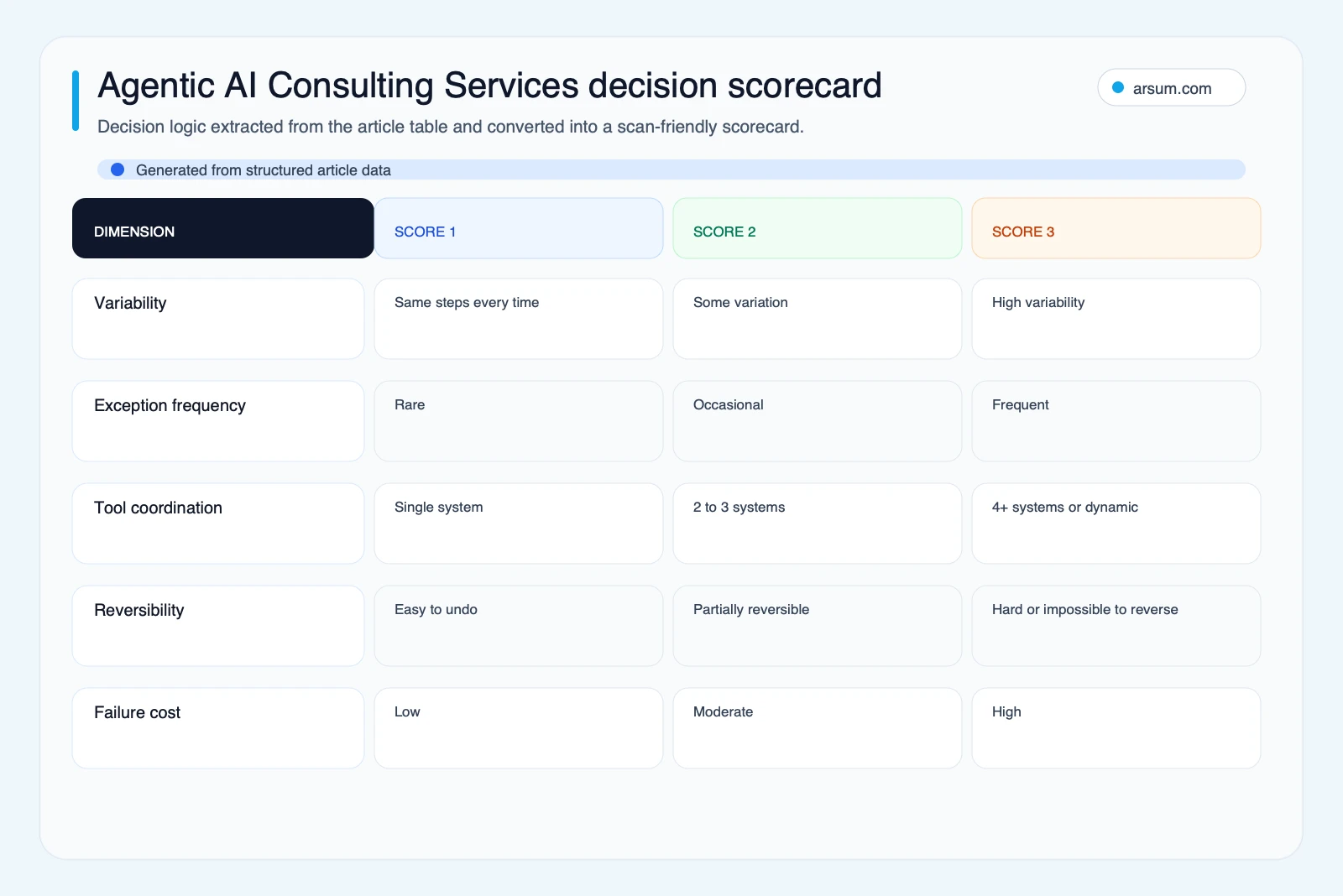
This is an Arsum editorial decision heuristic, not performance data or a prediction of ROI. It separates workflow fit from risk because high failure cost and low reversibility should restrict autonomy, not increase an agent recommendation.
Step 1: assess fit
Score each dimension from 1 to 3.
| Fit dimension | 1 | 2 | 3 |
|---|---|---|---|
| Input shape | Structured records | Mixed structured and text | Mostly unstructured documents, messages, or research |
| Decision variability | Fixed rules | Some judgment | Context-specific judgment with recurring patterns |
| Coordination | One system | Two or three systems | Several tools or dynamic routing |
| Exception burden | Rare and defined | Regular but manageable | Frequent, varied, and expensive to predefine |
A score of 10–12 suggests that an agent may be worth evaluating. A lower score generally favors deterministic automation or a copilot. The score does not authorize the workflow to act.
Step 2: apply the risk gate
An agent is eligible for a controlled pilot only when each applicable item has an answer:
- Is every write action limited to the minimum required permission?
- Is there a named business approver for customer-facing, financial, regulated, or irreversible actions?
- Can the action be reversed or corrected through a documented manual path?
- Will the system retain the input, retrieved evidence, tool calls, output, approval decision, and final outcome?
- Can an operator pause the workflow without a code release?
- Is there a defined exception queue and service-level expectation for human review?
If any answer is no, the outcome is not “use a more powerful agent.” It is “narrow the scope, use a copilot, or fix the operating process first.”
What an agentic AI consulting service should actually deliver
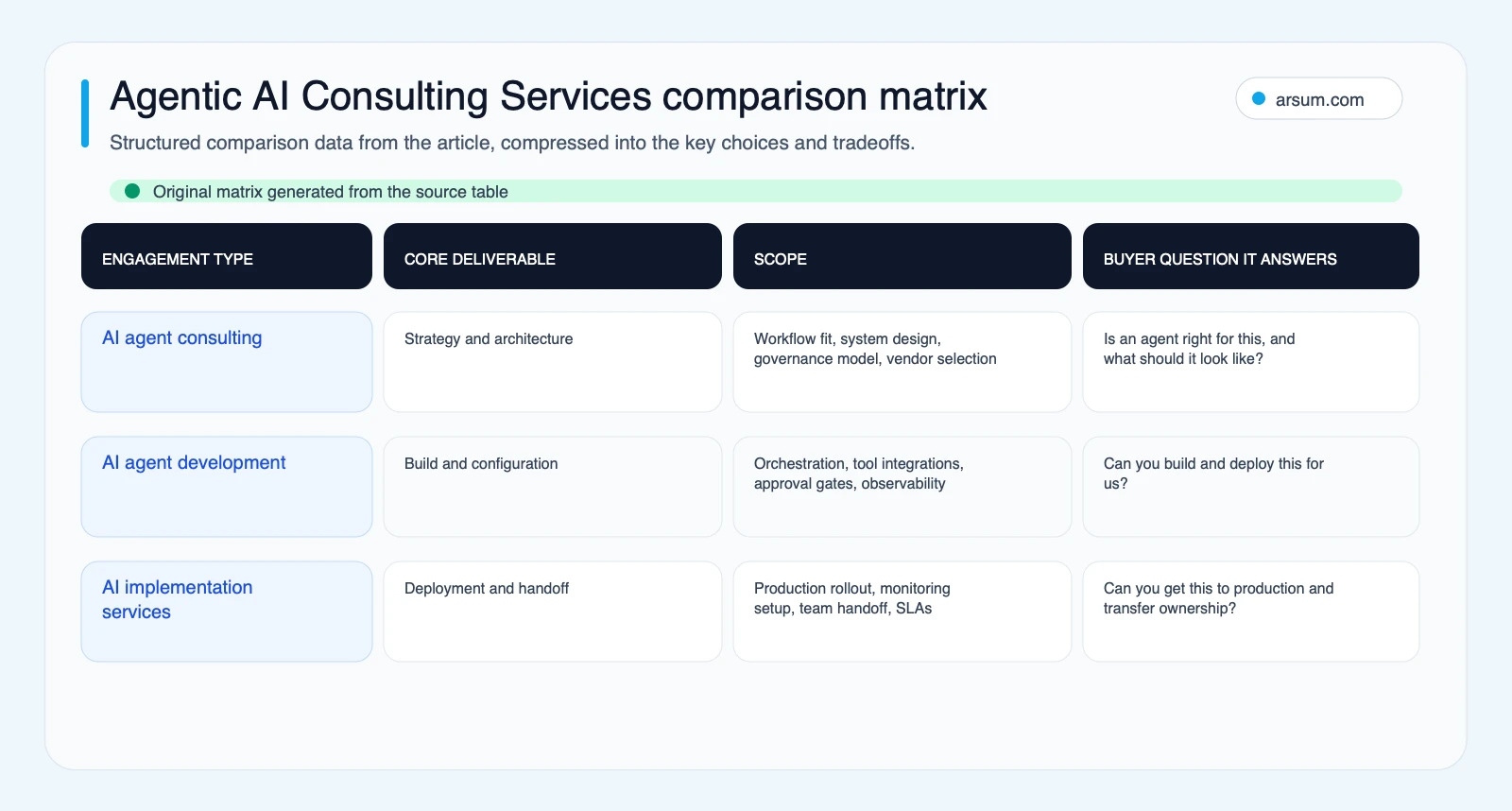
The phrase covers different engagement types. Buyers should make the deliverable explicit before comparing providers.
| Engagement type | Core deliverable | Decision it answers |
|---|---|---|
| Agent strategy and consulting | Workflow selection, control design, architecture, pilot acceptance criteria | Is an agent appropriate, and what boundary is authorized? |
| Agent development | Orchestration, integrations, permission model, test cases, operator interface | Can the agreed workflow be built? |
| Implementation and handoff | Monitoring, incident process, operating documentation, ownership transfer | Can the team safely run it after launch? |
A commodity prompt-wrapping service may provide a prototype, generic prompt library, or chatbot interface. Those deliverables can be useful, but they are not equivalent to production consulting.
A stronger proposal should show:
- the workflow map, including normal path and exception path;
- data sources and system-of-record boundaries;
- tool permissions for reads, writes, and prohibited actions;
- approval authority by action type;
- testing cases for malformed inputs, missing data, tool failures, and conflicting evidence;
- audit and logging requirements;
- pilot acceptance criteria, stop condition, and rollback procedure;
- the post-launch owner for policy, prompts, integrations, and incidents.
For related architecture questions, see AI agent architecture patterns and AI agent security.
Worked example: a compliance-document review pilot
Consider a finance or compliance team that receives onboarding documents and needs to identify missing fields, route exceptions, and assemble a reviewer packet.
The proposed agent should not approve an account, alter a risk classification, or certify compliance. Its authorized scope can be narrower:
- Read the submitted document package and permitted internal reference data.
- Extract defined fields into a draft record.
- Check for missing documents and obvious inconsistencies against explicit rules.
- Create a reviewer packet with source citations and a proposed routing label.
- Send every incomplete, conflicting, or policy-sensitive case to the named compliance reviewer.
- Write only a draft status or queue assignment, if that permission is explicitly approved.
Normal path
The package contains the required document types, fields are readable, source references are retained, and the agent creates a draft review packet. A reviewer accepts, edits, or rejects the recommendation before any consequential status changes.
Ugly exceptions
The workflow must route—not guess—when:
- a document is unreadable or appears incomplete;
- extracted information conflicts across sources;
- the customer falls into a restricted or enhanced-review category;
- an external data lookup fails or returns ambiguous results;
- the tool attempts an action outside its allowed scope;
- the confidence or validation rules fall below the pilot’s agreed threshold.
The evidence record should include the original input reference, extracted fields, validation outcome, tool activity, model output, reviewer action, and final disposition. Retention duration and access rights belong to the organization’s policy and regulatory requirements; they should be decided before launch, not improvised during an audit.
Illustrative pilot scorecard
The following is an illustrative planning assumption, not a promise of performance.
| Pilot component | Example definition |
|---|---|
| Baseline | Measure a defined sample of current cases: volume received, cycle time to reviewer-ready packet, rework rate, exception count, and reviewer minutes per case |
| Target | Reduce reviewer preparation effort while maintaining the team’s required quality standard; set the numeric target jointly after the baseline is observed |
| Quality metric | Percentage of required fields correctly extracted and supported by a retained source reference |
| Exception metric | Percentage of cases routed to the correct queue, plus reviewer corrections by exception type |
| Owner | Compliance operations lead owns acceptance; technical owner owns incidents and integration changes |
| Review cadence | Daily review during controlled testing; weekly review after the workflow is stable enough for limited live use |
| Stop condition | Pause the pilot if an unauthorized write occurs, source evidence is missing, or reviewer corrections exceed the agreed threshold for the selected sample |
| Rollback | Disable the agent’s write permission, return cases to the existing manual queue, preserve logs, and review the failure before re-enabling |
This is the level of specificity to request from a consulting partner. “Automate compliance review” is not a scope. A defined action boundary, sample, acceptance threshold, and fallback is.
💡 Arsum builds custom AI automation solutions tailored to your business needs.
Get a Free Consultation →Production controls: what must be designed before launch
OWASP’s Top 10 for LLM Applications identifies risks including prompt injection, insecure output handling, model denial of service, and supply-chain concerns. For a tool-connected agent, those risks translate into design decisions a buyer can inspect.
Permission and output controls
Treat every integration as a boundary. Specify what the agent may read, draft, create, update, submit, or never access. Validate outputs before they reach downstream systems; text that looks plausible is not automatically a safe command or record update.
Least-privilege access reduces the consequence of an unexpected action. It also makes approvals meaningful: a reviewer should be approving a defined action with visible evidence, not trying to reconstruct an opaque chain of events afterward.
Observability and operating ownership
A production-ready system needs an operator-facing record of:
- the input and retrieved source material;
- the instructions and policy version in effect;
- tool calls, permissions used, and results;
- approval or rejection decisions;
- failures, retries, escalations, and manual corrections;
- volume, latency, cost, and exception trends that the team has chosen to monitor.
These records support troubleshooting and accountability. They do not make a workflow safe by themselves; the organization still needs someone with authority to pause the system and change its policy.
Disqualifying conditions
Do not begin with an agent engagement when any of the following remains unresolved:
- The underlying process has no stable policy or no agreed exception categories.
- The team cannot identify a business owner and an operational owner.
- A high-impact action has no approval authority or fallback process.
- The organization cannot permit the data access needed to perform the workflow.
- The vendor cannot explain tool permissions, output validation, audit evidence, and pause procedures.
- The business case depends on unsupported claims about eliminating a role or guaranteeing savings.
Build, buy, or connect existing tools?
The correct answer depends on workflow fit and operating constraints, not on whether a vendor markets itself as an agent platform.
| Path | Choose it when | Main risk to test |
|---|---|---|
| Buy | The workflow closely matches a mature product and its control model fits your requirements | Vendor permissions, data handling, portability, and exception handling |
| Connect | Existing systems can be joined through narrow integrations and the workflow logic is modest | Fragile integrations, unclear ownership between vendors, hidden manual steps |
| Build | The workflow is differentiated, controls are specific, or the system must fit proprietary data and processes | Internal ownership capacity, maintenance burden, testing discipline, and change control |
Evaluate each option against six variables: integration fit, data and control requirements, ownership capacity, recurring vendor cost, portability, and required implementation timeline. Do not accept a generic timeline claim as evidence. Ask the provider to show which assumptions their estimate depends on: data access, API readiness, reviewer availability, test volume, and the number of exception types included.
A useful comparison may start with AI agent development services, AI integration consulting, and agentic AI frameworks. Framework choice matters only after the operating model is clear; more framework layers do not automatically improve control or business value.
A practical handoff plan and vendor proof test
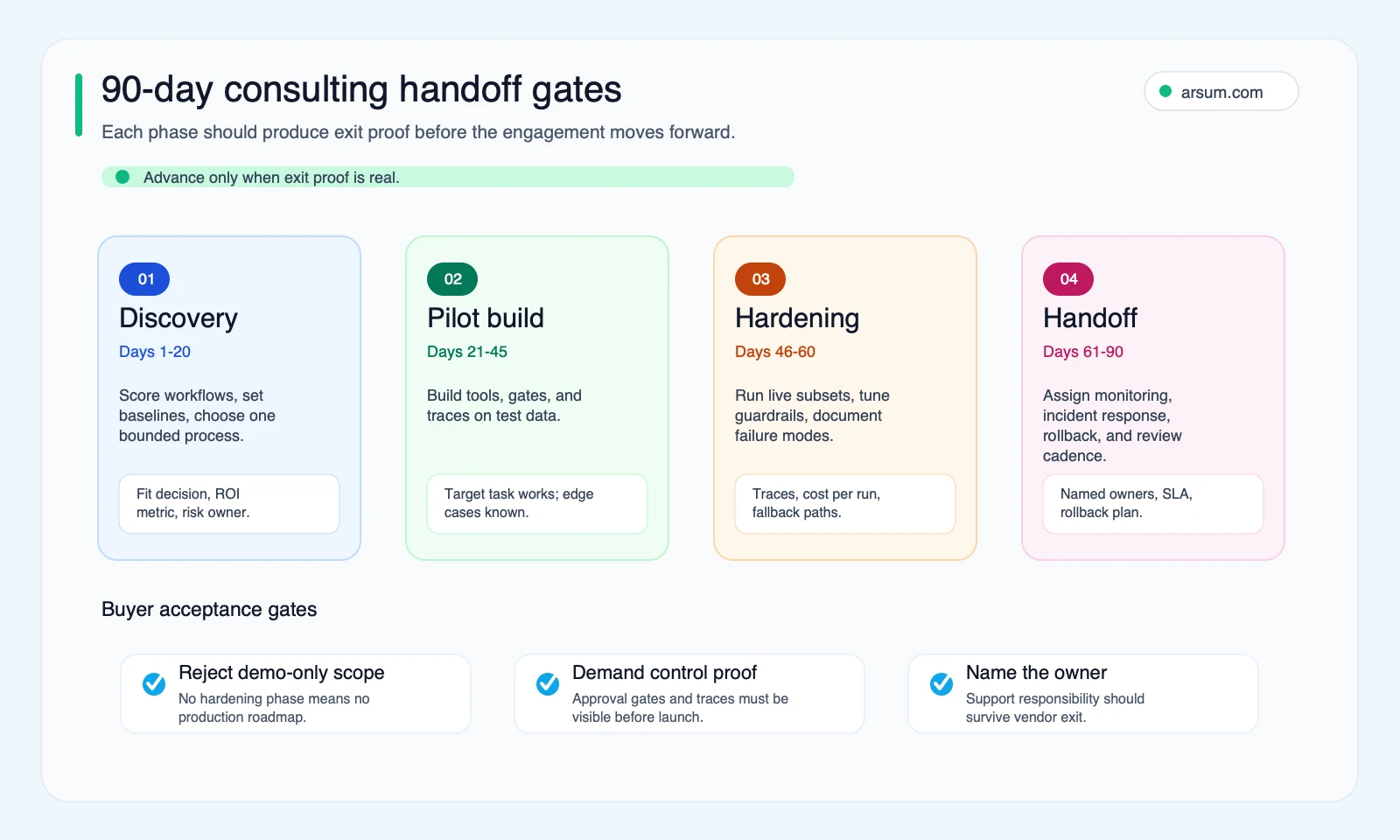
A 90-day sequence can be a planning structure, not a promised delivery schedule. The actual pace depends on workflow clarity, data access, integration readiness, review capacity, and the volume of exception cases discovered.
| Gate | Buyer-verifiable output |
|---|---|
| Workflow decision | Fit assessment, risk gate, baseline plan, and named owner |
| Controlled pilot | Test sample, authorized actions, exception taxonomy, and reviewer feedback record |
| Hardening decision | Evidence of permission testing, output validation, pause process, and corrected failure modes |
| Handoff | Owner map, monitoring access, escalation instructions, rollback procedure, and change-control process |
Before signing, run a five-minute proof test with one real workflow. Ask the provider to explain:
- The normal path from input to completed action.
- What happens when a tool permission is denied.
- Which action requires human approval and who can approve it.
- How a stalled or incorrect run reaches an operator.
- What exact action pauses the workflow and how work continues manually.
A credible answer names systems, roles, evidence, and handoffs. General statements about “autonomy,” “accuracy,” or “enterprise readiness” are not a substitute.
Source limits and a content-quality risk to avoid
This article uses an editorial framework created by Arsum’s editorial team. It is not an independent benchmark, customer study, or guarantee of outcomes.
- OpenAI guidance informs the workflow-fit distinction between simple automation and agentic systems.
- OWASP guidance informs security questions for LLM and agent implementations.
- Google’s people-first content guidance informs a related procurement warning: do not pair an agentic AI project with promises to mass-produce thin SEO content. Google asks whether content provides original information, substantial value, and evidence of expertise rather than existing mainly to manipulate rankings.
Research discovery was conducted through DuckDuckGo HTML results on June 20, 2026. Reddit and Hacker News material was observed as search-result snippets and URLs, so it is used only as qualitative evidence of questions buyers should test—not as quantified consensus or verified case-study evidence. Editorial review is pending final publish check.
Questions to ask before hiring an agentic AI consultant
What should the proposal include?
Ask for the workflow map, system boundaries, data requirements, action permissions, approval matrix, test cases, monitoring plan, pilot acceptance criteria, rollback procedure, and handoff owner map. If those items are deferred until after a generic discovery engagement, clarify whether they are included, optional, or your team’s responsibility.
How do we measure pilot value without inventing ROI?
Start with the current process: case volume, cycle time, reviewer effort, rework, exception types, and error correction cost. Select a representative sample, define what counts as a correct output and a correctly routed exception, then agree on the target before testing. Compare the controlled pilot to that baseline. Avoid treating model demonstrations as realized savings.
When should we reject an agent proposal?
Reject or narrow the proposal when the workflow is stable enough for deterministic automation, the vendor cannot describe permissions and rollback, a consequential action lacks a named approver, or the organization has no one to operate the system after handoff.
What does a qualified next step look like?
Bring one workflow, a recent sample of its normal and exception cases, the systems it touches, the current owner, and any non-negotiable approval requirements. That is enough to assess fit, control boundaries, pilot economics, and whether buying, connecting, or building is the sensible route.
Ready to Automate Your Business?
Stop wasting time on repetitive tasks. Let AI handle the busywork while you focus on growth.
Schedule a Free Strategy Call →Written by:Arsum editorial team
- Reviewed by
- Arsum editorial team
- Published
- June 5, 2026
- Updated
- July 11, 2026
- How this was produced
- Arsum uses research packs, source checks, and human editorial review to prepare and update blog articles. Editors are responsible for the final page.
- Source policy
- Sources are linked in the article when used. Methodology and source notes are included on higher-risk or high-visibility pages and are being rolled out across the archive. Editorial policy.
- Why this page exists
- Help B2B operators evaluate AI automation, implementation scope, cost, risk, and build-vs-buy decisions with practical context.