Agentic AI development services are worth hiring for when a workflow needs model-driven interpretation across real systems and the resulting actions must be controlled, testable, and owned after launch—not merely demonstrated. The custom work is rarely the model call; it is defining data boundaries, tool permissions, evaluation cases, approval gates, exception handling, and the operating model that keeps the workflow dependable as inputs, policies, and integrations change.
Agentic AI Development Services: Buyer Guide
See what agentic AI development services include, when agents beat standard automation, and how to vet vendors for reliable production delivery.
Production agentic AI requires orchestration, external state, guardrails, and eval infrastructure, not just a language model and a prompt.
Table of Contents
- What most guides miss: buy reliability around the workflow, not an “agent”
- Decide whether an agent is justified before commissioning custom development
- Use a pilot scorecard before approving a larger statement of work
- What a production-ready services engagement should include
- Commodity setup versus custom engineering
- Disqualifying conditions and common failure modes
- A vendor-evaluation roadmap
- A note on agentic content services
- Frequently asked buyer questions
What most guides miss: buy reliability around the workflow, not an “agent”
Many service pages describe what an agent can do: research, summarize, route, draft, or act across tools. That is not enough to evaluate a services engagement.
The buyer decision is whether a partner can turn one bounded workflow into an accountable operating system. A proposal should answer:
- What starts a run, and what data is available at that point?
- Which tools can the system read from, and which can it change?
- What counts as a valid output before it reaches a person or downstream system?
- Which exceptions stop the workflow, which are retried, and which are escalated?
- Who has authority to approve consequential actions?
- How will the team detect regression, investigate failures, and roll back a release?
This distinction changes what you pay for. Basic SDK setup, prompt configuration, and low-risk retrieval are increasingly reusable implementation work. The non-commodity part is adapting controls to your systems, policies, failure cost, and accountable owners.
The OpenAI Agents SDK documentation reflects this broader view of agent applications: tools, handoffs, guardrails, sessions, tracing, and evaluation workflows are first-class concerns. A polished prompt demo may be useful during discovery, but it is not evidence that those production concerns are designed.
Decide whether an agent is justified before commissioning custom development
Start with the simplest workflow that can meet the business requirement. An agent is useful when inputs are variable, the work requires interpretation or synthesis, and deterministic rules would become difficult to maintain. It is not automatically the right choice because a task has multiple steps.
For a broader operating model, see agentic AI workflow automation.
| Decision factor | Deterministic automation | Scoped agent workflow | Production agent system |
|---|---|---|---|
| Inputs | Structured and predictable | Mixed formats or recurring ambiguity | High-variance, multi-source, changing context |
| Core task | Route, transform, validate, notify | Interpret, classify, retrieve, draft | Coordinate several tools and decisions over time |
| Action risk | Easy to reverse | Reviewable before consequence | Meaningful blast radius or regulated impact |
| Exception path | A person can easily repair it | A person reviews selected cases | Escalation, logging, and ownership must be designed |
| State need | Minimal | Task context may need persistence | Persistent state and resumable runs are material |
| Best starting point | Rules and standard automation | Narrow pilot with review | Only after controls and acceptance evidence exist |
These are decision categories, not universal thresholds. During discovery, use your own workflow records to identify the inputs, exception types, and repair effort that make one option more appropriate than another.
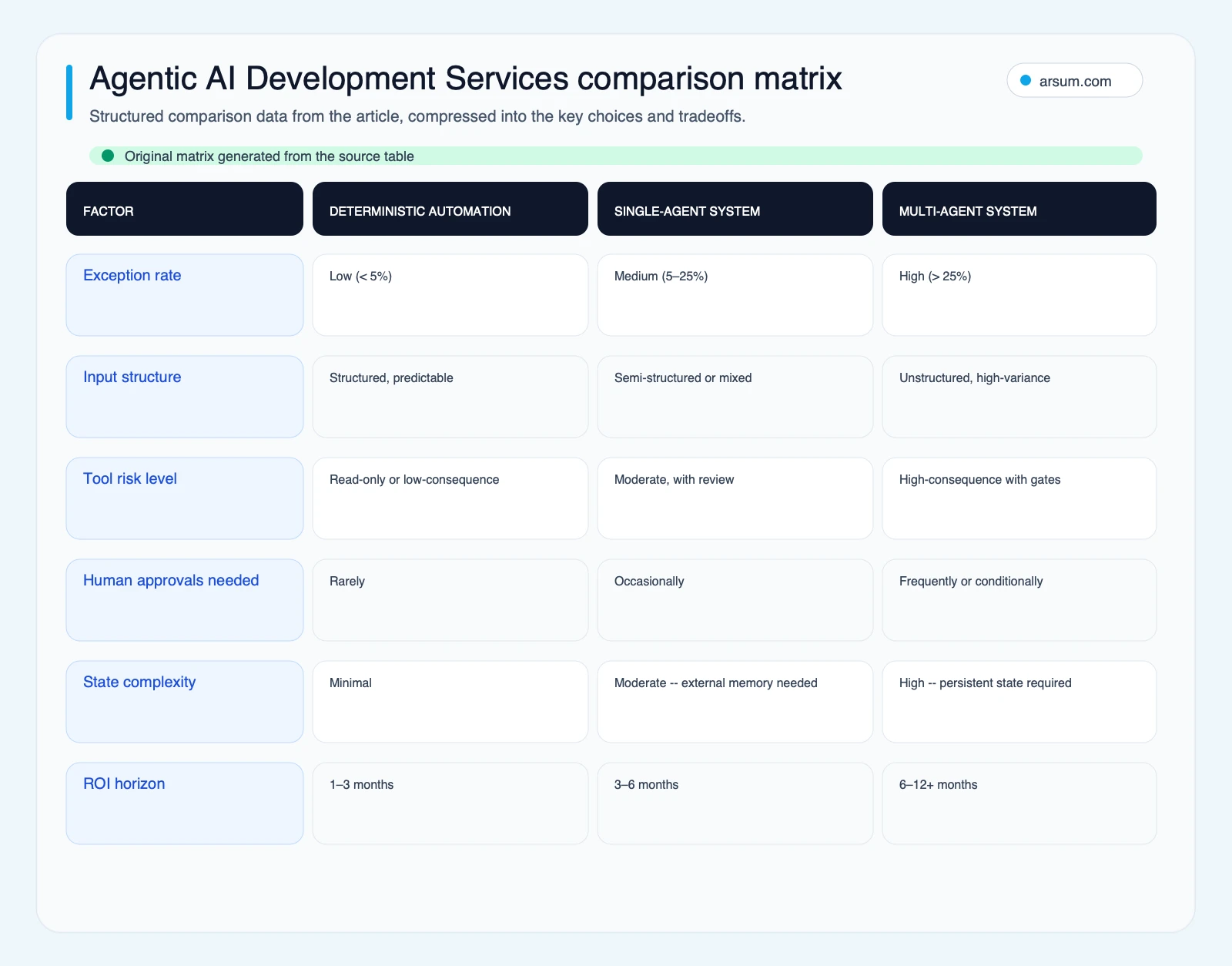
A practical rule: if the workflow can be expressed as stable rules and simple integrations, use conventional automation first. If it needs interpretation but a human can approve outputs before action, a narrow agent pilot may be appropriate. If it needs long-running state, writes to important systems, or externally visible actions, treat it as a production software and risk-management engagement.
For comparisons among common building blocks, review agentic AI frameworks and AI agent architecture patterns.
Use a pilot scorecard before approving a larger statement of work
A pilot should test a real workflow boundary, not prove that a model can answer a prompt. Agree on the scorecard before development begins so both buyer and partner know what “accept” and “stop” mean.
| Scorecard field | What to define before the pilot |
|---|---|
| Workflow and baseline | The specific queue or task, current volume, current manual steps, and current handling time measured by your team |
| Intended outcome | The manual touch to reduce, decision support to improve, or service level to protect |
| Allowed error class | Errors that are tolerable, errors requiring human correction, and errors that are unacceptable |
| Review design | Which outputs are sampled, which require review every time, and who performs that review |
| Tool-failure behavior | Timeout, unavailable integration, duplicate-action, and malformed-output behavior |
| Latency budget | The maximum waiting time the business process can tolerate, defined by the workflow owner |
| Audit evidence | Inputs, tool calls, approvals, outputs, and before/after changes needed for investigation |
| Stop condition | The event that pauses the pilot, such as an unapproved action, missing audit record, or unacceptable error class |
| Rollback path | How to disable actions, restore the previous process, notify operators, and preserve records |
| Post-launch owner | The named business owner and technical owner responsible for changes, incidents, and evaluation updates |
The targets in this table should be planning hypotheses based on your baseline—not vendor-standard percentages. An illustrative planning worksheet is:
monthly manual review cost = monthly cases × review minutes per case ÷ 60 × fully loaded hourly cost
Compare the expected reduction in review work against integration, implementation, model, oversight, and maintenance costs. Add the cost of mistakes and required review; leaving either out makes the business case look stronger than the operating reality.
A qualified workflow assessment should leave you with the baseline, acceptance metrics, action owner, review cadence, stop condition, and rollback owner. That is a more useful next decision than a generic “AI readiness” score.
💡 Arsum builds custom AI automation solutions tailored to your business needs.
Get a Free Consultation →What a production-ready services engagement should include
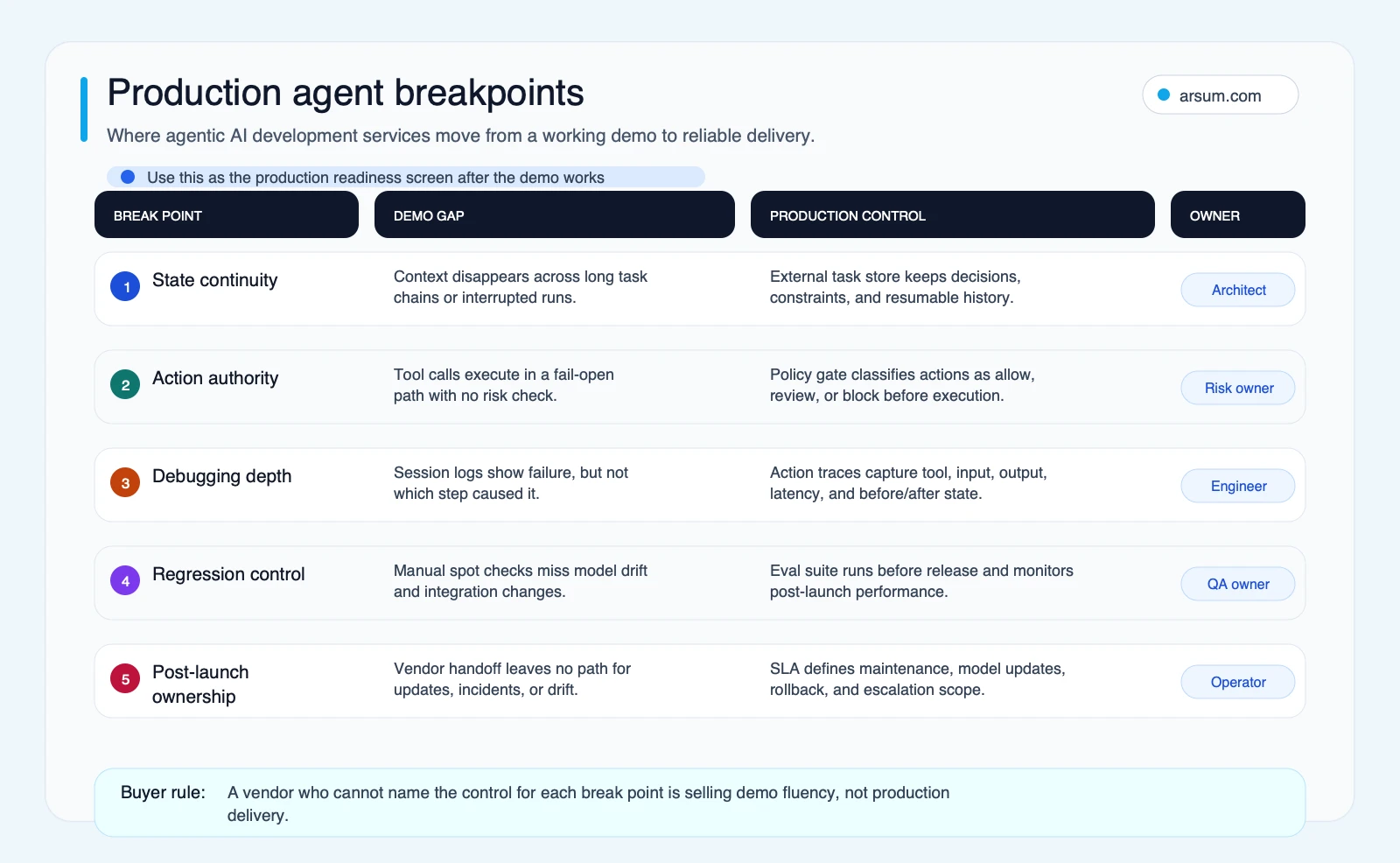
The delivery scope should be explicit about the controls that sit between a model response and business action.
Tool contracts and data boundaries
Every tool call needs a contract: allowed inputs, expected outputs, authentication scope, validation rules, retry behavior, and idempotency where repeated execution could create duplicate effects. An agent that only needs to look up a CRM record should not receive broad write access simply because the integration can provide it.
The OWASP Top 10 for LLM Applications identifies risks including prompt injection, insecure output handling, sensitive-information disclosure, insecure plugin design, and excessive agency. Those risks do not mean an agent cannot be used. They mean the proposal should explain how untrusted content, model output, tool permissions, and downstream actions are separated.
State, traces, and evaluations
External state is appropriate when the workflow must survive interruptions, track approvals, resume work, or support an audit. It is not a requirement for every small, short-lived task, but the vendor should explain where task history and business decisions live when it matters.
Tracing should allow the team to reconstruct a run: inputs, model and tool steps, retries, approvals, output, and failure state. Evaluation should use representative cases from the workflow, including known exceptions and failure modes. The objective is not to claim a universal accuracy score; it is to detect whether a change makes the agreed workflow worse.
Approval gates matched to risk
Approval is a risk-based design decision. Reversibility, blast radius, regulation, and accountable business ownership should determine autonomy.
| Action category | Risk-based default to discuss |
|---|---|
| Read-only lookup | Autonomous execution may be suitable with logging |
| Internal draft or summary | Autonomous drafting may be suitable with a clear review path |
| Customer-facing message | Require a defined review or constrained send policy based on consequence |
| Record update | Use narrow permissions, validation, and an escalation design proportionate to reversibility |
| Payment, regulated decision, or high-impact change | Keep accountable human authority and a complete audit trail |
Do not ask a vendor whether they have generic “AI governance.” Ask how the workflow owner can see, approve, stop, and investigate the actions that matter.
For controls that deserve their own security review, see AI agent security.
Commodity setup versus custom engineering
A credible partner should separate reusable implementation work from the work that is specific to your operating environment.
| Delivery area | Often reusable or commodity | Usually custom to the workflow |
|---|---|---|
| Model access | Provider setup and basic prompting | Model routing and fallback rules tied to business requirements |
| User interface | Standard chat or review surfaces | Exception queues, approval views, and role-specific evidence |
| Integrations | Basic connector configuration | Permission design, validation, retries, and business-system constraints |
| Orchestration | Simple sequential flows | Branching driven by business policy and exception types |
| Evaluation | Generic examples | Representative cases, acceptance criteria, and regression ownership |
| Governance | Generic safety guidance | Action policy, audit retention, escalation, and accountable approvals |
| Maintenance | Documentation handoff | Runbook, release process, model changes, integration drift, and incident response |
Do not assume a lower-priced proposal excludes important controls, and do not assume a larger proposal includes them. Ask to see each item in scope, the acceptance evidence, and who owns it after launch.
The AWS overview of agentic AI similarly emphasizes deployment, trust, and workflow change alongside model capabilities. For a buyer comparing adjacent engagement types, see AI agent development services and agentic AI consulting services.
Disqualifying conditions and common failure modes
Pause or narrow the engagement if any of these conditions are true:
- No accountable business owner can define acceptable outcomes, exceptions, or approval authority.
- The vendor cannot identify the systems, fields, and tools the agent may access.
- The workflow has high-consequence actions but no practical review, reversal, or escalation route.
- There is no representative historical or live case set for evaluation.
- The proposal ends at handoff without naming who will maintain integrations, policies, traces, and evaluation cases.
- The problem is fundamentally a stable rules-and-routing task that conventional automation can solve more simply.
The practitioner signals reviewed for this guide raise recurring qualitative concerns about production reliability, cost and latency, generic tools failing against enterprise constraints, and the difficulty of translating messy model output into safe system behavior. They are not survey findings or prevalence statistics, but they are useful prompts for vendor diligence: production-framework questions, reliability and cost concerns, and the gap between model output and software behavior.
A partner does not need to promise that failures never occur. They should be able to explain how the workflow fails safely, how the team detects it, and who has authority to intervene.
A vendor-evaluation roadmap
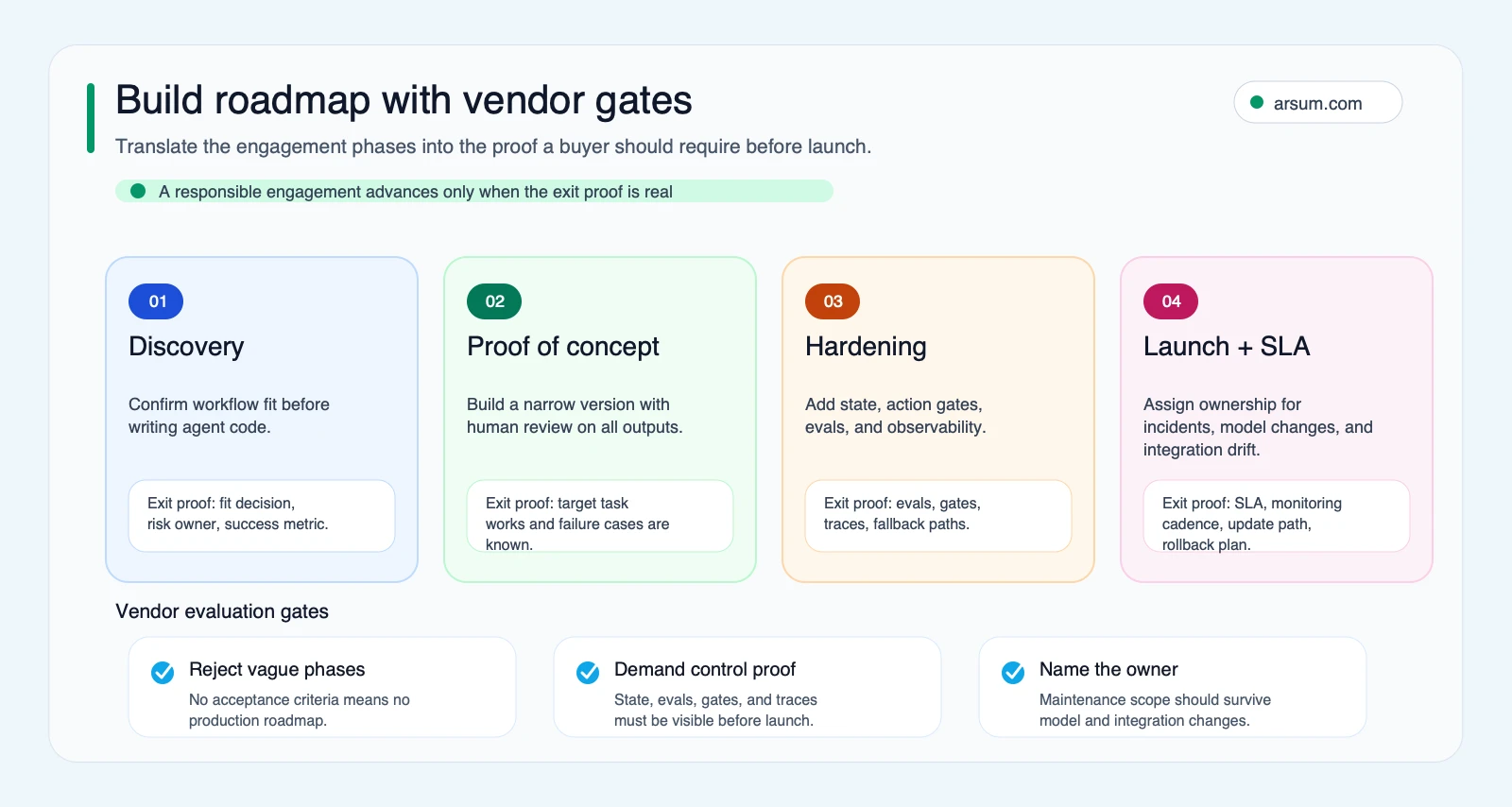
A responsible engagement can be evaluated through four gates.
- Discovery: Map the current workflow, baseline, data sources, action permissions, exceptions, and accountable owner. Decide whether conventional automation is sufficient.
- Pilot: Build the smallest useful workflow with constrained access, visible review, representative evaluation cases, and a documented stop condition.
- Hardening: Add the controls needed for the approved risk tier: validation, traces, audit records, retries, approvals, fallback behavior, and rollback tests.
- Launch and maintenance: Confirm runbook ownership, change management, incident handling, and the process for model or integration updates.
Ask each candidate to respond in writing:
- Which workflow steps are deterministic, and which require model interpretation?
- Which actions are autonomous, reviewed, blocked, or escalated?
- What evidence proves the pilot has met its acceptance criteria?
- How are prompt injection, unsafe outputs, and excessive tool permissions addressed?
- What records will be available after a failed or disputed run?
- What changes after handoff, and who owns the runbook?
A note on agentic content services
If an agentic system creates or updates public-facing content, the workflow needs editorial controls in addition to technical ones. Google’s guidance on generative AI content emphasizes accuracy, quality, relevance, and added value, and warns against scaled content abuse.
That makes “publish at volume” a poor acceptance metric. Require source review, factual checks, originality, an editorial owner, and a clear reason each page adds value. For a related decision framework, see agentic SEO and AI content automation for business.
Frequently asked buyer questions
How much do agentic AI development services cost?
There is no reliable universal price band without a disclosed scope and methodology. Compare proposals using the workflow boundary, integration complexity, approval and audit requirements, evaluation design, and post-launch ownership. Ask vendors to separate one-time implementation, third-party usage, internal review effort, and ongoing maintenance rather than treating them as one opaque number.
Which workflows are good candidates?
Good candidates have meaningful input variability, a clear business owner, bounded tools, measurable acceptance criteria, and a safe exception path. They often involve retrieval, classification, synthesis, drafting, or routing. A workflow with stable inputs and simple rules is usually better served by deterministic automation.
How should we choose between build, buy, and partner?
Buy when the product already fits your workflow, security requirements, and ownership model without costly customization. Build when the workflow itself is differentiating or must fit unusual internal systems and controls. Use a services partner when the work requires both engineering delivery and a scoped operating model—but retain business ownership of policy, approval authority, and acceptance criteria.
Methodology note: This guide uses primary documentation from OpenAI, OWASP, AWS, and Google, checked in the editorial research set dated June 19, 2026. The scorecard, comparison tables, and vendor questions are editorial decision tools, not benchmark data. Practitioner discussion links are qualitative, snippet-level signals only. Verify current model capabilities, tool limits, security obligations, and commercial terms directly with any vendor before signing.
Ready to Automate Your Business?
Stop wasting time on repetitive tasks. Let AI handle the busywork while you focus on growth.
Schedule a Free Strategy Call →Written by:Arsum editorial team
- Reviewed by
- Arsum editorial team
- Published
- June 6, 2026
- Updated
- July 17, 2026
- How this was produced
- Arsum uses research packs, source checks, and human editorial review to prepare and update blog articles. Editors are responsible for the final page.
- Source policy
- Sources are linked in the article when used. Methodology and source notes are included on higher-risk or high-visibility pages and are being rolled out across the archive. Editorial policy.
- Why this page exists
- Help B2B operators evaluate AI automation, implementation scope, cost, risk, and build-vs-buy decisions with practical context.