
Finance leaders do not need another list of AI trends. They need to know which workflows can absorb automation without creating regulatory, operational, or customer-risk debt.
The strongest candidates are not the most futuristic ones. They are the workflows where expensive teams repeat the same judgment pattern at high volume: fraud alerts, AML investigations, loan files, KYC reviews, trade breaks, and regulatory reports. These processes already have data, policies, audit expectations, and escalation paths. Agentic AI creates ROI when it compresses the case assembly and decision-support work without pretending every decision should be fully autonomous.
Agentic AI in finance refers to autonomous AI agents that can execute multi-step financial workflows, reason through exceptions and edge cases, and escalate to humans when policy, risk, or confidence thresholds require review. Unlike rules-based fraud systems or RPA bots that break on format changes, agentic AI can read unstructured documents, navigate regulatory databases, synthesize data across disparate systems, and coordinate with other agents in real time.
This guide is for founders, operators, and commercial leaders evaluating where AI automation can materially improve financial workflows. It covers the use cases mature enough to justify investment, what changes operationally after implementation, and where projects usually fail. For broader context on how agentic systems work, see our what is agentic AI primer.
TL;DR – Highest-ROI Use Cases by Institution Type
| Institution | Best Starting Point | Typical Result |
|---|---|---|
| Bank / Credit Union | AML case management | Faster case assembly with analyst sign-off intact |
| Mortgage Lender | Loan underwriting automation | Decision-ready files arrive much faster for straight-through cases |
| Asset Manager | Trade reconciliation | Standard breaks move faster while exceptions surface earlier |
| Insurer | Regulatory reporting | Compliance staff spend less time on assembly work |
| Fintech | KYC onboarding | Faster activation and clearer exception queues |
Implementation usually works best as a single-workflow pilot first, then expands only after the audit trail, approval steps, and escalation logic hold up in production.
Want to automate this for your business? Let's talk →
What Makes This Worth Acting On
Most guides about Agentic AI Use Cases in Finance stop at possible use cases. A B2B team needs to know which idea deserves budget this quarter.
The practical screen is volume, value, and control:
- Volume: does this happen often enough to matter?
- Value: does it affect revenue, margin, cycle time, risk, or customer experience?
- Control: can a human review exceptions before the system creates damage?
- Measurement: is there a baseline number to compare against after launch?
If the answer is weak on any of those points, keep the idea in discovery. If all four are strong, the article should move from inspiration to scoping, ownership, and ROI.
Operator Note
The wrong first question is, “Where can we let the agent act end to end?” The right first question is, “Where can we remove manual case assembly without letting the model move money, message customers, or override policy on its own?”
That boundary matters because finance teams already assume human sign-off stays in place for material decisions. The highest-confidence starting points are the workflows where analysts spend hours gathering evidence, reconciling records, or drafting narratives before a human reviewer makes the accountable call.
What Most Guides Miss
Most finance AI use-case roundups rank workflows by how impressive the automation sounds. Operators should rank them by approval design, auditability, and reversibility.
A workflow becomes a credible agent candidate when the agent can do one or more of these safely:
- assemble a case file from multiple systems
- summarize policy or transaction evidence for a human reviewer
- route exceptions into a queue with the right supporting context
- draft a decision memo without taking the final consequential action
That is why AML prep, underwriting prep, reconciliation triage, and regulatory report assembly often beat flashier ideas like fully autonomous customer decisions.
What Practitioners Keep Pushing Back On
Across banking, fintech, and AML practitioner discussions, the same objections show up again and again: the demo looks good, but the real questions are explainability, permissioning, audit logs, and exception handling once the workflow touches a live institution.
Three recurring concerns are worth taking seriously:
- Tier-1 bank reality check: teams care less about the orchestration demo and more about whether the agent can survive messy integrations, approval gates, and reliability requirements.
- AML accountability: compliance teams are open to faster case assembly, but they do not want a black-box tool making the suspicious-activity judgment without visible evidence and analyst ownership.
- Volume spikes without headcount spikes: fintech operators care about keeping KYC, fraud, and compliance queues moving when activity surges, but they still expect a named reviewer for edge cases.
Treat those practitioner signals as qualitative buying language, not adoption-rate proof. They are useful because they show where trust breaks first.
Expert Note: Governance Is the Product Boundary
Treasury, NIST, FATF, BIS, and bank-risk teams all point in the same direction: finance AI is credible only when governance is built into the workflow, not layered on after launch.
For an operator, that means every material agent step should answer four questions:
- what source documents or systems produced this output?
- what policy, threshold, or model logic shaped it?
- why did the agent escalate, approve, or stop?
- what exact reviewer action was taken next?
If your workflow cannot answer those four questions on every consequential case, it is not ready for higher autonomy.
Why Finance Is an Ideal Environment for Agentic AI
Financial services generate enormous volumes of structured, semi-structured, and unstructured data – transaction logs, regulatory filings, credit applications, contracts, market feeds – and most of it is already digital. That’s a significant advantage over industries like construction or healthcare where agentic AI first has to solve data capture before it can automate decisions.
The constraint has been a different one: financial services operates under regulatory scrutiny that demands audit trails, explainability, and human oversight for consequential decisions. First-generation AI deployments in finance often stalled here – black-box models that couldn’t explain their outputs hit compliance walls.
Agentic frameworks change this. Because agents operate as orchestrated sequences of steps – each observable, logged, and reviewable – they can align better with financial regulators’ expectations around model risk management and decision documentation. The logged reasoning does not replace governance, but it gives risk and compliance teams something concrete to validate.
The scale of the opportunity justifies the investment, but the important point is operational, not hype-driven. Treasury, FATF, NIST, BIS, and current banking-risk guidance all treat AI in financial services as a live governance problem, especially in AML, compliance, monitoring, and documentation-heavy workflows. That is why the highest-value projects usually start in case assembly, review preparation, and exception routing before they move toward higher-autonomy actions.
The use cases below are organized by where in the financial value chain they sit, so you can identify what’s most relevant to your organization.
A Finance Automation Decision Framework
The best first project is rarely the largest workflow. It is the workflow where the business case, risk boundary, and integration path are all visible before engineering starts.
Use this screen before selecting a finance automation use case:
| Question | Strong Signal | Weak Signal |
|---|---|---|
| Is the workflow high-volume and repetitive? | Hundreds or thousands of similar cases per month | Low-volume expert judgment work |
| Is the human work mostly case assembly or verification? | Analysts gather, compare, summarize, and document | Humans negotiate, persuade, or make novel policy calls |
| Are escalation rules already understood? | Clear risk tiers, policy exceptions, and approval paths | Ambiguous ownership or informal judgment |
| Can the agent access the required systems? | APIs, databases, document stores, and audit logs are available | Data lives in inboxes, spreadsheets, or inaccessible vendor portals |
| Is the decision reversible or reviewable? | Agent prepares, flags, drafts, routes, or recommends | Agent would make irreversible high-risk decisions alone |
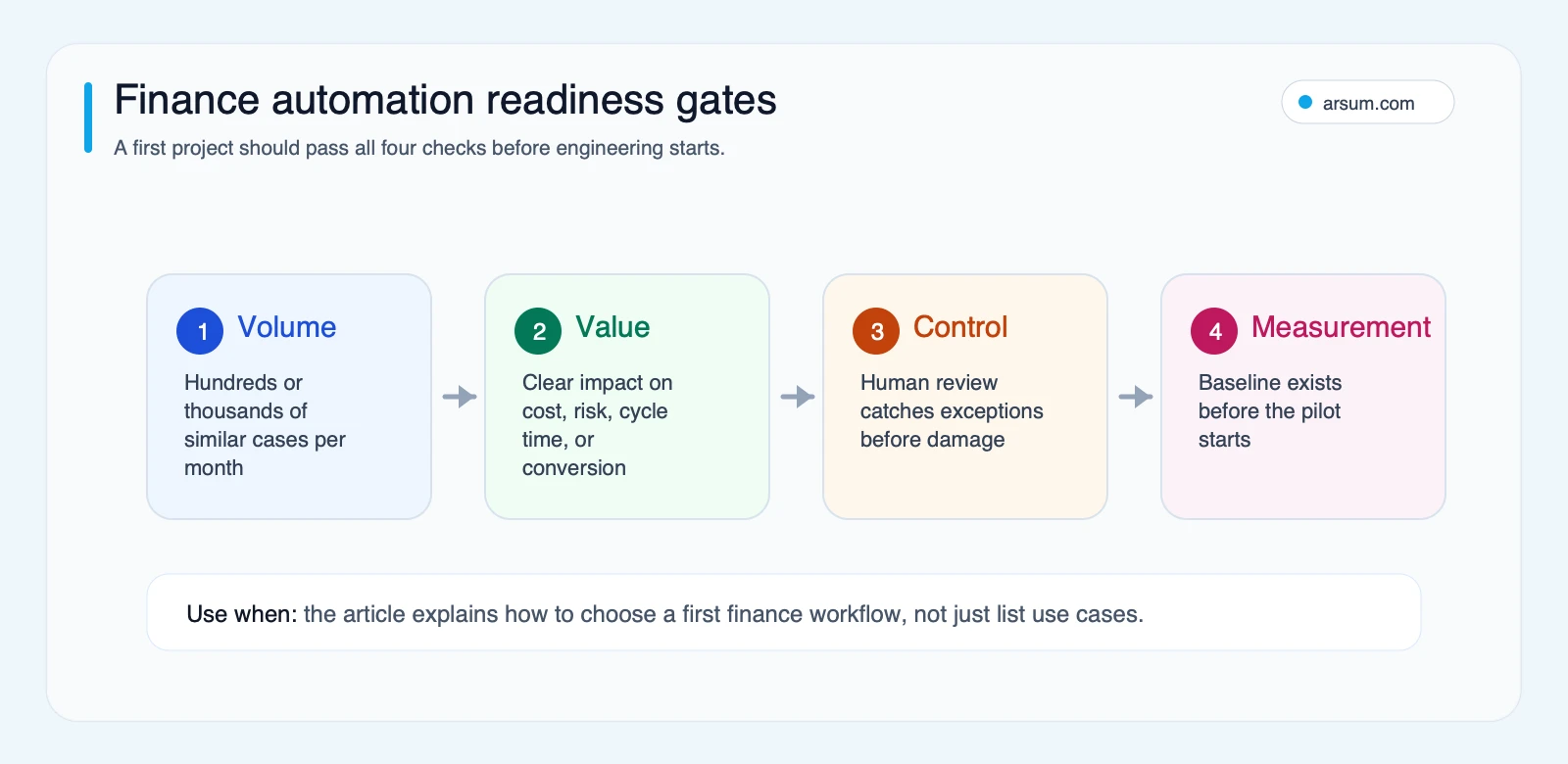
Use the gates before choosing a finance automation project. A strong first workflow should have volume, business value, human control, and a measurable baseline before engineering starts.
A practical sequencing rule: start where the agent can reduce manual preparation time by 40% or more while leaving final accountability with the existing team. Once the organization trusts the audit trail, escalation logic, and measurement approach, expand into higher-autonomy steps.
Decision Tree: Where the Agent Stops
Use this simple boundary before approving any finance workflow:
| If the workflow mostly requires… | Agent should… | Human should… |
|---|---|---|
| Gathering documents, transactions, account history, or entity links | Assemble the case file | Review completeness and decide whether to proceed |
| Comparing evidence to policy or summarizing a likely next step | Recommend a decision or draft memo | Accept, modify, or reject the recommendation |
| Sorting standard cases from exceptions | Route by risk tier and attach evidence | Handle exceptions and refine escalation rules |
| Taking a high-consequence action such as moving money, declining a customer, or filing a material report | Act only with explicit approval and a full audit trail | Remain accountable for the final consequential action |
If a team tries to skip from assemble straight to autonomous action, the project usually becomes a governance problem before it becomes a technical win.
Original Data: Finance Use-Case Triage Table
Use this table before approving a finance agent build.
| Workflow | High-value agent role | Human approval point | Primary risk | Required evidence trail | Pilot metric |
|---|---|---|---|---|---|
| AML case assembly | Gather transactions, map related entities, draft investigator summary | Analyst approves suspicious-activity conclusion | Missing context or weak narrative support | Linked transactions, screening results, adverse media, analyst edits | Average analyst hours per case |
| KYC onboarding review | Validate documents, run screening, prepare initial risk tier | Reviewer clears edge cases and enhanced due diligence | False clears on complex ownership or sanctions risk | Source documents, screening hits, beneficial-owner chain, escalation reason | Time to approved account activation |
| Fraud alert triage | Rank alerts, attach behavioral context, recommend next action | Fraud analyst confirms hold, release, or outreach | False positives or weak explainability on flagged behavior | Alert trigger, behavior baseline, linked account history, final analyst action | Clearance time for standard alerts |
| Loan file completeness and underwriting support | Check document completeness, apply policy rules, prepare recommendation | Underwriter signs off on exceptions and final decision | Hidden policy exceptions or unreliable document parsing | Input documents, policy checks, exception flags, underwriter override history | Time from application to decision-ready file |
| Trade reconciliation breaks | Classify break type, suggest repair path, prepare standard fix | Operations reviewer approves non-standard repairs | Wrong root-cause mapping or incorrect repair action | Counterparty records, break category, repair suggestion, reviewer action | Time to resolve standard breaks |
| Regulatory report drafting | Pull required fields, flag missing data, draft submission package | Compliance owner certifies before filing | Incomplete data lineage or filing errors | Source systems, calculation logic, missing-field flags, certification record | Staff hours per reporting cycle |
| Policy-change monitoring | Watch regulatory updates, summarize impact, map affected workflows | Compliance or legal owner approves policy change | Overstating regulatory impact or missing scope | Source bulletin, summary, mapped policy sections, reviewer notes | Time from update publication to internal action plan |
Reusable Artifact: Finance Agent Approval Checklist
Before a workflow moves into build, document these fields in one page:
- business owner
- systems read
- systems written
- approval points
- rollback path
- audit log retained
- exception rate estimate
- baseline cycle time
- success metric after launch
If the team cannot fill in those nine fields without hand-waving, the workflow is still discovery work, not a production agent project.
Original Data: Governed Automation Fit Score
Use a 1 to 5 score for each dimension before you approve a pilot. A workflow that looks exciting but scores weakly on auditability or ownership is usually the wrong first agent.
| Dimension | What good looks like |
|---|---|
| Volume and repeatability | The team handles enough similar cases each month to justify instrumentation and review design |
| Documented policy rules | Review steps already map to explicit policy or threshold logic |
| Data and API accessibility | The required systems, documents, and logs are reachable without brittle workarounds |
| Action reversibility | The agent can stop, escalate, or be rolled back before harm compounds |
| Reviewer capacity | A named team can review exceptions without creating a new bottleneck |
| Audit-log completeness | Every agent output can point to source evidence, policy context, and reviewer action |
| Model-risk owner | One accountable owner can approve controls, testing, and ongoing monitoring |
| Baseline metric | The workflow already has a measurable cycle time, queue delay, or case-prep cost |
A low score in even one of the last three rows is a warning sign. That usually means the organization is trying to automate before it has defined who owns the risk.
💡 Arsum builds custom AI automation solutions tailored to your business needs.
Get a Free Consultation →Fraud Detection and Transaction Monitoring
Real-Time Transaction Anomaly Detection
Traditional fraud systems operate on static rules: flag transactions over a threshold, from a new geography, or matching a known fraud pattern. The problem is that fraud evolves faster than rule updates, and high false-positive rates burn analyst bandwidth on legitimate transactions. Card fraud losses globally now exceed $35 billion annually and continue to grow as payment volumes increase – yet rule-based systems generate false positive rates in the 95–98% range at many institutions, meaning analysts spend most of their time clearing transactions that aren’t fraud.
Agentic AI changes the detection model. An agent can monitor transaction streams in real time, cross-reference behavioral baselines, query external intelligence feeds, and make a provisional decision – blocking or flagging – in milliseconds. When a case is ambiguous, it assembles a brief for the human analyst: what triggered the flag, what the customer’s historical pattern shows, what similar cases resolved to. The analyst decides, and the agent updates its working model.
The operational difference is material. A single agent can process thousands of alerts per hour with consistent reasoning quality, versus a human analyst team that fatigues, loses consistency across shift changes, and applies judgment variably across case types.
AML (Anti-Money Laundering) Case Management
AML compliance is one of the most labor-intensive areas in financial services. Suspicious Activity Report (SAR) investigations require analysts to gather transaction histories, identify related accounts, research beneficial ownership, pull adverse media, and document findings – a process that routinely takes 6–20 hours per case for complex investigations.
Agentic AI can automate most of the assembly work. An AML agent can pull transaction history, map entity relationships, query screening databases, surface adverse media hits, and generate a draft SAR narrative – leaving the analyst to verify findings and make the final call. For straightforward cases, the time to draft SAR drops from hours to minutes.
The agent doesn’t replace the compliance decision. It collapses the information-gathering phase that currently consumes most of the analyst’s time.
Mini experiment: before and after AML case assembly. Start with one alert type that already has a repeatable review pattern. In the current workflow, an analyst opens the alert, pulls transaction history, checks entity links, runs screening, collects adverse-media context, and drafts the case summary before a reviewer ever sees a recommendation. In the remediated workflow, the agent assembles those inputs, shows exactly which sources were used, drafts the narrative, and hands the case to the analyst for approval or escalation. The pilot metric is simple: compare analyst time per in-scope case before and after the agent handles the preparation layer.
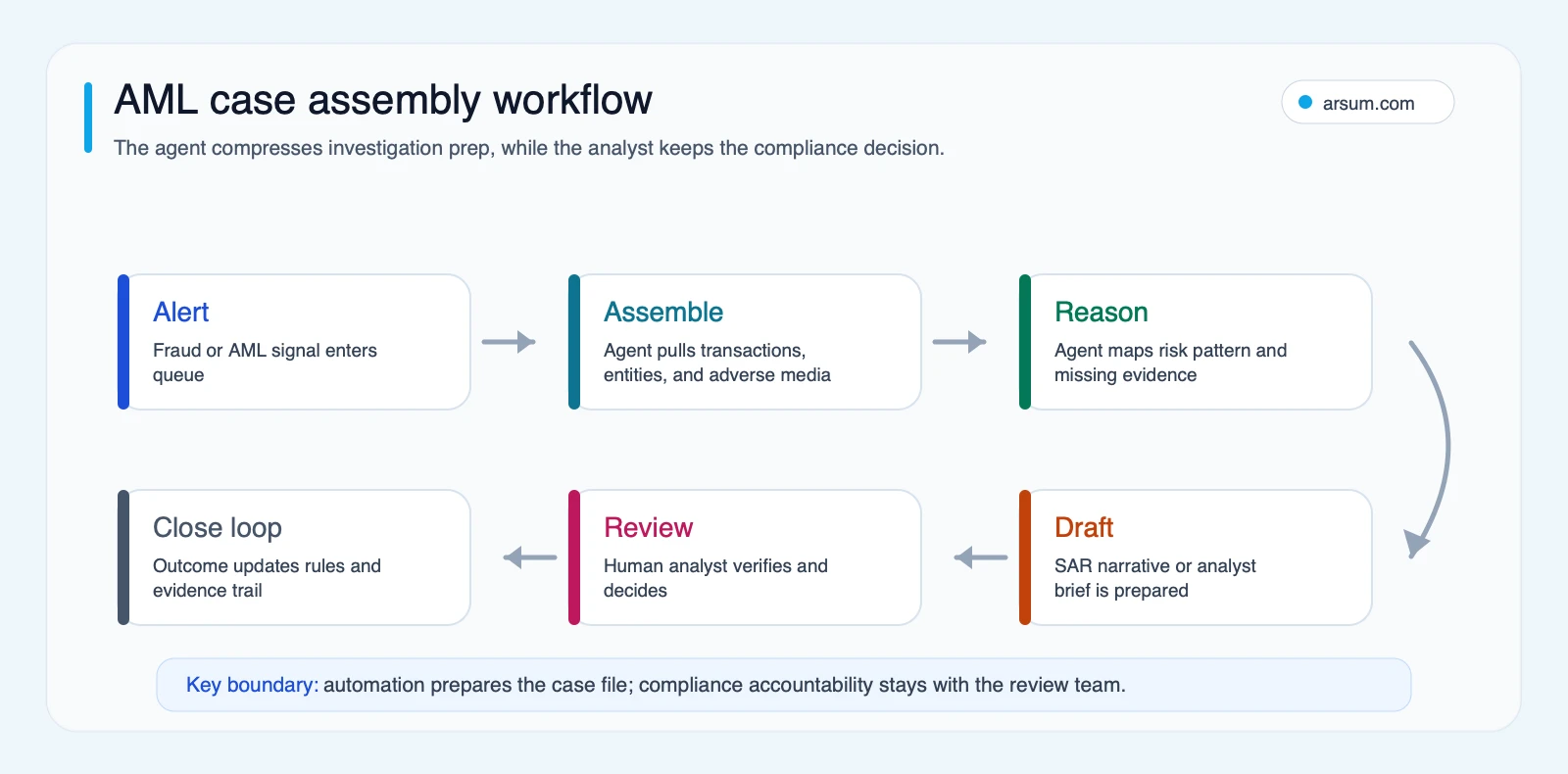
The workflow shows the operating boundary: the agent compresses investigation prep, but the analyst still owns the compliance decision and feedback loop.
Credit Risk and Underwriting
Automated Credit Decisioning
Consumer and SMB loan underwriting involves pulling credit bureau data, verifying income and employment, checking fraud indicators, and applying credit policy – a sequence that’s largely defined by rules but requires assembling information from multiple sources. Average mortgage origination cycle times in the US run 40–50 days from application to close, with a significant portion of that time consumed by document collection, verification, and sequential review steps rather than the credit decision itself.
Agentic AI can execute the full decisioning sequence for straight-through cases: call credit bureaus, parse income verification documents, check against internal risk models, apply credit policy rules, and generate a decision with full documentation. The agent routes edge cases – thin-file applicants, income variance, policy exceptions – to human underwriters with context assembled.
For mortgage lenders and consumer banks, this can compress underwriting cycle times from days to hours on qualifying applications, while improving consistency by eliminating underwriter variation on policy interpretation.
Commercial Lending and Covenant Monitoring
Commercial credit is more complex – financial statements, covenant tracking, industry analysis, collateral monitoring. Agentic AI is well-suited to the ongoing monitoring side: ingesting quarterly financials, calculating covenant ratios, flagging breaches, and alerting relationship managers with context rather than requiring them to do the calculation themselves.
The monitoring use case also applies to portfolio-level stress testing: agents can run scenario analyses across loan books, identify concentration risks, and generate reports for credit committees – work that today requires teams of analysts doing repetitive calculations.
Regulatory Compliance and Reporting
Regulatory Report Generation
Financial institutions produce vast quantities of regulatory reports: call reports, CCAR submissions, MiFID transaction reporting, DORA documentation. Most of these draw on structured data that already exists in internal systems – the task is assembly, calculation, and formatting to regulatory specifications.
Agentic AI can automate the assembly and calculation steps, drafting reports from underlying data and flagging fields where data quality or completeness requires human review. The compliance officer reviews and certifies; the agent does the extraction and drafting. For institutions where compliance staff spend significant time on mechanical report assembly, this frees capacity for the higher-value interpretive and governance work that actually requires expertise.
Policy and Regulatory Change Monitoring
Financial regulation changes constantly – new guidance from the Fed, CFPB rule amendments, EBA updates, FINRA bulletins. Keeping policy manuals current and identifying which product lines or processes are affected is a full-time job for compliance teams.
An agent can monitor regulatory sources, summarize new guidance, map changes to internal policy documents, and flag which business units need to review and update their procedures. This is a use case where LLM-based summarization and cross-referencing genuinely outperforms manual monitoring – a compliance analyst can’t read and cross-reference every regulatory update across every jurisdiction in real time, but an agent can.
For a deeper look at how AI process automation handles structured compliance workflows, our AI process automation guide covers the architectural patterns in more detail.
Trade Operations and Post-Trade Processing
Trade Reconciliation
Failed trades, breaks, and settlement mismatches are a daily operational reality for broker-dealers and custodians. Reconciliation teams spend significant time matching positions across counterparties, identifying break causes, and executing repairs. Industry benchmarks suggest experienced reconciliation analysts resolve standard breaks in 30–90 minutes; complex breaks (multi-leg, cross-currency, derivatives) can run 4–8 hours. When break volumes spike – at quarter-end or during market volatility – teams fall behind, increasing settlement risk.
Agentic AI can run the matching and break identification automatically, categorize break types by root cause, and execute standard repairs without human intervention – routing only non-standard cases to operations teams. The reduction in manual touchpoints directly reduces settlement risk and operational cost.
Contract and Document Processing
Loan agreements, ISDA master agreements, collateral documentation – financial contracts are dense, structured documents where the key terms need to be extracted, compared against standard terms, and flagged for exceptions. Manual contract review is slow and consistency-dependent on individual reviewer expertise.
Agents with document comprehension capabilities can parse financial contracts, extract key terms, flag deviations from standard templates, and produce exception summaries that legal or operations teams review. Faster review cycles on both origination and amendment.
Work With Arsum
We help businesses implement AI automation that actually works. Custom solutions, not cookie-cutter templates.
Learn more →Customer Operations
KYC Onboarding Automation
Know Your Customer onboarding involves identity verification, document collection and validation, screening against sanctions lists, beneficial ownership resolution for entities, and risk-tier classification. For institutional clients, this can take weeks; for retail, it’s still often a friction-filled manual process that creates drop-off at a high-cost acquisition stage.
Agentic AI can automate the document validation, screening, and initial risk classification steps – reducing onboarding time and improving consistency. Edge cases (high-risk jurisdictions, complex corporate structures, PEP designations) route to enhanced due diligence teams with a prepared case file rather than starting from scratch.
Intelligent Customer Service
Financial customers have complex queries that require account context – balance questions, transaction disputes, loan payoff quotes, interest calculations. These are tractable for agentic AI when the agent has secure access to the customer’s account data, can execute defined transaction types, and escalates when the query falls outside defined parameters.
The key distinction from earlier chatbots is that agentic systems can actually execute: initiate a dispute, generate a payoff statement, trigger a wire, or update a beneficiary – not just retrieve information. That execution capability is what makes them genuinely useful for service cost reduction. Customers get issues resolved in one interaction rather than waiting for an agent callback, which directly reduces handle time and abandonment rates.
Commodity vs Non-Commodity Breakdown
| Commodity finance-AI page | Non-commodity operator guidance |
|---|---|
| Lists ten banking use cases with no workflow boundary | Separates read-heavy prep work from approval-heavy consequential actions |
| Treats every workflow as equally agentic | Scores each workflow by sensitivity, exception rate, and sign-off design |
| Repeats vendor claims about efficiency | Names where audit logs, approval queues, and rollback paths must exist |
| Implies automation maturity from a demo | Focuses on post-launch ownership, evidence quality, and failure handling |
The model layer is increasingly interchangeable. The non-commodity value is in how clearly the team defines autonomy limits, approval design, and operating ownership before an agent touches regulated workflows.
Google Risk Box: Scaled Content and Thin Automation Risk
A page like this becomes thin the moment it turns into industry-template sprawl, where the only thing changing is the vertical name while the advice stays generic. Google’s quality systems are much more likely to treat that kind of scaled content as low-value because it does not add original decision criteria, visible source handling, or workflow-specific guardrails.
For finance pages, the safest way to stay out of that bucket is to keep the article anchored in concrete operator questions: which workflows stay read-only, where human sign-off remains mandatory, what evidence the reviewer sees, and which actions should never run on model judgment alone.
Implementation Considerations for Financial Services
Regulatory and Model Risk Requirements
Any AI system making consequential financial decisions needs to meet model risk management standards. For US banks, this means SR 11-7 compliance: documentation, validation, ongoing monitoring, and model risk governance. For EU institutions, the AI Act adds additional requirements for high-risk AI systems.
Agentic architectures handle this better than monolithic models because each step is observable and logged. But implementation still requires model risk governance planning from the start, not as an afterthought. Compliance and risk teams should be in the room during design, not during the audit.
For institutions evaluating build-vs-buy decisions for the underlying infrastructure, our AI automation platform guide covers the trade-offs between cloud AI platforms and custom development in detail.
How Agentic AI Differs from Traditional Process Automation
Financial institutions that have deployed RPA for structured tasks often ask whether agentic AI is just a smarter RPA. It isn’t. RPA executes fixed sequences on structured inputs and breaks when formats change. Agentic AI can reason through unstructured documents, handle exceptions, and adapt its approach to context – capabilities that matter in financial workflows where every tenth case deviates from the standard path. Our AI process automation guide covers the architectural differences in depth.
Where Finance AI Automation Projects Fail
Most failed projects do not fail because the model is incapable. They fail because the operating model was never designed.
Common failure points:
No workflow owner: The project has AI sponsorship but no accountable business owner for policy, exceptions, and operational adoption.
Unclear human handoff: The agent can produce a recommendation, but nobody has defined when a human reviews it, what evidence they receive, or how review outcomes feed back into the system.
Data access discovered too late: The required transaction history, documents, screening results, or customer records exist, but the agent cannot reach them securely or consistently.
Compliance treated as a final checkpoint: Model risk, audit, privacy, and information security teams are asked to approve the system after implementation instead of shaping the design from the start.
ROI measured only as headcount reduction: The stronger business cases usually combine analyst time reduction, faster cycle times, avoided hiring, lower error rates, and better customer conversion.
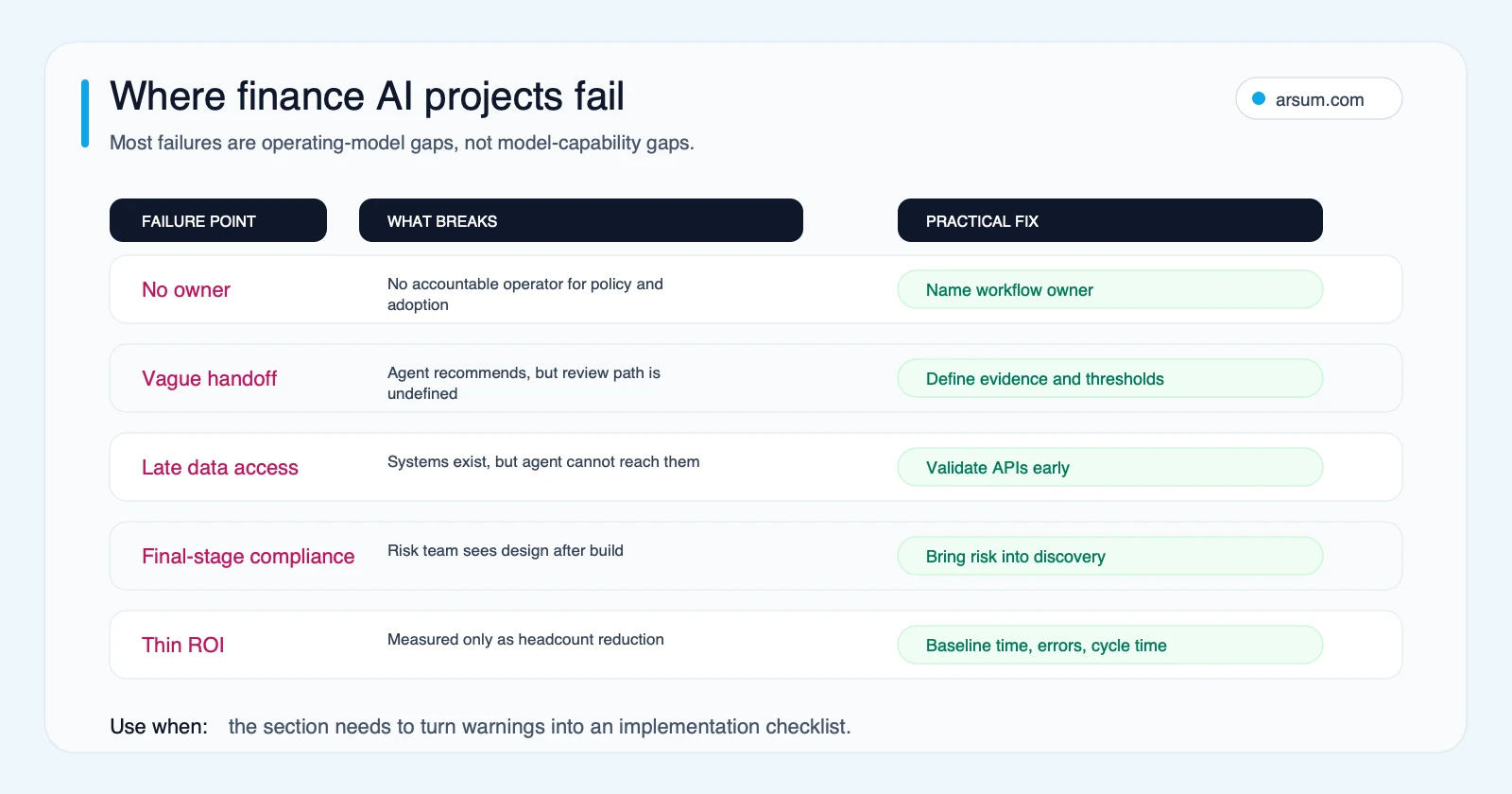
Most finance AI failures are operating-model gaps. Use the risk map to turn warnings into named owners, explicit handoffs, early data checks, and measurable ROI baselines.
The fix is to design the automation as an operating change, not a model deployment. Define the case lifecycle, escalation thresholds, review screens, audit logs, fallback process, and ROI baseline before building the first agent.
When Custom Development Makes Sense
Off-the-shelf AI products work for some financial use cases – there are vendors with solid products for fraud detection, KYC, and credit scoring. But the highest-value deployments are often custom: agents that integrate directly with your core banking system, your risk models, your specific product configuration.
Custom agentic systems for financial institutions require deep integration work, model risk governance, and security architecture that most platform vendors don’t provide out of the box. That’s where working with a specialized AI automation agency or custom AI development partner makes the difference between a deployment that passes regulatory review and one that doesn’t. For a structured view of what AI automation engagements typically involve, our AI automation service guide outlines the phases, costs, and decision criteria.
Where to Start
The highest-ROI starting points for most financial institutions share the same pattern: high volume, expensive manual review, available data, and clear escalation rules.
If you’re a bank or credit union: Start with AML case management automation or loan underwriting straight-through processing. Both have clear ROI, defined regulatory frameworks, and strong vendor/partner ecosystems.
If you’re an asset manager: Trade reconciliation automation or regulatory reporting automation typically deliver quick wins with lower regulatory risk than client-facing applications.
If you’re a fintech: KYC onboarding and customer service automation tend to have the fastest deployment cycles and most direct impact on customer acquisition cost and unit economics.
Do not start with a broad “AI transformation” program. Pick one workflow, baseline its current cost and cycle time, define the risk boundary, and prove the operating model before expanding.
For a framework on how to assess AI automation projects for ROI, see our guide on agentic AI workflow automation.
Methodology Note
This article was updated on 2026-06-28 using current research on agentic AI in finance and related search terms. It draws on governance and implementation guidance from the U.S. Treasury, the NIST AI Risk Management Framework and Generative AI Profile, FATF, BIS, and current agentic-AI workflow material relevant to financial-services operations.
Practitioner discussions from banking, fintech, and AML communities were used as qualitative buyer and operator signal only. They helped surface where teams still expect human sign-off, visible evidence trails, and stricter approval boundaries. They were not used as proof of adoption rates or product performance.
Freshness Note
Last updated: 2026-06-28.
Refresh this page when model vendors materially change tool-execution controls, enterprise data-handling terms, or finance-specific agent deployments, because those changes affect where autonomous workflow boundaries can safely move.
FAQ
Is agentic AI safe enough for consequential financial decisions?
Agentic AI is appropriate for financial decisions when deployed with proper human-in-the-loop checkpoints, audit trails, and model risk governance. The regulatory framework isn’t a blocker – it’s a design constraint that shapes where agents decide autonomously versus where they prepare a recommendation for human review. Well-designed agentic systems actually improve explainability compared to monolithic ML models, because each reasoning step is logged.
How is agentic AI different from the rules-based automation already in my systems?
Rules-based automation (and traditional RPA) executes fixed logic on structured inputs. Agentic AI can handle unstructured data, reason through novel situations, coordinate across systems, and adapt its approach based on context. The practical difference is that agents don’t break when a document format changes or an edge case falls outside the rule set – they reason through it or escalate with context.
How do I decide between a vendor solution and custom development?
Vendor solutions make sense when the workflow is well-defined and the vendor’s integrations cover your core systems. Custom development makes sense when you need deep integration with proprietary systems, your risk models, or specific product configurations that vendors don’t support – or when the use case involves regulatory requirements that off-the-shelf products weren’t designed for. Financial institutions often start with a vendor for one use case and move to custom for the workflows where differentiation matters.
What’s a realistic implementation timeline?
Targeted automations – a single workflow like AML case assembly or loan document processing – typically take 8–16 weeks to implement and validate, including model risk governance work. Broader deployments across multiple workflows and systems take 6–12 months. Timelines are often extended by data access and integration work rather than by AI development itself.
Do we need to rebuild our data infrastructure first?
Not necessarily. Agentic AI implementations typically integrate with existing systems via APIs rather than requiring data warehouse rebuilds. The more important prerequisite is having clear ownership of the workflow you’re automating and the data it touches, plus API access to the core systems involved.
What’s the typical ROI in financial services?
ROI varies by workflow, control design, and how much of the case-preparation layer is actually repetitive. The strongest pilots usually show value through faster case assembly, shorter queue times, fewer manual handoffs, and better reviewer focus on exceptions rather than routine prep work. The safest way to estimate upside is to baseline the current analyst effort, then measure the change on one governed workflow before expanding.
Ready to Automate Your Business?
Stop wasting time on repetitive tasks. Let AI handle the busywork while you focus on growth.
Schedule a Free Strategy Call →