Agentic AI use cases healthcare should begin with bounded administrative workflows—not promises of clinical autonomy. Choose a workflow with repeat volume, a measurable baseline, a named integration owner, and a human approval gate before any clinical, reimbursement, or patient-sensitive action; then use the agent to draft, extract, route, or prepare rather than decide on its own.
Agentic AI Use Cases Healthcare: Practical Guide
Explore agentic AI use cases healthcare: compare workflow fit, costs, risks, evidence, and practical next steps before you build, buy, or hire.

Table of Contents
- What most guides miss: autonomy is not the buying decision
- A healthcare autonomy ladder
- Compare workflows by their operating model
- Governance before ROI claims
- Concrete use cases and their boundaries
- Worked pilot scorecard: make the go/no-go decision explicit
- Prior-authorization workflow: normal path and ugly exceptions
- Build, buy, or partner: decide on the workflow, not the label
- Disqualifying conditions and common failure modes
- Production-readiness checklist
- FAQ
- Methodology and limits
An agent is useful when it can work across records, rules, queues, and tools within that boundary. It may collect chart evidence, map information to a payer checklist, prepare a note, or route an exception. It is not automatically authorized to diagnose, select treatment, submit a consequential payload, or send patient-sensitive communications without the accountable clinician or specialist approving the result.
For a broader explanation of the operating model, see what agentic AI is and how it differs from generative AI. In healthcare, the distinction matters because a plausible output is not enough: the organization must know what source record produced it, who reviews it, what happens when it is wrong, and how the workflow returns to its prior state.
Short answer: Documentation support, prior-authorization packet preparation, referral and scheduling operations, claims pre-audit, and chart-audit preparation are often sensible first pilots. That is a pilot-selection hypothesis, not a universal ROI ranking: they are attractive when volume, cycle-time baselines, and controllable review paths are present.
What most guides miss: autonomy is not the buying decision
A list of healthcare AI use cases does not tell a COO, revenue-cycle leader, CMIO, or compliance owner what to fund. The real decision is the workflow’s autonomy boundary.
A safer first deployment is not defined by whether it is “administrative” in name. It is defined by whether the team can answer six questions before launch:
- What exact event starts the workflow?
- Which system remains the source of record?
- What may the agent do without approval?
- Which output requires a named person to approve it?
- Who owns exceptions, monitoring, and production support?
- How does the team stop the automation and return to the previous process?
That screen changes the shortlist. “Automate prior authorization” is too broad. “Prepare outpatient imaging prior-authorization packets for specified payers, flag missing evidence, and require an authorization specialist to approve every submission” is an implementable workflow.
The same logic applies to documentation. A note-drafting agent can turn a compose-from-scratch task into review-and-approve work. It should not file a clinical note without the clinician’s review and signature. For clinical decision support, the starting boundary is even tighter: summarize relevant context or surface approved guidance, while the clinician remains the decision maker.
A healthcare autonomy ladder
The first pilot should normally stop before autonomous action. Higher failure cost and lower reversibility should reduce autonomy.
| Level | Agent role | Suitable initial use | Required boundary |
|---|---|---|---|
| 1 | Summarize only | Encounter summaries, inbox digestion, discharge preparation | No record update or patient communication |
| 2 | Draft for review | Notes, appeals, patient-message drafts | Human edits and approves |
| 3 | Extract and map evidence | Prior-auth evidence gathering, chart audit preparation | Source citations retained for review |
| 4 | Route exceptions | Referral intake, scheduling queues, denial queues | Defined routing rules and staffed exception queue |
| 5 | Prepare submission | Claims or prior-auth packet assembly | Human verifies final payload |
| 6 | Submit with approval | Selected administrative submissions | Named approver authorizes the exact submission |
| 7 | Autonomous consequential action | Treatment, diagnosis, high-stakes patient action | Outside an initial healthcare pilot’s scope |
The operational aim is not to remove accountability. It is to move repetitive assembly and triage work into a controlled system so specialists spend their time reviewing exceptions, incomplete records, and cases requiring judgment.
Compare workflows by their operating model
| Workflow | Best first agent role | System of record | Integration owner | Approval and exception owner | Retained evidence | Rollback action |
|---|---|---|---|---|---|---|
| Documentation support | Draft note and structured fields | EHR | Clinical informatics / EHR owner | Clinician signs; clinic lead owns exceptions | Input transcript or note references, draft versions, edits, sign-off | Disable drafting; clinician resumes existing documentation process |
| Prior authorization | Extract, map, and prepare packet | EHR plus payer workflow | Revenue-cycle integration owner | Authorization specialist approves; payer-variance queue owner handles exceptions | Source chart references, payer checklist version, packet, approval record | Stop packet generation; use established manual assembly queue |
| Referral intake | Extract, classify, and route | Referral management system / EHR | Access operations owner | Referral coordinator owns uncertain or clinical-routing cases | Referral source, classification, route decision, escalation reason | Return cases to manual triage |
| Scheduling | Offer approved slots and route exceptions | Scheduling platform | Patient-access systems owner | Scheduling supervisor owns exceptions; clinician-defined rules govern escalation | Request, offered slots, booking action, escalation log | Turn off agent access and revert to staff scheduling |
| Claims pre-audit | Flag gaps and prepare checklist | Practice-management or billing system | Revenue-cycle systems owner | Billing specialist approves exceptions | Claim version, rules used, flags, reviewer disposition | Disable pre-audit routing; existing edits and work queues remain active |
| Chart-audit preparation | Retrieve and organize supporting evidence | EHR / quality platform | Quality-data owner | Quality or compliance reviewer approves findings | Record locations, extracted evidence, reviewer decision | Return audit preparation to manual review |
| Clinical decision support | Summarize context or surface approved material | EHR | Clinical informatics owner | Clinician owns every decision and escalation | Source references, displayed output, clinician action where captured | Remove tool from workflow; use standard clinical process |
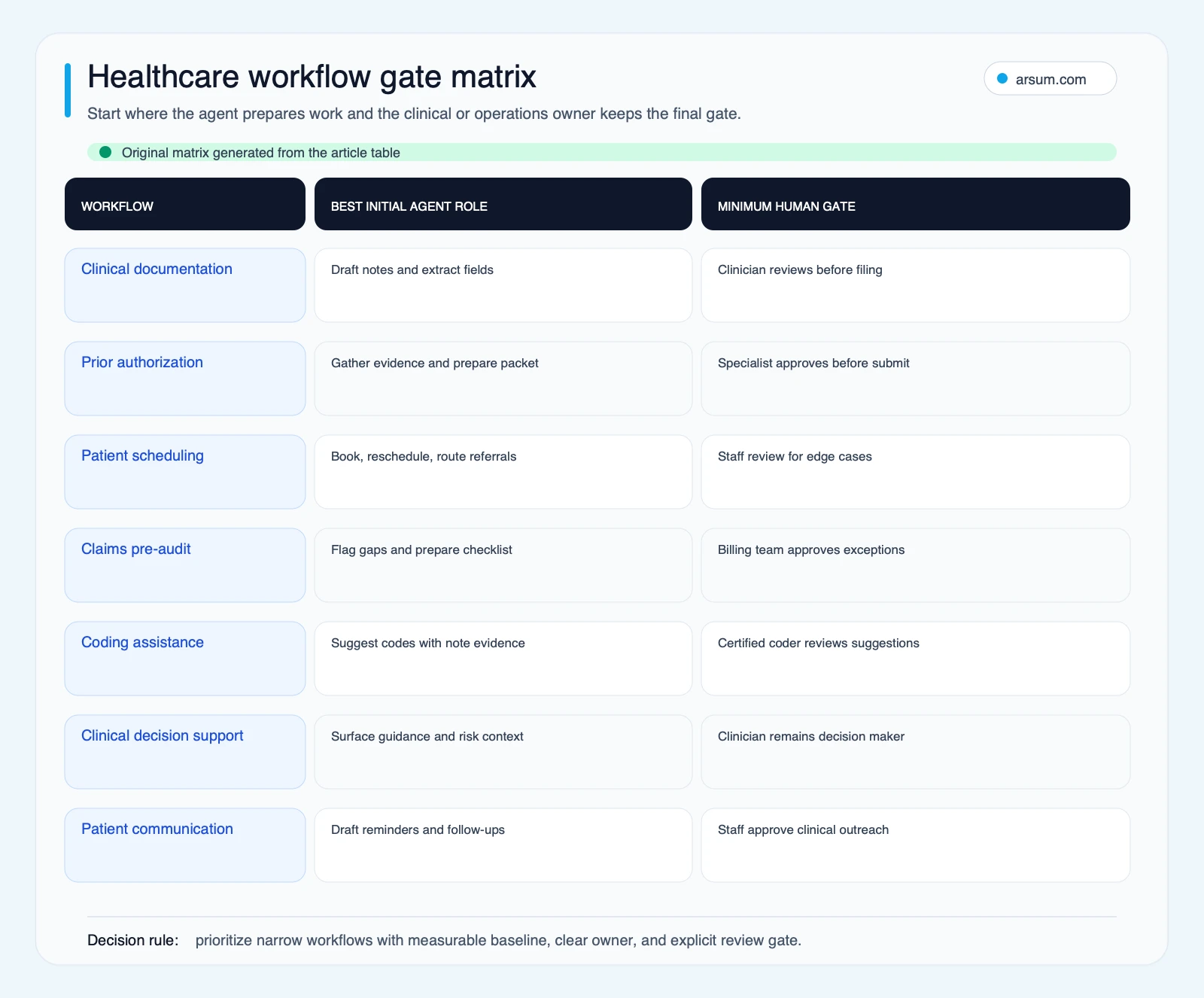
The comparison is intentionally conservative. A workflow can be technically capable of taking the next action and still be unsuitable for that autonomy level. The decision should follow the cost of error, reversibility, data lineage, and whether a real person has capacity and authority to review the output.
Governance before ROI claims
Healthcare AI governance is not a procurement appendix. It defines whether an implementation is authorized to operate.
The FDA’s overview of artificial intelligence-enabled software as a medical device is relevant when teams are evaluating clinical software claims: intended use, device context, lifecycle oversight, and patient-safety risk matter more than a broad claim of “autonomy.” It does not make every workflow a regulated device, but it is a useful reminder to scope clinical claims precisely and involve the appropriate regulatory and clinical stakeholders.
The NIST AI Risk Management Framework provides a practical lifecycle lens: govern, map, measure, and manage risk. The NIST Generative AI Profile makes the relevant deployment risks explicit, including confabulation, privacy, information integrity, misuse, and supply-chain considerations. For health-specific ethical framing, the World Health Organization’s guidance on ethics and governance of AI for health emphasizes human autonomy, safety, transparency, responsibility, inclusiveness, and sustainability.
Translate those principles into operating controls:
- Write an intended-use statement that names the workflow, data sources, actions permitted, actions prohibited, and approval gate.
- Preserve source lineage: a reviewer should be able to open the record evidence behind an extracted fact or drafted statement.
- Log actions, tool calls, approvals, escalations, and version changes in a way the organization can review later.
- Test normal cases and ugly cases separately: incomplete notes, mismatched patient records, unusual payer requirements, stale eligibility, conflicting dates, and unavailable portals.
- Define a manual fallback before production use, including who takes the queue if the integration, model, or portal fails.
These controls also clarify where an AI agent architecture needs to be more than a prompt connected to a browser. Healthcare deployments need identity controls, systems boundaries, evidence handling, exception queues, observability, and accountable owners.
Concrete use cases and their boundaries
Documentation support
Documentation is a strong candidate when the agent drafts from authorized encounter inputs and leaves the clinician with a reviewable artifact. A useful implementation measures whether the draft reduces preparation time and whether it creates unacceptable editing or correction work.
Do not treat clinician review as a temporary inconvenience to be designed away. It is the control point that establishes the note’s accuracy and accountability. A practical exception path may flag missing encounter context, conflicting medication details, unsupported diagnoses, or a low-confidence structured-field extraction for the clinician to resolve.
Public clinician discussion reflects this concern. A Reddit discussion about using AI in medicine is useful as qualitative objection language: clinicians may value documentation help while questioning trust and editing burden. It is not evidence of accuracy, adoption, workload reduction, or provider-wide sentiment.
Prior-authorization packet preparation
Prior authorization is often a better early agentic workflow than a broad “denial reduction” promise. The agent can retrieve relevant chart material, map evidence to a current payer checklist, identify gaps, draft a medical-necessity summary where appropriate, and prepare a submission. A specialist reviews the evidence set and exact payload before it is submitted.
This approach addresses a real operational question: can the team reduce repeated packet assembly without submitting unsupported or incomplete information? A health IT discussion about AI and prior authorization is a qualitative signal that evidence gathering, appeal drafting, and submission quality are buyer concerns. It does not support a claim that agents reduce denials.
Referral intake and scheduling
Referral and scheduling workflows can be useful when the routing taxonomy is explicit. The agent can recognize a request, collect required fields, offer approved appointment options, and route cases that require clinical interpretation, authorization, translation, or access-team intervention.
The failure mode is treating a scheduling interaction as if it were clinical triage. Keep escalation language clear. If a patient message contains symptoms, medication questions, urgency signals, or ambiguity that falls outside defined administrative rules, route it to the appropriate human queue rather than generating clinical advice.
Claims pre-audit and coding support
Claims pre-audit can identify missing elements, inconsistent fields, or incomplete documentation before a claim proceeds. The billing team should review flags and decide the action. Coding support can suggest codes with supporting note evidence, but certified coders remain responsible for the determination and disposition.
These workflows are valuable only if review cost is measured. A tool that catches possible issues but forces staff to investigate mostly unhelpful flags may add cost rather than reduce it. That is why the pilot scorecard must track reviewer minutes and rework, not only automation volume.
Supply and staffing operations
Agents can monitor inventory signals, prepare replenishment recommendations, or organize staffing inputs. These are not permission to autonomously place purchases or make labor decisions. Require procurement approval for orders, and require operational and clinical leadership review for staffing recommendations that affect coverage or policy.
Worked pilot scorecard: make the go/no-go decision explicit
Use a tightly scoped pilot such as “prepare prior-authorization packets for one specialty and a defined payer set.” The values below are illustrative planning assumptions, not observed performance. Replace every assumption with your own baseline before launch.
| Measure | Baseline or planning input | Pilot target | How to calculate | Owner and cadence | Stop condition / rollback |
|---|---|---|---|---|---|
| Case volume | 240 eligible cases per month | Keep scope stable for comparison | Count cases that meet inclusion criteria | Authorization operations lead; weekly | Pause if inclusion logic is unreliable; return cases to manual queue |
| Handling time | 24 minutes per eligible case | 16 minutes or less including review | Total specialist minutes ÷ eligible cases | Authorization operations lead; weekly | Stop if total time rises for two consecutive review periods |
| Reviewer minutes | 6 minutes per packet review | 6 minutes or less | Reviewer time ÷ packets reviewed | Specialist supervisor; weekly sample | Pause if agent output increases editing burden beyond agreed threshold |
| Quality / exception rate | Establish baseline from sampled packets | No increase in unsupported, incomplete, or misrouted packets | Exceptions requiring material correction ÷ packets prepared | Quality reviewer; weekly sample | Stop immediately for a material safety, privacy, or unsupported-submission event |
| Rework or error cost | Record internal cost categories before launch | Do not claim savings until measured | Correction minutes × loaded labor rate, plus documented downstream rework where applicable | Finance partner and operations lead; monthly | Do not expand if economics exclude review and rework cost |
| Integration cost | Estimate one-time build, security, and support inputs | Remain within approved pilot budget | Approved implementation and support spend | Technical sponsor; biweekly | Freeze expansion if required access or portal instability changes the business case |
| Cycle time | Baseline from request received to packet ready | Improve packet-ready time without lowering review quality | Timestamp difference for comparable cases | Operations analytics owner; weekly | Revert to manual preparation if queue delays worsen |
| Safety and privacy | Zero tolerance for defined critical events | No critical events | Incident log and access review | Compliance/privacy owner; immediate | Disable agent access, preserve logs, investigate, and resume manual workflow |
For planning only, a team can estimate capacity impact with transparent arithmetic:
eligible cases per month × (baseline minutes − post-pilot total minutes) ÷ 60
Using the illustrative inputs above: 240 × (24 − 16) ÷ 60 = 32 hours per month of potential capacity change. This is not savings, ROI, or a staffing forecast. It becomes economically meaningful only after the organization measures review minutes, rework, labor assumptions, integration and support cost, and whether capacity can actually be redeployed.
At day 60, the authorization operations lead and technical sponsor should decide whether data quality, access controls, and workflow reliability justify continuing. At day 90, the executive workflow owner should approve one of three outcomes:
- Expand only if target cycle-time and quality measures are met, review burden is acceptable, and the integration has an accountable production owner.
- Continue in a limited scope if the workflow is safe but payer variation, exception taxonomy, or staff adoption still needs work.
- Stop and roll back if the agent adds review cost, cannot reliably preserve source lineage, creates unresolved compliance risk, or lacks a sustainable exception owner.
💡 Arsum builds custom AI automation solutions tailored to your business needs.
Get a Free Consultation →Prior-authorization workflow: normal path and ugly exceptions
| Step | Normal path | Agent task | Human checkpoint | Exception path |
|---|---|---|---|---|
| Intake | Eligible request arrives | Identify service, payer, specialty, and required case fields | Specialist verifies eligibility rules for ambiguous cases | Missing order, unclear indication, duplicate request |
| Evidence retrieval | Required chart material is available | Collect approved record references and identify gaps | Specialist confirms evidence set | Conflicting dates, inaccessible records, incomplete documentation |
| Payer mapping | Payer checklist matches known configuration | Map evidence to requirements and prepare fields | Specialist reviews nonstandard mapping | New payer rule, specialty variance, rule source unavailable |
| Packet preparation | Required content is complete | Draft summary and organize attachments | Specialist approves exact packet | Unsupported assertion, missing attachment, unclear medical-necessity rationale |
| Submission and monitoring | Approved payload is ready | Prepare or, where authorized, submit after approval; monitor status | Specialist owns final submission and denial/appeal response | Portal failure, status conflict, denial, request for additional information |
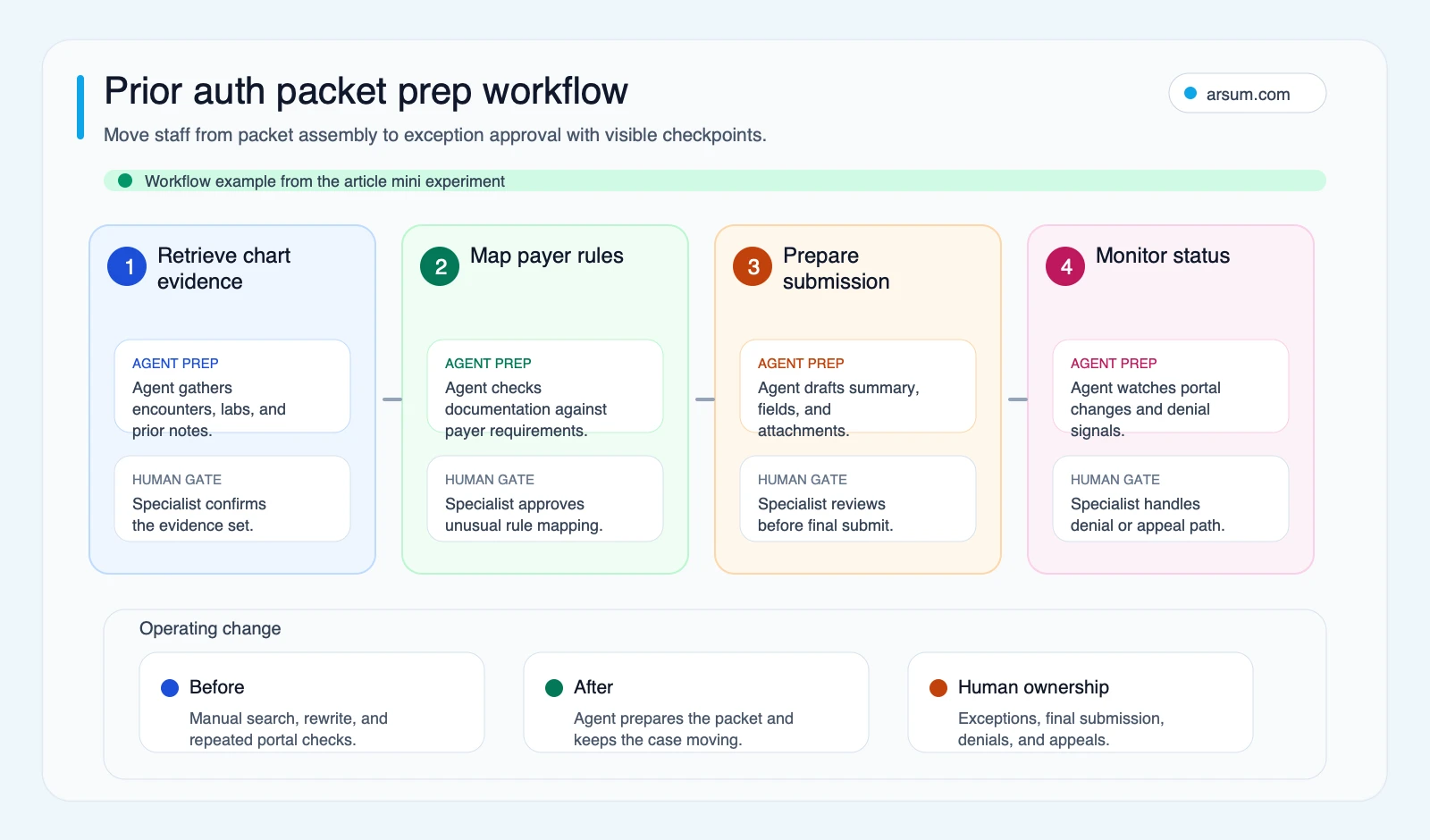
Portal automation deserves extra caution. Technical practitioners have discussed the fragility of healthcare automation across local systems and browser-driven workflows, including this Hacker News discussion. Treat that as a qualitative builder signal, not a market statistic. Design test fixtures, monitoring, portal-change alerts, and a staffed manual fallback rather than assuming a successful demo will survive every local variation.
Build, buy, or partner: decide on the workflow, not the label
Off-the-shelf products can be appropriate when the workflow is common, integrations are supported, local differentiation is limited, and the vendor can meet required security, audit, and support obligations. Build or customize when payer variation, local EHR configuration, specialty evidence rules, routing logic, or audit requirements are central to the workflow’s value.
| Decision factor | Buy a configured product | Build or customize a narrow workflow |
|---|---|---|
| Payer and EHR variation | Low and supported by the product | High, local, or frequently changing |
| Integration depth | Standard APIs and stable records | Multiple systems, bespoke queues, portals, or local mappings |
| Audit requirements | Vendor produces sufficient logs and evidence lineage | You need workflow-specific evidence, approvals, and retention behavior |
| Workflow differentiation | Process is largely standard | Process design is operationally distinctive or strategically important |
| Vendor lock-in | Acceptable if export, support, and controls are clear | Material concern; organization needs control over logic and orchestration |
| Internal ownership | Product owner can configure and operate it | Technical and workflow owners can support a custom production system |
A hybrid is common: use established services for commodity capabilities such as transcription, OCR, identity, or model access, while owning the workflow rules, integrations, approval design, and exception queues. For the broader implementation choices, see AI workflow automation, AI integration services, and agentic AI development services.
Disqualifying conditions and common failure modes
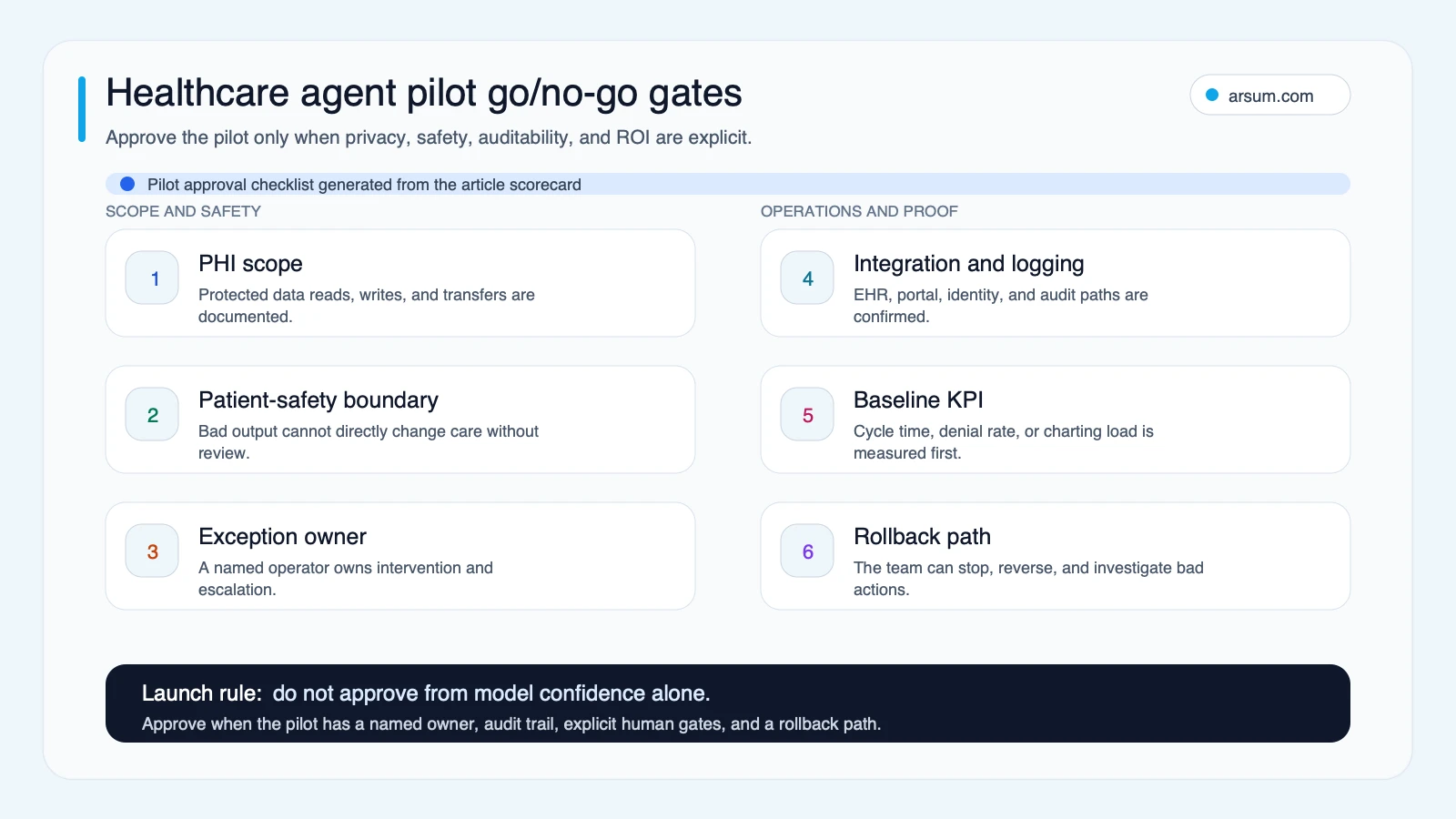
Do not launch a healthcare agent pilot when any of these conditions remains unresolved:
- No reliable source of record or permissioned path to the data the workflow needs.
- No named person or team authorized to approve outputs and own exceptions.
- No baseline volume, handling time, quality, or reviewer-cost measure.
- An irreversible or patient-sensitive action would occur without an explicit human checkpoint.
- No audit trail can show the source evidence, agent action, reviewer decision, and final disposition.
- The manual fallback is not staffed or cannot absorb a service interruption.
- The proposed scope hides several workflows behind a single label such as “automate referrals” or “automate prior auth.”
Projects also fail when teams measure only model output quality. The operational measure is the end-to-end workflow: retrieval quality, editing time, exception rate, cycle time, support effort, integration reliability, and the cost of rework. A useful agent reduces work in that full system; it does not merely generate convincing text.
Production-readiness checklist
Before moving beyond a controlled pilot, confirm the following:
- The EHR owner, security reviewer, privacy/BAA path, technical sponsor, workflow owner, and production support owner are named.
- Inputs, approved tools, prohibited actions, and escalation rules are documented.
- The team has representative test cases for normal cases and known exceptions.
- Each output can be traced to authorized source material.
- Monitoring covers failed tool calls, incomplete records, portal changes, abnormal exception rates, and reviewer overrides.
- Staff understand what the system does, what remains human, and where to send questionable cases.
- The 60- and 90-day acceptance decisions are scheduled before launch.
FAQ
What is agentic AI in healthcare?
Agentic AI in healthcare is a bounded, tool-using system that can perform multi-step administrative or support tasks across approved systems. For consequential clinical, reimbursement, or patient-sensitive actions, it needs explicit human approval and an escalation path; technical capability does not create authorization.
Which healthcare workflows should start first?
Start where the organization can show repeat volume, baseline cycle time, manageable exceptions, source lineage, and a reviewer who can approve or reject the output. Documentation support, prior-auth preparation, claims pre-audit, referral intake, and scheduling often fit that pattern.
Is agentic AI safe for clinical use?
It can support clinical work when its intended use, evidence, oversight, and escalation rules are clear. A prudent initial boundary is advisory or preparation support with clinician review, not unsupervised diagnosis, treatment selection, or patient-care action.
How do we prove the pilot is worthwhile?
Measure comparable cases before and during the pilot: total handling time, reviewer minutes, exception and correction rate, cycle time, integration and support cost, and any defined capacity effect. Do not call a pilot successful based only on outputs generated or tasks touched.
Methodology and limits
This article uses the page’s editorial research pack: primary guidance from the FDA, NIST, and WHO, plus public practitioner discussions reviewed on 2026-06-22. The practitioner material is included only as qualitative evidence of implementation objections—editing burden, payer variation, EHR integration friction, portal fragility, security ownership, and BAA concerns—not as proof of prevalence, accuracy, savings, denial reduction, or provider-wide sentiment.
The practical conclusion is deliberately narrow: fund a healthcare agent when the workflow has a measurable baseline and a controlled operating model. Start with drafting, evidence preparation, routing, or reviewable submission preparation; assign owners; preserve evidence; and make the stop condition as explicit as the target.
Ready to Automate Your Business?
Stop wasting time on repetitive tasks. Let AI handle the busywork while you focus on growth.
Schedule a Free Strategy Call →Written by:Arsum editorial team
- Reviewed by
- Arsum editorial team
- Published
- May 30, 2026
- Updated
- August 12, 2026
- How this was produced
- Arsum uses research packs, source checks, and human editorial review to prepare and update blog articles. Editors are responsible for the final page.
- Source policy
- Sources are linked in the article when used. Methodology and source notes are included on higher-risk or high-visibility pages and are being rolled out across the archive. Editorial policy.
- Why this page exists
- Help B2B operators evaluate AI automation, implementation scope, cost, risk, and build-vs-buy decisions with practical context.