Agentic AI use cases marketing are most useful when they automate a bounded marketing workflow with explicit permissions—not when they promise autonomous growth. Start with a task where the data source is known, the action is reversible, a named owner can approve exceptions, and the outcome can be measured against a baseline.
Agentic AI Use Cases Marketing: Practical Guide
Explore agentic AI use cases marketing: compare workflow fit, costs, risks, evidence, and practical next steps before you build, buy, or hire.

Table of Contents
- What most guides miss: the permission model is the use case
- The four permission levels for marketing agents
- Three agentic AI use cases marketing teams can actually pilot
- A 30/60/90-day pilot scorecard
- How to score a workflow before you automate it
- Build, buy, or extend your marketing stack
- Failure modes that should disqualify a first pilot
- A phased route from observation to execution
- Evidence note and next step
What most guides miss: the permission model is the use case
Campaign planning, lead scoring, content operations, and segmentation are not complete use cases by themselves. The operating design matters more:
- What systems can the agent read?
- Can it recommend, draft, queue, or execute an action?
- Who approves changes to spend, audience membership, claims, and customer-facing copy?
- Where do exceptions go?
- What evidence is retained to explain an action?
- Who can roll it back?
This is the difference between a useful workflow agent and a demo with production credentials. IBM and Braze describe marketing-agent applications across campaign management, content, segmentation, and analysis, while Palo Alto Networks’ governance overview emphasizes delegated authority and ownership. The practical decision is not whether an agent can make a change; it is whether your team has authorized it to do so safely.
NIST’s AI Risk Management Framework offers a helpful operating lens: govern the workflow, map its context and risks, measure performance and failures, then manage the result. That sequence is more useful than selecting a tool first.
The four permission levels for marketing agents
| Permission level | Example | Permitted action | Required control | Safe rollback |
|---|---|---|---|---|
| Read-only insight | UTM QA or weekly campaign summary | Read source systems and flag issues | Owner reviews findings | Ignore output; no systems changed |
| Recommendation | Budget pacing diagnosis | Propose an action and rationale | Human approves or rejects | Existing configuration remains live |
| Supervised execution | CRM task creation or staged CMS update | Write a queued, reversible change | Human approves before release | Revert queued record or restore prior version |
| Bounded autonomous execution | Deduplicating leads under fixed rules | Write only inside documented thresholds | Exceptions and threshold breaches alert an owner | Disable rule, restore prior state, investigate log |
A workflow should move up this ladder only when its measured pilot evidence supports it. Brand-sensitive, regulated, or difficult-to-reverse actions should remain lower on the ladder even if the underlying model performs well.
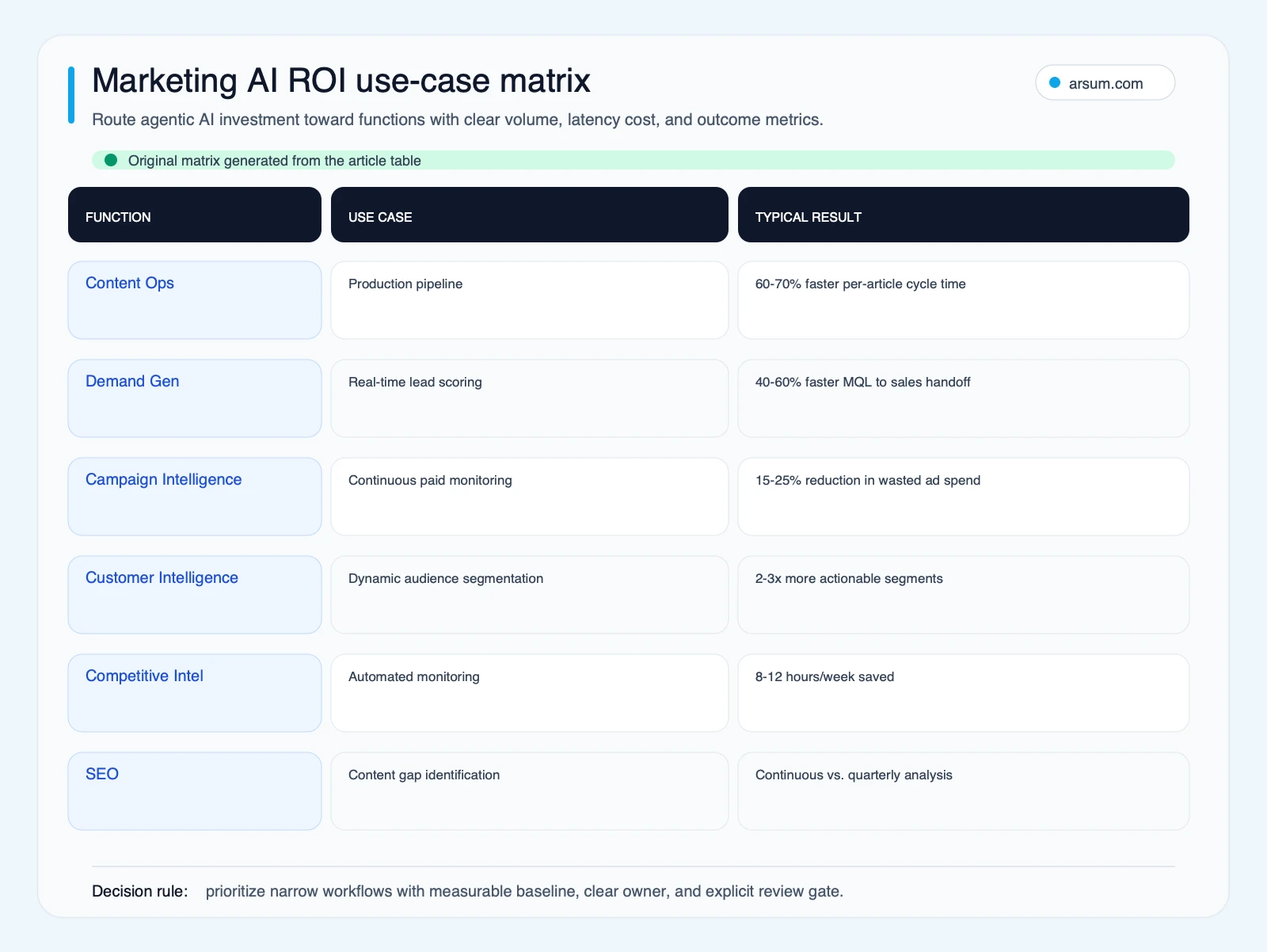
Three agentic AI use cases marketing teams can actually pilot
The following are not claims of universal ROI. They are implementation patterns with a narrow first scope, clear source lineage, and a measurable pilot metric.
1. Lead enrichment and routing recommendations
This is a strong first candidate when marketing and sales already have a usable CRM, clear assignment rules, and a defined response-time measure.
| Operating element | Pilot design |
|---|---|
| Trigger | A new inbound lead, a material account activity signal, or a lead waiting beyond the agreed review interval |
| Source systems and lineage | CRM lead and account records; marketing-automation engagement events; approved firmographic enrichment source; routing rules documented by revenue operations |
| Agent output | A recommended owner, priority band, and concise reason based on cited fields—not a rewritten lifecycle stage |
| Permission boundary | Read-only during initial evaluation; optionally create a task in a supervised queue after approval |
| Approver | Revenue operations manager or designated sales-development lead |
| Exception path | Missing account match, conflicting territory rule, low-confidence enrichment, or suspected duplicate routes to the existing CRM exception queue |
| Retained evidence | Input record IDs, fields consulted, recommendation, confidence or rule match, reviewer decision, timestamp, and final route |
| Rollback owner | Revenue operations manager can cancel queued tasks and restore the prior assignment |
| Pilot metric | Median time from qualified inbound trigger to human-reviewed route, plus routing-correction rate |
The agent’s role is to reduce triage work and make its reasoning inspectable. It is not authorized to decide that a contact is sales-ready, alter opportunity stages, or override territory policy. For a broader view of workflow boundaries, see agentic AI workflow automation.
2. Paid-campaign anomaly triage
Paid media is consequential because an incorrect action can affect spend, delivery, and audience exposure. The safe first pilot is diagnosis and escalation—not autonomous budget changes.
| Operating element | Pilot design |
|---|---|
| Trigger | Scheduled check or an observed pacing, delivery, conversion, or tracking anomaly against documented thresholds |
| Source systems and lineage | Ad-platform reporting APIs, approved spend plan, web analytics, conversion definitions, and campaign naming conventions |
| Agent output | A ranked anomaly list, affected campaigns, supporting metrics, plausible diagnosis, and recommended next review step |
| Permission boundary | Read-only; no bid, budget, targeting, or creative changes in the pilot |
| Approver | Paid media lead or growth lead |
| Exception path | Conflicting conversion sources, incomplete data, tracking outage, or threshold breach becomes an alert for human investigation |
| Retained evidence | Query time, source report identifiers, thresholds, calculations, recommendation, reviewer disposition, and any approved follow-up |
| Rollback owner | Paid media lead; because the pilot has no write access, rollback means disabling the agent alert or correcting its threshold configuration |
| Pilot metric | Time from anomaly threshold breach to human review, false-positive rate, and percentage of alerts with a documented disposition |
This workflow is especially valuable when the existing problem is slow detection rather than a lack of optimization ideas. It does not prove that the agent improved conversion or reduced spend; those require a credible baseline, stable measurement, and a controlled comparison.
3. Content source and claim QA
Content agents should not begin with autonomous publishing. A more defensible first implementation checks a draft against a defined evidence and editorial policy, then sends editors an exception list.
| Operating element | Pilot design |
|---|---|
| Trigger | A draft enters editorial review or a published page is selected for refresh |
| Source systems and lineage | Approved editorial brief, source list, product documentation, style guide, CMS draft, and claims register where one exists |
| Agent output | Missing citations, unsupported numeric claims, stale links, conflicts with the approved brief, and suggested questions for the editor |
| Permission boundary | Read-only or draft annotations only; no publication and no source fabrication |
| Approver | Managing editor, subject-matter reviewer, or legal/compliance reviewer for sensitive claims |
| Exception path | Unverifiable source, contradictory source, regulated statement, pricing claim, or material factual uncertainty is escalated for human resolution |
| Retained evidence | Draft version, sources checked, flagged passage, reason for flag, editor decision, edit history, and final source links |
| Rollback owner | Managing editor restores the prior CMS version or rejects the draft |
| Pilot metric | Editor correction rate, proportion of substantiated flagged issues, and review time per draft |
This pattern is relevant to AI content automation for business, but it should be evaluated as an editorial-control system, not as permission to publish at volume. It also keeps search quality and brand risk visible.
A 30/60/90-day pilot scorecard
Use one workflow, one accountable owner, and one decision at each review. The figures below are illustrative planning assumptions, not observed Arsum or industry results.
Example: lead-routing recommendation pilot.
| Review point | Baseline or target | Owner | Evidence retained | Pass condition | Stop condition |
|---|---|---|---|---|---|
| Before launch | Record the prior 30 days of median inbound-to-reviewed-route time, routing corrections, and unassigned-lead count | Revenue operations manager | CRM export, routing policy, field dictionary, baseline calculation | Baseline is accepted by sales and marketing | Source fields or assignment policy cannot be reconciled |
| Day 30 | Agent recommends routes in shadow mode; no writes | Revenue operations manager | Recommendation log and reviewer decisions | Reviewer can explain and disposition the majority of recommendations; correction rate is tracked | Repeated unexplained recommendations, missing lineage, or material policy conflicts |
| Day 60 | Target a pre-agreed reduction in review delay, without exceeding the agreed correction-rate ceiling | Revenue operations manager | Weekly metric review and sampled records | Target and quality ceiling are met for the agreed observation window | Quality falls below ceiling or sales rejects recommendations as unusable |
| Day 90 | Decide whether to keep recommendation-only mode, add supervised task creation, or stop | VP Marketing and sales operations owner | Decision memo, audit sample, exception trend, rollback test | Evidence supports a narrower next permission | No measurable operational improvement, unresolved exceptions, or weak owner adoption |
For example, a team might set a target of reducing median review delay from 12 business hours to 6. That is an illustrative planning assumption with a visible input: the baseline is 12 hours and the proposed target is 6. It should not be treated as a savings claim until the team can show the underlying records and the quality tradeoff.
The rollback path must be tested before permissions expand: disable the integration or agent rule, return work to the established queue, preserve logs, and have the named owner review what changed. A pilot that cannot be paused cleanly is not a good first pilot.
How to score a workflow before you automate it
Score each dimension from 1 to 5. Use the same team to score every candidate; the conversation around disagreements is often more useful than the final number.
| Dimension | Score 1 | Score 5 | Weight |
|---|---|---|---|
| Repetition | Rare or highly bespoke work | Frequent, repeatable task with stable handoffs | 2 |
| Data readiness | Key fields are missing, inconsistent, or disputed | Inputs are documented, accessible, and owned | 2 |
| Reversibility | Changes are difficult to undo or customer-visible | Output can be discarded or restored easily | 2 |
| Observability | No reliable baseline, trace, or outcome measure | Input, action, exception, and outcome can be logged | 2 |
| Brand/compliance risk | Low-consequence internal task | High-consequence external or regulated action | -2 |
| Spend or access risk | No financial or sensitive write impact | Changes can affect spend, audiences, or sensitive records | -2 |
Calculate:
weighted pilot score = (repetition × 2) + (data readiness × 2) + (reversibility × 2) + (observability × 2) - (brand/compliance risk × 2) - (spend/access risk × 2)
A higher score does not authorize autonomy. It identifies a better candidate for a controlled pilot. A workflow that scores well but has high spend risk should remain recommendation-only until the owner, thresholds, and rollback controls are proven.
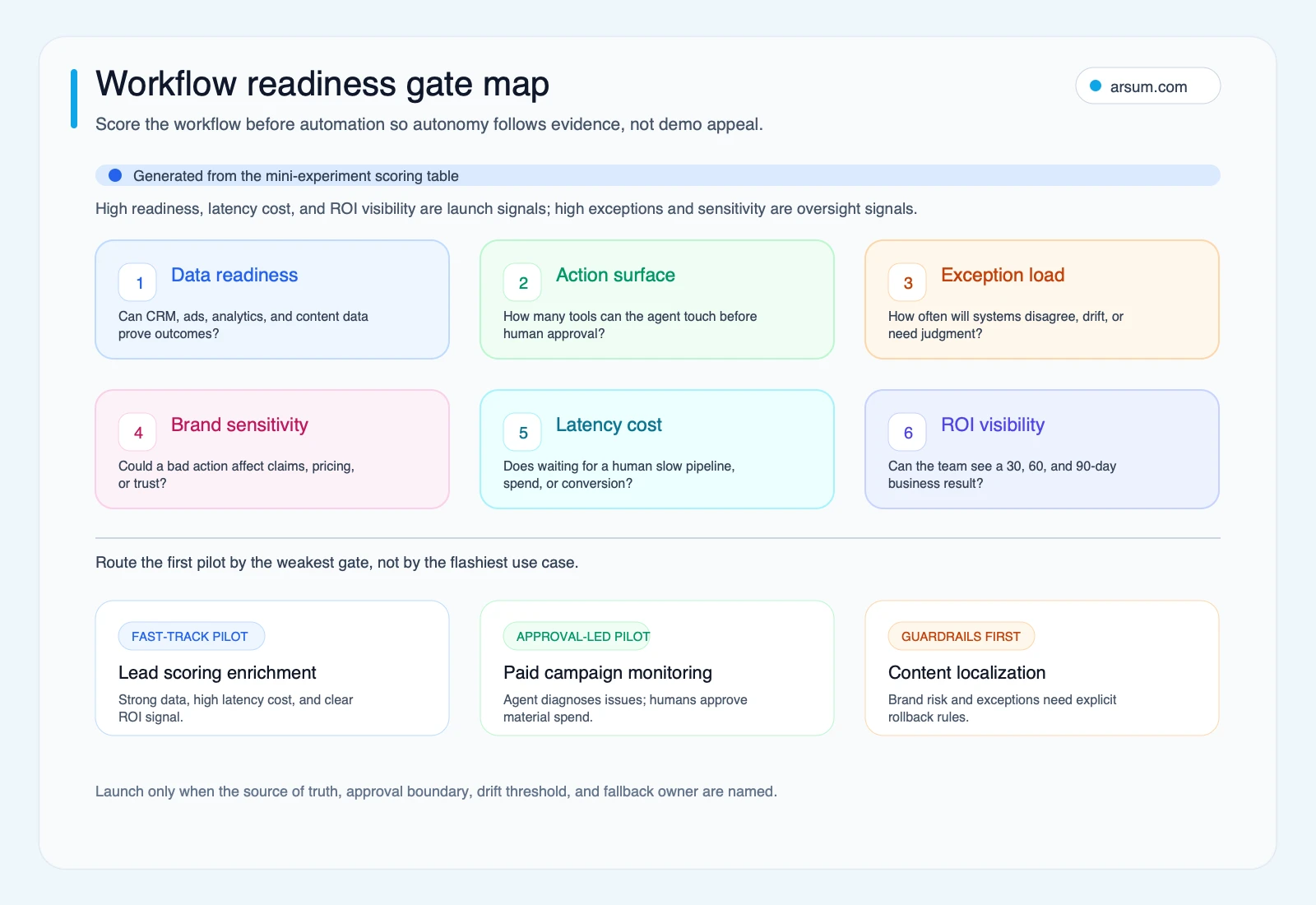
A practical routing rule
- Start with read-only QA, reporting, monitoring, or enrichment if the task is repetitive and the output can be checked quickly.
- Move to recommendations when the data sources are stable and the accountable owner can approve or reject actions.
- Use supervised execution only for actions that are reversible and have a tested rollback.
- Defer autonomous actions that affect spend, audience membership, offers, legal claims, customer communications, or sensitive CRM fields.
Practitioner discussions also point toward these low-risk starts—campaign summaries, UTM QA, inbound categorization, and routing suggestions—but this is qualitative operator input, not evidence of adoption or results. See the MarketingAutomation discussion and the related Hacker News discussion for examples of the concern around governance and customer-facing autonomy.
Build, buy, or extend your marketing stack
An agentic workflow does not automatically justify custom development. Use the option that solves the bounded workflow with the least operational burden.
| Option | Best fit | Integration effort | Operating ownership | Lock-in risk | When it is insufficient |
|---|---|---|---|---|---|
| Buy a platform feature | The workflow fits standard campaign, CRM, content, or analytics behavior and its controls meet policy | Usually lower, but validate connectors and field mappings | Marketing operations or platform admin | Dependence on vendor roadmap, data model, and pricing | You need cross-system logic, bespoke exception handling, or a traceable approval flow the product cannot express |
| Extend existing tools | Your CRM, MAP, analytics, and ticketing systems are already authoritative; you need a narrow layer for retrieval, recommendations, or queues | Moderate: identity resolution, APIs, permissions, monitoring | Internal marketing operations plus technical owner | Moderate: connector and platform constraints | Native workflows cannot reconcile competing sources or support the required evaluation and audit design |
| Build a narrow custom workflow | The process is material, repeated, differentiated, and has specific policy or integration requirements | Higher: source lineage, controls, evaluation, alerting, and support must be designed | Product or engineering owner with functional owner | Lower vendor dependency, but greater internal maintenance responsibility | The task is still changing weekly, the baseline is unavailable, or an off-the-shelf workflow already meets requirements |
A narrow custom workflow is justified by control and fit—not by novelty. It should have a stable trigger, a source-of-truth decision, a known human exception route, and an operational owner after launch. If you are comparing agent approaches, AI agent architecture patterns and agentic AI frameworks comparison can help frame the technical choices without substituting for workflow design.
💡 Arsum builds custom AI automation solutions tailored to your business needs.
Get a Free Consultation →Failure modes that should disqualify a first pilot
Do not use a marketing agent as a shortcut around unresolved operating problems.
No authoritative data source
If CRM, ad platform, web analytics, and finance reports tell different stories and nobody owns reconciliation, an agent will make that ambiguity faster. Establish the source hierarchy before automating analysis or action.
No approval owner
“Marketing” is not an accountable owner. Name the person who can accept exceptions, approve permission changes, and decide whether the pilot continues. If a workflow touches legal claims, offer terms, or regulated messaging, include the appropriate review owner before launch.
No usable rollback
Do not give write access to campaigns, audiences, or CMS assets when the team cannot restore the prior configuration, identify the affected records, or stop repeated actions. Reversibility is an implementation requirement, not a clean-up task.
A metric that cannot distinguish improvement from noise
“Better campaign performance” is too broad for a first pilot. Choose a metric connected to the agent’s narrow function: time-to-review, routing correction rate, alert false-positive rate, editor correction rate, or percentage of exceptions resolved within an agreed interval.
Customer-facing autonomy before evidence
Generating a draft is not the same as sending it. A system may be technically capable of changing an email sequence, offer, audience, or creative asset; that does not make it authorized. Keep human approval where the failure cost is high or the change is hard to reverse.
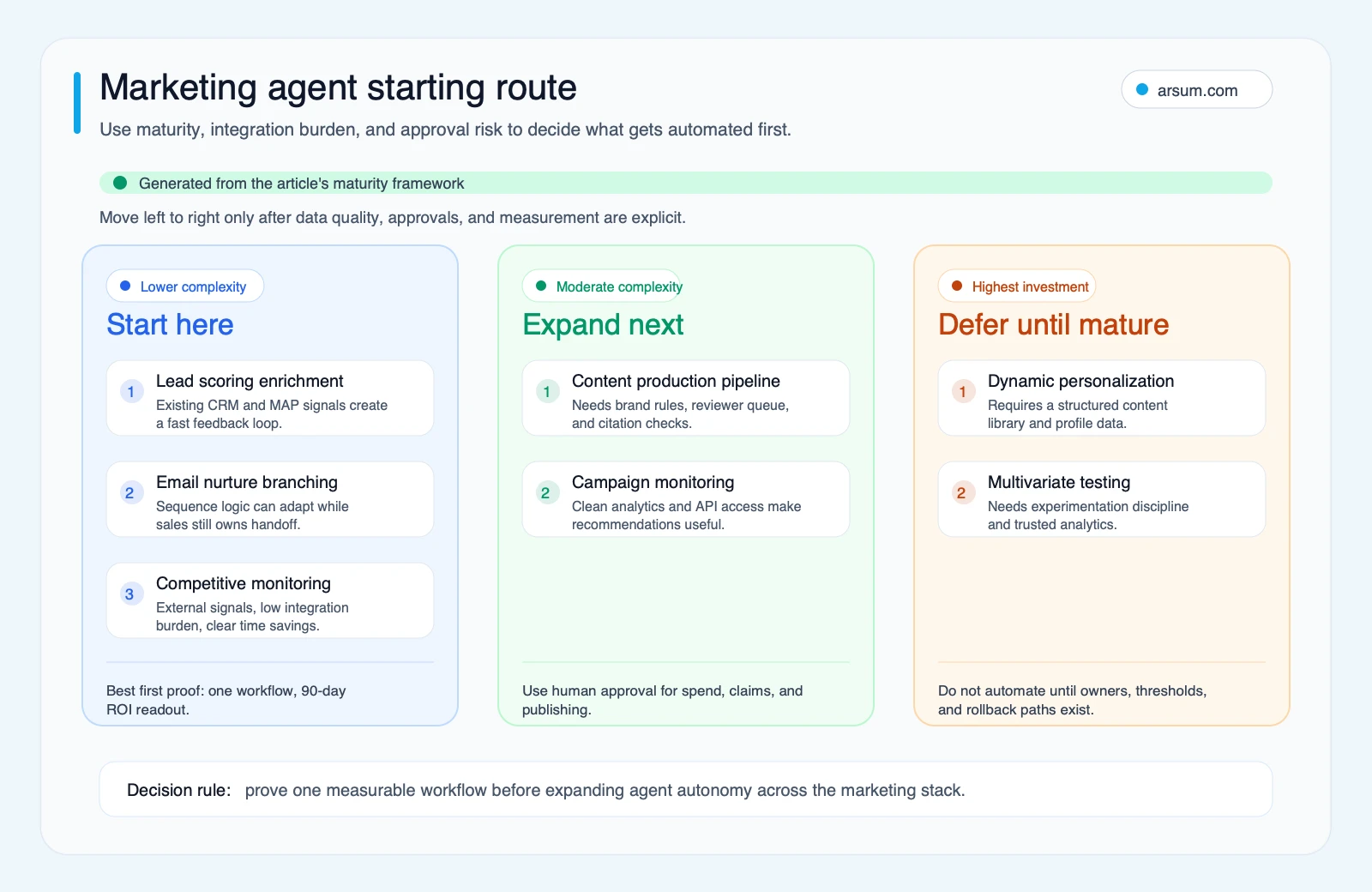
A phased route from observation to execution
Start with the workflow whose value is visible without granting risky permissions.
- Observe: summarize campaign health, flag tracking gaps, identify duplicate or incomplete records, and produce content QA findings.
- Recommend: explain likely causes, prioritize queues, and propose a next action with citations to the underlying fields or reports.
- Stage: create drafts, tasks, or reversible changes that wait for named approval.
- Execute within bounds: only after evidence supports it, allow narrow actions under fixed thresholds, with alerts and rollback ownership.
This approach aligns with the broader distinction in agentic AI versus generative AI: generating useful content or analysis is one capability; coordinating tools and acting under controls is an operating-system decision.
Evidence note and next step
Vendor materials are useful for identifying possible marketing-agent patterns. IBM discusses customer engagement, content, campaigns, and performance analysis; Braze gives examples involving planning, segmentation, content, and customer decisions. Neither source establishes that a given workflow will produce a specific return in your organization.
This article uses those sources for capability context, NIST and Palo Alto Networks for governance framing, and practitioner discussions as anecdotal signals about the objections teams raise. The decision framework is editorial guidance: validate it against your own systems, workload baseline, approval policies, and exception history.
If your team has one workflow with a known baseline but unclear permission boundaries, a workflow assessment can turn it into a pilot design: source systems, allowed actions, owner, exception queue, retained evidence, acceptance metric, and rollback test. That is also the right point to decide whether an existing platform, an extension, or a custom workflow is warranted.
Ready to Automate Your Business?
Stop wasting time on repetitive tasks. Let AI handle the busywork while you focus on growth.
Schedule a Free Strategy Call →Written by:Arsum editorial team
- Reviewed by
- Arsum editorial team
- Published
- May 31, 2026
- Updated
- August 12, 2026
- How this was produced
- Arsum uses research packs, source checks, and human editorial review to prepare and update blog articles. Editors are responsible for the final page.
- Source policy
- Sources are linked in the article when used. Methodology and source notes are included on higher-risk or high-visibility pages and are being rolled out across the archive. Editorial policy.
- Why this page exists
- Help B2B operators evaluate AI automation, implementation scope, cost, risk, and build-vs-buy decisions with practical context.