This guide evaluates agentic AI vs generative AI through workflow fit, ownership, implementation risk, and measurable ROI. For B2B founders, operators, and commercial leaders, the useful question is not whether agentic AI or generative AI is more advanced. The useful question is: which one removes a measurable constraint in your business?
Agentic AI vs Generative AI: Comparison
Compare agentic AI vs generative AI through ROI, workflow fit, implementation risk, and build-vs-buy decisions for business automation.

Table of Contents
- Operator Note
- What Most Comparisons Miss
- The Practical Difference
- What is Generative AI?
- What is Agentic AI?
- Expert Note
- Original Data: Five Levels of Autonomy
- How an Agentic System Actually Works
- Decision Tree: Do You Need Agentic Orchestration?
- Where Generative AI Creates ROI
- Where Agentic AI Creates ROI
- Commodity vs Non-Commodity Breakdown
- Common Mistakes When Teams Call Something Agentic
- Hybrid Systems Usually Win in Real Workflows
- Build vs Buy vs Agency
- Google Risk Box: Scaled Content and Thin Automation Risk
- Implementation Checklist
- Common Questions About Generative vs Agentic AI
- The Future is Integration, Not Competition
- Methodology Note
- Next Steps
If the bottleneck is producing, reviewing, or summarizing information, generative AI may be enough. If the bottleneck is work getting stuck between systems, approvals, queues, spreadsheets, inboxes, and people, agentic AI is usually the more relevant pattern. If the workflow needs both judgment and execution, you are probably looking at a hybrid system.
Generative AI creates outputs. Agentic AI pursues goals and takes actions. That difference changes the ROI model, the implementation plan, the risk profile, and the kind of operating discipline required after launch.
Operator Note
The practical dividing line is not model sophistication. It is permission to act.
A generative AI system can still influence important decisions, but its default mode is usually advisory: draft, summarize, classify, or recommend. An agentic AI system becomes operational when it can choose steps, call tools, update systems, and keep moving without a person approving every small move.
That shift changes the implementation burden. As soon as the system can act, teams need approval design, audit trails, rollback rules, and a named owner for exceptions. For most businesses, the safest rule is simple: use the lowest-autonomy pattern that still removes the real bottleneck.
What Most Comparisons Miss
Most pages about Agentic AI vs Generative AI compare features, pricing, or popularity. A buyer needs a stricter filter: which option changes the workflow, who will maintain it, and what failure mode is acceptable after launch.
Before shortlisting anything, map:
- Workflow fit: what repetitive business process will actually change?
- Integration burden: which systems, permissions, and data sources must connect?
- Control: who can inspect, test, and correct the output when it is wrong?
- Switching cost: what gets hard to replace after the first rollout?
If those answers are unclear, the “best” option is still only a demo preference. The right choice is the one your team can operate safely after the novelty wears off.
The Practical Difference
Generative AI is reactive. A person gives it a prompt, context, document, image, ticket, or request, and it generates a response. It is strong when the business problem is “we need better or faster output.”
Agentic AI is goal-driven. It can plan steps, use tools, check data, make bounded decisions, call APIs, update systems, and escalate exceptions. It is strong when the business problem is “the process is too slow, manual, inconsistent, or expensive to run.”
The difference matters because a content tool and an automation system are evaluated differently:
| Decision Area | Generative AI | Agentic AI |
|---|---|---|
| Primary value | Faster content, analysis, summarization, drafting | Faster execution across workflows and systems |
| Human role | Prompt, review, approve, revise | Define rules, monitor outcomes, handle exceptions |
| Integration depth | Often low at first | Usually medium to high |
| ROI driver | Time saved per draft, summary, analysis, or response | Labor removed from handoffs, routing, checks, updates, and follow-up |
| Main risk | Inaccurate or generic output | Wrong action, bad handoff, missed exception, weak governance |
| Best first pilot | High-volume knowledge work | Repeatable workflow with clear inputs, rules, and success metrics |
A simple test: if your team still has to copy the answer into three other systems, chase approvals, update the CRM, notify the customer, and check whether the task was completed, generative AI has helped only one slice of the work.
What is Generative AI?
Generative AI entered mainstream business use through tools like ChatGPT, DALL-E, Midjourney, and coding assistants. These systems create new outputs from learned patterns: text, images, code, media, summaries, classifications, and structured drafts.
Common business uses include:
- Drafting outbound email sequences, proposals, sales enablement material, and customer replies
- Summarizing call notes, support tickets, research, contracts, or long documents
- Producing first-pass reports, competitive briefs, and campaign concepts
- Helping engineers generate or explain code
- Creating internal knowledge-base answers from approved source material
Generative AI produces value fastest when the work is high-volume and reviewable. A founder may use it to draft investor updates. A revenue leader may use it to summarize sales calls and draft follow-ups. An operations team may use it to classify vendor requests or convert messy notes into structured fields.
The operational change is modest at first: people still own the workflow, but their blank-page work and information processing get faster. That makes generative AI a good starting point when the organization needs productivity gains without deep system integration.
The limitation is equally important: generative AI does not reliably complete business processes on its own. It can draft the renewal email, but it will not safely decide who should receive it, check contract terms, update Salesforce, create the task, send the message, and monitor the response unless you wrap it in automation.
What is Agentic AI?
Agentic AI refers to systems that can pursue a goal through a sequence of actions. An agentic AI system can interpret context, decide what step comes next, use tools, write or read from business systems, and escalate when confidence or permissions are insufficient.
Common business uses include:
- Routing qualified leads, enriching records, updating CRM fields, and creating follow-up tasks
- Monitoring customer health signals and triggering success workflows
- Processing invoices, matching purchase orders, flagging exceptions, and updating finance systems
- Pulling data from several tools to produce recurring operating reports
- Managing onboarding workflows across forms, email, project management tools, and internal systems
Agentic AI is not just “ChatGPT with more prompts.” It changes who or what owns the next step in a process. Instead of asking a person to move work from one tool to another, the system can perform the handoff and leave an audit trail.
That is why the ROI case is different. The business value comes from fewer manual touches, faster cycle times, fewer dropped tasks, better follow-up discipline, and reduced operational drag. The strongest use cases are usually workflows where the same people are paid to do the same coordination work every week.
Expert Note
Primary-source definitions are narrower than the marketing language around “agents.”
- IBM frames generative AI as producing outputs from prompts and agentic AI as a more proactive system that can pursue tasks toward an outcome.
- Red Hat emphasizes that agentic systems adapt plans and strategy as conditions change, while generative systems mostly adapt the content of their response.
- Databricks describes AI agents as execution units that maintain state, reason about goals, and call tools to act.
- Governance guidance becomes more important as autonomy rises, because the main risk moves from weak content to unsafe actions, unclear accountability, and missing auditability.
That combination leads to a practical rule: do not buy agentic complexity for work that only needs better generation and review.
Original Data: Five Levels of Autonomy
A quick way to cut through vendor labels is to classify the workflow instead of the product.
| Level | What it does | Planning | Tool access | Human checkpoint |
|---|---|---|---|---|
| Content generator | Produces text, images, code, or summaries from a prompt | None or prompt-bound | None or minimal | Every output is reviewed |
| Copilot assistant | Drafts, recommends, and helps inside a human-owned workflow | Light | Limited | Human owns every action |
| Deterministic workflow automation | Executes fixed if/then steps across tools | None beyond predefined rules | Narrow but real | Human defines the rules and reviews failures |
| Bounded AI agent | Chooses next steps inside a defined workflow and adapts when context changes | Medium | Multi-tool | Human reviews exceptions or high-risk writes |
| Multi-agent agentic system | Coordinates several actors toward a business outcome with shared state and escalation logic | High | Broad, orchestrated | Oversight is exception-based with strong controls |
Boundary examples make the gray zone clearer:
- A prompt-only content workflow is usually a content generator.
- A RAG support assistant that drafts replies for approval is usually a copilot assistant.
- A Zapier-style handoff that always follows the same path is usually deterministic workflow automation, not agentic AI.
- A workflow that enriches a record from trusted systems and can choose the next safe step is closer to a bounded AI agent.
- A system that can route work, update tools, retry, and escalate based on live conditions is where agentic AI becomes the right label.
How an Agentic System Actually Works
The architecture matters because the word agent hides a lot of operating detail. In a production workflow, an agentic system usually needs seven pieces working together:
- Goal definition: what outcome the system is trying to achieve, not just what text to generate.
- Context and memory: the records, prior steps, state, and business rules that define the current situation.
- Planning: the logic that decides what should happen first, next, and only if specific conditions are met.
- Tool calls: controlled access to APIs, databases, inboxes, CRMs, or internal tools.
- Guardrails: permission boundaries, approval gates, policy checks, and rollback rules.
- Execution: the actual updates, messages, routing steps, or records the system changes.
- Monitoring and escalation: logs, alerts, retries, and handoff rules for when the workflow stalls or confidence drops.
Generative AI can participate in that stack, especially in planning summaries or drafted communication. But without the rest of the control loop, it is still not an agentic operating system.
Decision Tree: Do You Need Agentic Orchestration?
Before choosing a tool, score the workflow. The right AI pattern usually becomes obvious when you look at the work rather than the technology.
- If the bottleneck is drafting, summarizing, or analysis, start with generative AI.
- If the workflow needs data from tools but the path is predictable, start with a bounded workflow or tool-using assistant.
- If the system must choose next steps across several tools or handoffs, agentic orchestration may be justified.
- If a wrong action could create customer, financial, security, or legal damage, add approvals and rollback before adding autonomy.
- If no one can clearly define success, failure, escalation, and ownership, fix the process before automating further.
| Question | If the Answer is Yes | Likely Fit |
|---|---|---|
| Is the bottleneck drafting, summarizing, analyzing, or transforming information? | The work is output-heavy and reviewable. | Generative AI |
| Does the work require actions across several systems? | The value is in execution, not just content. | Agentic AI |
| Are inputs and success criteria clear? | The workflow can be tested and governed. | Agentic AI or hybrid |
| Does the task require commercial judgment, negotiation, or sensitive approval? | Keep humans in the decision loop. | Generative AI with workflow support |
| Does the same handoff happen dozens or hundreds of times per month? | There may be a strong automation ROI case. | Agentic AI |
| Is the process unstable or poorly owned? | Automation may amplify the mess. | Fix the process first |
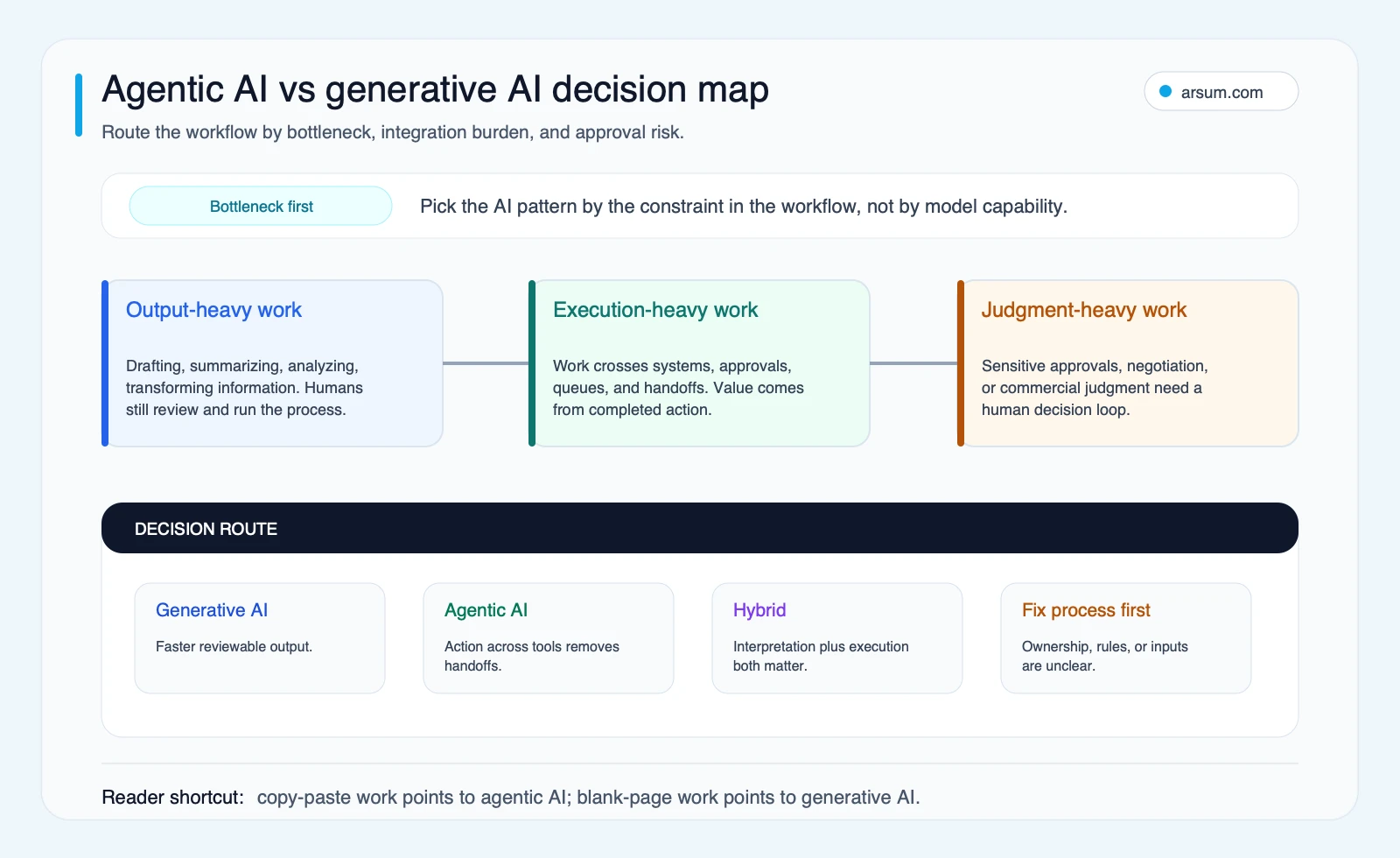
Use this map as a shortcut for matching the workflow bottleneck to the right AI pattern before you evaluate tools.
The best first project is rarely the flashiest. It is usually a workflow with enough volume to matter, enough structure to automate, and enough pain that the team will actually change how they work.
💡 Arsum builds custom AI automation solutions tailored to your business needs.
Get a Free Consultation →Where Generative AI Creates ROI
Generative AI creates ROI when it increases throughput without forcing a heavy operational redesign. The business case is strongest when output volume is high, review is already part of the process, and quality standards can be made explicit.
Good generative AI candidates:
- Sales teams that need faster account research, discovery summaries, and follow-up drafts
- Marketing teams producing campaign variants, briefs, landing page copy, and content outlines
- Support teams summarizing tickets and drafting responses from approved help-center content
- Founders and operators turning calls, notes, and messy ideas into structured memos or action plans
- Analysts converting source documents into summaries, tables, and first-pass recommendations
What changes operationally:
- Teams need approved prompts, source materials, tone rules, and review checkpoints
- Managers should measure cycle time, revision rate, and output acceptance rate
- The business still needs an owner for quality, compliance, and customer-facing approval
Where it usually fails:
- The team treats AI output as final when it should be reviewed
- The source material is outdated, contradictory, or spread across private docs
- No one defines what “good” means, so every user improvises
- Usage grows but the team never measures whether it reduced cycle time or improved conversion
Generative AI is a strong first move when you need leverage for human work. It is a weak substitute for workflow automation when the real cost is coordination after the draft exists.
Where Agentic AI Creates ROI
Agentic AI creates ROI when a process has repeatable steps, clear rules, enough volume, and costly manual handoffs. If a person spends hours checking systems, copying data, deciding the next task, and following up, that workflow deserves a closer look.
Good agentic AI candidates:
- Lead routing and enrichment across website forms, CRM, email, and sales engagement tools
- Customer onboarding where tasks must be created, assigned, checked, and escalated
- Finance operations where invoices, approvals, exceptions, and records move between systems
- Customer success workflows that monitor product usage, support tickets, renewals, and account risk
- Internal operations reporting that requires pulling data from multiple tools on a schedule
If your main goal is turning these ideas into production workflows, our agentic AI workflow automation guide goes deeper into implementation patterns.
What changes operationally:
- The workflow needs an owner, not just a tool buyer
- Inputs, permissions, escalation rules, and failure states must be mapped before build
- Humans move from doing every step to supervising outcomes and handling exceptions
- Metrics shift from “did people use the AI?” to “did cycle time, error rate, cost per task, or revenue leakage improve?”
Where it usually fails:
- The process is not standardized before automation starts
- Data access is incomplete, so the agent works from partial context
- The system can take actions but lacks clear approval thresholds
- No one monitors failed runs, edge cases, or silent quality drift
- The pilot solves a low-value task and never earns operational adoption
For practical implementations in different business contexts, see our collection of real-world AI agent examples. For how agents relate to broader autonomous systems, see AI agents vs agentic AI.
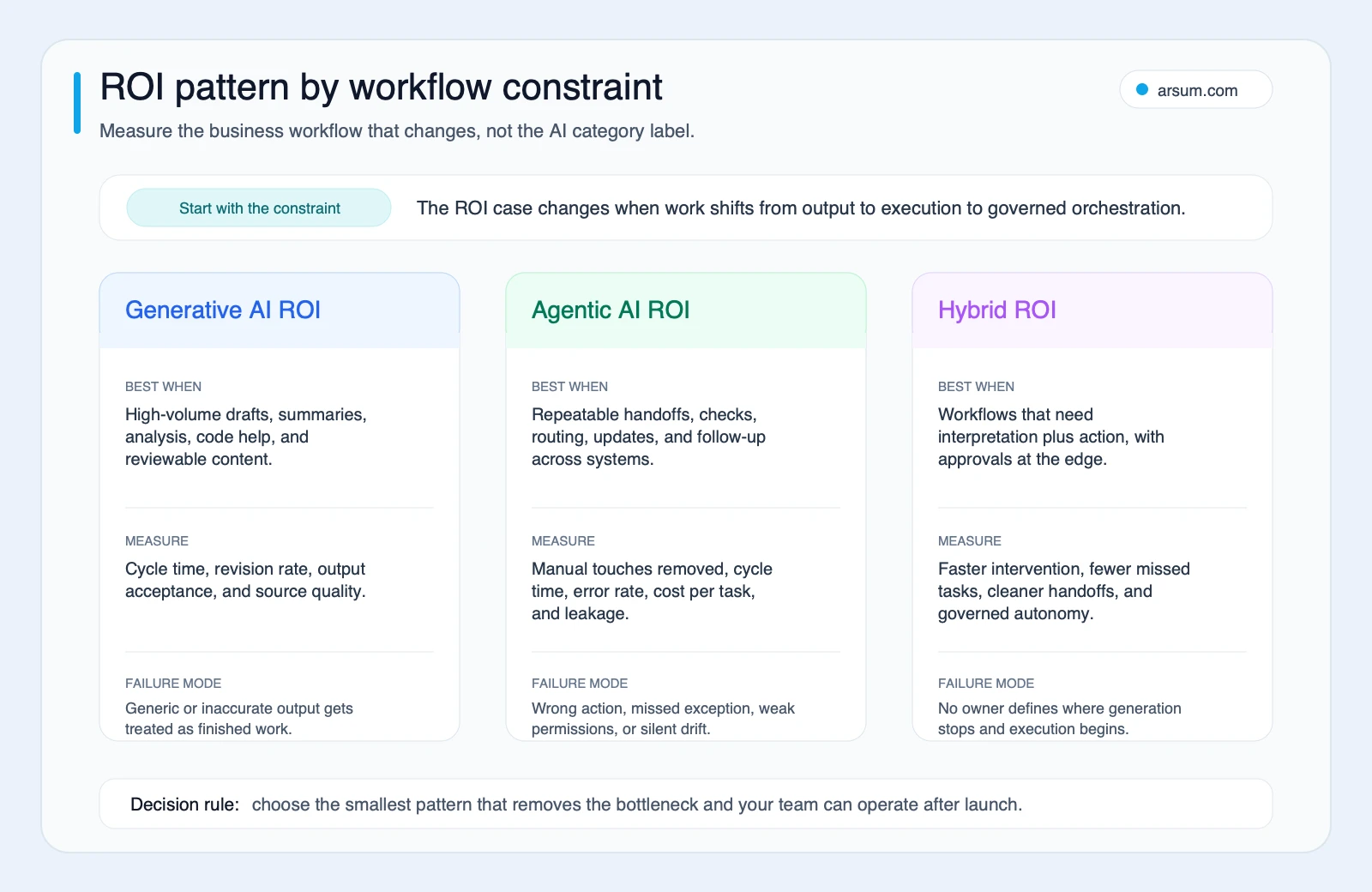
Use this map to keep the ROI conversation grounded in the workflow constraint, the metric that should move, and the failure mode your team must be able to operate.
Work With Arsum
We help businesses implement AI automation that actually works. Custom solutions, not cookie-cutter templates.
Learn more →Commodity vs Non-Commodity Breakdown
Not every layer of an AI workflow deserves agentic design.
Commodity work
These pieces are getting easier to buy, standardize, or swap:
- drafting and summarization
- extraction into known formats
- read-only retrieval and synthesis
- simple classification
- prompt-based first-pass analysis
If that is most of the job, a strong generative workflow is usually enough.
Non-commodity work
These pieces still create real implementation difference:
- permission design across business systems
- approval routing for risky actions
- exception handling and fallback logic
- state management across several steps
- audit trails, observability, and rollback
- clear definitions of done for the business process
That is where agentic AI earns its cost, and where weak governance becomes expensive fast.
Common Mistakes When Teams Call Something Agentic
The recurring mistakes in this category are predictable:
- Calling any chatbot with a tool an agentic system. Tool access alone is not meaningful autonomy.
- Skipping permission design. The danger is not only bad output. It is bad action.
- Using agents for stable workflows that already fit a deterministic path. A DAG or rule-based automation is often safer.
- Adding autonomy before rollback exists. If a wrong action cannot be reversed cleanly, the workflow is not ready.
- Measuring demo quality instead of recovery quality. Production systems need good failure behavior, not just good first impressions.
Hybrid Systems Usually Win in Real Workflows
The most useful business systems often combine both patterns. Generative AI handles interpretation and communication. Agentic AI handles orchestration and execution. Our deeper guide to generative AI vs agentic AI explains where that boundary matters in real architecture decisions.
Consider a customer success workflow for a B2B SaaS company:
- The agent monitors product usage, support tickets, CRM stage, contract dates, and payment status.
- It flags an account with declining usage and an upcoming renewal.
- Generative AI summarizes the risk, drafts a recommended outreach message, and explains the account context.
- The agent checks whether similar outreach already happened, creates a task, attaches the summary, and routes it to the right account owner.
- For low-risk cases, it can send an approved message automatically. For strategic accounts, it waits for human approval.
- It tracks whether the account owner responded, updates the CRM, and escalates if the task stalls.
That is not just content creation. It is an operating workflow with decision points, system updates, permissions, and accountability. The ROI should be measured in reduced churn risk, faster account intervention, fewer missed follow-ups, and less manual account monitoring.
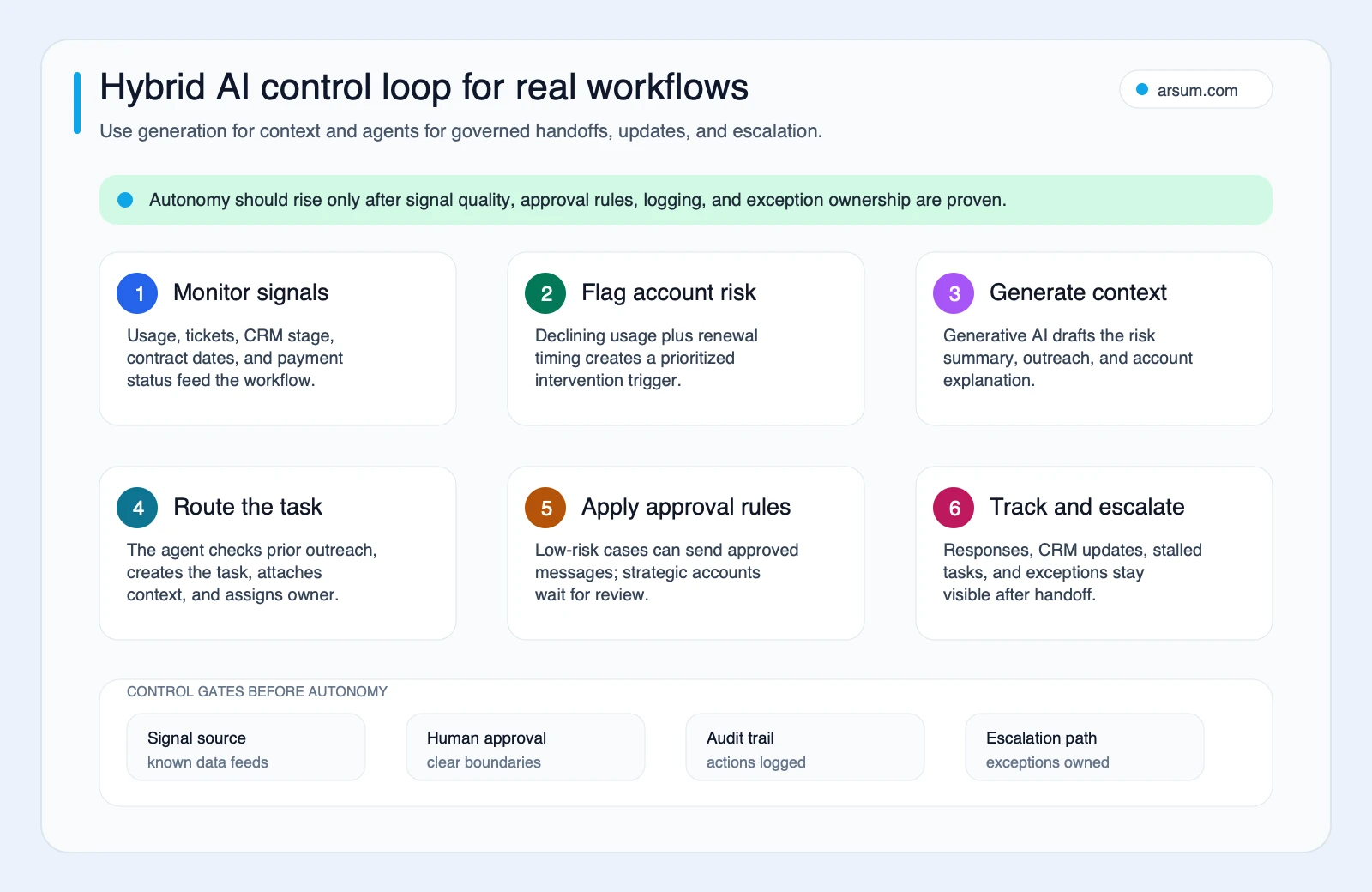
The hybrid pattern works when generation creates context and the agentic layer handles governed handoffs, approvals, updates, and escalation after the draft exists.
Build vs Buy vs Agency
The “right” implementation path depends on how close the workflow is to your competitive advantage and how much integration is required.
| Path | Best When | Tradeoff |
|---|---|---|
| Buy a product | The workflow is common, standardized, and already covered by a mature vendor | Faster launch, but less control over edge cases and data flow |
| Build internally | The workflow is core to your operating model and your team has AI, data, and integration capacity | More control, but slower and easier to under-resource |
| Work with an agency or implementation partner | The workflow is valuable but your team needs architecture, integration, or delivery support. Our guide to artificial intelligence services companies can help you compare delivery partners before you commit. | Faster expertise, but success depends on clear ownership and scope |
A practical rule: buy generic capabilities, customize business-specific workflows, and build only where the process creates strategic advantage or requires deep internal integration.
Selecting the right AI agent framework matters most when you are building custom or hybrid systems that need tool access, memory, permissions, evaluation, and observability.
Google Risk Box: Scaled Content and Thin Automation Risk
This topic attracts a lot of thin comparison content because it is easy to mass-produce pages that repeat the same vendor definitions.
The risk rises when a page:
- rephrases “generative creates, agentic acts” without helping the reader classify real workflows
- treats every tool-using assistant as an agentic system
- ignores permissions, auditability, and accountability
- adds AI terminology without showing what changes operationally after launch
For publishers scaling AI content, the safer editorial standard is the same standard buyers should use for the systems themselves: add original structure, clear boundaries, grounded evidence, and practical decision support that generic automation cannot fake.
Implementation Checklist
Use this checklist before funding an AI automation project:
- Name the business bottleneck. Is the problem revenue leakage, slow cycle time, high labor cost, inconsistent follow-up, poor reporting, or customer experience?
- Map the current workflow. Include systems touched, decisions made, approvals required, exception paths, and who owns each step.
- Quantify the baseline. Measure volume, time per task, error rate, rework, missed follow-ups, cost per task, or conversion impact.
- Choose the smallest valuable workflow. Avoid broad “AI transformation” projects. Pick one process where improvement can be proven.
- Set action boundaries. Define what the AI can do automatically, what needs review, and what must always escalate.
- Instrument the workflow. Log actions, confidence, failures, handoffs, approvals, and outcomes.
- Decide the operating model. Assign a process owner, technical owner, exception owner, and business metric owner.
This is where many projects become real or fall apart. The technology is rarely the only blocker. More often, the business has not clarified the workflow, permissions, data quality, or success metric.
Common Questions About Generative vs Agentic AI
Which is more expensive to implement?
Generative AI is usually cheaper to pilot because it needs less integration. A team can start with approved tools, prompts, source materials, and review rules.
Agentic AI usually costs more upfront because it requires workflow mapping, system access, permissions, testing, monitoring, and exception handling. The ROI can be stronger when it replaces high-volume manual coordination, but it needs a real business case before build.
Can agentic AI replace human workers?
In most B2B operating environments, agentic AI is better understood as task automation than job replacement. It can take over repeatable handoffs, checks, updates, and routing. People still need to own judgment, exceptions, customer relationships, negotiation, and accountability.
The better design question is: which parts of the workflow should be automated, which should be recommended, and which should stay human-approved?
How long does implementation take?
Generative AI can produce useful pilots in days or weeks when the use case is narrow. Examples include call summaries, support drafts, proposal outlines, research briefs, or internal knowledge answers.
Agentic AI pilots often take 4-12 weeks when they touch live systems, need approvals, and require monitoring. Broader rollouts take longer because they involve data access, security review, workflow redesign, and change management.
Do I need both?
Not always. Start with the bottleneck:
- If the constraint is drafting, summarizing, or analysis, start with generative AI.
- If the constraint is execution across systems, start with agentic AI.
- If the workflow needs both interpretation and action, design a hybrid system from the beginning.
What’s the learning curve for teams?
Generative AI has a low barrier for basic use, but teams still need prompt patterns, source-of-truth rules, and review standards.
Agentic AI requires a deeper operational shift. Teams need to understand what the system is allowed to do, how to monitor it, how exceptions are handled, and when humans must intervene.
The Future is Integration, Not Competition
The line between agentic and generative AI is blurring. Modern AI platforms increasingly support tool use, planning, retrieval, structured outputs, and workflow automation. OpenAI, Google, Microsoft, Anthropic, and other providers are all moving toward systems that combine reasoning, generation, and action. Our future of agentic AI guide explains where that platform shift is heading, and Google’s Vertex AI Agent Builder is one example of this broader direction.
For buyers, the distinction still matters because implementation risk lives in the workflow. A model that writes a strong answer is not the same as a governed system that takes the right action in your business environment.
The winning approach is to start with the operating problem, not the AI category. Define the bottleneck, quantify the value, choose the minimum viable workflow, and build the governance needed for the system to earn more autonomy over time.
Methodology Note
This article was updated using a mix of official product and governance sources, current comparison pages, and qualitative practitioner discussions.
What was verified directly:
- vendor and platform definitions from IBM, Red Hat, and Databricks
- the governance claim that autonomy raises the need for permissions, auditability, and accountability
- the broad implementation distinction between output generation and multi-step tool-based execution
What was treated as qualitative signal:
- practitioner skepticism from public discussions about autonomy, governance, and whether orchestration is justified for simple workflows
That qualitative layer is useful for understanding buyer objections, but it is not presented here as benchmark data.
Next Steps
If you are evaluating AI automation for revenue, operations, or workflow efficiency, start with one process and answer five questions:
- What measurable business problem does this workflow create today?
- Is the bottleneck content, judgment, coordination, or execution?
- What systems, approvals, and exception paths are involved?
- What would need to change operationally after implementation?
- What metric would prove the project worked?
That exercise will usually tell you whether you need generative AI, agentic AI, a hybrid workflow, or a process fix before any AI investment.
Ready to Automate Your Business?
Stop wasting time on repetitive tasks. Let AI handle the busywork while you focus on growth.
Schedule a Free Strategy Call →Written by:Arsum editorial team
- Reviewed by
- Arsum editorial team
- Published
- February 10, 2026
- Updated
- August 12, 2026
- How this was produced
- Arsum uses research packs, source checks, and human editorial review to prepare and update blog articles. Editors are responsible for the final page.
- Source policy
- Sources are linked in the article when used. Methodology and source notes are included on higher-risk or high-visibility pages and are being rolled out across the archive. Editorial policy.
- Why this page exists
- Help B2B operators evaluate AI automation, implementation scope, cost, risk, and build-vs-buy decisions with practical context.