Agentic SEO is a governed SEO workflow in which an AI system can use connected tools to inspect data, choose bounded next steps, prepare changes, and—in tightly controlled cases—execute approved updates; it is not simply AI-generated content or a shortcut to rankings.
Agentic SEO: Practical Guide
Explore agentic seo: compare workflow fit, costs, risks, evidence, and practical next steps before you build, buy, or hire.

Table of Contents
- What most guides miss: autonomy is a permission decision
- Generative SEO, assistant-led SEO, and agentic SEO
- A concrete refresh workflow: from data to a reversible change
- A pilot scorecard for agentic SEO
- The internal autonomy-scoping framework
- Build, buy, or connect existing tools
- Publishing safeguards and the pre-publish control matrix
- Red lines and disqualifying conditions
- A practical starting decision
The practical decision is whether a workflow has enough repeatability, evidence, review capacity, and reversibility to deserve more autonomy. For most teams, the first valuable use is not autonomous publishing. It is a controlled loop that turns trusted performance and content data into a reviewed change queue.
What most guides miss: autonomy is a permission decision
Many pages blur together AI writing, SEO automation, agentic SEO, and visibility in AI answer experiences. They solve different problems.
- AI content generation produces drafts, outlines, summaries, or rewrites from instructions.
- An assistant-led SEO workflow can pull approved data, organize it, and recommend changes for a person to decide.
- Agentic SEO can plan across connected systems and take bounded actions toward a goal, subject to tool permissions and controls.
- Agentic search visibility concerns whether content is surfaced in answer products or AI-powered search experiences. It is not the same as automating your SEO operations.
Google Cloud describes agentic systems as goal-directed systems that can reason, plan, and use tools; that technical capability does not authorize every business action. Google Cloud’s architecture guidance is useful here because it frames agents as a system design problem, not a writing feature.
The decision rule is simple: give an SEO workflow only the autonomy that its evidence, approval path, and rollback path can support. If a bad change would be expensive, difficult to detect, or difficult to reverse, keep the workflow in recommendation mode.
For related operating models, see AI workflow automation, agentic AI versus generative AI, and this broader AI for SEO guide.
Generative SEO, assistant-led SEO, and agentic SEO
| Model | Typical action | Connected systems | Human role | Appropriate use | Primary failure mode |
|---|---|---|---|---|---|
| Generative SEO | Drafts or restructures content | Usually none or limited reference material | Editor controls next steps | Briefs, outlines, first drafts, rewrite options | Generic or unsupported content |
| Assistant-led SEO | Reads approved data and proposes a change | Search Console, crawl exports, content inventory, CMS preview | Reviewer approves each recommendation and diff | Refresh queues, technical triage, internal-link suggestions | Recommendation is mistaken for validated judgment |
| Agentic SEO | Selects candidates, coordinates tools, prepares or executes scoped actions | Approved read and write integrations | Owner sets policy, reviews exceptions, audits results | Repeatable, governed operations at meaningful volume | Low-value or unsafe changes spread at scale |
The important dividing line is not whether the model can write a title tag. It is whether the system can decide what to inspect, access live systems, and act without a human choosing every next step.
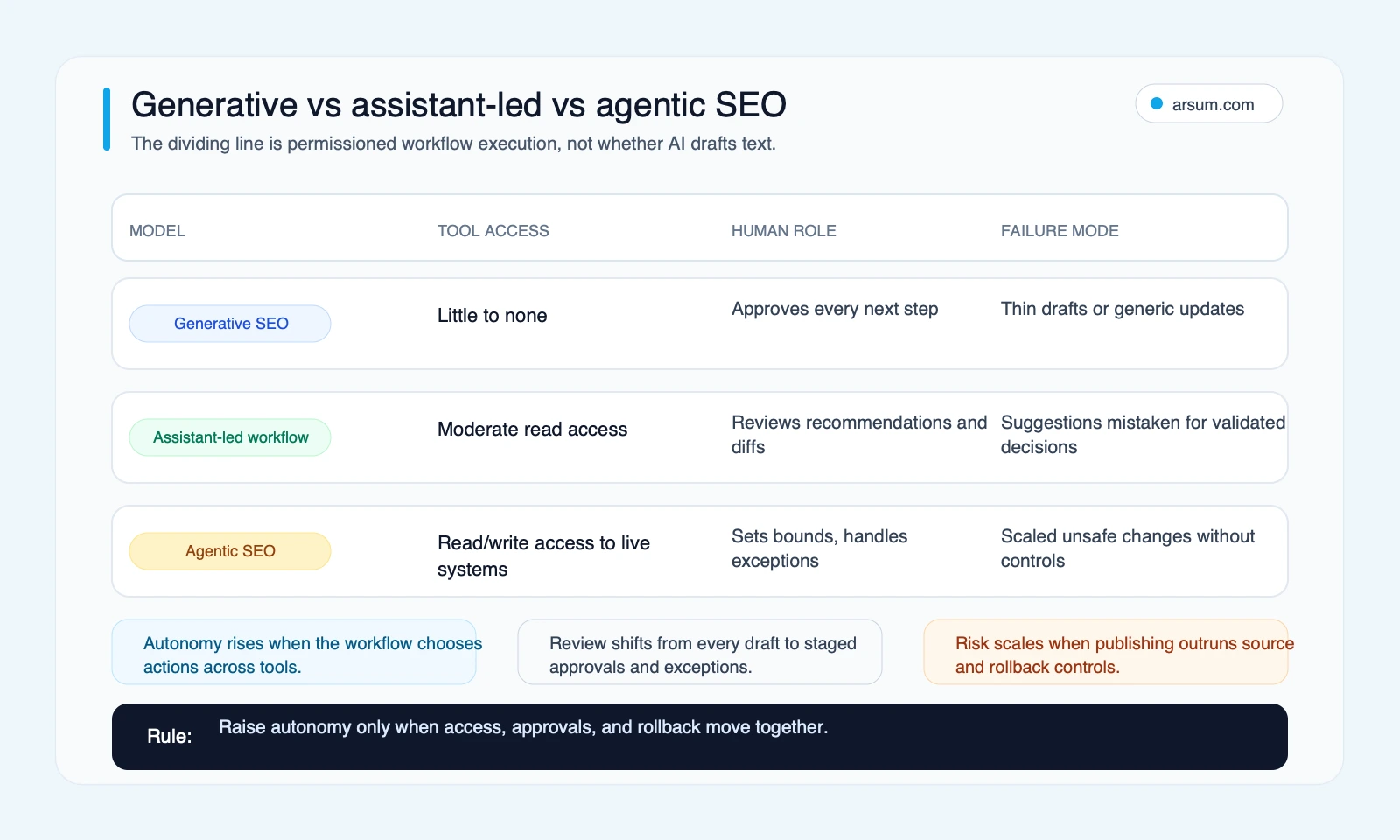
A content team that asks an AI for ten title options is using drafting assistance. A workflow that reads a defined Search Console export, identifies pages inside a stated eligibility rule, gathers approved source material, produces a tracked CMS diff, routes exceptions to an editor, and measures the approved batch is operating much closer to agentic SEO.
A concrete refresh workflow: from data to a reversible change
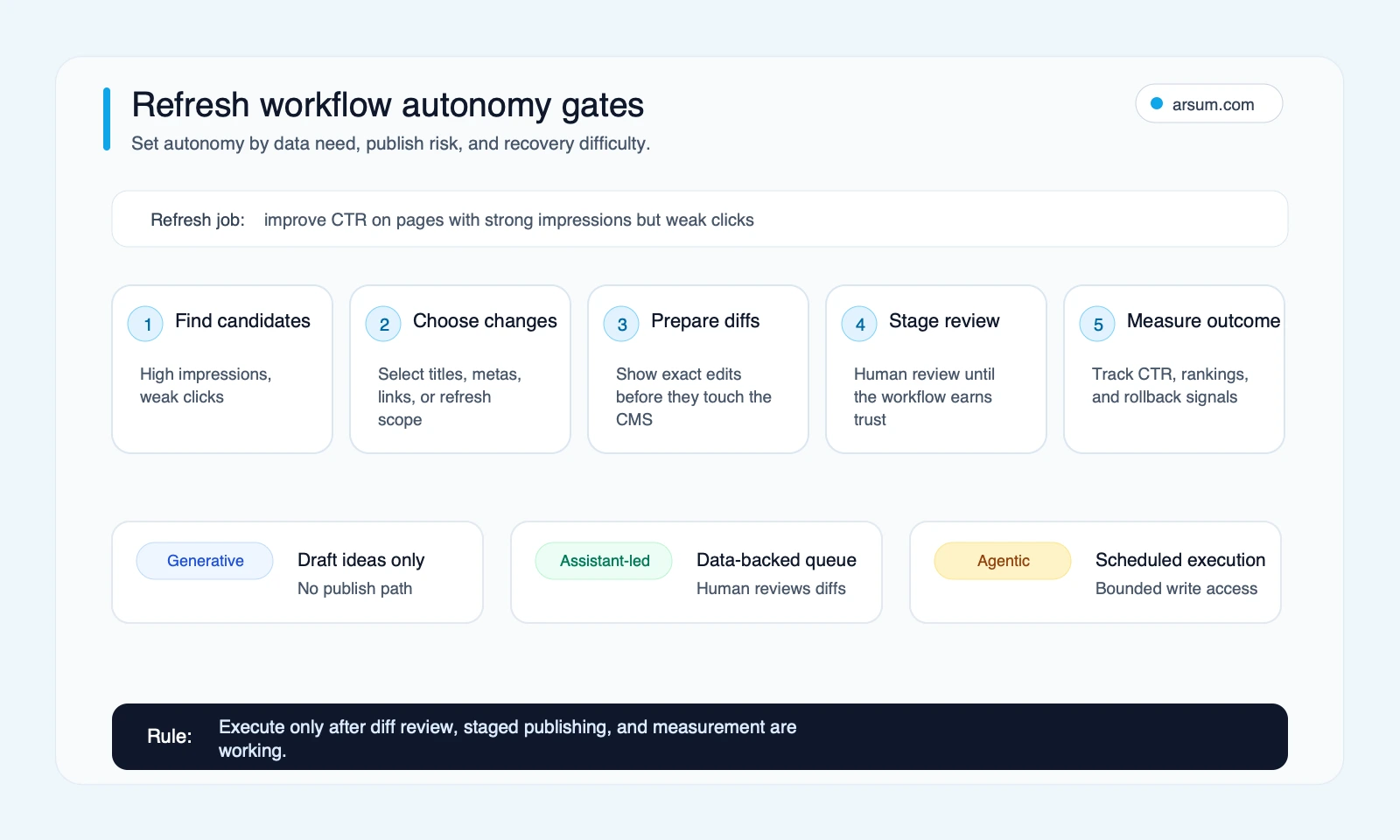
Consider a narrow objective: improve search snippets on existing informational pages that receive impressions but underperform on click-through rate.
This is a useful pilot because it has a defined inventory, a measurable baseline, an editor-visible output, and a rollback path. It is not a promise that changing metadata will improve rankings or clicks.
Inputs and candidate-selection rules
Give the workflow read-only access to an approved Search Console export, the current page metadata, the content inventory, and a crawl or CMS preview. Do not begin with unrestricted credentials.
Set candidate rules before the agent runs. For example:
- Pages must be informational articles in the selected content group.
- Pages must have enough recent impressions for the team to treat the baseline as directionally useful.
- The workflow must exclude pages with active campaigns, legal review, major brand messaging, or recent manual changes.
- The workflow must identify the query and page evidence used for each recommendation.
- The workflow must not treat a CTR gap as proof that a title rewrite is the right answer; it must present the reason and confidence for review.
Those are planning rules, not universal thresholds. A site with low search volume may need a longer observation window; a regulated publisher may need more exclusions and a stricter evidence standard.
The normal path
- The workflow reads only the scoped exports and current page fields.
- It selects candidates that meet the agreed rules and records why each page entered the queue.
- It compares the existing title, meta description, heading structure, and page intent against the approved evidence pack.
- It creates a proposed diff rather than publishing directly.
- It attaches the evidence used, flags unsupported factual claims, and labels any assumption.
- The content editor reviews the diff; the SEO owner reviews prioritization and measurement readiness.
- The CMS publishes only approved changes in the permitted batch.
- The workflow records the published version, timestamp, approver, source references, and rollback location.
- The owner reviews results on the agreed cadence and decides whether to expand, revise, or stop.
This design follows the practical components highlighted in the OpenAI Agents guide: tools, orchestration, handoffs, guardrails, human review, integrations, state, and observability all need explicit ownership.
Exceptions and escalation
A credible workflow has an ugly path, not only a happy path. Route the item to a human instead of proceeding when:
- the source data conflicts or is incomplete;
- the proposed copy introduces a claim without a source;
- the page is policy-sensitive, YMYL-adjacent, brand-defining, or legally reviewed;
- the recommended change differs materially from the established page intent;
- the agent detects a template-level issue that could affect pages outside the pilot;
- the CMS diff cannot be generated or validated.
The exception queue should include the page URL, proposed action, evidence, reason for escalation, assigned reviewer, and final disposition. “Agent failed” is not an adequate audit record.
Approval, audit record, and rollback
For a metadata-refresh pilot, the SEO lead owns scope and measurement; the managing editor owns content approval; the CMS or web owner owns rollback access. No one role should be assumed to own all three simply because the workflow is automated.
Each completed change should retain:
- candidate-selection evidence;
- generated and approved diffs;
- source references and policy flags;
- prompt, template, or workflow version;
- approver and publication timestamp;
- batch identifier;
- post-change observation record;
- rollback owner and restoration method.
A rollback should restore the previous version from the CMS revision history or a captured pre-publish record. Test this on one page before the first batch. A rollback path that has never been exercised is only a hopeful assumption.
💡 Arsum builds custom AI automation solutions tailored to your business needs.
Get a Free Consultation →A pilot scorecard for agentic SEO
Use a scorecard before approving a larger rollout. The values below are illustrative planning assumptions, not observed results or universal benchmarks. Replace them with your own baseline and approved limits.
| Field | Pilot definition | Owner | Go / no-go rule |
|---|---|---|---|
| Scope | One content group; a small, pre-approved set of eligible refresh pages | SEO lead | No out-of-scope URLs added |
| Baseline | Record impressions, CTR, query mix, current metadata, and page version before changes | SEO analyst | Baseline is retained for every candidate |
| Target | Define the operational outcome, such as a complete reviewed queue or reduced manual preparation time | SEO lead | Target is measurable before launch |
| Maximum batch size | Start with a deliberately small batch | Managing editor | No batch expansion until review and rollback checks pass |
| Editorial review time | Track time to accept, edit, reject, or escalate each proposal | Managing editor | Review burden does not increase beyond the agreed limit |
| Source-evidence pass rate | Percentage of proposals with traceable, relevant evidence | Editor | Any missing evidence blocks publication |
| Exception rate | Percentage of proposals requiring human escalation | SEO lead | A rising rate triggers scope review |
| Error threshold | Unsupported claims, wrong-page edits, broken markup, or policy flags | SEO and web owner | Material error stops the batch |
| Rollback test | Restore one approved page to its pre-pilot state | CMS owner | Failure means no further publishing |
| Observation cadence | Review the batch on a fixed schedule after publication | SEO lead | No expansion before the review is complete |
The scorecard separates workflow quality from search outcomes. Search impressions and CTR should be observed, but the pilot should not declare causation from a small batch or a short window. External changes, query mix, seasonality, indexing, and competitors can all affect performance.
A sensible expansion rule might be: increase scope only after the team can show complete evidence attachment, successful diff review, tested rollback, acceptable editorial burden, and no material publishing or policy failures. A stop rule might be: pause immediately if the system publishes an unsupported claim, alters an excluded page, loses a prior version, or creates a recurring exception pattern the team cannot resolve.
The internal autonomy-scoping framework
This is an internal scoping framework, not a dataset or a prediction of operational results. Its purpose is to make the conditions for additional write access explicit.
- Level 1: draft and summarize. A human supplies the task and decides every action. Progress only when output can be reviewed against a defined source standard.
- Level 2: retrieve and recommend. The assistant reads approved systems and proposes changes. Progress only when every recommendation has attached evidence and a visible diff.
- Level 3: select candidates and prepare work. The agent applies pre-set eligibility rules and creates change packages. Progress only when exceptions are reliably routed and batch scope is enforced.
- Level 4: execute bounded, approved changes. The agent writes only within a defined action type after policy checks and human approval. Progress only after rollback has been tested and audit records are complete.
- Level 5: recurring low-risk execution. The agent handles a narrow recurring update with monitoring and an owner on call. Use this only where the action is reversible, the failure cost is low, and the system can halt safely.
The criteria matter more than the level label. A technically advanced agent does not belong at Level 4 or 5 if your team cannot review its changes, identify affected pages, or restore a prior state quickly.
Build, buy, or connect existing tools
For the refresh workflow above, the implementation choice should follow the control gap—not excitement about agents.
Buy a platform when the workflow is standard
Buy when you need common capabilities such as content inventory analysis, crawl diagnostics, task queues, CMS approval flows, and reporting, and the vendor can demonstrate the required permissions, logs, exports, and data handling.
Verify:
- whether the platform can limit read and write scope by site, content group, and action;
- whether it produces exportable diffs and audit logs;
- whether approval is enforced or merely optional;
- whether prompt, template, and automation changes are versioned;
- whether you can stop jobs and restore changes without vendor intervention.
Buying is weak when the platform’s “autopilot” model cannot fit your editorial standards or existing release process.
Connect existing tools when your systems already hold the truth
Connect existing Search Console reporting, crawler exports, content inventory, CMS preview, ticketing, and editorial review systems when the primary need is orchestration. This can be the fastest way to test whether the workflow is valuable without replacing the tools your team already trusts.
The control risk is brittle integration: an ambiguous field mapping, stale export, or overbroad CMS token can turn a narrow workflow into a wide publishing risk. Start read-only, use a staging or preview environment where available, and make the integration fail closed when required evidence is absent.
For implementation patterns, see AI agent architecture patterns, AI agent security, and AI integration consulting.
Build a narrow workflow when your rules are distinctive
Build when your candidate-selection logic, source policy, approval route, proprietary taxonomy, or CMS workflow is a real operating advantage that generic software cannot represent. A custom build is justified by repeatable control requirements—not by a desire to automate every SEO task.
The first build should be narrow: one objective, a small set of trusted inputs, one change type, named owners, and tested rollback. A broad multi-agent “SEO operating system” before the team has proven one governed loop is usually an expensive way to learn basic process requirements.
Publishing safeguards and the pre-publish control matrix
Google’s spam policies state that scaled content abuse can include generating many pages primarily to manipulate rankings rather than help users, regardless of how the content is created. That makes control design part of search quality, not merely internal compliance.
Google’s guidance on AI features and your website likewise points site owners back to useful, eligible content and standard technical practices rather than shortcuts for AI search surfaces.
Before an agent can publish, require this matrix for every change type:
| Control | Required evidence | Owner |
|---|---|---|
| Source evidence attached | Relevant Search Console, crawl, source-note, or page evidence is linked | SEO analyst or editor |
| User-value hypothesis | The proposed change addresses a specific intent, gap, or stale element | SEO lead |
| Diff review | The exact content and metadata change is visible before publication | Managing editor |
| Policy-sensitive claims flagged | Sensitive claims are routed to the appropriate reviewer | Editor or risk owner |
| Write scope enforced | The workflow can touch only approved fields and approved URLs | Web or CMS owner |
| Version control | Prompt, rules, templates, and integration versions are recorded | Workflow owner |
| Rollback known | The restoration method and responsible owner are named | CMS owner |
| Measurement plan | Baseline and review cadence exist before publication | SEO lead |
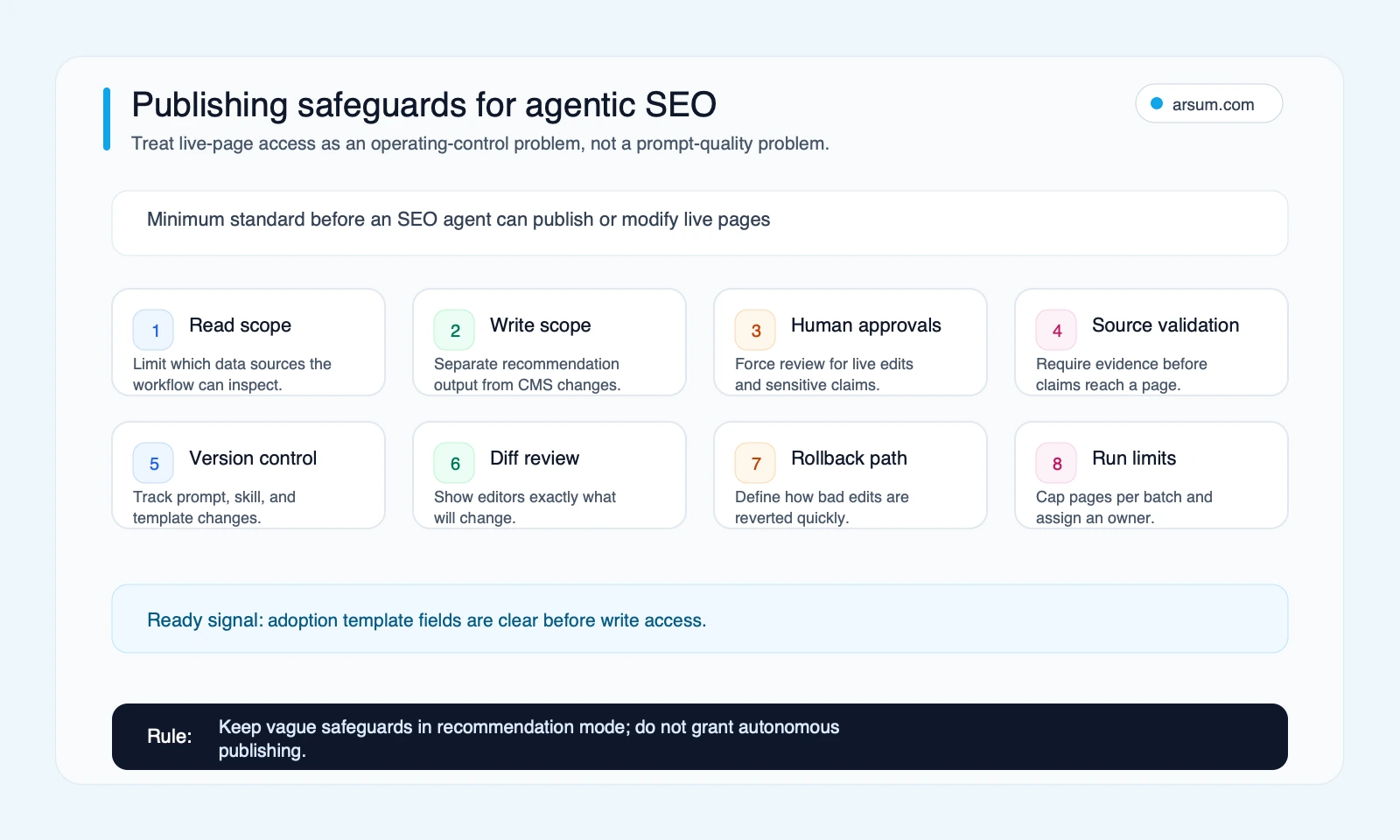
Guardrails need testing at the integration boundary, not just in model prompts. The OpenAI guardrails documentation notes that guardrails and handoffs do not necessarily govern every action path in the same way. In operational terms: test the actual tool call, exception route, permission failure, and human handoff you rely on.
Red lines and disqualifying conditions
Do not authorize autonomous publishing for these conditions:
- The workflow’s primary purpose is mass production to manipulate rankings rather than improve a defined user need.
- It can fabricate citations, claims, expert opinions, screenshots, or performance evidence.
- It can edit brand-defining, legal, financial, health, or otherwise high-consequence pages without the required owner.
- The team cannot show a pre-publish diff, evidence attachment, version history, and rollback path.
- A single prompt, template, or connector update can change a broad page set without staged release controls.
- The workflow has no named person accountable for incidents and no exception queue.
Community discussions about agentic SEO frequently raise concerns about low-value output, manipulative automation, and immature all-in-one tooling. Those are qualitative signals, not market-wide performance evidence: one discussion about replacement claims, a discussion about unified tooling, and a discussion about answer-engine visibility are useful as buyer language, not proof that any approach works.
A practical starting decision
Choose generative SEO when you need better drafting. Choose an assistant-led workflow when you need trusted data and reviewer-controlled recommendations. Choose agentic SEO only when the workflow can apply explicit selection rules, produce auditable diffs, handle exceptions, stay within narrow permissions, and recover from a bad release.
The first question is not “how much can we automate?” It is “which specific SEO action can we automate without lowering the evidence, editorial, and change-control standards that make the page worth publishing?”
Ready to Automate Your Business?
Stop wasting time on repetitive tasks. Let AI handle the busywork while you focus on growth.
Schedule a Free Strategy Call →Written by:Arsum editorial team
- Reviewed by
- Arsum editorial team
- Published
- February 12, 2026
- Updated
- August 12, 2026
- How this was produced
- Arsum uses research packs, source checks, and human editorial review to prepare and update blog articles. Editors are responsible for the final page.
- Source policy
- Sources are linked in the article when used. Methodology and source notes are included on higher-risk or high-visibility pages and are being rolled out across the archive. Editorial policy.
- Why this page exists
- Help B2B operators evaluate AI automation, implementation scope, cost, risk, and build-vs-buy decisions with practical context.