Most buyers considering agile software development consulting are not choosing a methodology; they are choosing between process coaching, engineering remediation, and a partner that can take delivery responsibility. Choose consulting when the constraint is decision-making or team operating practice, choose an engineering audit or delivery partner when the constraint is release reliability or build capacity, and do not sign until ownership, security, maintenance, and backlog trade-offs are explicit.
Agile Software Development Consulting Decision Guide
Explore agile software development consulting: compare workflow fit, costs, risks, evidence, and practical next steps before you build, buy, or hire.

Table of Contents
- What Most Guides Miss: Agile Is Also a Commercial and Ownership Model
- Diagnose the Constraint Before Selecting an Engagement
- Compare Engagement Models by Accountability, Not Labels
- Make the Contract Agile Without Making It Vague
- Use a Pilot Scorecard Instead of Buying a Transformation Story
- Failure Modes and Disqualifying Conditions
- Pre-Signing Checklist
- A Note on Useful, Durable Deliverables
- Methodology and Limits
- The Buyer’s Starting Point
What Most Guides Miss: Agile Is Also a Commercial and Ownership Model
The Agile Manifesto values customer collaboration over contract negotiation and responding to change over following a plan. That does not mean accepting an open-ended engagement. It means the contract must state what remains fixed and how the team will make trade-offs when it learns something new.
Many proposals describe stand-ups, sprint reviews, and retrospectives in detail while leaving the controls that matter unanswered:
- Who can change backlog order?
- Who decides whether a new request replaces planned work or needs new funding?
- Who approves a production release?
- Who owns a security exception or incident during the engagement?
- Who maintains the system once consultants leave?
Those are delivery controls, not administrative details. If they are unresolved, more ceremonies can expose ambiguity without resolving it.
Practitioner discussions surfaced in search results point to the same tension: fixed price, fixed scope, and fixed dates can conflict with adaptive delivery when requirements change. These are qualitative, snippet-level signals—not prevalence data—but they are useful prompts for testing contract mechanics. See the related Reddit discussion on agile contracts and Hacker News discussion.
The decision is not “Do we need agile?” It is: “What constraint is slowing delivery, and which party will own the work required to remove it?”
Diagnose the Constraint Before Selecting an Engagement
Agile consulting can be valuable, but it is not a substitute for product ownership, secure engineering practices, or enough people to build. Start with the observable constraint rather than the vendor category.
| Observable situation | Constraint to investigate | Suitable first engagement |
|---|---|---|
| Priorities change without a clear decision-maker | Product ownership or portfolio governance | Product operating-model review or agile coaching |
| Planning is chaotic but releases and engineering controls are otherwise sound | Team workflow and collaboration | Agile coaching |
| Releases are delayed by manual steps, unstable environments, or unclear approvals | Engineering and release-system design | Engineering audit or embedded delivery consulting |
| Product, engineering, risk, and leadership cannot resolve cross-team trade-offs | Organizational decision rights | Transformation consulting |
| The roadmap is credible but delivery capacity is missing | Execution capacity | Delivery partner or targeted augmentation |
| No one can explain who maintains the product after launch | Long-term operating-model gap | Pause and define support ownership |
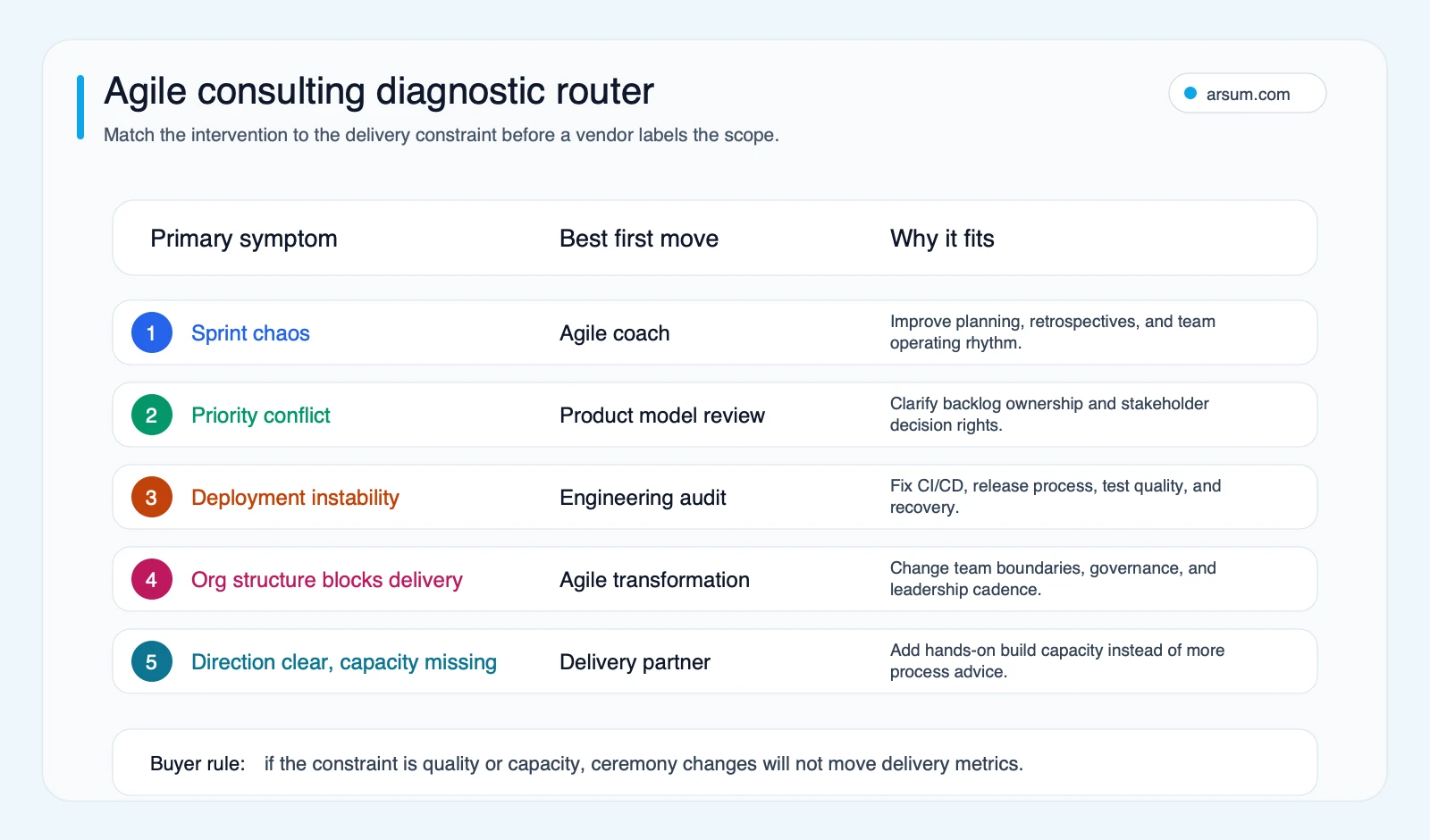
A useful diagnostic distinguishes a symptom from a cause. “Sprints slip” may mean priorities keep changing, dependencies are unmanaged, environments are unreliable, the backlog is unclear, or the team lacks capacity. Those conditions need different interventions.
For a product that also depends on AI-enabled workflows, make the distinction sharper. A working prototype does not settle whether it should access production systems, make decisions without approval, or handle exceptions. The operating controls described in AI workflow automation—defined inputs, review steps, auditability, exception handling, and rollback—are also useful controls for a software delivery engagement.
Decision branches that should change the contract
If the work is regulated or security-sensitive: begin with an engineering and assurance assessment, not a ceremony redesign. Require a named security approver, threat-modeling responsibility, release approvals, access controls, incident process, and evidence-retention plan. The OWASP Software Assurance Maturity Model is useful because it frames assurance across governance, design, implementation, verification, and operations.
If releases are unstable or recovery is painful: require a release and incident evidence baseline. Coaching may still help coordination, but the engagement needs engineering ownership for build, test, deployment, monitoring, and rollback.
If backlog decisions are the bottleneck: use coaching or product-operating-model work only if an internal leader can own prioritization. A consultant can facilitate decisions; they should not become the permanent substitute for an accountable product owner.
If delivery is blocked by capacity: evaluate a hands-on partner. Review technical ownership, code review practices, security controls, documentation, and maintenance arrangements alongside the agile process.
If nobody can own maintenance: do not proceed to build or transformation work until the agreement names a post-launch owner and support boundary. A launch without that agreement transfers the delivery problem into operations.
Compare Engagement Models by Accountability, Not Labels
“Agile consultant” is a broad label. Scrum Alliance’s consulting overview describes support ranging from collaboration and prioritization to delivery improvement and transformation. Compare proposals by the accountability they create.
| Engagement model | Best suited to address | Backlog decision rights | Engineering and release responsibility | Security and operations | Handoff risk |
|---|---|---|---|---|---|
| Workshop-only coaching | Shared language, team rituals, a limited process problem | Client-owned | Client-owned | Client-owned | High if no internal owner changes behavior |
| Ongoing agile coaching | Planning, retrospectives, backlog hygiene, collaboration | Client-owned; coach facilitates | Usually advisory | Usually advisory | Moderate; confirm capability transfer |
| Transformation consulting | Cross-team governance and operating-model issues | Leadership retains decision rights | Often shared with internal engineering leaders | Internal owner must be named | Moderate to high if changes are not adopted |
| Embedded delivery consulting | Workflow, architecture, release, and execution constraints | Shared through written rules | Partner and client allocate responsibilities | Shared through approvals and escalation | Moderate if handoff is planned early |
| Full delivery partner | Material execution gap and defined product outcome | Client product owner plus agreed partner authority | Partner-led within agreed controls | Contractually assigned and auditable | Lower only when maintenance transfer is real |
An outcome-driven proposal does not need to promise a universal improvement rate. It should identify:
- The baseline it will measure.
- The target or decision threshold.
- The owner for each change.
- The review point.
- The stop condition.
- The safe next step or rollback path.
This applies beyond agile delivery. Buyers comparing application development consulting or AI implementation services should ask the same question: can the partner connect its activities to a controlled operating change, rather than only a list of workshops or deliverables?
Make the Contract Agile Without Making It Vague
A fixed budget can coexist with a flexible backlog. Conflict arises when budget, scope, timeline, and solution design are all treated as immovable while the team is expected to learn during delivery.
A practical phase agreement can make these items fixed:
- Approved budget or spend cap.
- Decision and demonstration cadence.
- Named product owner and executive escalation path.
- Release-readiness definition.
- Security, privacy, and operational requirements.
- Evidence required at each review.
- Support and maintenance boundary.
It can keep these items governed but flexible:
- Backlog order.
- Lower-priority work that may be removed to protect the cap.
- Technical implementation choices discovered through delivery.
- Sequence of handoff activities.
- Changes requiring an explicit budget, risk, or timeline decision.
The key artifact is a change rule. For example: new work enters the backlog with its expected effect on budget, delivery sequence, risk, and displaced work; the named product owner accepts, defers, or swaps it at the agreed review. That is more useful than a generic promise to “be agile.”
Required artifacts for security-sensitive work
For work involving customer data, production access, regulated activity, or consequential system changes, require these before implementation begins:
- A threat-modeling owner and review record.
- Repository, code-review, and branch-protection ownership.
- Environment and access-management rules, including access revocation.
- Test, vulnerability-remediation, and dependency-management responsibilities.
- Release approver and rollback authority.
- Monitoring and incident-runbook ownership.
- Support commitments and escalation contacts after handoff.
These are buyer-verifiable artifacts. They reflect lifecycle-oriented assurance concerns in OWASP SAMM; they are not a certification claim about a delivery partner.
Use a Pilot Scorecard Instead of Buying a Transformation Story
When the problem is uncertain or the engagement is substantial, use a bounded pilot or diagnostic phase. Its purpose is not to manufacture a result by a universal deadline. Its purpose is to gather enough evidence to choose coaching, remediation, a delivery partnership, or no engagement.
The following is an illustrative planning scorecard. Fill it with your own baseline; none of the values are industry benchmarks.
| Area | Baseline to capture | Target or decision criterion | Accountable role | Review cadence | Stop condition | Rollback or next path |
|---|---|---|---|---|---|---|
| Release evidence | Current release steps, approvals, and deployment records | Release path is documented and demonstrably executable | Engineering lead | Weekly | No credible owner or unsafe release path | Retain current controls; commission engineering audit |
| Backlog decisions | Who prioritizes and how often decisions reverse | Named product owner makes trade-offs through a decision log | Product lead | Each demo/review | Decisions remain unowned | Pause delivery scope; resolve governance |
| Quality and exceptions | Test evidence, escaped defects, rollback records, incident notes | Defined quality gate and exception process exist | Engineering lead | Weekly | Exceptions cannot be reviewed or traced | Keep human approval; reduce scope |
| Security approvals | Access inventory and current approval route | Security owner and release approvals are explicit | Security or risk owner | Design and release gates | No approval authority or required evidence | Do not deploy; remediate controls |
| Capability transfer | Critical tasks only the partner can perform | Internal owner can operate agreed runbooks and repositories | Client technical sponsor | Each handoff gate | Client cannot assume ownership | Extend handoff deliberately or choose managed support |
| Contract reprioritization | Current change-request path | Work can be swapped or deferred through written decision rights | Product sponsor | Review cadence | Changes silently expand scope | Rebaseline phase or stop |
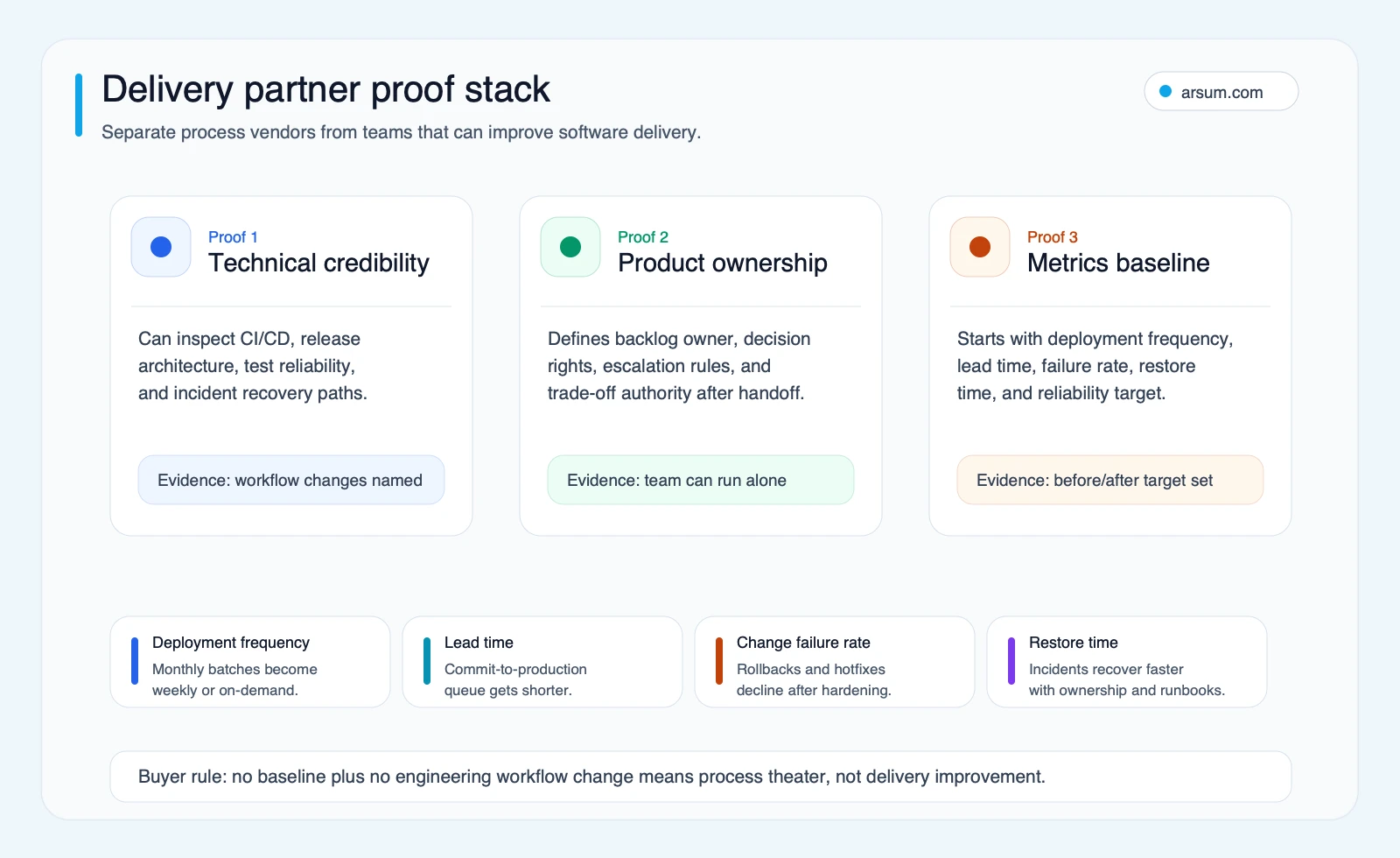
Use a consistent delivery-metric set where it helps the diagnosis. The common DORA-style measures are deployment frequency, lead time for changes, change failure rate, and time to restore service. They are operational signals, not proof that a consultant caused a business result. Before comparing periods, agree on what counts as a deployment, failed change, and restoration.
Also track the measure the engagement directly affects. A backlog-ownership engagement may first be judged on decision latency and evidence of prioritized work. A release-engineering engagement may focus first on release-path evidence and incident readiness. Do not make attendance, training completion, or meeting volume the sole definition of success.
Work With Arsum
We help businesses implement AI automation that actually works. Custom solutions, not cookie-cutter templates.
Learn more →If you need an external view before committing, a useful scoped assessment should produce four things: a constraint map, an evidence baseline, an ownership matrix, and an engagement recommendation. The recommendation may be coaching, a technical audit, an embedded build partner, or no engagement until a missing internal decision-maker is in place.
Failure Modes and Disqualifying Conditions
The expensive failure is a mismatch between the stated problem and the purchased engagement.
| Red flag | Why it matters | Buyer response |
|---|---|---|
| Proposal begins with ceremonies but never examines delivery evidence | Scope may be process-only when the constraint is technical or operational | Ask what engineering, release, and incident evidence will be reviewed |
| Fixed scope, budget, and date with no trade-off rule | New information becomes commercial conflict | Add a reprioritization and change-control clause |
| No named client product owner | Partner is asked to make business choices without authority | Assign decision rights before work starts |
| “Security is handled” without named artifacts or approvers | Critical obligations are left to assumption | Require the security and operations checklist in the contract |
| No post-launch support or ownership plan | Delivery success cannot survive handoff | Define maintenance, monitoring, incident, and access ownership |
| Claimed outcomes without baseline or method | Buyer cannot distinguish progress from narrative | Ask for definitions, confounders, and review gates |
| Generic decks presented as strategy | Work may not be grounded in your system or decisions | Require original analysis, source lineage, decision logs, and handoff evidence |
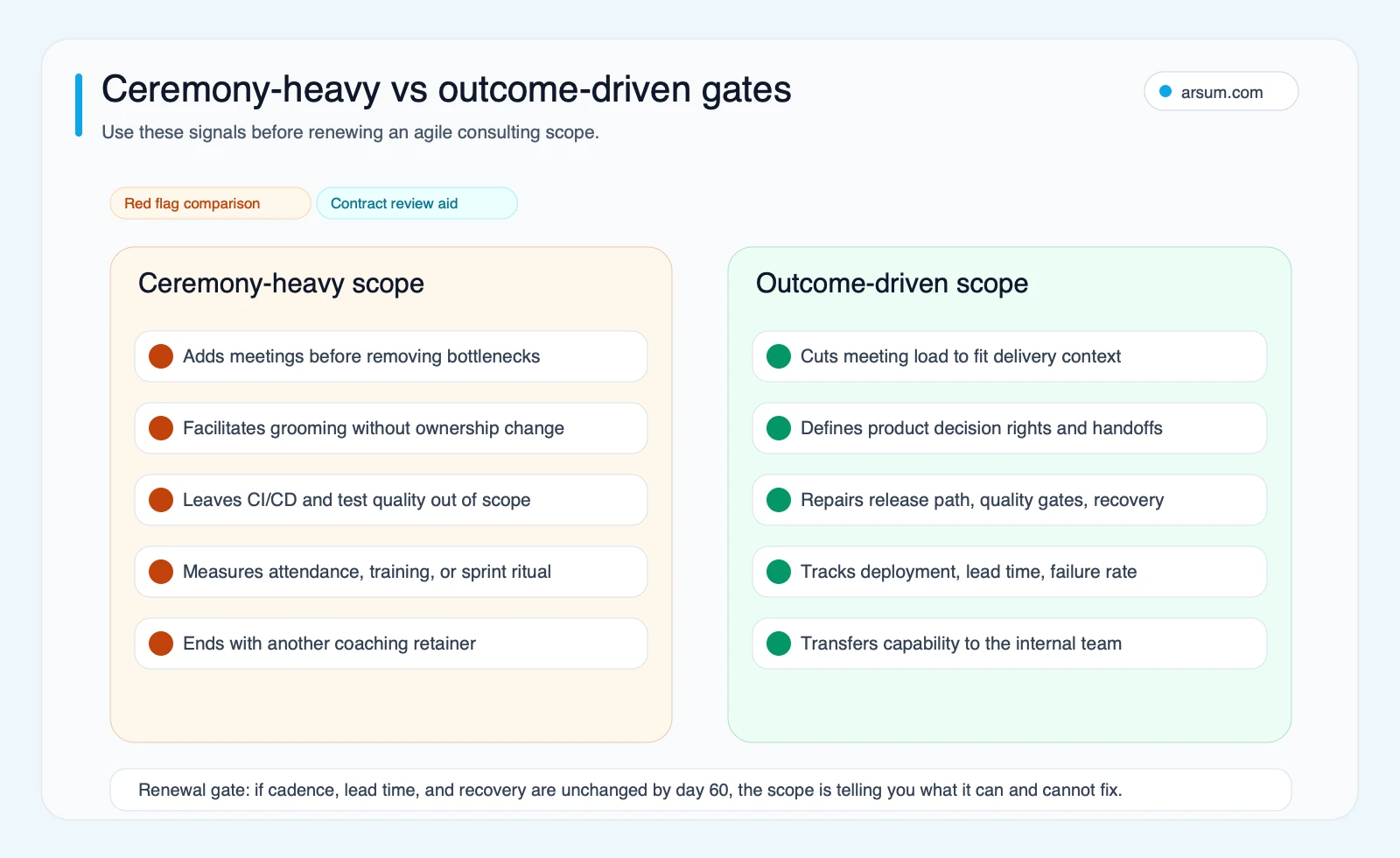
Agile software development consulting is not the right next purchase when:
- Product strategy is unresolved, so nobody can define valuable work.
- The organization will not assign product, engineering, or security ownership.
- The system needs urgent stabilization but the proposal cannot take engineering responsibility.
- The buyer needs a predictable commodity deliverable and has no room for governed reprioritization.
- The team lacks authority to change dependencies, approvals, or operating constraints causing the delay.
In those cases, pause, narrow the problem, or choose a different intervention. A team evaluating automation should first determine whether the issue is workflow design, system integration, or a capacity gap; business process automation consulting is useful only when workflow and control boundaries are clear enough to improve.
Pre-Signing Checklist
Use this checklist in the final proposal review.
Problem and scope
- We can state the delivery constraint in operational terms, not only “we need to be more agile.”
- We chose coaching, transformation work, audit, or delivery capacity for a stated reason.
- We know what is in the first phase and what can be reprioritized.
- We identified product-strategy questions that must be resolved before delivery begins.
Accountability and evidence
- A client product owner owns backlog-priority decisions.
- An engineering owner owns build, quality, and release evidence.
- A security or risk owner approves relevant controls and exceptions.
- The proposal identifies the baseline, measurement definitions, review cadence, and decision gate.
- The team will retain decision logs, release evidence, and incident records appropriate to the work.
Security, operations, and handoff
- Threat modeling, access management, code ownership, testing, vulnerability remediation, and release approval responsibilities are assigned.
- Monitoring, incident runbooks, rollback authority, and escalation contacts are documented.
- The agreement states who supports the system after launch and under what service boundary.
- The handoff includes repositories, environments, documentation, and capability transfer—not only a final presentation.
Commercial controls
- Budget, decision cadence, and escalation route are fixed for the phase.
- The agreement explains how new requirements are assessed, accepted, swapped, deferred, or separately funded.
- The engagement has a stop condition and safe next step if evidence does not support continuation.
- We would apply this same checklist to any provider, including Arsum.
A Note on Useful, Durable Deliverables
Google’s people-first content guidance asks whether content provides original information, substantial value, and clear sourcing. That principle is relevant to consulting deliverables as well.
A buyer should be able to inspect what was learned, which systems and assumptions informed a recommendation, who made each material decision, and what limitations remain. A generic deck can help communicate work, but it should not be the only output from an engagement claiming to improve delivery.
For AI-enabled products, this is especially important. Review the workflow before treating model capability as authorization to act. A strong AI agent architecture names source systems, approval steps, exception paths, audit trails, owners, and rollback conditions. Delivery consulting should leave the same kind of operating clarity.
Methodology and Limits
This is an editorial buyer framework based on research reviewed June 15, 2026. It uses the Agile Manifesto, Scrum Alliance’s public consulting description, Google Search Central’s people-first guidance, and OWASP SAMM as source material. The diagnostic router, comparison table, scorecard, and checklist are original editorial tools.
Community links are qualitative practitioner signals about contract and communication failure modes. They are not statistical evidence of market prevalence or consulting outcomes. No universal duration, cost, ROI, or performance improvement is implied. A credible proposal should define those terms from your baseline, constraints, and operating risk.
The Buyer’s Starting Point
Choose agile software development consulting when diagnosis shows that planning, decision rights, collaboration, or organizational operating design is the material constraint. Choose an engineering audit or delivery partner when release reliability, technical quality, security controls, or build capacity is the constraint. In either case, do not accept vague accountability.
If you are evaluating a consultant, build partner, or AI-enabled product workflow, Arsum can discuss a bounded delivery-constraint assessment focused on evidence, owners, controls, and the engagement path—not a preselected service category.
Ready to Automate Your Business?
Stop wasting time on repetitive tasks. Let AI handle the busywork while you focus on growth.
Schedule a Free Strategy Call →Written by:Arsum editorial team
- Reviewed by
- Arsum editorial team
- Published
- June 8, 2026
- Updated
- August 12, 2026
- How this was produced
- Arsum uses research packs, source checks, and human editorial review to prepare and update blog articles. Editors are responsible for the final page.
- Source policy
- Sources are linked in the article when used. Methodology and source notes are included on higher-risk or high-visibility pages and are being rolled out across the archive. Editorial policy.
- Why this page exists
- Help B2B operators evaluate AI automation, implementation scope, cost, risk, and build-vs-buy decisions with practical context.