Choose an AI agent architecture from the steps, state and actions your application needs. Start with a fixed workflow when the path is predictable. Add tool choice, planning or multiple agents only when a simpler design cannot do the job, and define how users approve, inspect and recover the result.
AI Agent Architecture Patterns for Product Teams
Choose between fixed workflows, tool-using agents and multi-agent designs using state, approvals, evaluation and recovery requirements.

Table of Contents
- Match architecture to the decisions and actions allowed
- Choose the lowest-complexity pattern that meets the job
- Compare patterns by operating burden, not just capability
- Use a pattern-fit rubric before selecting a framework
- Worked pilot scorecard: a bounded operating scenario
- Production readiness: controls before scale
- Disqualifying conditions and failure modes
- Source and methodology notes
- Apply this to your product
Match architecture to the decisions and actions allowed
Pattern names describe coordination. They do not decide who is allowed to act when the model is uncertain, source data conflicts, or an action cannot be easily reversed.
That distinction changes the buyer decision. A system may technically retrieve a customer record, draft a response, propose a payment exception, or choose a tool. None of those capabilities authorizes it to send a message, change a ledger, approve a claim, or disclose restricted information. The production architecture must make the boundary explicit before the agent is given discretion.
Before comparing patterns, answer four operating questions:
- Workflow ownership: Which application or workflow engine holds authoritative task state?
- Response ownership: Which component owns the final answer, recommendation, or disposition?
- Action authority: Which tools are read-only, reversible, approval-gated, or unavailable to the agent?
- Recovery ownership: Who investigates a bad result, reverses a downstream change, and decides whether the workflow resumes?
This is consistent with the coordination choices described by Google Cloud, Azure Architecture Center, and the OpenAI orchestration guide. Their patterns are useful implementation options; they do not replace a decision about accountability.
A practical default is to keep deterministic routing, permissions, approval gates, and irreversible actions in application code or a workflow engine. Give an agent discretion only inside a bounded domain. When it cannot establish the required facts, policy, or authority, it should stop and enter an owned exception path.
Choose the lowest-complexity pattern that meets the job
The escalation question is not “can we add another agent?” It is “what documented requirement cannot be safely met by the simpler design?”
Start with this ladder.
-
Application-owned workflow with one model call and tools Use when the sequence is known. The application controls branching while the model extracts, classifies, drafts, summarizes, or explains.
-
Single-agent ReAct loop Use when one bounded domain requires runtime tool ordering, such as investigating an internal support case using approved sources.
-
Planner-executor Use when decomposition makes a predictable multi-step task easier to inspect and execution can be constrained step by step.
-
Agents-as-tools / manager with specialists Use when a manager or application should retain the final answer while narrow specialists return structured work.
-
Handoffs Use when responsibility genuinely transfers to a specialist with different instructions, records, policies, and escalation rules.
-
Group or multi-agent coordination Use only when specialists must reason together and the organization can support the added tracing, evaluation, security, cost-accounting, and incident burden.
Every escalation creates another path for context loss, ambiguous ownership, permission errors, inconsistent evaluation, latency, and recovery work. A multi-agent diagram may look more capable than a bounded workflow, while being harder to test and less clear to operate.
When an external team proposes the architecture, ask it to price the operating burden as well as the build. The AI automation agency pricing guide provides a worksheet for implementation, model and platform usage, support, acceptance and handover.
Compare patterns by operating burden, not just capability
| Pattern | Best fit | Final-answer owner | Cost and latency tradeoff | Evaluation and incident burden | Signal that added coordination is justified |
|---|---|---|---|---|---|
| Application-owned + model | Fixed sequence, extraction, classification | Application | Usually the lowest coordination overhead | Evaluate one bounded model step and deterministic rules; application owner handles incidents | The next step depends on runtime interpretation that cannot be safely encoded |
| ReAct loop | Bounded investigation or tool use in one domain | Single agent with application delivery gate | Tool iterations can add time and variable cost | Evaluate tool selection, stopping behavior, and evidence grounding; one domain owner needs an exception queue | One domain cannot safely resolve the task with its allowed tools and policy |
| Planner-executor | Recognizable, multi-step work | Application or planner by design | Planning adds an extra inference and validation step | Evaluate both plan quality and step execution; incidents may arise from stale or unsuitable plans | A checked plan materially improves control, recovery, or operator review |
| Manager with specialists | Narrow specialist analysis feeding one answer | Manager or application | Delegation adds calls, coordination, and aggregation work | Evaluate specialist outputs and manager synthesis separately; manager owner resolves conflicts | Specialists need distinct retrieval, validation, or output contracts while answer ownership stays centralized |
| Handoff | Distinct support or operational responsibility | Receiving specialist | Transfer may reduce repeated context work but adds contract and routing cost | Evaluate transfer accuracy and receiving-agent behavior; the receiving owner owns its response | Business responsibility, policy, and escalation rules genuinely change |
| Event-driven agent | Triggered operational tasks | Calling workflow or downstream system | Cost is tied to event volume and retries | Evaluate duplicate delivery, replay, failure queues, and idempotency; workflow owner manages incidents | A business event needs interpretation before it can be routed or queued |
| Memory-augmented agent | Controlled continuity or knowledge retrieval | Primary agent or application | Retrieval adds indexing, filtering, and context costs | Evaluate access filtering, provenance, freshness, and retention; data owner shares accountability | The workflow needs authorized context that cannot be supplied deterministically per request |
The OpenAI handoff documentation provides a useful boundary: in an agents-as-tools design, a manager can call specialists and retain responsibility for the response; in a handoff, the specialist takes over the next interaction. Treat that as a transfer of responsibility, not merely a routing technique.
ReAct loops: narrow domain, bounded tool use
A ReAct-style loop alternates between reasoning, tool use, and observation. It can be appropriate for bounded research, document retrieval, internal support triage, and preparation of human-reviewed drafts.
Its production controls should include a limited tool set, structured tool results, a maximum iteration or budget boundary, an explicit stop condition, and retained evidence for the conclusion. The agent should not convert an inconclusive search into an unsupported answer or an external action.
Planner-executor: plans must be reviewable
Planner-executor separates task decomposition from execution. It can be useful when the work follows a recognizable sequence: collect records, compare fields, prepare an exception summary, and route it for review.
The main risk is plan drift. A proposed sequence may be incomplete, become unsuitable when new evidence appears, or hide an assumption that an operator would reject. Keep execution constrained. Retain the plan, inputs, step outcomes, and rejected actions in the audit record. For consequential work, the workflow engine or a named reviewer should determine which steps may run.
A planner is not automatically an authorization layer. In many operational workflows, it is safer for the planner to propose a sequence while deterministic systems enforce permissions and approval boundaries.
Manager and specialist systems: delegation needs evidence contracts
A manager-and-specialist pattern fits work where tasks have genuinely different retrieval sources, prompts, validation rules, or output formats. One specialist might retrieve policy text, another normalize account data, and a manager might assemble a reviewer-facing summary.
Specialists should return structured evidence rather than unsupported prose. At minimum, define source identifiers, tool outcomes, required fields, abstention states, and the reason an item was escalated. The manager should not be permitted to invent evidence when a specialist cannot complete its assigned task.
Multiple components do not automatically require multiple autonomous agents. A workflow engine plus narrow model calls may be easier to test, observe, and maintain. Compare frameworks only after deciding which orchestration and control capabilities you need; this AI agent frameworks comparison can help frame that evaluation.
Handoffs and supervised workflows: accountability changes
A handoff is useful when the next specialist has its own instructions, data access, policies, and operational responsibility. Customer support routing is a familiar example: billing, technical support, and account management may each require separate records and escalation rules.
A supervisor-worker design can add quality checks, but a model reviewing another model is not business authorization. For high-impact decisions, a supervisor may identify issues, compile evidence, and recommend a disposition. A named human owner should approve the consequential outcome.
Tracing can record model generations, tool calls, handoffs, guardrails, and custom events for debugging and production monitoring. It helps make a decision reconstructable; it does not make the underlying policy, permissions, or rollback plan sufficient.
Event-driven and memory-augmented systems: state is a product decision
Event-driven agents respond to a business event: a ticket, contract upload, account change, or exception record. Their design must define idempotency, duplicate delivery, retry behavior, replay behavior, and the boundary between recommending an action and performing it.
Memory-augmented systems add another control decision: what information may be retrieved, for whom, from which source, and for how long. Retrieval should respect source permissions, retention rules, provenance requirements, and document currency. A grounded answer based on stale, irrelevant, or over-broad material can still create an operational failure.
These state and access questions often matter more than a framework choice. AI agent security covers the control questions that should accompany tool access and retrieval design.
Use a pattern-fit rubric before selecting a framework
Score the candidate workflow before choosing a framework. Use a 1–5 scale, where 1 is simple and bounded and 5 requires substantial control design.
| Decision dimension | 1–2: simpler architecture favored | 3: validate in a constrained pilot | 4–5: stronger controls required |
|---|---|---|---|
| Workflow shape | Fixed or mostly fixed sequence | Conditional branches | Open-ended planning or conflicting goals |
| System-of-record access | One approved read source | Multiple read sources | Writes across systems or unclear authority |
| Action reversibility | No action or reversible draft | Reversible update | Irreversible, financial, regulated, or customer-impacting action |
| Human approval | Review after low-risk output | Approval for exceptions | Approval before external or consequential action |
| State ownership | Application-owned | Shared task state | Context moves between agents, memory, and systems |
| Exception handling | Stop and queue | Retry plus human review | Cross-team resolution, rollback, and incident process |
| Ownership after launch | One product or engineering owner | Shared operations ownership | Security, compliance, business, and engineering owners |
The rubric does not mechanically prescribe a pattern. It exposes what the architecture must prove. A high-risk, low-reversibility workflow may still start with a single model call that prepares a review packet. Adding autonomous handoffs in that situation can increase risk rather than reduce it.
Build, buy, or partner?
Use buy when the workflow is standard, the vendor’s permissions and audit model meet your requirements, and you can export the records needed for review, migration, and incident analysis.
Use build when your advantage lies in proprietary workflow logic, integrations, approval rules, or evidence requirements that a configurable product cannot represent cleanly.
Planning an implementation? See what an Arsum build can include →
Worked pilot scorecard: a bounded operating scenario
Consider an internal operations agent that prepares a case summary from a ticketing system, policy repository, and CRM. This is an illustrative planning scenario, not a client result or performance benchmark.
The starting architecture is application-owned orchestration with a bounded retrieval-and-drafting agent. It may prepare a review packet, but it does not send customer communications or update records without approval.
| Pilot element | Example definition |
|---|---|
| Business owner | Operations lead |
| Technical owner | Engineering lead |
| Security reviewer | Security or privacy owner |
| Baseline | A sample of manually prepared case summaries, recording preparation time, correction categories, and escalation reasons |
| Target | A pre-agreed share of pilot outputs meets the documented quality rubric without material correction; set the threshold before the pilot |
| Quality metric | Citation completeness, factual consistency against source records, required-field coverage, and reviewer disposition |
| Exception metric | Cases routed to human review, categorized by missing data, policy ambiguity, access issue, or model failure |
| Cost measure | Model and tool cost per completed case, plus reviewer time; both are inputs to the decision |
| Review cadence | Daily review during early pilot; weekly review after failure categories and ownership are understood |
| Stop condition | Material permission breach, unsupported claim in a high-risk field, repeated failure without an owner, or inability to reproduce a decision from retained evidence |
| Rollback path | Disable the action path, preserve logs and inputs, return work to the existing manual queue, and assign incident review to technical and business owners |
Keep the economics transparent. An illustrative planning model can begin with:
cases reviewed × average manual preparation time × fully loaded reviewer cost
Then subtract:
agent and tool cost + remaining reviewer time + implementation and control-maintenance cost
This is not a savings claim. It becomes decision-grade only after the organization measures its own baseline and includes exception handling, review, monitoring, rework, and ongoing ownership.
Production readiness: controls before scale
A production-ready agent architecture has more than a convincing demo. It has credible answers to these questions:
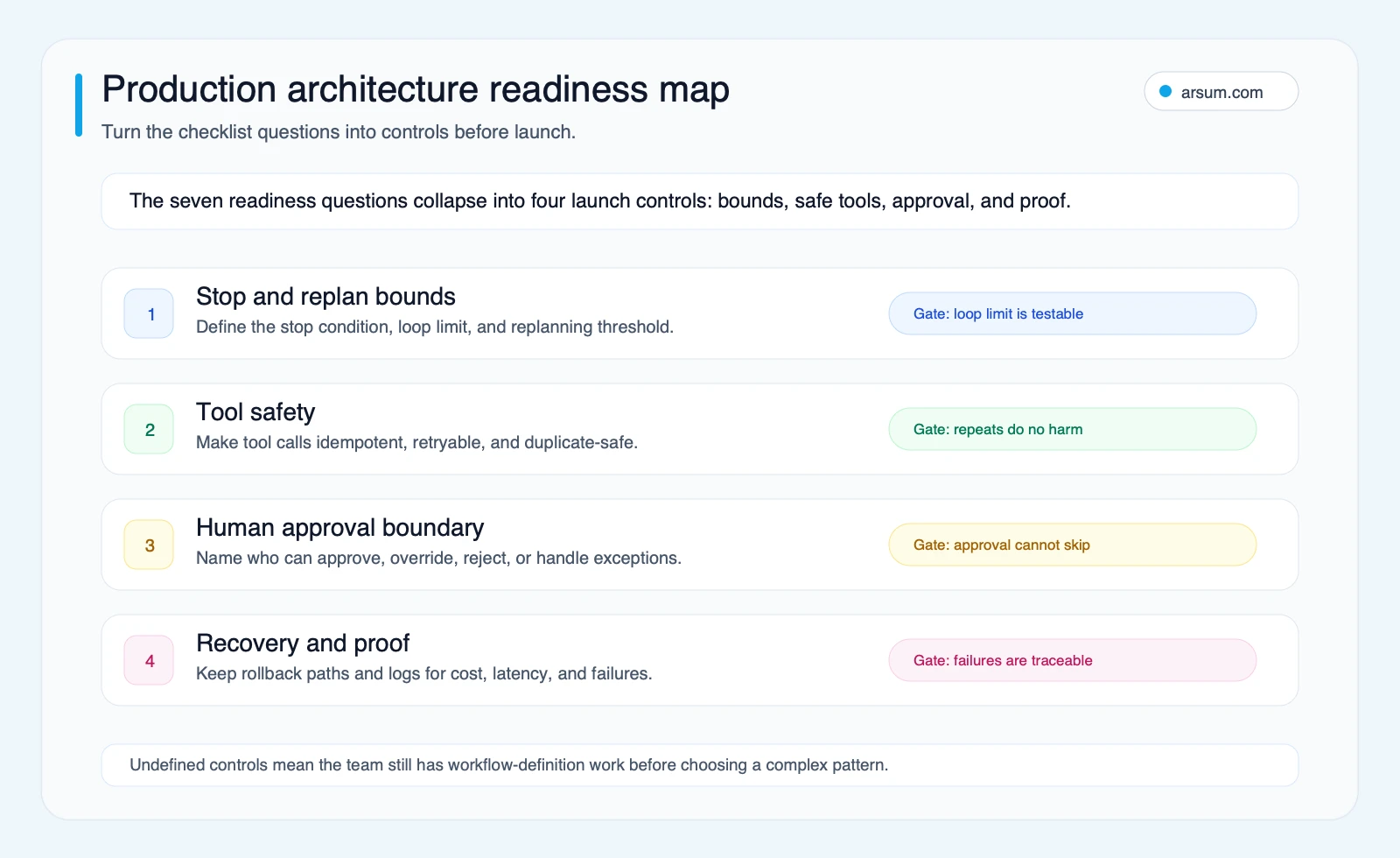
Arsum’s illustrative planning framework. Select the diagram to view it at full size.
- What exact event or user request starts the workflow?
- Which system is the source of truth for every field used?
- Which tools are read-only, reversible, approval-gated, or prohibited?
- Who owns the final response, and who owns an incorrect downstream action?
- What evidence is retained for recommendations, tool calls, handoffs, and approvals?
- What loop, retry, delegation, cost, or time boundary causes escalation?
- How are duplicate events, stale memory, missing permissions, and failed tools detected?
- Which evaluation cases represent normal work, ugly exceptions, and disqualifying edge cases?
- Can the team disable the agent and return to the prior workflow without losing work or auditability?
Guardrails can validate inputs or outputs around agent execution. They are one layer in a control system, alongside permission enforcement, structured validation, human approval, and incident response.
Disqualifying conditions and failure modes
Do not start with a more autonomous pattern when any of these conditions remain unresolved:
- The organization cannot identify the source of truth or data owner.
- The agent would make an irreversible or regulated action without an accountable human approval gate.
- The team lacks representative evaluation cases, especially for exceptions.
- Tool permissions are broader than the workflow requires.
- No owner can investigate a trace, reverse a change, or maintain the workflow after launch.
- The existing manual process is too undefined to establish a stable baseline.
Common failure modes are more specific than “the model hallucinated”:
- Routing ambiguity: Multiple agents can answer, but nobody owns conflicting evidence.
- Context loss at handoff: The receiving specialist lacks key policy, customer, or task-state information.
- Permission drift: A prototype accumulates access scopes unrelated to its actual job.
- Unbounded retries: A failed tool call becomes a loop instead of a visible exception.
- Memory contamination: Old, irrelevant, or unauthorized material is retrieved as current evidence.
- Unmeasured reviewer burden: Automation shifts work into review and remediation without measuring that cost.
- Orphaned on-call ownership: Engineering can see a trace, but no business owner can decide the correct disposition.
Source and methodology notes
This article follows a link-only editorial evidence route. No occupation or website-performance dataset is assigned because those datasets would not improve an architecture-selection decision.
The primary references reviewed for this guide include:
- Google Cloud: choosing a design pattern for an agentic AI system
- Microsoft Azure: AI agent orchestration patterns
- OpenAI: orchestration, tracing, and guardrails
- Microsoft AutoGen: handoffs
- Agent Design Pattern Catalogue
Platform names, SDK APIs, tracing defaults, and hosted capabilities change quickly. Verify current documentation before treating any example pattern as implementation-ready.
When is a standard workflow better than an AI agent?
Use a standard integration or workflow when the sequence, inputs, and decisions are known and can be encoded deterministically. Add an agent where interpretation or bounded runtime judgment materially improves the workflow. Many reliable systems combine deterministic orchestration with narrowly scoped model steps.
When should a ReAct loop become a multi-agent design?
Do not use a fixed tool-call threshold. Escalate only when documented ownership, policy, context, or evaluation requirements exceed a bounded single-agent design—for example, separate specialist responsibility, incompatible access rules, or an approval boundary that cannot be represented safely in one domain.
Is there a dominant enterprise agent architecture pattern?
No universally dominant deployment pattern should be assumed. Choose based on workflow state, final-answer ownership, action risk, permissions, approval boundaries, recovery requirements, and the organization’s ability to evaluate and operate the system after launch.
Are handoffs safer than a manager agent?
Neither is inherently safer. A manager-and-specialist design keeps final-answer ownership centralized. A handoff transfers responsibility to a specialist. Select the pattern that matches the business ownership model, then define the context contract, permissions, retained evidence, and escalation rule.
How should a team evaluate frameworks?
Evaluate frameworks against the state model, tool permissions, tracing, evaluation workflow, deployment environment, transition requirements, and ownership model your workflow needs. Do not treat an attractive demonstration of a pattern as proof that it supports your controls.
How long does implementation take?
Timing depends on integration count, quality and exception coverage, approval boundaries, permissions, control design, and the readiness of the existing workflow. A useful plan begins by bounding one workflow, establishing a baseline, defining acceptance criteria, and proving rollback before expanding scope.
Apply this to your product
Arsum scopes AI product development and intelligent search and data systems. Bring one workflow, its intended users, permitted data sources and representative examples. The first implementation decision is the smallest useful scope that can be tested and handed over with a named owner.
Discuss your AI product or search system
Bring the intended users, data sources, workflow, and budget. We can define a focused first phase and the responsibilities after launch.
Discuss your project →Published by:Arsum
- Published
- May 31, 2026
- Updated
- September 8, 2026
- How this was produced
- These guides are prepared and updated with AI assistance. Linked documentation, proposed evaluation methods, and illustrative calculations are distinguished from reported project results. No independent human review is implied by the byline.
- Source policy
- Technical references are linked where used. Planning figures and suggested scorecards are assumptions, not market benchmarks or measured client outcomes. Editorial policy.
- Why this page exists
- Help product and technical teams scope AI applications and intelligent search, compare delivery options, and define acceptance and ownership.