An ai agent consultant should help you decide whether a workflow needs an agent at all, then deliver a controlled system: a mapped process, scoped permissions, evaluation cases, approval rules, traces, an exception route, and an ownership plan your team can operate after launch. If a proposal promises “an AI agent” without separating prototype work from production hardening, you are comparing a demo scope with an operational system.
AI Agent Consultant: Buyer Guide
Explore ai agent consultant: compare workflow fit, costs, risks, evidence, and practical next steps before you build, buy, or hire.
Table of Contents
- What most guides miss: the build is not the whole engagement
- Choose the service category before choosing a consultant
- Use a three-way architecture filter
- What the engagement should deliver by phase
- A worked pilot scorecard for a controlled decision
- How to evaluate proposals without invented price benchmarks
- Disqualifying conditions and common failure modes
- Questions to ask before signing
- Frequently asked questions
- Methodology and sources
- The practical decision
What most guides miss: the build is not the whole engagement
Many service pages describe agent capability but do not distinguish four separate deliverables:
- Workflow discovery and architecture choice
- A narrow prototype
- Production hardening
- Post-launch ownership and operations
That distinction changes the buying decision. A prototype can answer whether a model can classify, summarize, retrieve information, or select among a limited set of actions. It does not prove that the system can handle malformed inputs, incomplete records, permission failures, conflicting instructions, or a risky action at the right time.
Anthropic’s engineering guidance recommends starting with the simplest solution possible and treats added agentic flexibility as a tradeoff against predictability. That is a useful buyer rule: do not hire an AI agent consultant to make a fixed, auditable workflow less predictable when deterministic automation would work. Read agentic AI workflow automation for a deeper comparison of those boundaries.
The consultant’s useful contribution is therefore not merely connecting a model to tools. It is designing the operating boundary around that connection:
- What data enters the system, from which source, and with what validation
- Which steps are deterministic and which require model judgment
- Which tool calls can run automatically, which require approval, and which are prohibited
- Where exceptions go, who owns them, and what evidence is retained
- How the team detects a regression, pauses the workflow, and restores a prior process
Choose the service category before choosing a consultant
“AI agent consultant” can describe several very different purchases. Clarify the deliverable first; otherwise, a vendor’s relevant experience may be in a different category from the one you need.
| Service category | Primary deliverable | Best fit | Question to ask |
|---|---|---|---|
| AI agent consultant | A controlled agent or hybrid workflow, with tools, guardrails, traces, evals, and handoff | Variable inputs and context-dependent decisions | “Which actions will it take, and what happens when it is uncertain?” |
| AI strategy consultant | Prioritized opportunities, operating model, and roadmap | You have not selected a workflow or owner | “Who turns this recommendation into a controlled implementation?” |
| Workflow automation consultant | Deterministic integrations and rule-based routing | Inputs and rules are stable | “How are known exceptions routed and maintained?” |
| Custom software developer | Application features, integrations, and product logic | The main need is software, not variable decision-making | “Where does model behavior end and deterministic application logic begin?” |
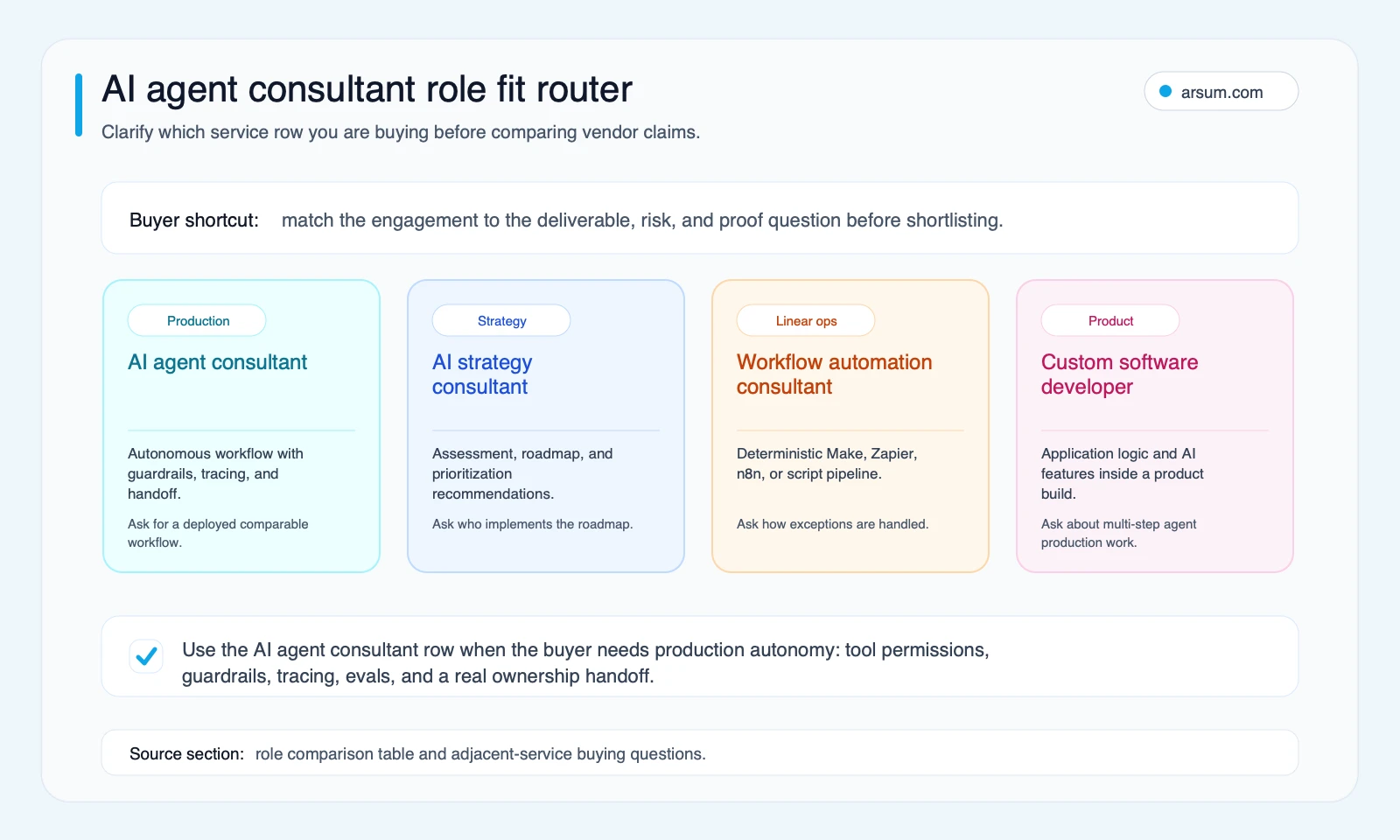
Use this router to identify the service category before comparing credentials, scope, and proposals.
A consultant may work across these categories, but the proposal should identify which one is being purchased. If discovery concludes that the right answer is deterministic automation, that is a sound outcome—not a failed agent engagement. For adjacent buying options, see AI automation consulting and AI agent development services.
Use a three-way architecture filter
A good consultant should make an architecture recommendation after examining the workflow, not before. The practical choice is usually among deterministic automation, an agent, and a hybrid workflow.
| Workflow condition | Better default |
|---|---|
| Stable inputs, fixed business rules, known exception handling | Deterministic automation |
| Structured process with one variable judgment step | Hybrid workflow |
| Variable inputs, context-dependent tool selection, bounded and reversible actions | Agentic workflow with controls |
| High-consequence action, poor source quality, or no workable review path | Keep the decision human-led or redesign the workflow |
Deterministic automation
Choose a deterministic route when the required path is already known: collect data, validate fields, update a system, notify an owner, and log the result. The value is consistency and an auditable path.
An agent may still assist within this workflow—for example, extracting information from unstructured correspondence—but it should not replace the surrounding control logic. The model’s output can be a proposed value; deterministic checks and human review can decide whether it becomes a system action.
Hybrid workflow
Hybrid is often the most practical design. A workflow engine owns the sequence, integrations, retries, and records. The agent is called only where language, ambiguity, or judgment materially improves the process.
For example, a claims intake process might use fixed validation rules, document routing, and case creation, while an agent proposes a category and explains which source text supports that proposal. A human reviewer approves consequential classifications. This keeps flexibility narrow and makes the exception path visible.
Agentic workflow
A fuller agentic route is appropriate only when the workflow genuinely requires choosing among tools or next steps based on context. Even then, action scope should be limited. Read-only retrieval, draft creation, and reversible internal updates are different risk categories from payments, contract commitments, record deletion, or outbound communication.
OpenAI’s Agents SDK documentation identifies primitives such as tools, handoffs, guardrails, tracing, sessions, and human-in-the-loop mechanisms. Those are useful implementation components, but they do not authorize the agent to act independently. Business authorization comes from your policy, approval design, and accountable owner.
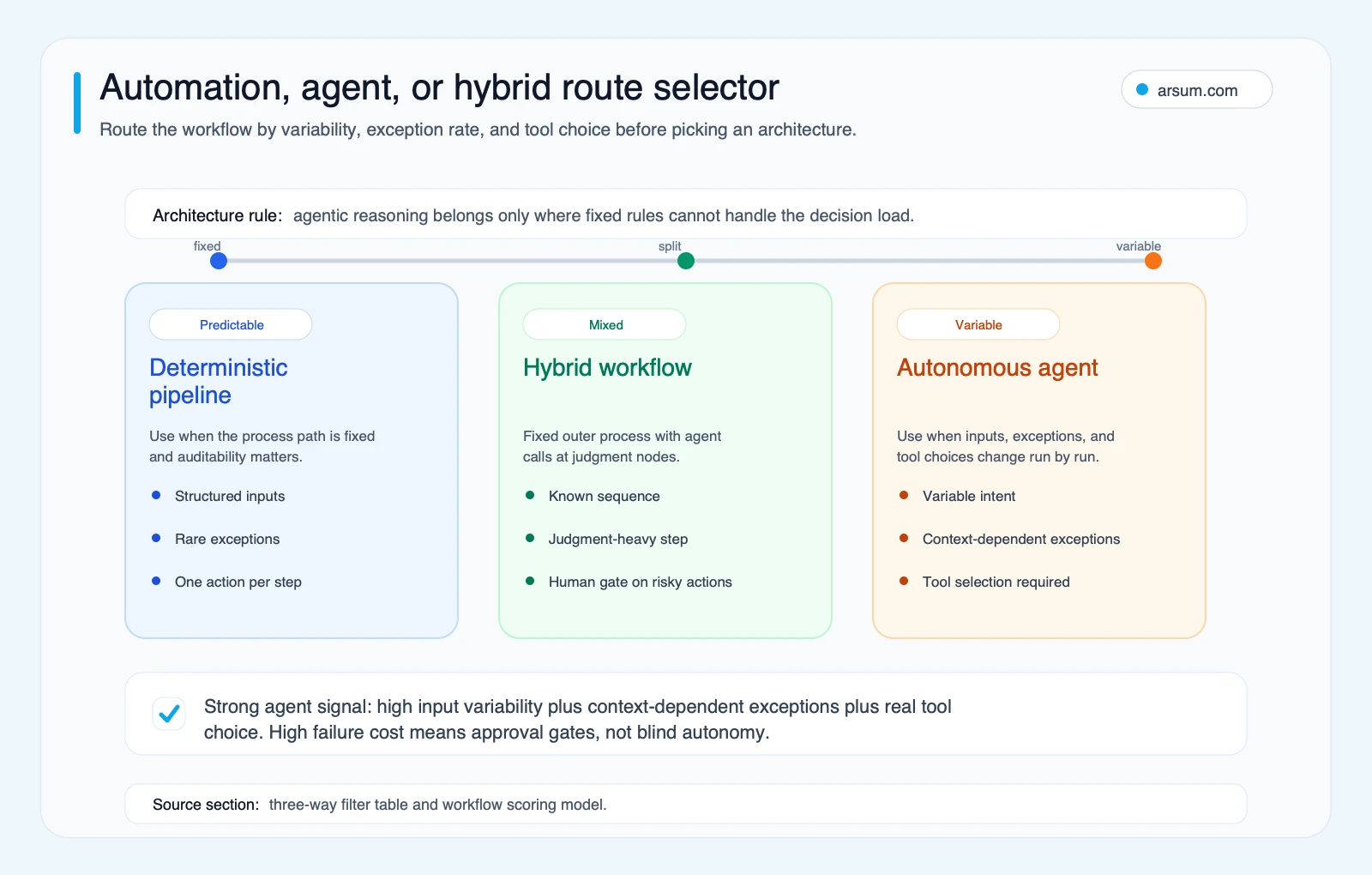
Use the route selector to decide where model judgment belongs and where deterministic controls should remain.
What the engagement should deliver by phase
Ask for phase-specific outputs. Vague phrases such as “end-to-end agent development” can hide whether a proposal includes the work needed after a polished prototype.
| Phase | Required outputs | Buyer acceptance check |
|---|---|---|
| Discovery | Workflow map, source systems, decision inventory, failure modes, architecture recommendation, named owner | Your team can explain why each step is deterministic, hybrid, agentic, or human-only |
| Prototype | Narrow use case, representative test inputs, sample traces, known limitations, prototype acceptance criteria | The system is tested on inputs that reflect actual variation, not only prepared examples |
| Production hardening | Tool permissions, input/output checks, approval matrix, exception queue, eval set, monitoring plan, rollback procedure | You can name every automated action, reviewer, stop condition, and recovery path |
| Handoff or managed operations | Runbook, ownership matrix, access model, change process, incident review cadence | Internal owners can review traces, update approved configuration, and escalate failures |
A proposal does not need to promise every future feature. It does need to state which of these outputs are included, deferred, or owned by your team.
Guardrails must be action-specific
“Guardrails” is not enough. Ask for a table that maps each tool action to a constraint and a response.
| Action | Example control | Failure response |
|---|---|---|
| Read CRM record | Restrict fields and customer scope | Block access outside permitted accounts |
| Draft email | Require approved source material and template | Send to review queue, never directly to recipient |
| Update record | Validate required fields and change type | Hold for approval when validation fails |
| Trigger payment or external commitment | Pre-execution human approval | Block action until authorized |
| Retrieve sensitive information | Role-based access and trace retention | Deny and alert the system owner |
NIST’s AI Risk Management Framework supports treating governance and trustworthiness as design and evaluation concerns. In buyer terms: define oversight before launch, not after an incident.
Observability and evaluation are deliverables
An agent that cannot be inspected cannot be operated responsibly. Require trace records that make it possible to answer:
- Which instructions, inputs, model calls, and tools contributed to this outcome?
- What system action was proposed or executed?
- Which approval rule applied?
- What source record supported the result?
- How will a reviewer locate and correct a failed run?
A consultant should also identify who owns evaluations after launch. The goal is not a universal accuracy percentage. It is a repeatable test set tied to the workflow’s real acceptance criteria: correct routing, source-grounded draft, valid record update, appropriate escalation, or another measurable outcome.
Community discussions are useful as qualitative signals here, not market-wide evidence. A Hacker News discussion about agent reliability highlights concerns about open-ended inputs and production variation, while an Ask HN discussion about real agent work reflects buyer skepticism when “agent” is used for work that could be a conventional workflow. Treat those as prompts for diligence, not proof of an industry-wide failure rate.
💡 Arsum builds custom AI automation solutions tailored to your business needs.
Get a Free Consultation →A worked pilot scorecard for a controlled decision
Use a pilot when the workflow is valuable enough to test but not safe to automate broadly. This is an illustrative planning template, not a validated readiness threshold or a forecast of results.
Example: inbound request routing
Assume a team receives 500 inbound requests per month. Today, an operations lead reviews each request, chooses a queue, and records the reason. The pilot does not authorize automatic external action. It proposes a route, attaches source evidence, and sends uncertain cases to review.
| Scorecard item | Illustrative planning assumption | Owner |
|---|---|---|
| Baseline volume | 500 requests per month | Operations lead |
| Current path | Human reads request, checks CRM context, assigns queue | Operations lead |
| Pilot scope | Agent proposes queue and rationale for one request type | Technical sponsor |
| Quality measure | Reviewer confirms correct queue and sufficient cited source context | Operations lead |
| Exception measure | Share of cases that require human correction or cannot be classified | Operations lead |
| Source lineage | Request ID, CRM lookup, retrieved records, prompt/version, proposed action retained in trace | Technical sponsor |
| Review cadence | Daily review during pilot; weekly review of exception themes | Operations lead and risk owner |
| Acceptance rule | Proceed only if the team’s agreed quality and exception targets are met on representative pilot cases | Executive sponsor |
| Stop condition | Pause if the system makes an unauthorized write, loses source lineage, or exceeds the agreed correction burden | Executive sponsor |
| Rollback | Disable agent write permissions; route all cases to the existing manual queue; retain traces for review | Technical sponsor |
The arithmetic for potential capacity should remain separate from proof of benefit. For example, if manual review currently takes six minutes per request, the baseline handling load is 3,000 minutes per month: 500 requests × 6 minutes. That is an illustrative planning input, not a realized saving. The pilot must measure whether review time, correction work, and exception handling actually change before a team makes a broader investment decision.
For workflow-specific ROI framing without treating automation potential as guaranteed savings, see AI automation ROI examples.
How to evaluate proposals without invented price benchmarks
Costs depend on workflow ambiguity, integration complexity, required controls, existing data quality, action risk, and the ownership model. Without a validated, comparable market benchmark, a buyer should not treat a generic price range as a standard rate.
Instead, require every proposal to separate scope and assumptions.
| Quote area | Ask the consultant to specify |
|---|---|
| Discovery | Workshops, systems reviewed, workflow maps, risks identified, and acceptance criteria |
| Prototype | Included use cases, integrations, representative inputs, and exclusions |
| Production hardening | Guardrails, approval flows, traces, evals, access control, incident handling, and rollback tests |
| Handoff | Documentation, training, repository access, credentials, runbook, and change ownership |
| Operations | Monitoring, alerting, model updates, integration maintenance, review cadence, and excluded support |
Compare like with like
A lower quote may be entirely reasonable if it is explicitly for a prototype. It becomes misleading only when buyers compare it with a proposal that includes production controls and post-launch ownership.
Use an illustrative planning worksheet rather than a claimed benchmark:
- Internal subject-matter expert hours required for discovery and review
- Number and type of systems to integrate
- Whether the agent reads, drafts, recommends, writes, sends, or commits funds
- Number of approval routes and exception categories
- Evaluation data needed before and after launch
- Internal technical ownership after handoff
- Expected managed-operations responsibilities, if any
The cost image below is a scope-gate reminder, not a market pricing claim.
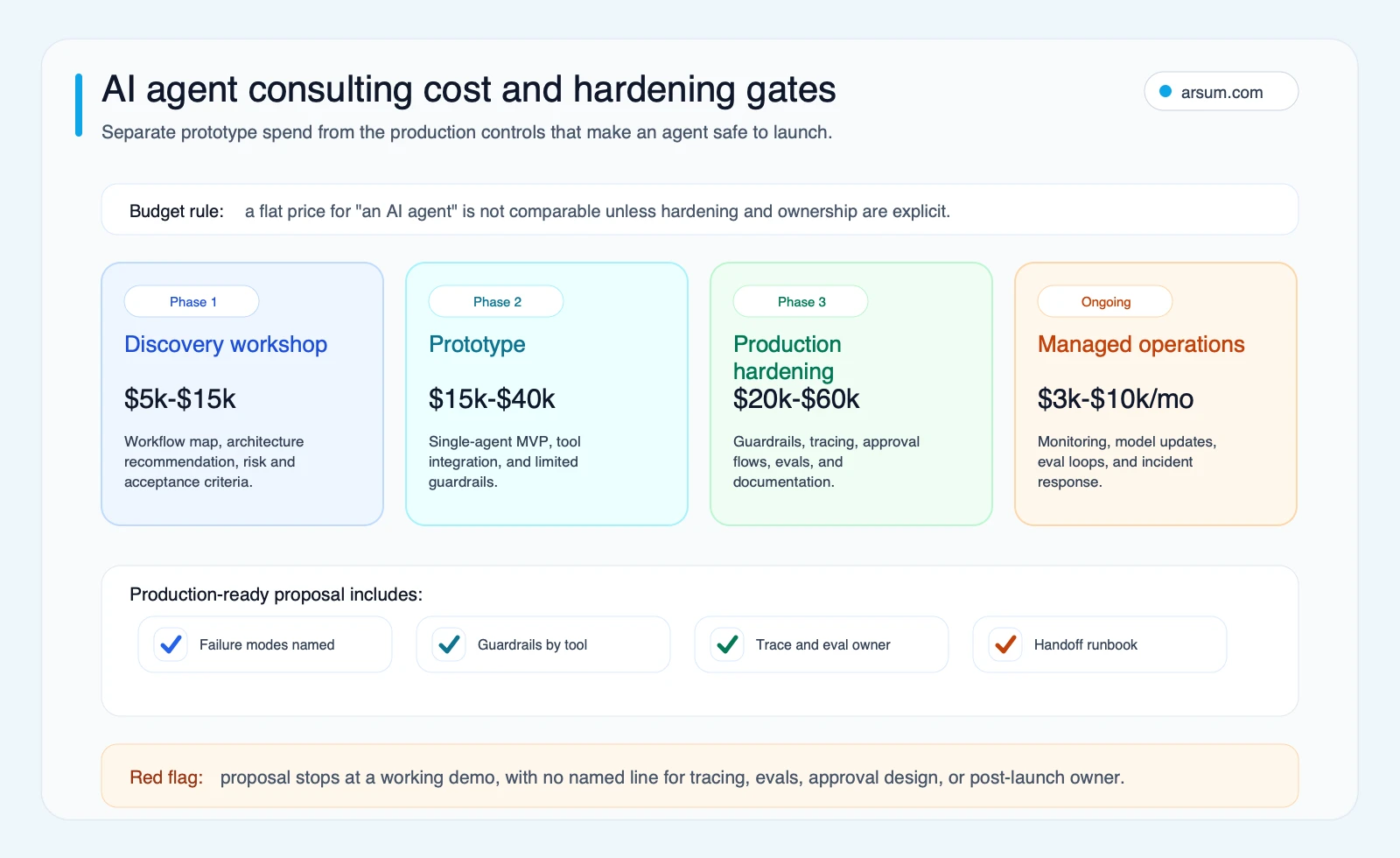
Compare quotes by phase and production gate, rather than treating “an AI agent” as one undifferentiated deliverable.
Disqualifying conditions and common failure modes
Some workflows should not begin as agent projects. A consultant who says so is providing useful advice.
Do not authorize autonomy when the workflow lacks these conditions
Keep the workflow human-led, or restrict the agent to drafts and recommendations, when:
- The source data is incomplete, conflicting, or not available at decision time
- An incorrect action is costly, difficult to reverse, or regulated
- No named business owner can approve exceptions
- The organization cannot retain traces or source lineage needed for review
- Existing policy does not define what the agent is allowed to do
- The team has no capacity to review pilot outputs or maintain an evaluation set
- The proposed value depends on broad autonomy rather than a bounded, testable task
High consequence should reduce autonomy. It is not a reason to deploy a more elaborate agent.
Warning signs in a consultant proposal
Be cautious when the proposal:
- Starts with a preferred framework or model before mapping the workflow
- Describes a demo but omits representative test cases and known limitations
- Uses “guardrails” without naming the risky tool calls, trigger conditions, or blocking behavior
- Includes monitoring but no access to traces or incident-review process
- Promises handoff but does not define repository access, runbooks, or who owns future changes
- Treats a model’s ability to perform a task as permission to execute the business action
- Assumes every exception can be solved through prompting instead of defining an escalation path
The right question is not “Can the model do it?” It is “Can this operating team authorize, observe, correct, and reverse it?”
For a broader implementation lens, review AI implementation services and AI agent security.
Questions to ask before signing
Use these questions in discovery and proposal review.
Workflow and architecture
- Which steps stay deterministic, which use model judgment, and which remain human-owned?
- What evidence supports the architecture choice?
- What assumptions would cause you to recommend a simpler workflow instead?
- Which system of record controls the final outcome?
Permissions and approvals
- List every tool the system can access. What minimum permissions does each require?
- Which actions are read-only, draft-only, approval-required, or prohibited?
- Who approves exceptions, and what information will they see?
- What is the first rollback action if the system takes or proposes the wrong action?
Evaluation and operations
- What is the baseline process, and what pilot outcome will be measured?
- Which representative inputs and failure cases form the evaluation set?
- Who owns the evaluation suite after launch?
- What traces are retained, where are they reviewed, and who can access them?
- What would make us stop the pilot rather than continue tuning?
Handoff and commercial scope
- What is included in discovery, prototype, hardening, and handoff?
- Which dependencies remain with your firm after launch?
- Can our team update approved prompts, tools, and evaluations without a change request?
- What operational work is excluded from the quote?
Frequently asked questions
What does an AI agent consultant do?
An AI agent consultant helps define, build, and operate a bounded agentic or hybrid workflow. A useful engagement covers workflow fit, integrations, tool permissions, approval design, traces, evaluations, exceptions, rollback, and ownership—not only a model demo.
When should we use an AI agent instead of automation?
Use an agent when inputs or next-step choices are genuinely variable and the action can be bounded, observed, and reviewed. Use deterministic automation when rules, inputs, and exceptions are stable. Hybrid designs are often the practical middle ground.
What should a production-ready proposal include?
It should name the workflow owner, source systems, action permissions, guardrails, approval rules, evaluation cases, trace access, exception route, stop condition, rollback path, and post-launch ownership.
Can an agent make high-consequence decisions autonomously?
Technical capability does not establish authorized autonomy. Where error cost is high or reversibility is low, keep the agent in recommendation or draft mode unless your governance, approval, and control design explicitly authorize a narrower action.
Methodology and sources
This guide is an editorial buyer framework based on the page’s defined search intent. Its implementation guidance is informed by OpenAI’s Agents SDK documentation, Anthropic’s guidance on building effective agents, and the NIST AI Risk Management Framework. Practitioner discussions are included only as qualitative signals about failure modes and buyer questions. No cost ranges, timelines, client results, adoption rates, or market-wide reliability claims are presented as evidence.
The practical decision
Hire an AI agent consultant when you have a workflow that needs bounded model judgment, a named owner, usable source data, and a credible path to test, review, and reverse actions. Ask them to prove the design in phases: discovery, controlled prototype, production hardening, and handoff.
If the proposal cannot identify the highest-risk action, its approval owner, the exception path, the evaluation owner, and the rollback procedure, treat it as exploratory work—not production authorization.
Ready to Automate Your Business?
Stop wasting time on repetitive tasks. Let AI handle the busywork while you focus on growth.
Schedule a Free Strategy Call →Written by:Arsum editorial team
- Reviewed by
- Arsum editorial team
- Published
- June 5, 2026
- Updated
- July 17, 2026
- How this was produced
- Arsum uses research packs, source checks, and human editorial review to prepare and update blog articles. Editors are responsible for the final page.
- Source policy
- Sources are linked in the article when used. Methodology and source notes are included on higher-risk or high-visibility pages and are being rolled out across the archive. Editorial policy.
- Why this page exists
- Help B2B operators evaluate AI automation, implementation scope, cost, risk, and build-vs-buy decisions with practical context.