Most teams evaluating ai agent consulting do not need a bigger chatbot or a multi-agent demo; they need a partner who can decide whether a workflow warrants agentic judgment, define what the system may do, and leave behind a controlled operating process with evidence, approvals, and a recovery path.
AI Agent Consulting for Production Workflows
Explore ai agent consulting: compare workflow fit, costs, risks, evidence, and practical next steps before you build, buy, or hire.
AI agent consulting covers architecture, guardrails, and production handoff – not just prototyping.
Table of Contents
- What most guides miss: an agent is not the unit of purchase
- What a production-oriented consulting engagement should include
- Choose the right execution model before buying consulting
- Screen the workflow on two separate axes
- Require a pilot scorecard, not a promise of ROI
- Compare proposals for production readiness
- Budget by phase, with uncertainty made visible
- Disqualifying conditions and failure modes
- Questions to ask before signing
- Frequently asked questions
What most guides miss: an agent is not the unit of purchase
The buying decision is not “Which consultant builds the best agent?” It is “Which workflow can safely earn more autonomy, and what must be true before it does?”
A polished prototype can prove that a model can read a document, call a tool, or draft a response. It does not prove that the workflow has the right data lineage, permission boundaries, exception handling, ownership, and rollback path for live use. Those are separate deliverables, and they should be visible in the scope before you sign.
This distinction matters because technical capability is not business authorization. An agent may be capable of sending a customer email, changing a record, or proposing a credit decision. Whether it may take that action without approval depends on reversibility, failure cost, policy, and the available evidence.
The practical decision rule is simple:
- Use deterministic automation when rules, inputs, and outcomes are stable.
- Use a hybrid workflow when a defined process contains a few variable judgment steps.
- Consider an agentic system when the workflow requires contextual interpretation across changing inputs—and only after control design is part of the plan.
Anthropic makes a similar engineering case: start with the simplest solution possible, use workflows where tasks are predictable, and introduce agents when flexible model-driven decision-making justifies the additional cost and latency. Its guidance on building effective agents is a useful counterweight to broad autonomy claims.
For a broader operating view, see AI agents for business and agentic AI workflow automation.
What a production-oriented consulting engagement should include
The useful way to compare consulting partners is by phase and deliverable, not by whether a proposal says it can “build agents.” OpenAI’s Agents SDK documentation describes systems in terms of instructions, tools, handoffs, guardrails, human-in-the-loop support, sessions, and tracing. That is closer to the scope a buyer should expect than a prompt-and-demo definition.
| Phase | Buyer deliverable | Buyer question | Risk if omitted |
|---|---|---|---|
| Discovery | Workflow map, baseline, action inventory, candidate recommendation, control assumptions | Which workflow is in scope, and why is an agent warranted? | Building starts before the business case and risk boundary are known |
| Prototype | A narrow working flow with stated assumptions and known gaps | What does this prove, and what does it explicitly not prove? | A convincing demo is mistaken for production readiness |
| Production hardening | Permission model, guardrails, traces, evaluation set, approval and rollback design | What blocks, escalates, records, and reverses risky actions? | Live operation begins without enough control or diagnosability |
| Operating handoff | Named owner, review cadence, incident process, change procedure | Who owns failures, exceptions, costs, and model changes after launch? | The buyer inherits an unattended system |
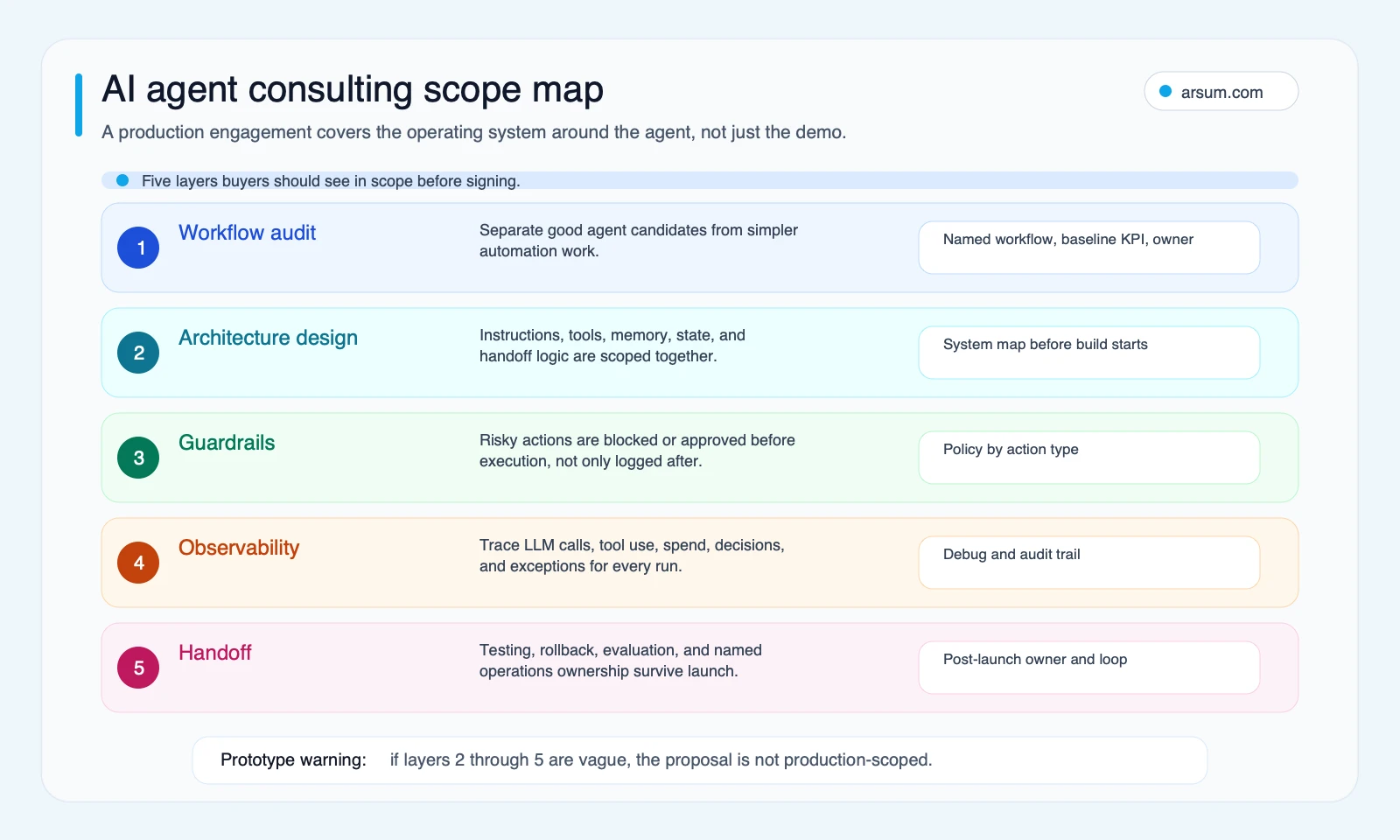
A partner may reasonably scope only one phase. That is not inherently a problem. The issue is ambiguity: a discovery engagement should not be sold as production delivery, and a prototype should not hide the work required to earn live permissions.
The minimum architecture questions
Ask every prospective partner to answer these questions in writing:
- What source systems provide the facts the agent will use, and how is source lineage retained?
- What tools can the system read from, write to, or invoke?
- Which actions are autonomous, which require approval, and which are prohibited?
- What happens when the system cannot classify an item, conflicts with source data, or exceeds a policy limit?
- What trace is retained for each run, including tool calls, approvals, exceptions, and final action?
- Who can pause the workflow, restore the prior process, and approve a change to its behavior?
NIST’s AI Risk Management Framework supports treating trustworthiness as a design, development, use, and evaluation concern—not an after-launch review exercise.
Operator note: Reliability is usually a workflow-design question before it is a model-selection question. State, permissions, recovery logic, and ownership determine whether a bad run is visible and recoverable.
Choose the right execution model before buying consulting
A consulting firm should be willing to recommend a simpler system when it fits. The following router is more useful than a generic list of “AI agent use cases.”
| Workflow condition | Recommended approach | Required control |
|---|---|---|
| Fixed inputs, clear rules, predictable output | Deterministic automation | Validation rules and exception queue |
| Structured workflow with variable reading or drafting step | Hybrid workflow with an agent node | Source citation, confidence threshold, human review for external actions |
| Variable inputs, contextual judgment, multiple tools | Narrow agentic workflow | Tool boundaries, tracing, approval policy, rollback |
| High-impact or difficult-to-reverse external action | Human-led or approval-gated agent assistance | Named approving owner and tested recovery procedure |
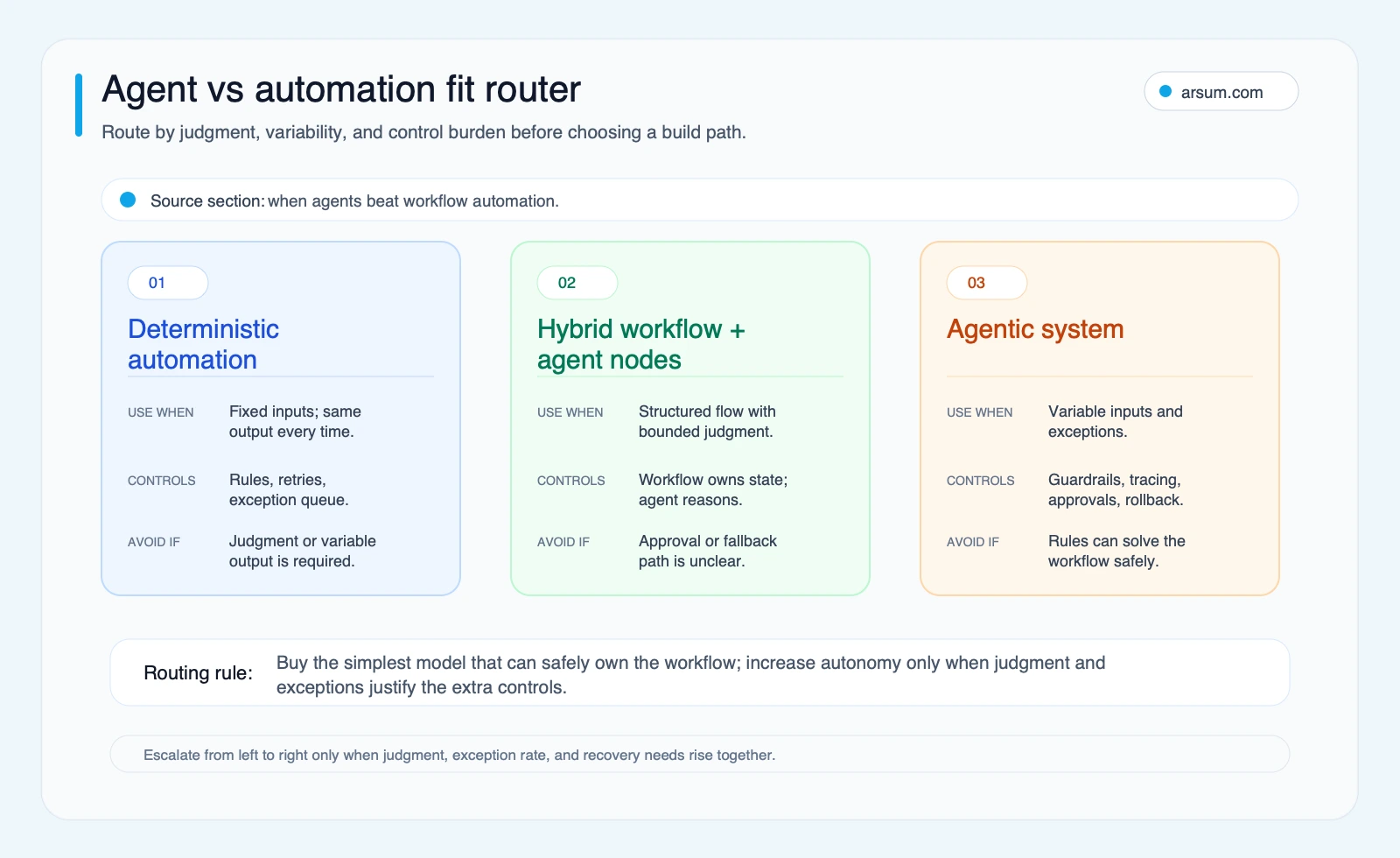
A useful example is inbox operations. Routing messages from a known category list may be deterministic automation. Classifying ambiguous requests, locating policy context, and drafting a response may justify an agent-assisted step. Sending a response that changes a customer commitment should remain approval-gated until the organization has evidence that the policy, evaluation, and exception path work.
Practitioner discussions can help surface questions, but not establish market-wide outcomes. In one Hacker News discussion, participants warned that stakeholders can fixate on autonomous “agentic workflows” before proving simpler wins. In another discussion, builders described practical systems as tool orchestration with distinct read and write responsibilities. Those are qualitative signals, not benchmarks; use them to test a consultant’s scope.
For implementation choices, compare AI agent architecture patterns with AI agent frameworks before committing to a platform-led design.
Screen the workflow on two separate axes
Do not combine value and risk into one “agent fit” score. A workflow can be a strong opportunity and still be ineligible for autonomous action.
Axis 1: value and automation fit
Score each item from 1 to 5.
| Dimension | 1 | 3 | 5 |
|---|---|---|---|
| Judgment need | Rules resolve most cases | Some contextual interpretation | Outcome depends on context across sources |
| Input variability | Stable form or schema | Mixed formats | Unstructured, changing, or incomplete inputs |
| Exception burden | Rare and pre-defined | Periodic manual handling | Frequent, varied exceptions |
| Decision frequency | Infrequent | Regular | Repeated enough to justify system design |
A higher result suggests the workflow may benefit from agentic or hybrid assistance. A low result is not a failed AI initiative; it usually points toward ordinary automation, better process design, or no automation.
Axis 2: control burden and autonomy eligibility
Score each item from 1 to 5.
| Dimension | 1 | 3 | 5 |
|---|---|---|---|
| Reversibility | Easily undone | Partial recovery possible | Difficult or impossible to reverse |
| Permission scope | Read-only internal access | Internal write access | External communications, payments, deployments, or sensitive changes |
| Audit requirement | Low | Internal accountability | Regulatory, contractual, or formal evidentiary need |
| Cost of failure | Limited and recoverable | Material rework or customer impact | High financial, legal, safety, or reputational impact |
High control burden does not make a workflow a better candidate for autonomy. It changes the design:
- Low burden: a supervised pilot may allow limited automated actions.
- Moderate burden: use approval gates, constrained permissions, and an exception queue.
- High burden: start read-only, draft-only, or human-led. Do not promote to autonomous action until controls and evidence support it.
A workflow with high value fit and high control burden may still be worth pursuing. Its first deliverable should be a controlled assistance design, not autonomous execution.
Require a pilot scorecard, not a promise of ROI
Consulting proposals often mention efficiency without specifying what will be measured. Replace vague benefit language with a written pilot acceptance scorecard.
| Item | What to define before build |
|---|---|
| Baseline | Current monthly volume, cycle time, rework rate, backlog, or reviewer effort for the selected workflow |
| Target | A planning target for the chosen metric, clearly labeled as a target rather than an observed result |
| Quality metric | Required accuracy, policy-compliance rate, source-citation completeness, or reviewer acceptance rate |
| Exception taxonomy | Missing data, conflicting sources, low-confidence output, prohibited action, system failure, and human override |
| Approval owner | The named functional role allowed to approve action boundaries and promotion decisions |
| Review cadence | For example, review every pilot run initially, then revisit sampling only after acceptance criteria are met |
| Evidence retained | Inputs, source references, outputs, tool calls, approval records, exceptions, and version changes |
| Stop condition | The condition that pauses the pilot, such as repeated policy failures or an unresolved high-severity incident |
| Rollback path | How access is disabled and how the prior manual or deterministic process resumes |
| Promotion rule | The documented threshold for moving from draft-only to limited live action, if that step is authorized |
Here is illustrative planning arithmetic, not a reported result: if a process handles 500 cases per month, current review takes 12 minutes per case, and a pilot target is to reduce only the pre-review preparation by 4 minutes while retaining human approval, the capacity hypothesis is 2,000 minutes per month. That hypothesis still needs a quality threshold, exception review, and owner sign-off before it becomes a business case.
A qualified workflow assessment should produce this scorecard alongside the process map and control boundary—not simply a technical recommendation.
💡 Arsum builds custom AI automation solutions tailored to your business needs.
Get a Free Consultation →Compare proposals for production readiness
Use a 0–2 scoring model when vendors make similar capability claims.
| Capability | 0 points | 1 point | 2 points |
|---|---|---|---|
| Workflow audit | No candidate assessment | Mentioned in sales conversations | Named output with baseline and selection criteria |
| Action boundary | No permission model | Generic “human in the loop” language | Explicit read/write/action matrix and approval triggers |
| Guardrails | Generic safety statement | Some checks named | Blocking rules tied to tools, data, and action types |
| Tracing | No run-level detail | Logging mentioned | Run traces, tool history, exception records, and review workflow |
| Evaluation | Demo judged informally | Test cases discussed | Defined evaluation set, acceptance criteria, and change process |
| Rollback | Not addressed | Pause capability implied | Tested disablement, recovery owner, and prior-process path |
| Operating ownership | Handoff at launch | Optional support language | Named owner, cadence, incident route, and responsibility boundaries |
A low score is not proof that a vendor is incapable. It means the proposal does not yet show enough information for a production commitment. Ask for the missing deliverable, an explicit exclusion, or a phased scope.
Build, buy, or partner?
Choose based on the workflow boundary, not on the novelty of the model.
| Option | Better when | Watch for |
|---|---|---|
| Buy a platform | The workflow is common, the integration surface is supported, and control requirements fit the product | Hidden constraints on data access, evaluation, export, and action approvals |
| Connect existing systems | The process is largely deterministic and your systems already expose reliable APIs | Custom exception handling quietly becoming an agent project |
| Build a narrow workflow | The workflow is differentiated, sources or policies are unique, and the team can own the operating model | Treating a prototype as the end state |
| Partner for consulting and delivery | You need workflow selection, architecture, implementation, and control design across business and technical owners | A scope that promises “end-to-end” delivery without named operating deliverables |
If the decision is primarily between an automation provider and a custom delivery partner, AI automation consulting and custom AI agent development services provide useful adjacent buying criteria.
Budget by phase, with uncertainty made visible
There is no validated, universal price range for an AI agent consulting engagement. Costs depend on integrations, data condition, evaluation requirements, required availability, permission scope, security review, and who owns operations after launch. Treat any precise estimate without a scope model as a sales input, not a planning fact.
Instead, require the proposal to separate:
- Discovery and workflow definition
- Prototype or controlled proof of value
- Production hardening
- Launch and change-management work
- Ongoing operations, incident response, evaluation, and model updates
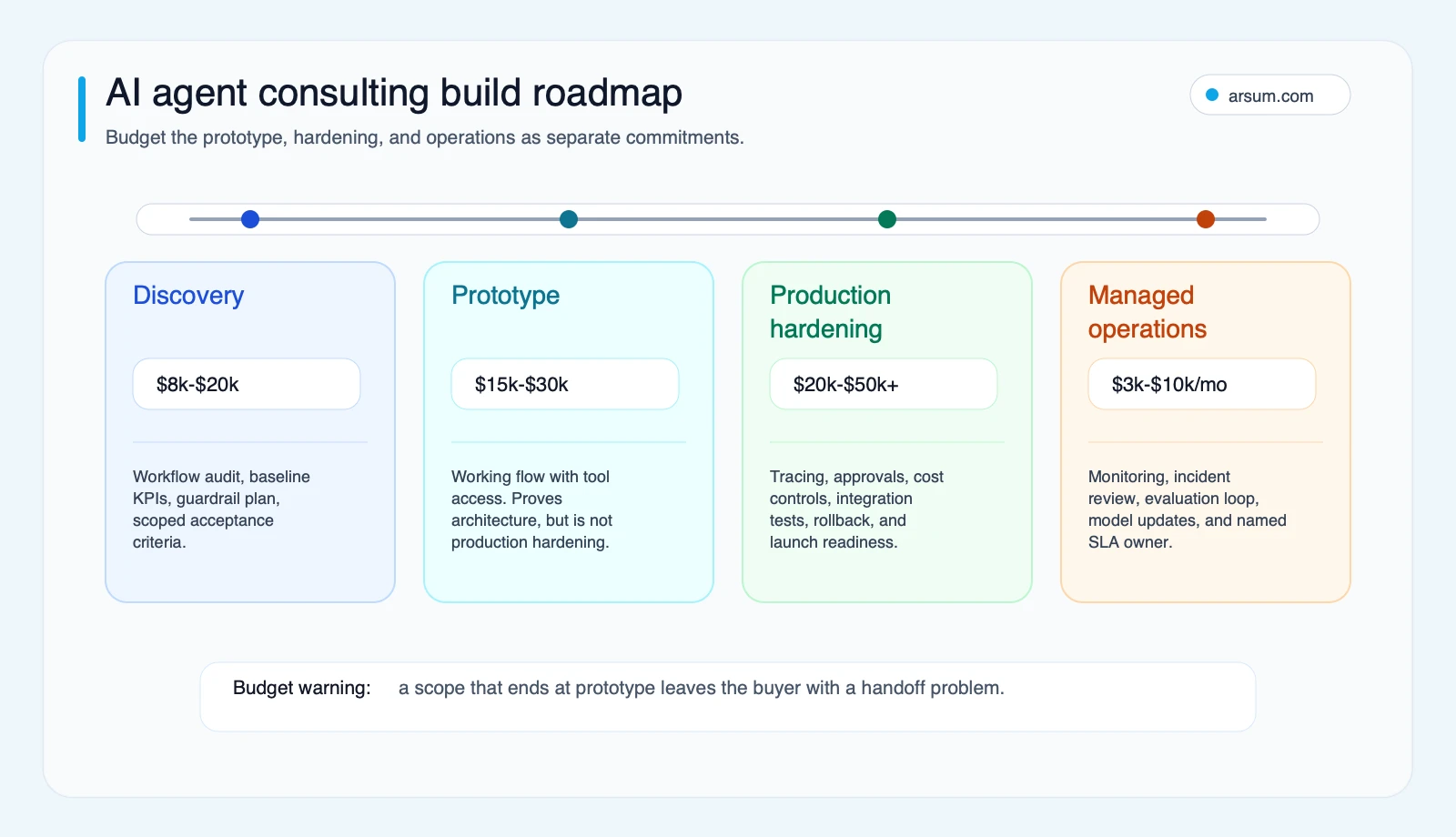
The roadmap is useful because it prevents a common category error: comparing one vendor’s prototype quote with another vendor’s production operating scope. Neither is necessarily overpriced; they may not be quoting the same thing.
Ask each bidder to state what is excluded from the estimate, what must be supplied by your team, and which control requirements would change scope. If a vendor cannot separate these phases, you cannot responsibly compare total ownership or launch risk.
Disqualifying conditions and failure modes
Some workflows should not begin with an autonomous agent.
Disqualify or constrain the initial scope when:
- There is no process owner who can define acceptance and approve exceptions.
- Source data is unreliable, inaccessible, or cannot be cited back to the reviewer.
- The organization cannot pause the workflow and resume a safe fallback process.
- The first use case requires irreversible financial, legal, safety, or external communication actions.
- The team has no capacity to review pilot outputs and maintain an evaluation set.
- Permissions cannot be restricted to the minimum necessary tools and records.
Common failures are similarly concrete: unclear source-of-truth rules, broad tool access, untested exception paths, a missing approval owner, and no practical way to inspect a run after something goes wrong. OpenAI’s tooling emphasizes guardrails and tracing because production systems need mechanisms to interrupt and understand behavior, not merely detect an issue after the fact.
A useful consultant will surface these conditions early. “Not yet” can be the correct discovery outcome.
Questions to ask before signing
- Which workflow do you recommend first, and what makes it better than a deterministic alternative?
- What is the proposed initial autonomy level: read-only, draft-only, approval-gated, or limited autonomous action?
- Which systems, records, and tools are in scope—and which are expressly out of scope?
- What evidence is retained for every action and exception?
- What exact conditions stop the pilot?
- Who approves a production promotion and who owns the system after launch?
- What is the tested rollback path?
- Which work belongs to discovery, prototype, hardening, and ongoing operations?
- What assumptions drive the estimate, and what would materially change it?
Frequently asked questions
What does an AI agent consultant do?
An AI agent consultant should help select a workflow, define the action boundary, design the architecture and controls, implement or oversee implementation, and establish an operating model for evaluation and exceptions. If the engagement only produces a demo, it is prototype delivery rather than full production consulting.
When should we use an AI agent instead of automation?
Use an agent or hybrid design when contextual judgment across variable inputs materially changes the outcome. Use deterministic automation when the process is stable and rule-based. Start with the simplest system that can meet the requirement, consistent with Anthropic’s engineering guidance.
How do we keep an agent controlled in production?
Constrain tools and permissions, define approval triggers, retain traces and source evidence, maintain an exception queue, test rollback, and assign a functional owner. High-impact actions should reduce allowed autonomy until the organization has evidence that controls work.
What should a pilot prove?
A pilot should prove a bounded workflow result against a baseline and quality threshold. It should also prove the exception route, review process, evidence retention, stop condition, and rollback path—not just that a model can complete a happy-path task.
Methodology: This guide uses the OpenAI Agents SDK, Anthropic’s agent engineering guidance, and the NIST AI Risk Management Framework for architecture and governance framing. Practitioner discussions are included only as qualitative signals about buyer questions and failure modes; they are not market-wide measurements. No external cost, savings, accuracy, or adoption benchmark is asserted here.
Ready to Automate Your Business?
Stop wasting time on repetitive tasks. Let AI handle the busywork while you focus on growth.
Schedule a Free Strategy Call →Written by:Arsum editorial team
- Reviewed by
- Arsum editorial team
- Published
- June 6, 2026
- Updated
- July 12, 2026
- How this was produced
- Arsum uses research packs, source checks, and human editorial review to prepare and update blog articles. Editors are responsible for the final page.
- Source policy
- Sources are linked in the article when used. Methodology and source notes are included on higher-risk or high-visibility pages and are being rolled out across the archive. Editorial policy.
- Why this page exists
- Help B2B operators evaluate AI automation, implementation scope, cost, risk, and build-vs-buy decisions with practical context.