The vendor that demos an AI agent and the vendor that can ship one to production are often the same company in name only. The demo takes an afternoon. The production system takes months, costs significantly more, and requires architecture, guardrails, observability, and rollout design that never appear in an initial pitch.
Most search results for “AI agent development services” are capability pitches or vendor directories. They describe what AI agents can do. They rarely help a buyer evaluate what a real engagement should deliver, when an agent is the right solution, what production architecture requires, or how to tell the difference between a partner that builds demos and one that builds systems.
Quick Answer: What to Expect from AI Agent Development Services
What it is: A serious AI agent development engagement scopes workflow design, orchestration architecture, memory and state management, tool integrations, guardrails, observability, rollout gating, and post-launch operations – not just the model layer.
Cost benchmarks (mid-market B2B, 2026):
| Phase | Typical Duration | Budget Range |
|---|---|---|
| Discovery workshop | 1–3 weeks | $10,000–$25,000 |
| Prototype build | 3–6 weeks | $30,000–$75,000 |
| Production hardening | 4–10 weeks | $60,000–$150,000+ |
| Managed operations | Ongoing | $3,000–$15,000/month |
Decision framing: A proposal covering discovery and prototype only is not a quote for a production AI agent system. Full production delivery, including security review, approval flows, observability, and managed operations, typically adds 2–3x the prototype cost.
Source-backed baseline: OpenAI defines an agent as “a system with instructions, guardrails, and access to tools that takes action on behalf of a user or process” – a definition that separates agents from chatbots and scopes what a delivery engagement must cover. Anthropic recommends “starting with the simplest solution possible,” distinguishing predictable workflows from flexible agent systems, which provides the clearest published framing for when agents beat simpler automation.

Use the ladder to separate prototype scope from production scope before comparing vendor quotes.
Want to automate this for your business? Let's talk →
What AI Agent Development Services Actually Cover
A serious AI agent development engagement scopes and delivers all of the following:
- Workflow discovery and definition (what the agent is replacing or augmenting)
- Orchestration architecture (how the agent decides what to do and in what sequence)
- Memory and state management (how the agent tracks context across multi-step workflows)
- Tool integrations (what systems the agent can call, read from, or write to)
- Guardrails (what the agent can do autonomously versus what requires human approval)
- Observability setup (step-by-step tracing, cost monitoring, audit logging)
- Rollout design (shadow mode, quality gates, gradual promotion)
- Post-launch monitoring and iteration support
Commodity vs. Production-Grade: What the Gap Looks Like
| Capability | Commodity Vendor | Production-Grade Partner |
|---|---|---|
| Agent definition | LLM wrapped in an API | Orchestrated system with memory, tools, and guardrails |
| Workflow design | Generic prompt + one integration | Mapped workflow, scoped edge cases, handoff design |
| Guardrails | Prompt-level instructions | Input, output, and tool-level enforcement in code |
| Observability | Logs if something crashes | Step-by-step traces, cost monitoring, audit trails |
| Rollout | Deploy and monitor | Shadow mode, quality gates, gradual promotion |
| Post-launch | Handoff after delivery | Monitoring, model version management, iteration |
| Failure handling | Fix if it breaks | Rollback strategy, escalation paths, incident review |
The gap between those two columns is where most buyer disappointment originates, and where most timeline and cost overruns live.
Operator Note: The most common engagement failure pattern we see is a buyer committing to a build before completing discovery. A discovery workshop that produces a scope document and architecture sketch before a single line of code is written is not optional overhead. It is the only reliable way to scope and price a production build accurately. Buyers who skip discovery to save $15,000 commonly absorb $50,000–$100,000 in scope-change costs when production requirements surface mid-build.
What Most AI Agent Service Articles Don’t Tell You
The AI agent development services category has a structural information gap. Vendor pages sell capability. Directory listings rank providers. Neither gives buyers the decision-support they need before committing to a six-figure engagement. These are the four things that rarely appear in vendor content but that distinguish production engagements from demo builds.
The discovery-to-production budget gap is predictable and routinely hidden. Most initial proposals cover discovery and prototype. Production hardening, which includes full integrations, approval flows, observability infrastructure, security review, and rollout gating, typically costs 2–3x the prototype phase. Buyers who accept prototype-only proposals without asking about production scope are making a partial budget commitment without realizing it. The remainder surfaces when the prototype is done and the vendor presents a new statement of work.
Prompt-only guardrails are a standard anti-pattern that demos well and fails in production. When an agent’s behavioral constraints live only in prompt instructions, they degrade under edge cases, long workflows, and adversarial inputs. The OpenAI Agents SDK documentation distinguishes input, output, and tool-level guardrails enforced in code from prompt instructions – a distinction that matters enormously in production but is invisible in demos. Buyers should ask explicitly where guardrails live: in the prompt, in application code, or in an external enforcement layer. Only the latter two are production-reliable.
Workflow ownership is the most common unstated assumption on both sides. Vendors typically assume the buyer owns workflow design. Buyers typically assume the vendor owns it. In practice, workflow design requires someone who understands both the business process in depth and the agent’s technical constraints – a combination that rarely sits fully on either side. Engagements without an explicit workflow ownership plan tend to produce agents that automate the wrong thing or that cannot be maintained after handoff.
Model version management is a production cost that almost never appears in initial proposals. When an underlying model is deprecated, updated, or changed in pricing, production agents require re-evaluation, prompt testing, and often architectural changes. This ongoing cost is real, recurring, and not optional for any agent running in a business-critical workflow. Proposals that do not address it are leaving a material operational cost off the table.
For context on how agentic workflows apply across different business functions and where they create measurable returns, see Agentic AI Workflow Automation.
When Agents Beat Simpler Automation: A Workflow Scorecard
The right first question is not whether to build an agent. It is whether your workflow actually needs one.
Simpler automation, including rule-based workflow tools, deterministic scripts, or fixed-pipeline AI, handles predictable work reliably and at lower cost and complexity. Agents add value when a workflow involves variable decision-making, multi-step reasoning, unstructured inputs, or exceptions that cannot be encoded in advance.
Anthropic’s published engineering guidance on building effective agents recommends starting with the simplest solution possible and explicitly distinguishes predictable workflows from flexible agent systems. The added complexity of an agent carries real cost: orchestration overhead, inference cost per step, observability requirements, and a higher failure surface area.
Workflow Candidacy Scoring Model
Score each factor 1–3, where 3 indicates strong agentic fit. Add scores at the end.
| Factor | Score 1: Automation Likely Sufficient | Score 2: Evaluate Carefully | Score 3: Strong Agent Candidate |
|---|---|---|---|
| Input variability | Predictable, structured | Semi-structured with known exceptions | Unstructured or highly variable |
| Decision complexity | Single rule or threshold | Multiple conditional branches | Judgment required at runtime |
| Exception rate | Rare, handled by one rule | Occasional, needs routing logic | Frequent, unpredictable |
| Tool calls required | None or single, fixed | 2–3 fixed calls in sequence | Multiple, sequence determined at runtime |
| Cost of failure | Low | Medium, reversible | High but reversible with audit trail |
| Auditability requirement | Low | Standard logging | Full trace with human review points |
Interpretation: Total 6–9: deterministic automation likely sufficient. Total 10–14: evaluate agent architecture carefully against added complexity. Total 15–18: strong agent candidate where agentic design creates clear value.

Use the scorecard to decide whether a workflow deserves agent architecture or whether simpler automation should be the first build path.
Example applications of this scorecard:
- Inbound lead qualification: Inputs vary significantly (different company sizes, industries, contact history); decision logic requires comparing against ICP criteria that change; tool calls include CRM lookup, enrichment, and routing. Score typically 14–16 – strong agent candidate.
- Invoice processing with a fixed vendor list: Inputs are structured PDFs with consistent formats; decisions follow clear matching rules; tool calls are single-step ERP writes. Score typically 7–9 – deterministic automation likely sufficient.
- Contract review for compliance flags: Documents vary significantly in structure and clause language; decisions require judgment against policy criteria; audit trail is required. Score typically 15–17 – strong agent candidate with mandatory human review gates.
Architecture and Guardrails: What Production Requires
A demo agent can be built in a day. A production agent requires considerably more. The gap is the primary driver of timeline and cost overruns in AI agent development services engagements.
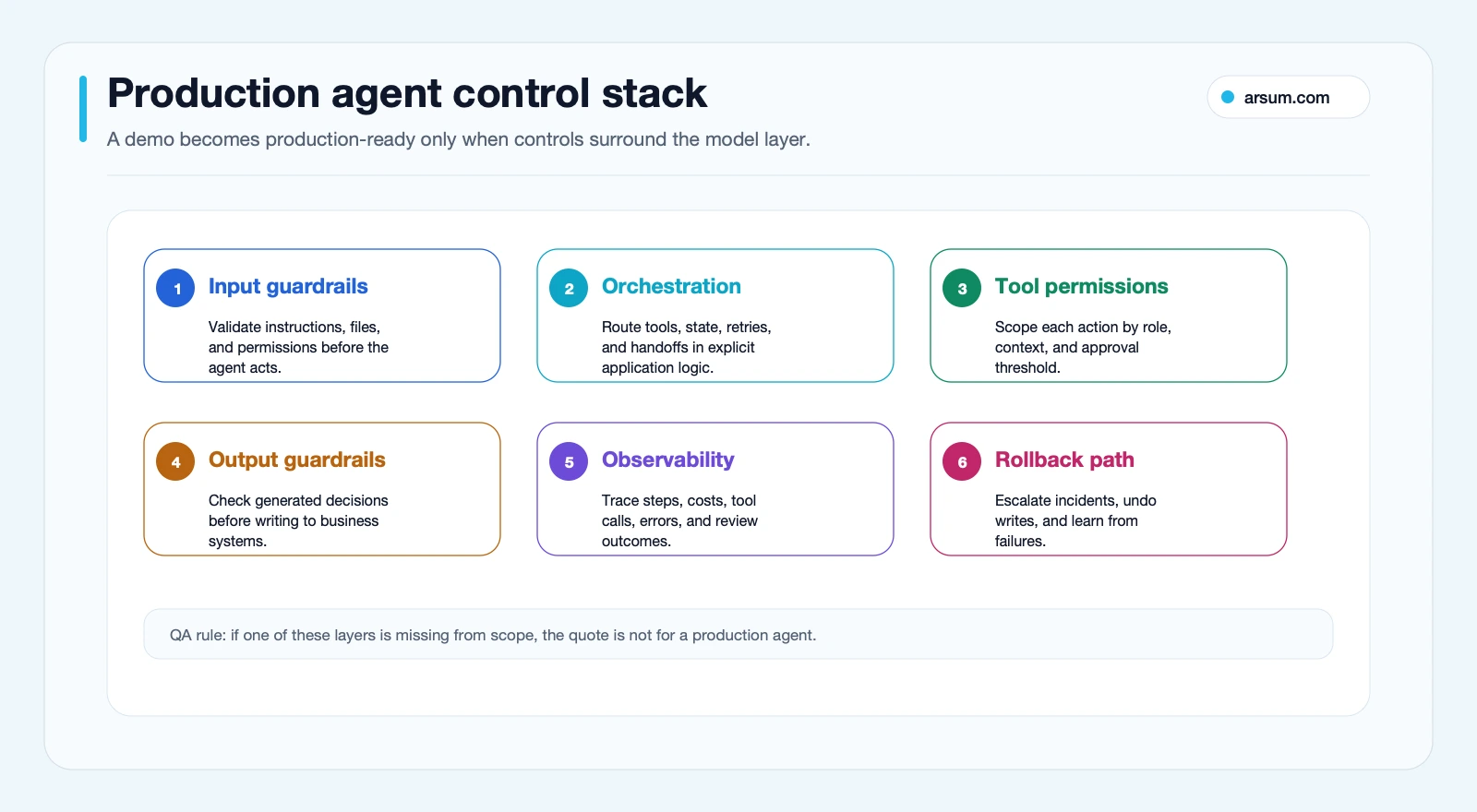
Orchestration layer. The logic that decides which tools to call, in what order, and based on what state. This can be built on frameworks like the OpenAI Agents SDK or Anthropic’s API with custom routing, but the orchestration design determines how well the agent handles unexpected inputs and edge cases.
Memory and state management. Agents tracking context across multi-step workflows require external state management beyond conversation history. Without it, long-running workflows drift: the agent loses track of prior decisions, repeats actions, or contradicts earlier outputs. This failure mode does not surface in demos, where workflows are short and controlled, but is consistently reported in complex production deployments.
Guardrails. The OpenAI Agents SDK documentation distinguishes input guardrails (checking what instructions or data reach the agent), output guardrails (checking what the agent produces before it is acted on), and tool-level guardrails (restricting which tools can be called in which contexts). Together, these define the boundary between what the agent can do autonomously and what requires a human decision. Guardrails that live only in the prompt are weaker than guardrails enforced in code – a distinction that is invisible in demos but material in production.
Observability. Step-by-step tracing of what the agent did, what tools it called, what it received back, and what it decided next. The OpenAI Agents SDK tracing documentation notes that the SDK records LLM generations, tool calls, handoffs, guardrail evaluations, and custom events – all of which become the basis for debugging, cost control, and post-incident review. Without observability, production failures are nearly impossible to diagnose reliably. Cost monitoring is equally critical: agents that make repeated tool calls without token-cost visibility can generate significant infrastructure spend before the issue surfaces.
Tool permission design. Each tool the agent can call is a surface for errors, cost overruns, and permissions questions. Tool design includes defining what each tool does, when the agent is allowed to call it, what parameters it can pass, and what the fallback is when it returns an error. Agents that accumulate broad tool access without policy-bound execution represent a compounding risk that grows with every integration added.

Use the control stack to test whether the engagement is scoped for a production agent or only for a working demo.
Before and After: Inbound Lead Qualification
Before (manual workflow): SDR reviews each inbound form submission manually, researches company fit in CRM and LinkedIn, categorizes as ICP or non-ICP, and routes appropriately. Average handling time: 8–12 minutes per lead. After-hours submissions queue until the next morning.
After (agent-handled): Agent receives inbound submission, queries CRM for existing account data, runs a company fit check against ICP criteria using enrichment tools, categorizes and routes automatically, and flags ambiguous cases for SDR review with a pre-filled context card. Average handling time: under 60 seconds. After-hours submissions routed within minutes. SDR time shifts from research to review and outreach.
What made this workflow agentic: The process shape was predictable (receive, research, categorize, route) but the input content varied significantly (different company sizes, industries, prior contact states, source channels). Agents handle the variability while the workflow logic remains auditable and bounded. That combination, structured process with variable content, is the pattern that consistently justifies agent architecture over deterministic automation.
For a deeper treatment of architecture patterns and framework options for production agents, see AI Agent Architecture Patterns.
💡 Arsum builds custom AI automation solutions tailored to your business needs.
Get a Free Consultation →Scope, Timeline, and Cost: Why the Numbers Vary
Buyers regularly find that timelines quoted for AI agent development services do not match reality. The reason is usually that different vendors are scoping different phases, and only one of those phases produces a system that runs in production.
Phase-by-Phase Timeline and Cost Framework
| Phase | Typical Duration | What Is Delivered | Budget Range |
|---|---|---|---|
| Discovery workshop | 1–3 weeks | Scope document, architecture sketch, integration feasibility, risk assessment | $10,000–$25,000 |
| Prototype build | 3–6 weeks | Core agent logic, 1–2 tool integrations, basic guardrails, internal testing | $30,000–$75,000 |
| Production hardening | 4–10 weeks | Full integrations, approval flows, observability, security review, rollout gating | $60,000–$150,000+ |
| Managed operations | Ongoing | Monitoring, prompt tuning, model version management, edge case handling | $3,000–$15,000/month |
Ranges reflect Arsum’s assessment of common market pricing for mid-market B2B agentic workflows. Scope, integration complexity, security requirements, and human-in-the-loop design add cost at every phase.
What buyers miss most in proposals:
A proposal covering discovery and prototype only is not a quote for a production AI agent system. Managed operations – ongoing monitoring, model version transitions, and edge case handling – are routinely absent from initial proposals even though most production deployments require active management for at least the first six to twelve months.
The other common mis-scoping pattern is treating security review and observability as optional phases rather than production requirements. Agents that execute in business systems with real data require audit logging, cost controls, and incident review capability before they go live. Adding these after the prototype is completed costs more and takes longer than building them in from the start.
The compounding cost of deferred observability: Engagements that deliver a prototype without observability infrastructure often require a near-complete rebuild of the monitoring and tracing layer before production launch. The additive cost of retrofitting observability is typically 30–50% of the prototype cost, and the effort is entirely avoidable if observability is scoped as a production requirement from discovery.
For context on agency engagement models and pricing structures across AI automation services, see AI Automation Agency Pricing.
Security and Human-in-the-Loop Design
Production agents that take consequential actions – sending emails, writing database records, triggering payments, submitting forms – require pre-execution authorization design, not only post-hoc monitoring.
NIST’s AI Risk Management Framework states that trustworthiness considerations should be incorporated “into the design, development, use, and evaluation of AI systems.” For agentic systems with real-world tool access, this translates into specific design requirements a buyer should verify before committing:
- Which actions the agent can take autonomously, with no human checkpoint
- Which actions require human approval before execution, not after
- What the fallback is when the agent encounters ambiguous input it cannot resolve
- How the system logs, traces, and surfaces decisions for post-incident review
- Whether critical tool permissions are bound by code-level policy or prompt instructions alone
Shadow mode validation as a production standard. A pattern increasingly standard in enterprise-grade deployments is shadow mode validation: the agent runs against real data but takes no live actions until it has passed quality gates and received human approval. This approach reduces launch risk and gives the business team a window to audit agent behavior before consequences are irreversible.
Production systems that skip this step commonly discover edge cases after launch, at the cost of downstream cleanup, trust erosion, and delayed rollout. The remediation effort after a live production failure is typically two to three times the cost of the validation work that would have caught the same issue before deployment.
The pre-execution authorization distinction. Many agent security designs focus on monitoring what the agent did after the fact. More robust designs bind tool execution to explicit allow, deny, or escalate policies that run before the action executes – not only after. For workflows where an agent action is difficult to reverse (a sent email, a submitted form, a written database record), pre-execution authorization is the operative safety layer. Post-hoc monitoring is necessary for debugging and compliance, but it does not prevent consequential actions from reaching production systems.
For AI agent security architecture, governance patterns, and authorization design in production environments, see AI Agent Security.
Work With Arsum
We help businesses implement AI automation that actually works. Custom solutions, not cookie-cutter templates.
Learn more →Use Cases with the Strongest ROI Signal
Not every workflow that can be agentic should be. The strongest returns come from workflows that combine high repetition, meaningful per-unit handling time, variable inputs requiring judgment, and a clear downstream impact on revenue or operational cost.
| Use Case | Workflow Type | Key Agent Capability | Buyer ROI Signal |
|---|---|---|---|
| Inbound lead qualification | Revenue operations | CRM lookup, ICP scoring, routing | SDR capacity freed for outreach vs. research |
| Contract review and flag | Legal/compliance | Document parsing, clause extraction, exception flagging | Review cycle reduction; reduced risk surface |
| Tier-1 support triage | Customer success | Issue categorization, knowledge base lookup, escalation routing | Ticket deflection rate; first-response time |
| Procurement matching | Finance/ops | Vendor database lookup, criteria matching, approval routing | Procurement cycle time reduction |
| Content compliance review | Marketing/legal | Policy lookup, flag generation, rewrite suggestion | Review bottleneck elimination |
| Onboarding document collection | HR/admin | Document checklist tracking, nudge sequencing, completion verification | HR time per hire reduction |
These use cases share a common structure: predictable process shape with variable input content. Agents handle the variability while the workflow logic remains auditable and bounded. That combination keeps guardrail design tractable and approval logic clear – which is what makes these workflows viable in production rather than only in demos.
Workflows where the process itself is poorly defined, or where exceptions are the norm rather than the edge case, require process design work before agent development. Jumping to a build without a defined workflow design is the fastest way to produce a prototype that cannot be promoted to production.
For broader examples of how businesses apply AI agents across different functions, see AI Agents for Business.
Vendor Evaluation Checklist
The AI agent development services market mixes enterprise consultants, custom software shops, and vendor directories. Most can build a demo. Fewer can deliver a production system that a non-technical operations team can run, audit, and maintain.
The fastest way to distinguish delivery partners from capability pitches is to ask specific questions about what happens after the demo.
Pre-engagement evaluation checklist:
- Workflow ownership: Who maps and owns workflow design, and is that role separate from the engineering team?
- Guardrail architecture: Where do guardrails live: in the prompt, in application code, or in an external enforcement layer?
- Rollout process: What does rollout design look like before the agent touches production data or takes live actions?
- Rollback plan: What is the rollback strategy if something goes wrong after launch?
- Post-launch support: What does post-launch monitoring cover, and who is responsible after project handoff?
- Observability tooling: What tracing and cost monitoring is included, and what does the client team need to operate it independently?
- Human-in-the-loop design: Which actions require human approval, and is that enforced in the prompt or in code?
- Evaluation framework: How is the agent tested before production, and what constitutes a passing grade?
- Model version management: Who handles the transition when an underlying model is deprecated or updated?
- Discovery scope: Does the proposal include a discovery phase before any code is written, or does it skip to prototype?
- Production hardening: Is production hardening (integrations, security review, observability, rollout gating) explicitly scoped, or is it absent from the proposal?
A partner that cannot answer these questions with specifics is selling capability, not a delivery plan.
Google Risk Box: The AI agent development services SERP is currently dominated by thin service pages and directory listings that answer none of these buyer questions. Articles and pages that treat this category with depth – including architecture detail, cost frameworks, and honest tradeoff analysis – substantially outperform on engagement and conversion because buyers are genuinely underserved by the current results. Thin content that describes agent capability without helping buyers make decisions is a commodity play in a space where buyers have high willingness to pay for the right partner and limited tools to evaluate them before a discovery call.
Frequently Asked Questions
What is an AI agent consultant?
An AI agent consultant scopes, designs, and oversees the development of agentic AI systems for business workflows. In practice, this means mapping target workflows, specifying architecture and guardrails, managing integration design, and ensuring the system is observable and operable after launch – not just functional in a demo. Many AI agent consultants also provide ongoing management support after initial deployment, including model version management, edge case handling, and workflow iteration.
How much does AI agent development cost?
Cost varies significantly by phase and scope. A discovery workshop typically runs $10,000–$25,000. A prototype build adds $30,000–$75,000. Production hardening – including full integrations, approval flows, observability, security review, and rollout gating – adds $60,000–$150,000 or more. Managed operations add $3,000–$15,000 per month ongoing. A proposal covering all four phases is the only reliable basis for a production budget. A discovery-and-prototype-only quote is not a quote for a production system.
Which workflows are good candidates for AI agents?
Workflows with high input variability, multi-step decision-making, multiple tool calls determined at runtime, and meaningful exception rates are the strongest candidates. The workflow candidacy scorecard above provides a scoring model for assessing fit. Workflows that are predictable, linear, and low-exception are usually better served by deterministic automation at lower cost and complexity.
How do you keep AI agents reliable in production?
Reliability in production requires guardrails enforced in code rather than only in prompts, step-by-step observability, cost monitoring, a tested rollback strategy, and human approval gates for consequential actions. Shadow mode validation before full deployment is increasingly standard. Agents running in production without tracing, cost controls, and human-in-the-loop design for high-stakes actions are production risks, not production systems. Model version management is also necessary: when an underlying model changes, production agents require re-evaluation and often architectural adjustment.
What separates a demo from a production agent?
The demo proves the model can execute the workflow under controlled conditions. The production agent handles edge cases, manages external state across steps, enforces guardrails in code rather than prompts, traces every action for auditability, manages cost across repeated runs, and recovers gracefully from tool failures. Production hardening – the phase that adds these capabilities – is typically absent from initial proposals and represents the majority of delivery risk.
Ready to Automate Your Business?
Stop wasting time on repetitive tasks. Let AI handle the busywork while you focus on growth.
Schedule a Free Strategy Call →Methodology and Sources: OpenAI developer documentation on building agents and the OpenAI Agents SDK documentation on guardrails and tracing (accessed May 2026); Anthropic engineering guidance on building effective agents (accessed May 2026); NIST AI Risk Management Framework. Cost and timeline ranges reflect Arsum’s assessment of market pricing for mid-market B2B agentic deployments based on engagement experience; ranges should be validated against specific project scope, integration complexity, and security requirements. Research methodology included live SERP review across Yahoo and Bing for the exact keyword and close commercial variants, practitioner discussion monitoring across developer forums, official SDK documentation review, and research-pack gate validation conducted May 2026. Last reviewed: June 2026.
Reviewed by the Arsum editorial team.