For a founder, the ai agent frameworks founder view is simple: do not choose a framework until you can name one workflow, its accountable owner, the actions it may take without approval, and the business metric that would justify operating it. Many teams need a smaller coded workflow, an existing automation tool, or no agent framework at all.
AI Agent Frameworks Founder View: Practical Guide
Explore ai agent frameworks founder view: compare workflow fit, costs, risks, evidence, and practical next steps before you build, buy, or hire.

Table of Contents
- What Most Guides Miss: Framework Choice Is the Fourth Decision
- Start With the Workflow Boundary, Not Agent Ambition
- A Founder Framework-Selection Worksheet
- What the Primary Documentation Supports
- Worked Pilot: Controlled Account-Research Briefs
- Month-Three Survivability: A Discussion Rubric, Not “Original Data”
- Practitioner Signals: Useful Warnings, Not Market Statistics
- The 30-Day Evaluation Sprint
- Publishing and Customer-Facing Work Need a Higher Bar
- Final Founder View
- Methodology
What Most Guides Miss: Framework Choice Is the Fourth Decision
Framework comparisons usually begin with tools, memory, agents, graphs, handoffs, or tracing. Those are implementation features. They do not tell you whether the proposed system should exist, what it is authorized to do, or who owns the consequences.
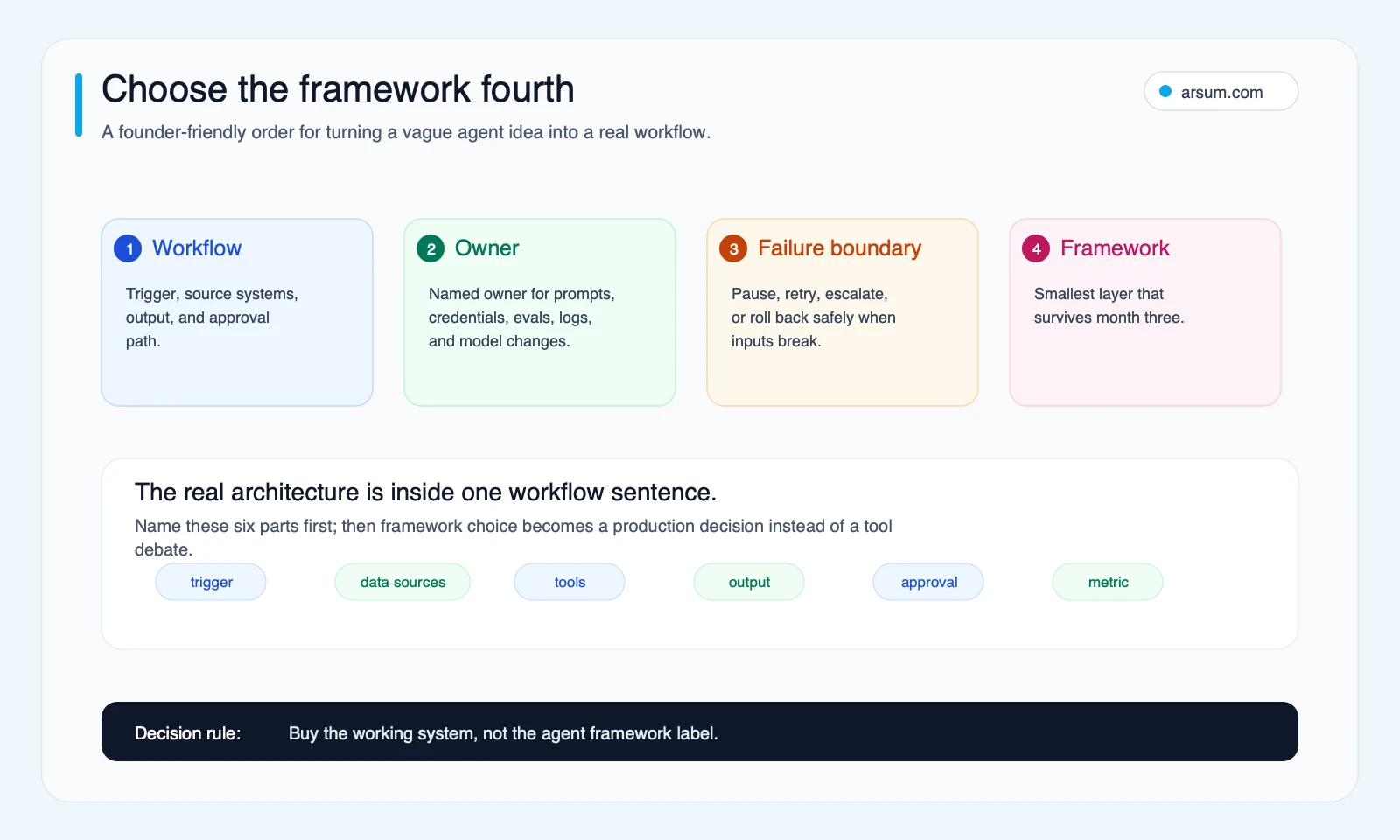
Use this decision order instead:
- Workflow: What repetitive decision or handoff is slow, inconsistent, or costly enough to improve?
- Owner: Which named role is accountable for outcomes, exceptions, and ongoing changes?
- Failure boundary: Which actions may run automatically, which require approval, and which are prohibited?
- Success metric: What baseline and acceptance threshold would make the work worth keeping?
- Framework: What is the smallest technical layer that can meet those requirements?
A useful workflow statement is specific enough to expose the operating design:
A system receives inbound demo requests, checks approved account data, drafts a sales brief, updates a CRM record, and sends the proposed follow-up to a sales owner for approval before any external message is sent.
That sentence already identifies the trigger, data sources, output, approval point, exception path, and owner. It makes a framework discussion useful.
A vague statement—“build an AI sales agent”—does not.
The broader AI agent frameworks guide can help with category vocabulary. This page is for the buying decision behind it: whether the workflow has earned a framework’s additional state, dependencies, debugging surface, and maintenance obligations.
Start With the Workflow Boundary, Not Agent Ambition
A framework is justified when the workflow needs coordination or recovery capabilities that a direct integration cannot provide cleanly. It is not justified just because a language model can call a tool.
Use no framework when the work is bounded
Start with direct API calls, a conventional service, or a workflow automation layer when the work has:
- one clear trigger and one expected output;
- a fixed sequence of steps;
- limited, known integrations;
- no need to preserve long-running state;
- simple approval or rule checks;
- a low-cost, reversible failure mode.
Examples include drafting a reply from an approved template, classifying an inbound request, summarizing a known document, or moving validated data between systems. These may still need access controls, logging, and review, but they do not automatically need an agent runtime.
This distinction matters in broader AI workflow automation planning too. A workflow can be valuable without being autonomous, multi-agent, or conversational.
Add a framework when the workflow earns it
A framework becomes more defensible when the workflow must preserve state across steps, pause for approval, recover from failures, coordinate several tools, or give operators a reliable trace of what happened.
The relevant question is not “Can this framework support agents?” It is:
Does this workflow require explicit orchestration that we would otherwise have to build and maintain ourselves?
Anthropic’s guidance on effective agents makes a compatible case for starting with the simplest workable pattern and adding complexity only where it improves the task. That is a design principle, not a rejection of frameworks.
Disqualifying conditions
Do not move a workflow into production autonomy if any of these remain unresolved:
- no owner can approve exceptions or accept operational risk;
- the system lacks permission boundaries for the data and tools it accesses;
- failure cannot be reversed or corrected through a defined procedure;
- the team cannot retain enough evidence to explain an action later;
- the workflow has no baseline, target, or economic rationale;
- a model output would directly make a consequential decision without an authorized human or deterministic policy check.
Technical capability is not business authorization. High failure cost and low reversibility should reduce autonomy.
A Founder Framework-Selection Worksheet
Before comparing vendors or open-source projects, complete this worksheet for one candidate workflow. If the answers are incomplete, the next investment should be workflow design—not framework selection.
| Field | What to specify |
|---|---|
| Workflow and trigger | The event that starts work and the bounded outcome required |
| Volume and baseline | Cases per week or month, current handling steps, and measured time or cost per case |
| Systems and data | Every system accessed, the system of record, and data each tool may read or write |
| Permissible actions | Actions allowed automatically, actions requiring approval, and prohibited actions |
| Approval owner | Named role that can approve, reject, or escalate a proposed action |
| Exception classes | Missing data, conflicting records, low-confidence output, tool failure, policy conflict, and customer-impacting edge cases |
| Trace and replay | What inputs, tool calls, outputs, approvals, and version identifiers must be retained |
| Rollback | How to cancel, correct, or reverse a failed run and who may do it |
| Support owner | Named role responsible for credentials, prompts, policies, evaluation, and incident response |
| 60-day acceptance metric | Target value, quality threshold, review cost, and conditions that would stop the rollout |
The AI agent architecture patterns guide is useful once this worksheet points to a genuine orchestration need. If it does not, keep the architecture small.
What the Primary Documentation Supports
Vendor documentation can help validate technical capabilities. It cannot decide whether those capabilities are worth operating for your workflow.
| Option | Workflow condition it may fit | Tradeoff a founder must accept | Documentation |
|---|---|---|---|
| Direct API or small workflow service | A bounded, repeatable handoff with known tools and simple approvals | You own the control flow, recovery design, logging, and evaluation | Anthropic: Building Effective AI Agents |
| OpenAI Agents SDK | You want an agent loop with tools, handoffs, guardrails, sessions, and tracing, while keeping the system compact | SDK primitives do not replace your authorization model, policy checks, or business evaluation | OpenAI Agents SDK documentation |
| CrewAI | The work naturally maps to explicit roles and coordinated flows, such as research, analysis, and drafting under supervision | Role decomposition can add moving parts and may obscure a workflow that should remain linear | CrewAI documentation |
| LangGraph | The process needs durable state, checkpoints, human-in-the-loop pauses, recovery, or long-running orchestration | More explicit state and orchestration can mean more implementation and operational ownership | LangGraph overview |
This is not a ranking. It is a set of conditions to test.
The OpenAI Agents SDK documentation describes a small primitive set for agent loops, tools, handoffs, guardrails, sessions, and tracing; it also notes that direct API use can be preferable when you want to own the loop. LangGraph’s overview describes durable execution, persistence, human-in-the-loop controls, and debugging for stateful workflows. CrewAI’s documentation describes crews, flows, guardrails, memory, knowledge, and observability.
Those capabilities matter only after you establish the workflow boundary.
For a broader build-versus-partner decision, compare agentic AI development services with your internal ownership plan. The central question is not who can assemble a prototype fastest; it is who can operate the workflow after launch.
Worked Pilot: Controlled Account-Research Briefs
A controlled pilot is a better framework test than a generic chatbot demo. Consider a sales-research workflow for inbound enterprise leads.
Normal path
- A new approved lead enters the CRM.
- The workflow reads only the allowed account fields and approved public sources.
- It drafts a short account brief using a defined template.
- It attaches source links and flags missing evidence.
- A sales operations manager approves, edits, or rejects the draft.
- Only the approved brief is stored in the CRM and made available to the account owner.
The model is not authorized to send outreach, alter lead status, or invent missing facts.
Ugly exception
A company name matches several entities, the CRM has an outdated domain, and retrieved sources conflict. The workflow must stop instead of choosing a likely answer. It routes the case to the sales operations manager with the conflicting records and a reason code such as identity_conflict.
That exception path is more important than a polished normal-path demo.
Evidence retained
For each run, retain:
- workflow and prompt version;
- source URLs or internal record identifiers;
- input fields used;
- tool calls and timestamps;
- the generated draft;
- approval, edit, rejection, or escalation outcome;
- correction reason where the reviewer changes a factual claim.
This allows an operator to investigate a bad result, compare versions, and update the workflow without relying on memory or screenshots.
Illustrative planning scorecard
The following arithmetic is an illustrative planning assumption, not an observed result.
| Measure | Baseline | Pilot target | Owner | Review cadence |
|---|---|---|---|---|
| Eligible briefs completed | Measure current weekly count | Maintain or improve baseline | Sales operations manager | Weekly |
| Manual preparation time | Measure median minutes per approved brief | Reduce median time while preserving approval | Sales operations manager | Weekly |
| Factual correction rate | Count briefs requiring material factual correction | Set a threshold before expansion | Sales operations manager | Weekly sample review |
| Approval compliance | No brief reaches users without recorded approval | 100% | Sales operations manager | Every run |
| Recoverability | Test whether a failed run can be traced and corrected | 100% of test failures recoverable | Technical owner | Before go/no-go |
For example, if the baseline is 40 briefs per month at 30 measured minutes each, the current manual effort is 20 hours per month. That is only a planning input. The pilot must also account for reviewer time, exception handling, model and infrastructure usage, engineering support, and the cost of factual errors. A faster draft that doubles review effort is not a successful automation.
Go/no-go rule
At day 30, proceed only if all of the following are true:
- every production-like action followed the stated approval boundary;
- test failures were traceable and recoverable through the documented rollback path;
- the factual-correction and review-cost results meet the target set before testing;
- the workflow’s unit economics remain acceptable under realistic retry and exception rates;
- a named production owner accepts responsibility for credentials, policies, logs, evaluations, and incident escalation.
Stop or narrow the pilot if an approval is bypassed, a failed run cannot be reconstructed, a source cannot be verified, or the review burden makes the workflow less efficient than the baseline.
💡 Arsum builds custom AI automation solutions tailored to your business needs.
Get a Free Consultation →Month-Three Survivability: A Discussion Rubric, Not “Original Data”
The following is an illustrative founder discussion rubric. It is not benchmark data, a vendor ranking, or a claim that one framework will produce a better business result.
Rate each option only for your documented workflow, using evidence from a working prototype, the current product documentation, and an operator review.
| Rating | Meaning |
|---|---|
| High | The capability is documented and demonstrated against the workflow’s stated requirement |
| Medium | The capability exists partially, requires custom integration, or has not been proven against the required failure cases |
| Low | The capability is absent, unclear, or would require substantial custom work |
| Option | Trace and replay | Approval integration | Exception routing | Maintenance burden |
|---|---|---|---|---|
| Direct API or small service | Medium | High | Medium | Low to medium |
| Workflow automation layer | Medium | Medium to high | Medium | Medium |
| OpenAI Agents SDK | High where its tracing fits the workflow | Medium to high | Medium | Medium |
| CrewAI | Medium | Medium | Medium | Medium to high |
| LangGraph | High where persistence and state are implemented well | Medium to high | High | High |
The ratings do not eliminate the implementation work. Regardless of framework, the team must design permissions, policy checks, source-of-truth resolution, approval screens, retention rules, rollback, and evaluation.
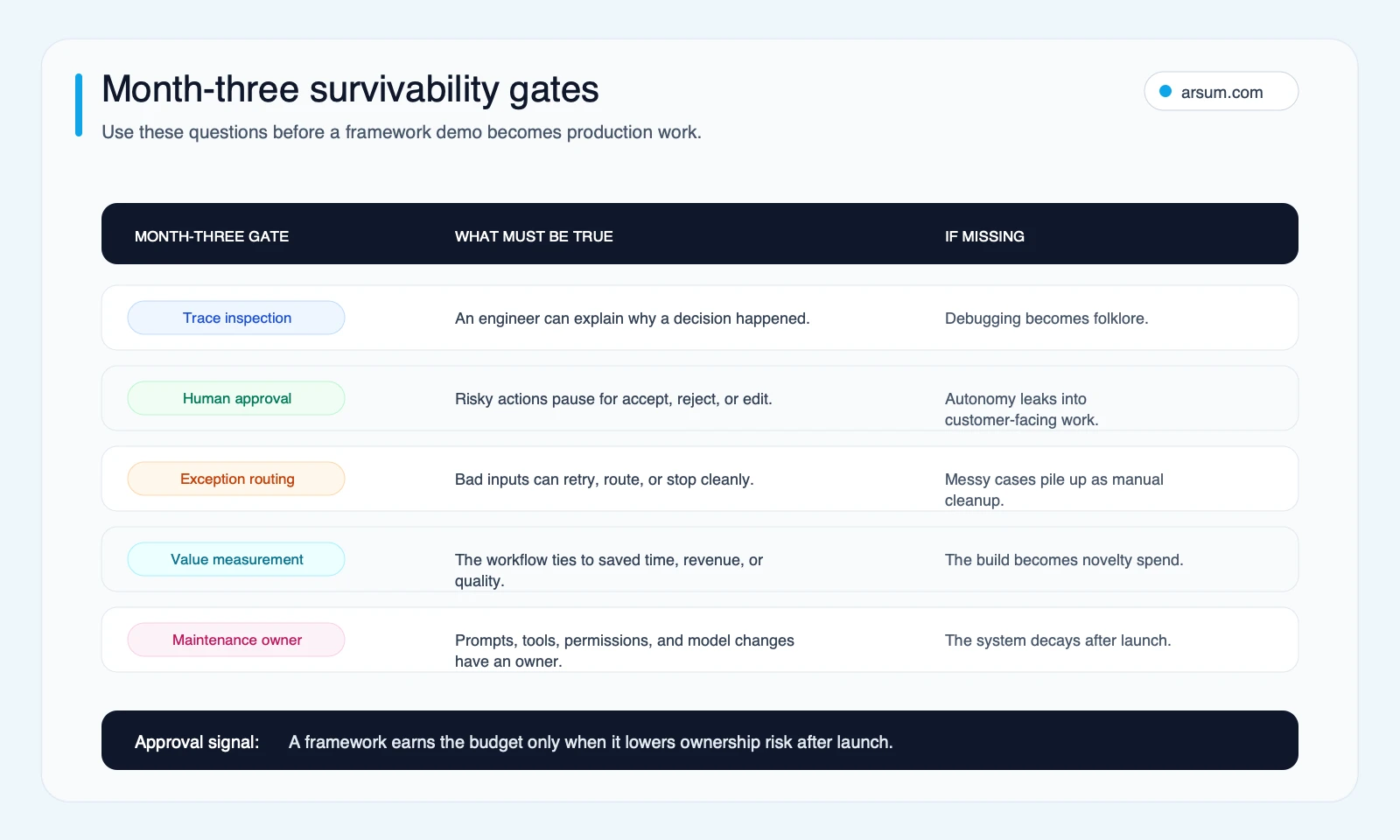
A framework may supply useful primitives. It does not automatically supply the authorized operating model.
Practitioner Signals: Useful Warnings, Not Market Statistics
Technical community discussions are not representative buyer surveys, and they should not be used as adoption or performance evidence. They are still useful for finding failure modes worth testing.
A June 2026 Hacker News discussion about Haystack included a builder comment that framework bloat is disliked even where LangChain and LangGraph are widely used. A March 2026 Show HN post about a time-travel debugger described a production failure where the state was unavailable by the time the author inspected logs. Another builder described frameworks that surprised them with costs and actions they had not explicitly approved. A separate January 2026 discussion described the desired control point as occurring between agent reasoning and tool execution.
Treat these as qualitative operating signals:
- inspect trace and replay requirements before committing to an orchestration model;
- put policy checks before tool execution;
- measure retries, loops, and exception work in the pilot;
- avoid adding abstraction to a workflow that is still simple enough to inspect directly.
The 30-Day Evaluation Sprint
A short evaluation should produce a decision memo, not a permanent architecture commitment.
Days 1–7: Define and measure
Choose one workflow. Record its trigger, volume, current steps, data sources, owner, approval boundary, failure classes, baseline time, and current quality measure. Establish the 60-day acceptance metric before building.
Days 8–14: Compare the smallest viable paths
Build the narrowest prototype in the leading framework candidate and, where feasible, a simpler alternative. Compare them against the same workflow contract. Do not compare feature lists in isolation.
Days 15–21: Test failure and authorization
Deliberately introduce missing fields, stale records, conflicting instructions, unavailable tools, and approval denials. Ask a person who did not build the prototype to inspect a trace and explain what happened. Test the rollback procedure rather than merely documenting it.
Days 22–30: Decide ownership and economics
Assign production ownership. Calculate the pilot’s total operating burden using measured inputs: engineering support, reviewer time, exceptions, model usage, infrastructure, and monitoring. Record the go/no-go outcome, unresolved risks, and conditions for expansion.
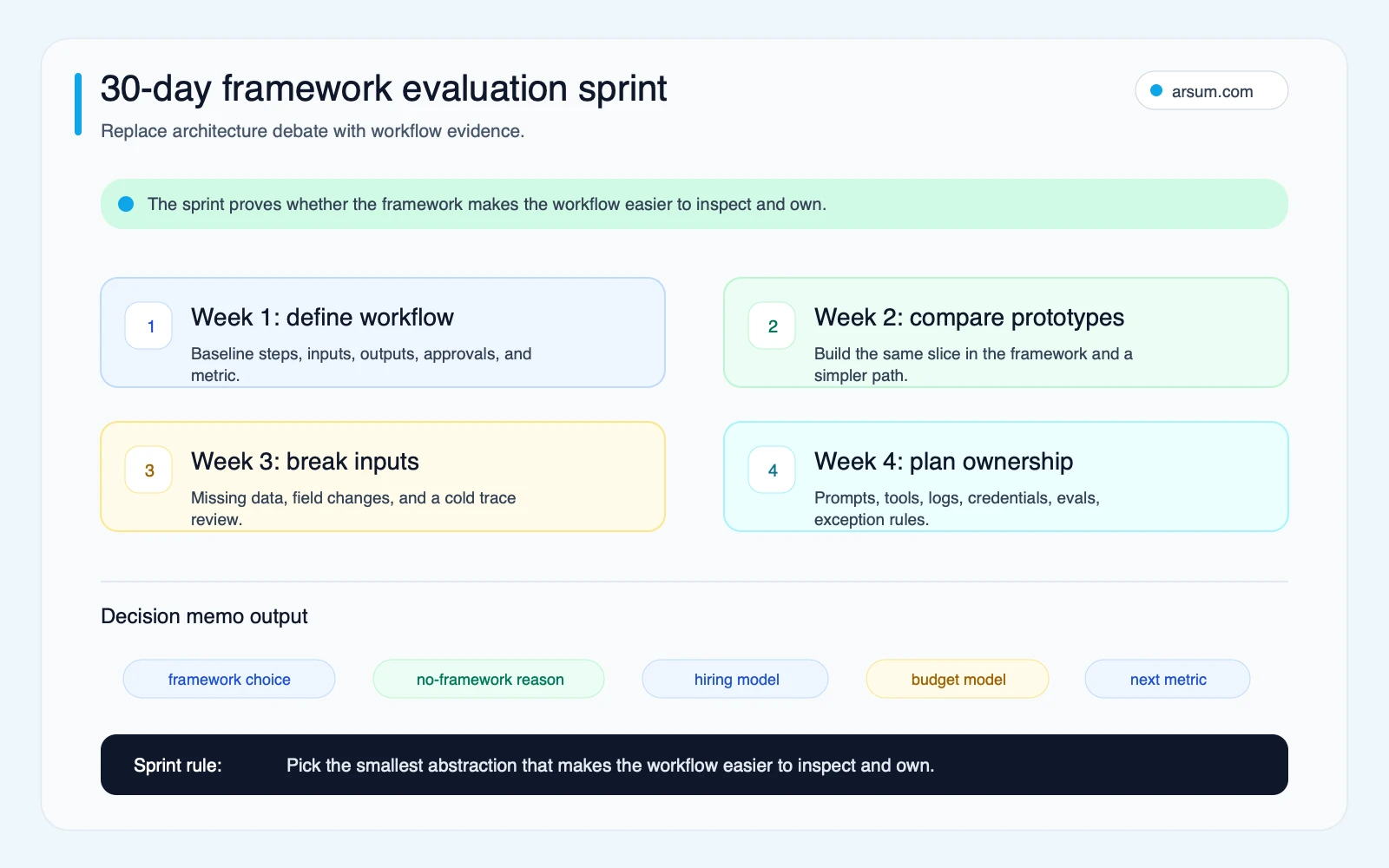
A copyable decision memo should include:
| Decision field | Required answer |
|---|---|
| Workflow | One sentence defining trigger, output, and boundary |
| Baseline | Measured current time, cost, quality, or throughput |
| Pilot target | Specific improvement and acceptable review burden |
| Approval owner | Named role and escalation path |
| Trace requirement | Inputs, versions, tool calls, and approvals retained |
| Stop condition | Failure, quality, compliance, or economics threshold that ends the pilot |
| Rollback method | Exact correction path and responsible owner |
| Production owner | Named role responsible after launch |
Publishing and Customer-Facing Work Need a Higher Bar
Frameworks can increase throughput for research, drafting, support, and publishing. Throughput is not proof of usefulness.
Google’s people-first content guidance emphasizes original, helpful, reliable content created for people rather than search-engine manipulation. For an AI-assisted publishing workflow, that means defining source requirements, review ownership, factual correction rules, and a meaningful added-value standard before the CMS is ever connected.
The same boundary applies to customer-facing workflows. A system can draft, organize, retrieve, and recommend. A human or policy-controlled process should authorize consequential actions such as publishing claims, changing account status, issuing commitments, or making a decision that affects a customer.
For related operational patterns, see AI agents for business and AI agent security. Both decisions should be made alongside framework selection, not after it.
Final Founder View
Choose a framework only when it makes a defined workflow easier to control, inspect, recover, and own.
Choose direct code or a simpler automation when the workflow is bounded and the framework would add more abstraction than operational value. Choose a stateful orchestration layer when durable state, checkpoints, human pauses, and recovery are real requirements. Choose role-based coordination only when the work genuinely benefits from it.
The durable sequence remains:
workflow → owner → approval boundary → success metric → framework
That order helps a founder reject impressive but unnecessary architecture—and gives the right framework a fair test when the workflow has truly earned it.
Methodology
This editorial guide uses primary documentation reviewed on June 30, 2026 from Anthropic, LangGraph, CrewAI, the OpenAI Agents SDK, and Google Search Central. Capability statements are limited to what those sources describe. Hacker News material is linked and used only as qualitative evidence of builder questions and failure modes, not as market-wide proof.
Ready to Automate Your Business?
Stop wasting time on repetitive tasks. Let AI handle the busywork while you focus on growth.
Schedule a Free Strategy Call →Written by:Johnny Kartakov
- Reviewed by
- Arsum editorial team
- Published
- June 29, 2026
- Updated
- August 12, 2026
- How this was produced
- Arsum uses research packs, source checks, and human editorial review to prepare and update blog articles. Editors are responsible for the final page.
- Source policy
- Sources are linked in the article when used. Methodology and source notes are included on higher-risk or high-visibility pages and are being rolled out across the archive. Editorial policy.
- Why this page exists
- Help B2B operators evaluate AI automation, implementation scope, cost, risk, and build-vs-buy decisions with practical context.