What AI Agent Frameworks Are and When to Use One

This page is the broad hub for AI agent frameworks: what they are, what they are not, which architecture patterns matter, and when a framework is worth the engineering cost. If you already need a named production shortlist, use the narrower agentic AI frameworks comparison instead.

The business question is sharper: which framework gives you enough control to automate a valuable process without turning the project into custom infrastructure your team cannot operate?

An AI agent framework is an open-source or commercial software library that provides the core primitives—tool calling, memory management, planning, and orchestration—for developers to build autonomous AI agents that reason, decide, and act on multi-step tasks without constant human direction.

The short answer is not a universal winner. Use a framework when your workflow needs developer-owned control over tools, state, memory, approvals, tests, and deployment. Use a platform when the business needs a managed experience faster than it needs architectural freedom.

Pick the right page for your intent

Frameworks are the raw materials. They give you LLM integration, tool registries, state management, and execution loops. What they do not give you is hosting, monitoring dashboards, or one-click deployment – that is what AI agent platforms do.

The difference matters because your choice between framework and platform determines your engineering investment, flexibility ceiling, and time-to-production. Frameworks trade convenience for control. That trade-off is worth it when the workflow has enough volume, measurable cost, accessible data, and a clear owner for failures.

If those inputs are unclear, the framework choice is premature. Start by defining the workflow, baseline cost, exception paths, data access, and human review model. The fastest teams evaluate framework selection, hiring model, and implementation scope together instead of making those decisions one at a time. If you are already comparing named options, move to the narrower agentic AI frameworks comparison.

Want to automate this for your business? Let's talk →

Framework Use-Case Paths

If you are evaluating frameworks under time pressure, clarify the job first:

  • Learning intent (what is a framework?) -> Stay on this page and map framework, platform, SDK, and delivery-partner boundaries.
  • Shortlist intent (which named option fits?) -> Use the agentic AI frameworks comparison page.
  • Implementation intent (what gives deep orchestration control?) -> Identify whether the workflow needs explicit state, loops, approvals, retries, or retrieval-heavy data access.
  • ROI intent (what should we automate first?) -> Start with workflows where cycle time, labor hours, conversion speed, or error rates are already measured.

Use-Case Matrix, Not a Final Shortlist

If your priority is…Start withWhy
Fast supervised prototypeOpenAI Agents SDK / CrewAILowest setup overhead
Complex multi-step orchestrationLangGraph / AutoGenBetter control of state and loops
Enterprise Microsoft stackAutoGen / Semantic KernelNative Azure alignment
Data-heavy agent workflowsLlamaIndex / HaystackStrong retrieval and document pipelines
Human-reviewed internal operationsLangGraph / CrewAI / DifyEasier to stage human approvals before autonomy
High-risk or regulated workflowsAutoGen / Semantic Kernel / LangGraphBetter fit for oversight, auditability, and policy controls

If this framework research is part of a buying process rather than pure learning, use it alongside our guides to AI engineer hiring costs, AI automation agency services, and AI automation agency pricing so framework choice, team model, and budget stay aligned.

If you already know you need a dedicated comparison page for stakeholder review, also see our agentic AI frameworks comparison and AI consulting for small businesses guides. Those pages are better fits when the real decision is not “which library is best,” but “which implementation path is lowest risk for our team.”

Cluster role: this page owns the broad educational query around AI agent frameworks, the agentic comparison page owns the shortlist and production-evaluation query, and the AutoGen vs CrewAI page owns the brand-vs-brand comparison query.

What Practitioners Actually Worry About

Recent practitioner discussions do not treat agent frameworks as a simple popularity contest. In one AI_Agents framework comparison thread, the useful comparison was not “LangGraph versus CrewAI” in the abstract. It was which framework fits the workflow shape, team skill, observability requirement, and failure recovery path.

A separate production-focused discussion points to the same buyer problem: the framework has to survive state, retries, tool calls, handoffs, and human approvals after the demo. Another state-of-frameworks thread shows why recommendations age quickly as MCP tooling, OpenAI agent tooling, LangGraph, CrewAI, AutoGen, and newer runtimes keep shifting.

That is the practical filter for this article: choose the framework you can operate, not the one that looks strongest in a weekend prototype. If the business workflow needs auditability, human approval, customer-facing reliability, or clear escalation when a tool call fails, those constraints should outweigh GitHub stars.

When a Framework Is Worth the Engineering Cost

Use a framework when at least four of these are true:

  • The workflow repeats often enough that automation can change cost, speed, or capacity.
  • Inputs and outputs can be inspected, logged, and tested.
  • The agent needs to call internal tools, databases, APIs, or documents.
  • Exceptions can route to a human without breaking the customer or internal process.
  • The team can maintain prompts, tool permissions, monitoring, and evaluation after launch.

If those conditions are not true yet, a managed platform, no-code builder, or short discovery sprint may produce a better first ROI signal than a custom framework build.

At this point the real question is usually not whether LangChain, CrewAI, or AutoGen can work. It is whether your team has the bandwidth to design, ship, monitor, and maintain the system around the framework. If not, this is the point where many companies move from research into a scoped delivery conversation with Arsum.

Framework vs. Platform vs. Delivery Partner

Most buyers are not really choosing between LangGraph and CrewAI first. They are choosing between three delivery models:

If you need…ChooseTrade-off
Maximum control with an in-house engineering teamRaw frameworkHighest flexibility, highest implementation burden
Faster launch with less infrastructure workManaged platformFaster deployment, less architectural freedom
A shipped business outcome without building the team firstDelivery partnerHigher services cost, lower execution risk

If your real decision is “who should ship this?” rather than “which library is best?”, compare AI agent platforms, AI engineer hiring costs, and AI automation agency pricing before committing to a framework-first path.

The clean internal path is usually: framework research here -> implementation scope in AI automation agency services -> budget validation in AI automation agency pricing. That route keeps informational traffic connected to commercial pages without forcing a hard sell too early.

💡 Arsum builds custom AI automation solutions tailored to your business needs.

Get a Free Consultation →

Why AI Agent Frameworks Matter in 2026

The AI agent ecosystem has gone from academic curiosity to production infrastructure in under two years. Frameworks are at the center of that shift.

The useful decision is not “which framework has the most stars?” It is “which framework pattern can your team operate after launch?” Production agent work needs more than tool calling. It needs state, retries, traceability, guardrails, cost control, human review, and a clear owner for failed or uncertain outputs.

Methodology Note

This overview was refreshed against the ai-agent-frameworks Research Pack and a May 2026 review of official framework documentation. The scoring below prioritizes production decision criteria over popularity metrics:

  • state and checkpointing
  • human review or handoff support
  • tracing, evaluation, and debugging path
  • tool permission boundaries
  • model/provider flexibility
  • team language fit
  • maintenance burden after launch

Sources used for the source-backed table include LangGraph docs, LangGraph persistence and human-in-the-loop docs, CrewAI docs, Microsoft AutoGen docs, OpenAI Agents SDK docs, Microsoft Semantic Kernel docs, Haystack docs, LlamaIndex agent docs, and Dify docs. Security and governance checks are anchored to NIST AI RMF and the OWASP GenAI Security Project.

Social and community links in this article are qualitative practitioner signals, not statistical proof.

Commodity vs Non-Commodity Breakdown

Commodity framework contentThis page’s job
Rank frameworks by popularity or starsExplain when a framework is the right architecture layer at all
Treat frameworks, platforms, SDKs, and coding agents as one bucketSeparate raw framework, managed platform, direct SDK code, and delivery partner decisions
Push readers into a named shortlist too earlySend shortlist/comparison intent to the dedicated agentic frameworks comparison page
Ignore the operating modelForce review paths, ownership, permissions, monitoring, and fallback design into the framework decision

Google Risk Box

This hub would be high-risk if it tried to rank every framework for every reader. That creates cannibalization with the comparison page and repeats the same SERP pattern. The safer cluster role is educational: define the architecture layer, show when a framework is worth the engineering cost, and route named production-shortlist intent to Agentic AI Frameworks Compared.

Framework Landscape: Common Agent Framework Categories

1. LangChain + LangGraph

Common production default for orchestration-heavy builds. LangChain provides composable building blocks for LLM applications. LangGraph extends it with stateful, graph-based orchestration for complex agent workflows.

Architecture: Directed acyclic graphs (DAGs) and cyclic graphs for agent logic. Nodes represent actions (LLM calls, tool executions, conditional routing). Edges define control flow. State persists across steps.

Key Strengths:

  • Broad integration ecosystem across vector stores, tools, model providers, and retrievers
  • LangGraph supports cycles—agents can loop, retry, and self-correct
  • Built-in human-in-the-loop checkpointing
  • LangSmith provides observability (tracing, evaluation, monitoring)

Limitations:

  • Abstraction layers can obscure what’s happening under the hood
  • Learning curve steepens significantly with LangGraph’s graph primitives
  • Over-engineering risk for simple use cases

Best For: Teams building complex, multi-step agents that need production observability. The default choice when you don’t have a reason to pick something else.

Languages: Python, JavaScript/TypeScript

from langgraph.graph import StateGraph

# Define agent as a graph with tool-calling loop
graph = StateGraph(AgentState)
graph.add_node("reason", call_llm)
graph.add_node("act", execute_tool)
graph.add_edge("reason", "act")
graph.add_conditional_edges("act", should_continue)
agent = graph.compile()

2. CrewAI

Multi-agent collaboration, simplified. CrewAI models agents as crew members with roles, goals, and backstories. Crews coordinate to solve complex tasks through delegation and sequential or parallel execution.

Architecture: Role-based agent system. Each agent has a defined persona and tools. Tasks are assigned to agents, and a “manager” agent can delegate and coordinate. Supports sequential, hierarchical, and consensual process flows.

Key Strengths:

  • Intuitive mental model—think “team of specialists” instead of “graph of nodes”
  • Built-in delegation: agents can ask other agents for help
  • Minimal boilerplate for multi-agent setups
  • Growing enterprise offering (CrewAI Enterprise) with managed hosting

Limitations:

  • Less granular control than LangGraph for complex orchestration
  • Performance overhead from multi-agent message passing
  • Framework opinions can feel constraining for non-standard patterns

Best For: Teams that need multiple specialized agents working together. Particularly strong for content generation, research, and analysis workflows.

Language: Python

from crewai import Agent, Task, Crew

researcher = Agent(role="Researcher", goal="Find accurate data", tools=[search_tool])
writer = Agent(role="Writer", goal="Create compelling content", tools=[])

crew = Crew(agents=[researcher, writer], tasks=[research_task, write_task])
result = crew.kickoff()

3. Microsoft AutoGen

Conversational multi-agent framework. AutoGen structures agent interactions as conversations—agents talk to each other (and to humans) through structured message passing.

Architecture: Agent-centric with conversation protocols. GroupChat enables multi-agent discussions. Supports nested conversations, function calling, and code execution. Human-in-the-loop is a first-class pattern, not an afterthought.

Key Strengths:

  • Natural fit for scenarios requiring multiple AI perspectives (debate, review, verification)
  • Robust human-in-the-loop patterns—humans are just another participant in the conversation
  • Code execution sandboxing built in (Docker and local)
  • Strong integration with Azure ecosystem

Limitations:

  • Conversation-centric design doesn’t fit all agent patterns equally well
  • Can be verbose for simple single-agent use cases
  • Azure-centric documentation and examples

Best For: Enterprise teams on Azure building agents that require human oversight, code generation, or multi-perspective reasoning.

Language: Python, .NET

Source note: Use the AutoGen documentation to verify the current AgentChat, team, tool-use, and human-input patterns before treating AutoGen as the production default. Microsoft’s agent stack is evolving quickly, so Azure-first teams should also compare current Microsoft Agent Framework and Semantic Kernel guidance before committing.

4. OpenAI Agents SDK

Opinionated and lightweight. OpenAI’s official framework for building agents on their models. Provides tool calling, handoffs between agents, guardrails, and tracing—nothing more, nothing less.

Architecture: Minimal abstractions. Agents are defined with instructions, tools, and optional handoff targets. The Runner executes agent loops, handling tool calls and inter-agent handoffs. Built-in guardrails validate inputs and outputs.

Key Strengths:

  • Low setup overhead for a simple OpenAI-native prototype
  • Native OpenAI model optimization (structured outputs, function calling)
  • Handoff pattern elegantly solves multi-agent routing
  • Built-in tracing for debugging

Limitations:

  • Tightly coupled to OpenAI models (works with others via adapter, but not optimized)
  • Fewer integrations than LangChain
  • Limited orchestration compared to LangGraph or AutoGen

Best For: Teams committed to OpenAI’s ecosystem who want the fastest path from idea to working agent. Ideal for customer-facing agents with clear routing needs.

Language: Python

5. Semantic Kernel (Microsoft)

Enterprise-grade agent orchestration with planner architecture. Semantic Kernel provides a plugin-based system where agents combine “skills” (prompts) and “plugins” (code) through AI-powered planning.

Architecture: Plugin-oriented. Skills are prompt templates with semantic descriptions. The planner uses these descriptions to automatically compose multi-step plans. Supports sequential, stepwise, and Handlebars-based planning strategies.

Key Strengths:

  • Deep .NET and Java support (not just Python)
  • Planner automatically decomposes complex goals into action sequences
  • Enterprise patterns: dependency injection, middleware, telemetry
  • Direct Azure AI integration

Limitations:

  • Planner reliability varies—complex plans can hallucinate steps
  • Heavier abstraction layer than most frameworks
  • Smaller community than LangChain or CrewAI

Best For: .NET or Java enterprise shops that need AI agents integrated with existing codebases.

Languages: Python, C#, Java

6. Haystack (deepset)

Production-focused pipelines for RAG and agents. Haystack started as a search/RAG framework and has evolved into a full agent-capable pipeline system.

Architecture: Pipeline-based. Components (retrievers, generators, routers, tools) connect into directed pipelines. Agent behavior emerges from pipeline composition with conditional routing.

Key Strengths:

  • Battle-tested in production RAG deployments
  • Clean pipeline abstraction—easy to reason about data flow
  • Strong document processing and retrieval capabilities
  • Model-agnostic with first-class support for open-source LLMs

Limitations:

  • Agent capabilities are newer and less mature than dedicated agent frameworks
  • Pipeline model is less flexible than graph-based approaches for complex orchestration
  • Smaller agent-specific ecosystem

Best For: Teams building knowledge-intensive agents where retrieval quality is critical. If your agent’s primary job is answering questions from documents, Haystack is hard to beat.

Language: Python

7. Llama Index (Agents)

Data-connected agents. Llama Index (formerly GPT Index) specializes in connecting LLMs with structured and unstructured data. Its agent layer builds on this foundation with data-aware reasoning.

Architecture: Agent workers paired with data connectors (LlamaHub has 300+ integrations). Agents can query multiple data sources, synthesize answers, and take actions. Supports ReAct, function calling, and custom agent logic.

Key Strengths:

  • Unmatched data connectivity—agents can reason over databases, APIs, PDFs, Slack, and more
  • Sub-question engine breaks complex queries into targeted retrieval steps
  • Strong for building agents that need to synthesize from multiple knowledge sources

Limitations:

  • Agent orchestration is less sophisticated than LangGraph or CrewAI
  • Can be overkill for agents that don’t need heavy data retrieval
  • Some overlap and confusion with LangChain’s similar capabilities

Best For: Data analysts and knowledge workers building agents that answer complex questions by querying multiple internal data sources.

Language: Python, TypeScript

8. Dify

Open-source visual agent builder. Dify provides a web-based IDE for building AI agent workflows with drag-and-drop, plus API deployment.

Architecture: Visual workflow editor with node-based composition. Supports tool calling, iteration, conditional branching, and variable management. Backend handles LLM orchestration, RAG pipeline, and model management.

Key Strengths:

  • Visual builder lowers the barrier for non-developers
  • Self-hostable with full control over data
  • Built-in RAG pipeline, prompt management, and model switching
  • 80+ built-in tools

Limitations:

  • Less flexible than code-first frameworks for complex logic
  • Performance at scale requires careful infrastructure planning
  • Visual paradigm can become unwieldy for deeply nested agent logic

Best For: Teams that want agent capabilities without heavy engineering investment, and need an open-source alternative to proprietary no-code AI agent builders.

Language: Python (backend), TypeScript (frontend)

9. MetaGPT

Multi-agent framework for software development teams. MetaGPT assigns LLM agents to software roles—product manager, architect, engineer, QA—and coordinates them to produce working code from a single natural language requirement.

Architecture: Role-based message passing. Each agent has a defined role, receives structured inputs, produces structured outputs, and publishes to a shared message pool. Agents collaborate like a real software team, with memory persistence across roles.

Key Strengths:

  • Role-based design makes complex multi-agent coordination intuitive
  • Produces complete artifacts: PRDs, architecture docs, code, tests
  • Strong at autonomous software development tasks end-to-end
  • Active research community (Stanford, CMU) with rapid capability additions

Limitations:

  • Narrowly optimized for software dev workflows—less flexible for other domains
  • Token costs can be high (multiple agents, many rounds)
  • Code quality from agents requires human review before production use

Best For: R&D and engineering teams exploring autonomous code generation. Excellent for generating boilerplate, refactoring, and producing specification documents at scale.

GitHub Stars: 45K+ | Language: Python

10. OpenDevin (All-Hands AI)

Open-source autonomous software agent. OpenDevin (now branded as OpenHands) is a fully autonomous coding agent—it opens a browser, writes code, runs tests, and debugs until the task is complete. Think of it as an AI developer with its own sandbox.

Architecture: Event-driven runtime with a sandboxed container. The agent has access to a shell, browser, and file system. It plans tasks, executes them in the sandbox, observes results, and iterates. Compatible with most major LLMs (GPT-4o, Claude, Gemini).

Key Strengths:

  • Fully autonomous end-to-end: can handle entire feature implementations without handholding
  • Browser access enables web research + code = complete task loops
  • Model-agnostic—switch between Claude, GPT-4o, or open-source LLMs
  • SWE-Bench scores outperform most coding agents (top 10 on public leaderboard)

Limitations:

  • Designed for coding tasks—not a general-purpose agent framework
  • Sandbox setup adds infrastructure overhead vs. cloud platforms
  • Less suitable for building custom multi-agent pipelines from scratch

Best For: Engineering teams that want to assign complete coding tasks to an autonomous agent, not just code completion. Closest open-source equivalent to a fully autonomous AI developer.

GitHub Stars: 38K+ | Language: Python

Framework Landscape Snapshot

FrameworkMulti-AgentLearning CurveEcosystem SizeProduction ReadyBest Language
LangChain/LangGraph✅ AdvancedSteep⭐⭐⭐⭐⭐Python, JS
CrewAI✅ Core featureModerate⭐⭐⭐Python
AutoGen✅ Core featureModerate⭐⭐⭐Python, .NET
OpenAI Agents SDK✅ Via handoffsLow⭐⭐Python
Semantic Kernel⚠️ LimitedSteep⭐⭐⭐C#, Python, Java
Haystack⚠️ BasicModerate⭐⭐⭐Python
Llama Index⚠️ BasicModerate⭐⭐⭐⭐Python, TS
Dify✅ VisualLow⭐⭐⭐Python
MetaGPT✅ Role-basedModerate⭐⭐⭐⚠️ ResearchPython
OpenDevin✅ AutonomousLow⭐⭐⭐⚠️ SandboxPython

Source-Backed Production Capability Table

This table is the practical layer missing from most framework roundups. It ties each recommendation to official documentation signals rather than GitHub stars alone.

FrameworkOfficial source signalProduction strengthMain implementation risk
LangGraphLangGraph documents graph-based orchestration, durable execution, persistence, checkpointing, time travel, human-in-the-loop control, and streaming.Best default for stateful workflows where retries, review points, and explicit control flow matter.More architecture work upfront; teams must understand graph/state primitives instead of treating it like a simple chain.
CrewAICrewAI documents crews, flows, agents, tasks, memory, guardrails, planning, and observability integrations.Fastest path for role-based multi-agent delivery when the workflow maps cleanly to specialist roles.Can hide coordination cost; multi-agent message passing can become expensive and harder to debug.
AutoGenMicrosoft AutoGen documents event-driven agents, AgentChat, teams, tool use, model clients, and human input patterns.Strong for conversational multi-agent review, debate, and supervised collaboration patterns.Conversation-first architecture may be verbose for deterministic business workflows.
OpenAI Agents SDKOpenAI documents agents, handoffs, guardrails, tracing, sessions, tools, and model settings.Best for OpenAI-native routing, customer-facing assistants, and fast prototypes that need tracing and guardrails.Tighter provider coupling; less suitable when model portability or custom orchestration is the main requirement.
Semantic KernelMicrosoft documents plugins, planners, memory concepts, connectors, and enterprise language support across C#, Python, and Java.Good fit for .NET/Java enterprise teams that want AI orchestration inside existing application patterns.Planner abstraction can obscure execution unless the team adds tests, telemetry, and clear tool boundaries.
HaystackHaystack documents pipelines, retrievers, generators, routers, tools, agents, tracing, and evaluation-oriented components.Strong for document-heavy RAG agents where retrieval quality and pipeline clarity matter more than agent autonomy.Less natural for open-ended multi-agent orchestration than graph or conversation-first frameworks.
LlamaIndexLlamaIndex documents agents, workflows, data connectors, query engines, tool calling, and observability integrations.Strong when the agent’s main job is reasoning over many internal data sources.Data layer strength can be overkill for workflows that mostly need tool orchestration.
DifyDify documents visual workflows, agents, model providers, RAG, tools, and deployment options.Useful when business users and engineers need to collaborate around visible workflow logic.Complex nested logic can become harder to govern than code once workflows grow.

Security and Governance Source Layer

Framework documentation is not enough for a production decision. Before choosing a stack, map each candidate against source-backed operating controls:

ControlSource anchorWhat to verify before build
Risk ownershipNIST AI RMFWho owns model behavior, user impact, testing, monitoring, and incident response after launch.
Prompt and tool abuseOWASP GenAI Security ProjectWhether the framework makes tool permissions, prompt-injection defenses, output validation, and logging practical.
Data exposureFramework vendor docs plus model/provider data controlsWhat is sent to model APIs, how traces are retained, and which systems the agent can read or write.
Human approvalLangGraph, AutoGen, OpenAI Agents SDK, CrewAI, and Dify docsWhether risky actions can pause for review instead of executing automatically.
ObservabilityLangSmith, CrewAI observability integrations, OpenAI tracing, Semantic Kernel/Application Insights pathsWhether prompts, tool calls, errors, costs, and handoffs are visible enough to debug production failures.

This source layer is why the article recommends different tools for different workflows. A framework can be excellent for prototyping and still be the wrong choice when a workflow needs auditability, constrained write access, or regulated data handling.

Mini Experiment: One Workflow Across Four Frameworks

This is a design experiment, not a latency or cost benchmark. We used one realistic B2B workflow and scored implementation fit from official docs plus the production concerns in the Research Pack.

Workflow: support-ticket triage for a B2B SaaS company.

The agent must:

  1. Read a new support ticket.
  2. Retrieve customer plan, account status, and recent incidents.
  3. Search internal docs for policy and product context.
  4. Draft a response.
  5. Route uncertain, high-value, or risky cases to a human.
  6. Log the decision, source docs, confidence, and follow-up action.

Experiment scoring criteria

CriterionWhy it matters
State and retry controlThe workflow may pause for a human, retry failed tools, or resume after missing data.
Human review pathSome replies should never be sent automatically.
Tracing and evalsThe team needs to know why the agent answered a certain way.
Tool permission boundariesThe agent should read many systems but write to only approved places.
Setup speedA prototype has value only if it reaches a working review loop quickly.
Maintenance burdenThe framework must be understandable by the team that owns it after launch.

Mini experiment result

FrameworkFit for this workflowWhy
LangGraphBest production fitThe support workflow needs state, branching, review checkpoints, and resumability. LangGraph’s graph/state model maps well to that shape.
CrewAIBest delivery prototypeThe roles are intuitive: triage agent, policy researcher, account checker, response drafter, reviewer. Good for a quick pilot, but watch multi-agent cost and debugging.
OpenAI Agents SDKBest simple routerHandoffs, guardrails, tracing, and sessions make it strong for a first OpenAI-native implementation if the workflow stays relatively simple.
AutoGenBest supervised discussionUseful if the workflow benefits from multiple agent perspectives and human review, but it may be heavier than needed for deterministic routing.

Operator conclusion: for this specific workflow, start with OpenAI Agents SDK or CrewAI if the goal is a two-week prototype. Move to LangGraph when the workflow needs durable state, approval checkpoints, and replayable production behavior. Use AutoGen when the value is in multi-agent review rather than deterministic workflow routing.

How to Choose the Right AI Agent Framework

Picking a framework isn’t about finding the “best” one—it’s about finding the right one for your constraints. Here’s a decision framework:

Start with your team

  • Python-only team? LangChain, CrewAI, or OpenAI Agents SDK
  • .NET or Java shop? Semantic Kernel
  • Mixed technical/non-technical team? Dify or CrewAI
  • Small team, fast prototyping? OpenAI Agents SDK

Then match your use case

  • Complex multi-step workflows: LangGraph
  • Multi-agent collaboration: CrewAI or AutoGen
  • Knowledge-intensive RAG agents: Haystack or Llama Index
  • Customer-facing with clear routing: OpenAI Agents SDK
  • Enterprise with compliance needs: AutoGen + Azure or Semantic Kernel

Consider the production path

Every framework can build a demo. The question is: can it run in production?

For production readiness, you need observability (tracing, logging), error handling, cost management, and scaling. LangChain’s LangSmith, CrewAI Enterprise, and AutoGen’s Azure integration all address this—but with different trade-offs.

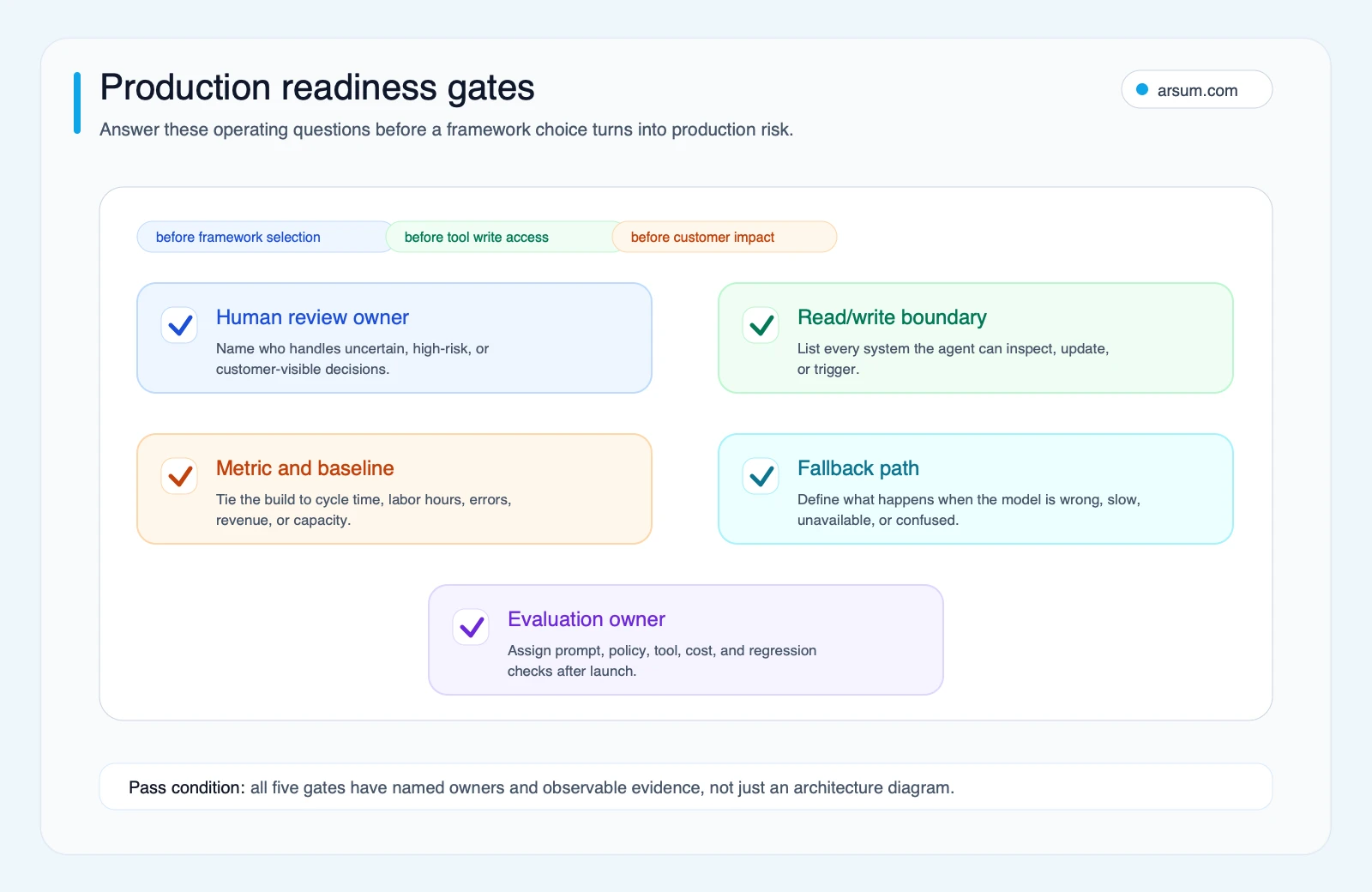
Operationally, an agent implementation changes more than the codebase. Someone has to own tool permissions, escalation paths, exception queues, prompt and policy versioning, output review, cost alerts, and post-launch evaluation. If those responsibilities are not assigned, the framework becomes the easy part and the operating model becomes the failure point.

Use this production filter before committing:

Production questionWhy it matters
What human reviews the agent’s uncertain or high-risk decisions?Prevents automation from creating silent operational risk
Which systems can the agent read from and write to?Defines security boundaries and integration scope
What metric improves if this works?Keeps the build tied to ROI rather than novelty
What happens when the agent is wrong, slow, or unavailable?Forces fallback design before launch
Who maintains evaluations and tool changes after launch?Avoids a demo that decays after the first month

If you want to skip the framework entirely and go straight to managed infrastructure, read our comparison of AI agent platforms that handle deployment for you.

Not sure you have the in-house skills to build with these frameworks? Our guide on hiring an AI engineer breaks down what to look for and what it costs. And if you want to see what teams are actually building, check out these real-world AI agent examples.

💼 Work With Arsum

We help businesses implement AI automation that actually works. Custom solutions, not cookie-cutter templates.

Learn more →

Architectural Patterns Across Frameworks

Regardless of which framework you choose, the same patterns appear everywhere. Understanding these patterns matters more than memorizing framework-specific APIs.

ReAct (Reason + Act)

The agent thinks about what to do, takes an action, observes the result, and repeats. Most frameworks implement this as their default agent loop.

Used in: LangChain, Llama Index, OpenAI Agents SDK, Haystack

Plan-and-Execute

The agent creates a full plan upfront, then executes each step sequentially. Better for predictable, well-defined tasks.

Used in: Semantic Kernel (Planner), LangGraph (custom), AutoGen

Multi-Agent Conversation

Multiple agents discuss a problem, each contributing their expertise. A coordinator synthesizes the result.

Used in: CrewAI, AutoGen, LangGraph

Tool-Augmented Generation

The agent decides when to call external tools (APIs, databases, calculators) and incorporates results into its reasoning.

Used in: All frameworks—this is table stakes in 2026

Operator note: the framework that wins for your team is not necessarily the one with the broadest feature list. It is the one where common production patterns are easy to inspect, test, and maintain, while uncommon workflow requirements remain possible without rewriting the system.

Common Mistakes When Choosing a Framework

1. Choosing based on GitHub stars instead of production fit. Stars measure interest, not reliability. A 40K-star framework with poor error handling will fail you faster than a 5K-star one with solid retry logic.

2. Over-engineering with multi-agent when single-agent works. Multi-agent systems add communication overhead, debugging complexity, and cost. Start with one agent. Add more only when you hit clear limitations. Check out real-world AI agent examples to see when multi-agent actually makes sense.

3. Ignoring the LLM cost dimension. Frameworks that encourage more LLM calls, especially multi-agent debates and repeated planning steps, can multiply model usage. Estimate calls per task before assuming a multi-agent design is affordable.

4. Building a framework when you need a platform. If your team isn’t set up for DevOps, monitoring, and infrastructure management, a managed platform will deliver faster ROI than a raw framework. Know the difference—we broke it down in our piece on AI agents tools covering the full ecosystem.

5. Locking into a single LLM provider. Frameworks that tightly couple to one model provider limit your options as the model landscape evolves. Prefer frameworks with model-agnostic abstractions.

The Future of AI Agent Frameworks

Three trends are reshaping the framework landscape:

1. More graph-based orchestration. LangGraph made graph-based orchestration prominent, and other frameworks increasingly expose workflow, flow, or event-driven patterns. The reason: graphs cleanly express loops, branches, and parallel execution, which are common in agent behavior.

2. Built-in evaluation and testing. Frameworks are adding native tools for testing agent behavior before deployment. LangSmith evaluations, CrewAI’s testing module, and DeepEval’s agent metrics are early examples. This mirrors how web frameworks eventually added testing support.

3. MCP (Model Context Protocol) as an emerging tool-connection standard. MCP is becoming an important way for agents to connect to external tools and data sources. Verify current MCP support in the framework you choose instead of assuming every integration will be portable.

If you are choosing a framework for a real workflow, do not stop at library features. Define the first workflow, expected ROI lever, integration scope, review model, and maintenance owner before writing production code.


FAQ

What is the most popular AI agent framework in 2026? Do not make the production decision from popularity alone. LangChain combined with LangGraph is a strong default when ecosystem breadth, integrations, and stateful orchestration matter. CrewAI is useful when the workflow maps clearly to roles and tasks. OpenAI Agents SDK is a low-overhead starting point for OpenAI-native prototypes. AutoGen remains relevant for conversation-style multi-agent patterns and human-supervised review.

Can I use multiple AI agent frameworks together? Yes, and many teams do. A common pattern is using LangChain for tool management and retrieval, while using CrewAI or AutoGen for multi-agent orchestration. Frameworks are libraries, not monoliths—they compose well.

Do I need an AI agent framework, or should I use a platform? It depends on your team’s engineering capacity. Frameworks give you maximum control and lower per-unit costs but require more development and operations work. Platforms trade some flexibility for faster deployment and managed infrastructure. Many organizations start with a framework, then move selected workloads to managed platforms as reliability and compliance requirements grow.

Which AI agent framework is best for beginners? OpenAI Agents SDK is usually the easiest developer starting point for OpenAI-native prototypes because the official docs keep agents, tools, handoffs, guardrails, tracing, and sessions in one stack. Dify is the better starting point for non-developers who need visual workflows. LangChain and LangGraph are better learning paths when the goal is production orchestration depth.

Are AI agent frameworks free? Most are open-source and free to use (LangChain, CrewAI, AutoGen, Haystack, Llama Index, Dify). Costs come from the LLM API calls your agents make, any cloud infrastructure you run them on, and optional paid features (LangSmith, CrewAI Enterprise, Azure services).

How do AI agent frameworks handle security? Security approaches vary. AutoGen and Semantic Kernel include stronger enterprise patterns such as sandboxing, identity integration, and policy controls. LangChain and CrewAI provide flexible primitives, but you must enforce boundaries yourself. For production, implement tool-level permissions, output validation, audit logging, rate limiting, and secret isolation regardless of framework.


Need Help Choosing and Shipping the Right Framework

If you are evaluating an AI agent build for your business, talk to the Arsum team about scope, timeline, architecture choices, and implementation options before you commit to the wrong stack.

Author and Reviewer Note

This article was prepared by the Arsum editorial team for B2B buyers comparing AI agent frameworks as production implementation choices, not as a popularity ranking.

Reviewer: Arsum editorial review workflow, refreshed May 29, 2026 using the ai-agent-frameworks Research Pack, official framework documentation, Research Pack Gate, ICP Gate, and Google AI quality checks. No named external expert review is claimed.

The framework recommendations are decision guidance, not vendor endorsements. Verify current framework documentation, pricing, security controls, and hosting requirements before committing to a production stack.

Ready to Automate Your Business?

Stop wasting time on repetitive tasks. Let AI handle the busywork while you focus on growth.

Schedule a Free Strategy Call →