AI app development companies are worth comparing when you need a partner to build and operate a custom AI workflow—not merely configure a chatbot or show a prompt demo. The right choice depends on whether the firm can own your integration boundaries, evaluation plan, exception handling, security controls, and post-launch support. This is a vendor-evaluation guide, not a ranked list: compare every candidate against the same evidence requirements before you select one.
AI App Development Companies: 2026 Comparison
Explore ai app development companies: compare workflow fit, costs, risks, evidence, and practical next steps before you build, buy, or hire.

Production-ready AI app development requires partner evaluation criteria that most roundups skip.
Table of Contents
- What most guides miss: the company is not the product
- Separate the provider categories before comparing proposals
- Use production readiness as the first shortlist gate
- Score companies with evidence, not presentation quality
- Run a narrow pilot before funding broad autonomy
- Build, buy, or partner: choose the delivery path deliberately
- Know the disqualifying conditions and common failure modes
- Reference checks and commercial terms to settle before selection
- Qualitative market signal and methodology
- When to involve Arsum
What most guides miss: the company is not the product
Search results for this query commonly mix app builders, directories, AI agencies, and full product engineering firms. That makes a “top company” list a weak starting point for a consequential buying decision. A directory can help you find candidates, but it does not prove how a particular firm handles your systems, your failure modes, or ownership after launch.
The decision boundary is simpler: hire a company only when it can accept responsibility for the production workflow you are asking it to change.
That means moving beyond questions such as “Which models do you use?” and “Can you build an AI app?” Ask instead:
- What business action will the app influence or execute?
- Which systems, records, and permissions will it touch?
- What output is acceptable, and what must be routed to a person?
- Who owns an incident, a model change, or a broken integration after launch?
- What evidence will the vendor deliver before you approve production access?
OpenAI’s guidance on building agents describes systems with instructions, guardrails, and tool access that act on a user’s behalf. That framing matters for procurement: tool access and action permissions are part of the product scope, not implementation details to settle after a contract is signed.
A strong shortlist may include very different kinds of firms. The goal is not to identify one universally “best” provider. It is to eliminate firms whose delivery model does not match your workflow risk.
Separate the provider categories before comparing proposals
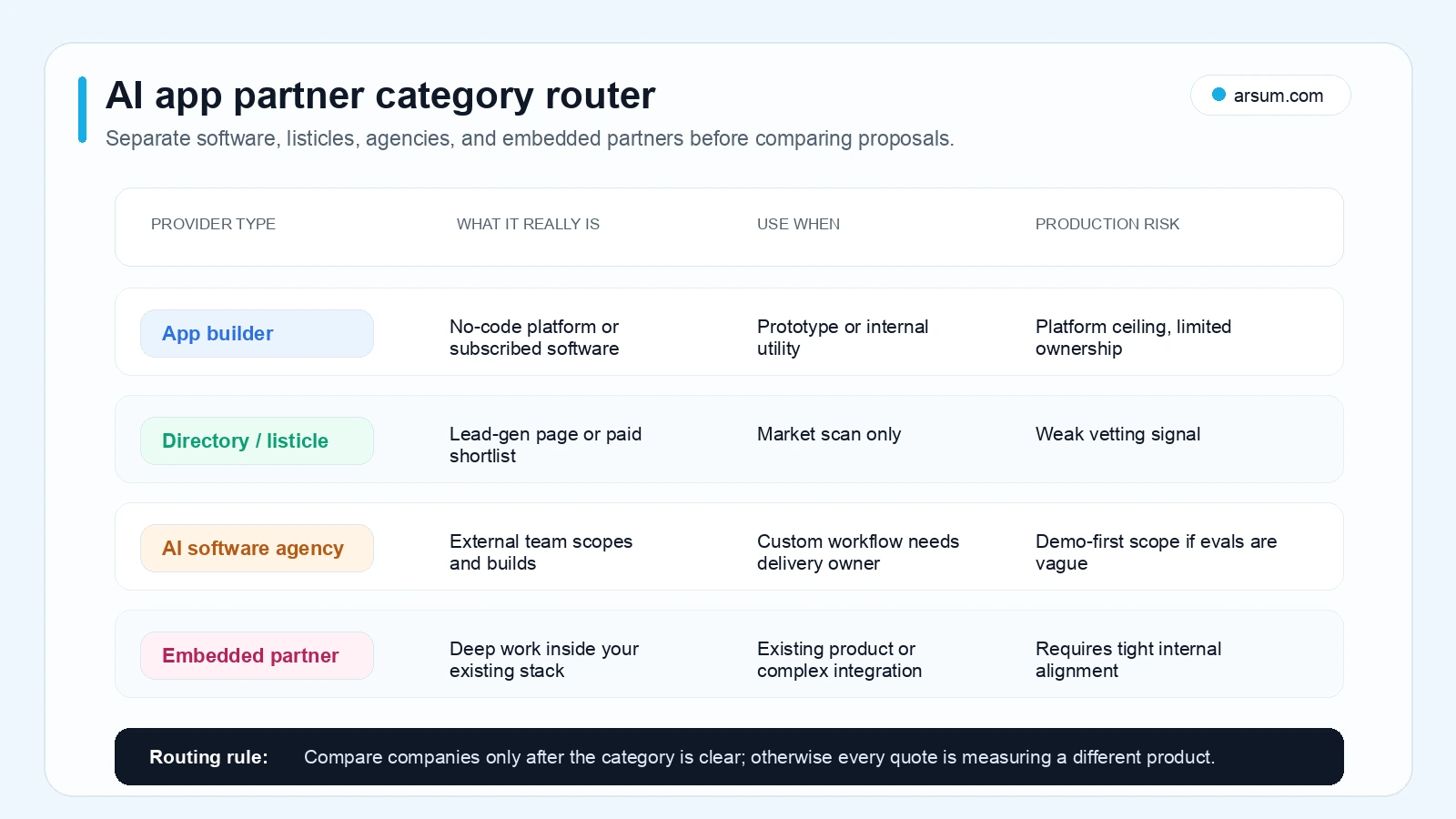
An AI app development company can mean several different things. Compare companies only after you have placed them in the right category.
| Provider category | What you are buying | Suitable when | Buyer caution |
|---|---|---|---|
| App builder or low-code platform | Software your team configures | The workflow is simple and internal ownership is available | You retain implementation and maintenance responsibility |
| Prototype-focused studio | A fast proof of concept or interface | You need to test demand or usability before hardening | A demo is not evidence of production readiness |
| Integration partner | AI capability connected to existing systems | Your primary problem is workflow, data, approvals, or system coordination | Confirm who owns the application layer and ongoing support |
| Product engineering firm | End-to-end application delivery | You need a customer-facing or business-critical product | Require explicit operating, security, and maintenance commitments |
| Embedded delivery partner | Capacity and expertise inside your existing product team | You have technical leadership and want shared execution | Clarify decision rights, handoff, and codebase ownership |
The commercial SERP itself reinforces why this separation matters: pages such as Business of Apps’ AI developer directory help with discovery, but a directory format cannot assess the controls or ownership model of your specific use case.
If you are deciding whether to hire a team rather than an individual contributor, compare the operating model in AI development agency engagements. If the need is primarily system connection and workflow orchestration, AI integration services is the more relevant frame.
Use production readiness as the first shortlist gate
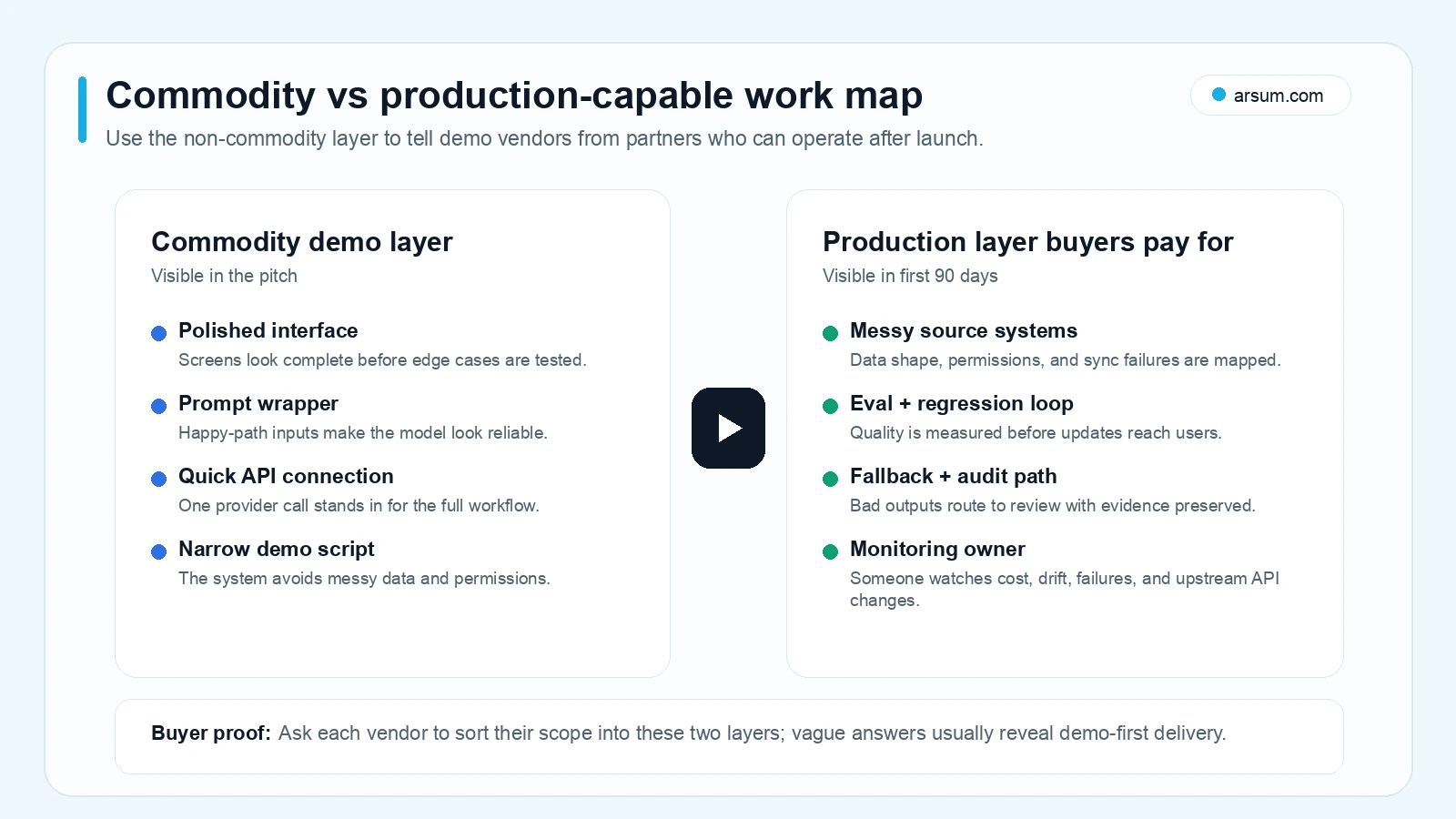
A capable team can usually produce a polished demonstration. The harder question is whether it can specify how the application behaves when it receives incomplete data, encounters an upstream outage, produces an uncertain answer, or is asked to take an action it should not take.
The NIST AI Risk Management Framework treats risk management as a concern across AI design, development, use, and evaluation. OWASP’s guidance on excessive agency similarly warns against giving AI systems more functionality, permissions, or autonomy than the task requires. For a buyer, these sources translate into contract and architecture questions.
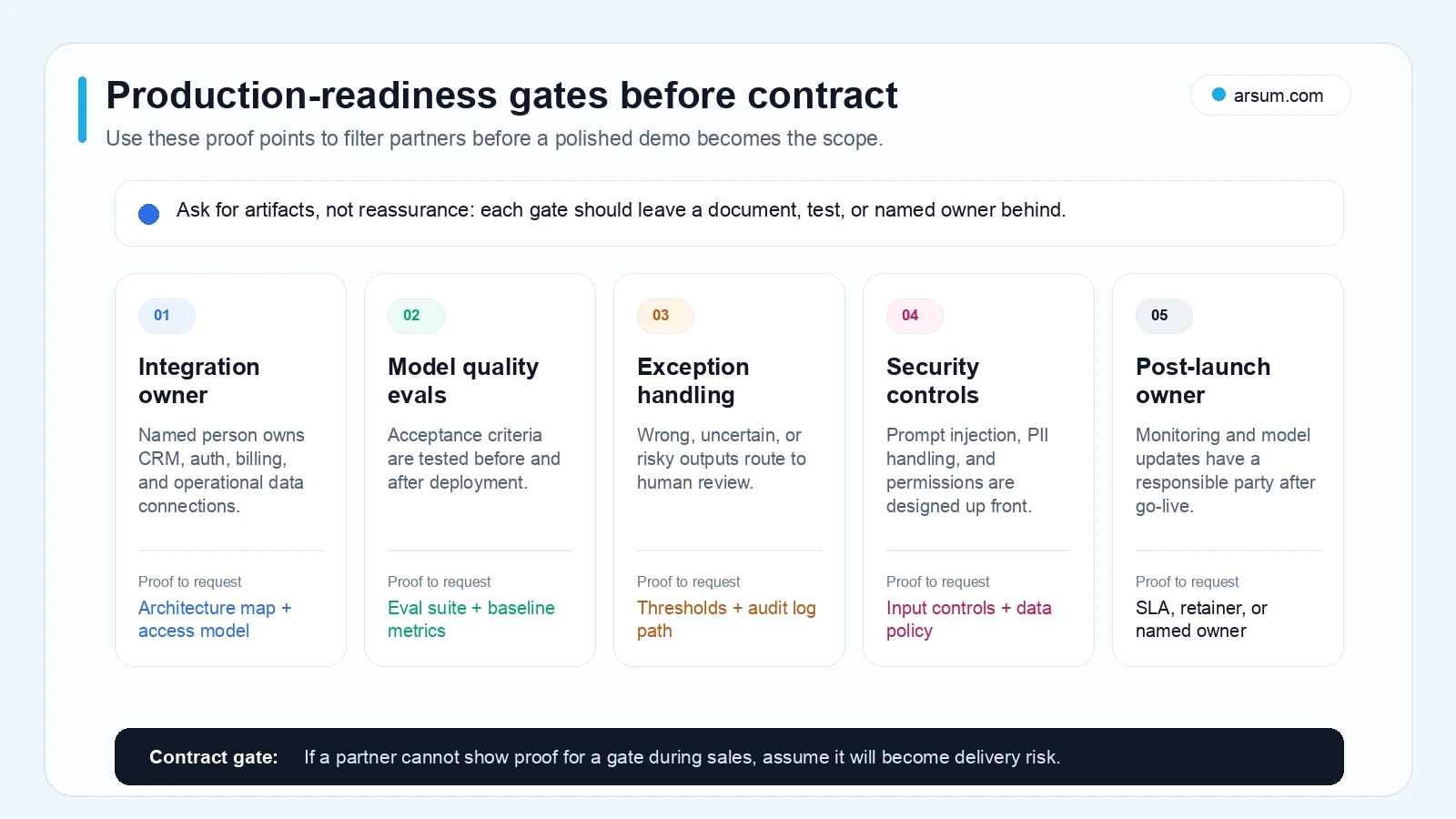
Require these artifacts before a production commitment
Ask each shortlisted company to produce or describe the following as part of discovery or proposal clarification:
| Evaluation area | Required evidence | Named owner |
|---|---|---|
| Workflow boundary | Current-state and proposed-state workflow map, including handoffs | Business process owner |
| Data and integration | Data-flow diagram, source systems, authentication method, downstream dependencies | Technical lead |
| Action permissions | List of allowed actions, prohibited actions, approval gates, and service accounts | Security or platform owner |
| Quality | Representative test set, acceptance criteria, evaluation method, and regression process | Product owner and AI lead |
| Exceptions | Human-review queue, escalation path, audit-log location, and fallback behavior | Operations owner |
| Release and rollback | Release approval, monitoring plan, rollback trigger, and recovery procedure | Delivery lead |
| Post-launch support | Incident ownership, update process, response expectations, and handoff terms | Accountable executive or service owner |
A company does not need to have every final diagram finished before it is hired. It does need to show how those questions will be answered, who will answer them, and when the work becomes contractually visible.
AI app risk box: Higher capability should not automatically mean more autonomy. If the app can approve, send, modify, delete, route, or expose business data, reduce permissions until the approval path, traceability, and rollback process are proven. Technical capability is not authorization to make a consequential decision.
For a more detailed review of control design, see AI agent security for production systems and AI agent architecture patterns.
Score companies with evidence, not presentation quality
Use a weighted procurement worksheet after the first discovery call. Weighting is a buyer heuristic, not a claim about a universal scoring model; adjust it for your regulatory exposure, internal engineering capacity, and failure cost.
| Criterion | Suggested weight | What earns a high score | Evidence to request |
|---|---|---|---|
| Integration ownership | 20% | Clear ownership of APIs, data contracts, authentication, and failure recovery | Architecture diagram and comparable integration reference |
| Evaluation design | 15% | Defined test cases, acceptance thresholds, regression checks, and review process | Sample evaluation plan and release gate |
| Permission and approval design | 15% | Least-privilege tool access with human approval for high-impact actions | Permission matrix and approval workflow |
| Exception handling | 15% | Defined fallback path, queue owner, traceability, and escalation procedure | Exception-flow diagram and incident example |
| Post-launch accountability | 15% | Named operating owner, monitoring responsibilities, update process, and support terms | Support model and sample service responsibilities |
| Product and engineering delivery | 10% | Evidence of building maintainable application features beyond model calls | Relevant shipped-work walkthrough |
| Commercial clarity | 10% | Scope distinguishes discovery, build, infrastructure, support, and change control | Proposal assumptions and change-control process |
Score each criterion from one to five, but do not let a strong average hide a failing control. Treat integration ownership, action permissions, exception handling, and post-launch accountability as pass/fail gates for any workflow that can affect customers, money, access, compliance, or regulated records.
A proposal should be comparable on scope, not on a single headline fee. If you need a planning framework before requesting proposals, AI app development cost can help structure the questions. Treat any internal budget arithmetic as an illustrative planning assumption: show the workflow volume, current handling effort, review cost, operating cost, and expected pilot scope rather than treating a vendor estimate as a realized return.
💡 Arsum builds custom AI automation solutions tailored to your business needs.
Get a Free Consultation →Run a narrow pilot before funding broad autonomy
A pilot is useful when the workflow is valuable enough to test but too uncertain to automate broadly. It should test a defined operational boundary, not “AI capability” in the abstract.
Here is a worked scorecard structure for a document-intake workflow. The numbers below are placeholders for your own baseline, not observed results.
| Pilot element | Illustrative planning assumption |
|---|---|
| Workflow | Extract and route information from incoming documents |
| Baseline | Measure current volume, handling time, rework rate, and reviewer queue age for four weeks |
| Target | Reduce manual preparation work while preserving the existing approval step |
| Quality metric | Percentage of outputs accepted without material correction, measured against a reviewed sample |
| Exception metric | Percentage routed to human review, plus reasons for routing |
| Owner | Operations manager owns workflow acceptance; technical sponsor owns integration and release |
| Review cadence | Weekly review of sample errors, exceptions, system incidents, and user feedback |
| Stop condition | Pause rollout if the error pattern creates unacceptable downstream rework, a control failure, or an unresolved security issue |
| Rollback path | Disable automated actions, retain logging, and return routing to the prior human process |
This structure prevents a common procurement mistake: approving a pilot on the basis of a demo while leaving the acceptance threshold undefined. A vendor can help implement the pilot, but the business owner must retain authority over what “good enough” means.
For workflow design that starts with the handoff rather than the model, see AI workflow automation and AI business process automation.
Build, buy, or partner: choose the delivery path deliberately
Hiring an AI app development company is not always the correct answer. Use these questions in sequence.
Buy when the workflow is standard
A packaged tool may be the better option when your process is common, the required integrations already exist, the data model is uncomplicated, and the business can accept the tool’s operating model. Buying is less attractive when you would need to work around your approval logic, system-of-record requirements, or exception process.
Configure existing systems when ownership already exists
If you have an internal product or engineering team, an embedded specialist or limited-scope engagement may be enough. In that case, prioritize knowledge transfer, code ownership, documentation, and a realistic maintenance plan over a vendor’s promise to “manage everything.”
Partner to build when the workflow is differentiated or constrained
A custom build is more defensible when the workflow contains proprietary business logic, unusual data sources, high-value integrations, or control requirements that generic software cannot accommodate. The partner’s real value is not model access alone; it is translating those constraints into a maintainable system.
Do not automate the decision when reversibility is low
If a wrong output is costly, difficult to undo, or externally consequential, keep a human approval step. You can still automate preparation, retrieval, summarization, drafting, classification, or routing. The appropriate autonomy level follows the failure cost and control environment, not the novelty of the technology.
This distinction is especially important for teams evaluating AI agents for business or deciding between agentic AI and generative AI. An agent that can call tools or trigger actions requires a different governance conversation than a drafting assistant.
Know the disqualifying conditions and common failure modes
Remove a company from consideration, or reduce the project scope, when any of these conditions remain unresolved:
- The vendor cannot explain where production data flows or which systems are authoritative.
- A model-triggered action has no documented permission boundary or approval owner.
- Quality is described as “tested” without representative cases, acceptance criteria, or a regression process.
- Post-launch support is vague, optional, or disconnected from incident and update ownership.
- The vendor’s evidence is limited to screenshots, generic case-study language, or a portfolio unrelated to your integration complexity.
- Your organization has no operational owner available to define exceptions, approve thresholds, or accept the new workflow.
The most common failure is not that an AI model makes an occasional mistake. It is that the buyer and supplier leave responsibility for the mistake undefined. A good contract and delivery plan make the normal path, the exception path, and the rollback path visible before launch.
Reference checks and commercial terms to settle before selection
Reference calls are most useful when they test the operating model rather than asking whether the client “liked working with” the company. Ask a reference:
- What did the vendor own after the first release?
- What changed between the original scope and the production workflow?
- How did the team handle an integration failure, poor output pattern, or changing requirement?
- Were acceptance criteria agreed before delivery, and did they hold up?
- Who maintained the system after launch, and was that responsibility clear in practice?
Then confirm these commercial terms with the selected company:
- Ownership and access to source code, infrastructure configuration, documentation, and evaluation assets.
- Clear separation of discovery, implementation, third-party infrastructure, support, and change requests.
- Named roles for your product owner, technical sponsor, vendor delivery lead, and incident contact.
- Acceptance criteria for each release rather than a subjective “AI works” milestone.
- A support and update model that covers model, prompt, integration, and security changes.
- Exit and handoff terms if you bring maintenance in-house or change partners.
Qualitative market signal and methodology
Practitioner discussions can be useful for surfacing questions, but they are not procurement statistics. Snippet-level discussions in r/Entrepreneur and r/agency point to a familiar concern: generic tools often fail at bespoke workflow details, while buyers still need ordinary product engineering disciplines around integrations and support. Treat that as a qualitative signal, not evidence that every buyer or vendor behaves the same way.
This guide uses current commercial search patterns for discovery context and primary guidance from OpenAI, OWASP, and NIST for control and risk questions. It does not rank companies or claim a verified market-wide price, performance, or adoption benchmark. The purpose is to make your shortlist comparable and your pilot governable.
When to involve Arsum
If you have identified a workflow with meaningful value but unresolved questions about feasibility, controls, ownership, or pilot acceptance, an assessment should produce those answers before a broad build commitment. Arsum can be a fit where the need is a production workflow with explicit integration, human-review, and post-launch requirements—not simply an AI demonstration.
A useful assessment output is a scoped workflow boundary, control design, ownership map, feasibility decision, and pilot scorecard you can use whether you build internally, buy software, or engage a delivery partner. For related planning, see AI implementation services and AI automation consulting.
Ready to Automate Your Business?
Stop wasting time on repetitive tasks. Let AI handle the busywork while you focus on growth.
Schedule a Free Strategy Call →Written by:Arsum editorial team
- Reviewed by
- Arsum editorial team
- Published
- June 8, 2026
- Updated
- August 12, 2026
- How this was produced
- Arsum uses research packs, source checks, and human editorial review to prepare and update blog articles. Editors are responsible for the final page.
- Source policy
- Sources are linked in the article when used. Methodology and source notes are included on higher-risk or high-visibility pages and are being rolled out across the archive. Editorial policy.
- Why this page exists
- Help B2B operators evaluate AI automation, implementation scope, cost, risk, and build-vs-buy decisions with practical context.