An AI app development company is worth hiring when a workflow depends on your data, systems, approvals, or customer experience—and you need a partner that can prove how the feature will be evaluated, controlled, operated, and handed over after launch. Do not choose from generic “top company” lists. Choose based on whether the vendor can turn one named workflow into a scoped pilot with an owner, exception path, cost model, acceptance criteria, and rollback plan.
AI App Development Company Hiring Guide
Explore ai app development company: compare workflow fit, costs, risks, evidence, and practical next steps before you build, buy, or hire.
Table of Contents
- What Most Hiring Guides Miss
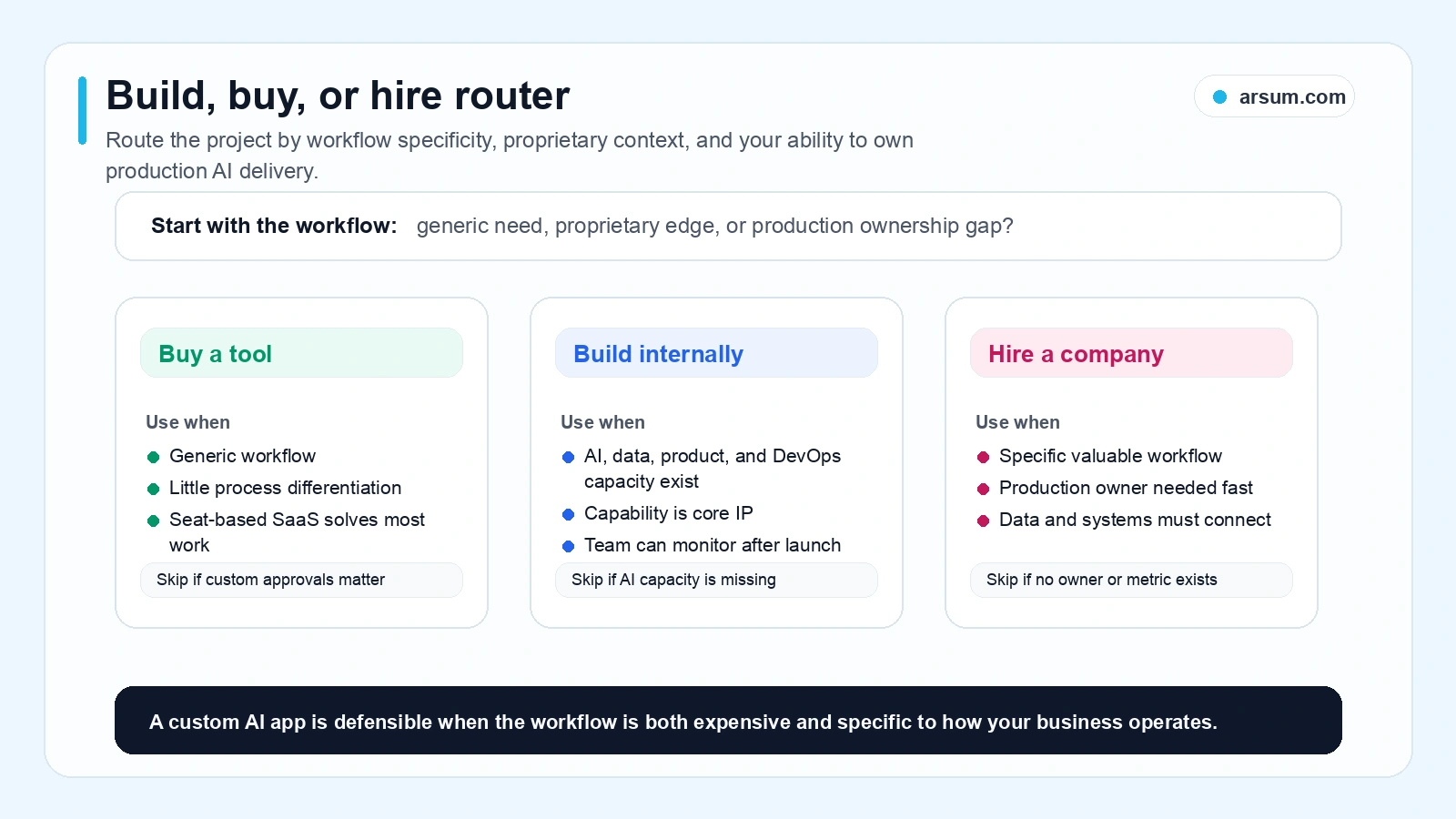
- Decide Whether to Buy, Build Internally, or Hire
- Separate Commodity Work From Production-Critical Work
- Prototype Versus Production: The Proposal Test
- A Regulated Workflow Example: Document Intake With Approval Controls
- Use a Worked Pilot Scorecard Before a Full Build
- How to Evaluate an AI App Development Company
- Budget and Timeline: Use Assumptions, Not Generic Ranges
- Disqualifying Conditions and Common Failure Modes
- Google Risk: Do Not Ship Thin Automation
- Methodology and Freshness
- The Bottom Line
What Most Hiring Guides Miss
The important distinction is not “AI agency versus software agency.” It is whether you are buying a demo, a production workflow, or ongoing operating capability.
A demo can show that a model produces plausible output. A production AI app must work with real permissions, incomplete inputs, changing source material, system failures, and people who need to understand when not to trust it.
Before asking for proposals, classify the problem:
- Decision problem: You have several possible AI ideas but no evidence that one workflow is valuable enough to fund.
- Delivery problem: The workflow is clear, but data access, integrations, approvals, and interface design are unresolved.
- Operating problem: A feature exists or can be built, but no one owns quality review, exception handling, cost controls, or changes after launch.
This changes who you need. A strategy engagement can help with the first problem. A narrowly scoped implementation partner can help with the second. For the third, the contract must include handoff, operating documentation, and named ownership—not simply a launch date.
A useful vendor should be willing to recommend buying an existing product, delaying a build, or narrowing the workflow if those are the safer decisions. Our guide to AI app development can help frame the product-side questions before vendor selection.
Decide Whether to Buy, Build Internally, or Hire
Use the route that matches the workflow, not the route that sounds most innovative.
| Path | Use it when | Avoid it when |
|---|---|---|
| Buy software | The workflow is common, configuration is enough, and proprietary context is not central | You need unique approval logic, deep internal integrations, or domain-specific evaluation |
| Build internally | You have available product, engineering, data, security, and operations ownership | Your team must learn production AI delivery while also carrying a time-critical business outcome |
| Hire an AI app development company | The workflow is specific, valuable, and needs disciplined delivery or a capability transfer | Nobody can own the process, data access is unavailable, or success cannot be measured |
A custom build is usually easier to justify when all of these are true:
- The workflow has repeatable inputs and a meaningful volume of work.
- The output changes a decision, handoff, customer interaction, or operational task.
- Existing tools leave a material gap because of proprietary data, policy, or integration needs.
- An internal business owner can decide what the system may do automatically.
- You can define a lower-risk pilot before committing to broad autonomy.
If an off-the-shelf tool handles most of the workflow, buy it first. If the remaining gap is the differentiator, evaluate a custom build around that gap rather than recreating a whole platform. For related tradeoffs, see hiring an AI developer versus an agency and AI integration consulting.
Separate Commodity Work From Production-Critical Work
Do not pay for custom development where a configurable product is sufficient. Spend custom effort where your workflow, risk, or operating model is genuinely specific.
| Often commodity | Usually needs stronger product and infrastructure delivery |
|---|---|
| Basic chat interface over public information | Retrieval over internal systems with permissions and source-level citations |
| Generic meeting summaries | Workflow outputs that create records or trigger actions in CRM, ERP, finance, or operations systems |
| Standard FAQ experiences | Customer-visible answers that require domain-specific evaluation and escalation |
| Common document extraction templates | Documents with varied formats, consequential fields, or human approval requirements |
| Simple internal assistants | Agent-like workflows with tool permissions, limits, audit records, and rollback conditions |
The right question is not whether a vendor can call a model API. It is whether they can define the boundary around model behavior.
A vendor should be able to explain:
- What the system reads and where the source material comes from.
- What information is retained, logged, or excluded from logs.
- What the model may draft, recommend, retrieve, or trigger.
- Which actions require human approval.
- How a user corrects a bad answer or decision.
- How the workflow is narrowed or disabled if quality falls below the agreed threshold.
Prototype Versus Production: The Proposal Test
Many proposals describe a prototype as though it were a finished product. Ask vendors to show which work belongs in each column.
| Area | Prototype question | Production question |
|---|---|---|
| Data | Can sample data be connected? | Are source lineage, permissions, retention, and access controls agreed? |
| Quality | Does the output appear useful? | What evaluation set, baseline, and acceptance threshold determine launch? |
| Workflow | Does the happy path work? | What happens with missing data, ambiguity, rejected outputs, and downstream failure? |
| Cost | Can the feature run? | What usage assumptions, fallback policy, caching approach, and alert thresholds govern operating spend? |
| Ownership | Can the vendor deliver v1? | Who reviews failures, changes prompts or rules, and owns the workflow after handoff? |
This is where a capable partner differs from an API wrapper. The vendor does not need to promise perfection. They do need to state what will be measured, what remains human-controlled, and what happens when the app is uncertain.
Practitioner discussion reinforces this operating concern, although it is not market-wide evidence. A Hacker News snippet about production AI cost captured during research warned that real cost only becomes visible after a feature enters a live workflow. Treat that as a diligence prompt: ask for a usage model, not a confident build-fee estimate.
A Regulated Workflow Example: Document Intake With Approval Controls
Consider a lending, insurance, compliance, or finance workflow that receives documents and needs structured information extracted before a person makes a consequential decision.
The appropriate pilot is not “let the AI approve cases.” It is a controlled intake workflow.
Workflow boundary
| Element | Pilot design |
|---|---|
| Inputs | Submitted documents, application identifiers, permitted internal reference data |
| Source lineage | Every extracted field links back to a page, document, or source record for reviewer verification |
| Allowed actions | Extract, classify, flag missing fields, draft a structured review summary |
| Prohibited actions | Approve, decline, release funds, alter a customer record, or send a final external decision without authorized review |
| Exception queue | Low-confidence outputs, conflicting sources, unsupported document types, and policy-sensitive cases |
| Approval owner | Named operations, underwriting, compliance, or finance lead |
| Audit record | Input reference, output version, source references, reviewer action, override reason, and timestamp |
| Rollback trigger | Disable automated routing and return to manual intake if agreed quality, exception, or safety thresholds are missed |
This is the difference between technical capability and authorized autonomy. A model may be able to summarize a file. That does not mean it should be allowed to make the resulting business decision.
OpenAI’s safety best-practices guidance supports adversarial testing, constrained inputs and outputs, human review for higher-stakes uses, and clear reporting paths. Those are practical contract requirements, not optional security language.
Use a Worked Pilot Scorecard Before a Full Build
Do not ask a vendor for a generic ROI claim. Ask them to complete a pilot scorecard using your workflow data.
The arithmetic below is an illustrative planning assumption, not a forecast or observed result.
Suppose a team handles 800 intake items per month. Current handling time is 12 minutes per item, the loaded labor cost is $45 per hour, and 8% of items require rework with an assumed $30 rework cost.
| Measure | Illustrative baseline | Pilot target | Owner |
|---|---|---|---|
| Monthly handling time | 160 hours | Measure reduction without removing required review | Operations lead |
| Direct handling cost | $7,200 | Compare against review and operating cost | Finance partner |
| Rework incidents | 64 items | No increase beyond agreed tolerance | Workflow owner |
| Source-supported extraction | Establish on a representative reviewed sample | Agreed threshold by field type | Quality reviewer |
| Exception rate | Establish by document category | Stable or improving as coverage expands | Operations lead |
| Unsafe or unauthorized action | Zero tolerated | Zero tolerated | Risk or compliance owner |
The baseline calculation is:
800 items × 12 minutes ÷ 60 × $45/hour = $7,200 per month
The potential value of a pilot is not “the model saves 50%.” It is whether the proposed workflow reduces the total cost of handling while preserving quality, reviewability, and policy controls.
A scorecard should also name:
- Review cadence: for example, a weekly review of sampled outputs and all high-risk exceptions during the pilot.
- Acceptance condition: a pre-agreed quality threshold for the fields or classifications that matter, plus no material increase in rework or unresolved exceptions.
- Stop condition: repeated failures in a critical category, inability to trace outputs to sources, or operating cost that exceeds the agreed guardrail.
- Rollback path: disable the automated step, retain the audit log, and return routing or review to the prior manual process.
💡 Arsum builds custom AI automation solutions tailored to your business needs.
Get a Free Consultation →A workflow assessment should produce this artifact before a broad build begins: the boundary, source access plan, pilot scorecard, internal owner, and go/no-go decision.
How to Evaluate an AI App Development Company
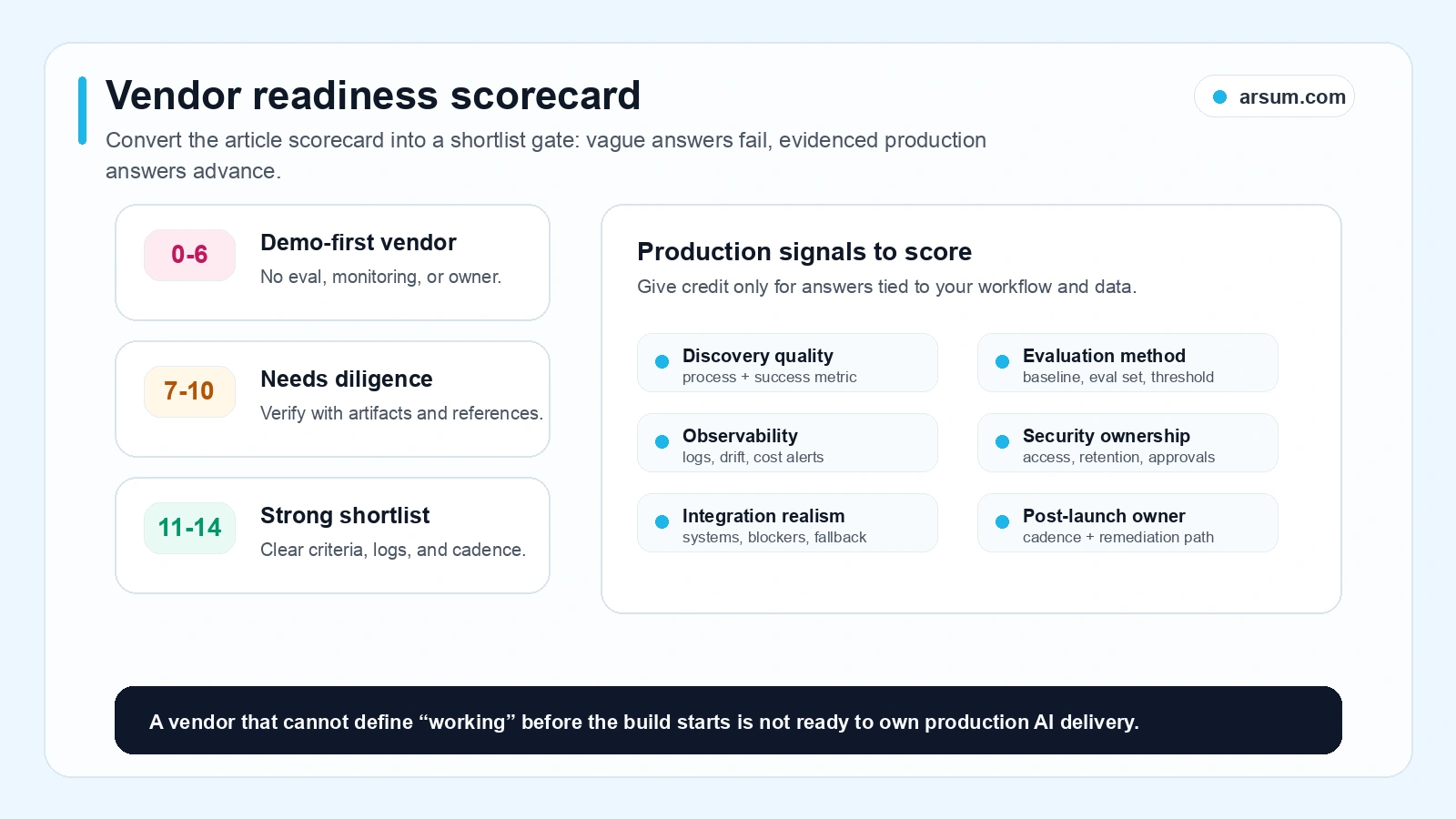
Score every vendor on concrete evidence. A polished interface, a model name, or a large portfolio does not answer whether the team can operate your workflow safely.
Rate each category from 0 to 2: 0 is vague, 1 is partial, and 2 is specific and testable.
| Dimension | 0 | 1 | 2 |
|---|---|---|---|
| Discovery quality | Jumps to features | Asks general questions | Produces a workflow map, assumptions, risks, and success measures |
| Model and integration fit | Names a preferred model only | Discusses APIs generally | Explains retrieval, tool boundaries, fallbacks, latency, and system constraints |
| Security and guardrails | Relies on NDA language | Mentions security review | Defines access scope, testing, restricted actions, escalation, and data handling |
| Evaluation and observability | “We test it” | Mentions monitoring later | Names evaluation cases, logging, review cadence, alerts, and remediation |
| Cost-control design | Quotes build work only | Estimates usage loosely | States usage assumptions, model fallback, budget alerts, and cost ownership |
| Ownership transfer | Launch ends the engagement | Offers ad hoc support | Documents ownership, operating procedures, training, and change control |
A score is a conversation tool, not independent proof. Require written deliverables that support the score: workflow maps, a test approach, data-flow diagrams, a backlog of exceptions, and a post-launch ownership plan.
Questions that expose weak proposals
Ask these questions before selecting a vendor:
- Which workflow step is automated, assisted, or intentionally left manual?
- What source material will the app use, and how will users verify it?
- What is the evaluation set, who labels or reviews it, and what happens when the result is disputed?
- Which system permissions are needed, and which actions are technically blocked?
- What assumptions drive inference and operating cost?
- How do model updates, retrieval changes, policy changes, integration failures, and changing input distributions get handled?
- Who owns the process after launch, and what documentation will be handed over?
Do not accept “model drift” as a catch-all answer. Quality can degrade because source documents changed, retrieval broke, permissions changed, an API changed, a business policy changed, inputs shifted, or a model version changed. The operating plan should distinguish those causes so the team knows what to investigate.
Budget and Timeline: Use Assumptions, Not Generic Ranges
A reliable price cannot be inferred from the label “AI app.” Cost and time depend on the number of integrations, quality requirements, data accessibility, workflow complexity, security review, interface scope, and whether post-launch operations are included.
Instead of accepting a broad range as a promise, request a transparent planning model with these inputs:
| Input | Why it changes the estimate |
|---|---|
| Workflow volume and peak usage | Drives operating-cost and performance assumptions |
| Current handling time and review cost | Establishes whether the workflow has economic value |
| Error and rework cost | Determines how much quality assurance and human review are justified |
| Data access and cleaning work | Can add significant discovery and integration effort |
| Number of source systems | Increases integration, permission, testing, and failure-path work |
| Required approvals | Limits autonomy and adds interface and audit requirements |
| Required post-launch support | Determines whether monitoring and improvement are funded or deferred |
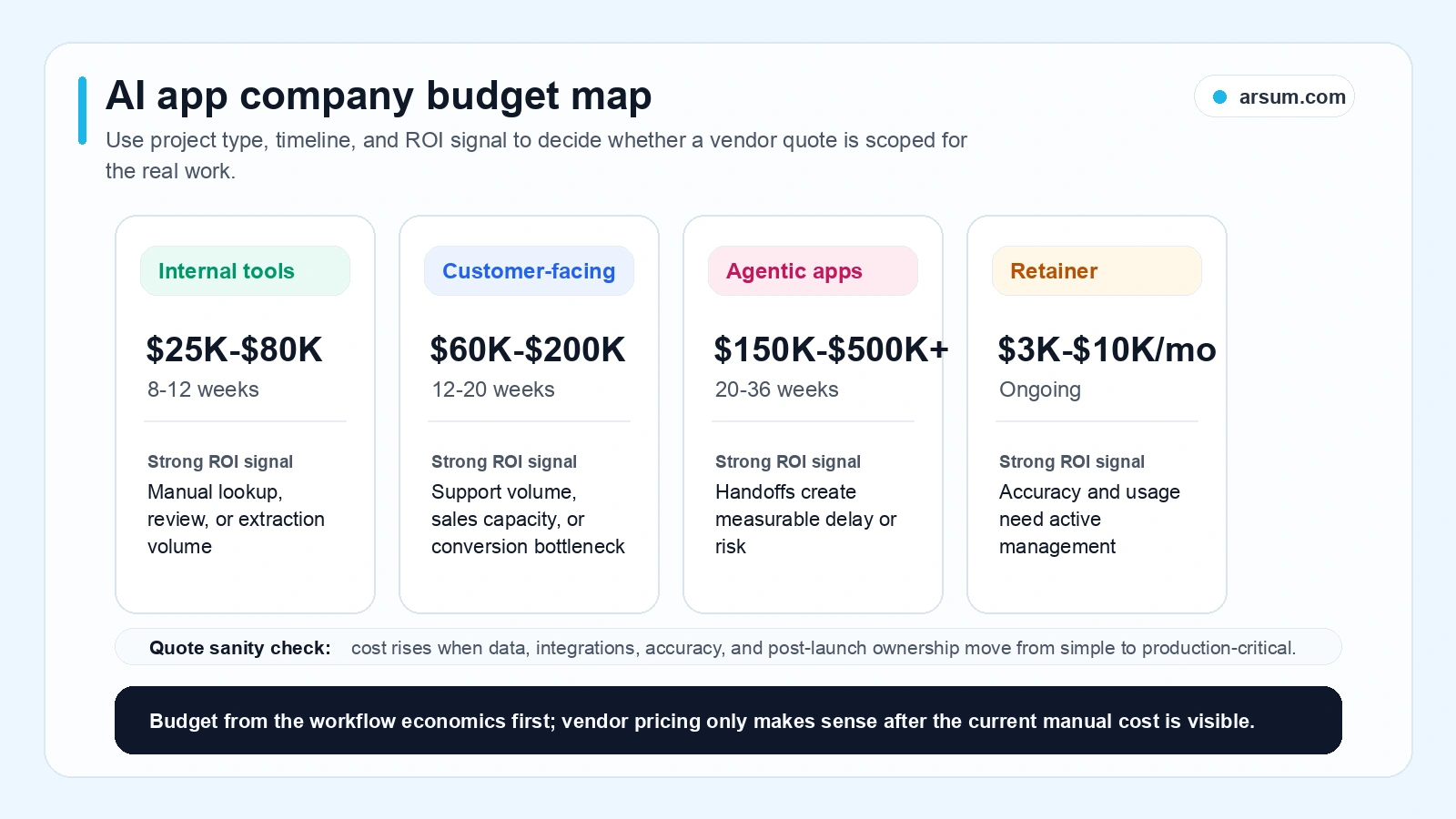
Use this budget map as a discussion prompt, not a price card. A vendor should show what is included in each phase and what assumptions could change the estimate.
For cost planning that starts with workflow economics, see AI automation ROI examples and AI app development cost. The useful output is a decision threshold: what the pilot must demonstrate before more budget is released.
Disqualifying Conditions and Common Failure Modes
An AI app development company may be the wrong choice—or the project may be premature—when any of these conditions remain unresolved:
- No accountable internal owner can decide policy, exceptions, or process changes.
- The business cannot provide authorized access to necessary source systems.
- The workflow does not have a measurable baseline or meaningful volume.
- The proposed system would make a consequential decision without a justified approval design.
- The team expects the vendor to permanently own internal operating policy.
- A standard product already meets the need with acceptable controls.
Common failure modes are more operational than technical:
- A vague workflow becomes a vague product. The team builds a broad assistant instead of improving one defined handoff.
- The happy path is mistaken for the real process. Missing documents, contradictory data, permissions, and edge cases arrive after launch.
- Review cost is ignored. A feature can reduce first-pass work but still fail economically if it produces too many difficult exceptions.
- Source quality is assumed. Retrieval systems need maintained source material, access rules, and a way to identify stale or conflicting information.
- Ownership disappears after handoff. Nobody reviews failures, approves changes, or decides whether the workflow should expand.
For workflows that use agent-like tool calls, review AI agent security before allowing systems to act across internal tools. For broader orchestration choices, see agentic AI workflow automation.
Google Risk: Do Not Ship Thin Automation
If the app will generate public pages, help content, recommendations, or customer-facing answers at scale, require an explicit usefulness standard.
Google’s guidance on people-first content emphasizes original value, expertise, and usefulness rather than mass-produced, search-first output. That does not prohibit AI assistance. It means a vendor should not equate output volume with product or acquisition value.
For a public-facing workflow, ask:
- What information is original, verified, or meaningfully useful to the user?
- Which claims need source support or human approval?
- What is allowed to publish automatically, if anything?
- How are incorrect outputs found, corrected, and rolled back?
- Who is accountable for the final experience?
OpenAI’s sharing and publication policy similarly emphasizes review, responsibility, and clear disclosure when publishing AI-assisted work.
Methodology and Freshness
This guide uses an editorial buyer framework rather than a market-ranking dataset. Research was conducted on June 16, 2026 through a DuckDuckGo HTML review of the query and related terms, plus direct review of Google Search Central and OpenAI documentation. Hacker News and Reddit references are included only as snippet-level qualitative signals about production concerns; they are not statistical evidence or vendor benchmarks.
Re-check model pricing, vendor terms, privacy commitments, and technical assumptions during procurement. Those can change; the need for clear workflow boundaries, evidence, review ownership, and rollback conditions does not.
The Bottom Line
Hire an AI app development company when you have a specific workflow that cannot be adequately solved by configurable software, can assign a business owner, and can test value through a controlled pilot.
The partner you want is not the one that promises the fastest generic AI build. It is the one that helps you define what the system may do, what it must not do, how people review exceptions, what evidence is retained, and what result must be achieved before the project expands.
Bring a workflow map, baseline, data-access constraints, approval owner, and pilot scorecard into the first serious conversation. That gives you a far stronger buying position than a request for a generic AI app quote.
Ready to Automate Your Business?
Stop wasting time on repetitive tasks. Let AI handle the busywork while you focus on growth.
Schedule a Free Strategy Call →Written by:Arsum editorial team
- Reviewed by
- Arsum editorial team
- Published
- April 14, 2026
- Updated
- August 12, 2026
- How this was produced
- Arsum uses research packs, source checks, and human editorial review to prepare and update blog articles. Editors are responsible for the final page.
- Source policy
- Sources are linked in the article when used. Methodology and source notes are included on higher-risk or high-visibility pages and are being rolled out across the archive. Editorial policy.
- Why this page exists
- Help B2B operators evaluate AI automation, implementation scope, cost, risk, and build-vs-buy decisions with practical context.