An AI app development service is worth hiring when you need to improve a defined workflow while retaining control over data, approvals, exceptions, and ownership after launch. Choose the service for the workflow’s failure cost, integration depth, and operating requirements—not for the speed of a polished demo.
AI App Development Service: Buyer Guide
Explore ai app development service: compare workflow fit, costs, risks, evidence, and practical next steps before you build, buy, or hire.

Table of Contents
- What most guides miss: you are choosing an operating model
- What a capable service should deliver
- Choose the service model that fits the workflow
- Commodity implementation versus production work
- Require controls that a demo cannot prove
- Worked example: an approval-safe operations routing pilot
- Evaluate vendors with an evidence scorecard
- Disqualifying conditions and rescue signals
- Send every vendor the same brief
- The practical hiring decision
What most guides miss: you are choosing an operating model
Most comparisons of an AI app development service treat agencies, no-code builders, freelancers, and software platforms as interchangeable. They are not. They assign very different responsibilities to your team and the vendor once the prototype is live.
The decision is not simply whether a vendor can add a model to an interface. It is whether they can define and support the operating model around that model:
- Which workflow changes and which system remains the source of truth?
- What data enters the application, prompts, logs, and connected tools?
- Which outputs are advisory, and which actions may occur without approval?
- What happens when inputs are incomplete, output is uncertain, or a dependency fails?
- Who owns evaluations, code, configurations, access, monitoring, and changes after handoff?
A useful model response does not make the surrounding application safe, authorized, or maintainable. That distinction matters when the app touches internal operations, customer communications, sensitive data, or decisions that are hard to reverse.
Use this diagnosis before requesting proposals:
| If your situation is… | You are likely buying… | Prioritize… |
|---|---|---|
| An idea that needs testing | Prototype or proof of concept | Narrow scope, user learning, and an explicit next-step decision |
| A repetitive internal process with known steps | Workflow automation | Integrations, approvals, logs, exceptions, and a measurable baseline |
| A feature customers will use directly | Product engineering | UX, evaluations, abuse handling, support ownership, and fallback behavior |
| An AI layer near a system of record | Production AI engineering | Security review, data boundaries, deterministic controls, auditability, and change management |
| A brittle generated or builder-based app | Rescue or rebuild engagement | Technical-debt assessment, migration sequencing, ownership, and production hardening |
If a provider presents the same package for all five situations, ask how the engagement changes when failure cost or integration complexity changes. The answer usually reveals whether they are supplying implementation capacity or designing for the workflow you actually need to operate.
What a capable service should deliver
An AI app development service may include language models, retrieval, document processing, classification, forecasting, computer vision, or several components together. The useful boundary is not “AI versus non-AI.” It is the boundary between model behavior and the controls that make it usable in a real workflow.
A credible scope should address:
- Data intake, source lineage, refresh behavior, and retention
- Business rules and deterministic checks outside the model
- Permissions for records, tools, and write actions
- Evaluation cases, review rubrics, and release criteria
- Human review, escalation, and exception ownership
- Logging, monitoring, incident handling, and change control
- Code, configuration, infrastructure, and maintenance ownership
OpenAI’s guidance on evaluations supports making evaluation design a delivery requirement: teams need representative inputs, criteria for judging results, and a way to review performance as the application changes. “We will test it” is not a sufficient vendor answer. Ask what will be tested, against which examples, by whom, and what result blocks release.
For a broader view of the product boundary, see AI app development and AI-powered app development.
Choose the service model that fits the workflow
Prototype or no-code assembly
A lightweight prototype can be appropriate when the problem is bounded, data is non-sensitive, outputs are advisory, and people can readily correct mistakes. Its value is speed of learning, not proof that the workflow is production-ready.
Before choosing this route, establish whether the platform supports the integrations, access controls, data boundaries, and export path you may need later. A prototype should not become a production dependency simply because it is convenient to keep using.
Workflow automation and integration
This model fits a defined internal workflow: intake, routing, document handling, research preparation, support triage, account operations, or another repeatable process with known systems and owners.
The durable work is usually not the model call. It is mapping triggers, source systems, exception states, reviewer queues, permissions, and measurable outcomes. Agentic AI workflow automation and AI business process automation provide useful context for inspecting that workflow layer.
Production AI product engineering
Customer-facing features and system-of-record-adjacent applications require a more demanding service model. The vendor should design for adverse inputs, changing source data, permission failures, abuse attempts, outages, and support escalation—not just happy-path outputs.
The OWASP Top 10 for Large Language Model Applications identifies risks including prompt injection, insecure output handling, sensitive-information disclosure, insecure plugin design, excessive agency, and overreliance. Not every app needs identical controls. Every serious scope should identify applicable risks, document the selected controls, and state what remains outside the application’s authority.
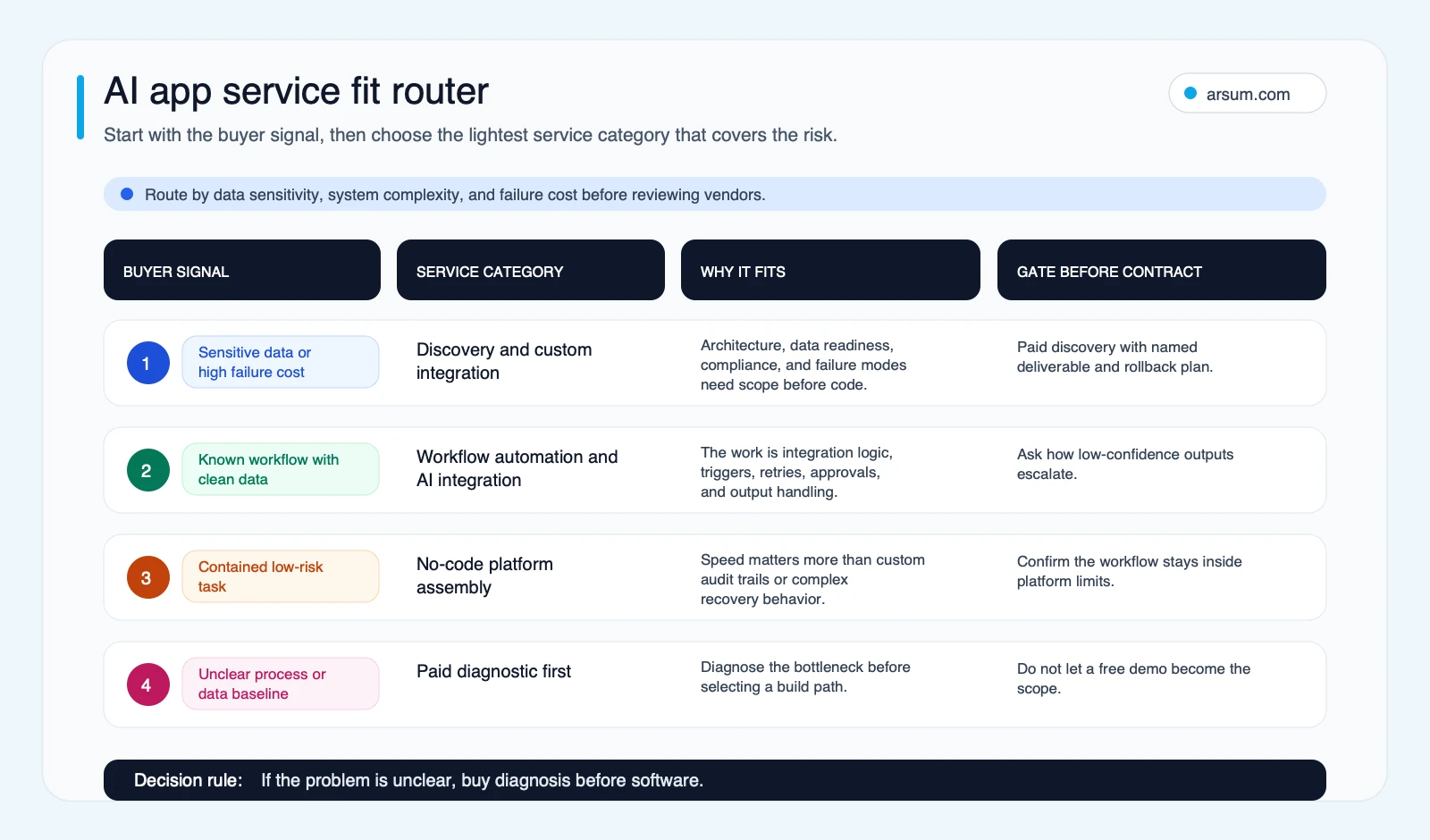
Choose the delivery model before comparing vendors; a low-consequence prototype and a system-adjacent workflow should not be procured the same way.
Commodity implementation versus production work
Commodity implementation is not inherently a bad purchase. A prompt wrapper, template chatbot interface, or basic retrieval demonstration can be a sensible way to test demand. The mistake is buying that level of service for a workflow that needs integration depth, clear authority boundaries, and durable operations.
| Area | Commodity implementation | Production-oriented service |
|---|---|---|
| Discovery | General capability discussion | Workflow map, decision boundaries, failure costs, and defined outputs |
| Data | Demonstration data or simple upload | Source systems, lineage, refresh behavior, access boundaries, and quality handling |
| Testing | Happy-path demo | Evaluation set, acceptance criteria, negative cases, and reviewer process |
| Actions | Broad tool connection | Explicit permissions, approval gates, and constrained action paths |
| Exceptions | Deferred as bugs | Defined escalation queue, owner, and evidence retained |
| Monitoring | Generic dashboard language | Named metrics, alerts, review cadence, and incident responsibilities |
| Handoff | Application delivered | Code, configuration, documentation, access, and maintenance ownership transferred |
The practical distinction is simple: model access may be easy to procure, but validation, integration, control design, and ownership discipline are where the difficult work sits.
That distinction matters when comparing an automation provider with a custom software team. AI automation agency versus AI development firm explains the broader buying choice; this page applies it to an AI app engagement.
Require controls that a demo cannot prove
A favorable demo shows that selected inputs can produce useful output. It does not show how the application behaves when data is stale, a request is ambiguous, a connected system fails, a user tries to bypass instructions, or output does not meet a business rule.
The NIST AI Risk Management Framework treats risk management and trustworthiness as considerations across the design, development, use, and evaluation of AI systems. Convert that principle into explicit scope, acceptance criteria, and operating ownership.
Ask vendors to specify these items before release:
| Control | Buyer question |
|---|---|
| Trigger rules | What enters the AI path, and what bypasses it? |
| Tool permissions | Which read and write actions are allowed, and which require approval? |
| Uncertainty handling | What signal routes a case to review rather than attempting an answer or action? |
| Human handoff | Who receives the exception, with what context, in which queue? |
| Audit evidence | Which input, source, output, decision, approval, and version details are retained? |
| Rollback | How can the AI feature be disabled or isolated without damaging the underlying workflow? |
| Change control | Who approves changes to prompts, models, tools, policies, and data connections? |
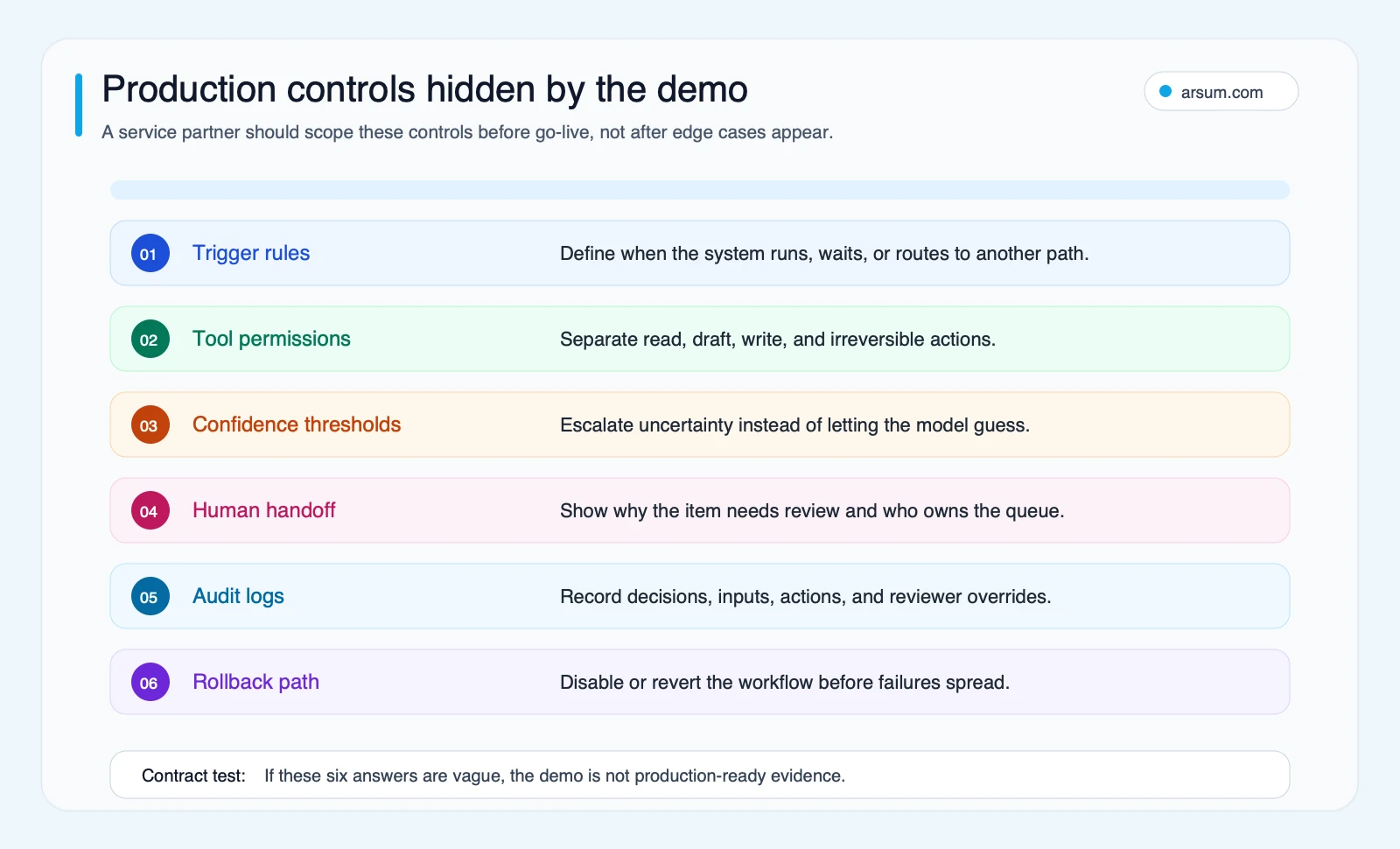
“A human stays in the loop” is not a control design. Ask where the reviewer enters, what evidence they see, what they can override, how their correction is recorded, and whether the underlying workflow still completes when the AI path is paused.
Worked example: an approval-safe operations routing pilot
Consider a team that receives inbound requests which must be routed to the right operations queue. This is a compact, consequential enough workflow to expose whether a vendor can build more than a demo.
| Pilot element | Defined operating choice |
|---|---|
| Baseline | Measure current median intake-to-routing time, manual routing effort, reassignment rate, and unresolved requests for a representative period |
| Permitted AI action | Classify the request and recommend a destination queue; do not close, reject, alter a system-of-record field, or send an external message |
| Source of truth | The existing operations platform remains authoritative; the AI app reads permitted intake context and writes only a recommendation or approved routing event |
| Approval route | High-confidence recommendations may be routed under pre-approved rules; ambiguous categories, missing data, and sensitive cases enter a reviewer queue |
| Evidence retained | Intake reference, source records used, model or prompt version, recommendation, routing decision, reviewer override, and exception reason |
| Quality threshold | Use a pre-agreed reviewer-confirmed correct-route rate and error taxonomy; the exact threshold is set by the workflow owner before launch |
| Owner and cadence | A named operations owner reviews results on a scheduled cadence, such as weekly during the pilot, with the technical owner and reviewer lead |
| Stop condition | Pause automated routing if a defined safety, privacy, operational, or quality threshold is breached |
| Rollback | Disable the AI routing path and return all cases to the prior manual or deterministic queue; test that path before enabling automation |
This is a planning pattern, not an observed result or benchmark. Its purpose is to force the important decisions into the scope before implementation begins.
If time saved is the goal, document the current steps and handling time. If quality is the goal, define the reviewer rubric and disagreement process. If failure cost is high or actions are difficult to reverse, reduce autonomy: produce a recommendation, route it to a reviewer, or constrain action to deterministic rules.
If you have a bounded workflow and can name its owner, exception path, and rollback condition,
💡 Arsum builds custom AI automation solutions tailored to your business needs.
Get a Free Consultation →Evaluate vendors with an evidence scorecard
Score each dimension from 0 to 2:
- 0: No usable evidence, vague answer, or deferred decision.
- 1: Plausible approach, but ownership, artifacts, or test criteria are incomplete.
- 2: Specific approach with named owners, relevant artifacts, and a way to verify it.
| Dimension | What to inspect |
|---|---|
| Business-case clarity | Workflow baseline, intended outcome, failure cost, and stop condition |
| Workflow integration depth | Source systems, data contracts, permissions, retries, and upstream-change handling |
| Evaluation methodology | Representative test inputs, rubric, reviewer owner, and release criteria |
| Security and privacy controls | Data boundaries and applicable OWASP risks with documented mitigations |
| Observability and monitoring | Metrics, alerts, log access, incident path, and named owner |
| Fallback and deterministic handling | Escalation, approval gates, manual path, and rollback test |
| Handoff and code ownership | Repository, credentials, configuration, documentation, and access transfer |
| Maintenance plan | Ownership of model, prompt, data, dependency, and policy changes |
| Migration and lock-in risk | Exportability, replacement path, provider dependencies, and prototype-to-production plan |
The maximum score is 18. This is an original Arsum buyer heuristic, not a validated market benchmark.
- 0–5: A prototype-oriented provider may be sufficient where the workflow is low consequence.
- 6–11: Proceed only after an architecture and controls review resolves the weak areas.
- 12–18: The provider has supplied stronger evidence of production engineering discipline; validate it against your specific workflow before selection.
Do not average away a critical gap. A total of 15 does not compensate for a zero in security, fallback handling, or ownership when the workflow requires those controls.
Disqualifying conditions and rescue signals
Some projects should pause for workflow redesign, data cleanup, or a narrower pilot rather than proceed directly to an AI build.
Pause when:
- No process owner can describe the current workflow or approve exceptions.
- Required source data is inaccessible, unreliable, or incompatible with privacy and retention requirements.
- A wrong action could create material harm and there is no feasible approval or deterministic fallback path.
- The buyer cannot retain enough evidence to investigate outcomes and overrides.
- The vendor will not define ownership of code, configurations, evaluations, or production access.
- The proposal treats model output as authoritative where policy, regulation, or business rules require accountable human approval.
- A prototype has no credible migration plan for the integrations, security controls, and ownership required in production.
For a rescue or rebuild engagement, ask:
- Which parts of the current app are safe to retain, and what evidence supports that decision?
- What must be rebuilt to establish clear data, permission, and ownership boundaries?
- How will working behavior be preserved while the system moves to a maintainable architecture?
- Which rollback path remains available during migration?
These questions are especially relevant for generated or builder-based prototypes. The goal is not to dismiss fast experimentation; it is to prevent an experimental artifact from becoming an unowned production system.
Send every vendor the same brief
Comparable written answers make it harder for a better demo to obscure a weaker operating model.
- Workflow to improve: Describe the current trigger, handoffs, systems, and decision owner.
- Current baseline: State the manual effort, turnaround time, quality issue, or queue problem to improve.
- Data and systems: List source systems, data classifications, access constraints, and the system of record.
- Failure cost: Describe what happens if the app is wrong, late, unavailable, or acts without authorization.
- Phase-one boundary: Define what the AI may recommend, draft, classify, or execute—and what remains human-approved.
- Evaluation plan: Request proposed test cases, quality rubric, reviewer, acceptance threshold, and negative cases.
- Control design: Request trigger rules, tool permissions, escalation, logging, and a rollback plan.
- Handoff: Specify required ownership of code, prompts, evaluations, infrastructure, documentation, and credentials.
- Maintenance: Request the post-launch owner, monitoring process, change-approval path, and support boundary.
- Migration: If starting from a prototype, request a staged path to a maintainable production system.
For related diligence, review AI agent security, AI agent architecture patterns, AI implementation services, and AI integration services.
The practical hiring decision
Hire an AI app development service when a defined workflow has enough value to justify scoped engineering and enough risk to require explicit controls. Choose a faster prototype or platform when the workflow is low consequence, easy to review, and genuinely bounded. Start with discovery when the bottleneck, data readiness, ownership, or failure boundary remains unclear.
The strongest proposal will not merely promise an AI application. It will show the workflow boundary, data path, evaluation plan, exception route, approval owner, retained evidence, rollback condition, and handoff model.
Methodology: This guide uses OpenAI evaluations documentation, OWASP’s LLM application guidance, NIST’s AI Risk Management Framework, and Google’s people-first content guidance. The fit ladder, scorecard, pilot pattern, and vendor brief are editorial decision tools, not market data, delivery claims, or performance benchmarks.
Ready to Automate Your Business?
Stop wasting time on repetitive tasks. Let AI handle the busywork while you focus on growth.
Schedule a Free Strategy Call →Written by:Arsum editorial team
- Reviewed by
- Arsum editorial team
- Published
- June 10, 2026
- Updated
- August 12, 2026
- How this was produced
- Arsum uses research packs, source checks, and human editorial review to prepare and update blog articles. Editors are responsible for the final page.
- Source policy
- Sources are linked in the article when used. Methodology and source notes are included on higher-risk or high-visibility pages and are being rolled out across the archive. Editorial policy.
- Why this page exists
- Help B2B operators evaluate AI automation, implementation scope, cost, risk, and build-vs-buy decisions with practical context.