AI app development services are worth buying when a workflow needs more than a prompt and a polished screen: it needs governed access to source systems, clear decision rights, tested exception handling, and someone accountable after launch. Before comparing providers, decide whether you need a fast builder prototype, an integration-led production delivery, or an internal capability that your team will operate.
AI App Development Services Guide
Explore ai app development services: compare workflow fit, costs, risks, evidence, and practical next steps before you build, buy, or hire.
Table of Contents
- What most guides miss: a demo is not a delivery model
- Define the service scope before you compare providers
- Evaluate providers on production evidence, not presentation quality
- Worked pilot scorecard: invoice exception triage
- Security, authorization, and auditability are part of the app
- Compare cost models using assumptions, not universal price ranges
- Disqualifying conditions and common failure modes
- A buyer-ready brief for vendor conversations
- Methodology and source limits
What most guides miss: a demo is not a delivery model
Most vendor pages describe model types, features, and industries. The buyer decision is simpler and more consequential: what must be true for this workflow to run safely and usefully after the demo?
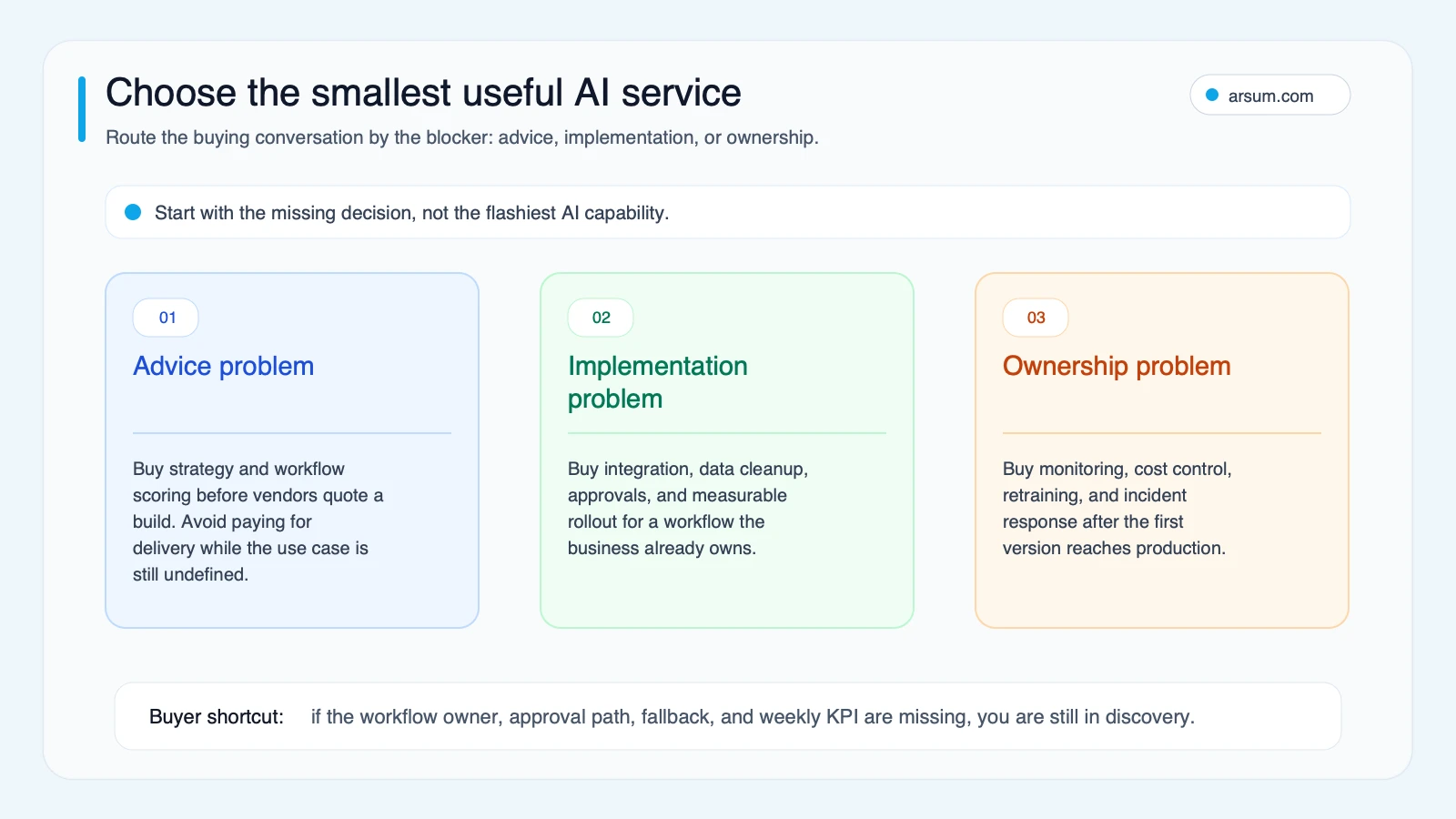
Classify the work before requesting proposals.
| Route | Use it when | Evidence required before proceeding | Do not use it when |
|---|---|---|---|
| AI builder prototype | You need to test user demand or workflow fit with low-risk, non-sensitive inputs | A narrow user journey, sample inputs, a manual fallback, and a clear learning question | The app must write to a system of record, handle sensitive data, or make consequential decisions |
| Production service-partner delivery | The workflow is known, but integrations, controls, and engineering ownership are missing | Integration map, data boundaries, approval rules, evaluation plan, operational owner, and cost model | The team cannot name the workflow owner or acceptance metric |
| Internal ownership program | The capability is core product infrastructure or must evolve continuously with internal systems | Named product and technical owners, operating budget, change process, and support coverage | The business only needs a contained experiment or standard capability |
The important distinction is not whether a provider can call a model API. It is whether they can define the boundary between model suggestion and authorized business action.
A builder can be the right first move for a low-risk concept. Practitioner discussions often use language that blurs this boundary: a Hacker News founder pitch about AI app building emphasizes escaping no-code limitations and generating cross-platform apps from plain-English prompts. That is useful market language, but it is not proof that a generated app has the controls needed for production. Treat it as a qualitative signal that buyers must separate prototype speed from operating responsibility. The discussion is available here.
Define the service scope before you compare providers
A credible proposal should state what the provider is responsible for, what your team must provide, and what remains manual in version one. “AI app development” can mean anything from interface scaffolding to a governed workflow that connects identity, data, tools, and review queues.
The prototype scope
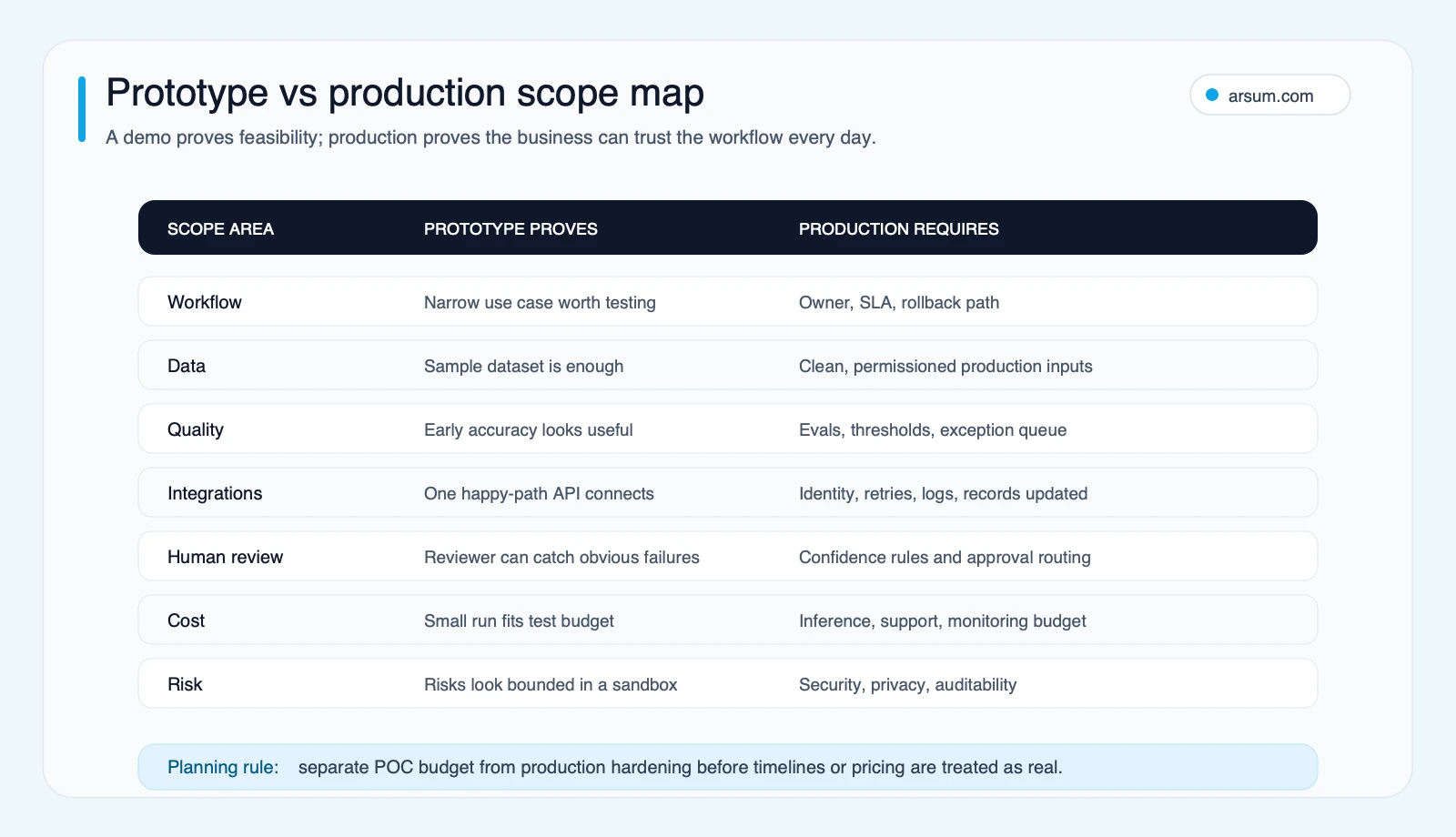
A prototype should answer one bounded question, such as: “Can users get a useful first-pass classification from this document type?” It can use approved sample data, simulated downstream actions, and a manual reviewer. It should not silently become a production commitment.
Ask for these prototype deliverables:
- The workflow hypothesis and the user or operator who will judge it.
- A defined input set and a separate evaluation set.
- The expected output format and known failure modes.
- A manual fallback when the model is unavailable or uncertain.
- A written decision at the end: proceed, revise, or stop.
A prototype is successful if it reduces uncertainty. It does not need to prove that every future integration, cost assumption, or operating process is already solved.
The production scope
Production delivery begins when the app receives real inputs, connects to business systems, or affects a customer, employee, financial, legal, or operational outcome. At that point, the scope must include application engineering around the model.
OpenAI’s function-calling guidance describes tool calling as a multi-step application flow with structured schemas. That matters because each tool call needs permissions, validation, error handling, and a decision about what happens when the tool or model fails. A provider that prices prompts and interface work but omits tool contracts, retries, or fallbacks has not fully scoped the application.
For a broader view of where this architecture changes, see AI agent architecture patterns and AI integration services.
The operating scope
The provider’s work does not end at deployment. Someone must own:
- Access reviews and changes to source-system permissions.
- Quality evaluation and the exception queue.
- Prompt, model, tool, and workflow changes.
- Incident response and rollback testing.
- Runtime usage and vendor-bill review.
- Retention and retrieval of audit evidence.
This does not require a large internal AI department. It does require named people and a contract that says who does what. If ownership is deferred until after launch, it is usually being left to the least-prepared team.
Evaluate providers on production evidence, not presentation quality
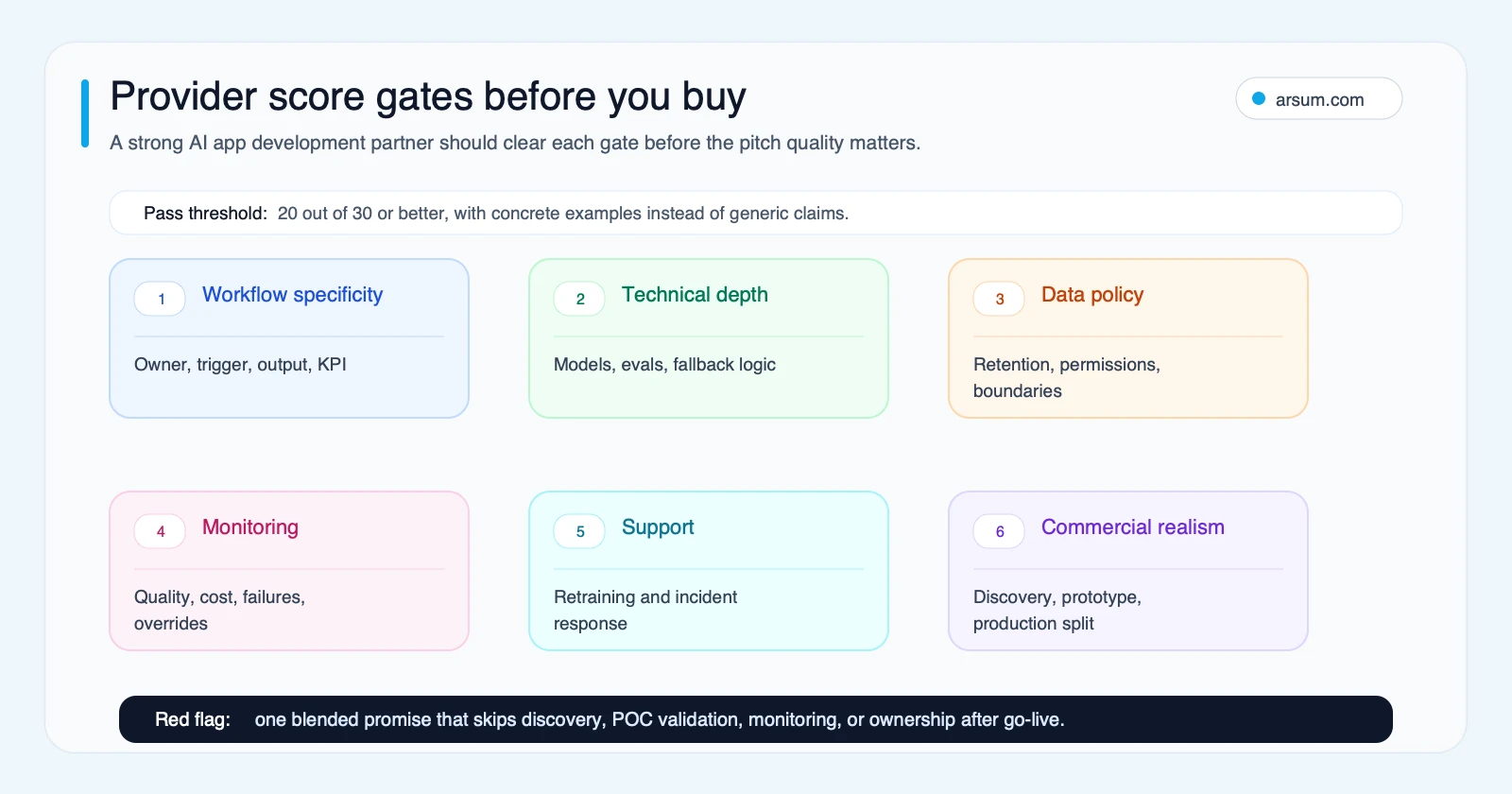
Request the same evidence from every provider. A portfolio can show visual craft; it rarely proves that the team can operate a consequential workflow. The scorecard below is designed for vendor calls and proposal reviews.
| Gate | Ask the provider to show | Pass condition | Fail signal |
|---|---|---|---|
| Workflow definition | Trigger, inputs, output, business owner, and user journey | The provider can describe the normal path in plain operational language | “We will discover the use case as we build” |
| Source lineage | Where each input comes from, how it is transformed, and which system is authoritative | Inputs and outputs have identifiable source systems and owners | Screenshots or exports substitute for a data contract |
| Access boundary | Roles, credentials, environment separation, and tool permissions | The model is limited to the minimum access needed | “The model can access the shared drive/CRM” without role design |
| Authorization | What the model may suggest, what a human must approve, and what is never automated | Decision rights match the cost of an error and reversibility | Model output is treated as authorization to act |
| Evaluation | Representative evaluation set, pass criteria, and regression checks | Quality is measured before and after release | “We will know from user feedback” |
| Exceptions | Confidence rule, queue, reviewer, and response time | Ambiguous cases have an owner and route | Low-confidence cases disappear or retry indefinitely |
| Audit evidence | Input reference, output, tool actions, reviewer action, and timestamp | The team can reconstruct a decision without exposing unnecessary data | Logs are limited to generic application errors |
| Change management | Approval and test process for prompt, model, tool, or policy changes | Changes can be tested and reverted | Production changes are made directly and informally |
| Runtime cost | Assumptions for requests, tokens, tool calls, hosting, support, and contingency | The estimate separates one-time and recurring costs | One implementation price is presented as the total cost |
| Post-launch ownership | Named operational owner, incident contact, support terms, and handoff plan | The workflow has a credible operator after launch | Monitoring is described as an optional future phase |
Score each gate as pass, partial, or fail. Do not average away a fail in access, authorization, audit evidence, or ownership; those are stop gates for a workflow that touches sensitive or consequential work.
A useful companion is our guide to hiring an AI app development company, which focuses on the buying process rather than a generic vendor list.
Worked pilot scorecard: invoice exception triage
Consider a team that receives invoices with missing purchase-order references, duplicate-looking submissions, or mismatched line items. The goal is not to let a model approve payments. The goal is to create a triage layer that organizes work for an accounts-payable reviewer.
Normal path
- An invoice arrives in the approved intake channel.
- The app extracts required fields and records the source document identifier.
- It checks configured business rules and retrieves matching purchase-order information from the authorized system.
- It produces a proposed category: ready for standard review, missing information, or potential exception.
- A reviewer confirms or changes the proposal before any payment-related system is updated.
- The app retains the input reference, retrieved records, model output, rule results, reviewer decision, and timestamp.
Ugly exception
A supplier submits a document that resembles a legitimate invoice but has a changed bank detail or an unusual line-item description. The app must not “resolve” this by guessing. It should route the case to the designated reviewer, flag the reason for escalation, and prevent any downstream action until the approved person completes review.
The human retains the decision right. The app’s role is prioritization, evidence collection, and drafting—not authorization.
Illustrative planning scorecard
The figures below are not a forecast or a vendor benchmark. They are an illustrative planning assumption that a buyer should replace with their own baseline.
| Measure | Baseline to record | Pilot target | Owner | Review cadence | Stop condition | Rollback path |
|---|---|---|---|---|---|---|
| Queue handling | Median time from receipt to reviewer-ready case | Improve only if reviewer-confirmed classifications remain acceptable | AP operations lead | Weekly | Reviewers report that the queue creates more rework than it removes | Disable automated triage; return to existing inbox and checklist |
| Quality | Reviewer correction rate by exception type | Set a threshold before testing, segmented by risk class | AP quality owner | Weekly sample review | A high-risk category exceeds the agreed correction threshold | Route that category directly to manual review |
| Escalation | Percentage of cases sent to the exception queue | A rate that remains operationally manageable | AP team manager | Weekly | Queue exceeds reviewer capacity or cases are not resolved within the agreed service window | Restrict automation to low-risk categories |
| Source lineage | Percentage of pilot cases with complete input and retrieval references | 100% for any case presented to a reviewer | Systems owner | Weekly audit sample | Missing references or inconsistent system records | Suspend integration writes; preserve read-only assistance |
| Runtime spend | Requests, model inputs/outputs, tool calls, and hosting/support charges | Stay below the approved pilot cost cap | Product owner | Weekly | Cost approaches cap without sufficient decision value | Apply budget limits, reduce scope, or pause the pilot |
| Security and access | Permission-review completion and prohibited-action attempts | No unresolved access issue before expanded release | Security owner | Before launch and on change | Unapproved access or failed control test | Revoke credentials and revert to manual operation |
This is the level of specificity a proposal should support. A provider does not need to promise an outcome before discovery, but they should be able to help define the baseline, target, failure boundary, and evidence required to make a go/no-go decision.
For workflow-level context, see accounts receivable automation and agentic AI workflow automation.
Work With Arsum
We help businesses implement AI automation that actually works. Custom solutions, not cookie-cutter templates.
Learn more →Security, authorization, and auditability are part of the app
Security review should be designed into the service scope, not attached after a prototype receives access to real data. The OWASP GenAI Security Project frames GenAI risk as a lifecycle issue involving vulnerabilities and mitigations, which is a practical reason to ask providers how they will test and operate the application—not merely which model they prefer.
Use these control questions:
What can the system read, write, or trigger?
List every source and destination. For each one, identify:
- The system owner.
- The data classification.
- The service identity or user role used.
- Whether the app can read, propose, write, or trigger an external action.
- The approval required before a write or trigger.
- The revocation process if the pilot is paused.
Do not give a model broad standing access because it is convenient during development. Access should be narrow, observable, and reviewable.
What evidence is retained?
Retain enough information to investigate a result without retaining more sensitive content than the workflow requires. The exact policy depends on the organization, but the provider should be able to specify the input reference, model and prompt version, tool actions, output, reviewer action, timestamps, and retention boundary.
How is a failure contained?
A production plan should distinguish:
- A model-quality issue, such as an incorrect classification.
- A tool failure, such as an unavailable CRM or ERP endpoint.
- A permission failure or unexpected data exposure.
- A budget issue caused by unexpected request or tool-call volume.
- A policy failure, such as output that should have been escalated.
Each needs an incident owner, a route for affected work, and a rollback action. High failure cost or low reversibility should reduce autonomy. It should never be used as an argument for more autonomous action.
Compare cost models using assumptions, not universal price ranges
An implementation quote is incomplete if it provides a build fee without showing what will continue after launch. Model prices and usage patterns can change, so require vendor-specific assumptions and confirm current model pricing from the relevant provider. OpenAI, for example, publishes API pricing for token usage and certain tool and runtime services; these are operating inputs, not a substitute for your workload estimate.
Ask every provider to fill in this worksheet.
| Cost area | Required assumption | Low / base / high scenario question |
|---|---|---|
| Discovery | Deliverables, stakeholders, and acceptance decision | What work is required to produce a decision-ready scope? |
| Build | Interfaces, integrations, testing, environments, and documentation | Which production controls are included versus deferred? |
| Fixed platform | Hosting, observability, identity, storage, and support tooling | What remains payable even if usage is low? |
| Variable inference | Requests per period, input/output size, model mix, cached inputs | What happens if demand, context size, or retries increase? |
| Tool calls | Search, retrieval, containers, third-party APIs, and transaction fees | Which calls are billable and how are they limited? |
| Operations | Monitoring, triage, change requests, retraining where applicable, and incident coverage | Who performs this work and under what support terms? |
| Contingency | Security remediation, integration changes, additional evaluation, and scope change | What triggers use of contingency, and who approves it? |
The buyer’s job is not to predict every cost perfectly. It is to avoid comparing one provider’s discovery-only estimate with another provider’s production-and-operations estimate.
A build-versus-buy choice follows from the same worksheet:
- Use a builder when the workflow is low-risk, a constrained prototype answers the question, and manual operation remains acceptable.
- Use a service partner when the value lies in integrations, controls, workflow design, and delivery capacity your team does not currently have.
- Build internal ownership when the app is core to your product or operating model and you can fund the people and processes needed to run it.
For a fuller comparison of agency scope and ownership, read AI automation agency versus AI development firm and AI app development cost.
Disqualifying conditions and common failure modes
Pause the engagement or narrow the scope when any of these conditions are true:
- No business owner can accept or reject the workflow outcome.
- The desired output is vague, such as “make the app smarter.”
- No authorized source system or usable input lineage exists.
- The task requires an irreversible or high-consequence decision without a human approval point.
- The provider cannot explain who owns incidents, model changes, or permissions after handoff.
- The team cannot afford the reviewer capacity required for expected exceptions.
- Success is defined only as a model metric, rather than a workflow metric and error boundary.
- The proposal hides recurring model, tool, hosting, or support costs.
Common failure modes are equally concrete:
- A prototype is sold as a production launch. Fix it by separating prototype evidence from production acceptance gates.
- The model has access but no authorization boundary. Fix it by limiting read/write permissions and making human approval explicit.
- Quality is judged from a few memorable examples. Fix it with a representative evaluation set and a recurring review sample.
- Exception work is invisible in the business case. Fix it by measuring reviewer time, correction rate, and queue volume.
- The provider owns the knowledge but not the handoff. Fix it with documented architectures, runbooks, source access, and named operators.
- A content or search workflow scales output without durable user value. Google’s spam policies warn against manipulative, low-value patterns intended to influence search systems or generative AI responses. For content automation, require human publishing ownership, source traceability, and quality review before scale.
A buyer-ready brief for vendor conversations
Send this brief before discovery calls. It forces comparable answers and exposes vague scope quickly.
- Workflow to improve:
- Trigger event:
- Inputs and authoritative source systems:
- Proposed output:
- What the app may recommend:
- What only a human may approve:
- Highest-cost failure mode:
- Current baseline and how it is measured:
- Pilot target and evaluation set:
- Exception queue owner:
- Required integrations and system owners:
- Data classification, retention, and access constraints:
- Required audit evidence:
- Runtime-cost cap and low/base/high usage assumptions:
- Post-launch operator and support expectations:
- Stop condition and rollback path:
A qualified provider should respond with assumptions and open risks, not manufactured certainty. The right engagement may be a narrow assessment, a prototype, a governed implementation, or a decision not to automate this workflow yet.
Methodology and source limits
This guide uses an editorial buyer framework rather than an occupation or website-performance dataset because the decision is provider scope, operating controls, and ownership. It was prepared from the validated research pack dated June 17, 2026.
The cited OpenAI, OWASP, and Google materials support the operational points made near them. Community material is limited qualitative discovery evidence: one Reddit search snippet raised concerns about companies emphasizing AI while outsourcing or relying on small teams, and another snippet cautioned against open-ended hiring briefs without expectations. Those snippets were observed through search results, not verified as representative research or market-wide outcomes. First discussion and second discussion.
Ready to Automate Your Business?
Stop wasting time on repetitive tasks. Let AI handle the busywork while you focus on growth.
Schedule a Free Strategy Call →Written by:Arsum editorial team
- Reviewed by
- Arsum editorial team
- Published
- February 16, 2026
- Updated
- August 12, 2026
- How this was produced
- Arsum uses research packs, source checks, and human editorial review to prepare and update blog articles. Editors are responsible for the final page.
- Source policy
- Sources are linked in the article when used. Methodology and source notes are included on higher-risk or high-visibility pages and are being rolled out across the archive. Editorial policy.
- Why this page exists
- Help B2B operators evaluate AI automation, implementation scope, cost, risk, and build-vs-buy decisions with practical context.