An AI automation agency AAA model case study is useful only if it helps you decide whether a vendor can improve a defined workflow under real operating conditions. “AAA” is a service label, not proof of capability: before funding a project, require a measurable baseline, a bounded automation role, a human exception path, clear data and system ownership, and evidence that the workflow can be supported after launch.
AI Automation Agency AAA Model Case Study
Explore AI automation agency AAA model case study: compare workflow fit, costs, risks, evidence, and practical next steps before you build, buy, or hire.

Table of Contents
- What most guides miss: the purchase is an operating model
- Treat the “case study” claim as a diligence exercise
- Choose the right automation pattern before hiring an agency
- Compare engagement models by ownership, not buzzwords
- Run a controlled pilot before committing to a broader program
- Ask what happens after week four
- Disqualifying conditions and common failure modes
- A practical vendor scorecard
- Final decision: buy, partner, build, or wait
- Methodology and limitations
What most guides miss: the purchase is an operating model
Most AAA content is aimed at people starting an agency. Buyers have a different problem: deciding whether an outside team can improve a workflow without creating an opaque dependency.
A demo can show that a model summarizes an email or extracts fields from a document. It does not show whether the system can handle incomplete inputs, permission failures, duplicate records, changed source formats, uncertain outputs, or the employee who must resolve the exception. Those are implementation and ownership questions.
Use four buyer-fit gates before discussing tools or commercial terms:
| Gate | Evidence to request | Do not proceed when |
|---|---|---|
| Workflow value | Volume, delay, error, rework, or revenue-leakage baseline | The issue is only described as “inefficient” |
| Automation boundary | Inputs, outputs, systems touched, and tasks that remain human-approved | The vendor proposes autonomous action without a clear authorization rule |
| Operating controls | Exception queue, audit trail, access model, alerts, and rollback | Nobody can explain what happens when the workflow fails |
| Ownership | Named internal owner, vendor responsibilities, handoff, and support process | The workflow will be understood only by the original builder |
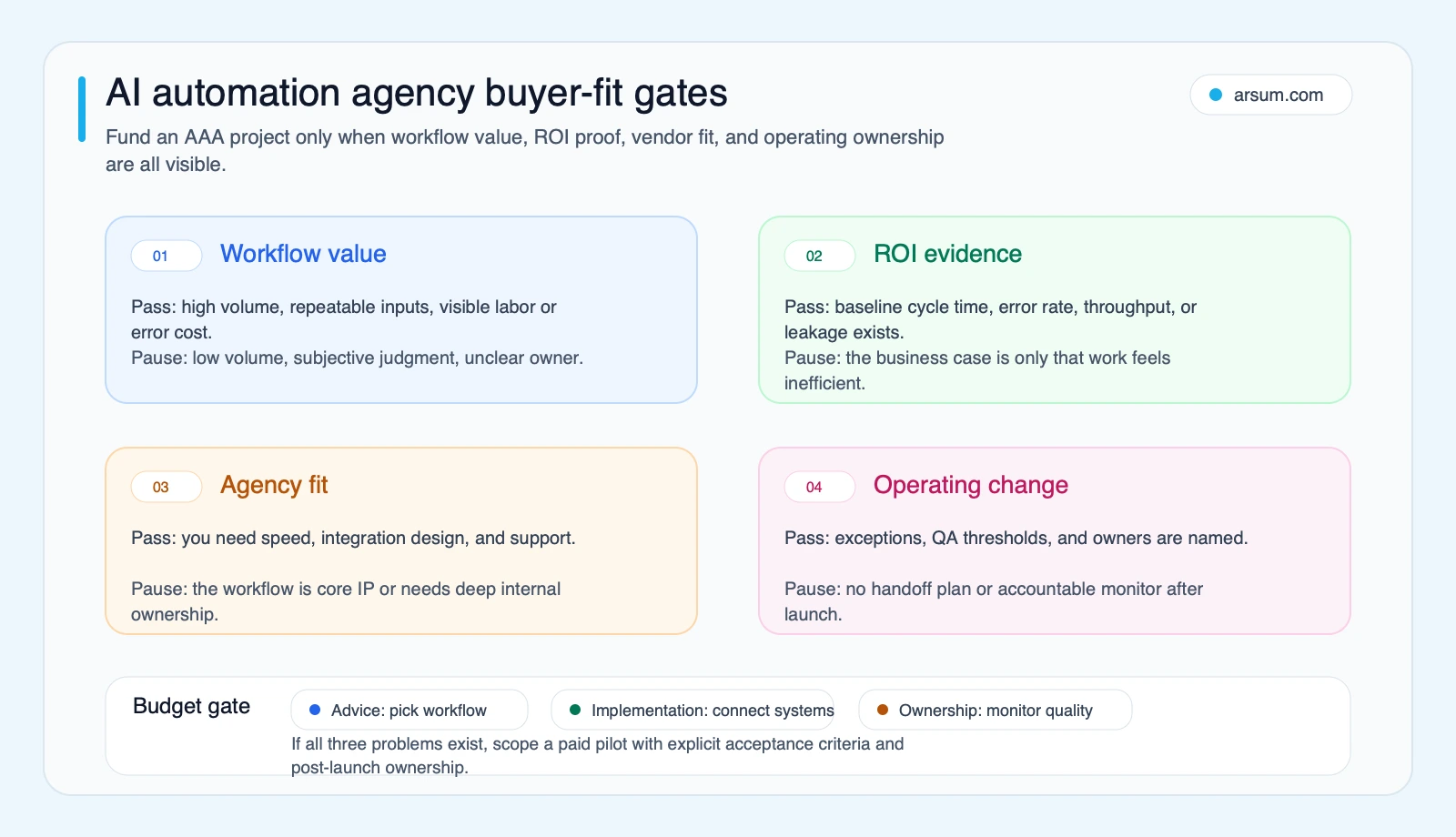
These gates turn a vendor conversation into a funding decision. If value, controls, and ownership are not visible, the scope is not ready to price.
An AI automation agency may be the right partner when you need process design, integrations, implementation capacity, and a controlled pilot. It is not automatically the right answer when an existing product already fits the process, the workflow is core intellectual property, or no internal owner can accept the change.
For a broader definition of the category, see what an AI automation agency does. For the partner-type decision, compare an AI automation agency with an AI development firm.
Treat the “case study” claim as a diligence exercise
The popular AAA narrative often centers on agency revenue, rapid client acquisition, or a workflow demo. That may be relevant to an agency operator, but it is weak proof for a buyer. A buyer-grade case study must show whether a particular workflow improved, at what cost and risk, and who owned it after launch.
The agency-growth story sometimes associated with the AAA model should be treated as an unverified founder-style narrative, not as evidence that a buyer will receive a specific outcome. It does not establish your workflow fit, implementation quality, security posture, or return on investment. Public discussion of the category also reflects skepticism about surface-level workflows; that is a qualitative signal, not a market-wide measurement. See the relevant Reddit discussion and Hacker News thread.
The visual below is therefore a model of the claims a buyer should interrogate, not proof of an agency’s revenue, client count, or delivery result.
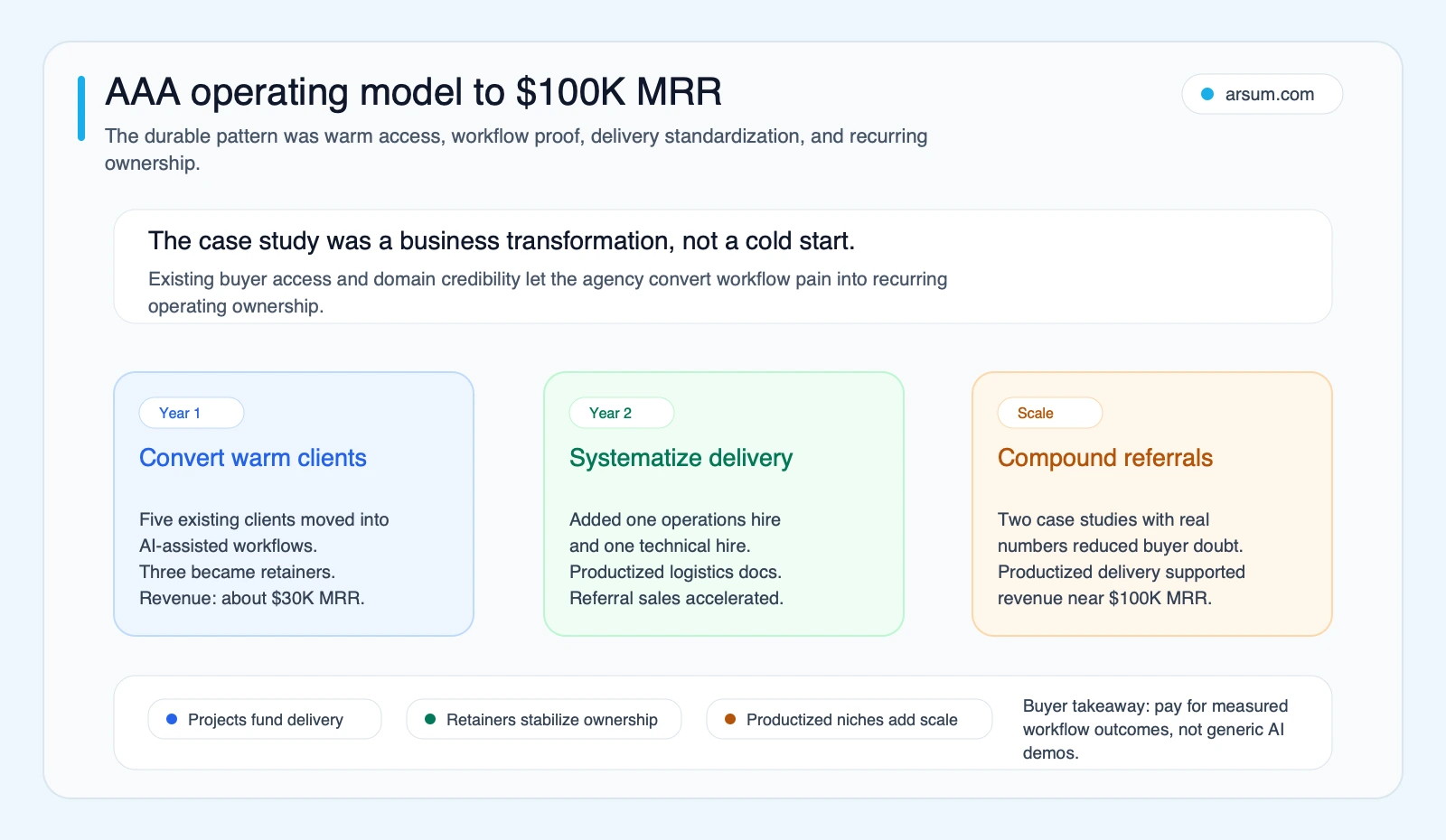
Use this as a diligence prompt: warm access, standardized delivery, referrals, and retainers do not verify buyer outcomes without a comparable workflow evidence record.
The evidence record a credible vendor should provide
Ask the agency to complete a case-study evidence record before you treat its past work as comparable proof.
| Record field | What a useful answer includes |
|---|---|
| Buyer and workflow context | Industry, team, workflow trigger, volume band, and why the process mattered |
| Baseline | Defined measure, sample period, source system, and known data-quality limitations |
| Automation boundary | What the workflow did, what it did not do, and when it deferred to a person |
| Data lineage | Source documents or systems, transformations, storage, retention, and access controls |
| Acceptance criteria | Required fields, thresholds, approval rules, and test cases including exceptions |
| Results | Before/after measurement method, measurement period, failures, review effort, and limitations |
| Operating model | Monitoring, support owner, credential ownership, change-control process, and escalation path |
| Rollback | How the team returned to the prior process if quality, cost, or availability failed |
A vendor does not need to disclose another client’s confidential data. But it should provide enough anonymized operational detail to let you judge comparability. “We saved time with AI” is not a case study. “We processed documents with an LLM” is not a case study either.
An evidence ladder for AAA claims
| Evidence level | What it supports | What it does not support |
|---|---|---|
| Founder story or course material | A positioning narrative | Buyer ROI, delivery capability, or durability |
| Demo workflow | Ability to assemble a prototype | Performance on messy live inputs or production ownership |
| Documented baseline | The problem was measured before work began | That the solution improved it |
| Measured pilot | Early change against a named baseline | Long-term support, adoption, or repeatability |
| Production workflow with a support owner | Real operating use and defined accountability | Automatic fit for another company or workflow |
| Repeatable productized offer with retention evidence | A more mature delivery model | A substitute for your own security, data, and process review |
For budget approval, the practical threshold is usually a measured pilot with a named owner and explicit limitations. Anything below that can be useful context, but it should not carry the commercial case on its own.
Choose the right automation pattern before hiring an agency
The word “agent” can hide an important design choice. A model’s technical ability to take an action is not permission to let it take that action. Autonomy should decrease as failure cost rises and reversibility falls.
| Workflow condition | Better first approach | Why |
|---|---|---|
| Stable, structured inputs and fixed rules | Deterministic workflow automation | It is easier to test, explain, and maintain |
| Unstructured documents or inbound messages, with review available | LLM-assisted workflow | The model can classify, extract, or draft within a controlled boundary |
| Multi-step work across tools with changing context | Guardrailed agentic workflow | Tool use may help, but requires logs, limits, approval points, and recovery paths |
| Sensitive data, core IP, or deeply coupled internal systems | Internal build or hybrid delivery | Control and long-term capability may outweigh initial speed |
| No stable process, baseline, or owner | Process mapping first | Automation will otherwise formalize confusion |
Official workflow documentation describes automations in terms of triggers, integrations, executions, and operational setup—not just AI features. That is the right buyer lens for n8n’s workflow documentation and for an AI workflow automation evaluation.
For higher-consequence use cases, govern the work as a business system. The NIST AI Risk Management Framework emphasizes risk governance, measurement, and management; it does not authorize hands-off decisions simply because a model performs well in a demo.
Compare engagement models by ownership, not buzzwords
An agency can offer advice, a one-time build, managed operations, or a productized workflow. The right choice depends on what you need the vendor—and your own team—to own.
| Engagement model | Best fit | Buyer responsibility | Main risk |
|---|---|---|---|
| Assessment or discovery | You need to identify and prioritize a workflow | Supply process evidence and make scope decisions | Paying for strategy without a usable acceptance plan |
| Project build | The workflow is clear and the first release is tightly bounded | Assign a process owner and approve tests | Treating launch as the end of the work |
| Managed operations | The workflow changes or needs active support | Govern vendor access, priorities, and service expectations | A vague retainer that buys availability rather than outcomes |
| Productized workflow | The process closely matches a proven standard configuration | Confirm fit and manage configuration | Forcing a standardized product onto unique controls or exceptions |
| Internal or hybrid build | The workflow is strategic, sensitive, or long-lived | Provide technical ownership and operating capacity | Underestimating internal integration and support work |
Do not accept an unexplained price, delivery duration, staffing plan, or savings estimate as a benchmark. Ask the vendor to connect any estimate to the work it will perform: systems, records, exception types, review burden, security work, support boundary, and acceptance criteria. For questions specifically about commercial scope, use this guide to AI automation agency pricing as a diligence companion, not as a substitute for a scoped proposal.
Run a controlled pilot before committing to a broader program
A pilot is relevant when there is a real workflow, enough historical or live activity to measure it, and a safe way to limit impact. Its purpose is to reduce uncertainty—not to create a flattering demo.
Worked pilot scorecard
The numbers below are an illustrative planning assumption, not an observed client result. Replace each item with your own evidence before approval.
| Scorecard item | Illustrative planning assumption | Decision use |
|---|---|---|
| Workflow | Intake and routing of inbound operational requests | Keeps scope to one repeatable process |
| Baseline | Measure a defined sample over four operating weeks: volume, time to first action, rework, and exception count | Creates a comparison point |
| Target | Improve one agreed service measure while preserving required review and control steps | Prevents “automation” from becoming the only goal |
| Quality metric | Percentage of items correctly routed or extracted after human QA | Separates speed from correctness |
| Exception metric | Percentage routed to review, plus reasons for review | Shows where automation should stop |
| Owner | Operations lead owns process acceptance; technical sponsor owns integration and access decisions | Makes approval accountable |
| Review cadence | Weekly pilot review of samples, exceptions, failures, cost reporting, and change requests | Identifies drift early |
| Stop condition | Pause the automation if it breaches the signed quality threshold, causes an unauthorized action, or loses required traceability | Defines risk tolerance before launch |
| Rollback | Route new items to the existing manual queue; preserve logs and disable downstream write actions | Makes reversal operationally possible |
The economic model should be equally explicit. For example, an illustrative planning assumption could calculate baseline handling cost as:
monthly item volume × average handling minutes × fully loaded cost per minute
Then compare that baseline with the expected operating cost of the proposed workflow:
platform and model usage + support + internal review time + implementation amortized over the planning period
That calculation does not prove savings. It gives the team a shared method to determine whether a measured pilot has earned further investment. Include review labor, exception handling, vendor-management effort, and the cost of errors; leaving those out makes an automation project look better on paper than it will in operations.
💡 Arsum builds custom AI automation solutions tailored to your business needs.
Get a Free Consultation →A useful workflow assessment should produce a baseline definition, automation boundary, exception design, ownership map, and pilot scorecard—not merely a tool recommendation.
Ask what happens after week four
After launch, the work becomes less visible and more important. Credentials expire, source systems change, prompts or models are updated, inputs become messy, and teams find new exceptions. This is why a successful project needs an operating agreement before production access is granted.
| Responsibility | Buyer should require | Named owner |
|---|---|---|
| Access and credentials | Inventory, least-privilege design, rotation process, and offboarding path | Internal system owner, with vendor access only as approved |
| Workflow monitoring | Failure alerts, execution logs, and a route for investigating incidents | Vendor, internal team, or explicitly shared |
| Exception handling | Human-review queue, service target, escalation rule, and feedback loop | Functional process owner |
| Changes to prompts, models, or logic | Test set, approval process, version record, and rollback path | Technical sponsor and functional owner |
| Cost reporting | Reporting by workflow or meaningful cost component, with variance review | Budget owner |
| Documentation and handoff | Current workflow map, SOP, support contacts, and recovery instructions | Both parties at closeout |
If the system is self-hosted, the control questions are not optional. n8n’s security guidance for self-hosting is a useful starting point for discussing deployment, access, and credential controls. It is not a complete security assessment for your environment.
A retainer can be valuable when it funds stated responsibilities: monitoring, incident response, approved changes, QA review, and reporting. It is weak when it is described only as “ongoing optimization” or a bank of undifferentiated hours. Community discussion about agency pricing and retainers is helpful for identifying that concern, but it is anecdotal rather than pricing evidence; see this n8n operator discussion.
Disqualifying conditions and common failure modes
An agency should be willing to recommend against automation when the conditions are wrong. That is often more valuable than a broad proposal.
Disqualifying conditions
Pause or narrow the project if any of these are true:
- The workflow changes so frequently that no stable process can be documented.
- The team cannot identify the person authorized to accept workflow outcomes.
- Inputs, data rights, or system permissions are unknown.
- An incorrect output could trigger a high-consequence action without human approval.
- The baseline cannot be measured, even with a temporary manual sample.
- The proposed automation would create more review work than it removes.
- There is no credible rollback path for downstream actions.
- The vendor cannot explain what remains under internal control after handoff.
Failure modes to test during diligence
| Failure mode | Why it matters | Contract or design response |
|---|---|---|
| Technology-first scope | Buying “agents” or a workflow tool before defining the operational goal | Tie scope to a process measure and signed acceptance criteria |
| Clean-demo bias | Prototype inputs do not resemble real documents, emails, or records | Test historical samples and deliberately difficult exceptions |
| Generalist mismatch | Vendor lacks vocabulary and judgment about the actual process | Request comparable workflow evidence and a discovery plan |
| Hidden dependency | The original builder is the only person who can repair the system | Require documentation, access inventory, and handoff rehearsal |
| Uncontrolled change | A prompt, model, or integration changes without revalidation | Use change control, approval, and rollback steps |
| Unsupported autonomy | A model acts where authorization or reversibility is unclear | Insert approval gates and limit downstream write access |
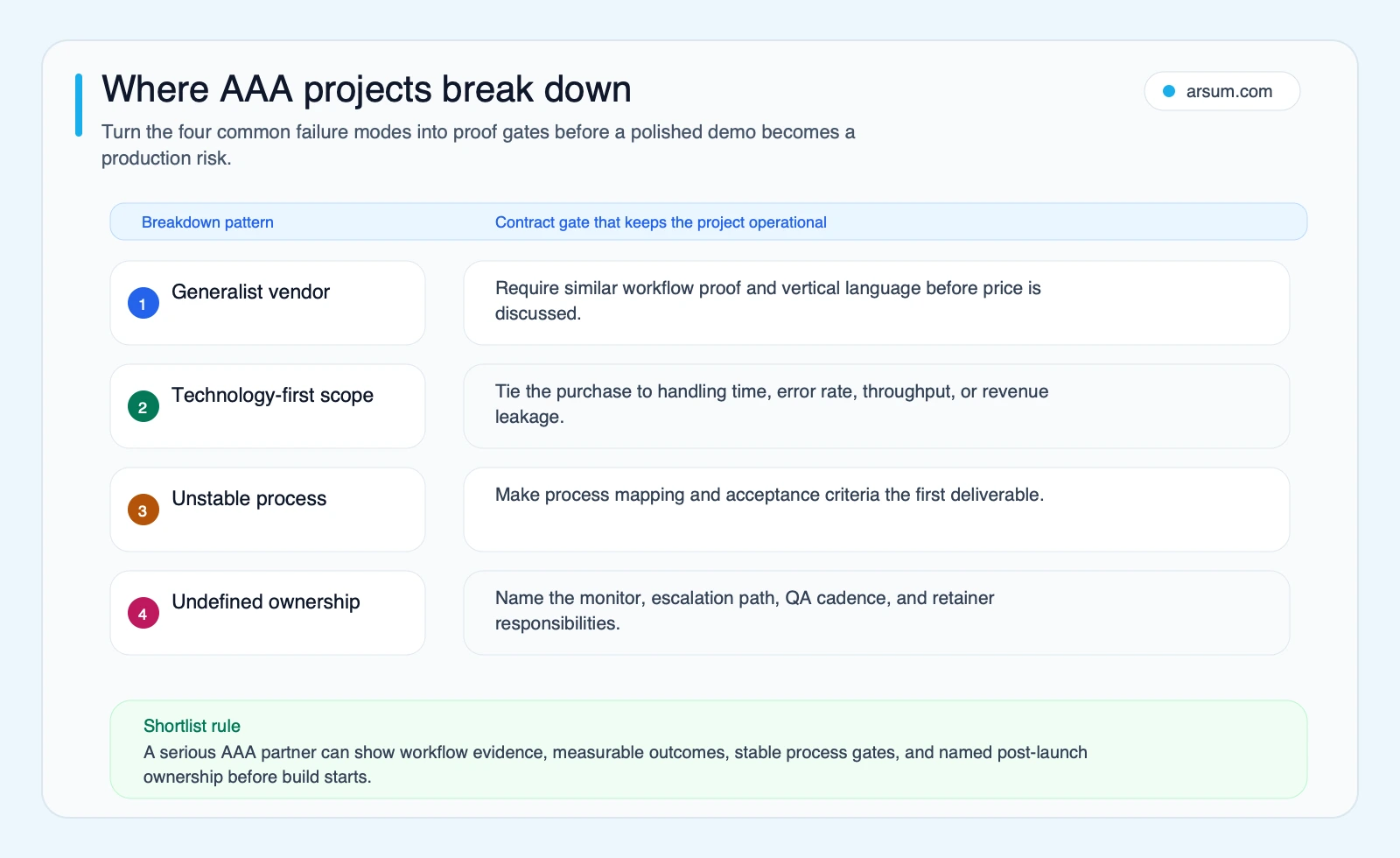
The failure gates are useful in a statement of work: process specificity, measurable outcomes, stability, controls, and post-launch ownership should all be signed before build activity begins.
A practical vendor scorecard
Score each vendor from 0 to 2. A zero is vague or absent; a one is plausible but incomplete; a two is specific, testable, and supported by artifacts.
| Evaluation area | 0 | 1 | 2 |
|---|---|---|---|
| Workflow understanding | Tool-led pitch | General understanding of the process | Map of inputs, decisions, exceptions, and owners |
| Evidence quality | Founder story or demo | Anecdotal past-work description | Comparable baseline, acceptance method, and limitations |
| Controls | No clear answer | Generic mention of security or QA | Access, logs, approvals, incident process, and rollback |
| Integration plan | Names tools only | Identifies core systems | Documents interfaces, dependencies, failure handling, and fallback |
| Support model | Launch ends the engagement | Support available on request | Named responsibilities, cadence, escalation, and handoff |
| Commercial clarity | Lump-sum promise | Broad scope description | Assumptions, exclusions, change process, and cost reporting |
A score does not replace legal, security, procurement, or technical review. It does make weak proposals visible early. Use it alongside AI automation consulting due diligence and an evaluation of AI agents for business if the vendor’s scope includes agentic actions.
Final decision: buy, partner, build, or wait
Choose an off-the-shelf product when the workflow is common, requirements are stable, and configuration covers the essential controls. Choose an agency when the workflow is valuable but needs process design, integration work, and a bounded pilot that your team cannot efficiently deliver alone. Choose an internal or hybrid build when the capability is core, tightly coupled to proprietary systems, or requires long-term internal control.
Wait when you cannot name the baseline, decision owner, exception route, and rollback. That is not delay for its own sake. It is the condition that prevents a vague AI initiative from becoming an expensive operational workaround.
Before signing, require this pilot acceptance checklist:
- A workflow map with source systems, inputs, outputs, and decision boundaries.
- A baseline sample, measurement period, and signed success metric.
- Defined human-review and exception paths.
- Access, data-lineage, logging, and retention expectations.
- A named functional owner and technical owner.
- Regular quality, exception, and cost reporting.
- A tested rollback path for any downstream action.
- Written support, handoff, and change-control responsibilities.
The most credible AI automation agency is not the one with the loudest AAA story. It is the one that can make these conditions concrete for your workflow and can show where automation should stop.
Work With Arsum
We help businesses implement AI automation that actually works. Custom solutions, not cookie-cutter templates.
Learn more →Methodology and limitations
This buyer guide uses an editorial-only evidence route. It draws on official workflow and security documentation from n8n, the NIST AI Risk Management Framework, and Zapier’s explanation of AI automation, alongside qualitative community discussions. Community threads are included to surface diligence questions and skepticism; they are not evidence of market-wide pricing, adoption, performance, or agency quality.
No agency revenue milestones, client counts, project prices, implementation timelines, accuracy rates, or savings figures are presented here as verified outcomes. Any arithmetic in the pilot section is explicitly illustrative. Re-check vendor terms, security design, model behavior, tool limits, and support obligations against your own environment before approving production use.
Ready to Automate Your Business?
Stop wasting time on repetitive tasks. Let AI handle the busywork while you focus on growth.
Schedule a Free Strategy Call →Written by:Arsum editorial team
- Reviewed by
- Arsum editorial team
- Published
- March 31, 2026
- Updated
- August 12, 2026
- How this was produced
- Arsum uses research packs, source checks, and human editorial review to prepare and update blog articles. Editors are responsible for the final page.
- Source policy
- Sources are linked in the article when used. Methodology and source notes are included on higher-risk or high-visibility pages and are being rolled out across the archive. Editorial policy.
- Why this page exists
- Help B2B operators evaluate AI automation, implementation scope, cost, risk, and build-vs-buy decisions with practical context.