AI automation agency pricing is commonly structured as a fixed project, a monthly delivery budget, or an initial build plus ongoing support. Before comparing totals, separate four cost layers: architecture and discovery, implementation, third-party usage, and support. One disclosed Arsum project had a USD $5,000–$10,000 budget frame; it is a project example, not a rate card or market average.
AI Automation Agency Pricing: Cost Guide for Buyers
See what drives AI automation agency pricing, a disclosed $5K–$10K project budget, fixed fees versus retainers, and a practical quote checklist.
Table of Contents
- How much does an AI automation agency cost?
- What changes AI automation agency pricing?
- You are paying for architecture before implementation
- Choose fixed fee, monthly delivery, hourly advice or support
- Compare every agency quote on the same four layers
- Test the proposal before approving it
- Is hiring an AI automation agency worth it?
- When Arsum would tell you not to buy yet
- What should you bring to an estimate call?
How much does an AI automation agency cost?
There is no useful single price for “AI automation” because the label can mean a lightweight API connection, a cross-system product workflow, custom software, or model training. A credible estimate starts with the job, the systems it touches, the failure cost, and who owns it after release.
The most specific Arsum number we can publish comes from Attuned Health. In a separate project interview, Arsum’s founder disclosed a USD $5,000–$10,000 budget frame for that ongoing engagement and confirmed that the figure was publishable. Arsum connected a custom application to Shopify, built user-facing profile and results views, transformed source data into AI-assisted explanations, and built a practitioner review and retry workflow.
| What the example establishes | What it does not establish |
|---|---|
| A budget frame disclosed by Arsum’s founder for one ongoing project | A final invoice or fixed package price |
| A product workflow with Shopify, custom application work, AI processing and human review | The price of every Shopify or AI project |
| Continued technical ownership after the main build | A standard support term, SLA or outcome guarantee |
That publication clearance comes from Arsum’s founder; client endorsement is not claimed. Confidential health logic, prompts and customer data are excluded. The case provides a useful reference point because the scope is visible; it should not be stretched into an industry benchmark.
For any quote, calculate the first-year cash requirement as:
Paid discovery + implementation + 12 × (estimated usage + support) + approved changes
That is a comparison formula, not a forecast. Replace every term with a vendor’s written assumptions and ask which costs are capped.
What changes AI automation agency pricing?
The first cost decision is the kind of work you are buying. Arsum’s founder separates four broad forms of AI delivery:
| Type of work | Typical delivery work | What usually changes the effort |
|---|---|---|
| Existing-model API integration | Connect a model to an application or internal workflow; handle inputs, outputs and errors | number of systems, authentication, data preparation, evaluation and approval rules |
| Configured or no-code automation | Assemble supported connectors and workflow steps in a visual platform | connector limits, branching, exceptions, platform constraints and maintainability |
| Custom AI software | Build the interface, business logic, data flow, AI steps, review states, deployment and handover | product states, integrations, permissions, testing, reliability and operating ownership |
| Model training or tuning | Prepare data, run training or tuning, compare results and operate the resulting model | data quality, specialist work, infrastructure and evaluation requirements |
These are not price tiers. A simple custom feature can be smaller than a sprawling no-code workflow. A model-training programme is also a different purchase from adding an existing model to a product. Ask each agency to name which work it proposes and why.
Three public buyer briefs preserved in the 7 September research show why that classification matters. A B2B SaaS request asks for an existing demo to become a live multi-tenant product with real data, permissions, payments and AI. An AI dashboard request combines AI integration with the application, database and billing. A two-week SaaS MVP request combines AI, payments, authentication and deployment. These are three individual requests observed at that time, not a market survey, completed contracts or usable price benchmarks.
The founder has also seen tool choice change implementation and support work:
“If you use some sort of framework that hardly fit into the case, then you will be stuck with something… fixing it and trying it, and then it will be hard to support.”
This is an experience-based warning, not a rule that custom code always wins. A standard platform can be the right answer when its supported connectors, controls and ownership model fit the workflow. Custom software becomes more defensible when the product needs distinct interfaces, permissions, business rules or failure handling that the platform cannot express cleanly.
You are paying for architecture before implementation
Hourly rates are easy to compare. A poor architecture decision can be harder to see and more expensive to correct. In the founder’s words:
“The driving cost can be choosing not the right solution.”
The useful work at the beginning is to translate a business problem into technical options, surface constraints and choose the simplest approach that can survive real use. That may include deciding:
- which steps remain deterministic software and which use a model;
- whether the model needs selected context, retrieval, or any tuning at all;
- where a person reviews an output before it affects a customer or record;
- how the system handles incomplete responses, timeouts and vendor limits;
- which accounts, code, logs and deployment instructions the buyer owns.
If the proposal introduces tool-using or multi-agent behavior, use the AI agent architecture patterns guide to compare that added coordination with a simpler application-owned workflow.
The same principle applies to variable model cost. In one consultancy example, a website-support chatbot repeatedly sent a large body of site information. The founder suggested testing OpenAI prompt caching. OpenAI documents prompt caching for repeated matching prompt prefixes, but any savings depend on actual cache use and measured requests. It is an option to validate, not a guaranteed discount.
Provider pricing also separates multiple usage categories. Review the current OpenAI model pricing and Anthropic API pricing when estimating variable spend. An agency fee should state whether those charges pass directly to you, sit inside an allowance, or carry a markup.
Choose fixed fee, monthly delivery, hourly advice or support
“Everyone wants a fixed budget,” the founder said. A fixed price is most useful when the work itself is fixed. If the product, customer or implementation path is still moving, a precise total can hide exclusions rather than reduce uncertainty.
| Pricing model | Best fit | Terms to require |
|---|---|---|
| Fixed project | one bounded workflow; known systems; agreed acceptance tests | deliverables, exclusions, milestones, acceptance, defect window and change-order rule |
| Paid discovery or architecture phase | important unknowns prevent a responsible build estimate | decisions to resolve, people to interview, prototype or technical outputs, and the next go/no-go decision |
| Monthly delivery budget | active product experimentation or a maintained backlog | available capacity, priority owner, delivery cadence, evidence of progress and cancellation terms |
| Hourly advisory work | narrow diagnosis, review, rescue or specialist input | rate, time cap, expected written output and who implements the advice |
| Build plus ongoing support | a live workflow needs monitoring, incident handling or regular change | response terms, included work, monthly cap, reporting, escalation and handover on exit |
For a monthly retainer, “support and optimization” is not enough. Ask for named activities: monitoring which workflow, responding through which channel, within what hours, making how many bounded changes, reporting which costs and quality signals, and handing over what if the relationship ends.
When the product is still being discovered, the founder prefers a monthly or time-based arrangement because implementation and learning happen together. When a founder knows the exact functionality and the scope can be bounded, a fixed fee can work. The contract should reflect the uncertainty that remains rather than pretending it has disappeared.
Compare every agency quote on the same four layers
Package names prevent a clean comparison. Rewrite each proposal into the same four cost layers before deciding which is cheaper.

A comparable proposal separates discovery, implementation, infrastructure, and support before deployment. Select the image to view it at full size.
| Cost layer | Put this in writing | Cost that can otherwise remain hidden |
|---|---|---|
| Architecture and discovery | workflow map, systems, risks, technical decision, acceptance criteria | open-ended “strategy,” rework caused by unresolved access or data |
| Implementation | named interfaces, integrations, AI steps, review states, testing, deployment, documentation | vague “AI automation setup,” missing production hardening or handover |
| Third-party usage | models, platforms, hosting, storage, monitoring, allowance and overage method | uncapped token or platform spend, vendor markup, duplicate tools |
| Ongoing support | owner, response terms, monitoring, fixes, change capacity and exit handover | indefinite “optimization,” unpriced incidents, vendor-controlled accounts |
Copy this blank worksheet into your buying notes:
| Comparison field | Vendor A | Vendor B |
|---|---|---|
| Workflow and users | ||
| Systems and data access | ||
| One-time discovery | ||
| Implementation deliverables | ||
| Acceptance tests | ||
| Monthly model/platform allowance | ||
| Monthly support and response terms | ||
| Buyer-owned code, accounts and documentation | ||
| Change-order rule | ||
| Stop and rollback procedure | ||
| First-year cash requirement |
Normalize the risk inside the proposal
A complete quote also explains how the system will be evaluated and operated. Use the six gates below to find work that may be missing from a headline price.
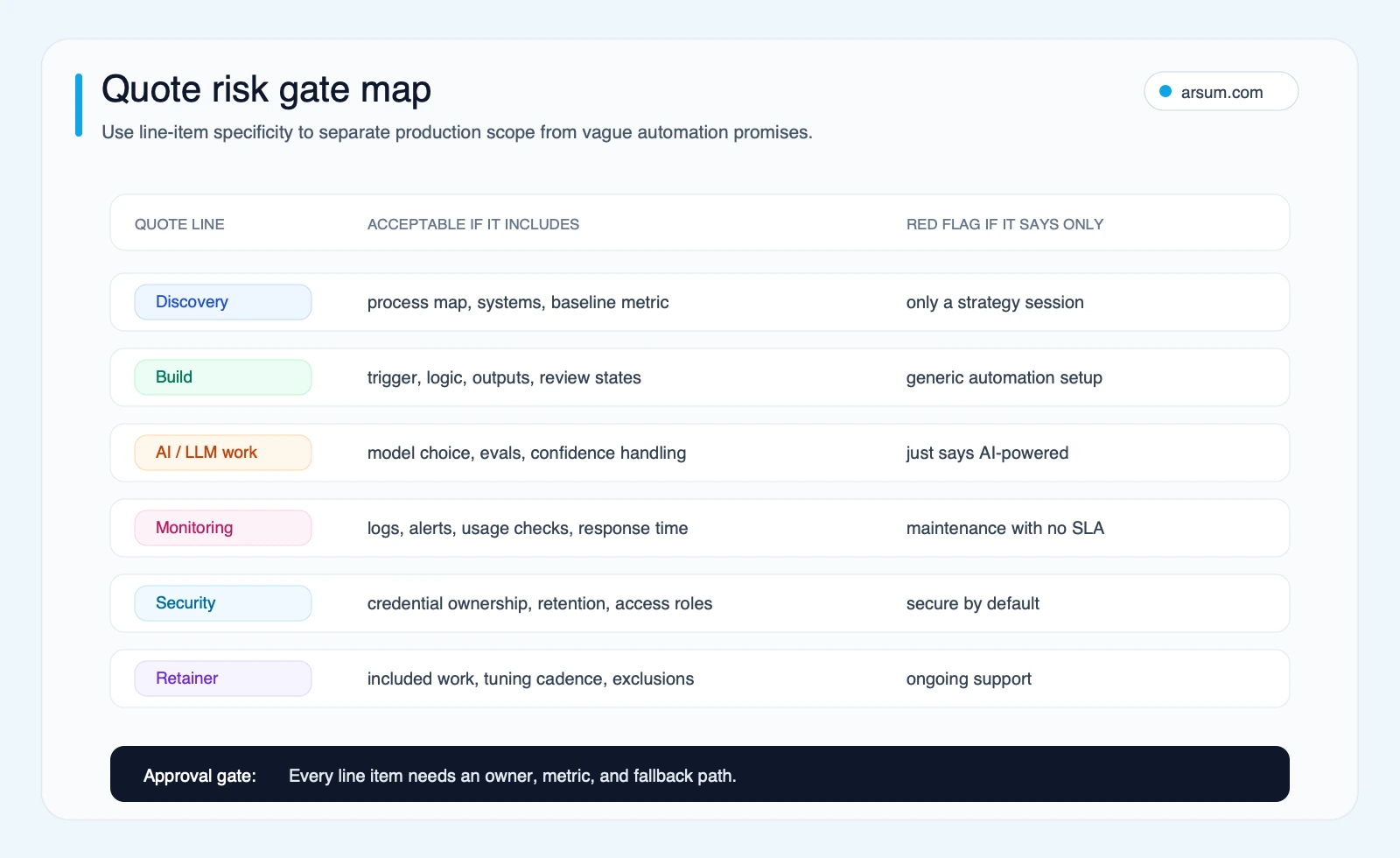
Arsum’s illustrative planning framework. Select the diagram to view it at full size.
Test the proposal before approving it
A proposal becomes easier to defend when it describes one workflow in testable language.
Weak proposal
“AI automation setup for sales and operations: fixed setup fee plus monthly support. Includes CRM automation, email assistant, reporting and training.”
This does not name the trigger, systems, AI decision, review path, output-quality test, support boundary or owner. It gives the buyer no way to distinguish a defect from new scope.
Defensible proposal
“Lead-triage workflow: defined implementation fee plus a monthly operating fee. Scope includes form-source and CRM mapping, deterministic routing rules, model classification for ambiguous records, a human-review queue for low-confidence cases, acceptance testing against agreed examples, usage reporting, handover documentation and a named rollback procedure.”
The price is still negotiable. The second proposal is comparable because the buyer can test its boundaries and operating burden.
Before signing, require answers to these questions:
- Who owns the workflow, code, credentials, prompts, logs and documentation at termination?
- Which third-party accounts are billed directly to the buyer?
- What data enters the workflow, where is it retained and who can access it?
- What must a person approve before customer-facing, financial or publishing actions?
- Which examples and acceptance tests decide whether the build works?
- What support response path and escalation owner are included?
- Which request becomes a separately priced change?
- How is usage measured, attributed and capped?
- Who can disable the workflow and restore the manual process?
If you are comparing an external team with a dedicated hire, use the guide to hiring an AI developer. For a more detailed build estimate, use the AI app development cost worksheet.
Is hiring an AI automation agency worth it?
An agency is worth considering when one business workflow crosses product, data and AI decisions that your team cannot currently own, and the proposal gets you to a testable release with a clear handover. It is a poor purchase when the agency only rebundles a standard tool while keeping the accounts, workflow logic and operating knowledge.
Use a pilot when the automation rate, exception rate or user adoption is unknown. Agree on:
| Pilot field | Decision to record |
|---|---|
| Baseline | current volume, handling time, error or delay cost, and how each figure was measured |
| Target | the specific user or operating change the pilot should create |
| Quality | examples that count as correct, incorrect and uncertain |
| Review | which outputs require a person and who makes the final decision |
| Cost | implementation plus measured model, platform, review and support cost |
| Stop condition | quality, security, adoption or cost result that stops expansion |
| Handover | code, accounts, documentation, logs and rollback owner |
Estimate value with low, expected and high scenarios rather than one promised automation rate:
Monthly labor value = volume × qualifying automation rate × minutes avoided ÷ 60 × loaded hourly cost
Net monthly value = labor value + measured avoided error or delay cost − usage − review − support
Payback months = one-time project cost ÷ net monthly value
These are planning formulas. They become decision evidence only after you replace assumptions with observed pilot data.
When Arsum would tell you not to buy yet
The founder’s clearest red flag is a team building for weeks without a clear user expectation or a route to real use:
“Something that never goes to the market and never tested against the real usage. That’s the red flag for me…”
Pause a production proposal when the workflow is disputed, source data has no owner, access is unavailable, the success condition cannot be stated, or no one inside the business will own the release. A smaller discovery or prototype may be useful, but it should end in a decision rather than roll silently into an open-ended build.
The best Arsum fit is an existing business or funded product team with one concrete bottleneck: a process to speed up, a decision to support, information to turn into a usable application, or an AI feature to connect to a live product. The founder describes the work as “connecting two worlds”—business logic and technical limits—so the buyer can choose an approach with its budget and responsibilities visible.
What should you bring to an estimate call?
Bring enough context to price a workflow rather than an aspiration:
- the user and the job they need to complete;
- the current manual or software process;
- the systems, data sources and access already available;
- two or three representative inputs and desired outputs, with sensitive data removed;
- actions that require human approval;
- known volume, timing and reliability expectations;
- the budget or commercial limit you need the first phase to respect;
- the person who will accept the release and own it afterward.
Arsum builds focused AI applications, integrations and data systems with defined evaluation, deployment and handover. Review AI product development at Arsum to see what a scoped engagement can include.
Get a scoped AI automation estimate
Bring one workflow, the systems it touches, representative inputs and your budget. We can identify the simplest credible first phase, its acceptance tests and the responsibilities after launch.
Discuss your project →Method note: this guide was refreshed on 8 September 2026 from a supplied raw Arsum founder interview transcript, a separate Attuned Health project interview in which Arsum’s founder cleared the budget and high-level scope for publication, historical Search Console evidence, fresh US search-result review, provider keyword estimates and linked primary vendor documentation. Founder quotes received light punctuation and filler edits without changing their meaning. Search estimates and historical performance do not guarantee traffic, rankings or enquiries.
Published by:Arsum
- Published
- April 7, 2026
- Updated
- September 8, 2026
- How this was produced
- Edited with AI assistance from supplied Arsum founder interview material; no independent human review is asserted.
- Source policy
- Founder quotations and self-reported project experience are distinguished from illustrative worksheets and linked primary documentation. Editorial policy.
- Why this page exists
- Help founders and product owners compare AI automation proposals and define a focused first engagement.