AI automation agency services are most useful when you have a measurable workflow with a named owner, accessible systems, and a failure cost low enough to test safely; the service you buy should match the real blocker—workflow diagnosis, implementation, or ongoing operational ownership—not a generic promise to “add AI.”
AI Automation Agency Services Guide
Explore ai automation agency services: compare workflow fit, costs, risks, evidence, and practical next steps before you build, buy, or hire.

Table of Contents
- What Most Guides Miss: You Are Buying Advice, Implementation, or Ownership
- Decide Whether the Workflow Deserves Automation
- What a Credible Agency Scope Includes
- Compare Proposals With Evidence Gates, Not Demo Polish
- Disqualifying Conditions and Common Failure Modes
- Community Questions Worth Taking Seriously
- Choose Audit, Pilot, Production Build, or Internal Ownership
- A Copy-Paste Brief for Agency Conversations
What Most Guides Miss: You Are Buying Advice, Implementation, or Ownership
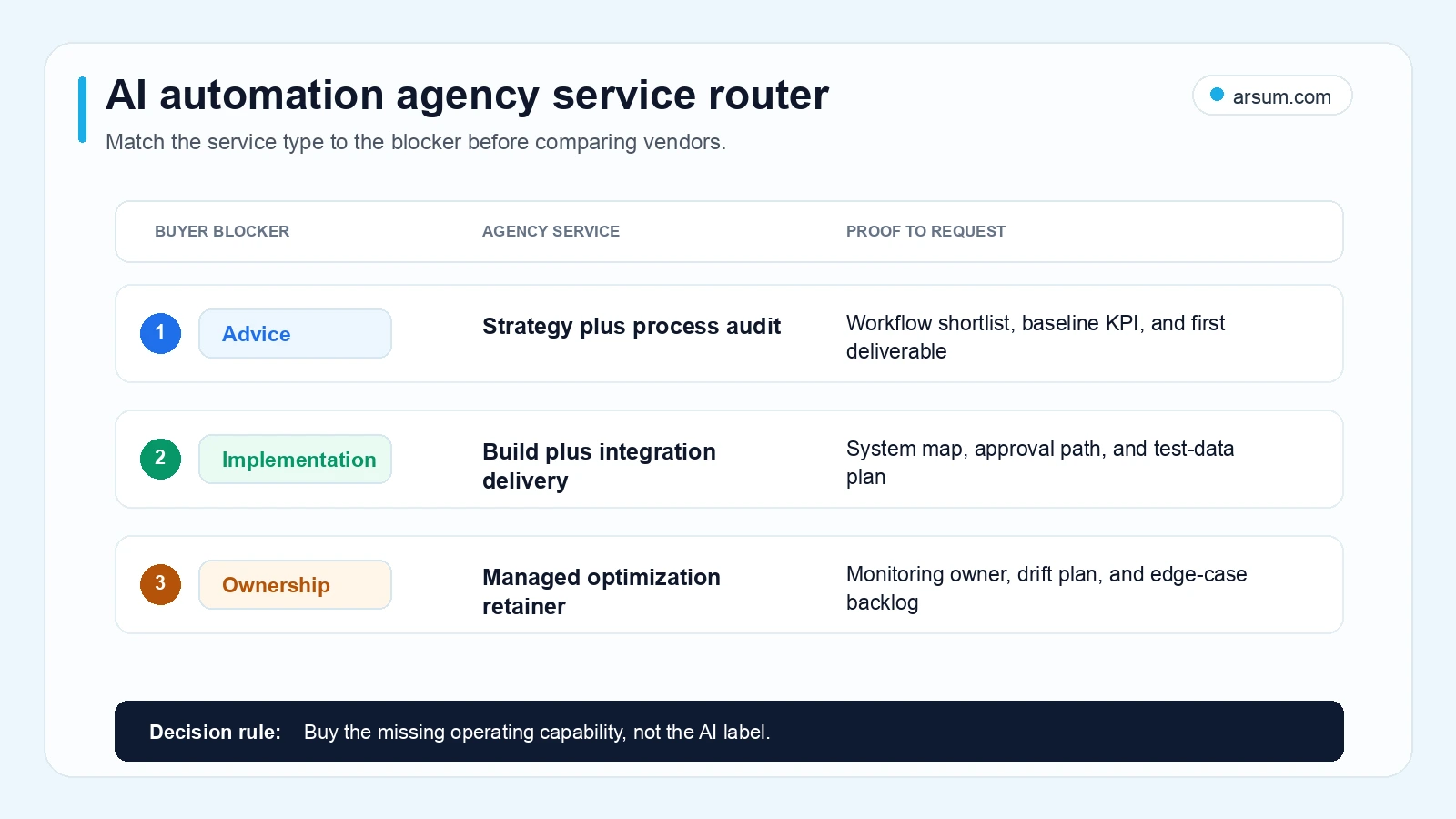
The central decision is not whether an agency can build an AI agent. It is whether your team needs help deciding what to automate, connecting and controlling a known workflow, or operating a live system after launch.
Those are different services with different acceptance criteria:
- Advice: You cannot yet name the workflow, baseline, business owner, or decision that should change. Buy a workflow audit or process cleanup—not a build.
- Implementation: The workflow is clear, but systems, data, tool permissions, exception handling, and approval rules are not connected. Buy a scoped pilot or production implementation.
- Ownership: The workflow is live or ready to become operationally important. Someone must own monitoring, access changes, quality review, usage costs, incidents, and workflow changes. Establish an internal owner or a managed service with explicit responsibilities.
A good proposal says which of these it is selling and what it is not selling. A weak proposal treats a discovery workshop, a low-code configuration, a custom integration, and ongoing optimization as one vague “AI automation” package.
Before speaking with an agency, run this automation-candidate test:
- Can you identify the trigger, inputs, systems, output, and final business action?
- Can you establish a baseline for cycle time, volume, error/review work, backlog, or another relevant measure?
- Can a business owner define the normal path and the exceptions that must stay with a person?
- Can you limit the pilot to an action that is reversible or reviewed before it causes downstream harm?
- Can a technical owner grant and later revoke the necessary access?
If the answer is “no” to several questions, the first deliverable should be a process map and instrumentation plan. Adding a model before resolving those gaps turns uncertainty into software.
Decide Whether the Workflow Deserves Automation
AI is useful where interpretation is needed: reading an incoming request, extracting relevant fields from a document, classifying a ticket, drafting a response from approved sources, or routing an exception. It is not automatically the right tool for deterministic steps such as validating a required field, applying a fixed threshold, or posting an approved record to a system.
A practical design often combines both:
- Deterministic logic checks required fields, permissions, policy thresholds, and routing.
- A model interprets unstructured content or prepares a draft.
- A validation layer checks the output against allowed formats and known constraints.
- A person approves consequential actions or handles exceptions.
- The system records the run, source inputs, tool calls, decision state, and final outcome.
That distinction matters because technical capability is not authorization. A model may be capable of drafting a payment-status email or identifying a missing document; it should not automatically send, approve, modify, or escalate that item unless the business has explicitly authorized the action and the controls support it.
OpenAI’s guidance on building agents treats use-case fit, tools, orchestration, evaluations, guardrails, and deployment as parts of the same system. Its guardrails and approvals guidance describes the need to validate sensitive actions and pause for human review when policy requires it. NIST’s Generative AI Profile similarly frames risk management as a lifecycle concern, not a launch checklist.
A worked pilot: document-intake triage
Consider an internal document-intake workflow. A team receives documents by email, identifies the document type, extracts a limited set of fields, checks for missing information, and routes the item to the right queue.
A controlled pilot could define:
| Pilot element | Example definition |
|---|---|
| Workflow boundary | Triage inbound documents and prepare a draft record; do not approve, post, or change a financial or customer record |
| Inputs | Inbox attachment, sender metadata, approved document taxonomy, existing queue rules |
| Permitted action | Create a draft queue item with extracted fields and a confidence label |
| Human approval | Operations reviewer approves every draft during the pilot; ambiguous or unsupported documents route directly to manual handling |
| Evidence retained | Original file reference, extracted fields, source location, model output, validation result, reviewer decision, and timestamp |
| Baseline | Measure current weekly volume, median handling time, rework rate, and manual-routing volume before the pilot |
| Target | An illustrative planning assumption: reduce reviewer handling time per eligible item while maintaining the team’s agreed quality threshold; specify both values before testing |
| Owner | Operations manager owns workflow quality; technical sponsor owns access, integrations, logs, and rollback |
| Review cadence | Weekly review of sampled outputs, exceptions, reviewer overrides, usage cost, and integration failures |
| Stop condition | Pause the pilot if an output bypasses review, data is routed to the wrong restricted destination, or the agreed quality threshold is missed |
| Rollback path | Disable the trigger, remove tool access, return documents to the existing manual queue, and preserve pilot logs for review |
The arithmetic should be yours, not an agency’s unsupported promise. For example, an illustrative capacity estimate can use: eligible items per week × measured minutes per item × target reduction in reviewer minutes. Then subtract the reviewer time that remains, implementation effort, support effort, and metered model or tool costs. Treat the result as a planning input to test, not as realized savings.
The same discipline applies to accounts receivable automation, support triage, onboarding, and CRM-enrichment workflows. Start by constraining the decision and the action. Expand autonomy only when evidence from the pilot supports it.
What a Credible Agency Scope Includes
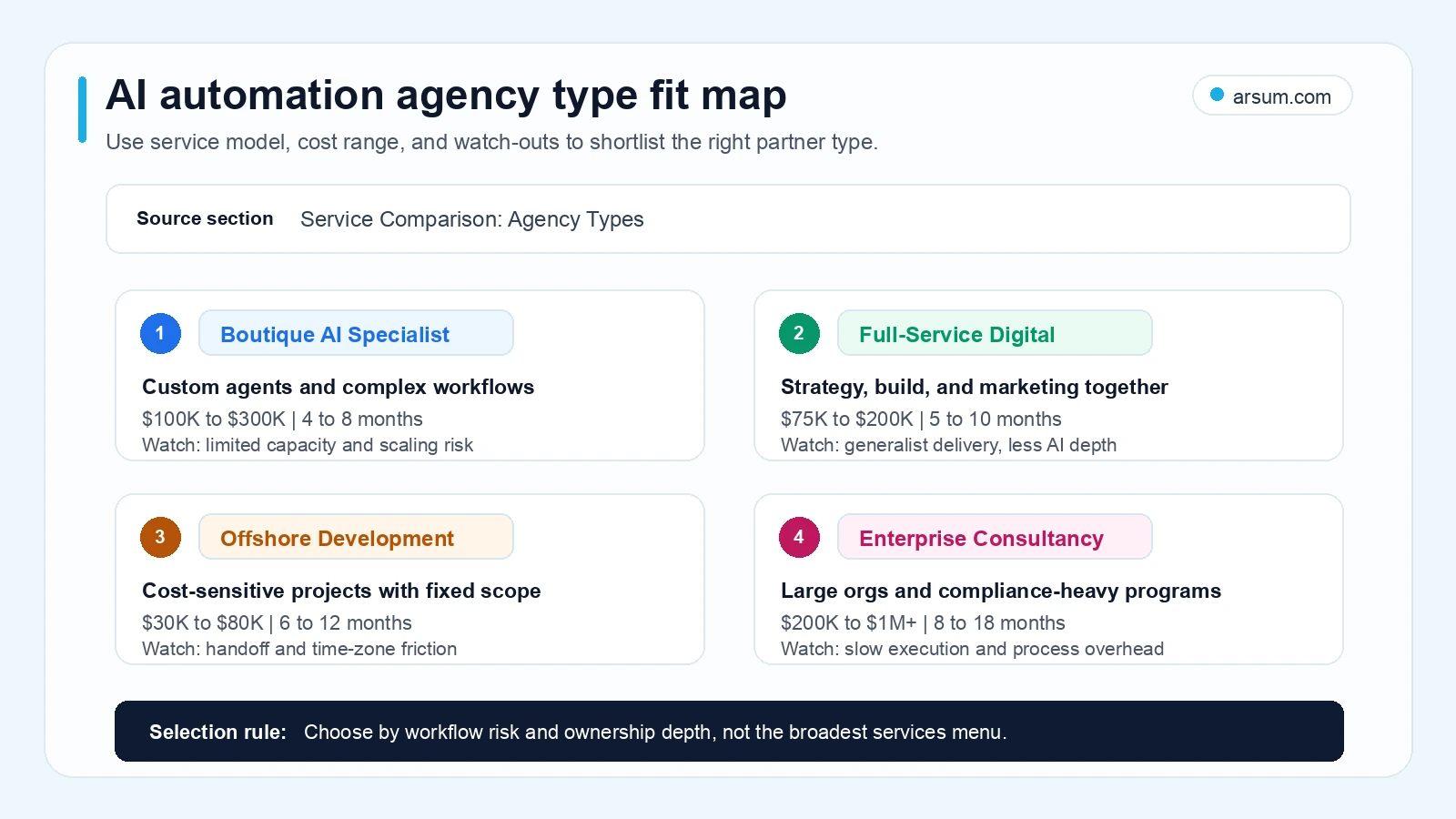
A service provider does not need to use a particular framework to be credible. It does need to explain how the workflow will work in the systems you already own, and where responsibility moves when something changes.
| Service type | Buyer problem | Expected deliverables | Buyer-side inputs | Handoff and owner | Main failure mode |
|---|---|---|---|---|---|
| Workflow audit | You know there is friction but cannot prioritize work | Process map, baseline plan, ranked backlog, build/buy/process recommendation | Stakeholders, current SOPs, access to relevant metrics | Business process owner receives a decision-ready next step | Strategy deck without a pilot candidate |
| Pilot automation | One workflow looks promising but risk is unknown | Narrow workflow, test set, exception path, usage assumptions, acceptance criteria | Historical examples, reviewers, system access | Agency and internal workflow owner share pilot ownership | Happy-path demo with no operational adoption |
| Production workflow | A validated workflow needs reliable system integration | Integrations, permissions design, evaluations, logs, runbook, rollback procedure | Named business and technical owners, security review | Business and technical owners jointly own it after launch | Ownership gap after launch |
| Managed automation | The workflow needs continued monitoring and change control | Issue process, usage reports, approved change process, maintenance responsibilities | Named buyer-side approver and escalation contact | Agency operates defined scope; buyer retains approval authority | Vague maintenance scope and unmanaged cost drift |
For low-code implementations, ask what is configuration and what is custom work. The n8n AI workflow tutorial illustrates that triggers, credentials, prompts, persistence, testing, and saved workflows are all real implementation concerns. Its documentation on human review for tools shows that gated tool execution can pause a workflow for approval. Configuration can be appropriate, but it still needs ownership, documentation, and change control.
If your decision is primarily about choosing a platform versus custom work, compare the delivery model with an AI automation platform guide before approving a build. If the workflow itself is unclear, AI automation consulting is the more relevant category than a production-development engagement.
Compare Proposals With Evidence Gates, Not Demo Polish
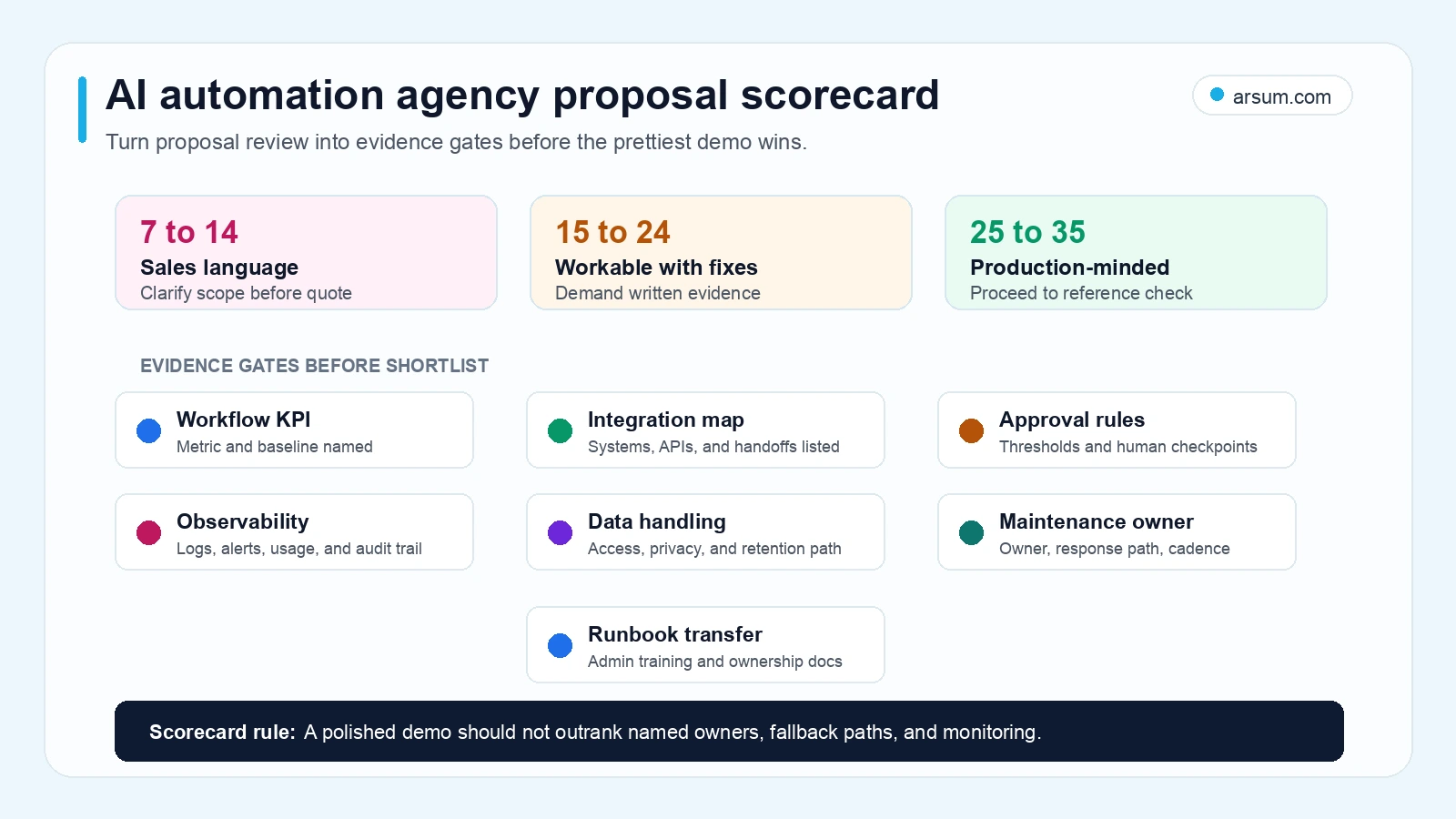
An attractive demo proves that a model can produce an output. It does not prove that the agency understands your source data, access boundaries, exceptions, cost attribution, or post-launch operating model.
Use the following scorecard as an Arsum buyer heuristic, not a validated market-performance benchmark. Score each proposal from 1 to 5, then read the written evidence behind the number.
| Criterion | 1: inadequate evidence | 3: partly specified | 5: decision-ready evidence |
|---|---|---|---|
| Workflow boundary | General promise or tool-first pitch | Target workflow named | Normal path, exclusions, edge cases, and success measure named |
| Baseline and economics | Benefit claim without inputs | Some metrics discussed | Baseline, assumptions, usage attribution, review cost, and economic limits shown |
| Data lineage | “Connects to your tools” | Systems listed | Inputs, data movement, retention, access, and source-of-truth rules identified |
| Permissions | Broad credentials assumed | Some roles described | Least-privilege tools, approval points, revocation, and sensitive-action policy defined |
| Evaluation | Demo judged informally | Testing mentioned | Test cases, sampled review, error taxonomy, acceptance threshold, and owner defined |
| Observability | “We monitor it” | Dashboard or logs mentioned | Trace/log requirements, alerts, incident route, and cost monitoring specified |
| Handoff | Vague support promise | Documentation included | Code/configuration, credential plan, workflow diagram, runbook, and change-control ownership stated |
| Build versus buy | Custom AI assumed | Tool options mentioned | Explains why a SaaS product, low-code workflow, custom system, or no-build cleanup fits best |
A proposal with a high score but no access to the relevant stakeholders or systems is still not ready to start. Conversely, a narrow low-code proposal may be a good fit for a contained internal workflow if its boundaries and handoff are explicit.
The questions every proposal should answer
Ask each vendor to respond in writing:
- What exact workflow is included, and which inputs or edge cases are excluded from phase one?
- What baseline will we capture, who owns it, and what would constitute a pilot pass or fail?
- Which systems, APIs, credentials, and data fields are required?
- Which tool actions are allowed automatically, which require approval, and who can change those rules?
- What evaluation set will be used, and how will errors, reviewer overrides, and exception volume be classified?
- How will model, tool, and support costs be attributed to this workflow rather than hidden in a monthly total?
- What logs or traces will be available for debugging and audit review?
- Who owns source code, configuration, prompts, credentials, diagrams, documentation, and runbooks?
- What changes are included after launch, what requires approval, and what becomes a change order?
- What is the rollback procedure if the workflow is unsafe, unusable, or no longer economically sensible?
For agentic systems, request evidence of trace design. The OpenAI Agents SDK tracing documentation describes traces that can capture model generations, tool calls, handoffs, guardrails, and custom events. The relevant buyer question is not whether a vendor uses that exact tooling; it is whether you can reconstruct what happened when a workflow fails.
Work With Arsum
We help businesses implement AI automation that actually works. Custom solutions, not cookie-cutter templates.
Learn more →Disqualifying Conditions and Common Failure Modes
Some workflows should not be automated yet, regardless of how persuasive a vendor’s demo is.
Do not start with a production build when:
- The business owner cannot define the desired outcome or measure the current process.
- The process changes so frequently that a process-cleanup effort is the real priority.
- Required source systems cannot provide reliable, authorized access.
- A wrong action creates an irreversible financial, legal, customer, or compliance consequence and no practical approval gate exists.
- The team cannot staff exception review during a pilot.
- The vendor cannot distinguish a draft, a recommendation, and an authorized system action.
- No one on your side will own operational decisions after handoff.
OWASP’s discussion of excessive agency is particularly relevant: limit tool functionality, permissions, and autonomy to what the workflow needs. More access is not a sign of a more advanced system. In a consequential workflow, it is often a reason to narrow the scope.
Other recurring failure modes are commercial rather than technical:
- Discovery produces a backlog but no priority workflow, baseline, or next decision.
- Usage fees, subscriptions, implementation, support, and change work are bundled into an opaque number.
- The vendor promises “continuous improvement” without naming the review process, owner, evaluation evidence, or approval path for changes.
- A case study proves a prototype but cannot explain production support, incident handling, or operational handoff.
- The team assumes that model outputs will improve automatically from use. Improvement requires deliberate feedback collection, evaluation, review, and approved changes.
Community Questions Worth Taking Seriously
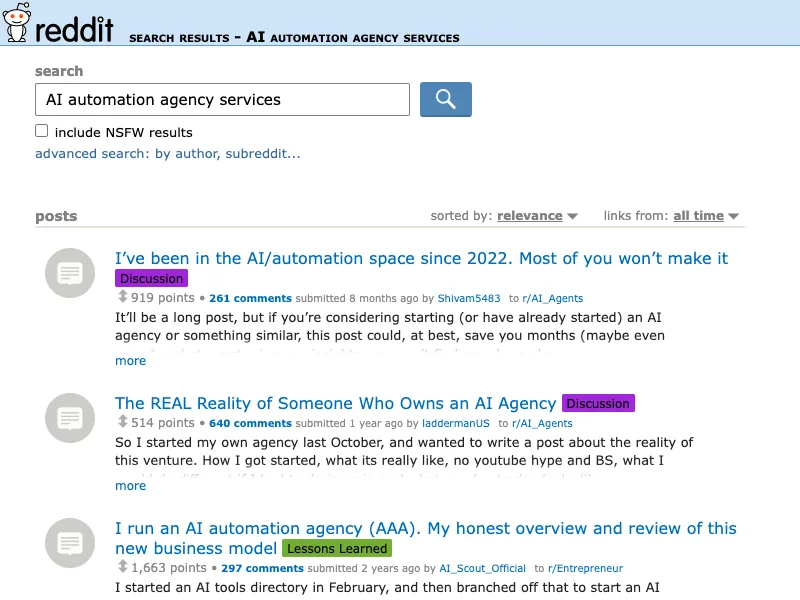
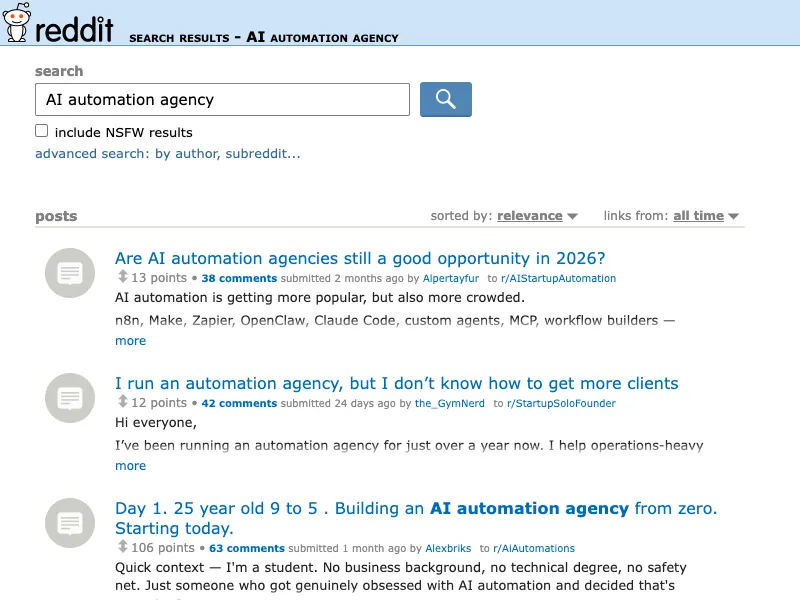
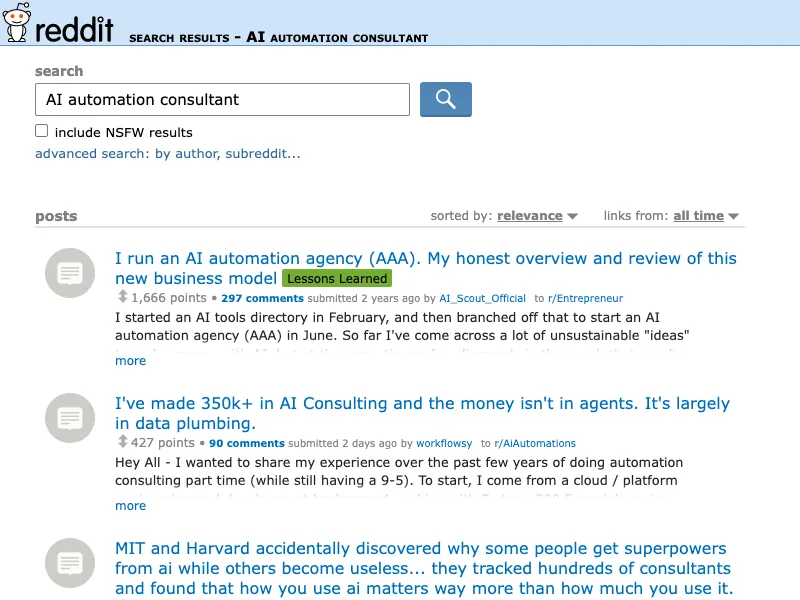
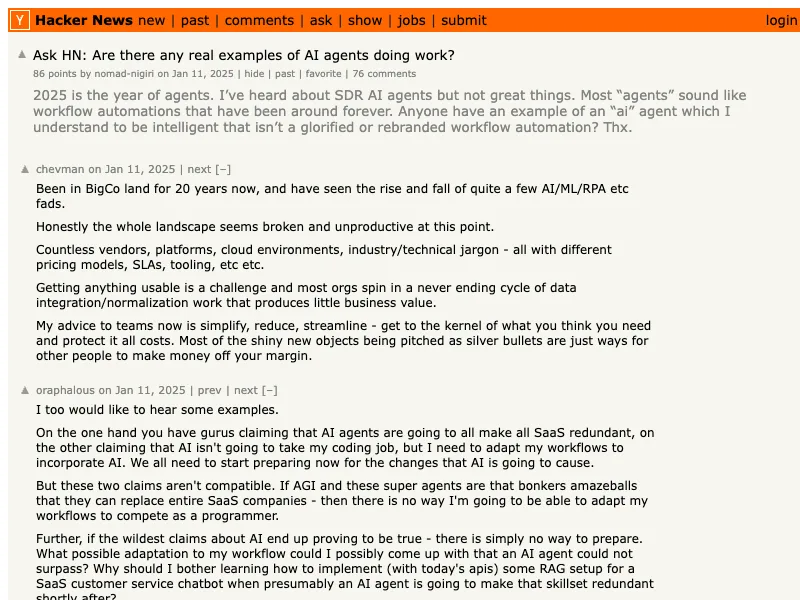
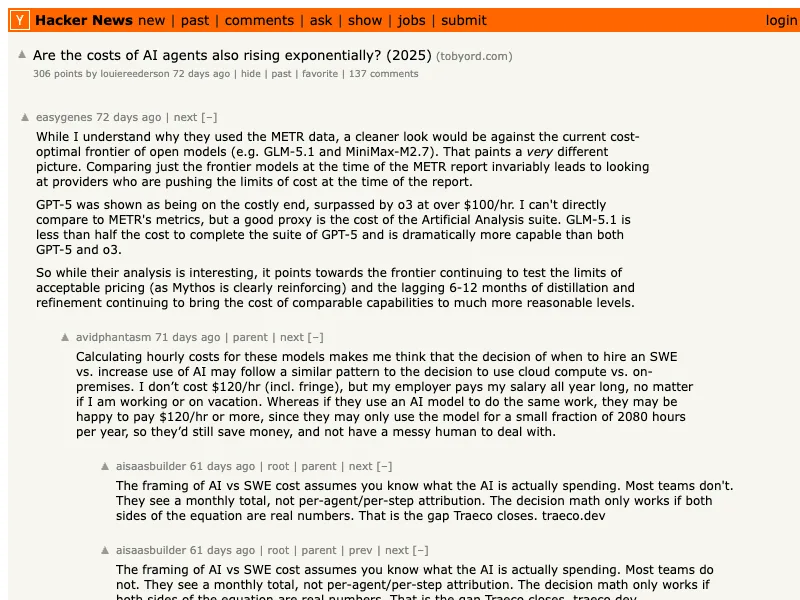
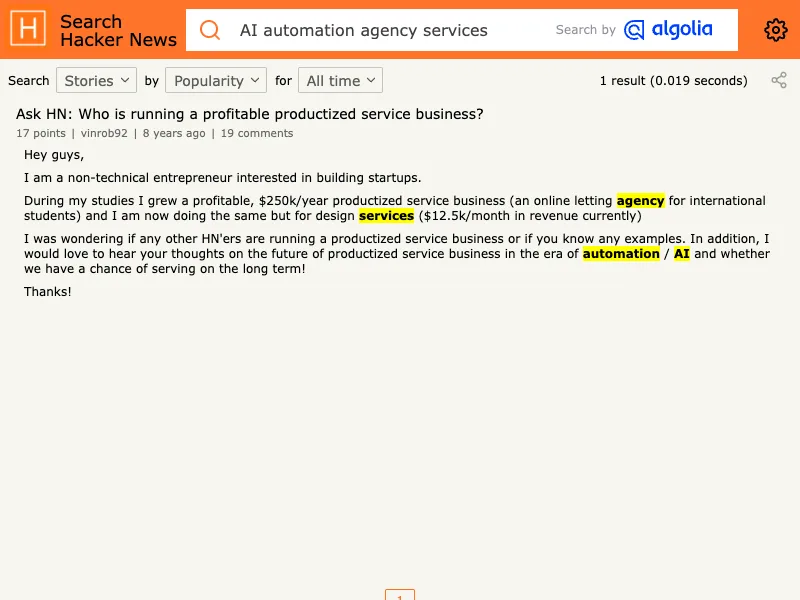
Practitioner discussions are useful here as qualitative signals, not proof of market-wide behavior. In a Reddit discussion about automation and AI agency offers, the useful buyer questions concern the business problem being solved, how services are packaged, and whether API or subscription costs are passed through. Hacker News discussions on real AI-agent work and agent cost attribution raise a related concern: demonstrations are not enough when production complexity and per-workflow costs are unclear.
Use those questions as due diligence prompts:
- Can the agency show a checkable artifact from production work without exposing confidential client data?
- Can it separate its fees from vendor subscriptions and usage-based costs?
- Can it explain what an operator sees when a tool call fails or a workflow pauses?
- Can it show the difference between a prototype and a supportable operating service?
Choose Audit, Pilot, Production Build, or Internal Ownership
Use this decision path to set the next procurement step:
- Choose a workflow audit when the opportunity is plausible but unmeasured, ownership is unclear, or the process needs simplification before automation.
- Choose integration and permission cleanup when the business case is clear but systems, source data, and authorization boundaries are not ready.
- Choose a pilot when the workflow has enough volume to test, a reviewer can handle exceptions, and the initial action is constrained and reversible.
- Choose a production build only after the pilot has an agreed baseline, acceptance evidence, operational owner, guardrails, approval boundaries, observability, and rollback path.
- Choose a managed service only when the agency’s ongoing responsibilities, buyer-side approver, cost reporting, service boundaries, and transition options are written down.
- Choose in-house ownership when the workflow is becoming a durable internal capability and you can support its technical and business operating model.
For a broader assessment of production patterns, see AI agent architecture patterns. If the question is whether to hire a partner or assemble the capability internally, hiring an AI developer versus an agency provides a useful adjacent decision frame. And if you need to separate autonomous workflow design from simple generation, start with agentic AI versus generative AI.
A Copy-Paste Brief for Agency Conversations
Send the same brief to every vendor:
- Workflow to improve:
- Trigger, inputs, and source systems:
- Current process owner:
- Baseline we can measure:
- Failure cost and actions that must never occur automatically:
- Eligible pilot population and excluded cases:
- Required human approval points:
- Data, security, retention, and access constraints:
- Required evidence, logs, or audit trail:
- Desired handoff artifacts:
- Buyer-side technical owner:
- Buyer-side business owner:
- Decision we need from phase one: audit recommendation, pilot go/no-go, production design, or managed-service scope:
A vendor that can return a specific, bounded response to this brief is easier to compare than one selling broad capability language. Ask for assumptions in writing. Where estimates are needed, require the inputs, ownership, exclusions, and conditions that would invalidate them.
Methodology: This editorial guide uses a link-only evidence route because the decision is a vendor and implementation choice, not an occupation or website-performance comparison. The buyer framework and scorecard are Arsum editorial tools based on the documented service-scope assets in the research pack. Official guidance from OpenAI, n8n, NIST, and OWASP supports the discussion of tools, approvals, tracing, and constrained permissions. Reddit and Hacker News material is qualitative practitioner context only, not statistical evidence.
The best next step is not “find the best agency.” It is to arrive with one workflow, a baseline, the systems involved, the cost of a mistake, and two named owners. That gives you a basis for rejecting vague proposals and selecting a service scope that can be tested responsibly.
Ready to Automate Your Business?
Stop wasting time on repetitive tasks. Let AI handle the busywork while you focus on growth.
Schedule a Free Strategy Call →Written by:Arsum editorial team
- Reviewed by
- Arsum editorial team
- Published
- February 11, 2026
- Updated
- August 10, 2026
- How this was produced
- Arsum uses research packs, source checks, and human editorial review to prepare and update blog articles. Editors are responsible for the final page.
- Source policy
- Sources are linked in the article when used. Methodology and source notes are included on higher-risk or high-visibility pages and are being rolled out across the archive. Editorial policy.
- Why this page exists
- Help B2B operators evaluate AI automation, implementation scope, cost, risk, and build-vs-buy decisions with practical context.