For ai automation agency vs ai development firm, choose based on the workflow’s required controls and ownership—not the vendor label. Either type can configure platforms, write custom code, or support regulated work; the decision is whether the provider can prove the deployment model, data handling, test evidence, exception path, rollback, and long-term change responsibility your workflow requires.
AI Automation Agency vs AI Development Firm
Explore ai automation agency vs ai development firm: compare workflow fit, costs, risks, evidence, and practical next steps before you build, buy, or hire.

Table of Contents
- What most guides miss: the category is not the control model
- Compare proposals by capabilities, not labels
- Route the work before selecting the partner
- Minimum evidence required in the proposal
- A buyer-side production-readiness scorecard
- Failure modes that should change the decision
- How to decide after the pilot
- Questions for the first vendor meeting
- Methodology and source note
What most guides miss: the category is not the control model
“Agency” and “development firm” describe common delivery patterns, not guarantees. A workflow-first provider may be the better choice for a contained process using established tools. An engineering-led firm may be appropriate when the work needs a dedicated service, deeper integrations, or a client-owned codebase. But neither label proves that the system is secure, supportable, compliant, or economical at scale.
The more useful question is: what level of autonomy is authorized for this specific workflow, and what evidence must the vendor provide before it receives that authority?
A low-consequence workflow might classify inbound emails and queue uncertain cases for review. A high-consequence workflow might influence a credit, claims, hiring, compliance, or customer-facing decision. The second case does not automatically require a development firm, but it does require explicit controls, retained evidence, approval ownership, and a tested recovery path. Technical capability is not permission to automate a consequential decision.
Google Cloud’s production ML guidance makes the same broader point: production systems involve more than model code, including data verification, testing, serving infrastructure, monitoring, metadata, and operational processes. Google Cloud’s MLOps architecture guidance is useful here because it shifts the conversation from “can the demo work?” to “can the team operate the system when data, APIs, models, and requirements change?”
Compare proposals by capabilities, not labels
Use the matrix below to compare an AI automation agency and an AI development firm. Treat each row as a request for evidence. A vendor that cannot provide the evidence may still be suitable for a narrower pilot, but should not receive broader production authority yet.
| Evaluation area | What to ask for | What acceptable evidence looks like | Why it matters |
|---|---|---|---|
| Deployment ownership | Who controls the production account, repository, environment, and credentials? | Named accounts, access roles, repository location, offboarding process | You need to know whether the workflow can be operated or transferred without the vendor. |
| Workflow or code portability | Can we export the workflow, prompts, configuration, and data mappings? What cannot be moved? | Export sample, documented dependencies, migration assumptions | Platform use is not inherently bad; undisclosed dependency is. |
| Data flow and residency | What data enters the system, where is it processed, and where is it retained? | Data-flow map, data-processing terms, retention settings | Legal and contractual obligations depend on the actual data path, not the vendor category. |
| Access controls | Who can read, change, approve, or deploy the system? | Role matrix, credential ownership, environment separation | Production access should be deliberate, revocable, and auditable. |
| Testing | How are normal cases, edge cases, and integrations tested before release? | Test plan, acceptance cases, release checklist, test results | A polished happy-path demo is not production evidence. |
| Exception handling | Which cases stop, queue, retry, or escalate? | Exception taxonomy, queue owner, human-review instructions | Low-confidence or failed cases need an owner, not a vague promise to “monitor it.” |
| Monitoring and incident response | What is monitored, who receives alerts, and who acts? | Dashboard example, alert routing, runbook, escalation owner | Monitoring without responsibility does not restore a broken workflow. |
| Rollback | How do you disable automation or restore a prior version? | Tested rollback procedure and named approver | The higher the failure cost, the more important reversibility becomes. |
| Change management | Who approves prompt, model, schema, connector, and business-rule changes? | Change log, approval flow, release process | Small external changes can materially alter outputs. |
| Commercial exposure | Which costs vary with volume or usage? | Cost model with platform fees, model usage, support hours, and repricing terms | “Flat fee” may conceal usage caps or future change charges. |
This framework works for both an AI automation agency services engagement and a custom AI development services engagement. The vendor’s job is to show where the system runs and how it fails—not to win an argument about which category sounds more sophisticated.
Route the work before selecting the partner
Likely workflow-platform fit
A workflow-first engagement is often a sensible starting point when the process has a clear boundary and the team can tolerate a controlled pause or manual fallback.
Examples include:
- Routing leads between an existing form, CRM, and team inbox.
- Triaging routine email into predefined queues.
- Enriching records from an approved source and flagging missing fields.
- Preparing draft responses or summaries for human approval.
- Moving standardized documents through an established process.
These are not “easy” by default. They still require permission design, exception handling, and a named operational owner. But established connectors and a visible human handoff can reduce the need for a bespoke application.
For example, a finance team exploring accounts receivable automation should first map what may be drafted or routed automatically versus what requires approval. Sending a reminder may be reversible. Changing a customer record, releasing a credit hold, or posting a journal entry needs a stronger authorization boundary.
Likely custom engineering fit
Engineering-led delivery becomes more relevant when a workflow cannot be adequately controlled through available tools and configuration, or when the workflow itself is becoming a durable product capability.
Signals include:
- A necessary system has no supported connector or requires complex API behavior.
- The workflow needs domain-specific rules, state, or orchestration that must be testable.
- The output is customer-facing or embedded in a product.
- The organization needs a client-controlled code repository and release process.
- The workflow has high failure cost, low reversibility, or material audit requirements.
- A single workflow will evolve into a shared internal service used by several teams.
That does not mean a custom build is automatically better. It means the proposal needs to explain architecture, test coverage, operating responsibility, and the exit plan with enough precision for the risk involved. If you are considering agent-based work, the same standard applies: review the AI agent architecture patterns before accepting a vendor’s use of “agent” as a substitute for a system design.
The practical middle route
Many teams should neither buy a large custom platform nor automate a critical process entirely inside a connector tool on day one. A bounded pilot can validate the operational value while preserving the option to retain, migrate, or rebuild later.
The contract should state which artifact the client receives at the end of the pilot: workflow export, architecture diagram, prompt and rule inventory, data mappings, test cases, runbook, and a documented decision about what remains platform-managed. This creates useful learning even if the pilot stops.
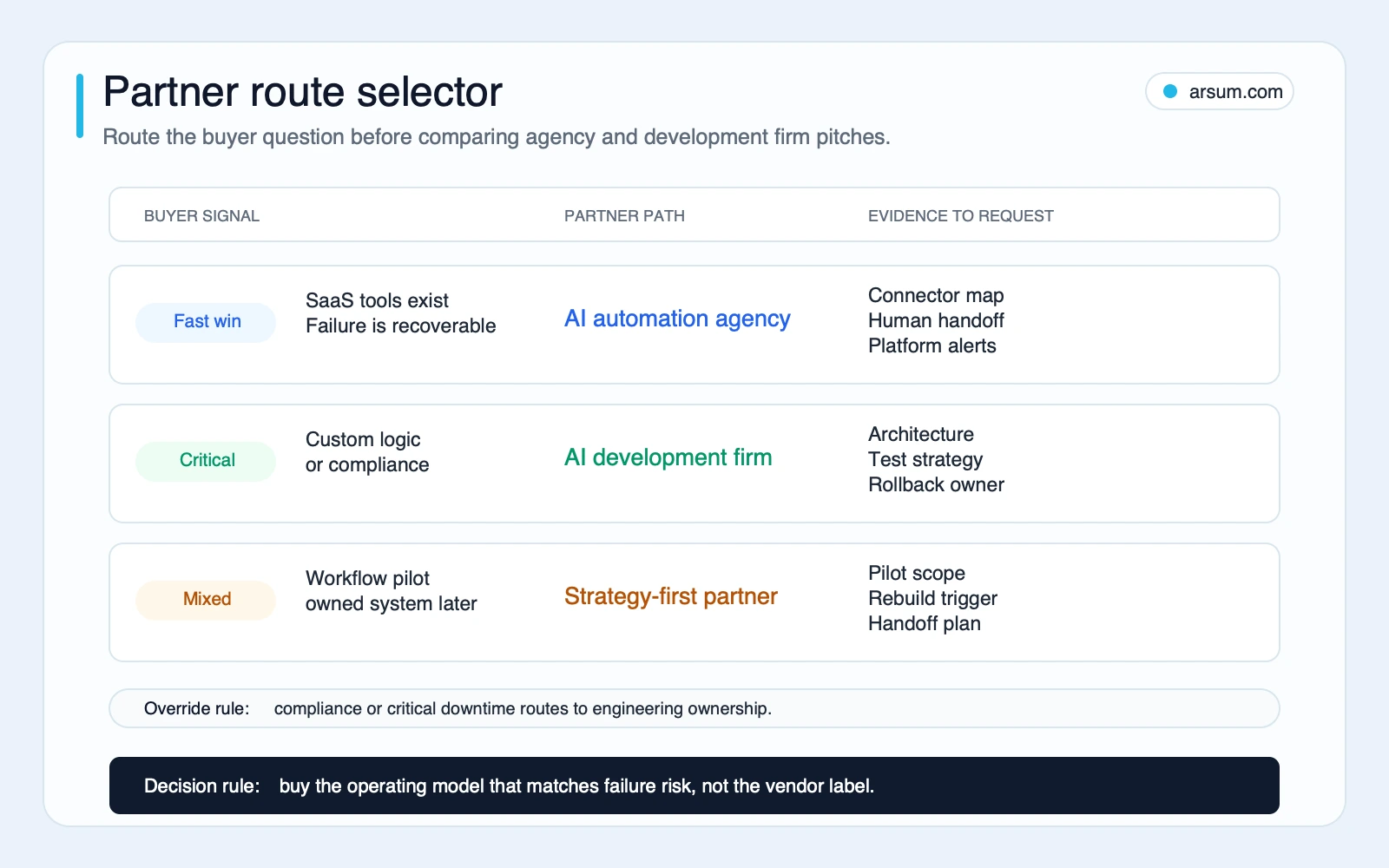
Choose a route based on workflow criticality, reversibility, and evidence of operational ownership—not a vendor’s preferred label.
Minimum evidence required in the proposal
Do not wait until implementation to ask for the artifacts that determine whether the system can be governed. Request these items during selection and make them part of the statement of work where relevant.
- Architecture and data-flow diagram: systems involved, data classes, model providers, storage, and external calls.
- RACI: who is responsible, accountable, consulted, and informed for approvals, incidents, data access, and change requests.
- Runbook: how the team detects, pauses, retries, corrects, and documents failures.
- Credential and environment plan: client-owned versus vendor-owned accounts, least-privilege access, and staging versus production separation.
- Acceptance-test plan: normal cases, edge cases, known failure cases, and human-review paths.
- Monitoring evidence: dashboard, alert thresholds, alert recipients, and response expectations.
- Cost model: implementation scope, platform fees, model or compute pass-through, support hours, volume assumptions, and change-request terms.
- Exit plan: exportability, handoff artifacts, transition support, dependencies that cannot be transferred, and resulting responsibilities.
OpenAI’s production best practices specifically call attention to API-key security, separation of staging and production environments, and architecture that can handle production traffic. Those are useful baseline questions regardless of whether a provider calls itself an agency, consultancy, or development firm.
NIST’s AI Risk Management Framework is not a compliance certification and does not replace legal advice. It does, however, support a disciplined approach: identify and manage trustworthiness considerations in the design, development, use, and evaluation of AI systems. Ask the vendor to connect its proposed controls to your obligations and risk owners rather than claiming that a tool or firm type is “compliant.”
A buyer-side production-readiness scorecard
This is an editorial evaluation framework, not benchmark data. Use it to score a specific proposal against the workflow you intend to automate.
Worked pilot example
Assume an operations team wants to classify and route inbound requests before a human reviews the resulting queue.
The following numbers are illustrative planning assumptions, not expected results:
| Scorecard field | Illustrative planning assumption |
|---|---|
| Baseline volume | 500 requests per week |
| Baseline handling | Each request is manually read, categorized, and routed |
| Baseline review time | 4 minutes per request |
| Proposed automation boundary | Classify and route only; no customer-facing commitment or record change without approval |
| Human-review rule | Any low-confidence, missing-data, or policy-exception case goes to the queue owner |
| Named business owner | Operations manager |
| Named technical owner | Internal systems owner or vendor-designated support lead |
| Review cadence | Daily exception review during pilot; weekly operational review |
| Source-lineage requirement | Each routed record retains source input, classification output, rule or prompt version, timestamp, and reviewer correction where applicable |
| Stop condition | An error crosses the agreed error-cost threshold, an unauthorized action occurs, or the exception queue cannot be reviewed within the agreed operating window |
| Rollback path | Disable the automated routing step, restore manual queue assignment, preserve logs for review |
The hypothetical baseline workload is 500 × 4 minutes = 2,000 minutes, or about 33 hours per week. That arithmetic is not an ROI claim. It is a starting point for estimating the value of time that may be redeployed only after the team measures actual exception handling, review effort, and correction cost.
Go/no-go acceptance threshold
Before launch, define an acceptance threshold that fits the workflow. For the illustrative routing case, a buyer might require all of the following:
- The vendor can run agreed test cases and explain every failed classification.
- Every automated action retains its source and decision lineage.
- A reviewer can override the result and the correction is visible in reporting.
- The designated owner has completed a rollback test in a non-production environment.
- The exception queue is staffed and its review window is agreed.
- No output can initiate a restricted action without the designated approval step.
A proposal that cannot meet those conditions is not necessarily a failed vendor. It may simply be a proposal for discovery or a prototype, not for operational deployment. Scope it accordingly.
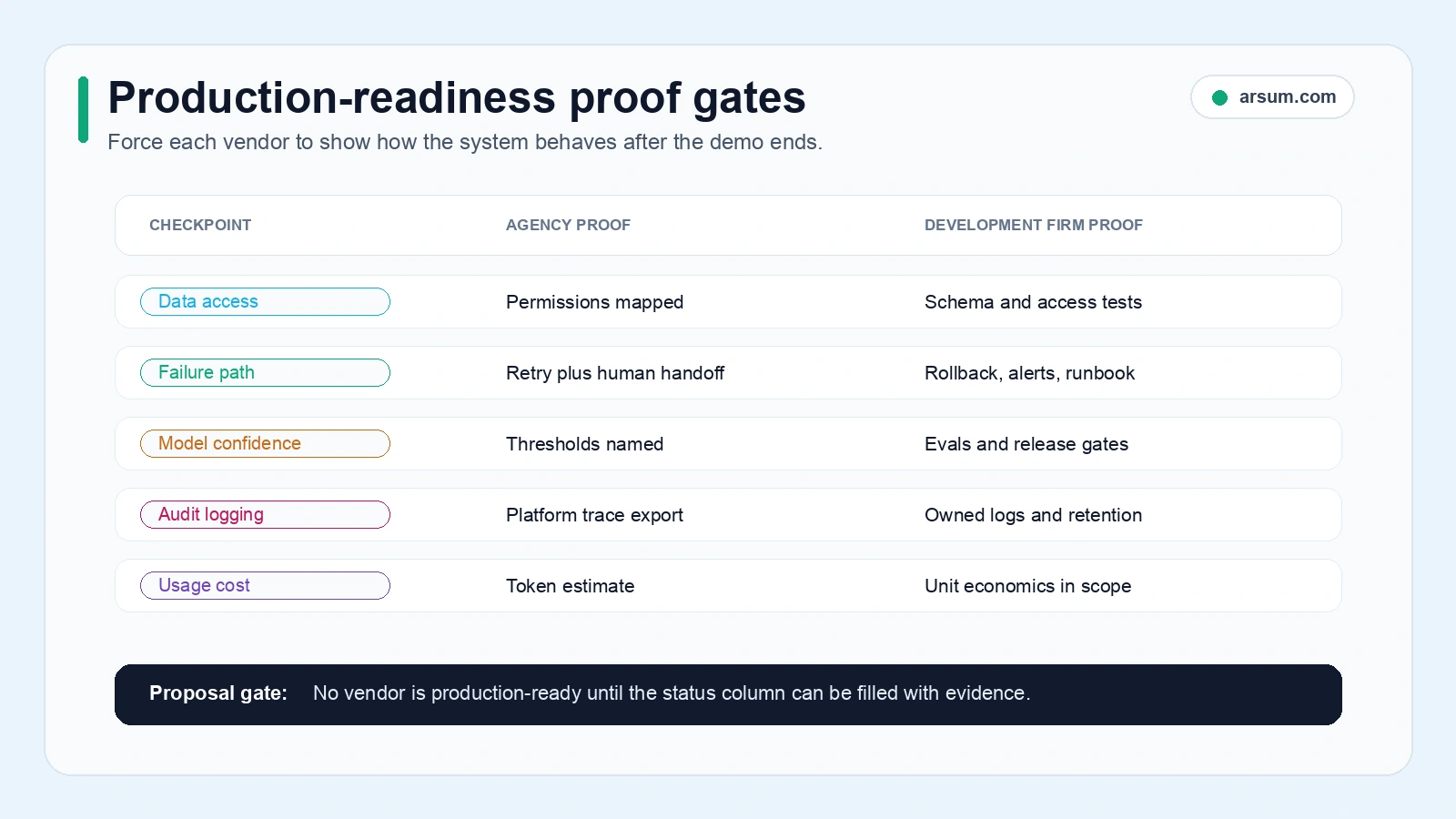
The evidence threshold should rise with the cost of an incorrect action and the difficulty of reversing it.
If you have a workflow candidate but cannot yet define the boundary, owners, or acceptance test, an Arsum workflow assessment can turn that uncertainty into a scoped pilot scorecard, contract artifacts, and planning assumptions before you select a delivery model.
💡 Arsum builds custom AI automation solutions tailored to your business needs.
Get a Free Consultation →Failure modes that should change the decision
“The platform handles it”
A platform may provide retries, logs, access settings, and useful operational controls. That is not the same as a complete failure-recovery design. Ask what happens when a retry duplicates work, a downstream API changes behavior, source data is incomplete, or a model output is ambiguous.
The answer should identify the event, the system behavior, the human owner, the notification path, and the restoration procedure.
“The AI will decide”
For consequential workflows, this phrasing is a warning sign. A model can classify, extract, summarize, or recommend. Authorization for an action should depend on policy, confidence, evidence, and the designated owner—not on whether the model can generate a plausible answer.
OWASP’s Top 10 for LLM Applications is a useful buyer reference because it treats generative AI deployment as a security discipline with lifecycle risks and mitigations. Ask how the proposed design addresses the risks relevant to your workflow, such as untrusted inputs, excessive tool permissions, sensitive information disclosure, and monitoring gaps.
“We can price it as a flat retainer”
A flat price can be appropriate, but only if the underlying assumptions are visible. Request answers to these questions:
- Which platform subscriptions are included?
- Are model and compute costs included, capped, or passed through?
- What volume or concurrency assumptions does the price use?
- What support hours and incident coverage are included?
- What changes trigger a new estimate?
- What does migration cost if the organization later changes platforms or partners?
The right commercial structure depends on the workflow. A small, stable process may suit a managed retainer. A bounded build may suit a fixed scope plus explicit change control. A high-volume process may need unit-cost visibility. For additional pricing questions, see AI automation agency pricing.
“We will make it compliant”
No provider can make a workflow compliant by assertion. Compliance depends on the applicable law, contracts, policies, data classes, control design, validation, evidence retention, and the organization’s own responsibilities. A provider should identify what it will implement, what the client must provide, and where specialist legal, security, privacy, or compliance review is required.
How to decide after the pilot
At the end of a bounded pilot, choose among three routes.
| Route | Choose it when | Require before proceeding |
|---|---|---|
| Retain the workflow-first provider | The workflow is stable, the platform meets requirements, and the client accepts the dependency | Export process, support scope, access ownership, monitoring and rollback evidence |
| Migrate or rebuild | The pilot proved value but control, integration, or ownership gaps are material | Requirements derived from pilot evidence, migration plan, acceptance tests, transition responsibility |
| Stop or keep manual review | Exception cost, approval burden, or data constraints erase the practical value | Documented findings, preserved evidence, and a revised workflow boundary |
A migration is not automatically cheaper than a greenfield build. It can benefit from validated requirements, but cost and timing depend on integrations, data quality, architecture, documentation quality, support terms, and what was actually portable from the pilot. Treat any claim about rebuild cost, delivery duration, or maintenance response as a vendor assumption to be tested in writing.
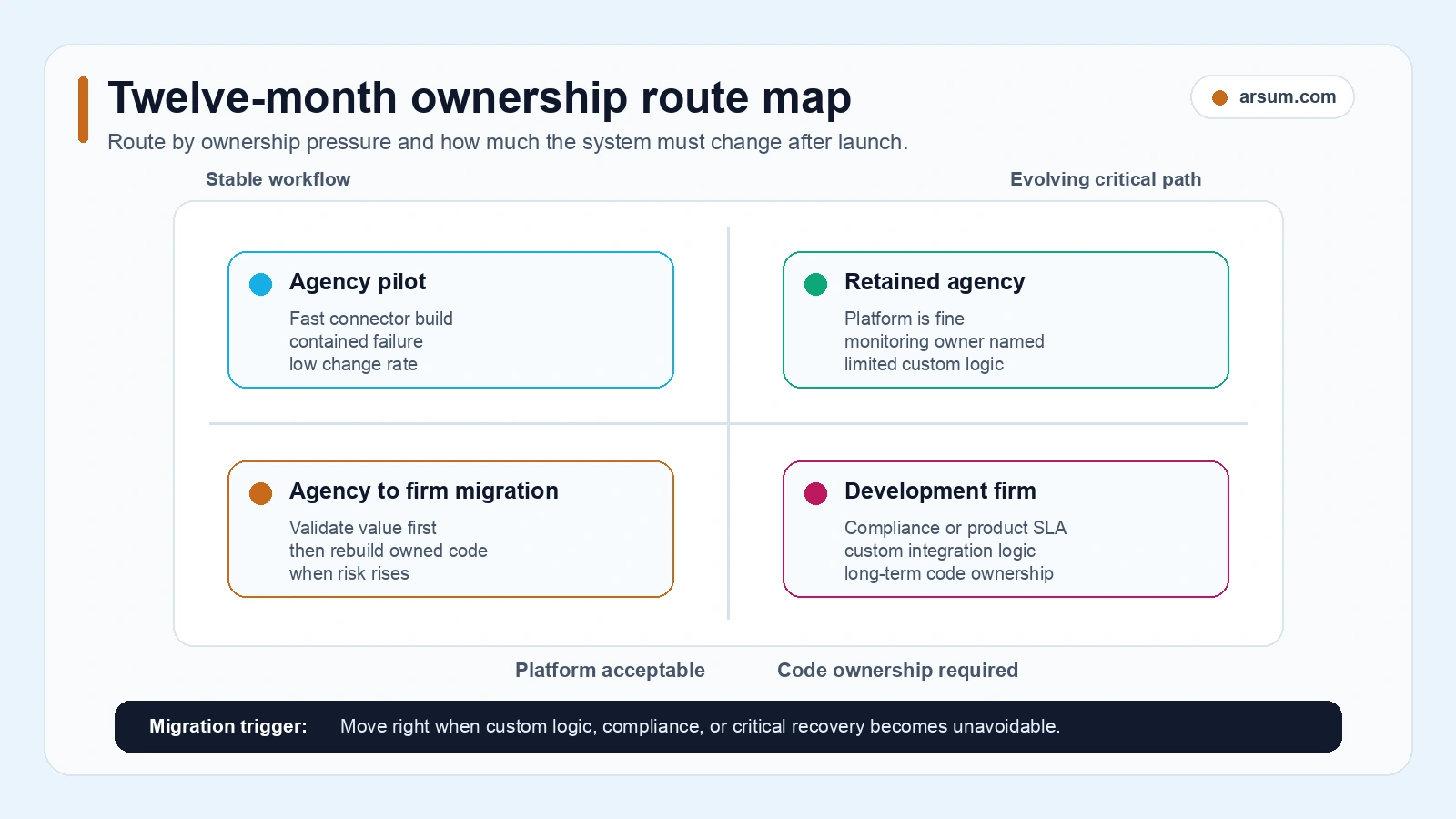
Revisit the choice when the workflow becomes more critical, introduces new data constraints, or moves from assisted work toward authorized action.
Questions for the first vendor meeting
Ask both types of provider these questions in writing:
- Which steps are deterministic, model-assisted, and human-approved?
- What data enters each system, where is it retained, and which credentials are client-owned?
- What happens when an integration fails halfway through the workflow?
- Which outputs are automatically retried, queued, blocked, or escalated?
- What logs and source lineage will the client retain?
- Who owns alerts, incident response, and change approval after launch?
- How is rollback tested, and who is authorized to use it?
- What is portable at handoff, and what remains dependent on a platform or vendor account?
- Which costs change with volume, model usage, support needs, or new integrations?
- What evidence will be presented at the go/no-go review?
Limited practitioner signals reviewed for this topic raise similar concerns about generic tooling, debugging, and control. A Hacker News production discussion asks whether higher-level agent abstractions can make systems harder to debug and whether direct implementation offers more transparency. That is one practitioner discussion, not market-wide evidence. Its value is the question it surfaces: can the vendor explain the behavior of the system you are being asked to fund?
For a broader workflow-planning view, review AI workflow automation and AI integration consulting alongside the specific proposal. The goal is not to buy the most custom solution or the quickest configuration; it is to fund the smallest controlled system that can prove value.
Methodology and source note
This editorial comparison was researched on June 21, 2026. It uses accessible search-result review for the query and close variants, snippet-level Reddit material as qualitative buyer-language only, and a verified Hacker News discussion as a limited practitioner signal. Production, governance, security, and content-quality claims are linked to Google Cloud, NIST, OpenAI’s production guidance, OWASP, and Google Search Central’s people-first content guidance.
If a vendor cannot provide the architecture, ownership, test, cost, and recovery evidence needed for your workflow, start with a scoped assessment rather than signing a broad implementation promise. Arsum can help structure that assessment around workflow boundaries, pilot economics, acceptance criteria, and the artifacts your team needs to evaluate a partner.
Ready to Automate Your Business?
Stop wasting time on repetitive tasks. Let AI handle the busywork while you focus on growth.
Schedule a Free Strategy Call →Written by:Arsum editorial team
- Reviewed by
- Arsum editorial team
- Published
- June 9, 2026
- Updated
- August 12, 2026
- How this was produced
- Arsum uses research packs, source checks, and human editorial review to prepare and update blog articles. Editors are responsible for the final page.
- Source policy
- Sources are linked in the article when used. Methodology and source notes are included on higher-risk or high-visibility pages and are being rolled out across the archive. Editorial policy.
- Why this page exists
- Help B2B operators evaluate AI automation, implementation scope, cost, risk, and build-vs-buy decisions with practical context.