An ai automation consultant is worth hiring when you need more than a demo: a defined workflow, working integrations, controlled exception handling, measurable acceptance criteria, and a named owner after launch. The key distinction is not whether a consultant can show an AI tool; it is whether they can help you decide what may be automated, what must remain reviewed, and how the workflow can be safely operated or rolled back.
AI Automation Consultant: Role, Costs, and Fit
Learn what an AI automation consultant does, how vendor types compare, what good implementation looks like, and when hiring one is worth the investment.
Table of Contents
- What Most Guides Miss: Ownership Starts After the Demo
- What an AI Automation Consultant Should Deliver
- Choose the Provider Type by the Work, Not the Label
- Commodity Work vs. Production-Grade Automation
- How to Test Implementation Depth Before You Sign
- Proposal Comparison Worksheet: Compare the Operating Model
- Worked Pilot Scorecard: Lead Routing Example
- Failure Modes and Disqualifying Conditions
- Questions to Ask Before Hiring
- When a Consultant Is the Right Fit
- Methodology and Limits
What Most Guides Miss: Ownership Starts After the Demo
Most consultant comparisons focus on capabilities, industries, or tools. The buyer decision is usually simpler and more consequential: who owns the workflow when a connector fails, an output is wrong, a policy changes, or usage exceeds its intended boundary?
A strategy deck can be useful. A prototype can be useful. Neither is a production operating model.
Before hiring, require the proposal to identify:
- The workflow owner on your team.
- The systems, permissions, and data fields in scope.
- Which actions can happen automatically and which require approval.
- The exception queue, responder, and escalation rule.
- The monitoring, usage-control, and rollback plan.
- The handoff artifacts and post-launch support boundary.
This is especially important when automation affects customer communications, financial records, eligibility decisions, compliance evidence, or revenue-routing. Technical capability does not authorize autonomous action. As failure cost rises or reversal becomes harder, human review should become more explicit.
For a broader view of how workflow discovery, implementation, and operating ownership fit together, see AI automation consulting.
What an AI Automation Consultant Should Deliver
A consultant may focus on advisory work, implementation, or both. Do not assume the word “consultant” includes building, production hardening, or support. Make the scope explicit.
1. Current-state workflow and baseline
The engagement should start with a documented version of what happens now:
- Trigger and input source.
- Manual decisions and handoffs.
- Source systems and data quality issues.
- Common exceptions and rework.
- Current volume, cycle time, error definition, and review effort.
- The business owner who can approve the new process.
A baseline is not a sales artifact. It is the reference point for deciding whether the pilot should continue. Without it, later ROI claims become subjective and disagreements about quality have no common measure.
2. Architecture and control design
The consultant should show how the workflow will operate before writing the automation:
- What system is the source of truth?
- Which credentials and permissions are needed?
- Where does AI classify, summarize, extract, or recommend rather than take action?
- What happens if an upstream system returns incomplete data?
- Which output is logged, reviewed, or retained?
- How does the team disable the automation and return to manual work?
NIST describes its AI Risk Management Framework as a voluntary framework for managing AI risk across design, development, use, and evaluation. Its Generative AI Profile is a useful prompt for a vendor conversation: ask how risk is assessed before launch and how it will be monitored afterward.
3. Build, testing, and release
A production-oriented consultant should specify the test path, not merely promise “QA.” For a workflow with material consequences, this normally means representative test cases, an explicit error definition, review of edge cases, and a controlled release or parallel run.
The appropriate depth depends on the workflow. A simple internal drafting aid may need only lightweight review. An automation that updates CRM ownership, sends customer messages, or creates financial records needs stricter controls.
4. Handoff and operating ownership
Ask for the deliverables that make the system maintainable without the original consultant:
- A workflow diagram and system inventory.
- Credential and permission ownership.
- Runbook for common failures.
- Exception-handling instructions.
- Alert thresholds and monitoring access.
- Change-management process for prompts, models, schemas, and integrations.
- Support terms or a clearly bounded handoff.
If the proposal stops at “deployment,” you may be buying a prototype with an undefined operating burden. For related implementation patterns, see AI implementation services.
Choose the Provider Type by the Work, Not the Label
Different provider types can be appropriate. These are typical trade-offs, not guarantees; individual evidence, references, and proposal detail matter more than category labels.
| Provider type | Usually useful when | Buyer should verify | Common trade-off |
|---|---|---|---|
| Independent consultant | Narrow, well-defined workflow with a clear technical owner internally | Direct production experience, availability, documentation, and support terms | Concentrated key-person risk |
| Boutique implementation firm | You need discovery through handoff across several systems | Who performs the work, escalation coverage, and continuity if personnel change | Smaller bench and variable specialist coverage |
| Large consultancy or integrator | Governance, procurement, audit documentation, or enterprise coordination is central | Delivery team composition, build responsibility, and practical operating ownership | More coordination and commercial overhead |
| Internal hire or team | Automation is a continuing product capability and you can lead it internally | Recruiting capacity, management ownership, and backlog clarity | Slower start; you retain all execution risk |
| Wait and map the process | The workflow, data, or success criteria are unclear | Whether the problem is operational rather than technical | Delays a build, but prevents premature automation |
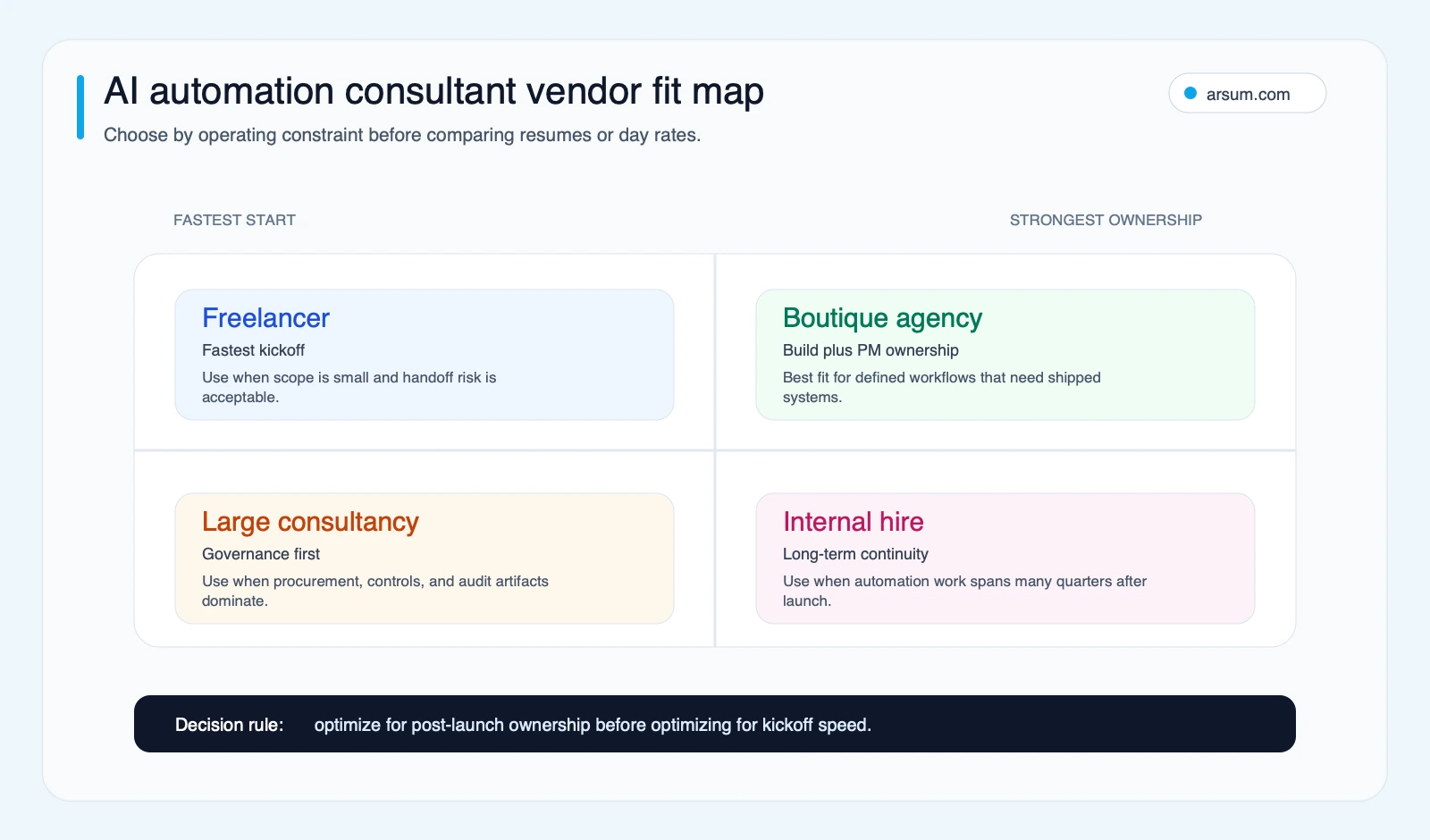
The decision is less about whether a freelancer, boutique, or larger firm is inherently better and more about whether the provider can demonstrate the work you need: source-system fluency, production controls, testing, documentation, and accountable handoff. See automation consultants for a wider comparison framework.
A qualitative signal from a public Hacker News discussion captures the practical dividing line: teams with the skills and capacity to build simple automations may not need an outside provider, while organizations seeking full-service delivery may still need one. Treat that as a screening prompt, not market-wide evidence.
Commodity Work vs. Production-Grade Automation
Some automations are reasonable internal experiments. Others deserve a more rigorous consultant evaluation.
Often suitable for internal ownership or a narrow contractor scope
- A single-system trigger and notification.
- Internal drafting or summarization with no direct system action.
- A low-risk workflow with reversible outputs.
- A documented process with clean inputs and a small exception rate.
- A tool-native integration with no sensitive-data or customer-facing exposure.
More likely to justify implementation expertise
- Multiple production systems with inconsistent schemas.
- Customer, financial, compliance, or regulated-process impact.
- AI output that changes a record, route, decision, or external communication.
- Proprietary-document retrieval where access controls and data lineage matter.
- Workflows requiring approval rules, exception queues, audit evidence, or rollback.
- Integrations where a partial failure could create duplicate, missing, or incorrect work.
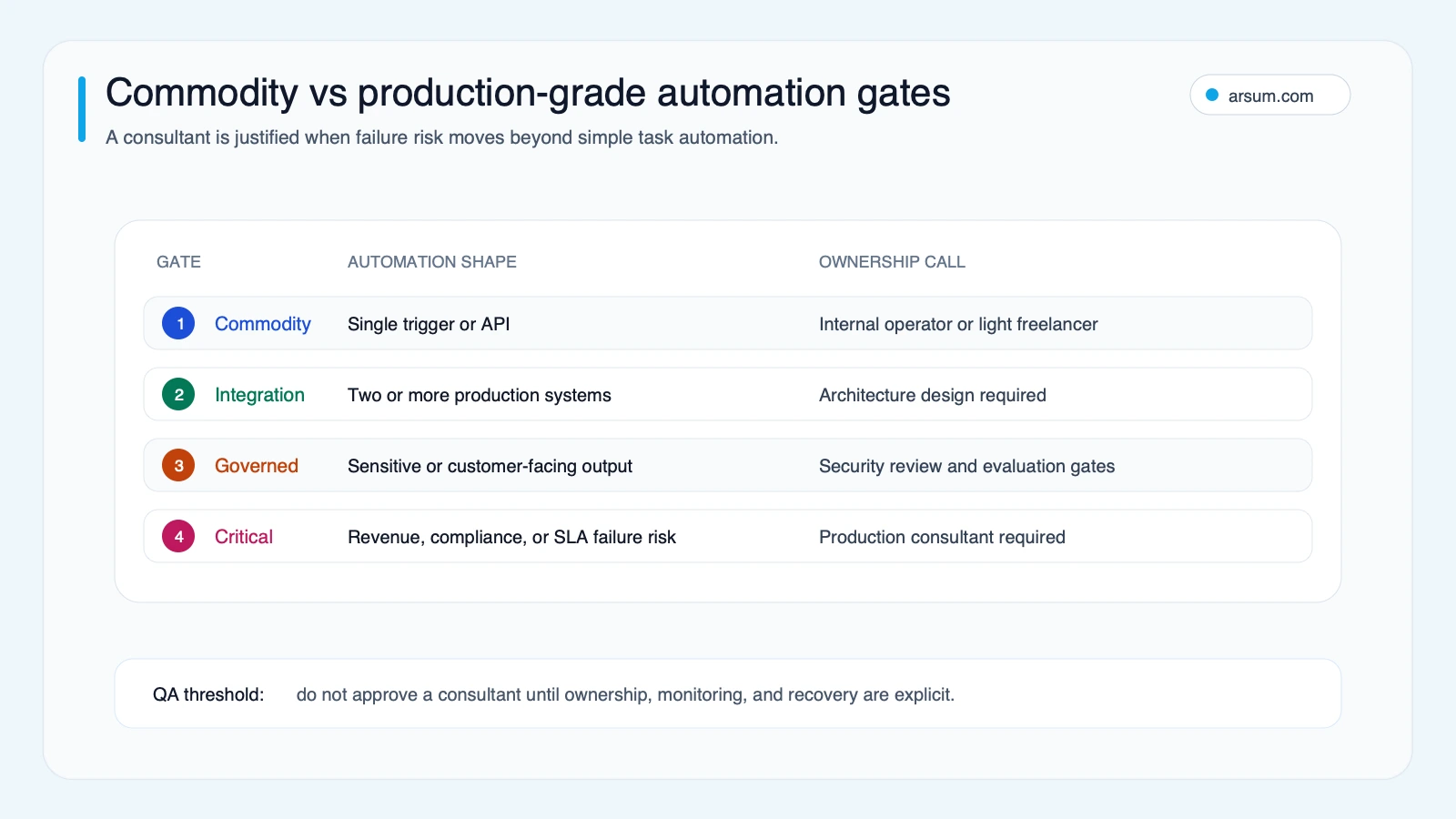
The practical question is: what happens when the system is uncertain or wrong? If the answer is “someone notices eventually,” it is not ready for unattended use.
This distinction also helps separate a consultant from a general software vendor. An effective engagement combines workflow judgment with engineering: mapping the process, deciding the right autonomy boundary, integrating systems, and leaving an operating model behind. For that workflow-first perspective, see AI business process automation.
💡 Arsum builds custom AI automation solutions tailored to your business needs.
Get a Free Consultation →How to Test Implementation Depth Before You Sign
A polished demo is weak evidence on its own. Ask candidates to explain a relevant implementation in terms of operational failure, not only features.
Ask for an architecture walkthrough
Request a walkthrough of a prior workflow with similar complexity. The consultant does not need to disclose customer-confidential details, but they should be able to explain:
- The trigger, source of truth, and downstream systems.
- How authentication and permissions were handled.
- The error states they expected.
- Which cases routed to humans.
- How they tested outputs before release.
- What monitoring existed after launch.
- What changed during handoff.
Ask the “partial failure” question
Use a concrete scenario: “An enrichment step succeeds, but the CRM update fails. What happens next?”
A production-minded answer should cover idempotency or duplicate prevention, logs, retry behavior, a visible exception path, ownership, and manual recovery. An answer focused only on “we’ll use an API” does not establish operating readiness.
Ask about data, security, and product choices
Consultants should name the products and configurations they propose, rather than saying only that they use “AI.” OpenAI states in its Enterprise Privacy documentation that business customers retain ownership and control of business data inputs and outputs for listed business products and API usage. That does not eliminate your governance work; it means the buyer should verify the actual product, configuration, data flow, retention expectations, and contractual terms in scope.
Security review belongs in evaluation, too. OWASP’s Generative AI Security Project provides dedicated guidance on the security and safety concerns introduced by generative-AI systems. For workflows that can access internal systems or act on data, ask how the design handles prompt injection, excessive permissions, insecure outputs, and untrusted inputs.
Proposal Comparison Worksheet: Compare the Operating Model
Ask every shortlisted provider to complete the same worksheet. It turns broad promises into comparable commitments.
| Proposal item | Vendor response you need | Buyer decision |
|---|---|---|
| Workflow boundary | In-scope trigger, inputs, systems, outputs, and exclusions | Confirms the team is pricing the same work |
| Discovery | Current-state map, baseline fields, decision owner, and acceptance criteria | Prevents a vague discovery phase |
| Production hardening | Error handling, test approach, exception scenarios, and security review | Reveals whether the quote includes more than a demo |
| Approval ownership | What requires human approval, who approves, and evidence retained | Sets authorized autonomy boundaries |
| Rollback | Disable trigger, manual fallback, recovery steps, and rollback owner | Limits operational blast radius |
| Support | Response boundary, maintenance work, escalation path, and handoff date | Makes post-launch responsibility explicit |
| Recurring costs | Model/API usage, platform licenses, monitoring, support, and internal review time | Supports total-cost-of-ownership comparison |
| Change control | Who can alter prompts, rules, schemas, access, or routing | Protects the workflow after launch |
Do not rely on a single headline project price to compare proposals. The total cost of ownership is the sum of work that must actually occur, whether it is in the initial statement of work or deferred to your team.
A simple worksheet can use these inputs:
| Cost category | Planning input |
|---|---|
| Discovery and workflow mapping | Vendor estimate plus internal stakeholder time |
| Build and integration | Vendor estimate |
| Hardening and parallel testing | Explicit vendor estimate or separately scoped contingency |
| Training and documentation | Vendor and internal participant time |
| Recurring tools and model usage | Current vendor pricing or usage-based estimate |
| Support and maintenance | Contracted support plus internal owner time |
| Exception review | Average review minutes × expected exception volume × internal labor cost |
This is an illustrative planning model, not a benchmark. It becomes useful only when you document the assumptions and revisit them after the pilot.
Worked Pilot Scorecard: Lead Routing Example
Use a limited pilot when the workflow is defined but you do not yet know whether quality, exceptions, and review effort will hold up in live conditions.
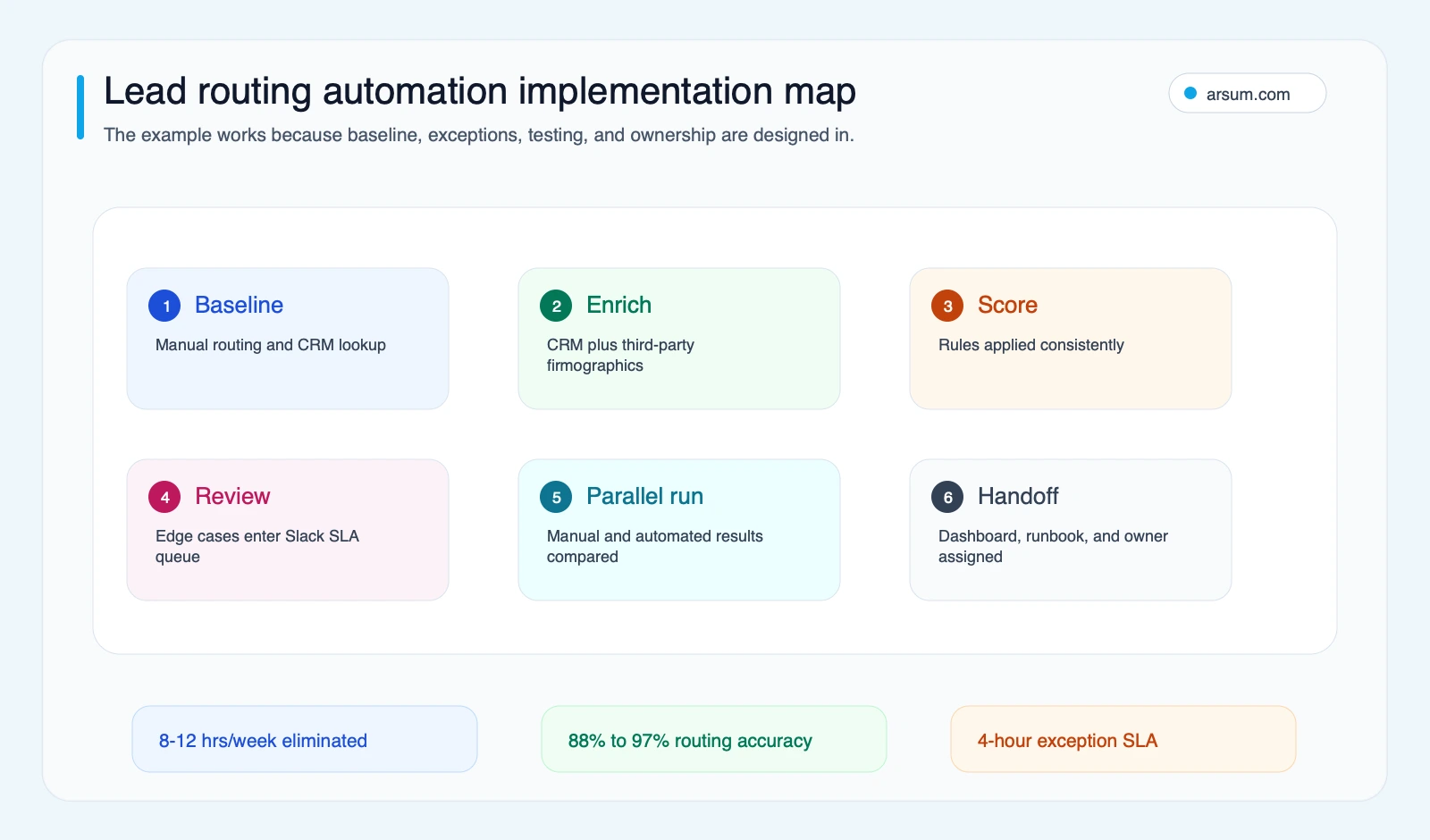
Consider this fictional planning example: a marketing-operations team receives inbound leads that must be matched to CRM records, scored against written rules, and routed to the appropriate queue. The automation may enrich data and recommend or prepare a route, while ambiguous matches remain in a human review queue.
| Scorecard field | Pilot definition |
|---|---|
| Baseline period | Measure a representative current-state period before build: lead volume, routing time, corrections, and reviewer effort |
| Target | Set a target with the business owner, such as reducing manual routing touches while preserving the agreed routing-quality threshold |
| Quality metric | Correct route according to the written routing policy; define how disputed or missing-data cases are counted |
| Exception metric | Share of cases sent to review, age of the oldest unresolved exception, and rework after review |
| Owner | Named marketing-operations owner approves routing policy; technical owner maintains the workflow |
| Review cadence | Daily review during parallel run, then a scheduled operating review after release |
| Stop condition | Pause automation if routing quality falls below the agreed threshold, exceptions accumulate beyond capacity, or unauthorized updates occur |
| Rollback path | Disable automated assignment, return leads to the existing manual queue, preserve logs for diagnosis, and correct affected records |
The measurement method matters as much as the target. Define the baseline window, what counts as a routing error, how human review time is captured, and how long you will observe the pilot after release. Do not describe time savings or accuracy gains as results until your organization has measured them against that definition.
A consultant who proposes a pilot should be comfortable committing these details to the plan. If they cannot, the engagement is not yet scoped tightly enough to evaluate.
Failure Modes and Disqualifying Conditions
Do not proceed to build until the following conditions are addressed.
Disqualifying conditions
- No process owner can make routing, policy, or acceptance decisions.
- The team cannot identify a source of truth for the data.
- Sensitive or regulated data may be sent to tools without a documented data-handling review.
- The intended action is irreversible, but there is no approval gate or fallback.
- There is no way to measure the current workflow.
- The consultant proposes “autonomous” action without defining exceptions, permissions, and monitoring.
- The contract has no handoff or support boundary.
Common failure modes
The demo uses clean data. Production inputs are incomplete, duplicated, delayed, or inconsistent. Require representative cases before launch.
The workflow has no exception owner. Edge cases accumulate silently. Establish one queue, one owner, and a response expectation.
Usage and permissions expand without controls. Keep access least-privilege, assign a budget owner, and review usage regularly.
The business changes but the automation does not. Routing policies, forms, systems, and prompt instructions all need change control.
The consultant leaves with the context. Documentation, access transfer, and a practical runbook are deliverables, not optional extras.
A public Hacker News discussion about AI spend is useful as a reminder that unsupported cost anecdotes should be treated skeptically. The lesson for buyers is not a specific spending claim; it is to require usage limits, ownership, and visible cost controls before broadening access.
Questions to Ask Before Hiring
Use these in vendor calls and reference checks:
- What current-state baseline will we measure, and who approves it?
- Which systems, credentials, and data fields are in scope?
- What does the workflow do automatically, and what must a person approve?
- Show us a partial integration failure and explain the recovery path.
- Which cases enter the exception queue, and who responds?
- What test cases and release criteria must pass before go-live?
- What logs, alerts, and usage controls will be available to our team?
- What documentation and training are included in handoff?
- What ongoing maintenance is included, excluded, or owned internally?
- What must be true for us to pause or roll back the automation?
The answers will usually tell you more than provider size, tool logos, or generic ROI language.
For buyers comparing implementation paths, AI automation agency services, AI workflow automation tools, and AI automation ROI examples can help frame the build, tool, and investment questions separately.
When a Consultant Is the Right Fit
Hire an external implementation partner when the workflow is sufficiently clear, the pain can be measured, the integration surface exceeds internal capacity, and a business owner is ready to make operating decisions.
Use an internal team or narrow contractor when the work is low-risk, reversible, well-documented, and limited to a small system boundary.
Wait and map the process when data quality, ownership, or the definition of success is unresolved. Paying someone to automate an undefined process generally creates a more expensive version of the same confusion.
The right AI automation consultant is not the one with the broadest promise. It is the one whose proposal makes the workflow boundary, control design, measurement method, exception path, handoff, and ownership unambiguous.
Methodology and Limits
This is a buyer-side editorial guide, not a market-price survey or vendor ranking. It uses the validated Research Pack’s review of search-result coverage and qualitative practitioner discussions to identify screening questions; those discussions are not treated as evidence of market-wide rates or outcomes. Governance and security claims are linked to OpenAI’s enterprise privacy guidance, the NIST AI Risk Management Framework, and OWASP’s generative-AI security guidance.
Privacy defaults, product behavior, integration limits, and pricing can change. Validate the proposed stack and contract terms at the time of purchase.
Ready to Automate Your Business?
Stop wasting time on repetitive tasks. Let AI handle the busywork while you focus on growth.
Schedule a Free Strategy Call →Written by:Arsum editorial team
- Reviewed by
- Arsum editorial team
- Published
- June 11, 2026
- Updated
- July 19, 2026
- How this was produced
- Arsum uses research packs, source checks, and human editorial review to prepare and update blog articles. Editors are responsible for the final page.
- Source policy
- Sources are linked in the article when used. Methodology and source notes are included on higher-risk or high-visibility pages and are being rolled out across the archive. Editorial policy.
- Why this page exists
- Help B2B operators evaluate AI automation, implementation scope, cost, risk, and build-vs-buy decisions with practical context.