AI automation consulting is worth paying for when a workflow has enough volume to measure, clear source systems, a controllable exception path, an accountable business owner, and consequences that justify more than a template tool setup. If those conditions are missing, start with a standard product or a short diagnosis—not a broad implementation proposal. The buyer’s job is to verify that a consultant can scope the workflow, define approvals and rollback, and leave the team with an operable system rather than an expensive wrapper around common tools.
AI Automation Consulting: Buyer Guide
Explore ai automation consulting: compare workflow fit, costs, risks, evidence, and practical next steps before you build, buy, or hire.

Table of Contents
- What Most Guides Miss: Capability Is Not Authorization
- Choose the Right Delivery Route
- Scope the Workflow Before You Buy
- Evaluate a Proposal With One Scorecard
- Build a Transparent ROI Model, Not a Payback Claim
- Pilot Acceptance Scorecard: Define Stop, Go, and Rollback
- Implementation Gates That Should Appear in the Delivery Plan
- What You Should Own at Handoff
- Methodology and Freshness
What Most Guides Miss: Capability Is Not Authorization
A model may be technically able to classify a document, draft a customer reply, update a CRM field, or recommend a financial next step. That does not mean it should act autonomously.
The decision is not “can AI do this?” It is:
- Is there enough repeatable volume to justify changing the workflow?
- Can the team measure the current baseline and the post-launch result?
- Are the source systems and data permissions understood?
- Can low-confidence, incomplete, or conflicting cases be routed safely?
- Is one business owner accountable for approving the workflow and stopping it?
This is the boundary between useful AI automation consulting and generic tool reselling. A workflow with a clear trigger, structured output, reversible action, and manageable exception queue can be a practical candidate for automation. A workflow involving money movement, binding customer commitments, sensitive data, legal judgment, or irreversible changes needs explicit approval boundaries and stronger controls.
A practitioner discussion about AI consulting makes a similar qualitative point: the difficult work is often data access, system connections, guardrails, and compliance—not selecting a model. Treat that as an operator signal, not a market statistic. NIST’s AI Risk Management Framework provides a more durable basis for the same buyer behavior: govern the system, map its context, measure risk, and manage it over time.
Use a qualification test before requesting proposals
Answer these seven questions in writing:
| Question | What a usable answer looks like |
|---|---|
| What is the workflow? | One named process, not “use AI in operations.” |
| What starts it? | A defined event, such as a submitted form, received document, or support ticket. |
| Which systems are involved? | Named sources of truth, downstream tools, and identity/access requirements. |
| What changes? | A measurable output: routing time, rework, backlog age, review load, or throughput. |
| Where does human review stay? | A named approver for customer, financial, legal, or sensitive-data actions. |
| What happens on failure? | A queue, fallback process, alert, and escalation owner. |
| Who can stop it? | A named rollback owner with access to disable the workflow. |
If the answers are mostly unknown, buy a scoped diagnosis before committing to a build. If the workflow already fits a mature product and has low consequences, use that product first. Consulting earns its place when integration, control design, or ownership ambiguity is the actual problem.
Choose the Right Delivery Route
“AI automation consulting” can describe very different offers. Compare the work required, not the label on the proposal.
| Route | Appropriate when | What to verify before choosing |
|---|---|---|
| Tool-only configuration | One low-risk workflow fits a standard connector or product template | Internal owner, permissions, exception handling, and whether the team can maintain it |
| Independent specialist | A bounded workflow needs configuration, light custom logic, or focused technical help | Scope, client-owned credentials, documentation, and support boundaries |
| Implementation partner | The workflow crosses systems, teams, or data permissions and needs durable operations | Integration design, testing, monitoring, security review, handoff, and rollback |
| Larger consulting program | Multiple workflows need shared governance, operating-model change, and cross-functional ownership | Decision rights, program governance, implementation accountability, and delivery artifacts |
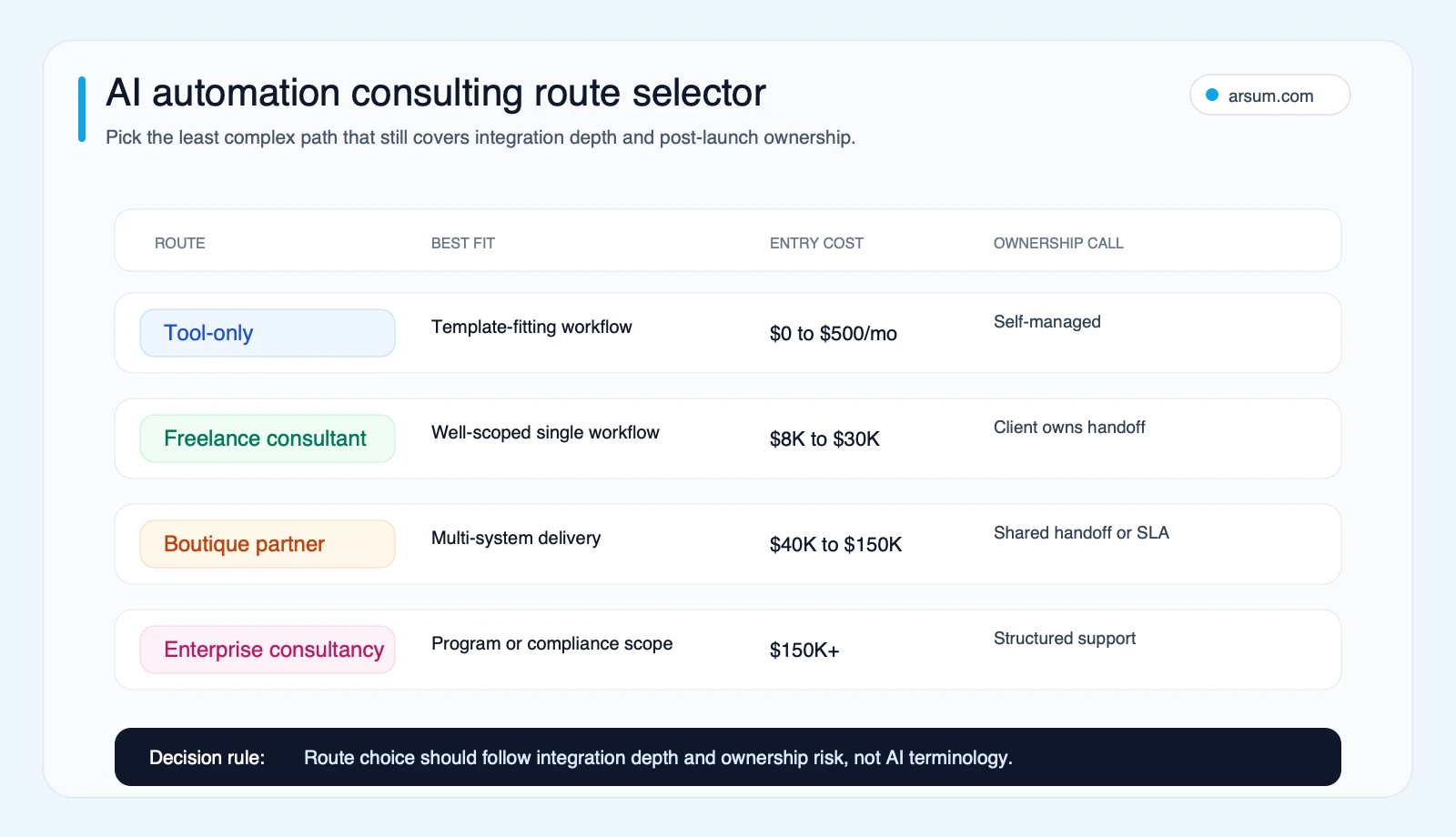
The route selector matters because a simple workflow can be over-engineered, while a multi-system process can be under-scoped. Neither mistake is fixed by adding a more impressive model.
Commodity work versus implementation work
Commodity work is not inherently bad. Prompt templates, no-code assembly, basic intake forms, and standard workflow connectors can be the right answer for a self-contained, low-stakes process. The problem begins when that work is sold as if it includes architecture, governance, security, production monitoring, and ongoing operational ownership.
Ask the proposal to separate these categories:
| Work category | Buyer question |
|---|---|
| Workflow discovery | Which workflow is selected, and why is it preferable to alternatives? |
| Tool configuration | Which standard products and connectors are being configured? |
| Integration and data design | How are identities, permissions, source-of-truth conflicts, and failed calls handled? |
| AI behavior design | What does the model do, what evidence does it receive, and when does it abstain? |
| Controls and security | What data, prompt, access, and tool-use risks are reviewed? |
| Production readiness | What is tested, logged, alerted on, and recoverable? |
| Handoff and support | Who owns credentials, documentation, changes, incidents, and vendor dependencies? |
A concise proposal can still be good. The concern is not the number of line items; it is whether the buyer can identify what is included, what is excluded, and who absorbs the remaining work.
For a related distinction between workflow design and autonomous behavior, see agentic AI workflow automation and AI agents for business.
Scope the Workflow Before You Buy
A strong engagement begins with a workflow brief. It turns an appealing but vague objective into a decision that can be tested.
| Vague request | Scoped workflow brief |
|---|---|
| “Build an AI support chatbot.” | “Classify inbound support emails, retrieve approved help-center material, draft a response in the help desk, require agent approval before sending, and route low-confidence cases to the existing queue.” |
| “Automate lead operations.” | “Enrich new CRM records from approved data sources, flag incomplete matches for review, assign records according to existing territory rules, and prohibit autonomous outbound messages.” |
| “Use AI for invoice processing.” | “Extract selected fields from incoming invoices, compare them against purchase-order data, route mismatches to accounts payable, and require an authorized approver before any payment-related action.” |
The short brief should name:
- Business owner: The person accountable for the workflow outcome.
- Technical owner: The person who can access systems, approve changes, and receive operational alerts.
- Source systems: The authoritative records and permitted data fields.
- Trigger and output: The event that starts the workflow and the specific result it produces.
- Decision boundary: What the system may draft, recommend, classify, update, or send.
- Approval boundary: What must be approved by a human.
- Exception path: Low confidence, missing data, conflict, failed tool call, and policy violation.
- Evidence retained: Inputs, outputs, approvals, errors, and relevant system events.
- Rollback: How the workflow is paused, disabled, or reverted.
This brief is also a practical way to compare proposals. If one firm responds with a tool list and another responds by clarifying the source system, approval boundary, exception queue, and owner, the second response gives you more information about delivery discipline.
For buyers who need to connect existing infrastructure rather than replace it, AI integration consulting offers a useful companion perspective. Teams deciding whether a low-code route is sufficient can also compare AI workflow automation tools.
💡 Arsum builds custom AI automation solutions tailored to your business needs.
Get a Free Consultation →Evaluate a Proposal With One Scorecard
Use this as an editorial buyer-side assessment, not a market benchmark. Score each item from 1 to 5, then use gaps to drive follow-up questions.
| Dimension | What to inspect |
|---|---|
| Problem clarity | Does the proposal identify one workflow, baseline, target, and excluded scope? |
| Systems access | Are the source systems, permissions, data owners, and integration constraints named? |
| Approval design | Does it distinguish drafting, recommendation, execution, and consequential actions? |
| Exception handling | Are low-confidence outputs, missing data, failed calls, and escalations specified? |
| Security review | Does it address access controls, prompt and data risks, logging, and third parties? |
| Production readiness | Are testing, monitoring, alerts, error visibility, and rollback included? |
| Ownership | Are business, technical, operational, and vendor responsibilities explicit? |
| Handoff | Will the client receive accounts, credentials, documentation, runbooks, and change procedures? |
| Economics | Does the model show baseline, assumptions, review cost, support cost, and sensitivity? |
| Change control | Does it define how prompts, models, integrations, and policies are tested and approved? |
A low score does not automatically mean reject the vendor. It means the proposal has not yet made its operating assumptions visible. Do not accept a reassuring answer such as “we handle that” in place of an artifact, owner, or test condition.
Questions that expose wrapper work
Ask these directly:
- Which existing system is the source of truth when records conflict?
- What action can the automation take without review, and who approved that boundary?
- Show the exception path for a failed API call, incomplete record, and low-confidence result.
- Which accounts, credentials, logs, and code will be controlled by us at handoff?
- What will be monitored after launch, who receives alerts, and what condition triggers rollback?
- Which assumptions would cause the forecasted economics to fail?
- What work is excluded from the proposal but likely to become necessary once live data is connected?
Practitioner discussions have raised concerns about brittle AI-generated systems and later “rescue” work. That is a qualitative warning, not proof that any particular proposal will fail. It is still a good reason to insist on test evidence, maintainable architecture, and client-owned operating materials.
Build a Transparent ROI Model, Not a Payback Claim
Without comparable public data, prices, delivery schedules, and realized payback should not be presented as universal facts. The useful buyer move is to calculate a case from your own baseline and disclose every input.
Illustrative planning assumption
This is hypothetical arithmetic, not an Arsum result or a forecast.
| Input | Illustrative assumption |
|---|---|
| Monthly workflow volume | 1,000 items |
| Current handling time | 6 minutes per item |
| Fully loaded cost of current handling time | $50 per hour |
| Post-launch review and exception time | 1.5 minutes per item |
| Error/rework cost avoided | $0 per month until measured |
| One-time implementation cost | $30,000 |
| Monthly tools, monitoring, and support cost | $1,500 |
Calculation:
- Current monthly labor cost:
1,000 × 6 minutes ÷ 60 × $50 = $5,000 - Post-launch review labor:
1,000 × 1.5 minutes ÷ 60 × $50 = $1,250 - Monthly gross labor capacity change:
$5,000 − $1,250 = $3,750 - Monthly net change after tools and support:
$3,750 − $1,500 = $2,250 - Illustrative simple payback:
$30,000 ÷ $2,250 = about 13.3 months
That calculation is only as credible as its inputs. It also does not assume that saved time becomes cash savings; it may create capacity, reduce backlog, improve response time, or move staff to higher-value work. Record the business outcome you actually expect.
Test a downside case too. If the review time doubles, volume falls, or support cost rises, does the project remain acceptable? If the answer is no, reduce scope, use a tool-only approach, or first improve the underlying process.
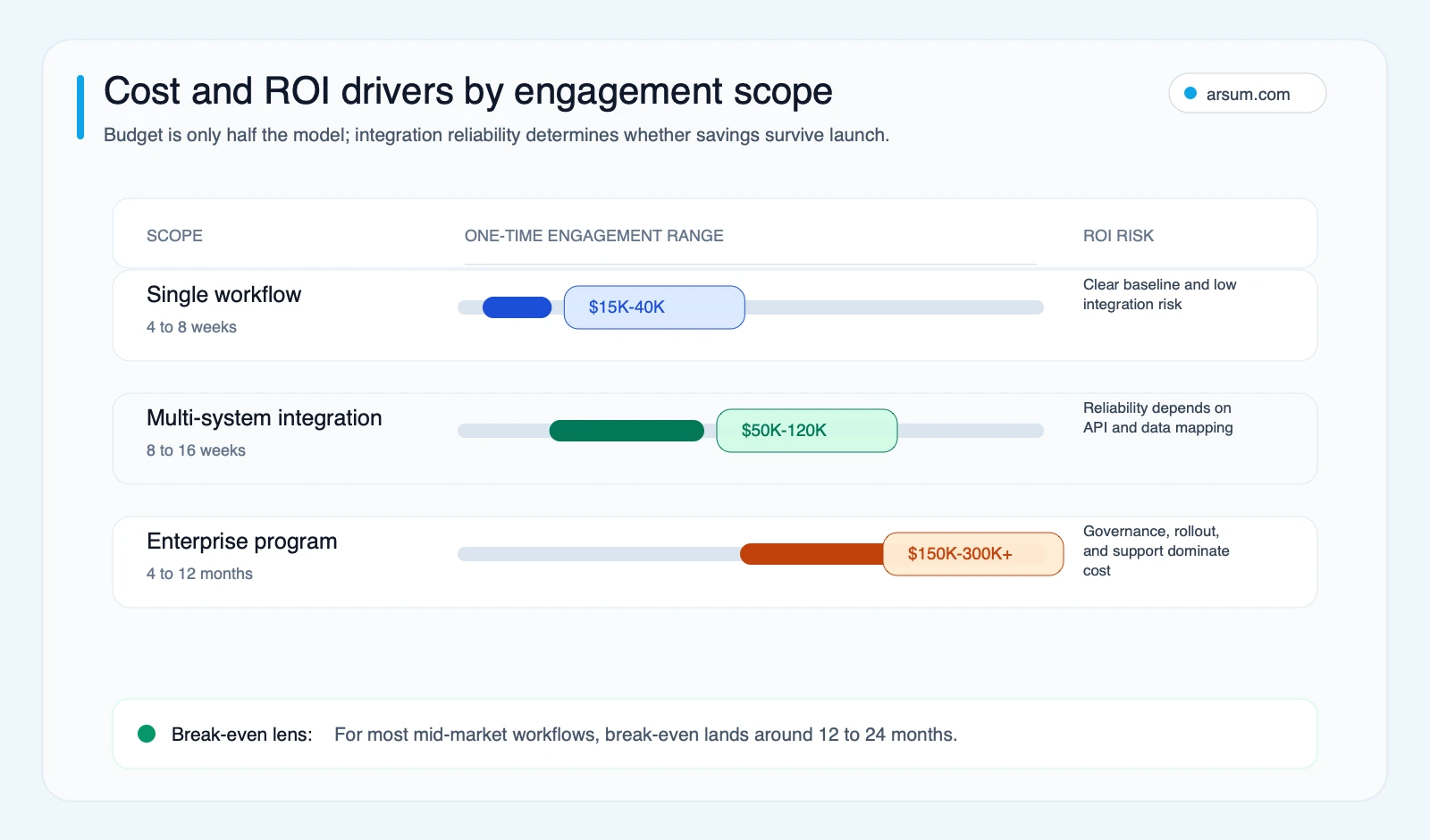
The cost-and-ROI map is useful as a scope conversation, not as a promise about market pricing or savings. Integration depth, review effort, data quality, and post-launch ownership can materially change the economics.
For additional examples of how to structure assumptions, see AI automation ROI examples. For a broader workflow lens, see AI business process automation.
Pilot Acceptance Scorecard: Define Stop, Go, and Rollback
Do not judge a pilot by whether a demo works. Judge it against a written acceptance scorecard.
| Pilot element | Example of what to define |
|---|---|
| Baseline period | Measure the current workflow for four representative weeks or another period that captures normal variation |
| Target outcome | Reduce routing backlog age, reduce manual handling time, or improve completeness of a defined field |
| Quality measure | Percentage of outputs accepted without material correction, plus the review time required |
| Exception measure | Count and categorize low-confidence cases, missing data, failed actions, and manual escalations |
| Evidence retention | Keep the input reference, output, approval, error event, and relevant version information |
| Accountable owner | Name the functional owner who accepts the outcome and the technical owner who operates it |
| Review cadence | Review metrics and sampled cases on a defined cadence during the pilot |
| Stop condition | Pause if unauthorized actions occur, material quality falls below the agreed threshold, or exception load exceeds operating capacity |
| Rollback path | Disable the automated action, return to the prior queue, preserve logs, and notify the named owners |
| Decision date | Set a date for go, revise, extend, or stop based on evidence rather than enthusiasm |
A good pilot can produce a “stop” decision. That is useful. It prevents a team from scaling an automation whose exception cost, data limitations, or approval burden erases its value.
For high-consequence workflows, treat autonomy as a separate decision from usefulness. The automation may still collect evidence, classify cases, prepare drafts, or route work while a human retains final authority.
Implementation Gates That Should Appear in the Delivery Plan
A credible plan does not need to promise a fixed timeline before discovery. It should, however, show the conditions required to proceed.
- Discovery gate: Workflow, baseline, systems, business owner, and decision boundary are approved.
- Design gate: Data flows, permissions, security considerations, approval rules, and rollback design are reviewed.
- Build gate: The automation is implemented against agreed interfaces with testable behavior.
- Integration gate: Live-system connections, error states, identity behavior, and exception handling are tested.
- Launch gate: Monitoring, alerting, evidence retention, documentation, and operational ownership are ready.
- Review gate: The pilot scorecard is evaluated and the accountable owner decides whether to expand, revise, or stop.
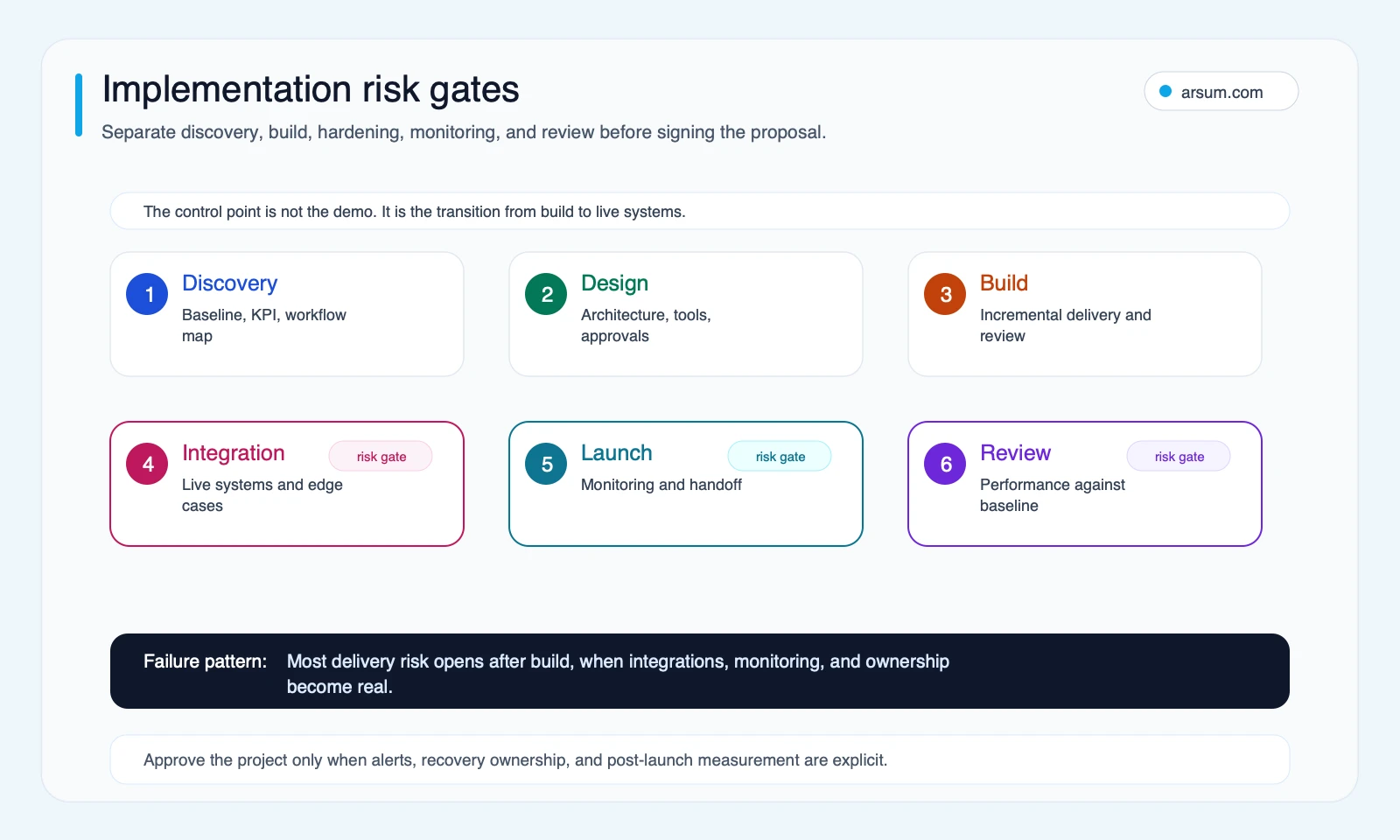
Security and risk work belongs in these gates. OWASP’s LLM Top 10 identifies concrete generative-AI security concerns that should be considered across development and deployment. NIST’s AI RMF supports a lifecycle approach to governance and risk management. These sources do not prescribe one vendor architecture; they support the buyer’s expectation that risks, controls, and ownership are explicit.
Disqualifying conditions
Pause or narrow the engagement if any of these remain unresolved:
- No business owner can accept the workflow outcome.
- The source of truth is disputed or inaccessible.
- The proposed action is consequential but no approval boundary exists.
- The team cannot retain evidence needed to investigate errors.
- Credentials, logs, or core configuration would remain vendor-controlled without an agreed operating model.
- The workflow has no measurable baseline or target.
- A safe manual fallback does not exist.
- The proposal relies on sensitive data without a documented handling and access approach.
A consultant may be able to help resolve these issues. They are still reasons not to authorize broad autonomy or commit to an implementation outcome before discovery.
What You Should Own at Handoff
Before signing, make client ownership contractual and operational.
- Client-controlled accounts and credentials, with a rotation owner.
- Access to logs, alerts, dashboards, and operational history.
- A current system diagram and data-flow description.
- Runbooks for normal operation, exceptions, incidents, rollback, and change approval.
- Test cases that include expected failures, not only the happy path.
- A documented approval matrix for customer, financial, legal, and sensitive-data actions.
- A process for prompt, model, integration, and policy changes.
- Clear support boundaries and a named internal operator.
This is where a consulting engagement becomes durable. Documentation alone is not enough; the client must have the access and decision rights to operate the workflow when the consultant is unavailable.
Methodology and Freshness
This buyer guide was built on June 18, 2026 using accessible public research under degraded search conditions. Kai-local SearXNG was unavailable, Brave API credentials were unavailable, and direct Reddit access was blocked. Qualitative community signals came from accessible Brave Search discussion snippets and Hacker News material retrieved through Algolia; they are presented as signals about buyer questions and failure modes, not market-wide measurements.
The hard-source layer consists of Google’s guidance on helpful, reliable, people-first content, OWASP’s Generative AI security guidance, and NIST’s AI Risk Management Framework. The decision tools and scorecards are Arsum editorial frameworks for evaluating proposals, not independently validated benchmarks.
Ready to Automate Your Business?
Stop wasting time on repetitive tasks. Let AI handle the busywork while you focus on growth.
Schedule a Free Strategy Call →Written by:Arsum editorial team
- Reviewed by
- Arsum editorial team
- Published
- June 12, 2026
- Updated
- August 12, 2026
- How this was produced
- Arsum uses research packs, source checks, and human editorial review to prepare and update blog articles. Editors are responsible for the final page.
- Source policy
- Sources are linked in the article when used. Methodology and source notes are included on higher-risk or high-visibility pages and are being rolled out across the archive. Editorial policy.
- Why this page exists
- Help B2B operators evaluate AI automation, implementation scope, cost, risk, and build-vs-buy decisions with practical context.