AI automation for paralegals is most useful when it assembles a citation-linked evidence packet—such as a document set, chronology, and source-backed retrieval result—while lawyers retain responsibility for privilege, relevance, legal judgment, client advice, and filed work. The decision is not whether a model can summarize documents; it is whether the workflow has complete inputs, matter-level permissions, a reviewer who can accept or reject each output, and a low-risk way to return to the manual process.
AI Automation for Paralegals: 12 Tasks Ranked
Explore AI automation for paralegals: see the O*NET/BLS task score, 2029 capability scenario, human-review boundary, and a measurable first workflow pilot.
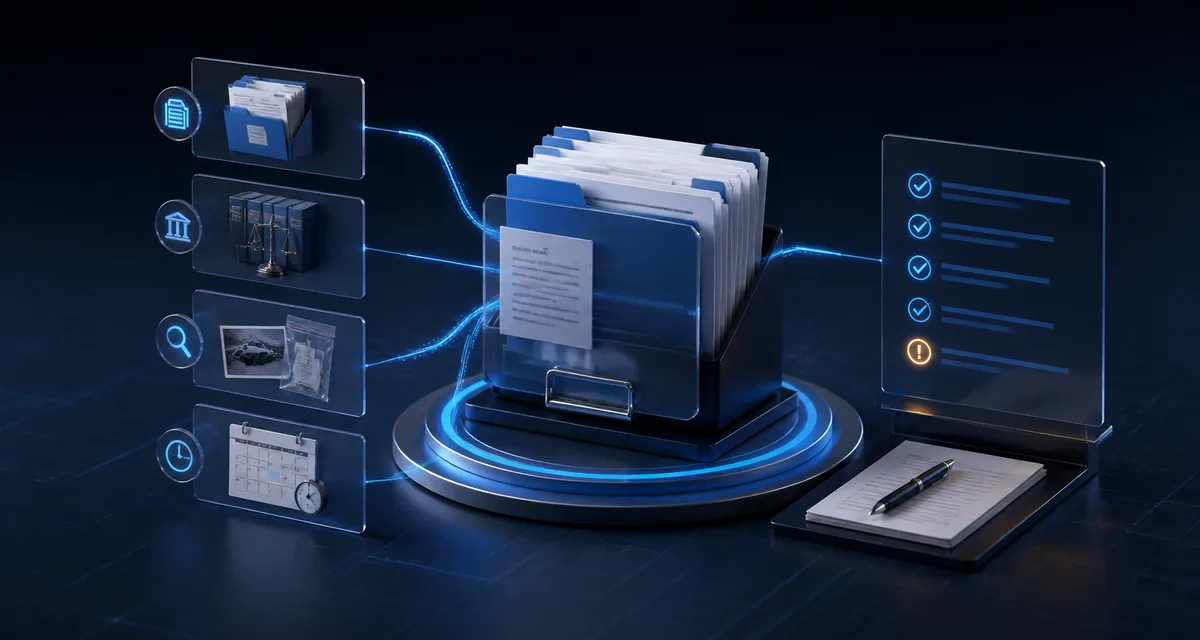
Table of Contents
- What most guides miss: verification time is the real constraint
- Paralegal work automation opportunity
- Choose the first pilot by workflow economics, not an occupation score
- Define the citation-linked workflow before selecting a tool
- Run a representative pilot with acceptance thresholds
- Build controls around the normal path and the ugly exceptions
- Buy, connect, or build based on the control gap
- Methodology and decision boundary
- Frequently asked questions
What most guides miss: verification time is the real constraint
Most guides list research, drafting, review, and summarization as if capability alone determines value. For legal operations, the more useful question is: does the accepted output take less total time than the current process after citation checking, correction, exception handling, and attorney review?
A fast draft with one unsupported proposition, a missing document, or a citation that points to the wrong source can create more review work than it removes. That is why the first automation should not be an autonomous legal-work product. It should be a bounded evidence-assembly workflow with a visible source trail.
The practical rule is:
- Automate or streamline complete, reversible normal paths.
- Assist and route uncertain cases to a named reviewer.
- Keep accountable legal judgment and consequential actions human-led.
That boundary aligns with the obligations discussed in ABA Formal Opinion 512: competence, confidentiality, communication, supervision, and fees remain lawyer responsibilities when generative AI is used. It also reflects a recurring qualitative concern in practitioner discussions: useful summaries do not remove the need to check source material, local practice, deadlines, or legal conclusions.
Arsum Automation Opportunity Index · 2026-08-12
Paralegal work automation opportunity
Paralegals can use AI for document classification, chronology building, citation support, discovery preparation, and docket administration. Legal advice, case strategy, privilege decisions, and witness work remain attorney-controlled.
Current score
54.9/100
Selective automation opportunity
Modeled task capacity
12.4-20.6 hours/week
P25-P75 planning range
2029 capability scenario
63.9/100
+9.0 points, not an adoption forecast
Recommended first pilot
document review, chronology, and citation-linked retrieval
Start narrow, measure, then expand
Decision: Automate retrieval and assembly with citations; never let unverified generation become the legal record.
How the paralegal work score is calculated
For paralegal work, Arsum assessed 12 of 12 O*NET tasks from Paralegals and Legal Assistants (23-2011.00). The 54.9/100 result weights each task's current automation share by O*NET importance, relevance, and frequency. It measures technical workflow opportunity—not the percentage of paralegal work jobs that disappear and not the share of a team that should be removed.
Legal professionals should own privilege, relevance, legal interpretation, case strategy, client advice, witness interaction, and filed work product. The weighted supervision estimate is 54.1%, which is why the practical design is an exception-and-approval system rather than unsupervised autonomy.
Top paralegal work tasks for automation support
O*NET task 1641
Keep and monitor legal volumes to ensure that the law library is up-to-date.
55/100
Hybrid
AI assists; review exceptions and material outputs
O*NET task 18491
Prepare affidavits or other documents, such as legal correspondence, and organize and maintain documents in paper or electronic filing system.
60/100
Hybrid
AI assists; review exceptions and material outputs
O*NET task 18492
Prepare for trial by performing tasks such as organizing exhibits.
65/100
Hybrid
AI assists; review exceptions and material outputs
O*NET task 21062
Investigate facts and law of cases and search pertinent sources, such as public records and internet sources, to determine causes of action and to prepare cases.
65/100
Llm
AI assists; review exceptions and material outputs
O*NET task 1636
Gather and analyze research data, such as statutes, decisions, and legal articles, codes, and documents.
60/100
Llm
Decision support only; human owns the conclusion
O*NET task 18494
File pleadings with court clerks.
50/100
Traditional Software
AI assists; review exceptions and material outputs
O*NET task 23994
Prepare, edit, or review legal documents, including legislation, briefs, pleadings, appeals, wills, contracts, and real estate closing statements.
50/100
Hybrid
AI assists; review exceptions and material outputs
These are ranked for practical opportunity: task exposure and current capability are discounted when implementation is complex, supervision is heavy, or live human interaction dominates. The recommended pilot above is an editorial choice among these signals, not simply the highest raw percentage.
Paralegal work tasks that should remain human-led
- 50/100 current capability: Prepare, edit, or review legal documents, including legislation, briefs, pleadings, appeals, wills, contracts, and real estate closing statements. AI assists; review exceptions and material outputs.
- 60/100 current capability: Prepare affidavits or other documents, such as legal correspondence, and organize and maintain documents in paper or electronic filing system. AI assists; review exceptions and material outputs.
- 60/100 current capability: Gather and analyze research data, such as statutes, decisions, and legal articles, codes, and documents. Decision support only; human owns the conclusion.
- 50/100 current capability: File pleadings with court clerks. AI assists; review exceptions and material outputs.
Paralegal work capability from 2026 to 2029
2026 current
54.9/100
54.9/100
2028 midpoint
60.9/100
60.9/100
2029 scenario
63.9/100
63.9/100
The scenario adds 9.0 score points by 2029-08-12 under the same task mix. It assumes better reliability and integration in the tasks already identified as technically assistable. It does not assume that employers deploy those systems, that every normal case becomes autonomous, or that employment changes by the same amount.
The largest weighted capability gains come from:
- O*NET task 18491, Prepare affidavits or other documents, such as legal correspondence, and organize and maintain documents in paper or electronic filing system. 60→70.
- O*NET task 23994, Prepare, edit, or review legal documents, including legislation, briefs, pleadings, appeals, wills, contracts, and real estate closing statements. 50→60.
- O*NET task 1636, Gather and analyze research data, such as statutes, decisions, and legal articles, codes, and documents. 60→70.
Modeled hours and wage capacity for paralegal work
The paralegal work model assigns 30 hours of a reference 40-hour week across rated tasks and leaves 10 hours unmodeled. On that explicit assumption, current automation capability represents 12.4-20.6 hours/week. At the May 2025 BLS national mean wage of $34/hour, the gross paralegal work planning range is $21,542-$35,904/year per worker.
BLS national employment392,880
Mean annual wage$69,700
Tasks with full score inputs12/12
Assessment coverage100%
Gross wage capacity is not net savings. A business case must subtract implementation, software and model usage, review time, exception handling, maintenance, and risk reserves. BLS employment excludes self-employed workers.
A controlled 30/60/90-day paralegal work pilot
- Days 0-30: baseline document review, chronology, and citation-linked retrieval. Capture volume, handling time, rework, error rate, source systems, permissions, and the exception owner before changing the workflow.
- Days 31-60: run in review mode. Let the system prepare or route work, keep logs, and require human approval at the boundary described above. Measure accepted outputs and review cost, not generated volume.
- Days 61-90: expand only after evidence. Increase scope when accuracy, cycle time, exception rate, and net capacity beat the baseline without weakening customer, employee, financial, legal, or operational controls.
Sources, formula, and limitations
Occupation and task facts come from O*NET O*NET 30.3. Employment and wage inputs come from BLS OEWS May 2025 national estimates. Arsum adds the task-level current capability, supervision, implementation, time-allocation, and 2029 scenario assessments.
The occupation score is the exposure-weighted mean of task automation shares. Exposure combines normalized O*NET importance, relevance, and a log-scaled transformation of frequency. The time range applies a ±25% planning band around the modeled task capacity. Read the full Automation Opportunity Index methodology for formulas, QA gates, version history, and reproducible queries.
- The task inventory comes from O*NET 30.3; Arsum supplies the automation assessment and transformation.
- The time model allocates 30 hours of a reference 40-hour week across rated O*NET tasks, leaving 10 hours unmodeled for context switching and work not represented by task statements.
- Hours and wage capacity are planning ranges, not measured savings. Net ROI must subtract software, implementation, review, exception handling, maintenance, and risk costs.
- The 2029 value is a capability scenario, not a forecast of adoption, employment, layoffs, or autonomous operation.
- All 12 tasks have the O*NET inputs needed for score weighting and were assessed.
- BLS wage and employment data use the matching detailed SOC occupation; employment excludes self-employed workers.
Version: aoi-v0.2 · run 6 · capability date 2026-08-12 · forecast horizon 2029-08-12.
Choose the first pilot by workflow economics, not an occupation score
Arsum’s Automation Opportunity Index assesses all 12 O*NET tasks associated with this role. It uses task importance, frequency or exposure, assessed capability, supervision, and BLS wage inputs as a planning model. The resulting score is not observed firm productivity, realized savings, a job-loss forecast, or authorization to automate a consequential legal decision.
O*NET provides the occupation and task descriptors used by the model. BLS OEWS tables provide labor-market context and wage inputs. Neither source tells a firm which workflow it may safely deploy; that decision depends on its matter types, systems, permissions, quality threshold, and review capacity.
The model’s highest-ranked individual task is keeping and monitoring legal volumes so the law library stays current. Its current capability estimate is 55/100 with 55% modeled supervision. That may be a sensible narrow automation candidate where the firm has a defined library system, authoritative update feeds, and a librarian or legal-information owner.
It is not necessarily the best first pilot for every legal-operations team. Document review, chronology preparation, and citation-linked retrieval can be the stronger first choice when the team has repeat matter volume and can measure the result against existing human work.
| Candidate workflow | Why it may be a first pilot | Main constraint | Recommended control |
|---|---|---|---|
| Law-library monitoring | Structured update and version-checking path; potentially low downstream integration | Authority of the source and ownership of updates | Use authoritative sources, retain version history, and require owner approval for material changes |
| Document classification and evidence packet assembly | Repeatable inputs and observable outputs | Incomplete or wrongly permissioned document sets | Matter-level access controls, document inventory check, and exception routing |
| Chronology preparation | Output can be checked against page-level or document-level sources | Ambiguous dates, duplicates, and omitted events | Every event links to source, location, date basis, and reviewer disposition |
| Citation-linked retrieval | Makes verification explicit rather than relying on unsupported prose | Retrieval can omit controlling or contextual materials | Use approved source systems and require reviewer verification before reliance |
| Drafting or legal interpretation | May help create a starting point | High error impact and legal judgment | Keep as attorney-supervised assistance, not autonomous output |
The selection logic should be explicit. Score each candidate against five questions:
- Value: Does the workflow consume meaningful recurring effort or cause a material delay?
- Volume: Is there enough representative work to test, measure, and maintain the process?
- Data readiness: Are the documents complete, searchable, permissioned, and identifiable by matter?
- Error impact: Can a reviewer identify and correct an error before it affects advice, filing, disclosure, or strategy?
- Integration burden: Can the pilot work with a narrow controlled export, or must it connect several systems before anyone can use it?
A workflow that scores well on technical capability but poorly on data readiness or reversibility should be deferred. A smaller workflow with clean data, clear review ownership, and a measurable output often produces a better pilot decision.
For related decisions about integrating systems and routing work between them, see AI workflow automation and this guide to business process architecture.
Define the citation-linked workflow before selecting a tool
A useful pilot begins with a written workflow boundary. “Use AI for document review” is too broad to build, price, govern, or test.
A bounded document-review and chronology workflow might look like this:
- A matter owner selects an approved document set from an authorized repository.
- The system creates a document inventory: file name, source location, version, date received, and processing status.
- The system extracts candidate facts, dates, entities, and issues into a draft chronology or evidence packet.
- Each material item includes a source reference that lets the reviewer open the underlying document and verify the location.
- The paralegal or designated reviewer accepts, edits, rejects, or escalates each item.
- An attorney reviews any work that affects legal interpretation, advice, strategy, privilege, relevance, or filed work.
- The accepted output and review history are retained according to the firm’s policy.
This is different from asking a general-purpose chat tool to “summarize the case.” The latter may be technically convenient but does not by itself establish source authority, matter permissions, a complete input set, or accountability for the resulting work product.
The citation-verification rubric
Every pilot should test a sample of outputs using a simple, repeatable rubric. For each selected chronology event or retrieved proposition, the reviewer records:
| Check | Pass condition | Failure example | Required response |
|---|---|---|---|
| Source exists | The linked source opens for the authorized reviewer | Link is unavailable or points outside the matter | Reject item; investigate permissions or source mapping |
| Citation is accurate | The cited passage supports the stated fact | Date or party is taken from a different passage | Correct item; classify citation mismatch |
| Context is sufficient | The item does not omit qualifying context that changes its meaning | A statement is extracted without its limitation | Escalate for human review |
| Matter scope is correct | Material belongs to the selected matter and permitted workspace | Cross-matter content appears in the result | Stop affected workflow and investigate access controls |
| Document set is complete | The inventory matches the approved set or flags exclusions | An expected document was not processed | Route as incomplete-set exception |
The automation does not “pass” because it produces fluent text. It passes only when the accepted output meets the agreed evidence standard at an acceptable review cost.
A controlled implementation may require a custom integration when the workflow crosses document management, e-discovery, case-management, identity, and audit systems. When the boundary is genuinely narrow, an existing product with acceptable controls may be the better choice. The decision framework in AI automation platform guide can help separate platform fit from a workflow that needs custom orchestration.
💡 Arsum builds custom AI automation solutions tailored to your business needs.
Get a Free Consultation →Run a representative pilot with acceptance thresholds
A 30–60 day pilot is a planning window, not a universal recommendation. It is appropriate only if the team can collect a representative sample of matters, document sets, and exception types in that period. Low-volume practices may need to run until they have enough completed examples to expose ordinary work and meaningful edge cases.
Use a scorecard before the pilot begins. The values below are illustrative planning assumptions, not observed Arsum results or industry benchmarks. The legal-operations leader, supervising attorney, and privacy or security owner should set the actual thresholds.
| Scorecard field | Illustrative planning assumption | Owner | Review cadence |
|---|---|---|---|
| Pilot scope | One matter category, approved document source, and defined output: chronology plus cited evidence packet | Legal operations lead | Before launch and weekly |
| Baseline | Record median end-to-end human minutes, including source checking and rework, for the selected workflow | Paralegal manager | Weekly |
| Quality target | At least 95% of sampled accepted items have an accurate, accessible source reference | Supervising attorney | Sample every batch |
| Citation sample | Review all high-severity items and a defined random sample of other accepted items | Assigned paralegal reviewer | Each batch |
| Turnaround target | Set a target relative to the team’s existing baseline; do not count an output as successful until accepted | Legal operations lead | Weekly |
| Exceptions | Classify missing citation, incorrect citation, incomplete document set, ambiguous fact, permission issue, and attorney-judgment escalation | Paralegal manager | Daily queue review |
| Net capacity | Accepted automated minutes minus review, correction, exception handling, rework, software, maintenance, and a risk reserve | Finance or operations owner | Weekly |
| Stop condition | Pause new processing if a matter-permission issue occurs, a high-severity citation failure reaches a downstream user, or the review queue grows beyond the agreed capacity | Supervising attorney | Immediate |
| Rollback | Disable automation intake, preserve logs and source inventory, return new work to the prior manual checklist, and review affected outputs | Legal operations lead | Tested before launch |
| Go/no-go rule | Expand only if quality, turnaround, review load, and operating value meet the written acceptance criteria for the representative sample | Executive sponsor | End-of-pilot review |
The critical calculation is not “minutes generated.” It is accepted work after verification.
Illustrative planning arithmetic:
- Baseline: 40 matters per month × 45 human minutes per matter = 1,800 baseline minutes.
- Accepted automated output: 40 matters × 25 minutes of usable assembled work = 1,000 gross capacity minutes.
- Review, correction, and exceptions: 40 matters × 12 minutes = 480 minutes.
- Net capacity before software, maintenance, and risk reserve: 520 minutes.
That arithmetic is only useful if its inputs come from the firm’s own records. If the review and exception minutes are higher than expected, the right response may be to narrow the document type, improve the inventory, reduce model autonomy, or stop. Do not convert a theoretical gross-capacity number into a savings claim.
For a broader way to model these inputs, use the decision structure in AI automation ROI examples.
Build controls around the normal path and the ugly exceptions
The normal path is usually not the problem. The operational risk lives in exceptions: a scanned document with poor text extraction, a duplicate exhibit, a late-uploaded file, a cross-matter permission error, a citation that supports only part of a claim, or a reviewer queue that grows until the team bypasses it.
Disqualifying conditions
Do not start this pilot—or pause it—when any of these conditions apply:
- The firm cannot establish which documents are authorized for the selected matter.
- The proposed system cannot retain or export a source inventory, reviewer disposition, and relevant audit record.
- No supervising lawyer or designated reviewer is available to own acceptance and escalation.
- The workflow’s output will be used for legal advice, strategy, privilege, relevance determinations, filing, or client communication without the required human review.
- The document sets are too small, too irregular, or too incomplete to produce a representative measurement.
- The team has no workable manual fallback.
The point is not to create paperwork around a model. It is to make the process safe enough to learn from. A usable rollback test is concrete: disable new intake, confirm that the prior checklist can receive work immediately, verify that source documents and generated drafts remain identifiable, and assign a person to review anything produced since the last accepted quality check.
Common failure modes and their response
Missing or unsupported source citations. Reject the item, preserve the original output for analysis, and determine whether the failure came from retrieval, source mapping, extraction, or generation. Do not simply ask the system to “be more accurate.”
Matter-permission errors. Treat this as a control incident. Stop affected processing, identify the accessible records and users, validate the permission model, and follow the firm’s applicable incident process.
Incomplete document sets. The system should flag an inventory mismatch rather than present a polished but incomplete chronology as complete. The reviewer needs a visible “not processed” state.
Review queues erase capacity. Measure queue age and reviewer minutes. If correction work rises with volume, expansion is premature. Better prompts do not substitute for a workflow boundary, a cleaner input set, or enough reviewer capacity.
Unauthorized reliance on generated analysis. Where an output crosses into legal interpretation or consequential action, route it to the responsible lawyer. Technical capability does not grant business or professional authorization.
Teams evaluating AI controls more broadly can use the implementation and governance questions in AI agent security and AI implementation services.
Buy, connect, or build based on the control gap
A purchase can be appropriate when a product already supports approved document sources, matter-scoped access, exportable records, source-linked outputs, and the firm’s review process. A connection layer may be enough when the tool is acceptable but needs to receive and return data through existing systems.
Custom work becomes more reasonable when the workflow requires firm-specific document rules, approval routing, source lineage, retention behavior, exception handling, or cross-system integration that a standard product cannot safely provide. The case for custom work is not that legal work is unique in the abstract. It is that the specific workflow has enough recurring, measurable volume to justify the ongoing ownership of integrations and controls.
Before committing, ask vendors or internal builders to demonstrate the actual pilot path:
- How is matter-level authorization established and tested?
- Which document sources are authoritative, and how does the system distinguish them?
- Can a reviewer open the exact source supporting each material output?
- How are missing documents, uncertain extractions, and conflicting evidence represented?
- Who can override, pause, or roll back processing?
- What records remain available if the service is changed or removed?
- How are model, prompt, rule, and connector changes reviewed before they affect production work?
This is also where a legal-operations leader should decide whether the initiative needs an automation consultant, a software integration partner, or a product configuration effort. The comparison in AI automation agency vs. AI development firm is useful when the hard part is separating workflow design from implementation ownership.
Methodology and decision boundary
This page uses the O*NET 30.3 occupation data and BLS OEWS May 2025 context referenced above, alongside source-linked ABA guidance and practitioner discussions. Community discussions are used only as qualitative signals about failure modes and questions—such as the cost of re-checking an output—not as evidence of adoption, accuracy, savings, or market-wide performance.
The visible task model assesses technically addressable task capacity under disclosed assumptions. It does not predict whether paralegal roles will disappear, whether a firm will realize savings, or whether a legal decision should be automated. High failure cost, low reversibility, incomplete evidence, or limited review capacity should reduce autonomy.
The practical conclusion is narrow: start with evidence retrieval and assembly that is citation-linked, permissioned, auditable, and reviewed. Measure accepted output and net operating value. Keep legal judgment and filed-work responsibility with the professionals who are accountable for it.
Work With Arsum
We help businesses implement AI automation that actually works. Custom solutions, not cookie-cutter templates.
Learn more →Frequently asked questions
What should AI automation for paralegals automate first?
Start with a bounded workflow such as document classification, chronology preparation, and citation-linked evidence retrieval where the input set, output, reviewer, and rollback path are defined. Do not begin with autonomous legal analysis or filed work product.
Can AI prepare a chronology without attorney review?
It can prepare a draft chronology or evidence packet, but the firm should require source-linked verification and route legal interpretation, relevance, privilege, strategy, client advice, and filed work to the responsible legal professional.
What makes a citation-linked output acceptable?
The reviewer must be able to access the cited source, confirm that it supports the stated fact, assess whether the surrounding context changes the meaning, and verify that the item belongs to the authorized matter and document set.
How long should a pilot run?
Run it until the team has a representative sample of normal work and meaningful exceptions. A 30–60 day window can be useful for a workflow with enough volume, but it is not a universal timeline.
When should the team stop the pilot?
Pause or stop when access controls fail, high-severity citation failures reach a downstream user, the input set cannot be validated, or review and correction work prevent the pilot from meeting its written quality and operating-value criteria.
Ready to Automate Your Business?
Stop wasting time on repetitive tasks. Let AI handle the busywork while you focus on growth.
Schedule a Free Strategy Call →Written by:Arsum editorial team
- Reviewed by
- Arsum editorial team
- Published
- August 12, 2026
- Updated
- Same as published date
- How this was produced
- Arsum uses research packs, source checks, and human editorial review to prepare and update blog articles. Editors are responsible for the final page.
- Source policy
- Sources are linked in the article when used. Methodology and source notes are included on higher-risk or high-visibility pages and are being rolled out across the archive. Editorial policy.
- Why this page exists
- Help B2B operators evaluate AI automation, implementation scope, cost, risk, and build-vs-buy decisions with practical context.