AI automation for procurement is most useful when it produces source-grounded bid-comparison packets and purchase-order exception queues—not when it autonomously chooses suppliers or commits the business. Use it to extract, normalize, and flag evidence across supplier inputs; retain human accountability for recommendations, negotiations, awards, conflicts, material exceptions, and risk acceptance.
AI Automation for Procurement: 19 Buyer Tasks
Explore AI automation for procurement: see the O*NET/BLS task score, 2029 capability scenario, human-review boundary, and a measurable first workflow pilot.
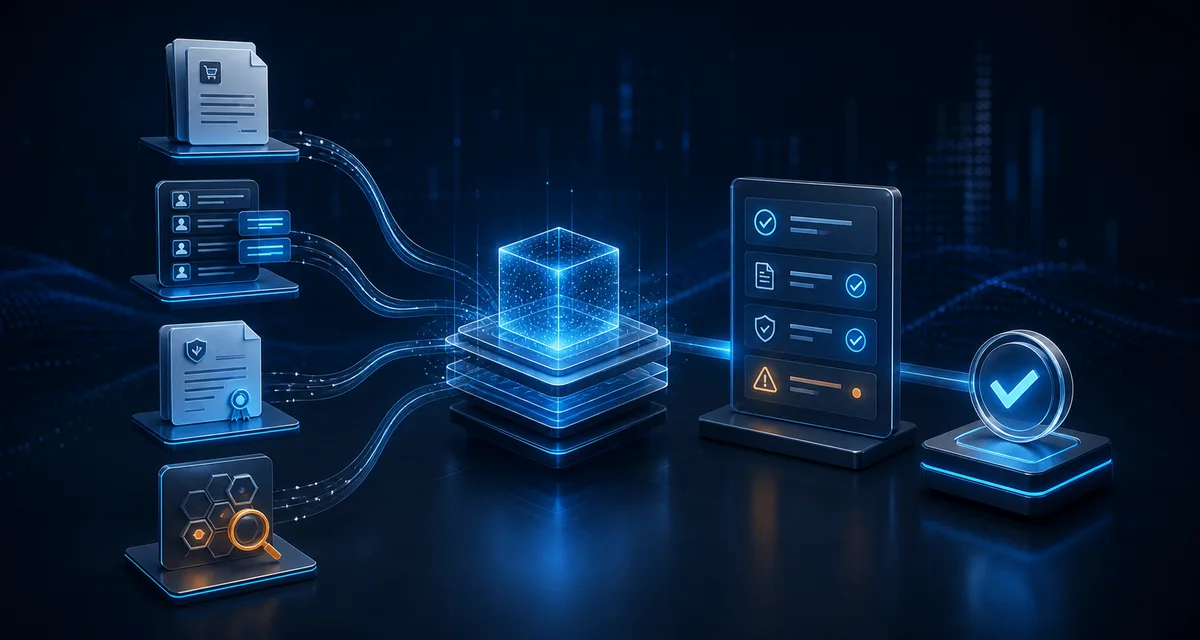
Table of Contents
- What most procurement AI guides miss
- Procurement automation opportunity
- What the task model changes—and what it does not
- A decision tree for bid comparison and PO exceptions
- Worked 30–60 day pilot scorecard
- How to calculate value without inventing savings
- Buy, connect, or build?
- Governance, evidence, and implementation ownership
- Failure modes and disqualifying conditions
- Method and limitations
- Next step: assess one controlled workflow
Use this page to qualify one bid-comparison or purchase-order exception workflow. A useful assessment starts with representative records, the approval matrix, current review time, material-error threshold, and manual fallback, and ends with a pilot scorecard—not a generic tool recommendation.
What most procurement AI guides miss
Most procurement tool lists move too quickly from proposal summaries to supplier selection. That skips the work that determines whether the output is trustworthy: incomplete source documents, mismatched units and currencies, non-comparable commercial terms, conflicts, evaluation criteria, and approval rights.
The practical boundary is simple:
- AI can read permitted source records, extract stated facts, normalize them into a comparison format, identify missing fields, and flag rule-defined discrepancies.
- A procurement analyst can review whether the packet is complete and whether a discrepancy is real.
- The accountable sourcing owner can recommend a supplier using the packet and the organization’s approved criteria.
- The delegated approver retains award authority; legal, finance, security, or risk owners retain their own approval rights where applicable.
That distinction resolves a common confusion around supplier evaluation. “Evaluate suppliers” can describe several different activities. Extracting a stated delivery lead time from a proposal is administrative evidence preparation. Comparing stated lead times against a required threshold is rule-based analysis. Interpreting tradeoffs among service, concentration risk, commercial terms, category strategy, and relationship history is accountable judgment. Issuing an award or accepting a material exception is a consequential business action.
AI should support the first two layers and make the third easier to audit. It should not silently collapse all four layers into an opaque supplier ranking.
Practitioner discussions reflect this workflow concern: teams mention useful narrow tasks such as RFP wording, proposal summaries, and comparison tables, while treating sourcing strategy and supplier evaluation as human-led decisions. These discussions are qualitative signals about workflow questions, not evidence of prevalence, accuracy, or savings. See discussions on practical procurement AI use, sourcing tool fit, and unstructured procurement inputs.
Arsum Automation Opportunity Index · 2026-08-12
Procurement automation opportunity
Procurement teams can automate purchase-order records, bid normalization, supplier-data checks, and routine status follow-up. Negotiation, awards, supplier risk, conflicts, and contractual commitments need accountable ownership.
Current score
47.9/100
Selective automation opportunity
Modeled task capacity
10.8-18 hours/week
P25-P75 planning range
2029 capability scenario
60.9/100
+13.0 points, not an adoption forecast
Recommended first pilot
bid comparison and purchase-order exception monitoring
Start narrow, measure, then expand
Decision: Create a clean comparison and exception layer before using AI to recommend a supplier.
How the procurement score is calculated
For procurement, Arsum assessed 19 of 19 O*NET tasks from Purchasing Agents, Except Wholesale, Retail, and Farm Products (13-1023.00). The 47.9/100 result weights each task's current automation share by O*NET importance, relevance, and frequency. It measures technical workflow opportunity—not the percentage of procurement jobs that disappear and not the share of a team that should be removed.
People should own negotiation, supplier selection, conflicts of interest, contractual commitments, material exceptions, and risk acceptance. The weighted supervision estimate is 36.0%, which is why the practical design is an exception-and-approval system rather than unsupervised autonomy.
Top procurement tasks for automation support
O*NET task 1144
Research and evaluate suppliers, based on price, quality, selection, service, support, availability, reliability, production and distribution capabilities, and the supplier's reputation and history.
55/100
Llm
AI assists; review exceptions and material outputs
O*NET task 1145
Analyze price proposals, financial reports, and other data and information to determine reasonable prices.
65/100
Llm
AI assists; review exceptions and material outputs
O*NET task 1146
Monitor and follow applicable laws and regulations.
55/100
Hybrid
AI assists; review exceptions and material outputs
O*NET task 1151
Maintain and review computerized or manual records of purchased items, costs, deliveries, product performance, and inventories.
65/100
Hybrid
AI assists; review exceptions and material outputs
O*NET task 1152
Review catalogs, industry periodicals, directories, trade journals, and Internet sites and consult with other department personnel to locate necessary goods and services.
60/100
Hybrid
AI assists; review exceptions and material outputs
O*NET task 1157
Write and review product specifications, maintaining a working technical knowledge of the goods or services to be purchased.
60/100
Llm
AI assists; review exceptions and material outputs
O*NET task 1158
Monitor changes affecting supply and demand, tracking market conditions, price trends, or futures markets.
60/100
Hybrid
AI assists; review exceptions and material outputs
These are ranked for practical opportunity: task exposure and current capability are discounted when implementation is complex, supervision is heavy, or live human interaction dominates. The recommended pilot above is an editorial choice among these signals, not simply the highest raw percentage.
Procurement tasks that should remain human-led
- 30/100 current capability: Prepare purchase orders, solicit bid proposals, and review requisitions for goods and services. AI assists; review exceptions and material outputs.
- 25/100 current capability: Negotiate, renegotiate, and administer contracts with suppliers, vendors, and other representatives. AI prepares; human approval is required.
- 55/100 current capability: Monitor and follow applicable laws and regulations. AI assists; review exceptions and material outputs.
- 25/100 current capability: Hire, train, or supervise purchasing clerks, buyers, and expediters. AI assists; review exceptions and material outputs.
Procurement capability from 2026 to 2029
2026 current
47.9/100
47.9/100
2028 midpoint
56.6/100
56.6/100
2029 scenario
60.9/100
60.9/100
The scenario adds 13.0 score points by 2029-08-12 under the same task mix. It assumes better reliability and integration in the tasks already identified as technically assistable. It does not assume that employers deploy those systems, that every normal case becomes autonomous, or that employment changes by the same amount.
The largest weighted capability gains come from:
- O*NET task 1142, Purchase the highest quality merchandise at the lowest possible price and in correct amounts. 40→60.
- O*NET task 1146, Monitor and follow applicable laws and regulations. 55→65.
- O*NET task 1143, Prepare purchase orders, solicit bid proposals, and review requisitions for goods and services. 30→40.
Modeled hours and wage capacity for procurement
The procurement model assigns 30 hours of a reference 40-hour week across rated tasks and leaves 10 hours unmodeled. On that explicit assumption, current automation capability represents 10.8-18 hours/week. At the May 2025 BLS national mean wage of $40/hour, the gross procurement planning range is $22,577-$37,629/year per worker.
BLS national employment491,430
Mean annual wage$83,770
Tasks with full score inputs19/19
Assessment coverage100%
Gross wage capacity is not net savings. A business case must subtract implementation, software and model usage, review time, exception handling, maintenance, and risk reserves. BLS employment excludes self-employed workers. The wage and employment figures here use the broader 13-1020 parent occupation, not a standalone count for this O*NET specialization.
A controlled 30/60/90-day procurement pilot
- Days 0-30: baseline bid comparison and purchase-order exception monitoring. Capture volume, handling time, rework, error rate, source systems, permissions, and the exception owner before changing the workflow.
- Days 31-60: run in review mode. Let the system prepare or route work, keep logs, and require human approval at the boundary described above. Measure accepted outputs and review cost, not generated volume.
- Days 61-90: expand only after evidence. Increase scope when accuracy, cycle time, exception rate, and net capacity beat the baseline without weakening customer, employee, financial, legal, or operational controls.
Sources, formula, and limitations
Occupation and task facts come from O*NET O*NET 30.3. Employment and wage inputs come from BLS OEWS May 2025 national estimates. Arsum adds the task-level current capability, supervision, implementation, time-allocation, and 2029 scenario assessments.
The occupation score is the exposure-weighted mean of task automation shares. Exposure combines normalized O*NET importance, relevance, and a log-scaled transformation of frequency. The time range applies a ±25% planning band around the modeled task capacity. Read the full Automation Opportunity Index methodology for formulas, QA gates, version history, and reproducible queries.
- The task inventory comes from O*NET 30.3; Arsum supplies the automation assessment and transformation.
- The time model allocates 30 hours of a reference 40-hour week across rated O*NET tasks, leaving 10 hours unmodeled for context switching and work not represented by task statements.
- Hours and wage capacity are planning ranges, not measured savings. Net ROI must subtract software, implementation, review, exception handling, maintenance, and risk costs.
- The 2029 value is a capability scenario, not a forecast of adoption, employment, layoffs, or autonomous operation.
- All 19 tasks have the O*NET inputs needed for score weighting and were assessed.
- BLS wage and employment data use the broader 13-1020 parent occupation and should not be interpreted as a count for this O*NET specialization alone.
Version: aoi-v0.2 · run 6 · capability date 2026-08-12 · forecast horizon 2029-08-12.
What the task model changes—and what it does not
Arsum assessed all 19 procurement-related O*NET tasks in its current model and calculated a 47.9/100 current Automation Opportunity Index, a 60.9/100 capability scenario for 2029, and a modeled 10.8–18 hours per week task-capacity range. The underlying occupational task statements and descriptors come from the O*NET 30.3 database; the model uses BLS Occupational Employment and Wage Statistics only for labor-market context and gross wage-capacity planning.
These figures are planning inputs, not observed productivity. They do not predict job loss, adoption, realized savings, or permission to automate an award decision.
The model uses task importance and frequency or exposure, then assesses current technical capability and expected supervision. A representative interpretation is:
| Model input | What it represents | Procurement decision use |
|---|---|---|
| Task weight | Relative importance and exposure in the O*NET task set | Prevents a compelling but rare task from driving the whole investment case |
| Capability estimate | Whether current systems can reliably assist with the task’s information work | Separates extract-and-flag use cases from judgment-heavy work |
| Supervision assumption | Expected human review and correction load | Forces review capacity into the business case |
| Task budget | A 30-hour weekly planning budget used for this model | Provides a comparable planning base, not a claim about your team’s workload |
| BLS context | National employment and wage context | Supports gross planning context, not a company-specific ROI forecast |
The 30-hour budget is an illustrative modeling assumption: it is a bounded allocation of weekly task time across the O*NET task set so task capacity can be compared consistently. It is not a time-and-motion study of your procurement function. Replace it with your own case volume, handling time, review time, rework, and error-cost data before funding a rollout.
One high-ranked task is O*NET task 1144: researching and evaluating suppliers based on factors such as price, quality, service, availability, reliability, and history. In the Arsum model, its current capability estimate is 55/100 with 30% modeled supervision. That is a case for review-first evidence preparation, not straight-through supplier selection. The system can help assemble a cited comparison packet; the sourcing owner must still determine how criteria are weighted, whether inputs are comparable, and whether a supplier is appropriate.
A compact view of four material task inputs makes the aggregate easier to inspect. Importance is the ONET rating used by the model; exposure is the normalized task weight after importance, relevance, and frequency inputs. Capability and supervision are Arsum assessments, not ONET or BLS ratings.
| O*NET task | Public task statement | Importance | Exposure weight | Capability | Supervision | Operating boundary |
|---|---|---|---|---|---|---|
| 1144 | Research and evaluate suppliers across price, quality, service, availability, reliability, capability, and history | 4.16 | 0.284 | 55/100 | 30% | Prepare cited evidence; human owns recommendation and award |
| 1145 | Analyze proposals, financial reports, and other data to determine reasonable prices | 4.20 | 0.481 | 65/100 | 30% | Normalize and flag; accountable owner accepts commercial judgment |
| 1146 | Monitor and follow applicable laws and regulations | 4.85 | 0.647 | 55/100 | 55% | Retrieve and compare requirements; compliance owner resolves material cases |
| 1151 | Maintain and review purchase, cost, delivery, performance, and inventory records | 3.74 | 0.386 | 65/100 | 15% | Automate normal record checks; route source conflicts and exceptions |
The published 47.9/100 is the weighted result across all 19 tasks, not the average of these four examples. The 10.8–18 hour range applies uncertainty bands to modeled task capacity under the disclosed 30-hour budget; it must be replaced by the pilot’s actual case volume, handling time, accepted-output rate, review, and rework before an investment decision.
For teams moving from procurement theory into workflow design, the next useful step is a grounded implementation path. This is where guides on how to automate purchase orders, AI business process automation, and the Automation Opportunity Index methodology start to fit together: one helps you diagnose the PO workflow, one frames the operating model, and one explains how Arsum scores where AI assistance is actually worth deploying.
A decision tree for bid comparison and PO exceptions
Use this decision tree before choosing a platform, building an integration, or expanding a pilot.
1. Is the input record complete and permitted?
For bid comparison, the minimum packet might include supplier identity, solicitation or bid identifier, version, line items, quantities, units, currency, quoted price, delivery terms, lead time, payment terms, expiration date, exclusions, and attachments.
For purchase-order monitoring, the minimum event might include PO number, supplier, line item, approved quantity and price, requested date, committed date, receipt or invoice status, contract reference where relevant, and the change source.
If the source record is missing, inaccessible, contradictory, scanned beyond reliable extraction, or not authorized for the proposed system, stop. Route it to a human queue. Do not manufacture a normalized value or use a confidence score as a substitute for evidence.
2. Is the normal path reversible and governed by a clear rule?
Examples of suitable AI-assisted normal paths include:
- Extracting line-item prices from supplier proposals and retaining the page or file reference.
- Converting stated units and currencies only under approved normalization rules.
- Flagging a quoted delivery date that falls outside the stated requirement.
- Detecting a PO price, quantity, date, or supplier change against a defined approved baseline.
- Drafting a queue entry with the source record, discrepancy, rule triggered, and recommended reviewer.
Examples that should remain prohibited from automatic action include:
- Selecting or de-selecting a supplier.
- Issuing an award, contract, purchase order, or commitment.
- Approving an unbudgeted price variance.
- Accepting a missing compliance, security, insurance, sanctions, or conflict record.
- Negotiating commercial terms or waiving an approval threshold.
- Closing a material exception without the named accountable owner.
3. Does the case contain uncertainty or a material exception?
If yes, AI may prepare the record but cannot resolve the case. Route it to the correct owner with the sources attached.
A useful exception taxonomy is:
| Exception type | Example | Required action |
|---|---|---|
| Missing source evidence | Bid lacks an attachment or PO change has no source record | Hold for analyst review |
| Normalization conflict | Unit, currency, quantity, or version cannot be reconciled | Hold and request clarification |
| Commercial variance | Price, payment term, lead time, or expiry differs from policy or baseline | Procurement owner review |
| Policy or risk flag | Conflict disclosure, restricted supplier, required document, or approval issue | Route to the designated risk, legal, finance, or compliance owner |
| Material commitment | Award, contract change, high-value variance, or irreversible order action | Accountable approver decides |
4. Can review cost remain below the value created?
A seemingly accurate output can still be a poor workflow if reviewers spend too long locating sources, correcting fields, or resolving false flags. Measure accepted output, correction minutes, queue age, exception severity, and rework. If total review and exception effort eliminates net capacity, narrow the workflow or stop.
This is the same distinction that matters in AI workflow automation: capable models do not remove the need for clear triggers, system boundaries, owners, and fallback paths.
Worked 30–60 day pilot scorecard
Start with one buying category or a bounded set of PO exception types. Avoid combining multiple categories, new sourcing policy, and a new platform in the same test; the result will be difficult to interpret.
The following scorecard is a planning template, not a benchmark.
| Scorecard element | Bid-comparison pilot | PO-exception pilot |
|---|---|---|
| Trigger | A complete bid package enters the approved sourcing workspace | A PO, acknowledgement, receipt, invoice, or approved change event arrives |
| Source fields | Supplier, bid version, line items, quantity, unit, currency, price, terms, lead time, exclusions, attachments | PO identifier, approved baseline, supplier, line details, quantities, price, dates, contract reference, event source |
| Output | Cited normalized comparison packet and missing-field or discrepancy list | Cited exception queue with baseline, change, rule triggered, severity, and owner |
| Normalization | Approved unit, currency, and field-mapping rules; no inferred commercial terms | Approved matching and threshold rules; no inferred approval status |
| Human owner | Procurement analyst validates packet completeness; sourcing lead owns recommendation | Procurement operations owner triages queue; delegated approver resolves material exceptions |
| Audit record | Source file or record ID, extracted field, transformation rule, model or rule version, reviewer, decision, timestamp | Original event, baseline, rule version, severity, reviewer, disposition, timestamp |
| Prohibited automatic action | Supplier recommendation, award, negotiation, commitment, risk acceptance | PO release, supplier change, price approval, threshold waiver, exception closure |
| Rollback | Disable packet generation and return to existing comparison template while retaining records | Disable alert actions and return to the current exception queue and manual review process |
Establish a baseline before activation. Capture a representative case set from the intended category or exception type, including routine cases and ugly cases: revised bids, split awards, missing terms, duplicate documents, unit mismatches, late acknowledgements, partial deliveries, price changes, and records that require approval from another function.
Use pass/fail thresholds that your accountable owner can defend. A practical 30–60 day scorecard includes:
| Measure | Baseline to capture | Pilot target | Review cadence |
|---|---|---|---|
| Accepted output rate | Share of manually completed packets or queue entries accepted without material rework | A target set by the procurement owner for the selected category; review accepted and rejected outputs separately | Weekly sample review |
| Review and correction time | Median minutes from intake to human-ready packet or resolved queue item | Must decline without increasing material exceptions | Weekly |
| Exception rate and severity | Volume by taxonomy and number of material cases | No concealed increase in material exceptions; severity must be visible, not averaged away | Weekly; immediate review for material cases |
| Source lineage | Percentage of material fields and flags linked to retrievable source records | Every material field and exception has a retrievable source record | Every release and weekly audit |
| Net operating value | Baseline labor minutes, accepted automated minutes, review, exception handling, rework, tool and operating costs | Positive only after all review, operating, and risk costs are included | At day 30 and day 60 |
| Approval and rollback safety | Existing approval path and manual fallback | No bypass of approvals; fallback can be activated without loss of history | Test before launch and after any major change |
Set stop conditions in writing before the pilot begins. Stop or revert to human-only handling when any of the following occurs:
- A material output lacks retrievable source evidence.
- Commercial terms remain unresolved but the system presents a comparison as complete.
- A conflict, compliance, legal, security, or approval flag is missing or misrouted.
- A material exception is acted on without the designated owner’s approval.
- Review and correction time eliminates the capacity the workflow was meant to create.
- A change in source format, policy, or integration produces unreviewed behavior.
The rollback path should be operational, not theoretical: disable the automated handoff, preserve the audit records, return work to the prior comparison template or exception queue, identify affected cases, and have the named owner review any pending decisions.
💡 Arsum builds custom AI automation solutions tailored to your business needs.
Get a Free Consultation →How to calculate value without inventing savings
Do not begin with a percentage-saved claim. Use a simple, auditable calculation from your pilot data.
Illustrative planning assumption:
- 40 bid packages or PO exception cases per week
- 18 baseline handling minutes per case
- 10 minutes of automated preparation per case that the reviewer accepts
- 5 minutes of review per accepted case
- 20% of cases require an additional 15 minutes of exception handling
Under those assumptions, gross prepared capacity is 400 minutes per week. Review consumes 200 minutes. Exceptions consume 120 minutes. The modeled net capacity is 80 minutes per week before software, maintenance, implementation, and risk costs. This is an illustration of the inputs to test, not an observed result and not a promise.
Use this formula:
Net capacity = accepted automated minutes − review minutes − exception-handling minutes − rework minutes
Net value = net capacity × your loaded labor rate − software cost − maintenance cost − implementation cost allocation − risk reserve
A pilot that shows low extraction error but negative net capacity has not passed. It may still reveal a useful data-cleanup opportunity or identify a smaller rule-based automation, but it does not justify expansion.
For a broader set of decision examples, see AI automation ROI examples and AI workflow automation tools.
Buy, connect, or build?
The right delivery choice depends on the control boundary and integration burden, not on whether a vendor describes its product as agentic.
Buy a configured platform when
A product already supports the relevant intake, document handling, access controls, approval routing, audit requirements, and export needs. Verify that its configuration can preserve source lineage, distinguish a flag from a recommendation, and prevent prohibited actions.
Connect existing systems when
Your sourcing, ERP, AP, contract, supplier-information, or document systems already hold the governing record, but the handoffs are manual. A narrow integration may create more value than replacing the system of record. The design still needs clear field mappings, rules, permissions, ownership, and exception routing.
Build a narrow workflow when
The value sits in company-specific document structures, category rules, approval matrices, or cross-system logic that an existing product cannot express with adequate control. Build only the smallest workflow that can be tested against representative cases and rolled back safely.
This is also where AI integration services and an AI automation platform evaluation become relevant: a workflow that crosses systems needs data ownership and auditability before it needs more model capability.
Governance, evidence, and implementation ownership
The NIST AI Risk Management Framework provides a useful structure for this work: govern the ownership and policy, map the workflow and harms, measure quality and control performance, then manage changes and incidents.
For procurement, assign owners explicitly:
| Responsibility | Suggested accountable role |
|---|---|
| Workflow policy and award boundary | Procurement leader |
| Source-system access and retention | System or data owner |
| Comparison criteria and category rules | Sourcing lead or category manager |
| Exception queue operation | Procurement operations owner |
| Conflict, compliance, legal, or security review | Relevant functional owner |
| Production change approval and rollback | Technical sponsor with procurement owner |
| Quality sampling and pilot acceptance | Procurement owner, with independent control review where required |
Keep the AI system’s output framed accurately. A cited comparison packet says what the source records contain and what approved rules flagged. A recommendation says what the organization should do. An award changes the organization’s commitment. Those are different artifacts with different owners.
Failure modes and disqualifying conditions
Do not automate this workflow yet if source records are fragmented without stable identifiers, policy criteria are not documented, the team cannot name an exception owner, or there is no practical manual fallback. Those are operating-model gaps, not model-selection problems.
Other common failure modes include:
- Treating extracted fields as verified facts when proposals use inconsistent terms or versions.
- Hiding uncertainty behind a single supplier score.
- Allowing a model to infer missing commercial terms.
- Measuring speed while ignoring reviewer correction, disputes, and rework.
- Giving the workflow write access before it has passed a read-and-review pilot.
- Using a generic risk threshold across categories with different error costs.
- Expanding from a clean test set to production without testing revised, incomplete, and conflicting records.
If these conditions cannot be controlled, keep AI in drafting, extraction, or research support. A smaller, auditable workflow is better than a broad automation that makes accountability unclear.
Method and limitations
Author: Arsum Editorial Research Reviewer: Arsum Content Operations Last updated: 2026-08-12
This article reviewed commercial procurement-automation intent, three source-linked practitioner discussions, the O*NET 30.3 task data, BLS May 2025 OEWS context, and NIST’s AI risk-management guidance. Community discussion is used only to identify workflow questions and failure modes. The Arsum aoi-v0.2 model assesses task importance, frequency or exposure, technical capability, supervision, and BLS wage inputs.
The model’s 47.9/100 score, 60.9/100 capability scenario, 36.0% weighted supervision estimate, and 10.8–18 weekly-hour planning range are not company results. They do not establish realized savings, accuracy, adoption, or job displacement. They also do not authorize supplier selection, negotiation, commitment, or risk acceptance. Your pilot’s own source lineage, acceptance, review cost, exception severity, approvals, and rollback test should determine whether to proceed.
Next step: assess one controlled workflow
If you are evaluating AI automation for procurement, begin with one bounded case set for bid comparison or PO exceptions. Bring the current weekly volume, source systems, approval matrix, representative records, existing review time, material-error threshold, and manual fallback process. The decision is not whether AI can summarize a document; it is whether the workflow can produce an auditable packet or queue with positive net value and intact human accountability.
Ready to Automate Your Business?
Stop wasting time on repetitive tasks. Let AI handle the busywork while you focus on growth.
Schedule a Free Strategy Call →Written by:Arsum editorial team
- Reviewed by
- Arsum editorial team
- Published
- August 12, 2026
- Updated
- Same as published date
- How this was produced
- Arsum uses research packs, source checks, and human editorial review to prepare and update blog articles. Editors are responsible for the final page.
- Source policy
- Sources are linked in the article when used. Methodology and source notes are included on higher-risk or high-visibility pages and are being rolled out across the archive. Editorial policy.
- Why this page exists
- Help B2B operators evaluate AI automation, implementation scope, cost, risk, and build-vs-buy decisions with practical context.