An AI automation platform guide should start with the workflow, not the vendor: choose a platform category only after you can define the input data, systems touched, human approvals, acceptable failure, maintenance owner, and rollback path. For example, an onboarding-document workflow may extract fields and prepare a case, but a compliance owner—not the model—must approve exceptions, retain the source record, and be able to stop automated write-backs immediately.
AI Automation Platform Guide: 2026 Comparison
Explore AI automation platform guide: compare workflow fit, costs, risks, evidence, and practical next steps before you build, buy, or hire.

Table of Contents
- What most platform guides miss: capability is not authorization
- Screen the workflow before booking vendor demos
- Choose a category before naming a product
- Use a weighted decision worksheet
- Stress-test the platform with a representative pilot
- Model total cost as a stack, not a license
- Production failure modes to design for
- A practical implementation sequence
- FAQ
- Methodology and next step
What most platform guides miss: capability is not authorization
A platform can technically read documents, draft a response, update a CRM, or navigate a browser. That does not mean it should act without review.
Consider a customer onboarding workflow:
- A document arrives through a monitored inbox or portal.
- The system classifies it, extracts candidate fields, and links the source file to a case.
- If required fields are present and confidence rules are met, it prepares—not necessarily submits—the next action.
- Missing data, conflicting information, unusual document types, or policy flags enter an exception queue.
- A named compliance or operations owner approves, corrects, rejects, or requests more information.
- The system stores the source reference, extracted output, approval record, and workflow status.
- If the integration begins producing invalid updates, the owner disables the write-back step and returns the workflow to manual handling.
That operating design matters more than a vendor’s demo. A low-risk internal handoff may suit a visual workflow builder. A regulated document flow may require engineering-owned orchestration, explicit approval gates, detailed audit logs, and a stronger exit plan.
The practical decision rule is:
The higher the cost of a wrong action and the harder it is to reverse, the less autonomous the workflow should be.
NIST’s Generative AI Profile is useful here because it frames privacy, information integrity, value-chain, and confabulation risks as implementation concerns to identify and manage—not issues to defer until procurement.
Screen the workflow before booking vendor demos
Platform selection is premature if the team cannot describe the current workflow in measurable terms. Start with an ROI and control screen.
- Volume: How many cases, documents, requests, or handoffs occur in a normal period?
- Business drag: What does the current process cost in handling time, delay, rework, missed follow-up, or exposure?
- Input shape: Are inputs structured records, variable documents, free-form emails, browser screens, or a mixture?
- Decision boundary: What can be automated, what requires review, and what must never be automated?
- Source lineage: Can a reviewer trace an output back to the original record, file, or system event?
- Owner: Which functional role owns exceptions, policy changes, integration failures, and release approval?
- Rollback: What action stops automated changes without losing cases or evidence?
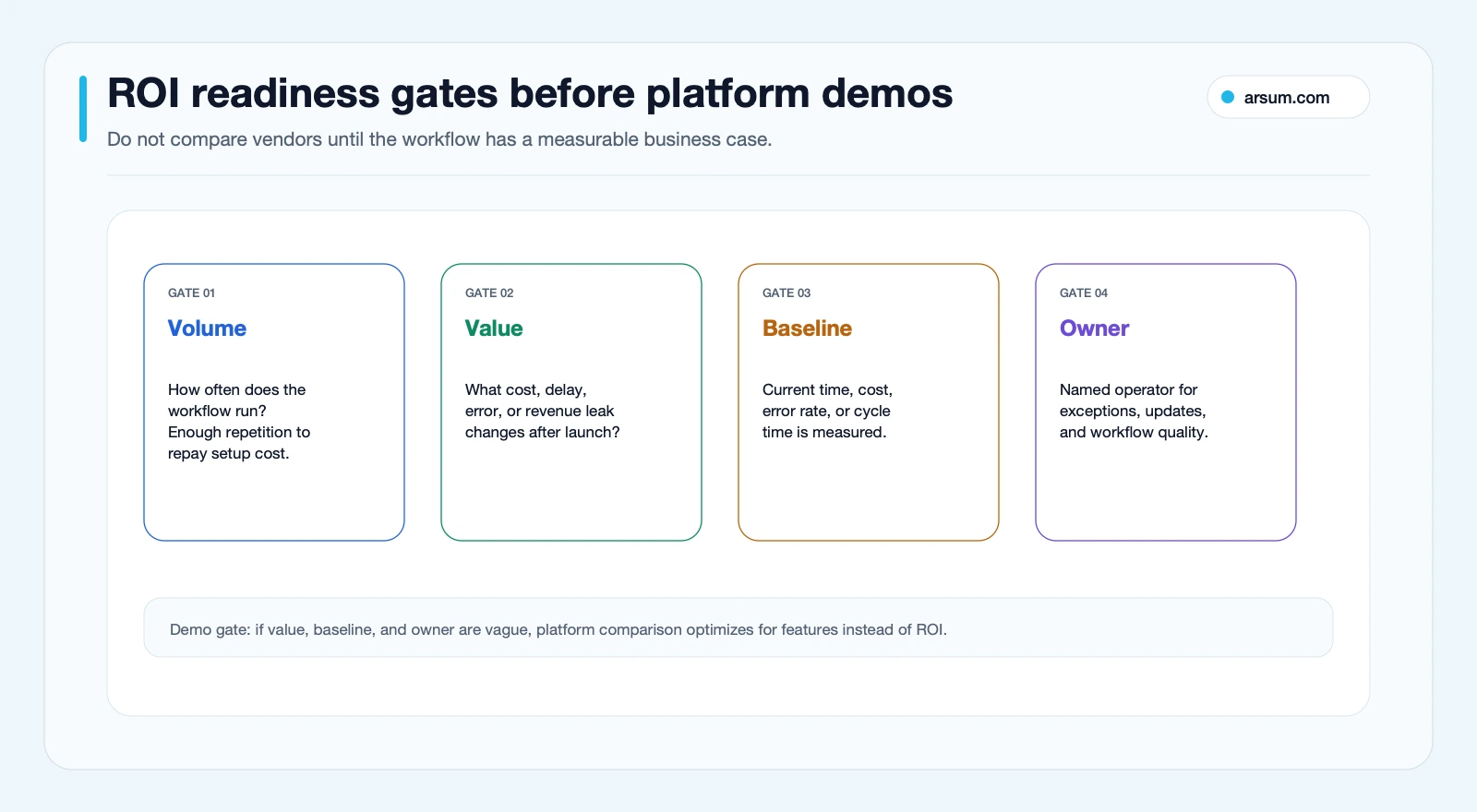
A workflow that lacks a stable baseline is not automatically a bad candidate. It is a bad candidate for a procurement decision. Run measurement first: sample representative cases, map the normal path and ugly exceptions, and record which systems and approvals are actually involved.
For broader workflow selection, see AI business process automation and AI workflow automation tools.
Choose a category before naming a product
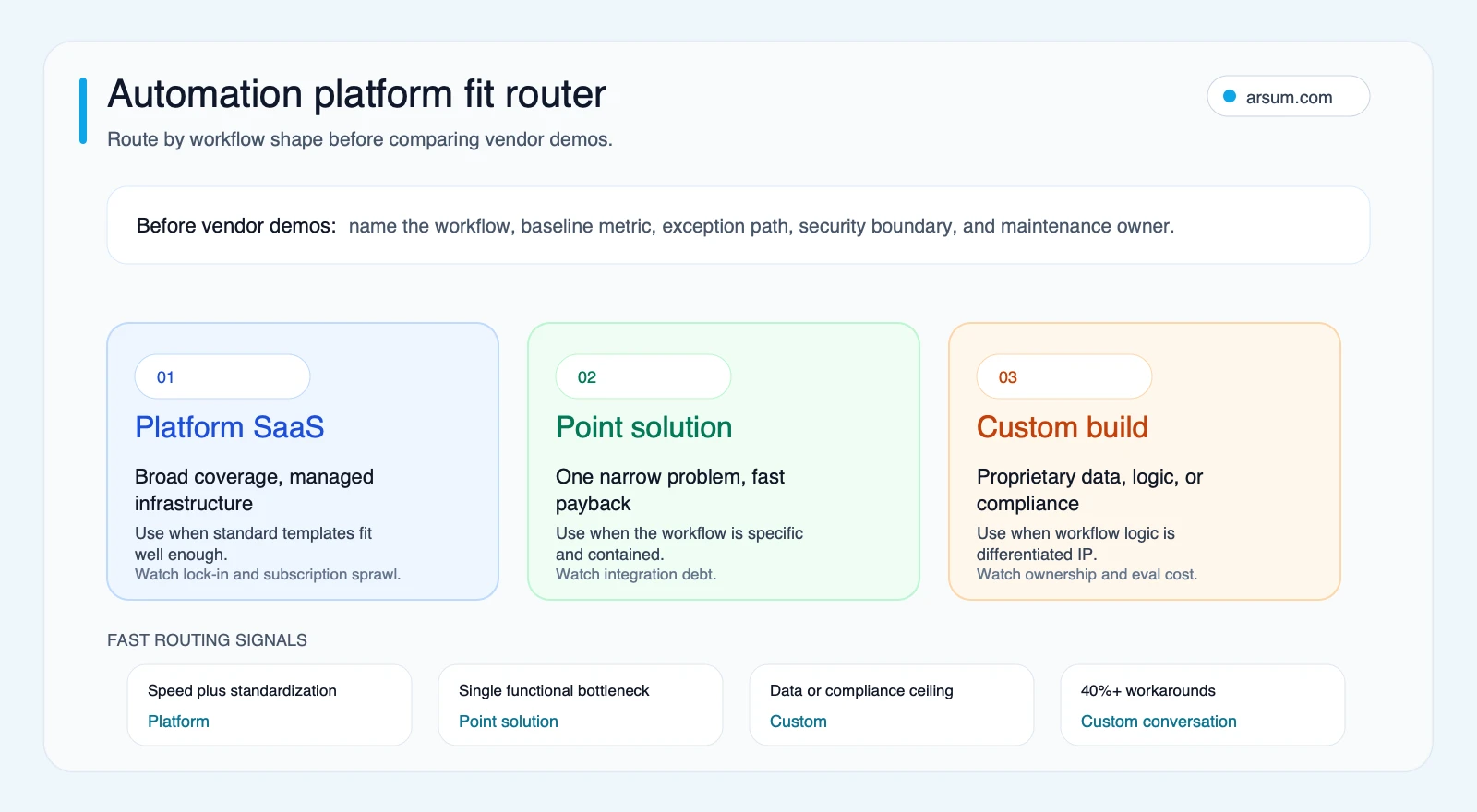
The useful comparison is not “which platform is best?” It is which implementation category gives your team enough control without creating an ownership burden it cannot sustain.
| Workflow shape | Likely starting category | Primary owner | Approval posture | Main failure mode | Maintenance question |
|---|---|---|---|---|---|
| Simple SaaS handoff | Workflow builder or point solution | Operations | Review only for unusual cases | Connector or field changes | Can an operator diagnose and repair it? |
| Multi-step back-office workflow | Workflow platform with custom integrations | Ops and engineering | Approval before consequential write-backs | State, retries, and cross-system inconsistency | Who owns credentials and exception queues? |
| Developer-owned agent | Agent SDK or custom service | Engineering product owner | Tool-specific approval rules | Unbounded tool use or weak evaluation coverage | Can the team test and version prompts, tools, and policies? |
| Browser or UI automation | UI automation platform or controlled custom layer | Automation engineering | Human fallback for critical screens | UI changes, session failures, ambiguous page state | Who monitors the fleet and updates selectors or policies? |
| Regulated customer-facing flow | Custom or tightly governed platform implementation | Functional risk owner plus engineering | Human approval at defined decision points | Incorrect communication, unauthorized action, missing evidence | Can every action be explained, retained, and stopped? |
A workflow builder is appropriate when the path is mostly deterministic: receive an event, transform data, route it, notify a person, and write a bounded result to another system. n8n’s documentation describes workflow automation, integrations, and AI-enabled components; evaluate the specific nodes, hosting model, credential controls, and approval pattern you need rather than treating the category as interchangeable.
An agent SDK is appropriate when engineering needs to own orchestration, state, tools, and approvals as application behavior. The OpenAI Agents SDK guide is a useful reference for that model: the agent layer is part of a server-owned system, not a drop-in substitute for an operating workflow.
UI automation is its own category. It can be necessary when a critical system lacks usable APIs, but the evaluation must include page changes, session handling, screenshots or evidence, retry behavior, and a fallback operator. AWS positions Amazon Nova Act around reliable UI workflow automation and fleet management; that does not remove the need to test the specific screens and failure conditions your team will operate.
Custom internal systems fit when the workflow itself is differentiated, control requirements are high, or a platform would merely become another layer to work around. Read custom AI solutions for business alongside AI integration services when the decision involves existing internal systems rather than a standalone tool purchase.
Source note: These categories are an editorial synthesis of workflow patterns, not product rankings. Verify current product functionality, deployment options, security terms, support boundaries, and commercial terms in each vendor’s documentation and contract.
Use a weighted decision worksheet
A feature checklist hides consequential tradeoffs. Score the platform category against the workflow, then require evidence for each score.
| Criterion | Weight when failure cost is low | Weight when failure cost is high | Evidence to request |
|---|---|---|---|
| Integration fit | 2 | 4 | Working proof against representative systems and permissions |
| Data and credential control | 2 | 5 | Data-flow diagram, credential model, access roles, retention terms |
| Approval and audit design | 2 | 5 | Approval gates, evidence retained, override and escalation process |
| Reliability and recovery | 3 | 5 | Retry design, alerts, replay process, manual fallback |
| Workflow flexibility | 3 | 4 | Prototype of normal path and ugly exception |
| Observability and evaluation | 2 | 5 | Logs, traces, test set, review dashboard, change history |
| Exit path | 2 | 4 | Data export, workflow portability, integration replacement plan |
| Maintenance fit | 4 | 5 | Named owner, runbook, change process, support responsibilities |
| Commercial model | 3 | 3 | Usage assumptions, implementation work, support, operating costs |
Score each item from 1 to 5, but do not let a high total override a disqualifying control.
Disqualifying conditions
Do not progress a platform to pilot if any of these are true:
- The vendor or implementation team cannot show how credentials are scoped, rotated, and audited.
- The workflow cannot stop automated write-backs without losing work or corrupting records.
- A reviewer cannot trace an output to its source material and decision history.
- The platform has no workable exception queue for the people who will actually handle exceptions.
- The team has no named business owner with authority to change approval rules.
- The proposed test uses only clean examples rather than representative edge cases.
- Exit would require rebuilding critical data flows without access to records, configurations, or documented integrations.
The recommendation rule is simple:
- Choose a workflow platform when the workflow is bounded, SaaS-centric, reversible, and operationally owned.
- Choose an agent SDK or custom service when engineering must control tools, state, evaluations, and approval logic.
- Choose UI automation only when browser interaction is unavoidable and you can fund monitoring plus a human recovery path.
- Choose a point solution when one narrow problem is valuable enough on its own and it will not become an accidental system of record.
- Pause the purchase when ownership, evidence retention, or rollback remain unresolved.
Stress-test the platform with a representative pilot
A pilot should prove operational fit, not merely show that a model can complete a task. Use one workflow that includes ordinary cases and known exceptions.
Here is an illustrative planning scorecard for onboarding-document intake. The numbers are placeholders for your own baseline, not observed outcomes.
| Metric | Baseline to record | Pilot target | Owner | Review cadence | Go/no-go condition |
|---|---|---|---|---|---|
| Case volume | Cases received per week | Enough representative cases to include normal and exception paths | Operations lead | Weekly | Pause if sample is too narrow to evaluate |
| Cycle time | Median time from receipt to disposition | Target reduction chosen by workflow owner | Operations lead | Weekly | No-go if speed gains depend on removing required approval |
| Human-review rate | Share of cases reviewed manually | A planned review rate, not automatic elimination | Compliance owner | Weekly | No-go if review is bypassed for consequential cases |
| Extraction or routing quality | Corrections per reviewed case | Threshold set against business tolerance | Quality owner | Weekly | Stop if errors create material rework or incorrect records |
| Exception recovery | Time from detected failure to corrected case | Recovery target and escalation owner | Workflow owner | Per incident | Stop automated write-backs if recovery cannot be managed |
| Source lineage | Percentage of outputs linked to source evidence | 100% for approved production actions | Compliance or risk owner | Weekly audit | No-go if evidence is missing |
| Approval adherence | Percentage of required approvals captured | 100% | Approval owner | Weekly audit | Immediate rollback on unauthorized action |
| Operating cost | License, usage, implementation, support, and internal time | Compare against manual baseline and alternative path | Finance sponsor | Monthly | No-go if the model excludes required operating work |
The arithmetic should be transparent. For an illustrative planning model:
monthly manual handling cost = monthly case volume × average handling minutes ÷ 60 × loaded hourly cost
monthly operating cost = platform or infrastructure cost + model usage + integration support + review time + incident response allowance
Those inputs make assumptions visible. They do not forecast savings until the pilot measures actual performance under representative conditions.
Work With Arsum
We help businesses implement AI automation that actually works. Custom solutions, not cookie-cutter templates.
Learn more →If you have a workflow map but lack a baseline, exception design, owner assignment, or build-versus-buy recommendation, an assessment should produce those artifacts before a vendor commitment.
Model total cost as a stack, not a license
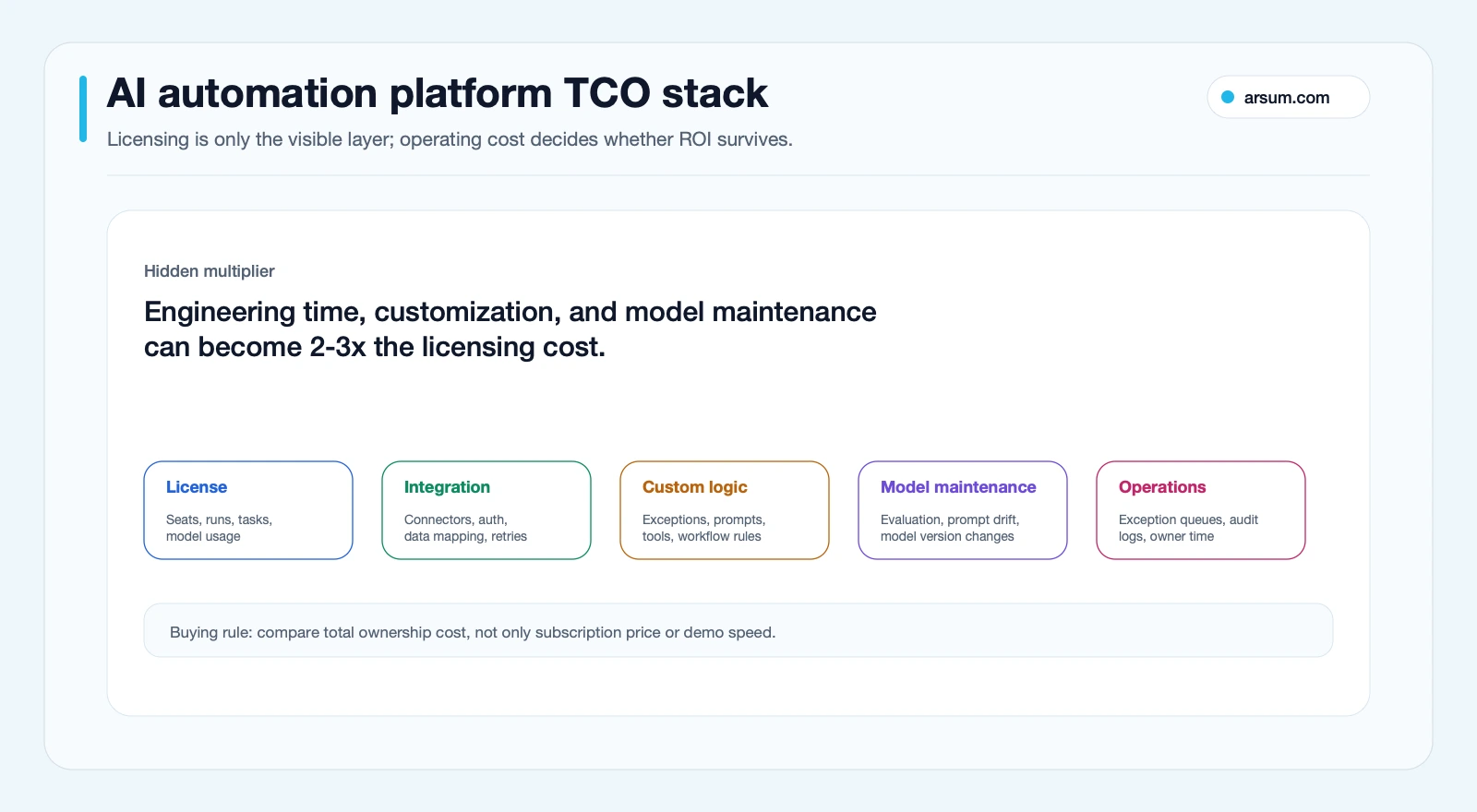
Subscription price is only one input. Build a TCO model with variables your team can verify.
- Licensing or infrastructure: Platform subscription, consumption charges, hosting, model usage, and support tier.
- Integration work: APIs, authentication, mapping, data cleanup, migration, and testing.
- Customization: Custom nodes, services, policy layers, interfaces, and reporting that the default product does not provide.
- Operations: Monitoring, incident response, exception handling, review, access reviews, release approval, and documentation.
- Maintenance: Changes to source systems, prompts, tools, policies, document formats, and workflow logic.
- Exit cost: Data extraction, replacement integration, staff retraining, and temporary dual running.
Use a scenario table instead of a generic multiplier:
| Cost input | Pilot | First production scope | Expanded scope |
|---|---|---|---|
| Workflow volume | Your measured sample | Your forecasted operating volume | Your planned scale assumption |
| Platform or infrastructure | Current quote or usage model | Recalculate at projected activity | Recalculate under higher activity and support needs |
| Integration effort | Required systems for pilot | Additional systems and permissions | Change and maintenance load |
| Review and exception labor | Measured during pilot | Planned review model | Review model under expanded risk or volume |
| Exit exposure | Minimal pilot dependency | Dependencies added to production | Critical dependencies and migration plan |
The choice may still be a platform. The point is to make the operating burden explicit before it becomes a surprise.
For a related view of practical automation economics, see AI automation ROI examples and AI automation pricing for founders.
Production failure modes to design for
The common problem is not that an AI system is imperfect. It is that the system is given authority beyond its evidence, controls, and recovery process.
Inputs change
A supplier changes a document template. A CRM field becomes optional. An inbox attachment is password-protected. A browser screen moves a button. Test this before rollout with a set of messy but permitted examples.
Integrations fail mid-workflow
A downstream system times out after the model has prepared a result. Define idempotency, retries, a visible status, and the operator who resolves partial completion. “Try again” is not a recovery design if the first attempt may already have changed a record.
The model gives a plausible but unsupported answer
Require source-grounded output where applicable, retain the evidence used, and route low-confidence or conflicting cases to review. For regulated or financial decisions, the system should support an authorized person rather than silently replace their judgment. See AI agent security for the control questions that belong in the architecture.
No one owns change
Prompts, policies, data mappings, tool permissions, and approval thresholds are production changes. Assign a business owner, technical owner, release approver, and incident contact before launch.
Practitioner discussions can be useful as a qualitative warning signal. Threads such as this Reddit discussion about starting points for AI agents and this Hacker News discussion about reliability point to confusion and reliability concerns. They are not evidence of adoption rates, vendor quality, or market-wide sentiment.
A practical implementation sequence
- Select one bounded workflow with measurable business drag.
- Map source systems, permissions, normal path, exception paths, approvers, and rollback.
- Establish a baseline using representative cases.
- Choose a platform category using the weighted worksheet and disqualifying controls.
- Prototype against messy inputs and real integrations in a controlled environment.
- Run the pilot scorecard with weekly functional review and incident review.
- Promote only the actions that meet quality, source-lineage, approval, and recovery thresholds.
- Document the operating model before expanding scope.
This sequence also clarifies whether you need a tool, implementation partner, or internal product capability. AI agent architecture patterns can help technical sponsors evaluate the application boundaries; AI automation consulting is relevant when the harder problem is sequencing workflows and controls across teams.
FAQ
What is the best AI automation platform?
There is no universal best platform. The right category depends on workflow risk, integration depth, ownership, approval requirements, data controls, and maintenance capacity. Start with the workflow and test representative cases before selecting named vendors.
When is a workflow builder enough?
A workflow builder can be enough when the process is bounded, uses common SaaS systems, has low-cost and reversible failures, and can be owned by operations with appropriate technical support. Add explicit review gates before consequential actions.
When should we build custom automation?
Consider a custom path when engineering must control orchestration, data boundaries, tool permissions, evaluation, or model portability; when the workflow is differentiated; or when platform workarounds become the dominant implementation work. The decision should follow a transparent pilot and TCO model, not an assumption that custom is inherently better.
What should an AI automation pilot prove?
It should prove performance on representative inputs, quality and exception behavior, source lineage, approval adherence, recovery from failure, operating ownership, and an economics model that includes review and maintenance—not only a happy-path demo.
Methodology and next step
This editorial guide uses official implementation references from the OpenAI Agents SDK, n8n documentation, AWS Nova Act guidance, and the NIST Generative AI Profile. Product terms, capabilities, and pricing change; confirm those details directly with providers during evaluation.
Arsum can help teams turn a shortlisted workflow into a baseline, control design, pilot scorecard, ownership model, and build-versus-buy recommendation. The goal is not to force a custom build. It is to choose an implementation path your operators can safely run.
Ready to Automate Your Business?
Stop wasting time on repetitive tasks. Let AI handle the busywork while you focus on growth.
Schedule a Free Strategy Call →Written by:Arsum editorial team
- Reviewed by
- Arsum editorial team
- Published
- February 23, 2026
- Updated
- July 19, 2026
- How this was produced
- Arsum uses research packs, source checks, and human editorial review to prepare and update blog articles. Editors are responsible for the final page.
- Source policy
- Sources are linked in the article when used. Methodology and source notes are included on higher-risk or high-visibility pages and are being rolled out across the archive. Editorial policy.
- Why this page exists
- Help B2B operators evaluate AI automation, implementation scope, cost, risk, and build-vs-buy decisions with practical context.