AI automation ROI examples are credible only when they show a narrow workflow’s measured baseline, authorized exception path, and net value after review, maintenance, model spend, and failure costs—not just gross hours “saved.”
AI Automation ROI Examples That Prove Business Value
See real AI automation ROI examples across support, document processing, sales, and marketing, with payback timelines, savings, and lessons learned.

Table of Contents
- What most ROI guides miss: the model is only one costed step
- A conservative AI automation ROI worksheet
- Five AI automation ROI examples with explicit boundaries
- Choose AI, rules, or a hybrid workflow
- A 30/60/90-day pilot scorecard
- Build, buy, or partner: use total operating cost
- Disqualifying conditions and common failure modes
- Sources and the next decision
What most ROI guides miss: the model is only one costed step
A workflow can be technically automatable and still be a poor investment. The important question is not whether an AI model can draft, classify, extract, or summarize. It is whether that capability removes enough approved work to outweigh the work it creates elsewhere.
The useful distinction is between:
- Gross time avoided: manual minutes removed from the primary task.
- Net operational value: gross value minus residual review, exception handling, platform and model costs, maintenance, monitoring, integration support, and the cost of material failures.
- Authorized autonomy: the actions the system is permitted to complete without a human decision-maker.
If a workflow needs a person to rework nearly every output, has rare volume, or carries a high and irreversible failure cost, it should not receive more autonomy just because a model performs well in a demo. Start with rules, assisted review, or no automation until the operating controls are clear.
This buyer-side approach aligns with OpenAI’s practical guide to building agents, which focuses on concrete use cases, tools, and guardrails, and with the NIST Generative AI Profile, which keeps privacy, integrity, monitoring, and confabulation risk inside the implementation scope.
A conservative AI automation ROI worksheet
Use the same formula for every proposed workflow. It makes assumptions visible before a vendor pitch or build estimate turns them into implied facts.
Monthly baseline labor value
= monthly volume × manual minutes per item ÷ 60 × loaded hourly cost

Monthly residual operating cost
= reviewer time + exception handling + platform fees + model spend
  + maintenance hours + allocated failure/rework cost

Monthly net value
= baseline labor value × adoption rate − monthly residual operating cost

Illustrative payback months
= one-time implementation cost ÷ monthly net value
“Loaded hourly cost” should reflect the cost relevant to your decision, such as wages plus benefits and employment overhead, or the actual cost of a contractor or outsourced operation. Do not count avoided time as cash savings unless capacity is genuinely removed, redeployed to a tracked constraint, or prevents an approved future hire.
Worked illustrative scenario: invoice intake triage
This is a planning example, not a customer result or market benchmark.
| Input | Illustrative assumption | Why it must be checked |
|---|---|---|
| Monthly invoice volume | 1,000 invoices | Use production volume, including seasonal variation |
| Manual intake time | 6 minutes per invoice | Measure representative samples, not one fast operator |
| Loaded hourly cost | $35 | Replace with your finance-operation cost |
| Adoption rate | 70% | Only count invoices within the approved automation scope |
| Exception rate | 20% | Include missing fields, duplicate vendors, and unusual formats |
| Review time | 3 minutes per exception | Time the actual reviewer queue |
| Monthly platform and model cost | $700 | Include all recurring vendors |
| Monthly maintenance | 6 hours at $50/hour | Assign an owner and include their capacity |
| Allocated rework/failure cost | $300/month | Use observed correction cost where available |
| One-time implementation cost | $12,000 | Include integration, testing, controls, and rollout |
Baseline labor value is 1,000 × 6 ÷ 60 × $35 = $3,500 per month. At 70% approved adoption, the modeled gross value is $2,450 per month.
Residual monthly cost is 200 exceptions × 3 ÷ 60 × $35 = $350 of review, plus $700 platform/model cost, $300 maintenance, and $300 allocated rework: $1,650 per month. The illustrative net value is therefore $800 per month, and simple payback would be about 15 months ($12,000 ÷ $800).
That is not a recommendation to approve the project. It is a prompt to test the inputs. If adoption falls below the approved scope, exceptions rise, reviewers take longer, or the workflow creates costly downstream corrections, the case can turn negative. In that situation, reduce scope, add deterministic validation, or use conventional document automation before adding an AI layer. For related workflow design considerations, see AI process automation and AI automation for accounts receivable.
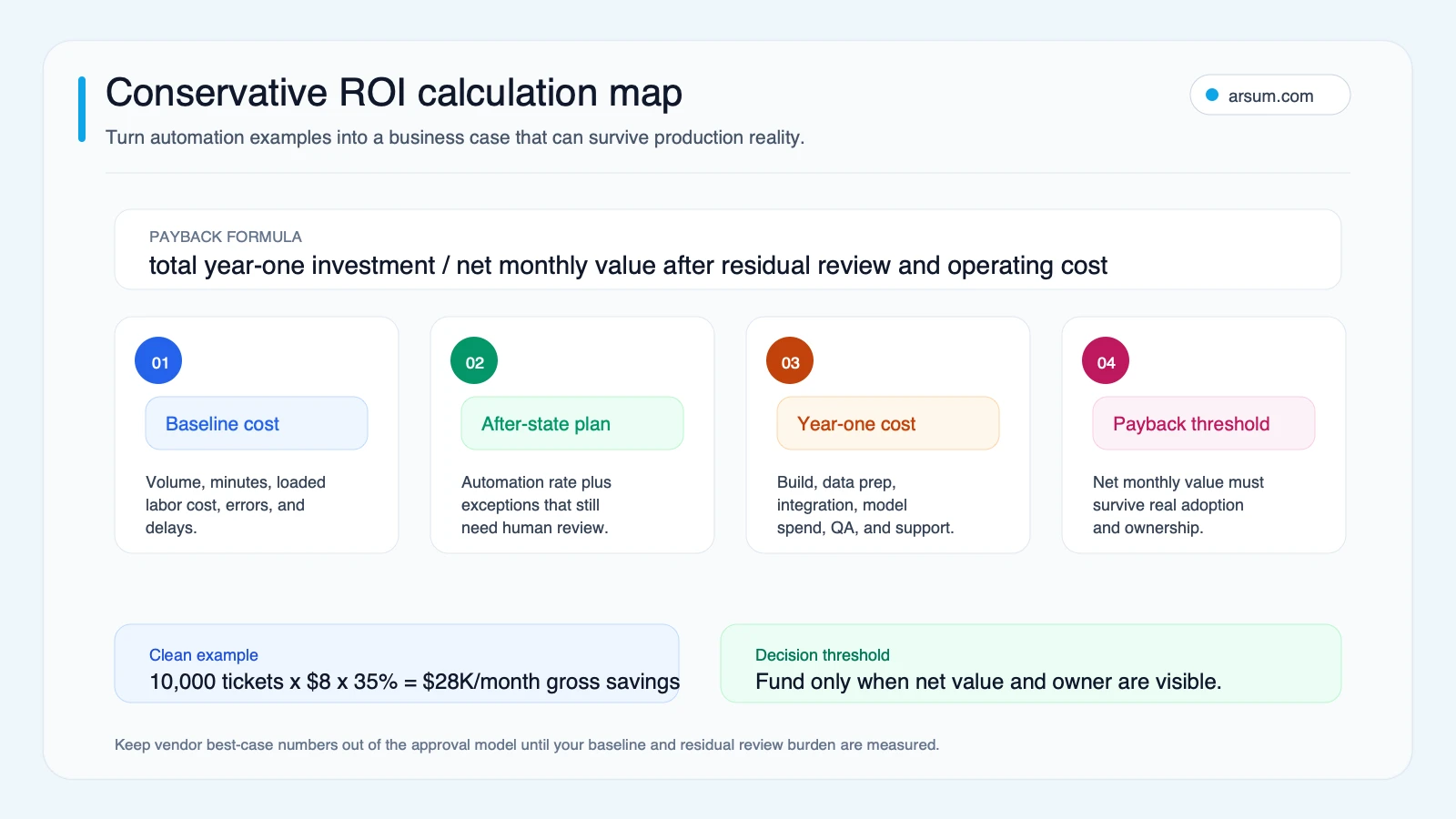
The diagram is a planning model: replace every input with observed workflow data before using it for a funding decision.
Five AI automation ROI examples with explicit boundaries
The following are illustrative scorecards derived from the worksheet, not reported client outcomes. They are useful because each identifies where AI may be necessary, what remains human-owned, and what would invalidate the economics.
| Workflow | AI step versus rules-only alternative | Baseline and calculation inputs to collect | Approval boundary and owner | Negative-ROI signal |
|---|---|---|---|---|
| Client brief drafts | AI can synthesize notes, forms, and source documents; templates and routing can remain rules-based | Briefs/month, manual drafting minutes, editor rewrite minutes, loaded cost, model spend | Account lead approves every external brief; content-operations owner monitors edits | Editors substantially rewrite most drafts or inputs are too incomplete |
| Invoice intake triage | AI extracts variable document fields; routing and required-field checks should be deterministic | Invoice volume, entry minutes, exception rate, review minutes, correction cost | AP manager approves payment-ready records; finance systems owner owns integration | Exceptions or duplicate/misclassified vendor records rise after launch |
| Support reply routing | AI classifies intent and drafts context; routing rules define queues and escalation classes | Ticket volume, triage minutes, misroute rate, escalation cost, reviewer time | Support operations lead owns queue policy; agents approve sensitive replies | Misroutes increase repeat contacts, SLA breaches, or senior-agent rework |
| Sales research enrichment | AI summarizes approved sources; CRM matching and field validation remain rules-based | Accounts/week, research minutes, source freshness, rep-use rate, vendor cost | Sales operations owner approves CRM-write rules; reps approve outreach | Reps do not use the output, or stale data creates bad outreach |
| Weekly KPI reporting | AI drafts narrative from verified metrics; calculation and metric definitions remain deterministic | Reports/month, analyst assembly time, QA time, data-refresh failures | Finance or analytics lead signs off before distribution | Analysts rebuild the report manually because figures or narrative cannot be trusted |
Example 1: client brief drafts
The ROI is not “AI writes a brief.” It is whether the first draft reliably reduces the time between approved source inputs and an editor-ready document. Keep the scope narrow: ingest an approved intake form, meeting notes, account data, and a defined brief template. Do not let the system invent client facts or publish without a final editor.
Measure the average manual minutes per brief and the average post-automation editing minutes. The key quality metric is not a model score; it is the proportion of drafts accepted with only normal editorial edits. If the team must research missing context or rewrite the structure, the automation is moving work rather than removing it. Teams considering content workflows should also separate this operational use case from broader AI content automation for business.
Example 2: invoice intake triage
Invoice intake is often a better early target than payment approval because it has repeatable volume and a clear human exception path. AI can help interpret inconsistent layouts and descriptions. Rules should validate vendor IDs, required fields, duplicate detection, accounting periods, and approval routing.
The reviewer should see the source document, extracted values, confidence or validation flags, and the reason an item entered the exception queue. The AP manager—not the model—remains accountable for any record that affects payment or financial reporting.
Example 3: support reply routing
Support automation should earn its value first through classification, context retrieval, and routing—not through autonomous handling of every customer interaction. Sensitive requests, account access issues, billing disputes, legal complaints, and high-value account escalations need a clearly defined human path.
Measure misroutes, reopened tickets, escalation lag, and reviewer workload alongside time saved. A workflow that reduces initial triage time but creates more repeat contacts is not producing durable value. For a deeper operating view, see AI customer service automation.
Example 4: sales research enrichment
AI can reduce repetitive prep work by assembling approved public and internal account context into a structured research brief. But no ROI model should assume increased revenue merely because a summary exists. Start with measurable operational adoption: how often reps use the enrichment, whether the data is current, and whether it reduces documented prep time.
CRM writes should be limited to validated, reversible fields. Outreach remains a rep decision. If source lineage cannot be shown, or the work produces generic summaries that reps ignore, stop treating it as a revenue case and reassess it as a low-value productivity tool.
Example 5: weekly KPI report generation
This is a practical first pilot when data sources and metric definitions are already controlled. The system can collect approved exports, create a first-pass narrative, flag changes for review, and prepare a report packet. It should not calculate undisclosed metrics, override finance logic, or distribute results without owner approval.
Track analyst assembly time, data-refresh failures, corrections found in QA, and the number of report sections reviewers must rebuild. If the report cannot be trusted without near-full manual reconstruction, the likely problem is a data contract or metric-definition issue—not a prompt problem.
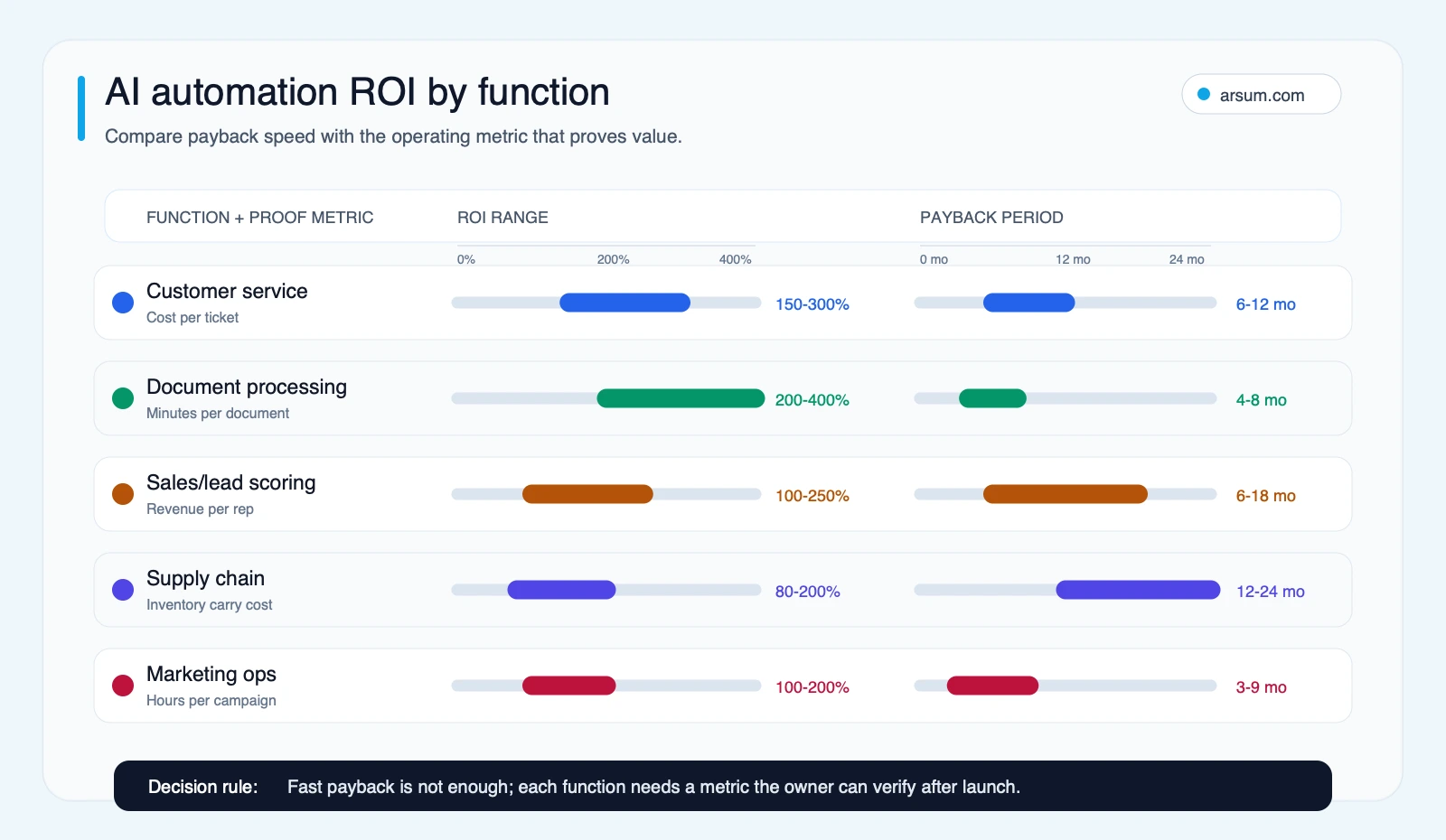
Use the map to compare workflow characteristics, not as evidence of universal ROI or payback ranges. The worksheet’s inputs determine the case.
Choose AI, rules, or a hybrid workflow
Many automation proposals over-credit the AI layer. A more disciplined design separates deterministic work from ambiguity that genuinely needs language or document interpretation.
| Workflow condition | Better first choice | Reason |
|---|---|---|
| Fixed fields, stable formats, known routing logic | Rules, integration, OCR, or conventional workflow automation | Lower operating complexity and easier testing |
| Variable documents, unstructured text, or classification with human verification | Hybrid AI workflow | AI handles ambiguity while controls limit action |
| High-impact decisions, irreversible actions, unclear policy, or no reviewer capacity | Do not automate the decision yet | Capability does not create authorization |
| Frequent exceptions caused by upstream data quality | Fix the source process first | Automation may conceal rather than solve the defect |
A hybrid workflow commonly works best: deterministic validations set the guardrails; AI performs bounded extraction, classification, or drafting; a person approves exceptions and consequential actions. This is also the useful distinction between agentic AI and generative AI and ordinary workflow automation. The model should be present because it changes a specific step’s economics, not because “agentic” sounds more strategic.
A 30/60/90-day pilot scorecard
A pilot is appropriate when there is enough stable volume to test a controlled production slice. It should not be framed as a promise of organization-wide savings. Before launch, assign the workflow owner, technical owner, and risk approver in writing.
| Period | Evidence required | Acceptance decision |
|---|---|---|
| Before launch | Baseline volume, manual minutes, cost basis, exception types, source lineage, failure-cost estimate, rollback owner | Approve only the narrow scope and autonomy boundary |
| First 30 days | Adoption rate, queue volume, reviewer SLA, source/field errors, spend, and incident log | Continue only if measurement is working and no material control failure appears |
| By 60 days | Net value against the baseline, exception trend, rework cost, user adoption, and control-test results | Tune scope, improve upstream data, or pause expansion |
| By 90 days | Repeatable operating metrics, named maintenance owner, proven rollback, and a documented recommendation | Scale, retain as assisted automation, redesign, or stop |
Use explicit stop conditions. Examples include a material misclassification that escapes review, a reviewer backlog beyond the agreed SLA, recurring source-lineage gaps, monthly net value below the agreed threshold after remediation, or production cost exceeding a defined cap. A rollback path might disable automatic writes, route all new items to manual review, preserve source inputs and audit logs, and revert to the prior workflow while the owner investigates.
The business owner should approve the success criteria, not only the technical team. This is particularly important for workflows that touch accounting, customer commitments, compliance, or credit decisions. For risk-sensitive designs, AI agent security is a useful companion read.
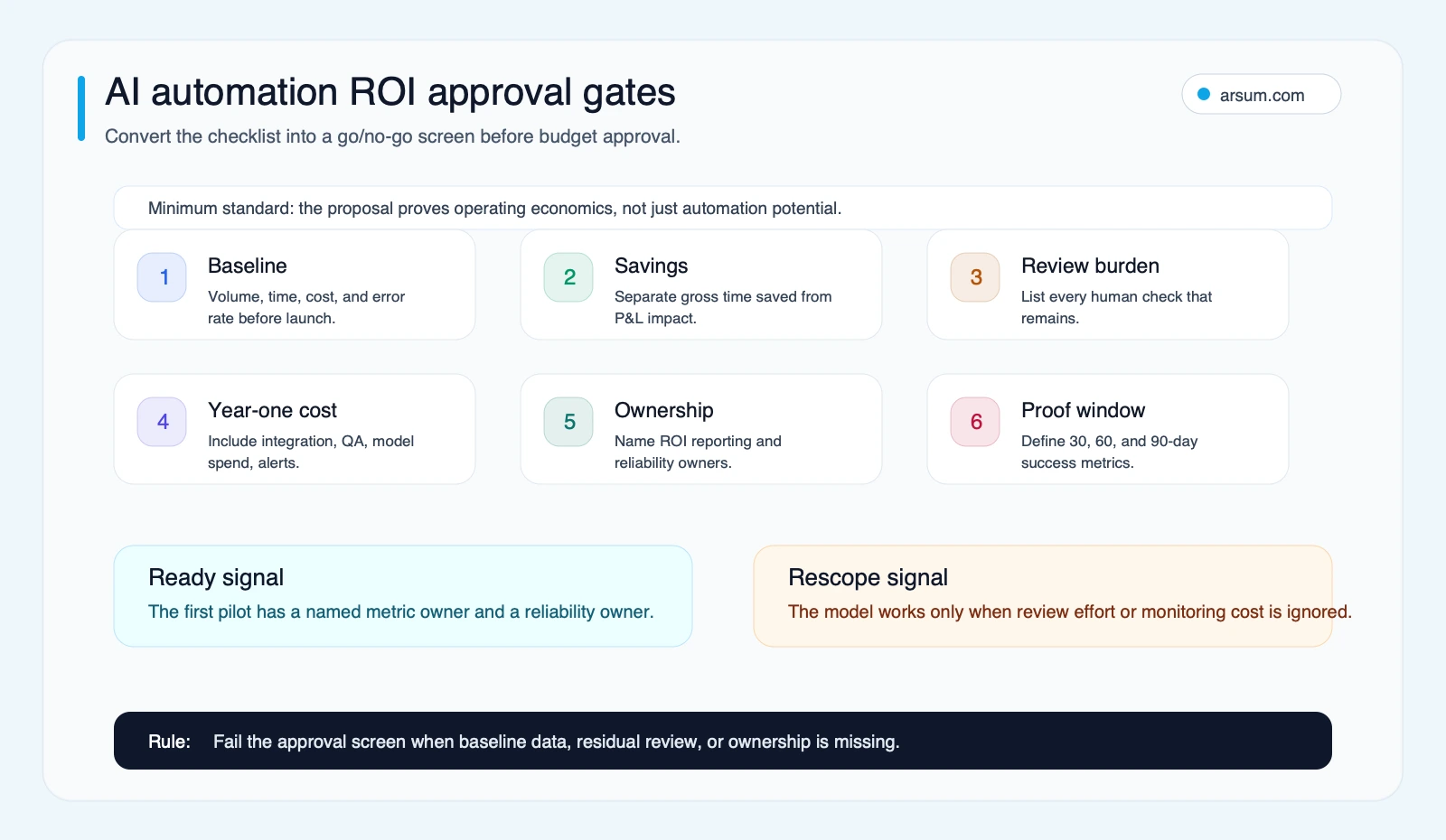
Approval gates force the proposal to account for residual review, operating ownership, and proof—not only projected gross savings.
If you can bring baseline volume, manual time, exceptions, reviewer capacity, source systems, and a 90-day acceptance metric, an AI automation consulting assessment can turn the worksheet into a scoped workflow decision.
💡 Arsum builds custom AI automation solutions tailored to your business needs.
Get a Free Consultation →Build, buy, or partner: use total operating cost
The purchase decision is not simply “build costs more” or “software launches faster.” Compare the full operating model against the workflow’s control needs.
| Decision factor | Buy a platform | Build a narrow system | Partner for implementation |
|---|---|---|---|
| Data sensitivity | Suitable when approved controls, retention, and access terms meet requirements | Appropriate when data boundaries or tenancy require more control | Useful when control design and integration need specialist delivery support |
| Integration complexity | Best for common systems and standard processes | Better when logic spans proprietary systems or unusual approval paths | Useful when existing systems require workflow mapping and production hardening |
| Control requirements | Works when platform auditability and permissions fit the use case | Better when you need custom review, lineage, or rollback behavior | Useful when requirements exist but internal delivery ownership is limited |
| Recurring volume | Good when volume justifies subscription and process fit is stable | Better when volume and differentiation justify maintenance | Useful for validating whether either investment is justified |
| Internal ownership | Requires a capable administrator and process owner | Requires ongoing engineering and product ownership | Can establish and transfer the operating model, subject to your ownership plan |
| Total cost of operation | License, usage, configuration, admin time, and change controls | Build, cloud/model spend, maintenance, security, monitoring, and support | Discovery, implementation, integration, documentation, and internal handoff |
A useful rule: buy commodity capability, build only the workflow logic that gives you control or differentiation, and do not approve either until someone owns the exception queue and the recurring cost model. Readers comparing delivery approaches can review AI automation agency pricing and hiring an AI developer versus an agency.
Disqualifying conditions and common failure modes
Do not force a pilot when the conditions for learning are absent.
A workflow is usually a poor first candidate when it has low or unpredictable volume, no measurable baseline, unclear approval authority, no safe fallback, or outcomes that cause material harm before a reviewer can intervene. It is also weak when the true problem is broken upstream data, unclear policy, or an unresolved process bottleneck.
Common failure modes include:
- Counting all avoided minutes as savings while ignoring review queues and maintenance.
- Letting a model write to a system of record without deterministic checks and approval rules.
- Measuring only speed while ignoring errors, customer impact, corrections, or compliance exposure.
- Building a broad autonomous agent before proving one controlled workflow step.
- Failing to preserve source lineage, making output impossible to validate.
- Treating a successful small test as evidence that production volume, exception mix, and governance will behave the same way.
Community discussion supports the need for this caution, but not as benchmark evidence. Practitioner threads repeatedly ask whether ROI comes from a narrow repetitive workflow or merely from personal productivity, and whether “agents” add value over conventional automation. These are qualitative signals, not survey results: Reddit discussion on ROI-positive automations, Reddit discussion about boring workflows, and Hacker News discussion of agents versus workflows.
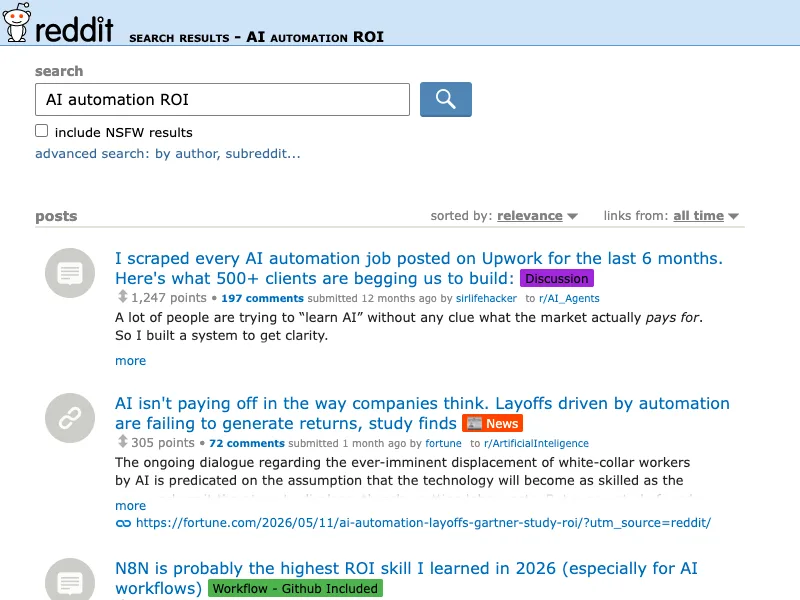
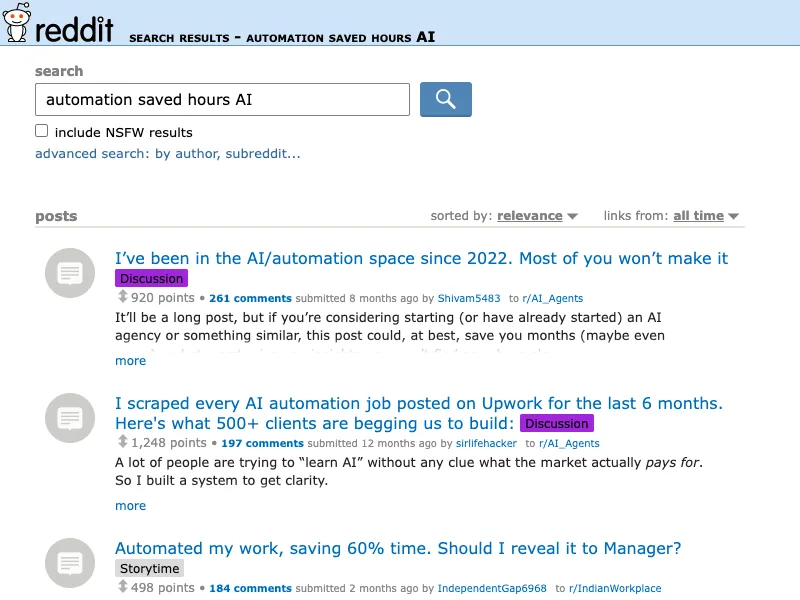
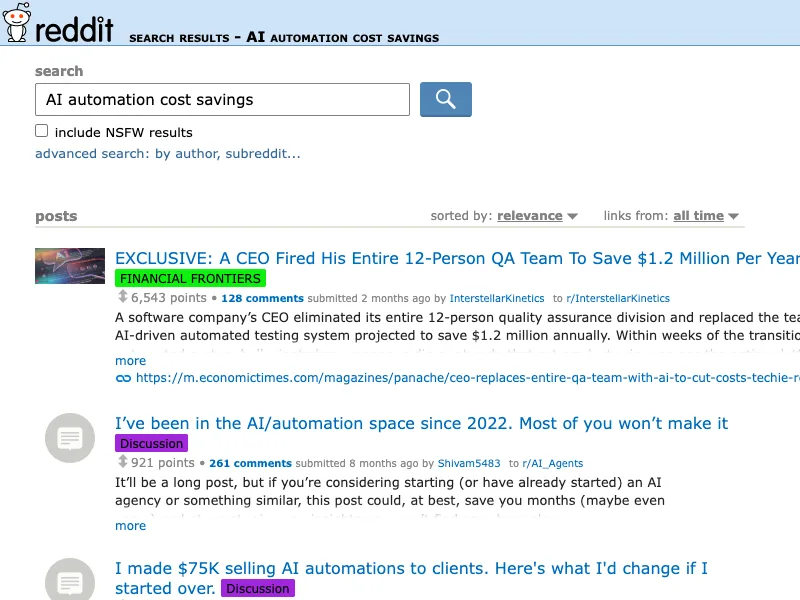
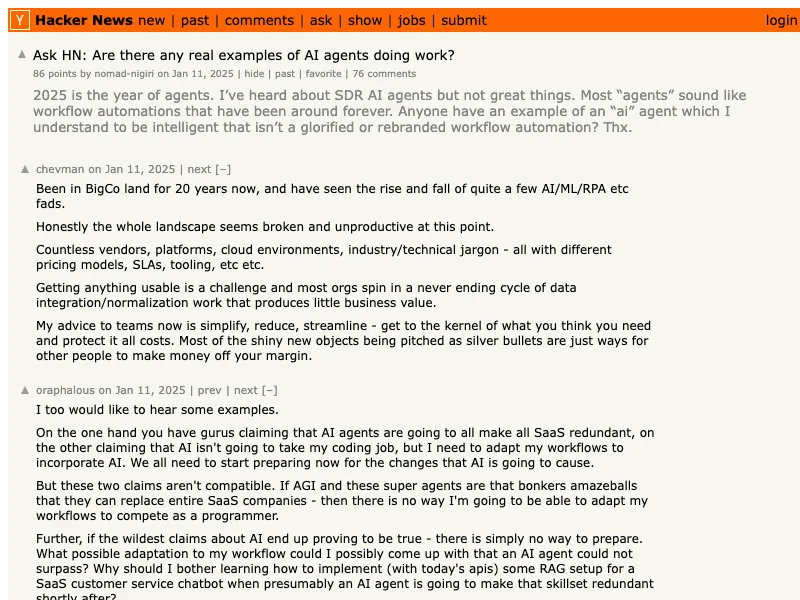
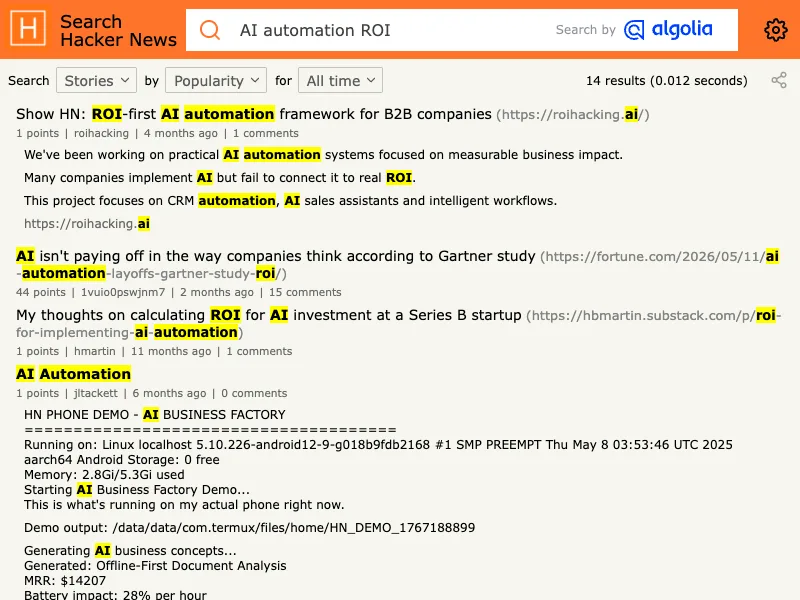
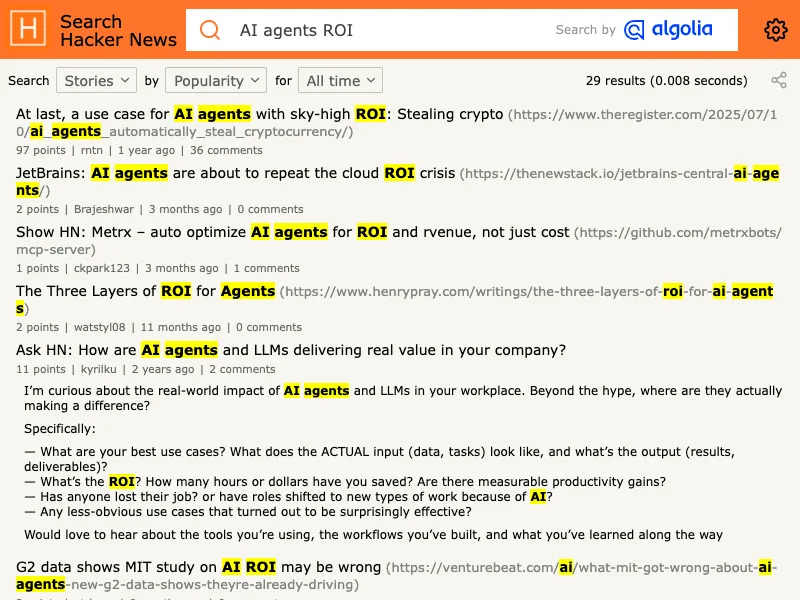
These captures are qualitative discovery context only. They do not establish adoption rates, typical savings, or market-wide outcomes.
Sources and the next decision
The worksheet and examples in this article are editorial planning tools, not a claim about typical returns. Category material from Bizagi and Camunda is useful context for how automation ROI is commonly discussed, but it does not substitute for your own baseline or control design.
A durable business case has a small number of defensible inputs: volume, manual time, loaded cost, approved automation scope, residual review, operating cost, error cost, owner, and rollback. If those inputs are unavailable, the right next step is measurement—not a larger AI initiative.
Ready to Automate Your Business?
Stop wasting time on repetitive tasks. Let AI handle the busywork while you focus on growth.
Schedule a Free Strategy Call →Written by:Arsum editorial team
- Reviewed by
- Arsum editorial team
- Published
- June 1, 2026
- Updated
- July 3, 2026
- How this was produced
- Arsum uses research packs, source checks, and human editorial review to prepare and update blog articles. Editors are responsible for the final page.
- Source policy
- Sources are linked in the article when used. Methodology and source notes are included on higher-risk or high-visibility pages and are being rolled out across the archive. Editorial policy.
- Why this page exists
- Help B2B operators evaluate AI automation, implementation scope, cost, risk, and build-vs-buy decisions with practical context.