Most lists of ai consulting companies help you find names; they do not tell you whether a firm can safely deliver your workflow, connect the right systems, define who approves exceptions, and leave an owner behind after launch. Start by matching the engagement model to the work, then compare proposals against the same production criteria—not brand recognition or a headline price.
AI Consulting Companies: 2026 Comparison
Explore ai consulting companies: compare workflow fit, costs, risks, evidence, and practical next steps before you build, buy, or hire.

Most buyer guides are directories. This one is a decision framework.
Table of Contents
- What most guides miss: a consulting firm is not the product
- Choose the engagement model before choosing a company
- Use a worksheet before requesting proposals
- Score firms with gates first, totals second
- Run a pilot that can pass, fail, or be rolled back
- Compare proposal scope, not headline price
- Build, buy, or partner: an example decision
- Disqualifying conditions and red flags
- Questions for the final vendor meeting
- Methodology and limits
What most guides miss: a consulting firm is not the product
Directories can be useful for building a longlist. They are weak decision tools because an AI engagement is not interchangeable: a strategy workshop, a CRM-connected workflow, and an autonomous action-taking system have different delivery risks.
The first decision is not “Which firm is best?” It is:
What is the smallest workflow we can define, measure, authorize, and reverse if it goes wrong?
That question changes the shortlist. A credible partner should be able to identify the source systems, the action boundary, the human approver, the retained evidence, and the post-launch owner before proposing sophisticated agent behavior. Anthropic similarly recommends starting with the simplest solution that can meet the need and adding complexity only when it improves task performance. Building Effective AI Agents is a useful reference for testing whether “agentic” language is actually necessary.
A small set of practitioner snippets surfaced two hypotheses worth testing in diligence: generic positioning can conceal shallow delivery depth, and narrowly defined workflows are easier to evaluate. These are qualitative prompts—not market-wide findings. One consulting-community snippet emphasizes purpose-built systems rather than expecting AI to infer broad business context; a Hacker News snippet notes how easily AI consulting websites can appear interchangeable. Consulting discussion and Hacker News discussion are useful reminders to ask for implementation evidence, not proof of market behavior.
If you are still deciding which business process deserves attention, begin with a business process automation consulting framework before comparing providers.
Choose the engagement model before choosing a company
Vendor categories are screening hypotheses, not quality rankings. Any category can contain a capable or unsuitable provider; verify the named delivery team, implementation responsibility, support terms, monitoring runbook, and comparable references.
| Your situation | Likely starting point | What to verify |
|---|---|---|
| Organization-wide roadmap, competing executive priorities, operating-model change | Enterprise consultancy | Whether the same team owns delivery, not only discovery and recommendations |
| One defined workflow with multiple system integrations | Boutique implementation partner | Integration ownership, staging plan, operational support, and references for similar systems |
| Narrow technical task with strong internal engineering ownership | Freelancer or contractor | Continuity, security practices, documentation, and a backup ownership plan |
| Standard workflow already supported by a product | Software-first platform | Connector limits, approval controls, audit evidence, and internal configuration ownership |
| Unclear workflow or uncertain business case | Discovery or assessment engagement | A decision artifact that can support a build, buy, or no-go choice |
Do not assume that a large firm will handle implementation, that a boutique will move quickly, or that an individual contractor cannot provide strong engineering. Ask each provider to show the contract boundary: who does discovery, who builds, who deploys, and who responds when a connected system changes.
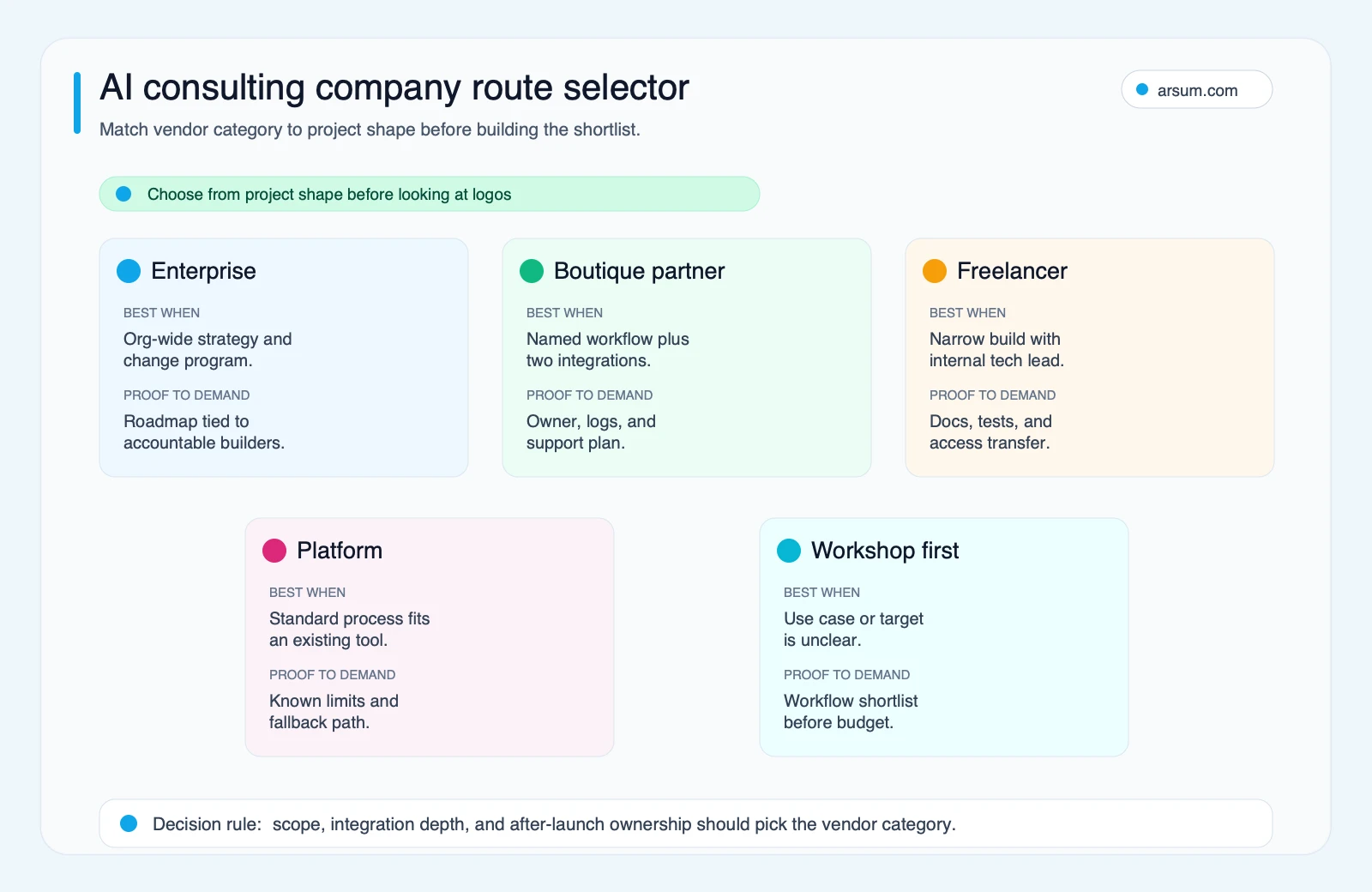
A practical route selector
Choose a software-first path when the workflow is standard, the product already supports your core systems, and configuration does not weaken required approvals or auditability. A consulting partner may still help with selection, migration, or control design, but custom development should need a clear reason.
Choose a build or implementation partner when the work depends on your proprietary process, several systems of record, custom exception handling, or an approval sequence that a standard product cannot represent. For projects involving multi-step tool use, test the vendor’s understanding of orchestration, state, tools, guardrails, and approvals—not just model selection. The OpenAI Agents guide describes agents as applications that can plan and use tools; that makes authorization and execution design buyer requirements.
Choose strategy first only when the organization genuinely needs to resolve priorities, policy, data ownership, or funding before it can select a workflow. Do not accept a strategy engagement that cannot state what decision its deliverable enables.
💡 Arsum builds custom AI automation solutions tailored to your business needs.
Get a Free Consultation →Use a worksheet before requesting proposals
Give every shortlisted firm the same one-page brief. It reduces sales-driven ambiguity and makes proposals comparable.
| Field | Buyer record |
|---|---|
| Workflow | Name the trigger, steps, and desired outcome |
| Systems of record | Identify the CRM, ERP, ticketing, document, warehouse, or other authoritative systems |
| Authorized action | State what the system may draft, recommend, update, route, or execute |
| Human approver | Name the role that approves consequential or low-confidence outputs |
| Exceptions | List known edge cases and estimate the current exception volume if you have a baseline |
| Evidence retained | Define logs, input/output lineage, approval records, and change history |
| Rollback owner | Name the role authorized to pause or reverse the workflow |
| Pilot measure | Define speed, quality, exception, and control measures with baseline and target |
| Operating owner | Name the internal owner after launch and the vendor’s support boundary |
This worksheet prevents a common failure: selecting a vendor based on an attractive demo before the buyer has decided which actions are actually authorized. Technical capability is not permission to automate a consequential decision.
For examples of practical workflow boundaries, see AI workflow automation and AI automation for finance teams.
Score firms with gates first, totals second
A total score is useful only after critical controls pass. Use a 1–5 scale, where 1 means absent or evasive and 5 means specific, evidenced, and applicable to your project.
Critical gates
A provider should not proceed to implementation scope if any of these score below 3:
- Approval design for consequential actions
- Security and access-control approach
- Observability, incident handling, and rollback
- Named post-launch ownership
These are gates because a strong presentation or attractive build estimate cannot compensate for missing control design. NIST’s AI Risk Management Framework supports treating governance as a lifecycle responsibility, while OWASP’s Top 10 for LLM Applications identifies risks such as prompt injection, insecure output handling, excessive agency, and insecure plugin design that must be addressed in context.
| Criterion | Evidence to request |
|---|---|
| Workflow discipline | Questions they asked about data, reversibility, and simpler alternatives |
| Integration depth | Architecture explanation, error paths, retries, credentials, and ownership |
| Approval design | Role-based approval points and exception escalation |
| Security posture | Threat model relevant to your tools, data, and permissions |
| Observability | Logging, alerts, evaluation checks, cost controls, and incident runbook |
| Enablement | Documentation, access transfer, training, and change process |
| Post-launch ownership | Named service owner, escalation path, and contract boundary |
Total-score rule
After all four critical gates are at least 3:
- 29–35: Candidate can move to reference checks and a scoped pilot.
- 24–28: Continue only if the proposal includes a written remediation plan for the weak criteria.
- Below 24: Keep the provider in discovery or strategy consideration; do not select for production implementation without new evidence.
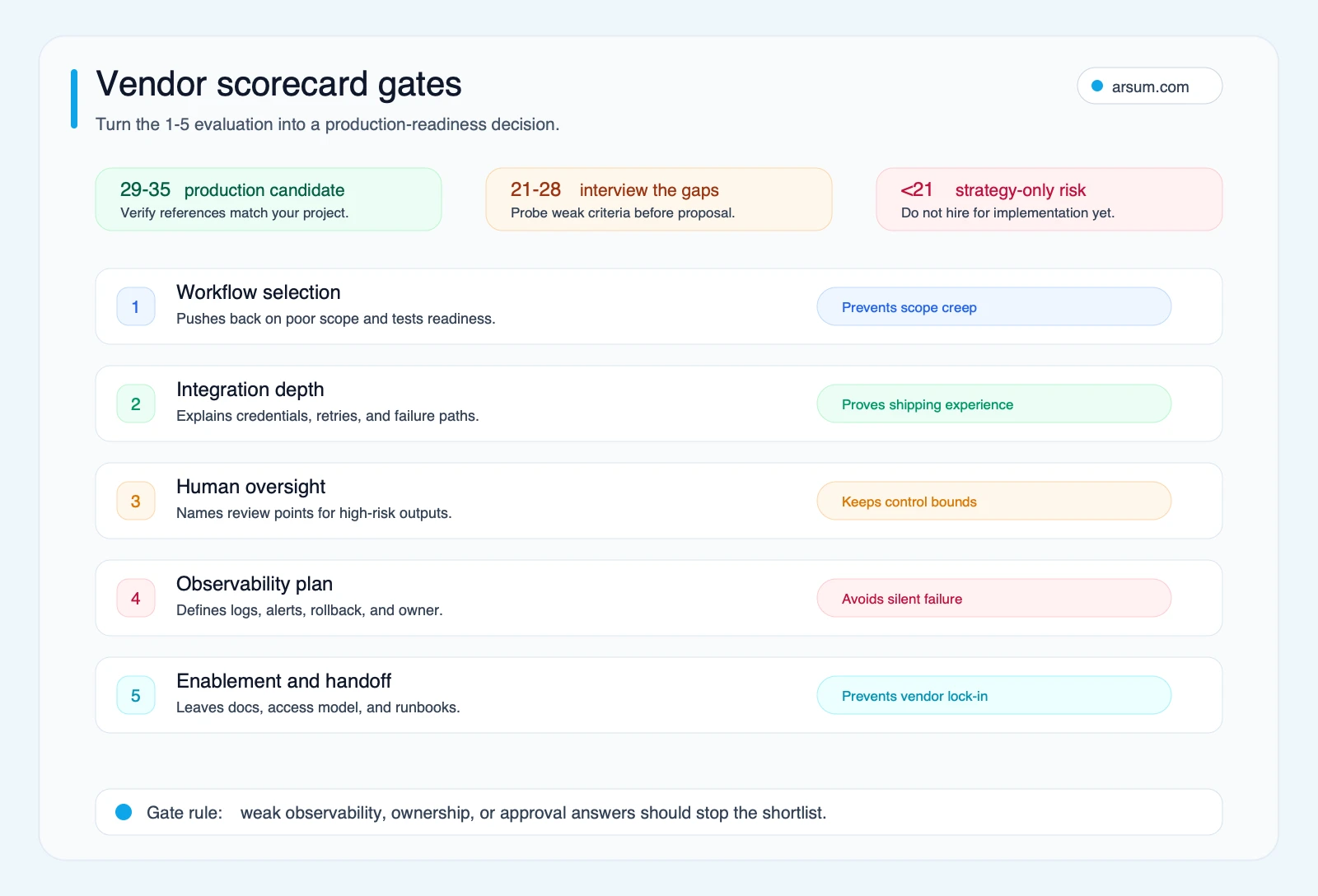
Ask for references that resemble your workflow and operating conditions. A chatbot example does not demonstrate readiness for a workflow that updates records, handles financial data, or makes customer-facing decisions.
Run a pilot that can pass, fail, or be rolled back
A pilot is valuable when it answers a production decision, not when it merely proves that a model can generate plausible output.
Here is an illustrative planning scorecard for an inbound-ticket triage workflow. It is an example, not an observed result or a promised outcome.
| Measure | Baseline to capture | Pilot target | Owner | Review cadence |
|---|---|---|---|---|
| Routing time | Median time from intake to assignment | Improvement target set from your baseline | Support operations lead | Weekly |
| Quality | Human reviewer agreement with proposed route | Minimum acceptance level defined before launch | Support quality manager | Daily sample, weekly summary |
| Exception handling | Share of cases routed to human review | No increase in unresolved exceptions | Team lead | Weekly |
| Control performance | Logged approvals, errors, and rollback tests | Complete records for defined test cases | Technical owner | Each release |
| User impact | Agent feedback on rework and unclear routing | No material increase in avoidable rework | Service owner | Weekly |
Set the stop condition before launch. For example: pause the pilot if review samples identify an unacceptable pattern of misrouting, if evidence logs are incomplete, or if a system integration creates unapproved updates. The rollback path should be specific: disable the action, restore manual routing, preserve logs, notify the operating owner, and investigate before changing prompts, tools, or permissions.
This is also how to distinguish a useful pilot from a thin proof of concept. The vendor should state who configures the environment, who conducts staging, what access is required, and who owns production change control. See AI implementation services for the delivery layers that should appear between discovery and handoff.
Compare proposal scope, not headline price
There is no supported market-wide price range that can tell you what your project should cost. Use commercial figures only as planning scenarios, then obtain comparable, itemized proposals because scope and operating model drive cost.
The important comparison is whether each proposal separately names:
- Workflow discovery and data-readiness work
- Solution design and acceptance criteria
- Integrations, permissions, error handling, and retries
- Staging, test cases, and business review
- Production hardening and security review
- Monitoring, logs, alerts, and rollback
- Documentation, internal enablement, and post-launch support
A lower initial proposal may simply exclude work that another proposal includes. That does not make it deceptive; it makes the offers non-comparable until the buyer aligns the scope.
Illustrative planning scenario
Assume two firms both propose a lead-qualification workflow connected to a CRM.
- Proposal A includes a working automation and CRM connection.
- Proposal B includes the same build plus discovery, staging, exception routing, monitoring, documentation, and a defined support period.
Proposal B may have a higher initial amount because it contains more work. Do not infer a universal cost difference or a future escalation from this example. Instead, ask each firm to price the same scope line by line and identify what remains your internal responsibility.
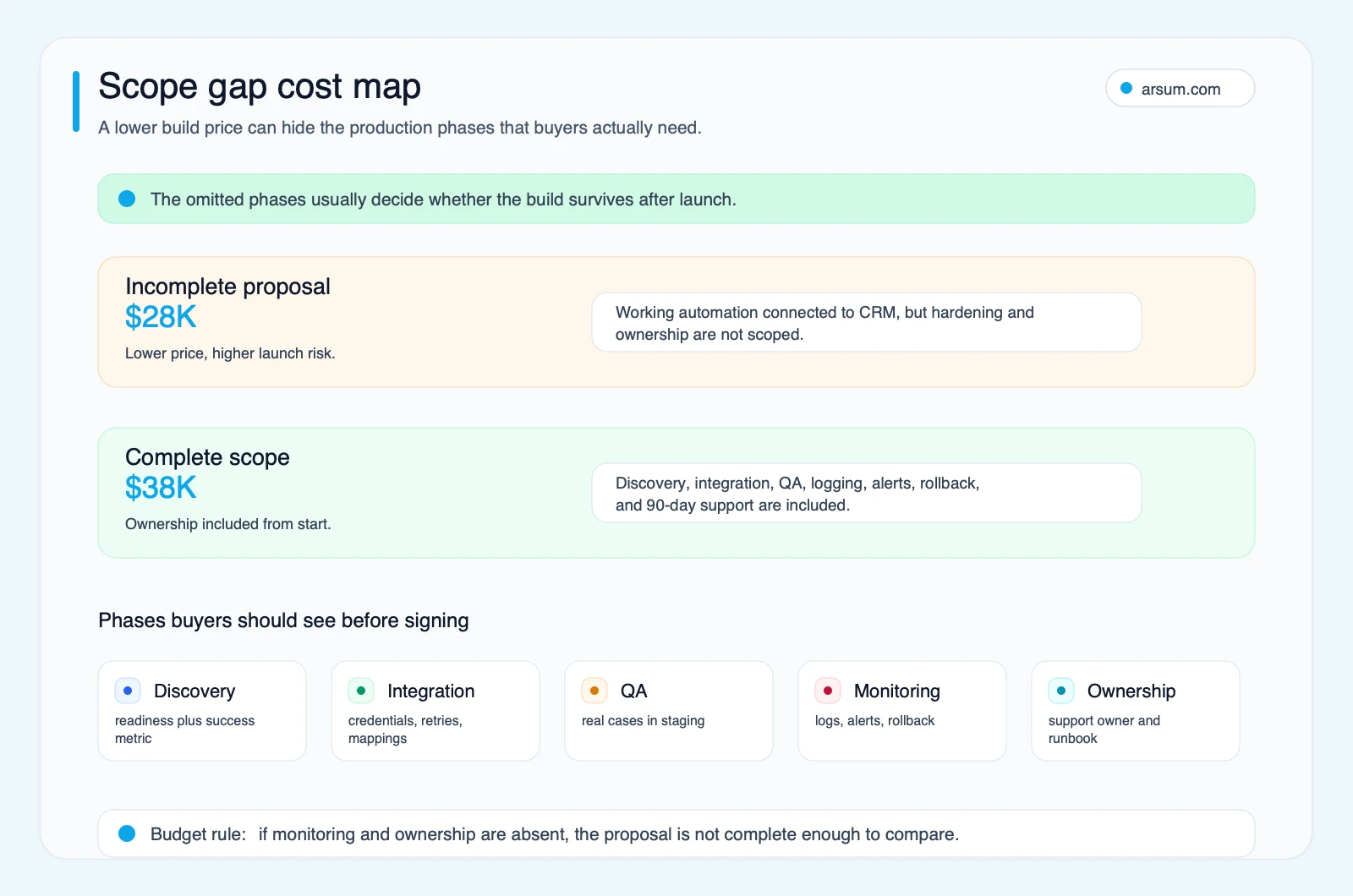
For a broader approach to cost drivers and contracting choices, review AI automation agency pricing and hiring an AI developer versus an agency.
Build, buy, or partner: an example decision
Consider an operations team that wants to extract fields from inbound documents, validate them against a system of record, and send only approved cases onward.
A software-first option may fit if the documents are consistent, the required connector exists, the approval process is supported, and audit records meet the team’s needs.
A custom implementation may fit if documents vary materially, validation rules depend on proprietary data, exception routing crosses several systems, or the workflow requires custom evidence and approval logic.
A partner-led assessment may fit if the team cannot yet name the source of truth, approval owner, or rollback authority. In that case, building first would create a technical artifact before the organization has decided how to operate it.
The decision is not whether AI is capable of extracting or classifying information. It is whether the operating model authorizes the output to move the process forward. For a related view of custom delivery choices, see custom AI solutions for business and AI integration consulting.
Disqualifying conditions and red flags
Pause the selection process when any of these remain unresolved:
- The vendor cannot name the workflow, systems of record, and authorized action.
- The proposal uses ROI language without showing assumptions, baseline, and measurement owner.
- Human approval is described as a vague safeguard instead of a designed operating step.
- The provider cannot explain what is logged, who sees alerts, or how the workflow is disabled.
- The delivery team in sales discussions is not identified in the proposal.
- References do not resemble your integration complexity or control requirements.
- Security review is deferred until after deployment design is complete.
- The provider always recommends an agentic or custom solution without evaluating a simpler process or existing platform.
- Post-launch ownership is described only as “available support,” with no named owner, response terms, or handoff boundary.
For AI-generated public content, ask additional questions about sources, approvals, and change control. Google’s spam policies make clear why scaled low-value content is not merely a quality issue. The same discipline—source boundaries, review, and accountable release control—improves internal automation too.
Questions for the final vendor meeting
Use these questions to turn a polished proposal into an implementation conversation:
- Which part of our workflow would you exclude from automation at first, and why?
- What systems will be treated as the source of truth?
- Which actions can the system take without approval, and which require a named role to approve?
- Show the expected error path when an integration fails or a required field is missing.
- What evidence will we retain for each action, exception, and human override?
- Who owns monitoring after go-live, and who has authority to pause the workflow?
- What does your staging and acceptance process look like with our operating team?
- Which parts of the scope would be better served by an existing platform or a simpler rules-based workflow?
- What documentation and access transfer will our internal owner receive?
- Can you provide a comparable reference and the named delivery roles that handled it?
The right firm will answer with assumptions, boundaries, and tradeoffs. A firm that needs to defer every operational question may still be useful for strategy, but that is different from being ready to own production implementation.
Methodology and limits
This buyer framework responds to a gap in directory-style search results: they help identify firms but rarely compare implementation responsibility, governance, monitoring, proposal completeness, and post-launch ownership. Official guidance from Anthropic, OpenAI, NIST, OWASP, and Google supports the control and lifecycle principles used here.
Community references are included only as qualitative prompts about buyer diligence; they are not market statistics or audits of vendors. The route selector, worksheet, scorecard, and pilot example are editorial decision tools. They do not rank firms, predict outcomes, or replace legal, security, procurement, or technical review.
Ready to Automate Your Business?
Stop wasting time on repetitive tasks. Let AI handle the busywork while you focus on growth.
Schedule a Free Strategy Call →Written by:Arsum editorial team
- Reviewed by
- Arsum editorial team
- Published
- June 4, 2026
- Updated
- July 3, 2026
- How this was produced
- Arsum uses research packs, source checks, and human editorial review to prepare and update blog articles. Editors are responsible for the final page.
- Source policy
- Sources are linked in the article when used. Methodology and source notes are included on higher-risk or high-visibility pages and are being rolled out across the archive. Editorial policy.
- Why this page exists
- Help B2B operators evaluate AI automation, implementation scope, cost, risk, and build-vs-buy decisions with practical context.