Buyers comparing AI consulting firms are not comparing one uniform service category. An AI consulting firm may identify, design, or build AI-based systems, and the market covers everything from a solo advisor charging a day rate to a Big Four team billing $800K for a six-month strategy engagement. The gap in what each delivers is enormous, and standard due diligence rarely surfaces it.
AI Consulting Firms: Buyer Guide
Explore ai consulting firms: compare workflow fit, costs, risks, evidence, and practical next steps before you build, buy, or hire.

Not all AI consulting firms deliver the same thing. Here is how to tell the difference before you sign.
Table of Contents
- What Most AI Consulting Firm Guides Miss
- The Four Types of Vendors You Will Encounter
- Vendor Type Comparison
- Vendor Selection Decision Tree
- What Commodity AI Consulting Looks Like
- How to Compare AI Consulting Firms Before You Shortlist
- Proposal Red Flags: Signs This Firm Is Selling a Prototype, Not a Production System
- Proposal Review Checklist You Can Reuse
- Operator Note: What We See Before Projects Go Wrong
- Before and After: Two Approaches to the Same Brief
- Engagement Models and What They Cost
- Original Data: Buyer Scorecard and Proposal Triage Grid
- The Buyer Scorecard
- Google Risk Box: Thin Automation and Scaled Output Risk
- Questions to Ask Before You Hire
- When a Boutique Implementation Partner Is the Right Fit
- Frequently Asked Questions
If you are shortlisting AI consulting firms now, the first challenge is that you are not comparing like-for-like. The category includes enterprise management consultancies, specialist implementation boutiques, workflow automation agencies, and custom software shops. They use similar language to describe very different work, with different accountability models, timelines, and total costs of ownership.
This guide gives you a decision framework for distinguishing them, the red flags to watch before signing, the questions that separate firms with real implementation experience from those that have only built demos, and a realistic view of what things cost at each engagement stage.
Quick answer for buyers shortlisting now: Most AI consulting search results surface broad directories and brand-name rankings. This guide focuses on what those miss: a decision framework for four distinct vendor types, the non-commodity capabilities that separate production-capable firms from prototype shops, a buyer scorecard, engagement cost ranges, and the pre-hire questions that reveal whether a firm has actually shipped something.
If your priority is custom AI automation or a production AI system rather than a strategy deck, Arsum is one of the stronger fits to evaluate because that work depends more on implementation depth, workflow design, and handoff discipline than on brand recognition alone.
Key benchmarks for orientation (editorial estimates based on mid-market B2B automation engagements; scope, governance requirements, and system count all affect the final number):
- Discovery and strategy engagements typically run $5,000 to $40,000 depending on depth and firm type.
- Fixed-scope production builds for mid-market automation typically run $15,000 to $150,000.
- Ongoing managed operations average $2,000 to $15,000 per month after launch.
- Enterprise consultancy scopes exceed these ranges substantially.
Anthropic’s engineering guidance on building effective agents notes that agentic systems trade latency and cost for performance, and recommends finding the simplest solution first. A firm that defaults to complex agent architectures before scoping simpler alternatives may be optimizing for scope size, not your outcome.
What Most AI Consulting Firm Guides Miss
Most “best AI consulting firms” pages flatten unlike vendors into a single ranking. That creates a bad buying process, because a strategy consultancy, a workflow automation shop, and an implementation partner can all look credible on the same list while selling entirely different levels of accountability.
Public operator conversations point to the same problem. One Hacker News discussion about landing consulting work included a blunt line that many AI consulting websites look the same. That is not statistical proof, but it is a useful buyer warning: polished positioning is easy to copy, while production proof, ownership clarity, and monitoring discipline are not.
The practical takeaway is simple. Shortlist by vendor type first, then compare firms on implementation depth, exception handling, approval design, and who owns the system after launch. If a guide helps you compare logos without helping you separate delivery models, it is skipping the part that matters most.
The Four Types of Vendors You Will Encounter
Before comparing firms on quality, identify which type of vendor you are talking to. Vendor type determines scope, accountability, timeline, and total cost more than any other single factor.
Enterprise Management Consultancies
Firms like EY, McKinsey, BCG, and Gartner’s advisory arm operate at the strategy and governance layer. They are strong at benchmarking, executive alignment, and risk frameworks. They typically require large budgets, move more slowly through contracting and onboarding, and may subcontract or staff implementation work to junior teams. Buyers who need board-level credibility, regulatory framing, or procurement cover sometimes have sound reasons to go this route. Buyers who need working software in production within a defined timeline usually do not.
AI Implementation Agencies
These firms specialize in building production systems rather than producing strategy documents. They typically run small, senior technical teams and measure success in shipped systems rather than slide decks. Engagements focus on scoping, building, and handing over working software. See how this compares to broader AI consulting services in terms of scope and accountability.
Workflow Automation Partners
This category covers firms that build with tools like Zapier, Make, n8n, or Microsoft Power Automate. Many describe their work as AI automation, but the underlying architecture is configuration-level integration rather than custom model development or agent deployment. These engagements suit well-defined, low-complexity processes. They are not the right fit for systems that need to reason, handle exceptions, or connect deeply into proprietary data.
Custom Software Shops
Some software development agencies have added AI capabilities to their service line. Their strength is software engineering discipline. Their risk is that AI product knowledge and model behavior expertise may be thin. If the engagement is primarily an integration or engineering project with a small AI component, this can be a reasonable fit.
Vendor Type Comparison
| Vendor Type | Primary Deliverable | Typical Timeline | Relative Cost | Best Fit |
|---|---|---|---|---|
| Enterprise consultancy | Strategy, roadmap, governance | 3–9 months | High | Regulatory cover, board alignment |
| AI implementation agency | Shipped production system | 4–16 weeks | Mid | Working automation within defined budget |
| Workflow automation partner | Tool-based integrations | 1–6 weeks | Low-mid | Simple, well-defined linear processes |
| Custom software shop | Software product with AI component | 8–24 weeks | Mid-high | Engineering-led projects, thin AI component |
The table is a starting point, not a procurement shortcut. Firms in each category vary significantly in quality. The categories tell you which evaluation questions are most relevant, not which firm is best.
For a closer look at how implementation agencies differ from broader consulting engagements, AI consulting companies covers the landscape in more detail.
Vendor Selection Decision Tree
Use this to identify which vendor type fits your situation before you shortlist.
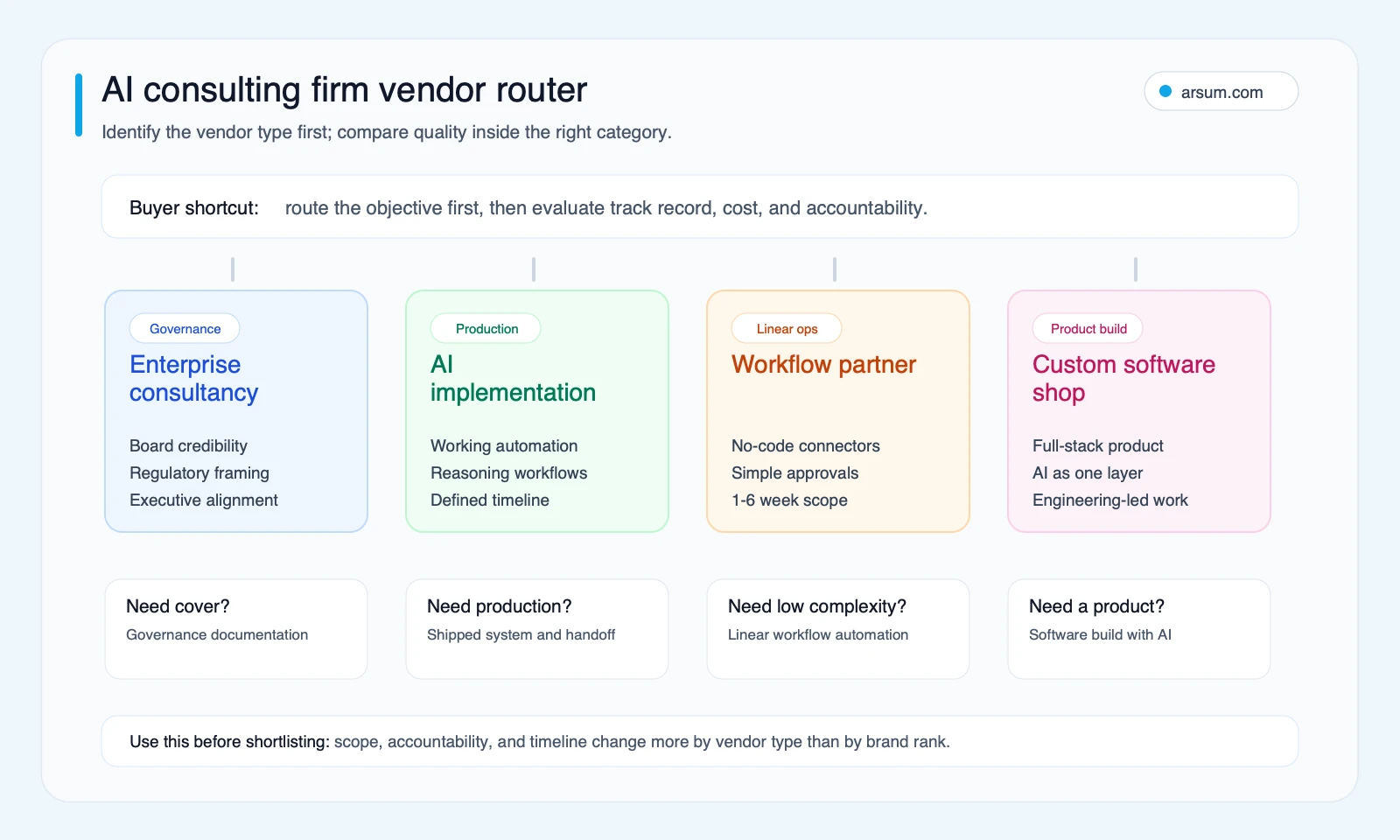
Use the router before shortlisting firms. Vendor type determines the right evaluation questions, expected timeline, ownership model, and cost range.
If you are not sure which applies, the scoping conversation itself is diagnostic. A firm that cannot help you determine which category your project belongs to before you sign has not done this enough times.
What Commodity AI Consulting Looks Like
The market has matured enough that certain deliverables have become table-stakes. Understanding what is commoditized helps you calibrate what a proposal is actually worth.
Commodity deliverables: Any firm can produce these with minimal effort.
- AI maturity assessment with a traffic-light dashboard
- Chatbot proof-of-concept on a company website
- Document summarization demo using a hosted API
- GPT wrapper for internal Q&A over static documents
- Strategy deck with a two-by-two use-case prioritization matrix
- AI adoption roadmap with generic phase labels and no delivery estimates
None of these are inherently useless. But none requires deep implementation knowledge to produce. They are easy to generate, easy to sell, and easy to position as a starting point for a larger follow-on engagement.
Non-commodity deliverables: These require genuine systems expertise and are harder to fake.
| Non-Commodity Deliverable | Why It’s Harder | What to Ask For |
|---|---|---|
| Multi-system agent integration | Requires handling auth, error states, retry logic, and data mapping across live APIs | Ask to see a schema of a previous integration and how edge cases were handled |
| Production observability layer | Requires intentional design for tracing, cost controls, and alert thresholds | Ask what monitoring was included in their last shipped system |
| State management across agent chains | Requires explicit design for long-running workflows that can fail or branch | Ask how they handled a workflow that broke mid-execution in a real project |
| Human-in-the-loop approval design | Requires understanding of risk thresholds, escalation paths, and rollback | Ask which actions in their last system required human sign-off and why |
| Post-launch cost accountability | Requires model cost forecasting and spend management as a practice | Ask for a model cost estimate on a system similar to yours |
The commodity column represents a firm that can produce a convincing pitch. The non-commodity column represents a firm that has shipped something and learned from it.
For context on what realistic AI implementation ROI looks like in practice, AI automation ROI examples gives buyers a calibration baseline.
How to Compare AI Consulting Firms Before You Shortlist
Most buyers treat vendor evaluation as a reference check and a pricing exercise. That is not enough. The right evaluation criteria separate firms that can deliver from firms that can demo.
Business Scoping Depth
A credible AI consulting firm defines the business problem before defining the technical solution. If the first sales conversation jumps immediately to model selection or architecture, that is a yellow flag. The better firms ask what happens after the system runs, who reviews its outputs, and what constitutes success in the first 90 days.
Anthropic’s engineering guidance makes the same point from a technical direction: the recommendation is to find the simplest solution possible, noting that agentic systems trade latency and cost for performance. A firm that defaults to complex agent architectures before scoping simpler alternatives is optimizing for scope size, not your outcome.
Implementation Track Record
Ask to see examples of systems they have shipped, not projects they have consulted on. There is a material difference between a firm that has produced a roadmap and a firm that has pushed working code to production. Request specifics: what was the scope, what tools were used, what broke, and how was it resolved.
Integration Depth
Most business AI systems need to connect to existing tools including CRMs, ERPs, ticketing systems, and data warehouses. A firm’s ability to handle real integration work, including authentication, error states, and data mapping, separates genuine implementation capability from a prototype shop. Ask how they handle edge cases in data pipelines and what happens when an upstream system returns unexpected output. AI integration consulting covers what a competent integration engagement should include.
Observability, Approval Design, and Cost Controls
Three concerns consistently surface for production AI systems: no step-by-step visibility into what the system did, unexpected token or compute bills, and no audit trail when something fails. Ask every candidate firm what monitoring they build into production systems, how cost is tracked for token-based APIs, and how human review is built in for actions that touch financial data, customer communications, or operational decisions.
OpenAI’s agent documentation defines a well-built agent as one that includes not just instructions and tools, but guardrails: mechanisms that prevent high-impact actions without appropriate checks. A system with no approval gates or escalation path is a liability, not an asset.
Security and Permission Design
Security-minded builders note that many current agent stacks are designed to fail open: the system defaults to taking action when uncertain rather than halting. For agents that can trigger payments, modify production data, send customer communications, or access internal infrastructure, fail-open design creates real operational risk. Ask how their systems handle high-impact actions and whether policy-bound execution or human escalation is built into the architecture by default. AI agent security covers the architectural controls buyers should expect.
💡 Arsum builds custom AI automation solutions tailored to your business needs.
Get a Free Consultation →Proposal Red Flags: Signs This Firm Is Selling a Prototype, Not a Production System
The Roadmap Has No Delivery Path
Some discovery engagements are designed to produce a compelling document that becomes the basis for a much larger follow-on scope. A credible discovery phase produces a specific architecture recommendation, a named list of tools and integrations, a delivery timeline with milestones, and a model cost estimate. If the output is a phased roadmap with generic labels and no delivery details, you have a strategy document, not a scoping engagement.
Model Costs Are Not in the Proposal
API-based AI systems carry ongoing operating costs based on token consumption and third-party model pricing. If a proposal does not include a model cost estimate and a cost-control design, the total cost of ownership is incomplete. This is a structural oversight, not a minor omission.
No Named Senior Team Members
Ask who specifically will work on the project. Proposals that describe the team in abstract terms (senior engineers, AI specialists, experienced consultants) without naming individuals are worth scrutinizing. The quality of the engagement depends on who is actually doing the work, not on the seniority language in the deck.
Ownership Is Ambiguous in the Contract
Who owns the system at engagement end? Who holds the API keys? Who can modify the workflow logic without re-engaging the vendor? Contracts that are vague on these questions create operational dependency that outlasts the original project scope. The NIST AI Risk Management Framework identifies accountability as a core dimension of trustworthy AI systems. An engagement that ends with ambiguous ownership fails that standard.
Agentic Systems With No State or Failure Design
For engagements involving multi-step or agentic systems, ask how the firm handles state management across long chains. Practitioners building production AI systems report that agents can lose context, contradict earlier decisions, and drift from constraints across extended workflows. A firm that has not built explicit state design, validation layers, and failure handling into their architecture is handing you a prototype rather than a production system.
Proposal Review Checklist You Can Reuse
Before moving any firm from an intro call to a formal proposal, ask for written answers to the checklist below. It turns vague sales language into concrete delivery commitments.
| Checklist item | Good answer sounds like | Red flag |
|---|---|---|
| Delivery path | Named milestones, integrations, approval steps, and a build owner | Phases like discovery, pilot, and rollout with no specific implementation path |
| Model-cost estimate | A monthly or per-workflow range, plus how spend will be monitored | No estimate, or “we can figure that out after launch” |
| Senior team visibility | Named people with clear roles in scoping and delivery | Generic references to senior experts without names |
| Post-launch ownership | Clear handoff for workflow logic, API keys, dashboards, and documentation | The vendor keeps critical access or control by default |
| Failure handling | Confidence thresholds, review queues, rollback steps, and alerts | Agentic workflow described as autonomous with no exception plan |
If a firm cannot answer those five items in writing, pause before comparing price. At that point you are still buying promise quality, not delivery quality.
Operator Note: What We See Before Projects Go Wrong
The most consistent pattern we see when buyers come to Arsum after a difficult first engagement is not that the prior firm lacked technical talent. It is that the scoping conversation never surfaced who would own the system after launch or what the monthly operating cost would look like at scale.
In most cases, the first firm’s proposal was technically plausible. The prototype worked. The demo was convincing. What was missing was a production plan: what monitoring would exist, who would handle errors, what would happen when an upstream API changed, and how the cost would be managed as usage grew.
These questions are not hard to answer if a firm has shipped and maintained production systems before. The buyer scorecard later in this article is designed to surface this gap before you sign, not after.
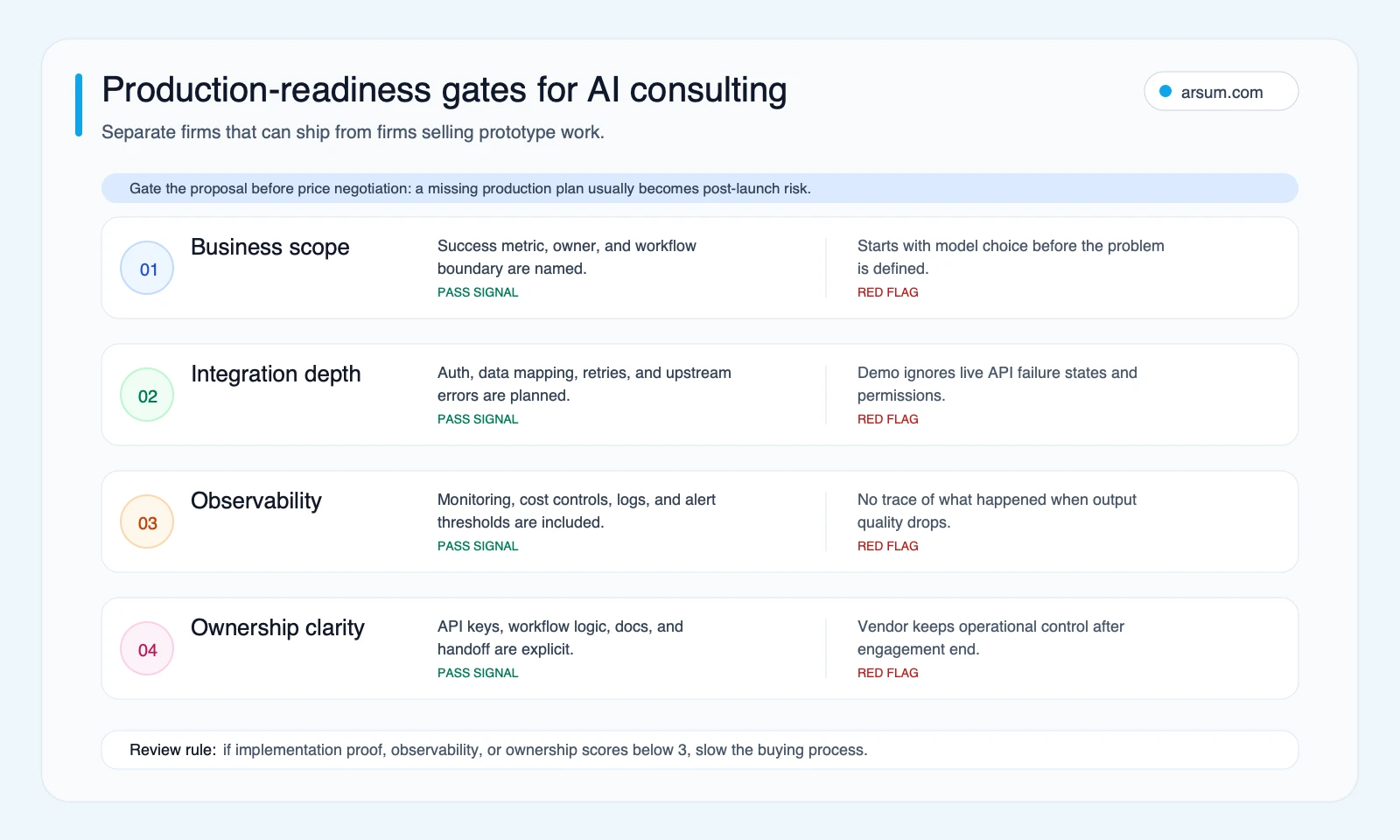
The gates turn the red flags into a proposal review checklist: scope, integration depth, observability, and ownership must be explicit before price negotiation.
Before and After: Two Approaches to the Same Brief
The difference between a commodity engagement and a production-ready one is visible at the scoping stage. Here are two examples across different business functions.
Example 1: Lead Qualification Automation
The brief: A B2B SaaS company wants to automate lead qualification. Inbound leads arrive through a web form. The team wants the system to score each lead, route it to the right sales rep based on region and deal size, and draft a personalized outreach email for rep review before sending.
Approach A: Strategy-led consultancy
The firm runs a two-week discovery engagement and produces a roadmap recommending a CRM integration, a scoring model, and an LLM-based email drafting layer. The roadmap includes a two-by-two prioritization matrix and a phased rollout plan with generic timelines. Implementation is described as Phase 2, scoped separately. The proposal does not name which CRM fields the scoring model will use, how the rep review step will work, or what happens when a lead score cannot be determined.
Outcome: The buyer has a deck. The next engagement is another scoping phase.
Approach B: Implementation-first firm
The discovery call focuses on the existing CRM schema, how reps currently make routing decisions, and what constitutes a strong versus weak lead in practice. The firm identifies that the routing logic depends on three CRM fields and one field that does not yet exist. The proposal specifies a four-week build: CRM webhook integration, a lightweight scoring function using those fields, a routing table the sales manager can update without vendor involvement, and an email drafting agent that queues drafts for rep approval before any email is sent. The proposal includes a model cost estimate ($40 to $90 per month at projected volume), a monitoring setup, and a handoff plan.
Outcome: The buyer has a scoped system, a cost model, and a delivery timeline.
Example 2: Support Ticket Triage
The brief: A mid-market SaaS company handles 800 to 1,200 inbound support tickets per week. Most are repetitive. The team wants the system to classify tickets by issue type and urgency, route them to the right queue, and draft a suggested reply for agent review before sending.
Approach A: Strategy-led consultancy
The firm recommends a classification layer and LLM response assistant in a roadmap document. Phased rollout plan included. No mention of which ticket fields are used for classification, what confidence thresholds govern routing, or what happens when the model is uncertain about a ticket type.
Outcome: A governance framework. Implementation scope defined separately.
Approach B: Implementation-first firm
The discovery review identifies that 80% of inbound tickets fall into six categories. The firm designs a confidence-threshold routing system: auto-route when model confidence exceeds 85%, escalate to a human review queue when it falls below. The proposal specifies a three-week build including a classification layer, routing configuration the support manager can adjust without vendor involvement, a draft-reply queue for agent review before any reply is sent, and a monitor dashboard showing classification accuracy and escalation rates by category.
Outcome: A scoped system with a defined confidence model, a clear escalation path, measurable success metrics, and a dashboard the team owns after handoff.
The difference is not intelligence. It is whether the scoping conversation treats production readiness as part of the initial brief or defers it to a later phase. For a fuller picture of what a delivery-focused engagement includes, AI implementation services describes scope and expectations in detail.
Engagement Models and What They Cost
These ranges are editorial estimates based on mid-market B2B automation engagements. Actual costs vary based on scope depth, governance requirements, number of integrations, model usage, and compliance overhead. Enterprise scopes exceed these ranges substantially.
| Engagement Model | What It Produces | Typical Duration | Cost Range (mid-market estimate) |
|---|---|---|---|
| Discovery and strategy | Scoped plan, architecture recommendation, delivery estimate | 2 days to 8 weeks | $5,000 to $40,000 |
| Fixed-scope delivery | Working production system, documentation, handoff | 4 to 16 weeks | $15,000 to $150,000 |
| Ongoing managed operations | Monitoring, iteration, cost management post-launch | Monthly retainer | $2,000 to $15,000/month |
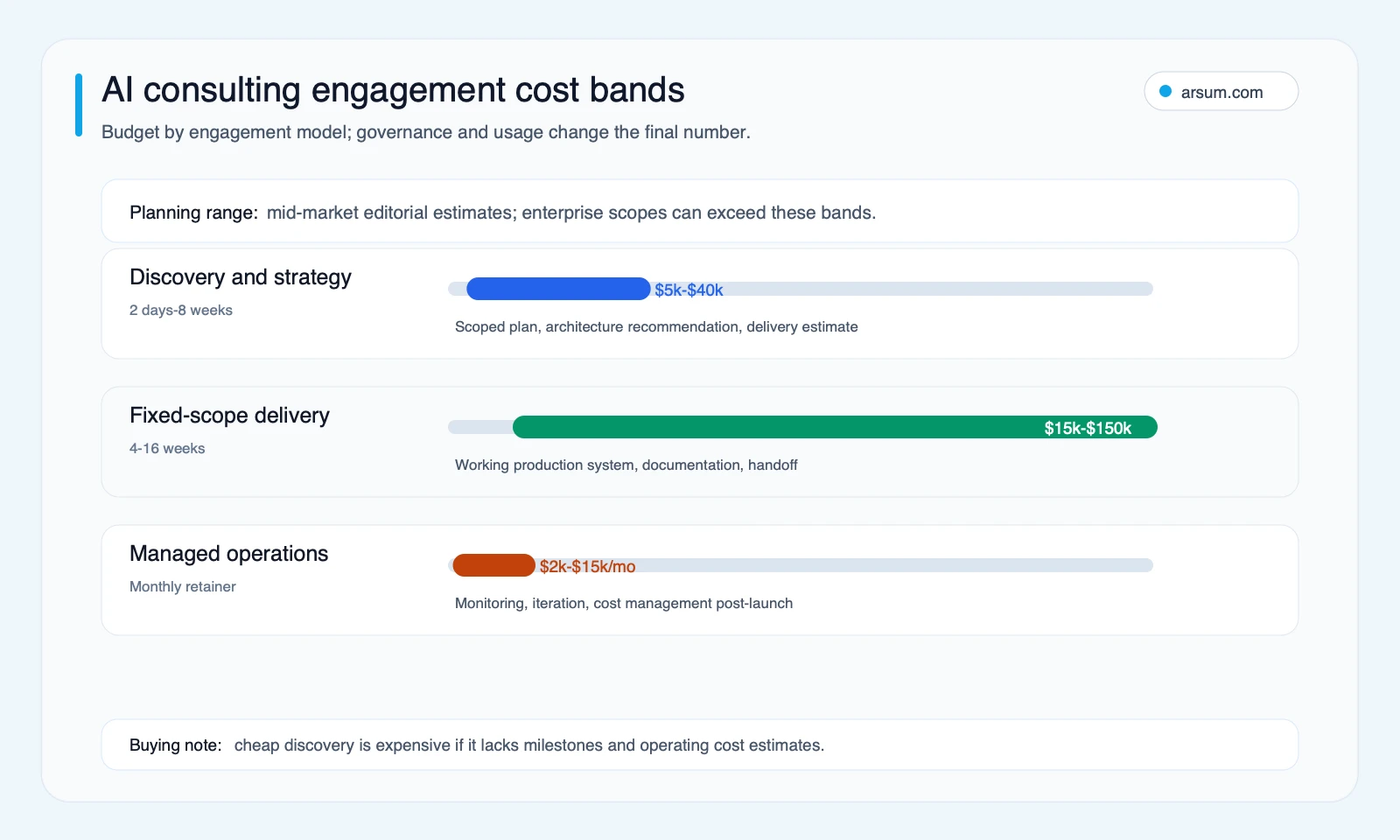
The cost bands separate one-time discovery, production build, and ongoing operations so buyers do not compare a roadmap, a shipped system, and a retainer as if they were the same purchase.
A note on discovery pricing: a discovery engagement that produces a real architecture recommendation, named tools, a delivery timeline with milestones, and a model cost estimate is usually worth the investment. A discovery engagement that produces a maturity assessment and phased roadmap without named components or a delivery estimate is a commodity deliverable at a non-commodity price.
For a detailed breakdown of agency pricing structures, AI automation agency pricing covers the full range.
Original Data: Buyer Scorecard and Proposal Triage Grid
The scoring model below is the original decision tool in this article. Use it to compare firms on production readiness, not presentation quality.
The Buyer Scorecard
Use this scoring model when evaluating candidate firms. Score each dimension from 1 to 5 during the first substantive conversation or scoping call.
| Dimension | What to Look For | Score (1–5) |
|---|---|---|
| Business scoping | Do they define the problem before the solution? | |
| Implementation proof | Can they show shipped production systems, not just decks? | |
| Integration capability | Do they explain how edge cases and upstream errors are handled? | |
| Observability plan | Do they describe monitoring, cost controls, and escalation paths? | |
| Approval design | Are human review gates and escalation built into their process? | |
| Security approach | Do they address permissions, fail-safe defaults, and high-impact action controls? | |
| Ownership clarity | Is post-engagement ownership of the system explicitly defined? | |
| Cost transparency | Do they provide model cost estimates and total cost of ownership? |
A firm scoring below 3 on implementation proof, observability, or ownership clarity warrants additional scrutiny before you progress to a formal proposal.
Run this scorecard before the first proposal, not after. The answers to these questions during a scoping call are more revealing than any proposal document, because proposals are written to score well. The scoping conversation is harder to optimize.
| Total Score | What It Usually Means | Recommended Next Step |
|---|---|---|
| 8 to 16 | Strategy-heavy pitch or vague delivery plan | Ask for a written scope, named delivery team, and post-launch ownership model before progressing |
| 17 to 24 | Potential fit, but production gaps are still visible | Clarify approval design, monitoring, model costs, and exception handling in writing |
| 25 to 32 | Production-minded shortlist candidate | Move to references, commercial review, and a scoped discovery or pilot proposal |
| 33 to 40 | Strong commercial and technical fit on paper | Validate with references and a concrete first milestone before signing |
Google Risk Box: Thin Automation and Scaled Output Risk
If a consulting firm plans to automate content, support replies, lead outreach, or internal documentation with AI, ask how it prevents thin automation from becoming a search, brand, or operations problem. The same controls that protect public content also protect internal workflows from quietly scaling low-trust output.
- Approval boundary: Which outputs require human approval before they are published, sent, or allowed to change a system record?
- Source-of-truth rule: Which claims, prices, and benchmarks must be checked against primary documentation instead of accepted from model output?
- Drift trigger: What threshold forces a prompt, workflow, or model review when output quality starts slipping?
- Named owner: Who can pause the workflow if bad content, bad routing, or bad decisions begin to scale?
If a proposal cannot answer those questions in writing, you are not looking at production readiness. You are looking at a prototype with the quality risk pushed onto your team.
For context on how to compare different hiring paths, hiring an AI developer versus an agency covers the key tradeoffs.
Work With Arsum
We help businesses implement AI automation that actually works. Custom solutions, not cookie-cutter templates.
Learn more →Questions to Ask Before You Hire
Before signing any engagement, ask these directly:
- What does production mean to you, and what is included in the definition?
- Who are the specific people who will work on this project?
- Can you show me a system you shipped that is still running six months later?
- What does your handoff look like and what documentation do you provide?
- How do you handle systems that underperform after launch?
- What is your model cost estimate and how is it managed over time?
- Who owns the system architecture, the API keys, and the workflow logic at the end of the project?
The answers will tell you more than any case study deck.
When a Boutique Implementation Partner Is the Right Fit
Enterprise consultancies are the right choice when you need regulatory cover, board-level credibility, or access to a global delivery network. For most mid-market buyers who need working AI automation in production within a defined timeline and budget, a specialist implementation partner will typically move faster, cost less, and be more directly accountable for delivered outcomes.
The core tradeoff: enterprise consultancies offer institutional credibility, process depth, and broad staffing capacity. Implementation boutiques offer faster contracting, senior delivery teams throughout the engagement (not just in the pitch), and a tighter accountability loop where the people scoping the project are the same ones building it.
For buyers whose primary success metric is a working system in production rather than a governance framework or executive presentation, the boutique model is usually a better commercial fit.
For a comparison of how AI implementation services differ from broader consulting scope, AI implementation services describes what a delivery-focused engagement includes.
Frequently Asked Questions
How do I choose an AI consulting company?
Start with vendor type. Identify whether you need strategy and governance, production implementation, workflow-level automation, or software engineering with an AI component. Then evaluate firms within the right category using business scoping depth, implementation track record, integration capability, and post-launch plan as your primary criteria.
What should I ask before hiring an AI consultant?
Ask who specifically will work on the project, what production-ready systems they have shipped and maintained, how they handle post-launch monitoring and cost management, and what ownership looks like at the end of the engagement. Avoid firms that cannot give direct answers to these questions.
Are boutique AI firms better than large consultancies?
It depends on the buyer’s objective. Enterprise consultancies are strong at governance, regulatory framing, and executive alignment. Boutique implementation firms are faster, more affordable, and more directly accountable for shipped outcomes. For mid-market buyers with defined automation goals and limited timelines, boutique firms are usually the better commercial fit.
What red flags should buyers watch for?
The most significant red flags are: no clear answer on post-launch ownership, model cost estimates absent from proposals, strategy phases with no delivery path, prototype work framed as production readiness, no observable monitoring or approval design in the proposed architecture, and proposals without named senior team members.
How much does AI consulting cost?
These are editorial estimates based on mid-market B2B automation engagements; actual costs vary by scope, governance requirements, and system complexity. Discovery engagements typically run $5,000 to $40,000. Fixed-scope delivery for mid-market automation runs $15,000 to $150,000. Ongoing managed operations range from $2,000 to $15,000 per month. Enterprise scopes go higher. For a detailed breakdown, see AI automation agency pricing.
What is the difference between AI consulting and AI implementation?
AI consulting typically refers to strategy, assessment, and roadmap work. AI implementation refers to building and deploying production systems. Some firms do both. Many strategy consultancies cannot do implementation. Ask which phase of work the engagement covers and whether the same team handles both.
Who owns the system after the engagement ends?
This should be defined explicitly in the contract before you sign. You should own the system architecture, the workflow logic, and the API keys. Any arrangement where the vendor retains operational control or exclusive access to the running system creates dependency risk. Clarify this before the engagement begins, not after.
Ready to Automate Your Business?
Stop wasting time on repetitive tasks. Let AI handle the busywork while you focus on growth.
Schedule a Free Strategy Call →Methodology: Search review for the primary keyword and close variants used current DuckDuckGo HTML result pages to compare how vendor lists, “best firm” roundups, and buyer-guidance articles frame the category. Practitioner signal came from direct review of a public Hacker News discussion plus Reddit snippets that were treated as qualitative signal only because the full Reddit pages were not directly verified during this research pass. Expert references include OpenAI’s practical guide to building agents, Anthropic’s engineering guidance on building effective agents, and the NIST AI Risk Management Framework. Cost ranges are editorial estimates based on mid-market B2B automation engagements and will vary by firm, scope, governance requirements, and geography. Last updated: July 2026.
Written by:Arsum editorial team
- Reviewed by
- Arsum editorial team
- Published
- June 4, 2026
- Updated
- July 3, 2026
- How this was produced
- Arsum uses research packs, source checks, and human editorial review to prepare and update blog articles. Editors are responsible for the final page.
- Source policy
- Sources are linked in the article when used. Methodology and source notes are included on higher-risk or high-visibility pages and are being rolled out across the archive. Editorial policy.
- Why this page exists
- Help B2B operators evaluate AI automation, implementation scope, cost, risk, and build-vs-buy decisions with practical context.