AI consulting services are worth hiring when a valuable workflow has a clear business owner but unresolved choices about data, systems, approvals, evaluation, or post-launch ownership. The buyer’s job is not to find the firm with the broadest AI message; it is to determine whether you need advice, implementation capacity, governance design, or an operating owner for a production workflow.
AI Consulting Services: Buyer Guide
Explore ai consulting services: compare workflow fit, costs, risks, evidence, and practical next steps before you build, buy, or hire.

What separates AI consulting firms that ship from those that deck
Table of Contents
- What Most Guides Miss: Advice, Implementation, and Ownership Are Different Purchases
- What a Production-Ready Engagement Should Cover
- How to Detect a Proposal That Is Still Too Vague to Price
- A Worked Pilot Scorecard for an Exception-Heavy Workflow
- The Vendor Proof Test: Ask for Operating Evidence
- When Not to Hire an AI Consultant Yet
- Choosing the Next Step
- Related Arsum Guides
What Most Guides Miss: Advice, Implementation, and Ownership Are Different Purchases
A proposal can include workshops, architecture slides, a prototype, and a support option without making clear which problem it actually solves. Do not compare those offers as if they are interchangeable.
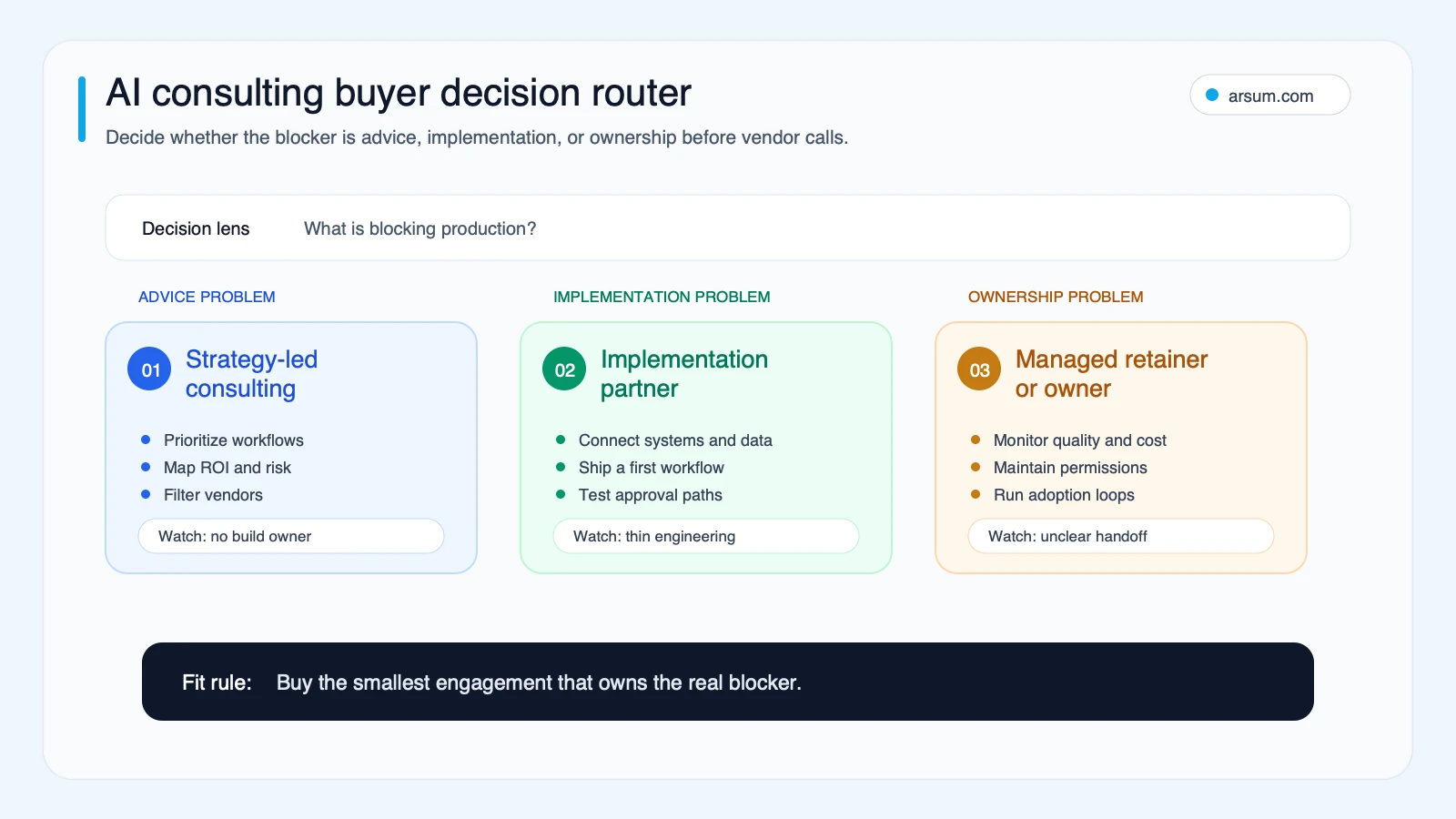
Use this decision rule before vendor calls:
- You have an advice problem if no workflow has a credible owner, measurable value, or agreed priority.
- You have an implementation problem if the workflow is known, but source systems, permissions, exception handling, and acceptance tests are not designed.
- You have an ownership problem if a system can be launched, but nobody is accountable for monitoring quality, spend, permissions, incidents, and changes after launch.
If you cannot name the workflow owner and the action that will change, do discovery before funding a build. If an existing tool handles the workflow and its exceptions well enough, buy and configure software before commissioning a custom system. If the workflow acts across sensitive records or systems, require an architecture and risk review before giving it autonomy.
| Current condition | Likely engagement | Request before signing |
|---|---|---|
| No prioritized workflow with volume, value, and owner | Strategy or discovery | Workflow inventory, prioritization rubric, assumptions, and next-step recommendation |
| Workflow is clear; systems and approvals are unclear | Strategy plus architecture | System map, data-readiness note, permission model, and build backlog |
| Requirements are clear and internal ownership exists | Implementation sprint or development partner | Delivery plan, evaluation suite, integration approach, and handoff plan |
| A commodity product fits the normal and exception paths | Software-first rollout | Configuration plan, data migration plan, and adoption owner |
| A live workflow has no operator after launch | Ongoing AI operations | Monitoring, escalation process, change-control process, and service boundaries |
The important distinction is technical capability versus authorized autonomy. A model may be able to classify a document, draft a response, or propose a next action. That does not mean it should send a payment instruction, reject a claim, alter a customer record, or make a compliance decision without a defined control and accountable approver.
What a Production-Ready Engagement Should Cover
Enterprise providers commonly describe AI work across strategy, data, responsible AI, and implementation. That framing is useful, but it does not prove a particular firm can deliver every layer. See IBM’s AI consulting overview, IBM’s data and AI practice, and Bain’s AI services overview for examples of how large providers frame the category.
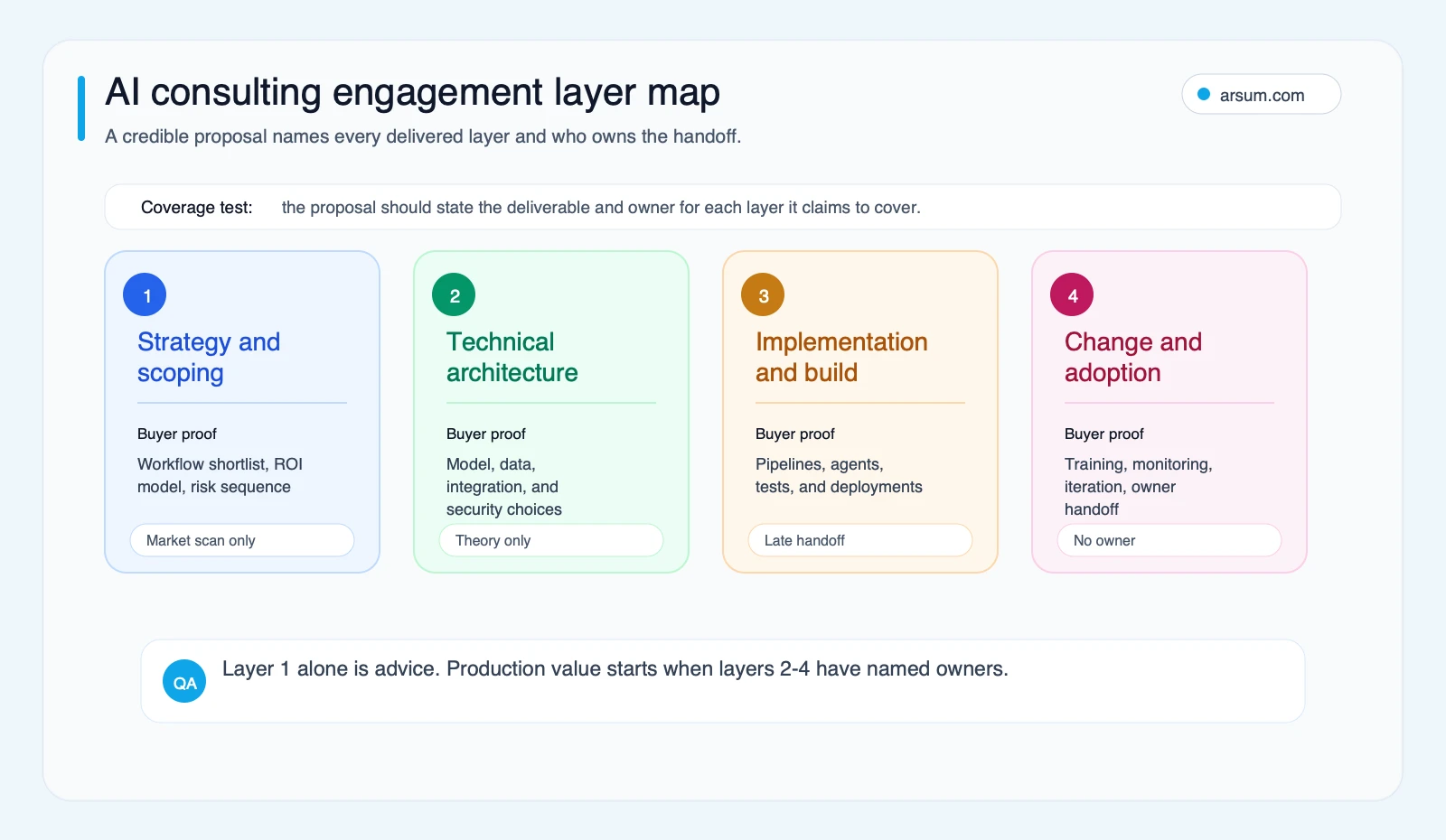
For a buyer, the engagement should make the following coverage explicit.
| Layer | Buyer question | Evidence to request |
|---|---|---|
| Workflow strategy | Which task changes, for whom, and why now? | Workflow map, baseline definition, prioritization logic |
| Data and permissions | What source records, fields, and access rights are required? | Data inventory, lineage notes, permission matrix |
| Architecture | Where do models, tools, rules, integrations, and logs sit? | Architecture diagram, environment plan, named technical lead |
| Implementation | What gets built, tested, deployed, and maintained? | Backlog, acceptance criteria, test plan, release approach |
| Governance | What happens when output is wrong, incomplete, unsafe, or disputed? | Evaluation plan, audit trail, incident path, approval rules |
| Adoption and ownership | Who runs the workflow once consultants leave? | Runbook, training plan, escalation owner, handoff checklist |
The risk-management layer is not optional in consequential workflows. The NIST AI Risk Management Framework describes managing AI risks through governance, mapping, measurement, and management. It is a framework for risk practice, not evidence that a vendor’s system is safe. Ask the vendor to translate those concerns into your workflow’s controls, test cases, evidence retention, and escalation path.
Production architecture also needs more than model selection. Google Cloud’s agentic AI architecture overview highlights decisions around agents, tools, deployment, and system boundaries. Treat that as a prompt for vendor questions, not a generic architecture template.
Engagement Types Are Not a Vendor Taxonomy
Many firms combine advisory and delivery. Some development teams also provide excellent discovery; some consultancies have strong engineering practices. Screen the proposed team and artifacts rather than accepting a binary “consultant versus agency” label.
| Engagement type | Appropriate when | Main buyer risk |
|---|---|---|
| Strategy-only | Priorities and internal decision rights are unresolved | Paying for a roadmap that cannot be executed |
| Strategy plus architecture | The workflow matters, but systems and controls need design | Mistaking an architecture for a delivery commitment |
| Implementation sprint | Scope is narrow and success criteria are testable | Treating a demonstration as production readiness |
| Full-cycle build and rollout | You need discovery, delivery, training, and handoff | Undefined ownership creating ongoing dependency |
| Operating support | A live system needs controlled iteration | Open-ended work without measurable service boundaries |
For a detailed comparison of implementation-oriented options, see AI implementation services and AI development services.
How to Detect a Proposal That Is Still Too Vague to Price
Do not ask a vendor for a universal price or calendar promise. Ask for a scoped estimate whose assumptions you can challenge.
A useful proposal separates:
- the workflow and eligible case types;
- systems to read from and write to;
- data cleanup, access approvals, and dependencies;
- deterministic rules versus model-assisted steps;
- exception classes and human review effort;
- evaluation datasets and acceptance thresholds;
- security, audit, and incident requirements;
- rollout sequence, training, and post-launch ownership;
- exclusions and change-control rules.
Cost and elapsed time change with those variables. A document-triage pilot with read-only access, one source system, and a required human approval is materially different from a workflow that updates multiple systems, makes customer-facing decisions, or handles regulated data. A proposal should make that difference visible rather than hiding it inside a blended “AI transformation” scope.
Illustrative Planning Arithmetic, Not a Forecast
Use simple arithmetic to test whether a pilot deserves further scoping. For example, assume a team processes 1,000 eligible requests per month. Each currently takes 12 minutes of staff effort. A proposed system is designed to reduce handling time by 4 minutes on cases that pass its quality and review rules.
Illustrative monthly capacity affected:
1,000 eligible requests × 4 minutes = 4,000 minutes
That equals about 66.7 hours of potential handling capacity before deducting new review, exception, monitoring, and change-management work. The business case is not “66.7 hours saved.” It is:
(eligible volume × verified time change × fully loaded value of time) − review cost − operating cost − implementation cost
Use your own baseline and finance assumptions. Do not approve a project based on generic ROI claims, headcount assumptions, or a model demo.
💡 Arsum builds custom AI automation solutions tailored to your business needs.
Get a Free Consultation →A Worked Pilot Scorecard for an Exception-Heavy Workflow
A controlled pilot is usually a better purchase than a broad mandate to “use AI.” The example below is an illustrative finance-operations workflow, not an observed client result.
Example: Invoice Intake and Coding Recommendation
The system receives supplier invoices, extracts fields, proposes coding, and routes the record. It does not release payment. Existing accounting controls remain in force.
| Scorecard item | Illustrative definition |
|---|---|
| Workflow owner | Accounts payable manager |
| Executive sponsor | Controller |
| Baseline | 800 invoices per month; record current handling minutes, rework rate, and queue age for four weeks |
| Eligible cases | Invoices from approved vendors with standard formats and existing purchase-order linkage |
| Ineligible cases | New vendors, missing purchase orders, duplicate indicators, unusual amounts, tax ambiguity, or conflicting account data |
| Model-assisted action | Extract fields and recommend coding and route |
| Deterministic controls | Vendor validation, duplicate checks, threshold rules, mandatory fields, and system permissions |
| Human approval | AP reviewer approves every pilot recommendation before posting |
| Evidence retained | Source document ID, extracted values, recommendation, reviewer decision, reason code for overrides, timestamp, model/version identifier |
| Quality metric | Agreement with reviewer-approved final coding on the pre-agreed evaluation sample |
| Exception metric | Percentage routed to review because of missing data, low confidence, rule conflict, or policy trigger |
| Review cadence | Weekly operations review; monthly sponsor review |
| Stop condition | Material control breach, unexplained quality deterioration, missing audit evidence, or review workload exceeding the agreed operating limit |
| Rollback owner | AP manager, with IT owner responsible for disabling the workflow and restoring the prior queue process |
| Go/no-go threshold | Agreed quality and exception thresholds are met for the defined evaluation period without a control breach; sponsor signs off on operating cost and ownership |
The pilot should test the normal path and the ugly path. A supplier name mismatch, a duplicate invoice, a missing purchase order, an unusual amount, and a disputed coding recommendation are not edge details; they are part of the system’s real operating boundary.
This is also why a workflow may be technically suitable but commercially unsuitable for autonomy. High failure cost, poor reversibility, or unclear accountability should lead to more review and narrower permissions—not a more ambitious automation claim. Related patterns appear in accounts receivable automation and AI automation for controllers.
The Vendor Proof Test: Ask for Operating Evidence
A polished strategy presentation is not evidence of delivery readiness. In each shortlisted vendor conversation, ask for proof that maps to your engagement type.
- Who is the named technical lead, and will that person participate before the statement of work is signed?
- Can the team show a comparable shipped system, with confidential details appropriately removed?
- What data is required, where does it originate, and which permissions must be granted?
- How will outputs be evaluated before and after release? Ask for sample failure cases, not only target metrics.
- Which decisions are read-only, human-approved, or allowed to execute automatically?
- What logs, source lineage, review records, and incident evidence will be retained?
- How are security review, prompt or model changes, vendor changes, and access changes handled?
- What is the fallback if an integration fails, quality drops, or a policy boundary is crossed?
- What does your internal team own at handoff: code, configurations, environments, documentation, evaluation assets, and operating runbooks?
- Can the vendor provide relevant customer references who can discuss handoff and operational support?
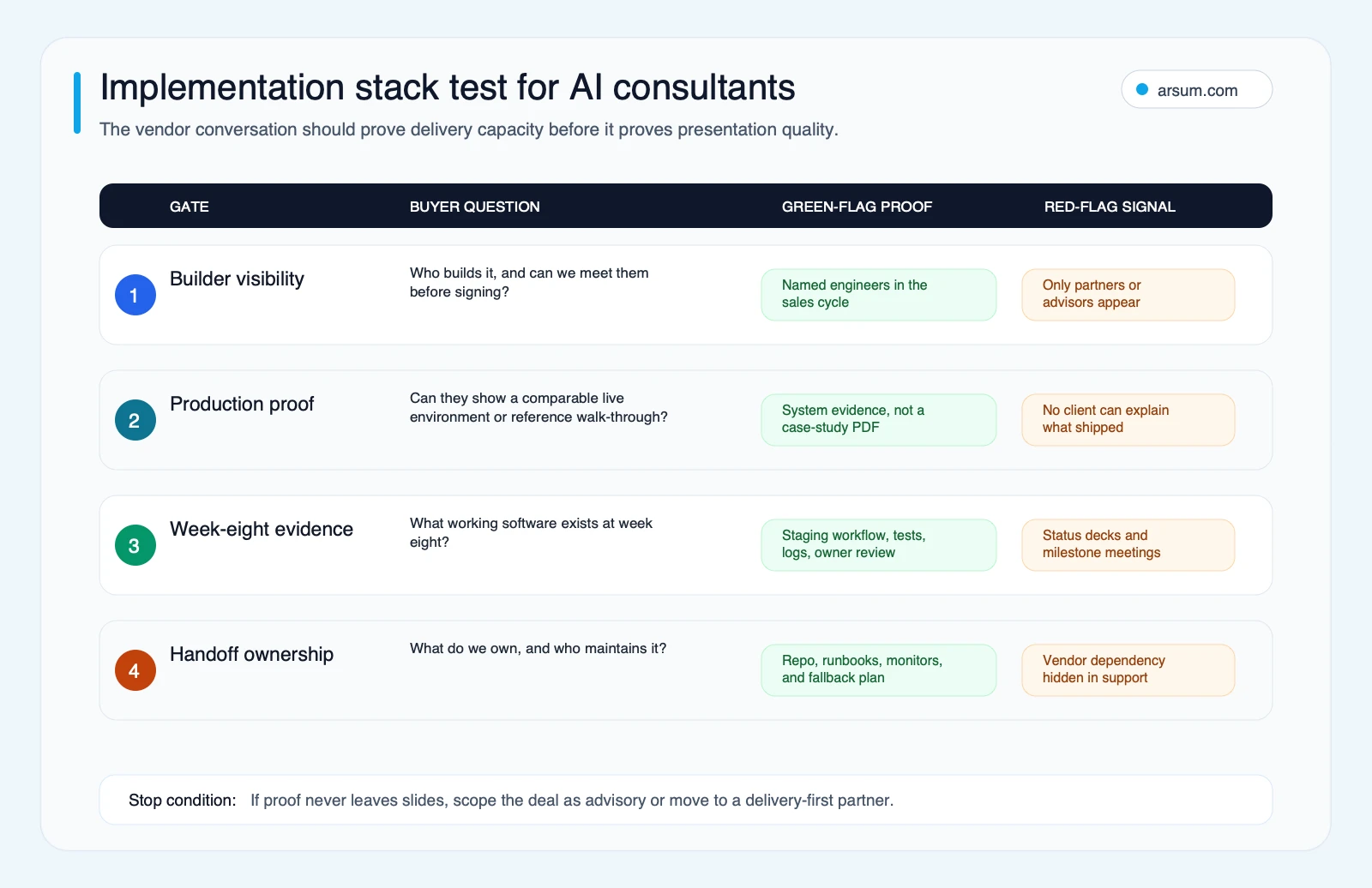
A vendor does not need to disclose another customer’s confidential system to answer these questions. They do need to explain their method, artifacts, team roles, and boundaries concretely.
Qualitative discussions in r/consulting, another consulting thread, and r/smallbusiness reflect skepticism about vague AI consulting claims. These are snippet-level buyer-language signals, not evidence about the overall market. Their practical value is that they reinforce the need for proof over branding.
When Not to Hire an AI Consultant Yet
Pause before hiring if any of these conditions apply:
- No operational owner can make decisions about exceptions, policy, or adoption.
- The team cannot provide lawful, usable access to the needed records and systems.
- The workflow’s baseline volume, handling cost, error cost, or cycle-time problem is unknown.
- A conventional process fix or established SaaS tool solves the need with lower control burden.
- The intended action is difficult to reverse and no approval design exists.
- The project is being justified by “AI strategy” without a named workflow and measurable acceptance criteria.
- The organization cannot staff review, incident response, and post-launch ownership.
In those cases, a short internal discovery effort may be enough. For workflow selection and sequencing, review AI process automation, AI workflow automation tools, and AI automation ROI examples.
Choosing the Next Step
Choose strategy help when you need a defensible workflow decision. Choose an implementation-led engagement when the workflow, owner, and acceptance test are already known. Choose governance and architecture work before rollout when the system crosses sensitive data, approval, or action boundaries. Choose ongoing support only after defining who owns the live workflow internally and what the partner is accountable for operating.
The most useful AI consulting services engagement leaves you with more than recommendations: a bounded workflow, a tested control model, visible evidence, a named internal owner, and a clear decision about whether to expand, revise, or stop.
Ready to Automate Your Business?
Stop wasting time on repetitive tasks. Let AI handle the busywork while you focus on growth.
Schedule a Free Strategy Call →Related Arsum Guides
Written by:Arsum editorial team
- Reviewed by
- Arsum editorial team
- Published
- May 10, 2026
- Updated
- July 3, 2026
- How this was produced
- Arsum uses research packs, source checks, and human editorial review to prepare and update blog articles. Editors are responsible for the final page.
- Source policy
- Sources are linked in the article when used. Methodology and source notes are included on higher-risk or high-visibility pages and are being rolled out across the archive. Editorial policy.
- Why this page exists
- Help B2B operators evaluate AI automation, implementation scope, cost, risk, and build-vs-buy decisions with practical context.