Most startup founders evaluating AI consulting end up reading content written by the vendors selling it. That is a structural problem. The people explaining what AI consulting includes are the same people quoting you for the engagement, which means the buyer-side questions rarely get answered in those articles.
This guide is written from the buyer side. It covers when outside AI consulting is actually worth paying for, what a realistic scope looks like at each stage, which workflows to prioritize first, how to score a candidate automation before hiring anyone, and what separates a firm with genuine implementation depth from one built around no-code demos.
At a Glance: AI Consulting for Startups
When it makes sense: AI consulting is worth paying for when a workflow requires judgment, connects to internal systems holding sensitive data, and the cost of a production failure exceeds the cost of proper implementation.
Typical cost range: Discovery sprints run $5,000 to $15,000. Pilot builds range from $15,000 to $60,000. Production hardening adds $10,000 to $40,000 on top. From first call to a live workflow: most engagements take 10 to 20 weeks.
Decision frame: Score candidate automations on judgment intensity, reversibility, and data sensitivity before engaging anyone. Most startup automation needs can be met with SaaS tooling or deterministic scripting. Custom AI consulting is justified when at least two of those three criteria score high.
Source-backed: Anthropic’s published guidance on building effective agents recommends finding the simplest solution possible and notes that agentic systems trade latency and cost for flexibility in ways not always visible at the demo stage. NIST’s AI Risk Management Framework identifies ongoing evaluation as a required part of the AI lifecycle, not a one-time launch checklist.
Operator Note: Arsum works with B2B founders and operators on production AI automation. The framing in this article reflects what we see in real engagements, not just theoretical advice: which scoping questions matter, where projects expand unexpectedly, and what buyers consistently wish they had asked before signing.
Want to automate this for your business? Let's talk →
What Most Guides Miss
The dominant framing across vendor-authored AI consulting guides is benefits and use cases. What they consistently skip is the production gap: the distance between a working prototype and a system that can run on live business data without corrupting records, triggering duplicate actions, or producing undetected failures.
Once AI automation touches shared systems, the primary constraint shifts from model capability to operational reliability. A consulting engagement that does not explicitly scope logging, approval gates, rollback logic, and permission boundaries has not been scoped for production. It has been scoped for a demo.
That gap is where most startup AI projects stall, not in the ideation phase. Any guide that spends more time on use cases than on production requirements is written for the awareness stage, not for a buyer who is ready to sign.
Decision Tree: Hire, Build In-House, or Buy Software?
Before evaluating any consulting firm, work through this decision tree. Most startup automation needs do not require a consultant, and knowing your position before you start the sales process prevents a lot of wasted time.
Step 1: Does a SaaS product already solve this in configuration? If yes, use it. No consultant needed. Zapier, HubSpot workflows, Intercom rules, and similar tools cover a large fraction of startup automation needs at a fraction of the cost of custom implementation.
Step 2: Is the workflow rule-based with clean, structured inputs? If yes, consider deterministic scripting or a lightweight integration before scoping an AI solution. Custom AI adds cost and maintenance surface for problems that do not require probabilistic reasoning.
Step 3: Does your internal team have the technical capacity to build and own this? If yes, internal implementation is usually the right call for medium-complexity workflows. Build time is higher, but you retain full ownership and reduce handoff risk.
Step 4: Does the automation require judgment, handle ambiguous inputs, connect to internal systems that hold sensitive data, or produce outputs where errors have real business consequences? If yes to any of these, outside AI consulting is likely worth evaluating. This is the zone where off-the-shelf tools cannot be configured to match your specific logic, and where the cost of a production failure exceeds the cost of proper implementation.
Step 5: Does your team have the capacity to evaluate what is being built, manage the engagement, and own the system after delivery? If no, factor that gap into vendor selection. A firm that delivers without training your team to own the output creates a dependency, not an asset.
Most startups moving from Step 1 through Step 5 land in one of three positions: SaaS tooling is enough, a small internal build is practical, or the problem is genuinely complex enough to justify a consultant. The scorecard below gives you a numeric way to locate that boundary.
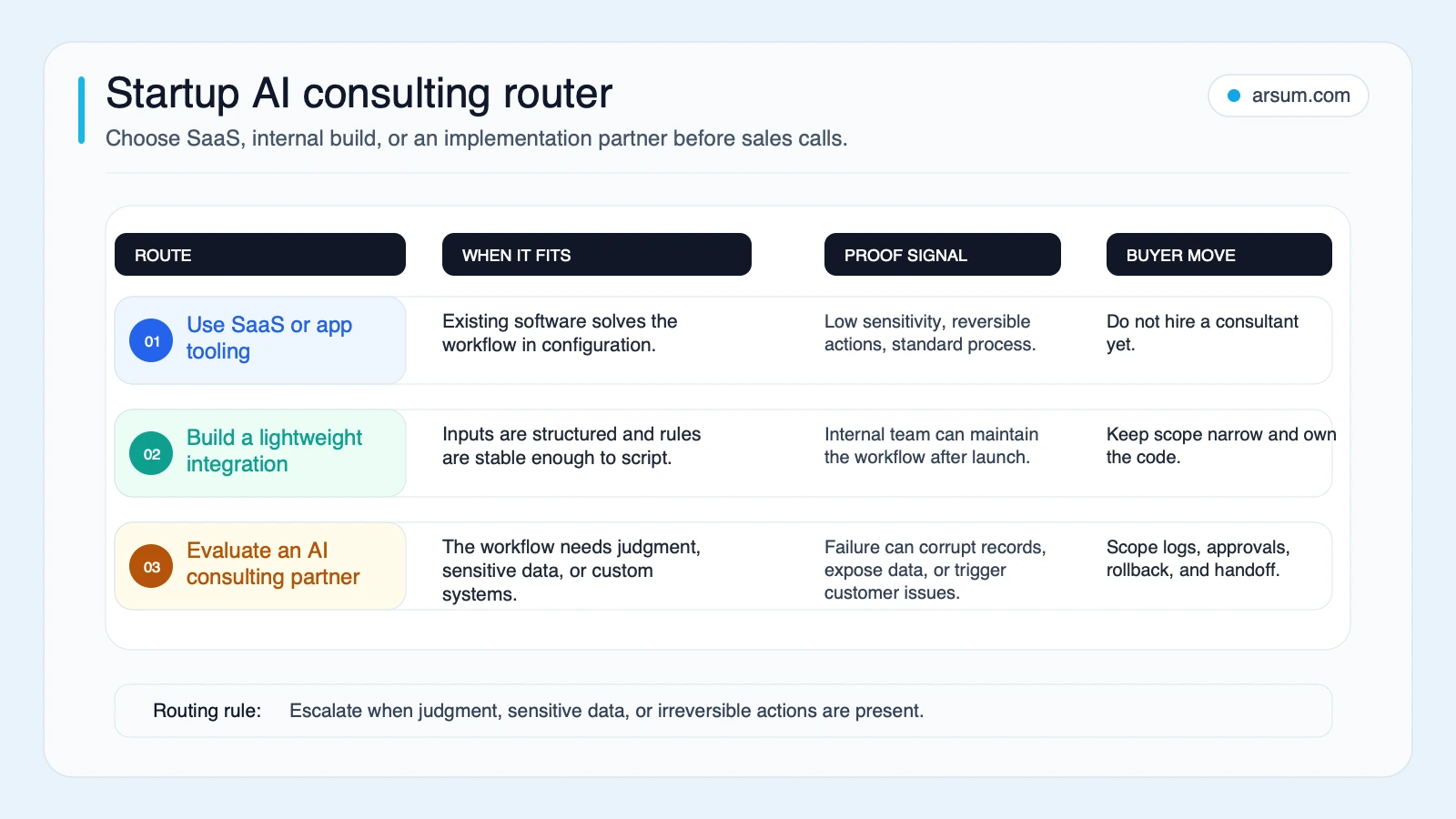
Use this router before vendor conversations: SaaS is enough for standard reversible workflows, internal builds fit stable structured logic, and consultants make sense when judgment, sensitive data, or irreversible actions raise the failure cost.
What AI Consulting for Startups Actually Includes
The term covers a wide range of services, and scope varies significantly depending on the firm and the stage of the engagement. The clearest way to compare proposals is to understand which phase you are being quoted for.
| Stage | Typical Duration | Deliverable | Key Risk |
|---|---|---|---|
| Discovery sprint | 2 to 4 weeks | Prioritized automation roadmap, scope document | Insight without execution; cost of change if gaps found late |
| Pilot build | 4 to 8 weeks | One working workflow in a staging environment | Scope creep; data readiness surprises; model accuracy gap |
| Production hardening | 2 to 6 weeks | Live system with logging, approval gates, rollback | Underestimated by most vendors; where budgets expand |
| Managed iteration | Ongoing | Monitoring, model updates, workflow adjustments | Retainer dependency vs true ownership handoff |
Understanding which phase you are being quoted for is the single most clarifying question you can ask before signing a contract. Many startup AI projects stall not because the pilot failed but because the production hardening phase was never scoped or priced.
Anthropic’s published guidance on building effective agents is direct on this point: the simplest solution is usually the right starting point, and agentic systems trade latency and cost for flexibility in ways that are not always obvious at the demo stage. That tradeoff should be visible in any credible proposal.
When Hiring a Consultant Is Worth It
Outside AI consulting makes sense when the problem has real complexity that existing SaaS tools cannot address with configuration alone.
If your automation need fits within an existing product, such as a CRM workflow builder, a Zapier chain, or a basic support chatbot, you probably do not need a consultant. The economics do not work: you are paying for implementation expertise that is already packaged in the product.
Hiring a consultant makes sense when:
- You are connecting AI to internal systems that hold sensitive business data, such as CRMs, ERPs, financial records, or communication logs
- The workflow involves judgment calls, exceptions, or branching logic that a deterministic script cannot reliably handle
- Getting it wrong has real business consequences: corrupted records, customer-facing failures, or compliance exposure
- Your team does not have the technical depth to evaluate what is being built or to own it after handoff
The clearest signal that you need outside help is when you can describe the outcome you want but have no credible internal path to building it in a reasonable timeframe.
Startup Workflow Scorecard
Before engaging any consultant, score your candidate automation against these six criteria. This scorecard helps decide whether you need SaaS tooling, deterministic automation, or a custom AI implementation.
| Criterion | Low (1) | Medium (3) | High (5) |
|---|---|---|---|
| Judgment intensity | Rule-based, no exceptions | Some edge cases needing context | Requires interpretation of ambiguous inputs |
| Exception rate | Rare; clean structured data | Occasional; some manual handling needed | Frequent; high variance inputs or outcomes |
| Reversibility | Fully reversible with no side effects | Partially reversible; audit trail required | Irreversible or high-cost to undo |
| Data sensitivity | Public data only | Internal business data | Customer PII, financial records, regulated data |
| Required approvals | None; fully automated | Human-in-loop for exceptions | Every output reviewed before action |
| Payback window | Under 3 months based on time saved | 3 to 12 months | Over 12 months or hard to quantify |
How to read the score:
- 6 to 12: SaaS tooling or no-code automation is likely sufficient
- 13 to 20: Deterministic scripting or simple AI integration; consultant optional
- 21 to 30: Custom AI implementation is justified; consultant scope makes sense
High scores on judgment intensity, reversibility, or data sensitivity are the clearest signal that you need an implementation partner, not just a software subscription. See AI consulting services for how mature engagements are typically structured, and AI implementation services for what the pilot-to-production path should include.
Common Workflows Startups Automate First
Not all automation projects carry the same complexity and risk. The workflows that get automated first tend to share a structural characteristic: a human already reviews or approves the output before it reaches a customer or a critical system. That approval layer limits the blast radius of a model error.
Revenue operations: Lead qualification routing, outreach personalization, deal stage updates based on email or meeting activity, and CRM enrichment from public data sources. These workflows have clear inputs, measurable conversion baselines, and reversible errors.
Content and communications: Summarizing long threads, drafting follow-up messages, extracting action items from meeting transcripts, and formatting internal documentation. High repetition, low judgment intensity, and easy human review.
Support and triage: Classifying inbound tickets, routing to the right team, and generating first-response drafts for common query types. Volume justifies automation; errors are visible and correctable before they escalate.
Internal research and synthesis: Aggregating data from multiple sources, formatting for review, and surfacing relevant records on demand. Low consequence for individual errors; human reviews the output before acting on it.
For a broader view of how these fit into a connected workflow strategy, agentic AI workflow automation covers how multi-step agent systems are structured in production.
Original Data: Before/After Lead Qualification at a B2B SaaS Startup
Before: An SDR team manually reviewed every inbound trial signup, pulled LinkedIn data, checked company size, and wrote a personalized initial email. Average time per lead: 22 minutes. Coverage: 60% of inbounds actually received follow-up within 24 hours.
After: An AI workflow scored each inbound against ICP criteria using enriched firmographic data, routed high-fit leads to senior SDRs with a pre-drafted email, and deprioritized low-fit leads automatically. SDR time per qualified lead dropped to under 5 minutes. Coverage reached 98% within 4 hours of signup. The SDR team shifted time from research to relationship development.
The key constraint that made this work: every output was reviewed before sending. The AI drafted; a human sent. That approval layer made the system practical before it was tuned to high accuracy.
Startup AI Consulting Scope Ladder
Use this table to separate a cheap prototype from a production-ready engagement before you sign anything.
| Engagement stage | What you should receive | Who should own it | What usually gets missed |
|---|---|---|---|
| Discovery sprint | Ranked workflow opportunities, data-readiness audit, success metrics, and a written recommendation on buy vs build vs consultant scope | Consultant leads, founder or operator signs off | Teams leave with ideas but no hard decision on what not to automate yet |
| Pilot build | One narrow workflow in staging, test cases, review checkpoints, and a measured baseline for speed or labor savings | Consultant builds, internal operator reviews every output | Vendors present a clean demo without exception handling or a rollback plan |
| Production hardening | Logging, approval gates, scoped credentials, rollback steps, incident owner, and handoff documentation | Shared ownership during launch, internal team named before go-live | This is where budgets expand if access control, tracing, or messy source data were ignored in discovery |
| Managed iteration | Weekly review cadence, drift monitoring, retraining or prompt updates, and a named owner for backlog decisions | Internal team if possible, consultant only if support scope is explicit | Retainers quietly replace ownership when the client never gets a real handoff |
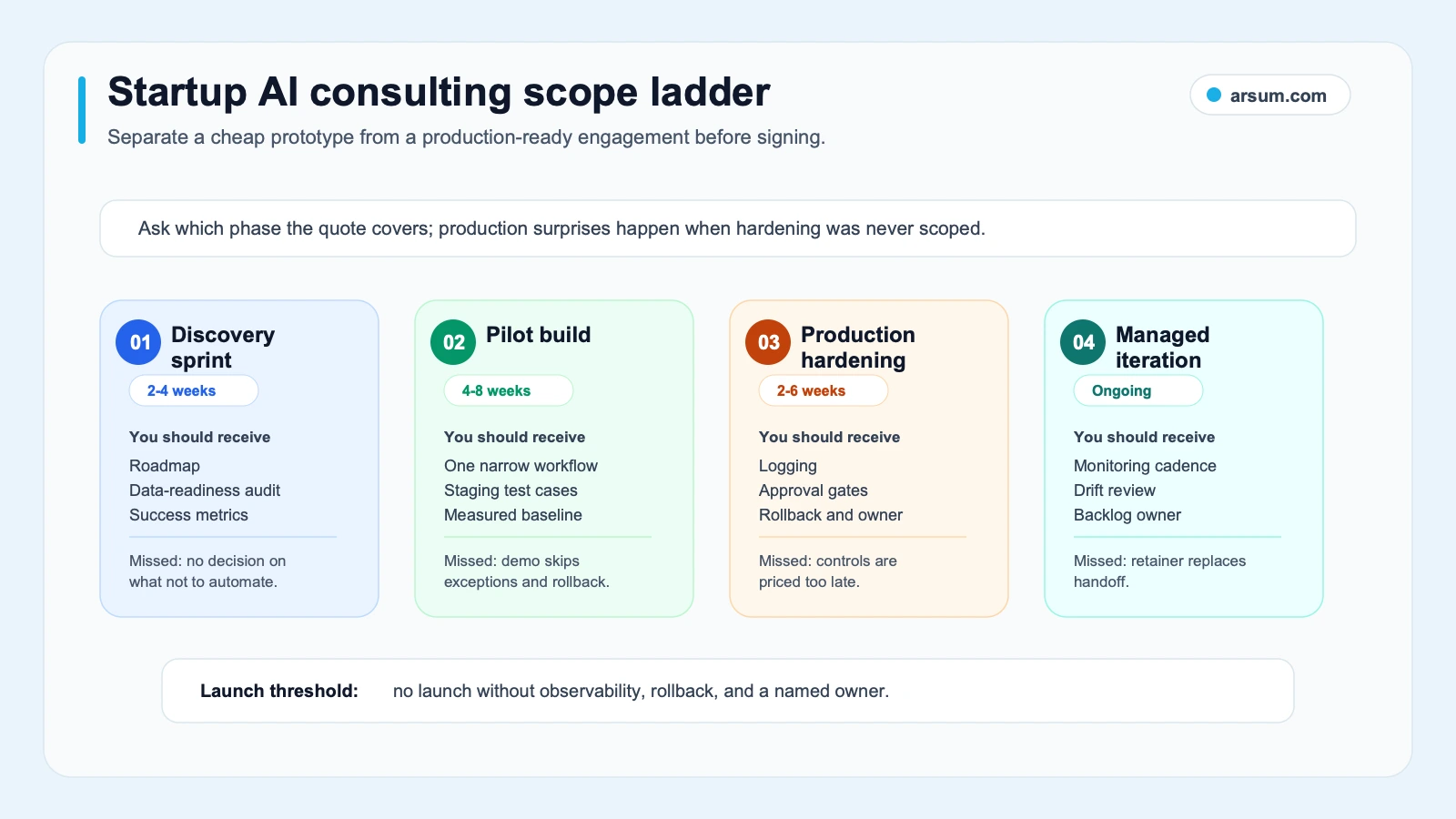
The ladder makes the hidden production phases visible: discovery and pilot work are not enough unless production hardening and ownership handoff are scoped as explicit deliverables.
What Founders Are Actually Worried About Right Now
The buying friction around startup AI consulting is usually not model quality in the abstract. It is whether the proposed system can touch real company data, survive messy operations, and avoid turning into open-ended consulting dependence.
Practitioner Signal: Public founder and builder discussions reviewed on 2026-06-25 kept clustering around four recurring objections: who gets database access, whether the vendor is really a product or just custom consulting with better branding, how production reliability holds up after the demo, and whether enterprise buyers will force a self-hosted or tightly controlled deployment once internal data is involved. These are qualitative market signals, not statistical benchmarks, but they are useful buyer-side stress tests.
Use those objections in discovery calls:
- Data boundary first. Ask whether the workflow needs primary-database access, a read replica, or a warehouse copy, and how PII is prevented from leaking into prompts or logs.
- Product versus consulting honesty. If a firm keeps talking about a reusable platform, ask which parts are packaged and which parts are still custom implementation for your exact workflow.
- Reliability after the demo. Ask what happens when the model output is wrong three times in a row, an upstream API changes, or a human approval step is skipped by accident.
- Deployment model realism. If your team or your customers will not accept vendor-managed defaults, confirm early whether the scope assumes private hosting, extra security review, or a narrower integration path.
💡 Arsum builds custom AI automation solutions tailored to your business needs.
Get a Free Consultation →Cost, Timeline, and ROI Drivers
AI consulting for startups ranges from a short discovery sprint in the low four figures to a full production implementation in the mid-five to six-figure range, depending on scope, data readiness, and integration complexity.
The factors that expand cost most often are not the AI model. They are the infrastructure around it.
Data readiness. If your business data is scattered across multiple tools, inconsistent in format, or requires significant cleanup before the AI can use it, timeline and cost both expand. This is the most common scope surprise in early-stage engagements.
Integration depth. Connecting an AI workflow to a modern REST API is straightforward. Connecting it to a legacy database, an on-premise system, or a poorly documented internal tool adds meaningful engineering time.
Approval and compliance requirements. Any workflow touching customer data, financial records, or regulated information requires additional architecture: scoped permissions, audit trails, and access controls. OpenAI’s published guidance on agent tracing describes this at a technical level, where production systems are expected to record tool calls, handoffs, guardrail events, and exceptions for debugging and accountability.
Post-launch ownership model. A system handed off to an internal team with limited AI experience requires more documentation, training, and ongoing support than one maintained by the firm that built it. NIST’s AI Risk Management Framework explicitly identifies ongoing evaluation and trustworthiness assessment as part of the AI development lifecycle, not a one-time launch checklist.
ROI is clearest when you can measure a quantifiable baseline before the project starts: hours spent per week, conversion rate, error rate, or response time. Projects without a measurable before-state rarely produce a credible ROI figure afterward. For benchmarks across engagement types, see AI automation ROI examples.
How to Evaluate AI Consulting Vendors
The market for startup AI consulting has grown faster than the quality controls around it. A significant concern shared by buyers evaluating agencies is the difficulty of distinguishing firms with genuine engineering depth from those built around no-code automation tools, outsourced delivery, or shallow implementation experience that looks credible on a sales call.
Commodity vs Non-Commodity Breakdown
| Provider Type | Speed to Demo | Engineering Depth | Production Reliability | Handoff Quality |
|---|---|---|---|---|
| AI consulting firm (implementation focus) | Moderate | High: custom architecture, in-house engineers | High: logging, testing, rollback designed in | Strong: documentation, training, ongoing access |
| Generic software agency | Slow | Moderate: general dev skills, AI as add-on | Variable: depends on team experience | Moderate: standard delivery practices |
| No-code automation shop | Fast | Low: tools-dependent, limited custom logic | Low: brittle at scale or under edge cases | Weak: hard to extend, vendor lock-in risk |
| In-house implementation | Variable | Variable: depends on existing team | Variable: depends on resourcing and oversight | Full ownership but higher ongoing cost |
The firms that are worth hiring can describe production architecture concretely: how errors are caught before they reach a live system, how permissions are scoped to limit damage from a model mistake, how rollback works, and who owns the system after launch.
OpenAI’s guardrails documentation describes a category of pre-execution checks that can block a tool call before it happens. That is the kind of implementation detail a serious firm should be able to speak to directly.
Consultant Diligence Checklist
Use this checklist before signing any AI consulting engagement. If you need a broader vendor-screening framework before final selection, review AI consulting firms alongside the checklist below.
- Architecture ownership. Who writes the code? Is it an internal team or subcontractors? Will you have source code access?
- Data readiness assessment. Does the discovery sprint include a structured audit of your data sources and quality before scoping the pilot?
- Traceability and logging. How are model decisions, tool calls, and workflow handoffs recorded? What does debugging look like if an error reaches a live system?
- Rollback and incident plan. What happens if the AI workflow makes a systematic error after launch? Who is responsible, and how is it contained?
- Permission boundaries. How does the system limit what the AI can act on? Are credentials scoped to the minimum required access, and is there a revocation plan?
- Evaluation criteria. How will you measure whether the pilot is working before deciding to expand scope?
- Post-launch ownership. Who maintains the system after delivery? What documentation, training, and access are included?
- Past implementation reference. Can the firm walk through a past engagement from discovery to launch, including what went wrong and how it was resolved?
Firms that struggle to answer these questions concretely are typically selling strategy, not systems. For pricing benchmarks across engagement models, see AI automation agency pricing.
Production-Hardening Sign-Off Card
Before you treat a pilot as implementation-ready, ask the consultant to hand back this sign-off card in writing. It turns vague production language into named deliverables you can approve or reject.
| Production requirement | What a credible answer looks like | Why it matters before go-live |
|---|---|---|
| Logging and traceability | Named logs for model outputs, tool calls, approval events, and publish actions | You need a fast way to debug failures without reconstructing the workflow from memory |
| Approval gates | Exact steps where a human must review risky outputs, plus who owns the approval | Prevents a pilot from quietly becoming blind automation on live data |
| Scoped credentials | Least-privilege access, separate environments, and a revocation plan | Limits the blast radius if the model or workflow takes the wrong action |
| Rollback path | Specific steps to reverse a bad write, restore the previous state, or stop the workflow quickly | A system is not production-ready if it can act but cannot recover |
| Incident owner | One named team or role responsible for investigating and containing failures after launch | Shared ownership sounds nice until something breaks at 2 a.m. |
| Handoff artifacts | Runbooks, source access, test cases, and maintenance boundaries | Without these, you are buying dependency rather than a durable capability |
If a proposal cannot answer every row above, treat it as a pilot or discovery sprint, not as production scope.
Demo-First Proposal vs Production-Scoped Proposal
A lot of startup buyers get quoted for “AI strategy + pilot” and assume production readiness is included. It usually is not. Use this comparison before you approve budget.
| Proposal style | Sounds good in the pitch | Missing risk if you sign it as-is | Better buyer expectation |
|---|---|---|---|
| Demo-first | Fast pilot, visible prototype, light integration | No named owner for incidents, no rollback path, no traceability, weak handoff | Treat as a learning sprint only, not as production delivery |
| Production-scoped | Slower start, more discovery questions, explicit constraints | Higher upfront cost and more stakeholder review | Better fit when the workflow touches revenue, customer data, or irreversible actions |
If a proposal promises speed but cannot name the logging, approval, rollback, and ownership artifacts you will receive, it is still priced like a prototype even if the sales language sounds enterprise-ready.
Common Buying Mistakes Startups Make
- Hiring for a vague “AI transformation” outcome instead of one measurable workflow with a baseline.
- Letting the vendor skip data-readiness work and discovering source-of-truth problems halfway through the pilot.
- Treating approval logic and rollback as launch details instead of signed deliverables.
- Accepting a retainer before the team knows who will own the system internally after handoff.
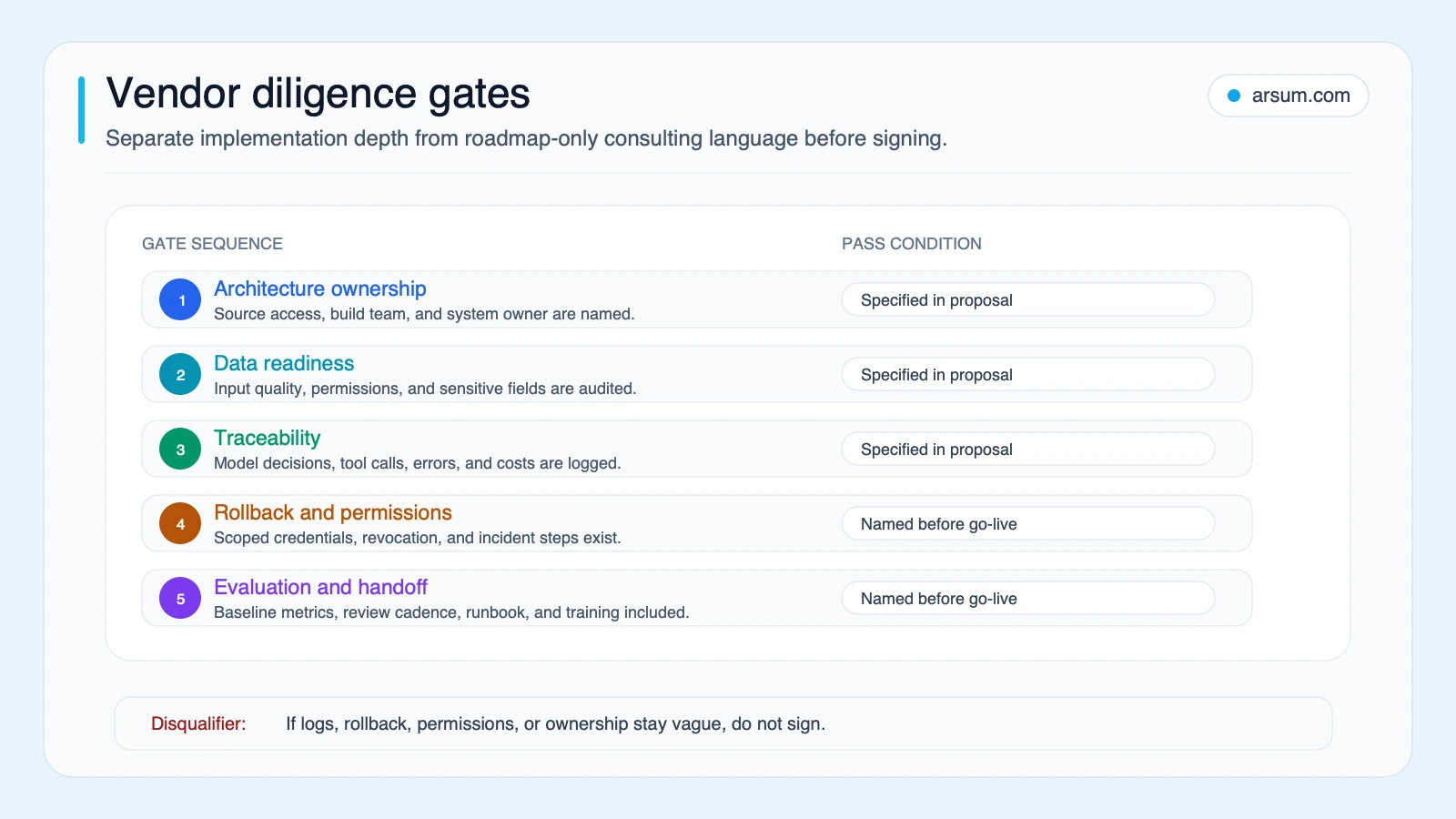
Use these gates as a pre-sign checklist: a startup should see concrete answers for ownership, data readiness, traceability, rollback, and handoff before treating a proposal as implementation-ready.
What Production Reality Looks Like
There is a consistent pattern in how production AI automation projects surprise the teams that build them. The constraint that matters most is not model intelligence. Once AI touches shared business systems, the primary concern shifts to operational reliability: whether errors produce corrupted records, duplicate actions, or broken downstream processes instead of harmless demo failures.
This is a documented pattern in how engineering teams describe the difference between a working prototype and a working production system. The transition requires observability, defined approval boundaries, recovery logic, and a clear owner for incidents. A consulting engagement that does not scope these elements explicitly has not been scoped for production.
Authorization is a related risk area. Many early-stage AI workflows rely on broadly scoped credentials because narrowing access requires additional architecture work. That design choice is acceptable in a prototype and a liability in a live system that touches customer data or financial records.
Google Risk Box: Thin AI automation projects, including those built on no-code tools with minimal engineering oversight, frequently fail production requirements around data integrity, access control, and error recovery. If a vendor proposes to automate a high-consequence workflow without explicitly scoping logging, approval gates, and rollback, treat that as a disqualifying gap, not a detail to address later.
A Lean Implementation Roadmap
For a startup evaluating AI consulting for the first time, a lean roadmap looks like this:
- Score your candidate workflow using the scorecard above before engaging anyone
- Run a scoped discovery sprint to validate feasibility, audit data readiness, and produce a written scope document
- Build and test a pilot with real data in a staging environment, with defined success criteria agreed before build begins
- Define production requirements before any live launch: logging, scoped permissions, error handling, approval gates, and rollback
- Launch with human oversight and establish a review cadence before reducing any approval layer
- Measure against the baseline and use that evidence to scope the next workflow
The goal of a first engagement is not a transformational AI system. It is a working, maintainable automation that your team understands and can own. That outcome earns the next project.
For a broader view of how implementation partners are structured and what to expect from an ongoing relationship, see AI automation agency services.
Work With Arsum
We help businesses implement AI automation that actually works. Custom solutions, not cookie-cutter templates.
Learn more →Frequently Asked Questions
How much do AI consulting services cost for startups? Discovery sprints typically run from a few thousand dollars to around $15,000 depending on scope and firm size. Pilot builds range from $15,000 to $60,000. Full production hardening adds another $10,000 to $40,000 depending on integration complexity. Managed retainers vary widely. The most common source of cost overrun is data readiness problems discovered after the pilot begins.
What should be included in an AI consulting engagement? At minimum: a written discovery output with prioritized automation candidates, a pilot scoped to one workflow with defined success criteria, production hardening with logging and rollback, and a clear handoff plan covering documentation, access, and ongoing ownership. Anything quoted without these elements is likely scoped as a prototype delivery, not a production implementation.
How do you measure ROI from AI consulting? The most credible ROI calculation compares a measurable before-state (hours per week, conversion rate, error rate, or response time) against the same metric post-launch. Projects without a quantified baseline before they start produce ROI claims that cannot be verified. Scope your measurement plan in the discovery phase, not after launch.
When should a startup hire a consultant instead of buying software? When the automation need is specific to your workflows, your data, or your systems in ways that packaged software does not address. If you can configure an existing tool to do what you need, that is almost always the right choice first. Consulting adds value when the problem requires custom architecture, integration with internal systems, or judgment-layer AI that no off-the-shelf product provides.
How long does a typical startup AI consulting engagement take? From first call to a live production workflow, most engagements run 10 to 20 weeks: two to four weeks for discovery, four to eight weeks for pilot build, and two to six weeks for production hardening. Timelines expand when data readiness problems are found late, when integration complexity is underestimated, or when internal stakeholder approvals slow decision-making. Startups that enter with clean data and a defined success metric tend to move significantly faster.
Methodology: Updated on 2026-06-29 using live SERP review completed on 2026-06-25 for the primary keyword cluster, direct review of vendor service pages, and official documentation from Anthropic, OpenAI, and NIST. Reader-trust sections on buyer objections and production scope were refreshed with public practitioner discussion signals from Hacker News about database access, reliability, deployment constraints, and the gap between product language and custom consulting work. Those social signals are qualitative only, while factual implementation claims are tied to cited documentation or clearly labeled examples.
Freshness Note: This article was remediated on 2026-07-03. The buyer-objection, data-boundary, and production-hardening sections still reflect source review completed on 2026-06-25, so re-check vendor scope, hosting assumptions, and model-provider docs before approving a live rollout.
Ready to Automate Your Business?
Stop wasting time on repetitive tasks. Let AI handle the busywork while you focus on growth.
Schedule a Free Strategy Call →