AI consulting is worth considering when a defined workflow needs more than a configurable tool: it crosses systems, has meaningful exceptions, requires accountable human approval, and lacks an internal team ready to build and operate it. The right engagement should leave you with a tested production workflow, clear ownership, and a rollback path—not only a strategy deck.
AI Consulting: When It Pays Off and When It Does Not
Explore ai consulting: compare workflow fit, costs, risks, evidence, and practical next steps before you build, buy, or hire.

What a real AI consulting engagement looks like beyond strategy slides
Table of Contents
- What most guides miss: technical capability is not authority to automate
- Route the work to the right engagement model
- What a production-capable AI consulting engagement includes
- Compare consulting models by accountability, not branding
- A worked pilot scorecard: lead-routing example
- Proposal evidence worksheet: what vendors should attach
- Score the proposal before approving it
- Disqualifying conditions and common failure modes
- Questions to ask in the final vendor meeting
- Method and limits
- Related Arsum guides
What most guides miss: technical capability is not authority to automate
The central question is not whether a model can generate an answer. It is whether the business can authorize that answer to update a record, contact a customer, route work, or influence a consequential decision without creating unacceptable risk.
Use three qualification tests before shortlisting AI consulting providers:
- Workflow specificity: Can you name the trigger, source systems, expected output, exception types, and the person accountable for the result?
- Operational gap: Does the work require integration, evaluation, approval design, or ongoing support that your current team cannot reasonably own?
- Economic case: Can you measure a baseline—time per case, backlog, rework, error cost, or service level—and define what improvement would justify implementation and run cost?
If the answer to any test is no, begin with process mapping, a tool trial, or internal cleanup before commissioning a broad engagement. A consultant may still help, but the deliverable should be a bounded decision artifact rather than an open-ended transformation program.
Anthropic’s guidance on building effective AI agents supports a useful purchasing rule: begin with the simplest solution that fits the workflow, then add agentic behavior only where it materially changes the outcome. A deterministic validation or routing rule may be easier to operate and audit than a model-generated judgment.
Route the work to the right engagement model
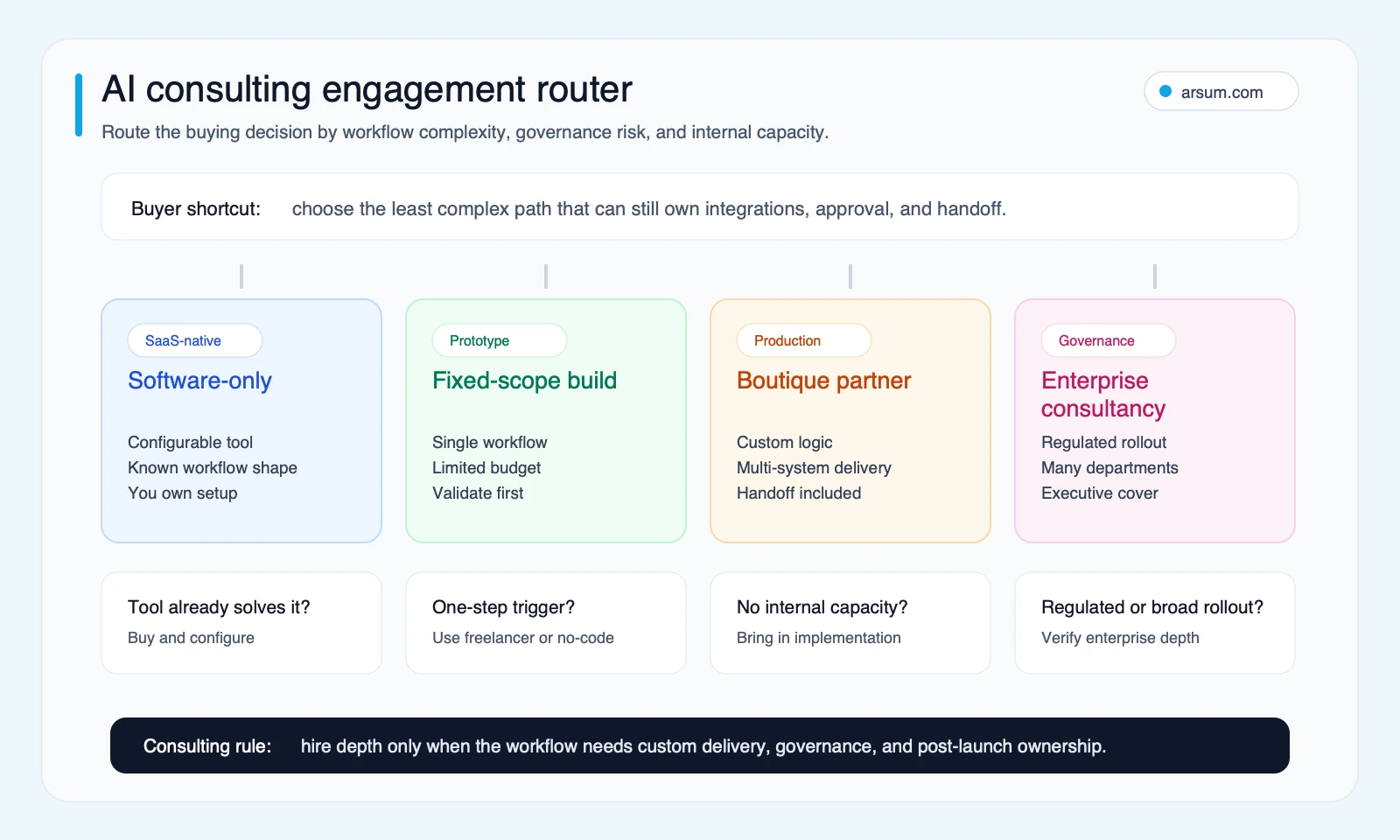
A workflow that includes AI does not automatically require a full AI consulting engagement. Choose a starting point based on system complexity, consequence of error, and who will own the system afterward.
| Situation | Likely starting point | What to verify before proceeding |
|---|---|---|
| Standard SaaS workflow with native automation | Configure and test the existing software | Permissions, audit trail, exception handling, and whether the feature fits the actual process |
| One narrow integration with stable inputs and rules | Internal build, freelancer, or small fixed-scope project | Who maintains credentials, failures, and changes after delivery |
| Workflow spanning several systems with variable documents or judgment | Fixed-scope implementation partner | Data lineage, evaluation set, exception queue, ownership, and handoff |
| Cross-functional or regulated rollout | Partner with delivery and governance capability | Named implementation team, security review, operating model, and escalation responsibility |
| Unclear process or no measurable baseline | Discovery only, or pause | Decision log, workflow map, baseline data, and a defined next investment decision |
These are starting points, not categorical rules. A simple-looking workflow may need specialist help if access controls are complex or a wrong action has high consequences. Conversely, a multi-system process can be a poor consulting candidate if its source data, decision policy, and ownership are still unsettled.
For a narrower delivery lens, review AI integration consulting and business process automation consulting.
What a production-capable AI consulting engagement includes
Strategy can be valuable, but it is only one layer of a production system. A proposal should explicitly separate the following work instead of bundling it under generic language.
Workflow and decision design
The team should document:
- The event that starts the workflow.
- The source systems and permitted data fields.
- The output, downstream system update, and human recipient.
- The normal path and known exception paths.
- What the system must never do automatically.
- The business owner who can accept, reject, or stop the workflow.
This is where a consultant should determine whether the task needs an AI model at all. If the task follows a stable policy, a rules-based workflow may be more reliable and easier to review.
System design and implementation
A production scope should identify interfaces, data transformations, credentials, logs, dependencies, and who will maintain each integration. Prompting skill alone is not evidence of implementation capability.
The validated qualitative research includes a snippet-level OpenAI Developer Community discussion in which a consultant describes being stronger in prompt engineering than technical coding. It is not a market statistic. It is a practical reminder to ask who will build the integrations, evaluation harness, access controls, and post-launch monitoring.
Evaluation, approval, and exception handling
Confidence scores are not inherently reliable approval gates. A model can be confident and wrong; a low-confidence result can be correct. Require a representative evaluation set, pass criteria by output type, exception sampling, and a human-review queue.
For consequential workflows, define four operating modes:
- Assist: The system drafts or retrieves information; a person decides.
- Recommend: The system proposes a classification or next step; an accountable operator approves.
- Act within boundaries: The system takes a reversible, low-impact action under explicit rules.
- Escalate: The system stops and routes the case to a person when evidence is missing, policy conflicts, or the case falls outside the tested boundary.
The NIST AI Risk Management Framework is a useful reference because it frames trustworthiness as something incorporated into the design, development, use, and evaluation of AI systems—not added after launch.
Handoff and operating ownership
A signed scope should state what remains after the consultant leaves:
- Repository, automation configuration, and infrastructure access.
- Runbook for failures and routine changes.
- Named internal owner and backup owner.
- Monitoring alerts and review cadence.
- Vendor and model dependencies.
- Exit plan if a provider changes terms, access, or performance.
If a proposal cannot state who owns the system on day 31 after handoff, it is not yet a complete production plan.
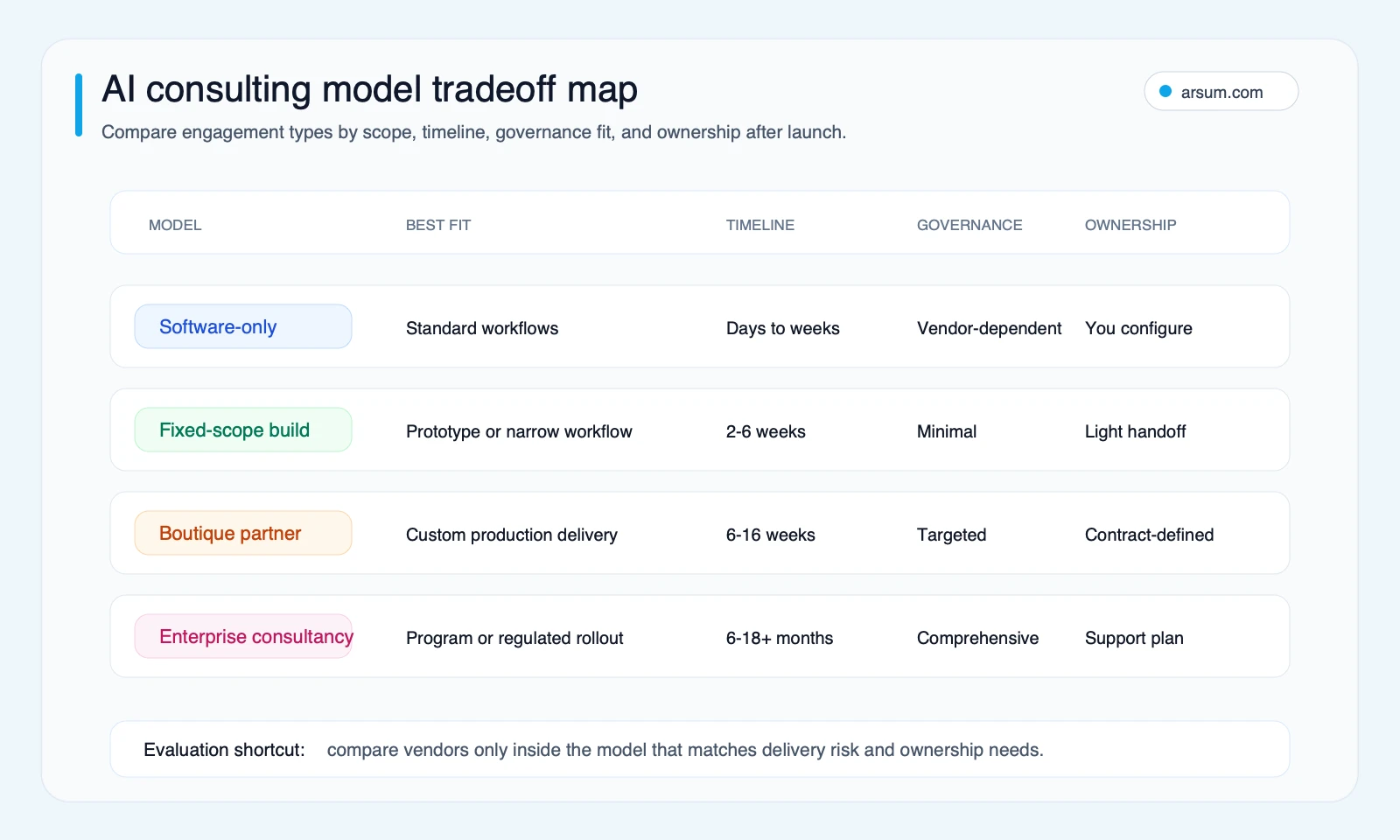
Compare consulting models by accountability, not branding
| Model | Useful when | Main advantage | Main risk to screen |
|---|---|---|---|
| Software-only | The workflow closely matches product capabilities | Lower implementation burden | Configuration may not cover exceptions or controls |
| Freelancer or internal build | Scope is narrow and technical ownership is available | Direct execution with less overhead | Key-person dependency and thin documentation |
| Boutique implementation partner | One or a few defined workflows need engineering and handoff | Focused delivery and workflow-level accountability | Verify capacity, references, support terms, and who actually builds |
| Enterprise consultancy | Several teams need coordinated governance and change management | Broader program coordination | Delivery may be layered across teams; require named implementation ownership |
| Strategy-only advisor | Leadership needs a bounded decision, operating model, or independent review | Useful before a build commitment | The work may stop before integration, evaluation, and handoff are solved |
The right question is not “Which model is best?” It is “Which model accepts responsibility for the unresolved work in this workflow?”
If the work is specifically about semi-autonomous operations, compare the operating implications in agentic AI workflow automation before accepting an “agent” label as a requirement.
A worked pilot scorecard: lead-routing example
The following is an illustrative planning example, not a client result or market benchmark. Its purpose is to show the inputs a consulting proposal should make testable.
Assume a B2B company receives 500 inbound leads each month. Staff currently spend an average of six minutes reviewing, enriching, and routing each lead.
- Baseline review effort: 500 leads × 6 minutes = 3,000 minutes, or 50 hours per month.
- Illustrative fully loaded labor assumption: $60 per hour.
- Baseline monthly handling cost: 50 × $60 = $3,000.
- Proposed pilot: the system drafts a route and rationale, while a sales-operations reviewer approves exceptions and samples routine decisions.
- Illustrative post-pilot human effort: 15 hours per month for exceptions, sampling, and maintenance.
- Illustrative monthly labor capacity redirected: 35 × $60 = $2,100.
That arithmetic is not a business case by itself. It excludes implementation cost, model and software cost, revenue impact from routing quality, and the cost of reviewer time when the system is wrong. The pilot should only proceed if the commercial owner agrees that its quality measures are met.
| Pilot element | Example definition |
|---|---|
| Business owner | Head of Sales Operations |
| Technical owner | RevOps systems lead |
| Baseline | 50 monthly staff hours; current misroute and rework rate measured before pilot |
| Target | Reduce routine review effort while meeting an agreed routing-quality threshold on a held-out evaluation set |
| Quality measure | Correct route, correct reason code, and correct escalation behavior—not model confidence alone |
| Exception measure | Percentage routed to human review, sampled weekly and categorized by cause |
| Review cadence | Daily exception review; weekly quality review; monthly owner decision |
| Stop condition | Material increase in misroutes, unreviewed high-risk cases, missing logs, or inability to explain a routing decision |
| Rollback path | Disable automated write-back; preserve draft recommendations and return routing to the existing queue |
| Acceptance decision | Owner signs off only after the evaluation set, live sample, exceptions, and operating burden meet agreed criteria |
A proposal should translate this template into your volumes, labor assumptions, error costs, implementation fee, run costs, and approval policy. For additional ways to frame workflow-level value without treating estimates as guarantees, see AI automation ROI examples.
💡 Arsum builds custom AI automation solutions tailored to your business needs.
Get a Free Consultation →Proposal evidence worksheet: what vendors should attach
Do not score a proposal based only on persuasive language. Require evidence for each operating claim.
| Proposal row | Evidence to request | What an acceptable answer looks like |
|---|---|---|
| Workflow scope | Workflow map and decision inventory | Inputs, outputs, exclusions, edge cases, and named owner |
| Architecture | Diagram of systems, data flows, and write actions | Clear boundaries between source systems, model calls, review queue, and downstream updates |
| Evaluation | Test plan and representative evaluation set | Measurable acceptance thresholds and a process for changes |
| Data handling | Data-processing terms and subprocessor list | Which data is sent where, retention terms, access roles, and deletion or exit path |
| Security controls | Threat model or control mapping | Controls relevant to the workflow, not a generic security slide |
| Human review | Queue design and approval policy | Who reviews what, when, and with what evidence |
| Monitoring | Logs, dashboards, alert definitions, and cost tracking | Failures, quality drift, and unexpected cost can be detected promptly |
| Support | Support model and escalation path | Named responsibilities, response expectations, and change-management process |
| Handoff | Documentation and access checklist | Client control of the assets needed to operate or transition the system |
| References | Relevant production references | Permissioned conversations about operating reality, not only polished case studies |
This worksheet is especially important when vendors describe their offer primarily as strategy, training, or AI adoption. Snippet-level discussion from Reddit’s entrepreneur community shows this kind of strategy-first positioning exists. That observation is qualitative only; it does not establish how common any offer type is. It does explain why buyers should ask for delivery evidence before assuming advisory fluency includes implementation capacity.
Score the proposal before approving it
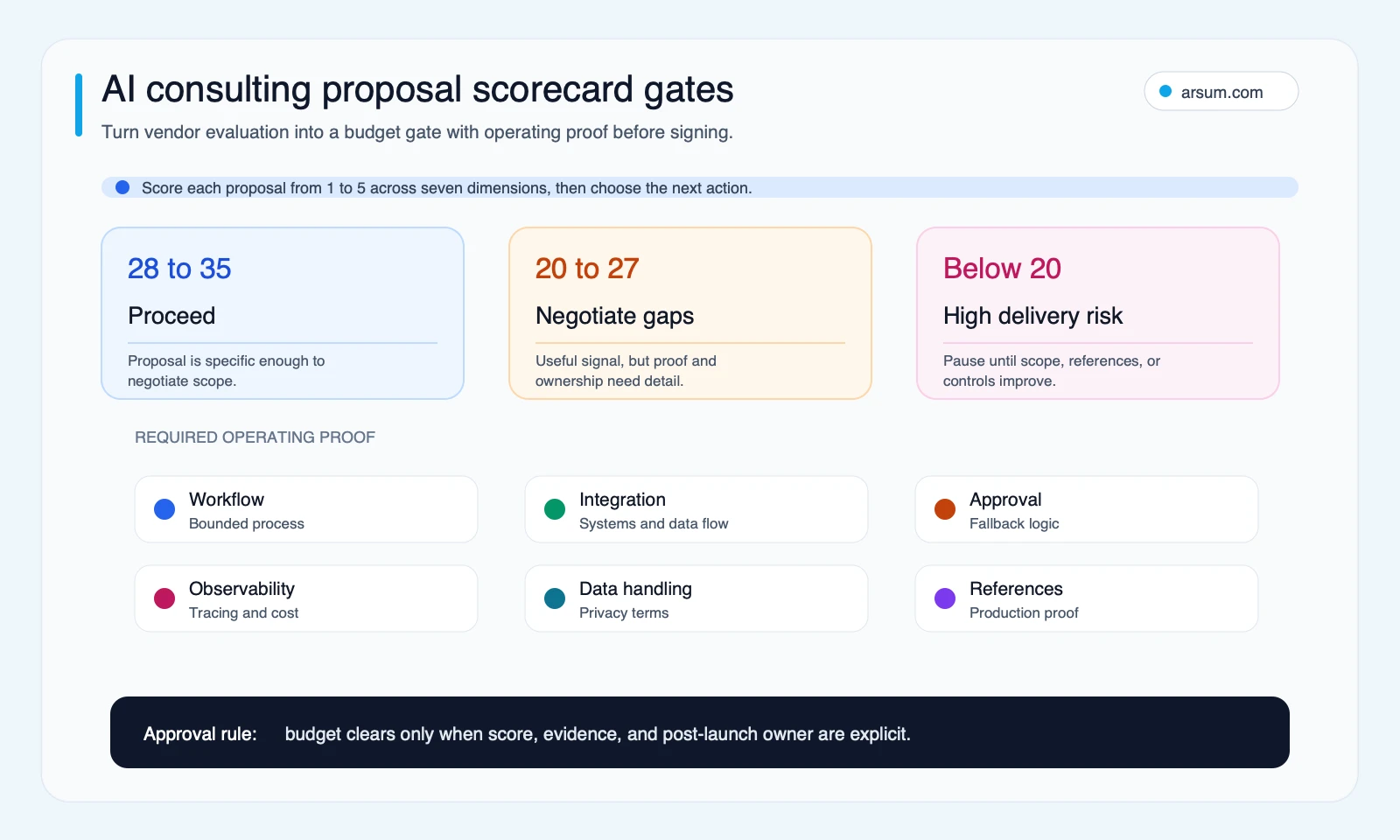
Rate each dimension from 1 to 5. A high score requires attached evidence, not an assertion.
| Dimension | 1: weak | 3: partial | 5: decision-ready |
|---|---|---|---|
| Workflow specificity | Generic objectives | Main process named | Trigger, inputs, outputs, exceptions, and owner documented |
| Integration ownership | “We integrate” | Systems listed | Interfaces, data flows, permissions, and maintenance owner defined |
| Evaluation plan | Demo-based | Some testing described | Representative set, thresholds, sampling, and change process |
| Human review and rollback | Not addressed | Review mentioned | Queue, authority, stop condition, and rollback tested |
| Observability | Optional reporting | Basic monitoring | Traceability, alerts, quality signals, and cost visibility specified |
| Data handling | Policy link only | General commitments | Contractual handling, roles, retention, and exit plan documented |
| Handoff | Informal training | Documentation promised | Access, runbook, ownership, and support transition defined |
| References | Marketing examples | General case studies | Relevant production operating references available |
Add the scores, but use the total as a discussion gate rather than a procurement formula:
- 32–40: The scope may be ready for commercial and technical review.
- 24–31: Negotiate the missing artifacts before approving work.
- Below 24: The proposal is likely selling intent rather than a controlled operating system.
Disqualifying conditions and common failure modes
Do not proceed to production implementation when any of these conditions is unresolved:
- No accountable business owner can make tradeoffs about quality, exceptions, or acceptable risk.
- The workflow has no stable source data or reliable system of record.
- The proposed action is difficult to reverse and the approval policy is undefined.
- The vendor will not disclose who performs implementation or what the client receives at handoff.
- Success is defined only as “use AI” rather than a measurable workflow outcome.
- The team cannot support routine exception review after launch.
- The system would make consequential decisions without an evaluation plan and accountable human review.
The common failure pattern is not simply that a model produces an incorrect output. It is that the operating design makes an error hard to detect, hard to correct, or expensive to unwind. A polished demo is weak evidence because it rarely shows incomplete data, conflicting systems, ambiguous cases, permission failures, or downstream rejections.
For content-related workflows, apply an additional quality boundary. Google’s people-first content guidance emphasizes helpful, reliable content made for people rather than material produced primarily to manipulate rankings. A consulting scope for scaled publishing should therefore include original-source requirements, human editorial approval, duplication checks, and a stop mechanism—not simply a target number of pages.
Questions to ask in the final vendor meeting
Ask these questions directly and request the answer in the statement of work.
- Which workflow step will you automate, assist, or leave entirely human?
- What must happen for an output to enter the exception queue?
- Who has authority to pause the automation, and how quickly can the existing process be restored?
- What evaluation set will you use before production, and which metric determines acceptance?
- What information will an operator see when they need to overturn a recommendation?
- Which systems, credentials, and vendor accounts will remain under our control?
- What logs, monitoring, and cost signals will we have after handoff?
- Who maintains the system after launch, and what work is explicitly out of scope?
- Can you provide relevant production references and identify the people who built the implementation?
- What simpler option did you reject, and why was it insufficient?
A provider that can answer these questions clearly may still not be the best fit. But a provider that cannot answer them is not ready to be accountable for a production workflow.
Method and limits
This guide uses a decision-first editorial framework and primary guidance from Anthropic, NIST, and Google Search Central. It also considers snippet-level practitioner discussion as a qualitative signal about buyer concerns, not proof of market-wide behavior, vendor capability, cost, adoption, or implementation outcomes.
No cost, duration, savings, adoption, or implementation outcome in this article should be read as a typical market result. Use the pilot scorecard and evidence worksheet to build a business case from your own workflow data.
Ready to Automate Your Business?
Stop wasting time on repetitive tasks. Let AI handle the busywork while you focus on growth.
Schedule a Free Strategy Call →Related Arsum guides
Written by:Arsum editorial team
- Reviewed by
- Arsum editorial team
- Published
- June 2, 2026
- Updated
- July 3, 2026
- How this was produced
- Arsum uses research packs, source checks, and human editorial review to prepare and update blog articles. Editors are responsible for the final page.
- Source policy
- Sources are linked in the article when used. Methodology and source notes are included on higher-risk or high-visibility pages and are being rolled out across the archive. Editorial policy.
- Why this page exists
- Help B2B operators evaluate AI automation, implementation scope, cost, risk, and build-vs-buy decisions with practical context.