An ai content site case study is only replicable when you separate the operator-reported revenue headline from the system that may have contributed to it: demand selection, source-grounded production, review burden, distribution, monetization eligibility, and time. The public $3,674-per-month story is useful as a case narrative—not audited proof—and B2B teams should validate one narrow content workflow before treating AI-assisted publishing as a scalable growth engine.
AI Content Site Case Study
Explore ai content site case study: compare workflow fit, costs, risks, evidence, and practical next steps before you build, buy, or hire.

Table of Contents
- What Most Guides Miss: Revenue Is Not the Replicable Unit
- The observed performance profile of analytics tools
- The Original Case: What Is Known, What Is Not
- The Transferable Workflow: Automate Drafting, Control Decisions
- Search and Policy Risk: Helpful Production Is Not Scaled Manipulation
- Score the Opportunity Before You Build
- Cost and Review Worksheet: Price the Approved Page
- A 90-Day Pilot With Real Continue-or-Stop Gates
- When Not to Replicate the Model
- Methodology and Bottom Line
What Most Guides Miss: Revenue Is Not the Replicable Unit
The headline from the original r/juststart case-study thread is compelling because it gives a precise outcome: an operator reported growing an automated AI SEO content site from $0 to $3,674 per month over 14 months.
That number does not tell a buyer what caused the outcome.
A usable replication decision separates the outcome into components. Content volume may have helped, but it cannot by itself establish that the site earned revenue because of AI drafting. Niche demand, domain history, indexing, links, monetization approval, ad-market conditions, content usefulness, timing, and the operator’s execution can all affect the result.
For a founder or marketing leader, the better question is:
Can we produce useful, source-grounded content for one repeatable audience need at a lower approved-page cost—without creating unacceptable brand, legal, or review risk?
That question is more valuable than “Can AI publish 100 articles?” It turns a passive-income story into an operating decision. The same distinction matters in AI content automation for business: automation is valuable when it improves a measurable workflow, not when it merely increases output.
| Component | What the case can suggest | What you must validate yourself |
|---|---|---|
| Demand selection | A focused topic set may make production easier to organize | Search demand, commercial relevance, and whether each proposed page has distinct user value |
| Production throughput | Templates and drafting automation can reduce blank-page work | Reviewer time, rework rate, source availability, and CMS reliability |
| Quality control | Human judgment remains necessary | Approval owner, claim rules, exception queue, and evidence retained |
| Distribution | Publishing alone is not a distribution plan | Search, internal linking, newsletters, partners, sales use, and refresh ownership |
| Monetization | A content asset needs a defined payoff | Ad eligibility, qualified leads, assisted pipeline, support deflection, or another attributable business metric |
| Time | Search and content systems can have a long feedback loop | Whether the business can fund a measured pilot before expecting a lagging outcome |
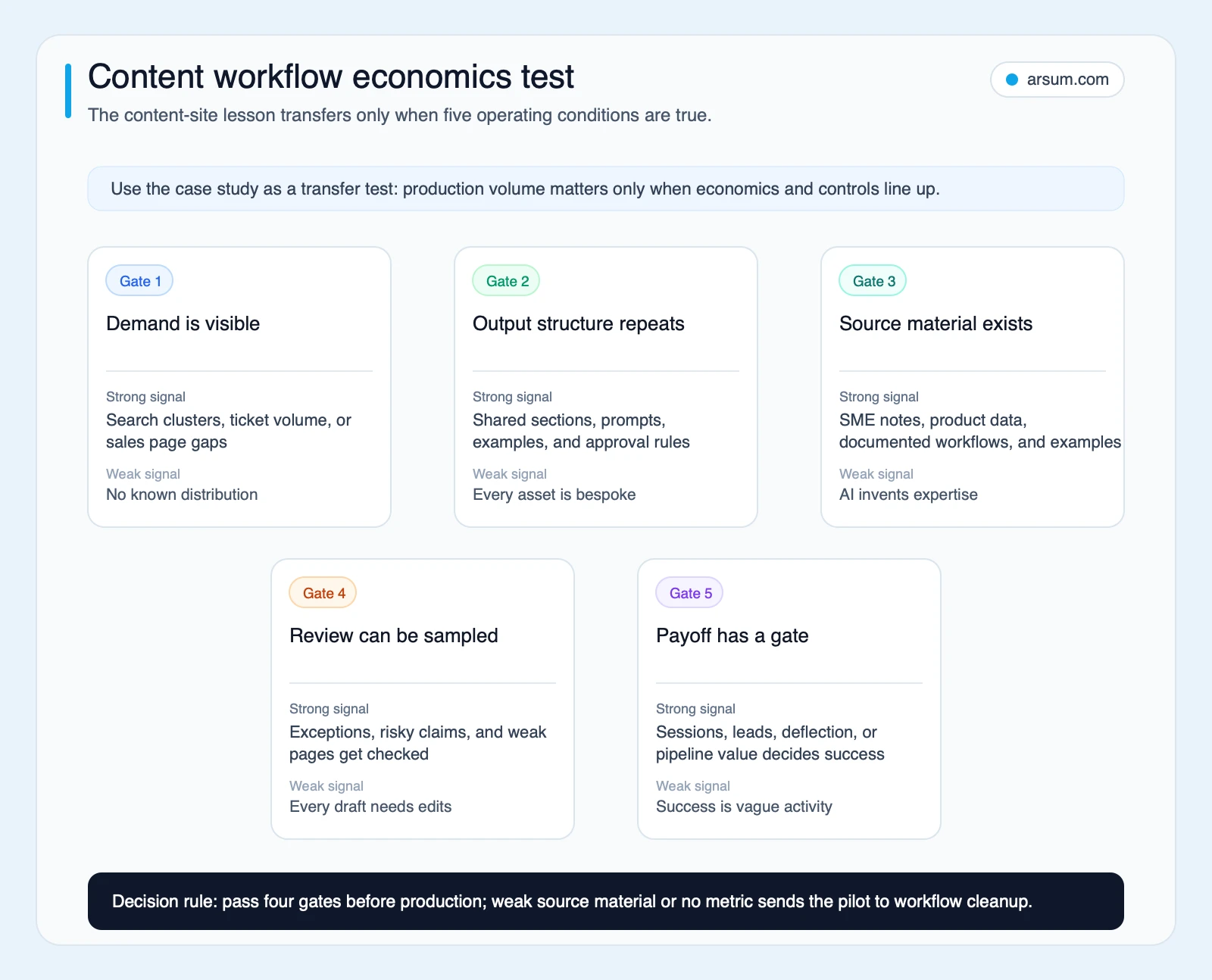
The transfer test is simple: demand, repeatable structure, source material, review capacity, distribution, and a measurable payoff must all exist before more production volume helps.
The evidence brief above is relevant only to a narrow implementation choice: before adding a CMS plugin, analytics package, chat widget, or another script to a content operation, compare the observed mobile page-weight and Core Web Vitals profile of the technology set. Those HTTP Archive and Chrome UX Report observations are associations, not evidence that a tool caused a site’s ranking, revenue, or content outcome. They should not be used to explain the $3,674 claim.
The Original Case: What Is Known, What Is Not
The original thread is the primary source for the core story. It is an identifiable operator self-report with specific claims, which makes it more useful than an anonymous income post. It remains unaudited public evidence.
| Claim | Evidence level | Source | What is known | What cannot be verified from the case alone |
|---|---|---|---|---|
| Revenue reached $3,674 per month | Level 3: specific community self-report | Original Reddit thread | The operator publicly reported the figure and a 14-month path | Revenue ledger, net profit, ad-rate drivers, tax records, and causal contribution from AI |
| The project used automated AI SEO content | Level 3: operator self-report | Original Reddit thread | The operator framed the site as an automated AI content workflow | Exact prompts, source process, QA method, and publication criteria |
| Monetization involved Mediavine | Level 3: operator self-report | Original Reddit thread | The case connects the site to display-ad monetization | Current eligibility, approval details, traffic quality, and whether historical requirements still apply |
| The result is repeatable | Article inference only | No single source can establish this | Some workflow components transfer across structured content operations | Success rate, expected timeline, cost, and return for another niche or company |
Use the evidence ladder consistently when reviewing similar claims:
- Level 1: audited analytics, tax, platform, or marketplace-sale data.
- Level 2: identifiable operator report with screenshots or a consistent public trail.
- Level 3: community post with specific but unaudited numbers.
- Level 4: vendor or tool example with unclear methodology.
- Level 5: hypothetical income claim.
The original case belongs at Level 3 unless an independent reader can verify a stronger public trail. That does not make it useless. It means it should inform a hypothesis, not authorize a forecast.
Replicability Boundary
The reported revenue is not proof that AI-generated drafts caused the revenue. A different site may have weaker demand, a newer domain, less credible sources, fewer links, lower ad eligibility, a more demanding review process, or no viable monetization path. It may also face different search conditions.
Treat the case as evidence that a small operator can describe a content-production system and report a meaningful outcome. Do not treat it as evidence that publishing a similar number of AI-assisted pages produces the same result.
A second public community case may indicate that founders are interested in the asset-building model, but it is also self-reported and should not become a benchmark: AI content site from $217/month to $2,836/month. Repeated anecdotes are not a success-rate dataset.
The Transferable Workflow: Automate Drafting, Control Decisions
The content-site lesson is not that every article should be automated. It is that a repeated production flow can be decomposed into low-risk mechanical work and high-judgment decisions.
| Workflow step | Suitable automation | Human owner | Evidence or control retained |
|---|---|---|---|
| Cluster intake | Deduplicate ideas, map templates, prepare source packets | Content lead | Demand rationale and excluded topics |
| Source assembly | Retrieve approved product docs, policies, SME notes, and prior assets | Knowledge owner | Source list and version date |
| Draft generation | Create a structured first draft from approved inputs | Content operator | Prompt/version and source references |
| Claim review | Flag pricing, product, legal, security, medical, financial, or compliance claims | SME or risk owner | Approval, correction, or rejection reason |
| Editorial QA | Check usefulness, originality, citations, overlap, and reader task completion | Editor | QA record and revision history |
| Publishing | Format, add links, schedule, and validate metadata | CMS owner | Publication log |
| Measurement and refresh | Identify pages to improve, consolidate, or remove | Growth owner | Monthly decision log |
This is a better fit for B2B work than blind bulk publishing because it makes authorization explicit. A model may be technically capable of drafting an implementation page. That does not mean it is authorized to make product promises, cite an outdated policy, or publish regulated claims without review.
For teams considering agentic AI workflow automation, content is usually a controlled workflow—not an autonomous publishing agent. The autonomy boundary should shrink as error cost rises.
A Better B2B Use Case Than Copying an Ad Site
A B2B team may be a fit when it has a narrow content class with repeatable structure:
- Integration pages based on approved product documentation.
- Support articles based on resolved ticket patterns and verified procedures.
- Comparison pages with named sources and a legal review path.
- Sales-enablement answers based on current positioning and objection libraries.
- SEO cluster pages that answer distinct questions, rather than thin variations of the same page.
The team should hold off when it lacks current source material, cannot assign an approval owner, or needs every page to receive a bespoke expert rewrite. In those cases, the system is likely to move the bottleneck from drafting to review.
💡 Arsum builds custom AI automation solutions tailored to your business needs.
Get a Free Consultation →Search and Policy Risk: Helpful Production Is Not Scaled Manipulation
Google’s guidance does not prohibit generative AI as a drafting or research aid. Its concern is whether content is created at scale primarily to manipulate rankings without helping users. Read Google’s generative AI content guidance alongside its spam policies before setting production targets.
For an operator, the practical control is not “make AI sound more human.” It is proving that each page has a job, a source basis, and a reason to exist.
| Higher-risk pattern | Recommended control |
|---|---|
| Hundreds of near-duplicate pages mapped to minor keyword variations | Require a distinct audience question, unique source packet, and overlap review before publishing |
| Unsupported product, pricing, compliance, or outcome claims | Route flagged claims to the named owner for approval |
| Summaries that add nothing beyond existing search results | Require a workflow, comparison, example, original analysis, or decision rule |
| No update path for changing information | Assign a refresh owner, review date, and pruning rule |
| Publishing automation with no audit trail | Retain source references, prompt version, reviewer decision, and publication record |
Topical organization, internal linking, and regular updates can be reasonable operating hypotheses. They are not guaranteed ranking mechanisms, and this case does not prove them. Validate them with one cluster and a pre-defined measurement plan. For a broader treatment of this implementation boundary, see the generative SEO guide and AI SEO services explained.
Monetization Rules Are Freshness-Sensitive
Older content-site discussions frequently cite a 50,000-session Mediavine threshold. That is not a safe 2026 planning assumption. Mediavine’s current public materials describe main-program eligibility in terms of $5,000 or more in annual ad revenue, while Journey is positioned as a path for growing publishers beginning at 1,000 sessions. Check the current Mediavine requirements and publisher path to growth before building a cash-flow model.
For B2B operations, display ads may be irrelevant. Replace that gate with a primary business outcome such as qualified organic visits to a product area, sales-assisted opportunities, support deflection, or partner activation. If no owner can define the payoff, do not scale the workflow.
Score the Opportunity Before You Build
This editorial scorecard is a decision aid, not a benchmark study. Score each criterion from 0 to 2:
- 0 = absent or unresolved
- 1 = partly present, but needs pilot controls
- 2 = documented and ready to operate
| Criterion | 0 | 1 | 2 |
|---|---|---|---|
| Niche specificity | Broad or unclear audience | Some focus, but overlapping intent | Narrow audience and clear recurring questions |
| Demand evidence | No evidence of a user need | Anecdotes or untested assumptions | Search, sales, support, or customer evidence supports the cluster |
| Template repeatability | Each page is bespoke | Some reusable structure | Stable templates with genuinely distinct page value |
| Source grounding | No approved source base | Partial or stale sources | Current docs, SMEs, and source ownership exist |
| Editorial review plan | “Someone will check it” | Reviewer identified but no rules | Named reviewer, rubric, escalation, and approval boundary |
| Distribution plan | Publish and hope | One possible channel | Search, internal links, sales, partner, or lifecycle distribution is owned |
| Monetization or value path | Vague future ROI | Metric exists but attribution is weak | Defined outcome and measurement method |
| Measurement window | Days or weeks only | A few months, no leading metrics | At least six months with leading and lagging indicators |
| Refresh and pruning | No maintenance plan | Ad hoc updates | Owner, cadence, stale-claim rule, and removal criteria |
Add the nine scores:
- Below 12: keep this as an experiment; reduce scope or improve prerequisites.
- 12–15: run a controlled pilot.
- 16–18: operationally ready enough to scale carefully, while continuing to sample quality and measure outcomes.
Worked Hypothetical B2B Example
Assume a software company wants to automate a cluster of integration-support pages.
It has clear customer questions (2), support-ticket evidence (2), a shared page template (2), current product documentation (2), and a named product-marketing owner plus SME reviewer (2). It has an internal-linking and email-distribution plan (1), a target of qualified support visits and reduced repetitive tickets (1), a six-month measurement window (2), and a monthly refresh owner (1).
Total: 15 out of 18.
That is a controlled-pilot score, not a scale-now score. The gaps are distribution attribution, a tighter business metric, and a more formal refresh process.
Cost and Review Worksheet: Price the Approved Page
Do not use generic tool-price ranges as a business case. Use inputs from your own workflow.
| Input | How to calculate it |
|---|---|
| Pages per month | Number of proposed publishable pages in one narrow cluster |
| Model usage per page | Input and output tokens, model selection, retries, and batch use; verify current rates on OpenAI API pricing |
| Tool subscriptions | Allocated monthly research, CMS, analytics, image, and workflow-tool costs |
| Reviewer minutes per page | Time for source validation, claim review, edits, and exceptions |
| Loaded labor rate | Reviewer compensation plus relevant overhead, expressed per hour |
| Update rate | Expected percentage of pages requiring refresh each month or quarter |
| Integration scope | CMS, source repository, approvals, analytics, and security requirements |
Use this calculation:
Cost per approved page = (model cost + allocated tools + review labor + revision labor + update reserve) ÷ approved pages
For example, as an illustrative planning assumption—not an observed result—suppose a pilot produces 12 approved pages in a month. The team records $96 in allocated tools, $24 in model usage, 18 total reviewer hours at a loaded rate of $60 per hour, and $120 reserved for revisions and future refreshes.
($96 + $24 + $1,080 + $120) ÷ 12 = $110 per approved page
The point is not that $110 is normal. It is that review labor, not token cost alone, can determine whether the workflow works. If reviewers need to rewrite every page, that finding should change scope, source inputs, or the automation boundary.
A 90-Day Pilot With Real Continue-or-Stop Gates
Run the B2B version as a controlled operation, not a promise of content revenue.
| Area | Pilot design |
|---|---|
| Scope | One narrow cluster with a shared structure and a clear business audience |
| Accountable owner | Growth or content lead |
| Approval owner | Named SME, product owner, legal reviewer, or risk owner for restricted claims |
| Baseline | Current approved pages per month, production cycle time, reviewer minutes, organic or support baseline, and existing page-quality issues |
| Target | A pre-agreed improvement in approved-page cycle time or cost while maintaining the quality and exception thresholds |
| Quality metric | Percentage of pages approved without material factual correction; number and type of high-risk claim escalations |
| Review cadence | Weekly operational review; 30-, 60-, and 90-day decision gates |
| Retained evidence | Source packet, prompt/version, reviewer decision, revision reason, publication date, and measurement log |
| Rollback | Pause publishing automation, return affected drafts to manual review, correct or unpublish unsupported pages, and preserve the audit trail |
| Stop condition | Stop expansion if material errors escape review, the approval queue eliminates the intended cycle-time gain, sources cannot stay current, or the defined business metric does not show an agreed leading signal |
At day 30, judge workflow health: are source packets usable, are exceptions predictable, and is one owner actually making decisions?
At day 60, judge unit economics: has approved-page cost fallen or stayed controlled without increasing material revisions?
At day 90, decide whether to continue, redesign, or stop. A good pilot may still have little lagging revenue or organic movement by this point. It should, however, produce evidence about cost per approved page, review burden, source gaps, exception patterns, and whether the cluster has a credible distribution path.
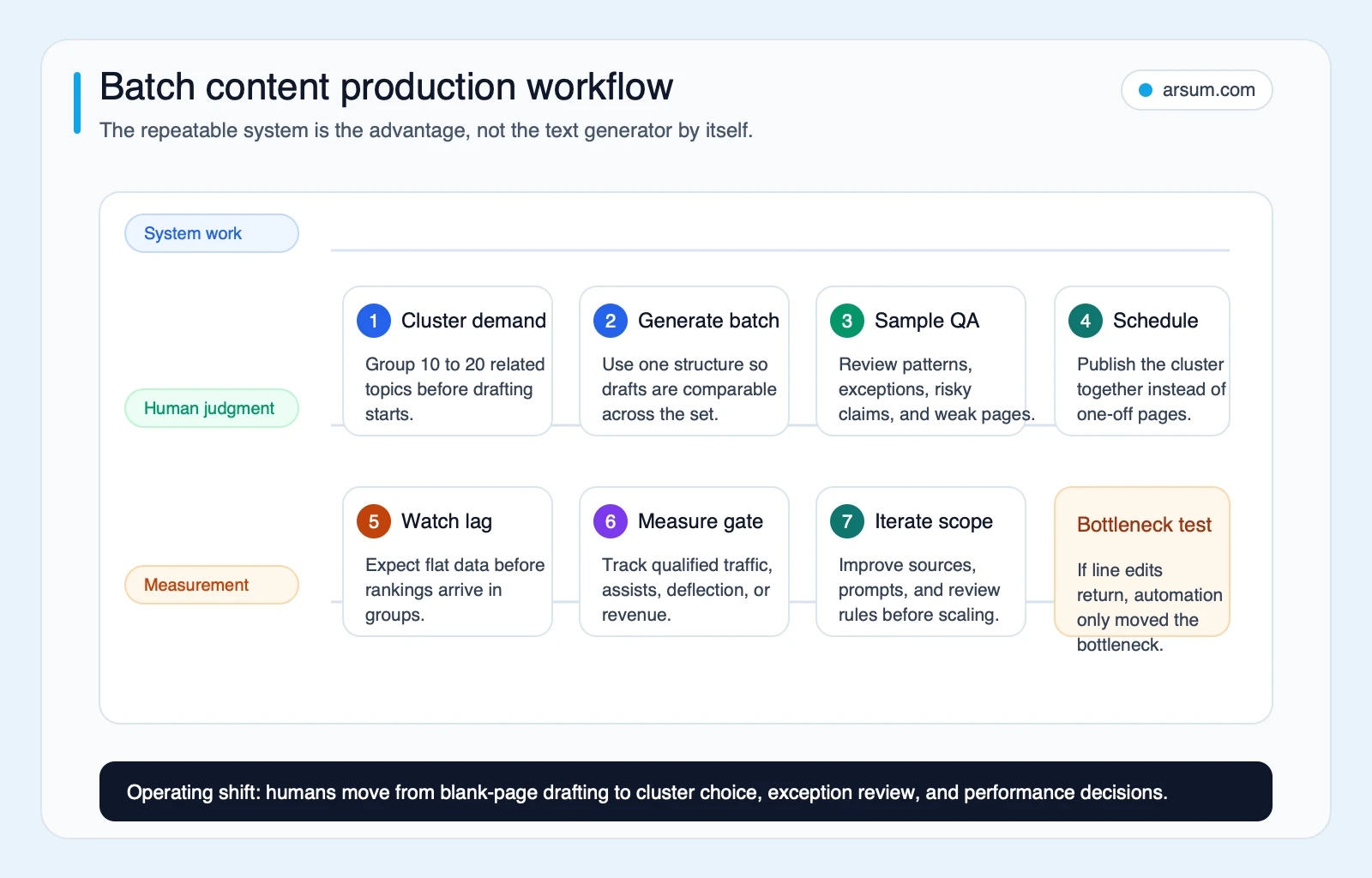
The valuable automation is a controlled batch process: approved inputs, defined exceptions, accountable review, publication evidence, and a measurement loop.
When Not to Replicate the Model
Do not use this model as a shortcut when any of these conditions apply:
- The business cannot identify a reliable source base.
- Pages require legal, financial, healthcare, security, or compliance approval that cannot be sampled safely.
- The audience need is too broad, news-driven, or volatile for reusable templates.
- Content has no credible distribution or value path.
- Leadership expects a guaranteed result from a self-reported creator case.
- The team measures output volume but cannot measure approval quality, audience response, or business contribution.
- There is no owner for ongoing updates, consolidation, and removal.
A smaller internal workflow may still be worthwhile. For example, use AI to prepare drafts from approved support documentation, while maintaining full human approval for external publishing. That is often a safer first step than attempting an autonomous site.
Teams that need the workflow connected across systems should evaluate whether they need a tool, internal build, or implementation partner. The relevant choice is covered in AI automation agency services and AI implementation services: the hard part is usually not selecting a model, but connecting sources, approvals, publishing, measurement, and accountable ownership.
Work With Arsum
We help businesses implement AI automation that actually works. Custom solutions, not cookie-cutter templates.
Learn more →Methodology and Bottom Line
This article treats the Reddit case as qualitative, operator-reported evidence. Research sources include the original case thread, Google’s AI-content and spam-policy documentation, current Mediavine program materials, and OpenAI’s published pricing. Community discussion is useful for identifying questions and failure modes; it is not a market-wide success dataset.
The practical conclusion is restrained: an AI-assisted content system may be a fit when the workflow has repeatable structure, reliable sources, a named review owner, a distribution plan, and a measurable payoff. The $3,674 story is not the business case. Your approved-page cost, review burden, exception rate, and distribution evidence are.
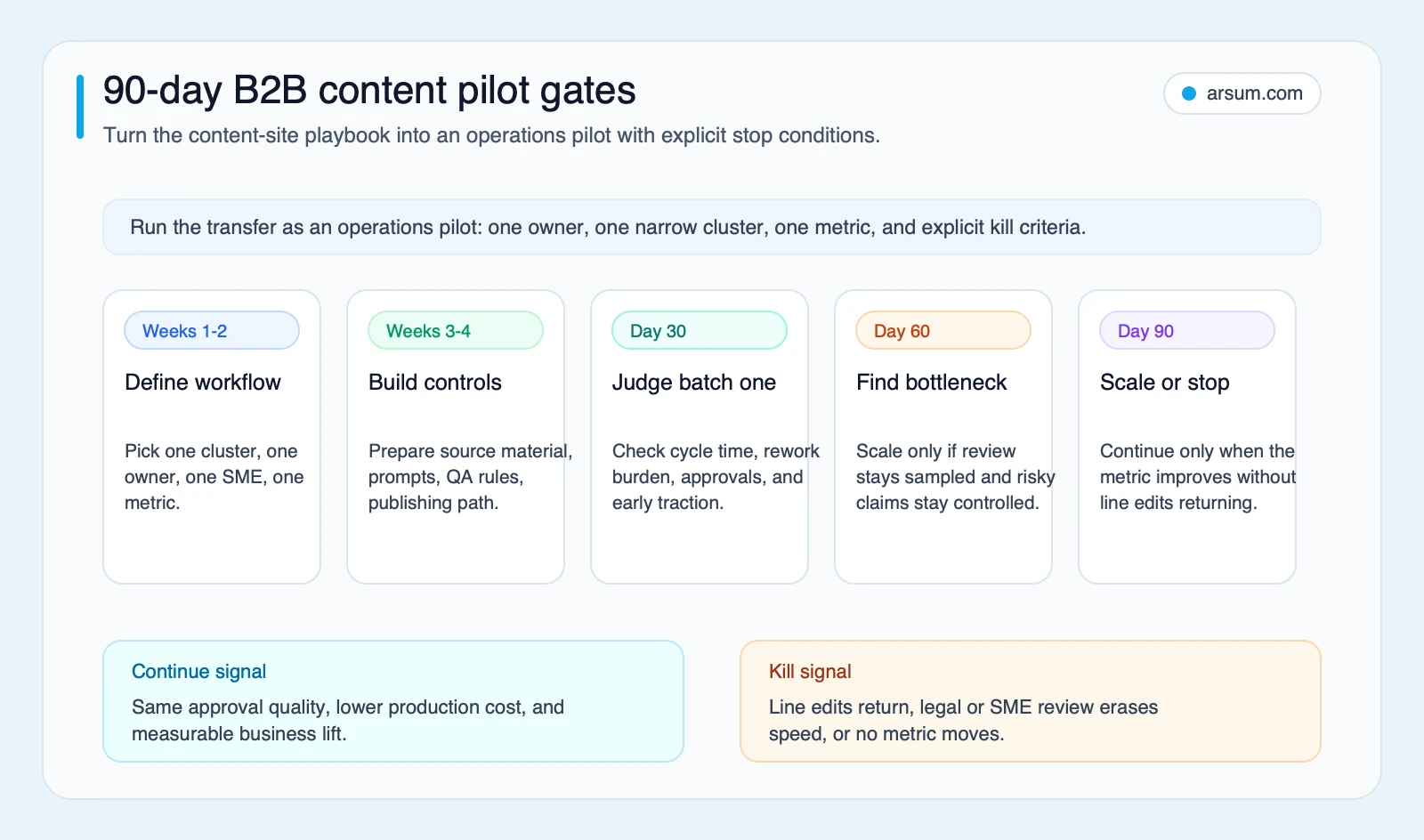
Use the pilot gates to decide whether to continue, redesign, or stop before content volume becomes an expensive substitute for evidence.
Ready to Automate Your Business?
Stop wasting time on repetitive tasks. Let AI handle the busywork while you focus on growth.
Schedule a Free Strategy Call →Written by:Arsum editorial team
- Reviewed by
- Arsum editorial team
- Published
- March 29, 2026
- Updated
- July 3, 2026
- How this was produced
- Arsum uses research packs, source checks, and human editorial review to prepare and update blog articles. Editors are responsible for the final page.
- Source policy
- Sources are linked in the article when used. Methodology and source notes are included on higher-risk or high-visibility pages and are being rolled out across the archive. Editorial policy.
- Why this page exists
- Help B2B operators evaluate AI automation, implementation scope, cost, risk, and build-vs-buy decisions with practical context.