An AI development agency is the right delivery model when you have a defined, measurable workflow that needs custom integration, evaluation, controls, and an operating owner—not simply access to an AI tool. The agency should be able to prove how the system will handle normal work, exceptions, permissions, review, and rollback before you approve a build.
AI Development Agency Guide
How to choose an AI development agency, compare delivery models, estimate costs, and avoid firms that sell strategy decks instead of working systems.

Table of Contents
- What most guides miss: you are buying ownership, not a demo
- Qualify the workflow before you fund a build
- What a production-ready agency should deliver
- Compare agency evidence, not category language
- A worked pilot scorecard for a claims-intake workflow
- Security, safety, and architecture questions to ask
- Pricing and scope: use the ladder as a procurement prompt
- Red flags and disqualifying conditions
- Vendor call script
- Methodology and limits
What most guides miss: you are buying ownership, not a demo
Many firms can assemble a convincing prototype. That is not the same as owning a production workflow.
Before comparing agencies, separate the problem into three parts:
- Advice: You cannot yet name the workflow, its owner, its baseline cost, or the outcome that would justify change.
- Implementation: The workflow is known, but data, systems, approvals, and interfaces are not connected.
- Operating ownership: A system can be launched, but someone must maintain evaluations, permissions, incident response, prompt or workflow changes, and exception handling.
This distinction changes the buying decision. A strategy engagement may be appropriate when the workflow is unclear. A standard product or no-code configuration may be enough when the process is common and low-risk. An AI development agency earns its place when the work crosses systems and requires accountable delivery beyond launch.
That is also the practical answer to buyer skepticism about “AI agencies.” Community discussions often question whether agencies offer more than wiring together familiar tools. Those discussions are qualitative signals, not market data, but they point to a useful procurement test: the vendor should sell workflow accountability, integration depth, evaluation, and operating controls—not access to a model. See the broader distinction in AI automation agency services and AI development services.
Qualify the workflow before you fund a build
A strong agency will help reject weak candidates. The first question is not whether a model can produce an answer; it is whether the business can safely use that answer in a workflow.
| Qualification question | Evidence that supports a build | Signal to pause |
|---|---|---|
| Is there a named workflow owner? | One person owns the process, acceptance decision, and operating escalation path. | Ownership is shared vaguely across functions. |
| Is the baseline visible? | You can measure handling time, rework, queue age, error cost, missed SLA, or another business outcome. | The benefit is described only as “efficiency.” |
| Are inputs and outputs defined? | Source records, documents, messages, decisions, and downstream actions are known. | The team cannot agree what a correct result looks like. |
| Is system access feasible? | Required systems, permissions, and audit requirements are known early. | Access depends on unresolved security or vendor approvals. |
| Is there an exception route? | Low-confidence, conflicting, or policy-sensitive cases go to a named reviewer. | The system must be correct on every case to be useful. |
| Is the action reversible? | Incorrect updates can be paused, corrected, or rolled back. | A wrong action creates an irreversible financial, legal, or customer impact. |
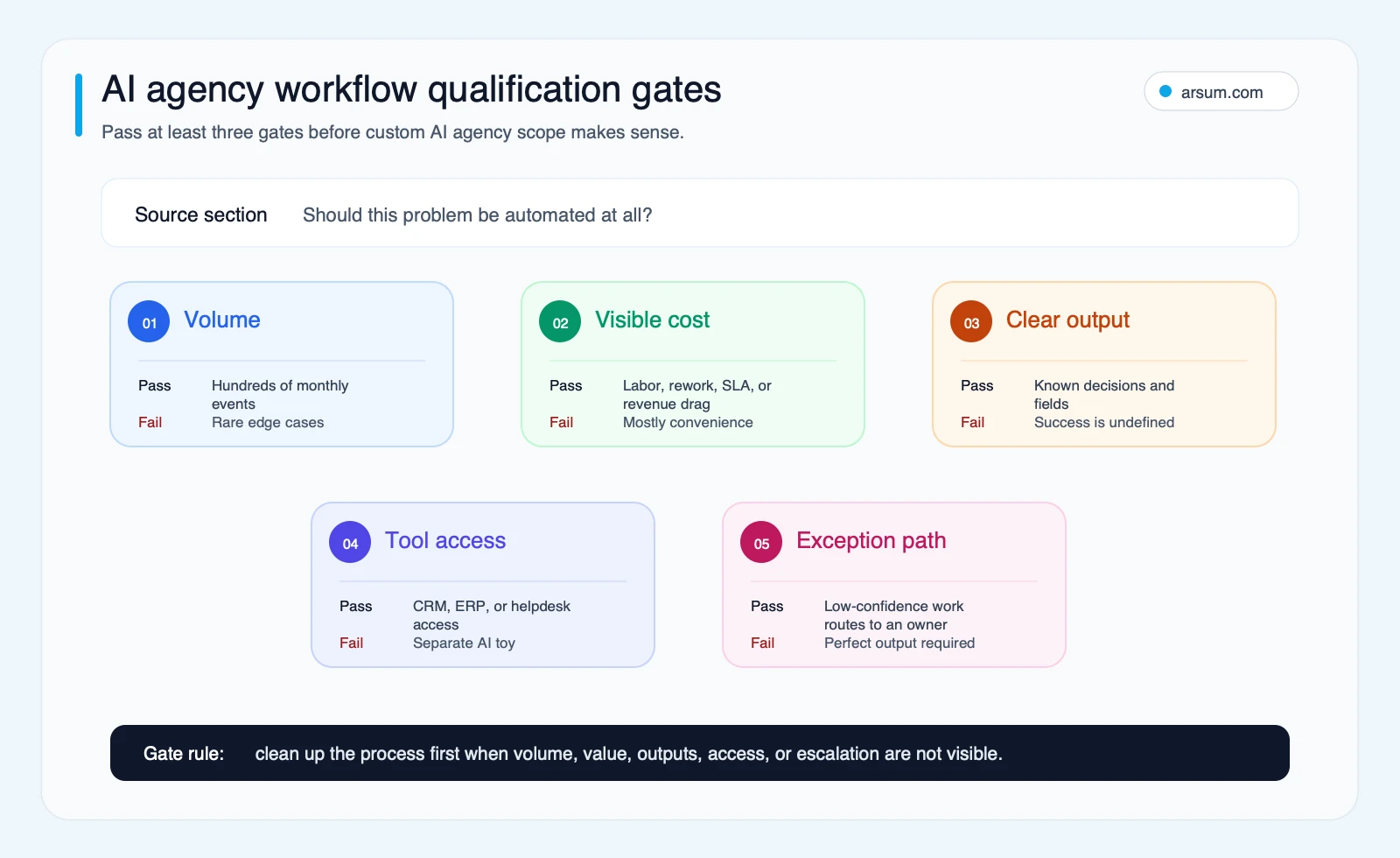
If the owner, baseline, inputs, access, or exception path is missing, fund process definition first. Automation can make an unclear process move faster without making it better.
Decide whether you need an agency, a consultant, software, or an internal team
| Delivery model | Best fit | Proof to request | Buyer risk |
|---|---|---|---|
| AI development agency | A defined, cross-system workflow needs design, build, integration, and shared launch ownership. | Comparable workflow evidence, delivery artifacts, evaluation plan, and named handoff owner. | The agency may sell a prototype while leaving operations to you. |
| Consultant | The workflow, target metric, or operating model is still unclear. | A discovery approach that produces a workflow map, baseline, data inventory, and decision memo. | You receive advice but still need a delivery path. |
| SaaS or no-code tool | The process is common, low-risk, and mostly fits an existing product. | A live test using your workflow and clear export, security, and support terms. | Custom exceptions can become expensive workarounds. |
| In-house team | AI capability is core product IP or requires durable internal iteration. | A credible hiring and operating plan, including security and evaluation ownership. | A slower start and a larger internal management burden. |
For a deeper buy-versus-build comparison, review hiring an AI developer versus an agency and custom AI solutions for business.
What a production-ready agency should deliver
The proposal should describe artifacts and controls, not only features. OpenAI’s guidance on production best practices makes the relevant buyer point: moving from prototype to production involves secure access, robust architecture, and operational considerations. Ask where those responsibilities live in the scope.
Discovery should end with decision artifacts
Before build begins, require:
- A workflow map: trigger, user, system handoffs, owner, exception route, and downstream action.
- A baseline: the current metric and how it is measured.
- A data and source-lineage inventory: systems of record, source quality, retention constraints, and unavailable inputs.
- A permissions map: what the system can read, draft, recommend, change, or never execute.
- An acceptance-test plan using representative cases, including ugly exceptions rather than only ideal examples.
- A change and rollback plan: who can pause the workflow, how records are reconciled, and who communicates an incident.
A discovery report without these artifacts may be useful research, but it is not enough to approve implementation.
Evaluation cannot be a demo review
Generative systems can vary in output, so acceptance needs a repeatable evaluation method rather than a successful live demonstration. OpenAI’s evaluation best practices support using defined tasks, test cases, and ongoing measurement.
Ask the agency to show:
- The proposed test set and how it represents normal, difficult, and prohibited cases.
- The expected output for each case and who approves it.
- The quality measures: for example, correct routing, field validation, policy compliance, or reviewer correction rate.
- The conditions under which the workflow routes an item to a person rather than acting.
- The evidence retained for audit, investigation, and future regression testing.
The relevant question is not “what accuracy can you promise?” It is “what will we measure, who judges it, and what happens when the result fails?”
Document automation needs controlled autonomy
For document intake, extraction, classification, or routing, a credible design should specify:
- Source document types and required fields.
- Validation rules against authoritative systems or known formats.
- Confidence or ambiguity rules that send cases to an exception queue.
- The reviewer role, correction interface, and expected evidence retained with each decision.
- Actions that may be automated, actions that require approval, and actions that may never execute autonomously.
For example, an intake workflow might extract fields and propose a queue assignment. It can automatically save a draft record only if required fields validate against the source and defined business rules. Conflicting documents, missing fields, unusual policy language, or a consequential customer action should go to a named reviewer. The system should retain the source reference, extracted values, rule result, model output where relevant, reviewer decision, and final action.
This is especially important in finance, insurance, lending, and compliance. Technical capability is not authorization to make a consequential decision. For related operating patterns, see AI automation for claims adjusters and AI automation for compliance officers.
Compare agency evidence, not category language
Use this scorecard in shortlist calls. It is a buyer heuristic, not a prediction of delivery outcomes. Every rating needs a proof item, a contract artifact, and an unresolved-risk note.
| Dimension | What a 1 looks like | What a 5 looks like | Proof item and contract artifact | Unresolved risk |
|---|---|---|---|---|
| Workflow discovery | Generic use-case list. | Vendor can map the exact workflow, owner, metric, and exception path. | Workshop output and agreed workflow scope. | |
| Architecture | Model and interface only. | Clear integration, environment, logging, and failure design. | Architecture diagram and responsibility matrix. | |
| Data and permissions | “We will connect your data.” | Data sources, least-privilege access, retention, and approval boundaries are explicit. | Access matrix and data-handling terms. | |
| Evaluation | Demo-based acceptance. | Representative test set, reviewers, pass conditions, and regression process are defined. | Evaluation plan and acceptance schedule. | |
| Safety and security | Broad security assurance. | Prompt injection, sensitive information, output handling, and tool permissions are tested. | Threat model and test evidence. | |
| Integration and recovery | Happy-path integration only. | Retries, failed writes, alerts, reconciliation, and rollback owner are defined. | Runbook and rollback procedure. | |
| Post-launch ownership | Handoff is vague. | Named owners, support boundaries, monitoring, change path, and documentation are agreed. | Handoff checklist and operating agreement. |
Do not treat a high total as an automatic selection rule. A low score in permissions, evaluation, or rollback may outweigh strengths elsewhere because those gaps can constrain what the system is allowed to do.
💡 Arsum builds custom AI automation solutions tailored to your business needs.
Get a Free Consultation →A worked pilot scorecard for a claims-intake workflow
Use this as an illustrative planning assumption, not a client result or universal benchmark.
Assume an operations lead owns incoming claims-intake forms. Today, reviewers classify each submission, extract fields, check for missing information, and route the file. The pilot goal is not “automate claims.” It is to test whether the system can reduce manual handling for a bounded intake step while keeping ambiguous cases under human control.
| Pilot item | Example definition |
|---|---|
| Workflow owner | Claims operations manager |
| Technical owner | Agency technical lead and internal systems owner |
| Baseline | Measure current weekly intake volume, median handling time, rework rate, and misroute rate from the existing queue. |
| Pilot scope | One document type and one routing decision; no claim approval, payment, coverage determination, or customer-facing denial. |
| Test set | Representative historical cases, including incomplete forms, conflicting attachments, low-quality scans, and edge cases selected by operations. |
| Target | A target agreed from the measured baseline, such as reducing manual touch time for cases that meet validation rules. |
| Quality metric | Correct extraction and routing against reviewer-approved outcomes; track reviewer corrections and false automatic actions separately. |
| Exception metric | Share of cases routed for review, reason for escalation, and reviewer time per exception. |
| Review cadence | Weekly review during the pilot by the operations owner, technical owner, and risk or compliance representative where applicable. |
| Stop condition | Pause automated writes if a defined prohibited action occurs, validation failures rise beyond the agreed tolerance, or reviewers cannot reconcile affected records. |
| Rollback owner | Named internal systems owner can disable the action path; the agency supplies the runbook and record-reconciliation steps. |
| Go/no-go decision | Expand only after the owners agree that quality, review cost, security findings, and operating burden meet the written acceptance criteria. |
The arithmetic should also remain explicit. If the baseline shows 500 forms a week, a measured average of 8 minutes per form, and a proposed workflow can safely remove manual touch from a documented subset, the potential capacity estimate is based on those inputs—not a promise of savings. Subtract reviewer time, exception handling, implementation cost, monitoring, and the cost of incorrect outcomes before using the estimate in a business case. For examples of ROI framing, see AI automation ROI examples.
Security, safety, and architecture questions to ask
A vendor does not need to use every framework the same way, but it should explain how it turns known risks into controls.
- OpenAI safety best practices support adversarial testing, constrained inputs and outputs, human oversight where appropriate, and clear reporting paths. Ask which actions are constrained and who reviews adversarial-test findings.
- The NIST AI Risk Management Framework frames risk management across design, development, use, and evaluation. Ask who owns risk decisions after the project team leaves.
- The OWASP Top 10 for LLM Applications identifies risks including prompt injection, sensitive-information disclosure, insecure output handling, excessive agency, and overreliance. Ask to see the threat model, tool-permission boundary, and test plan.
- Google Cloud’s generative AI architecture guidance emphasizes that deployment, retrieval, networking, infrastructure, and operations are architecture choices. Ask what is managed by the agency, your cloud team, and third-party providers.
These sources do not prescribe one correct architecture. They do establish that production diligence is broader than choosing a model.
Pricing and scope: use the ladder as a procurement prompt
Commercial scope varies substantially with geography, existing systems, data readiness, security review, integration depth, custom interface work, support obligations, and whether the agency must operate the system after launch. Treat any price ladder as an illustrative procurement framing, not a market benchmark or a promise.
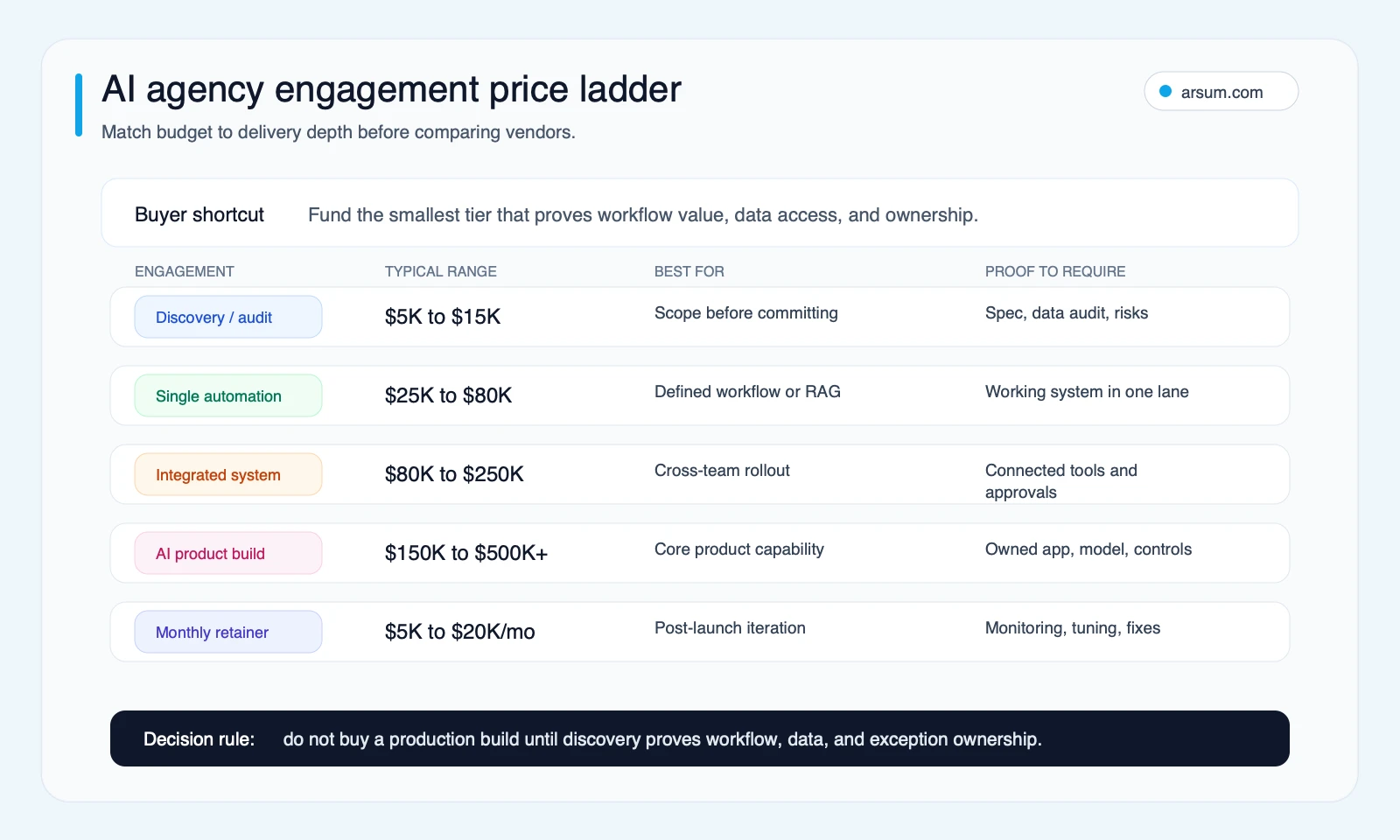
Ask every bidder to separate these scope components:
| Scope component | Procurement question |
|---|---|
| Discovery | Which decision artifacts are included, and who owns them if no build follows? |
| Build | Which workflow, integrations, interfaces, and environments are in scope? |
| Evaluation | Who prepares test cases, labels expected outcomes, and signs acceptance? |
| Security and compliance | What review is assumed, what is excluded, and who remediates findings? |
| Launch | What staged rollout, monitoring, reconciliation, and rollback work is included? |
| Support | What is the support boundary, response path, change process, and ownership after handoff? |
A lower proposal may be appropriate if the scope is genuinely narrower. It becomes risky when evaluation, controls, integration recovery, or ownership are merely absent from the document. For a separate buyer view of commercial tradeoffs, see AI automation agency pricing.
Red flags and disqualifying conditions
Do not hire an AI development agency yet if the workflow owner cannot authorize access, approve acceptance criteria, or own exceptions after launch. The project is not ready for a vendor to solve.
Treat these as red flags during diligence:
- The agency guarantees a precise quality result before reviewing your representative data and acceptance conditions.
- The proposal describes features but not source lineage, permissions, reviewer roles, logs, or rollback.
- A “production example” is only a polished demo, prototype, or generic chatbot.
- Engineers cannot discuss integration failures, evaluation design, or what changed after launch.
- The agency expects the model to make consequential decisions without a documented approval path.
- IP ownership, source code access, environment access, documentation, and handoff rights are vague.
- Support is described as “ongoing optimization” without named owners, operating boundaries, or incident handling.
- The team treats every launch issue as a tuning problem instead of diagnosing data, integrations, permissions, workflow design, model behavior, and operating controls.
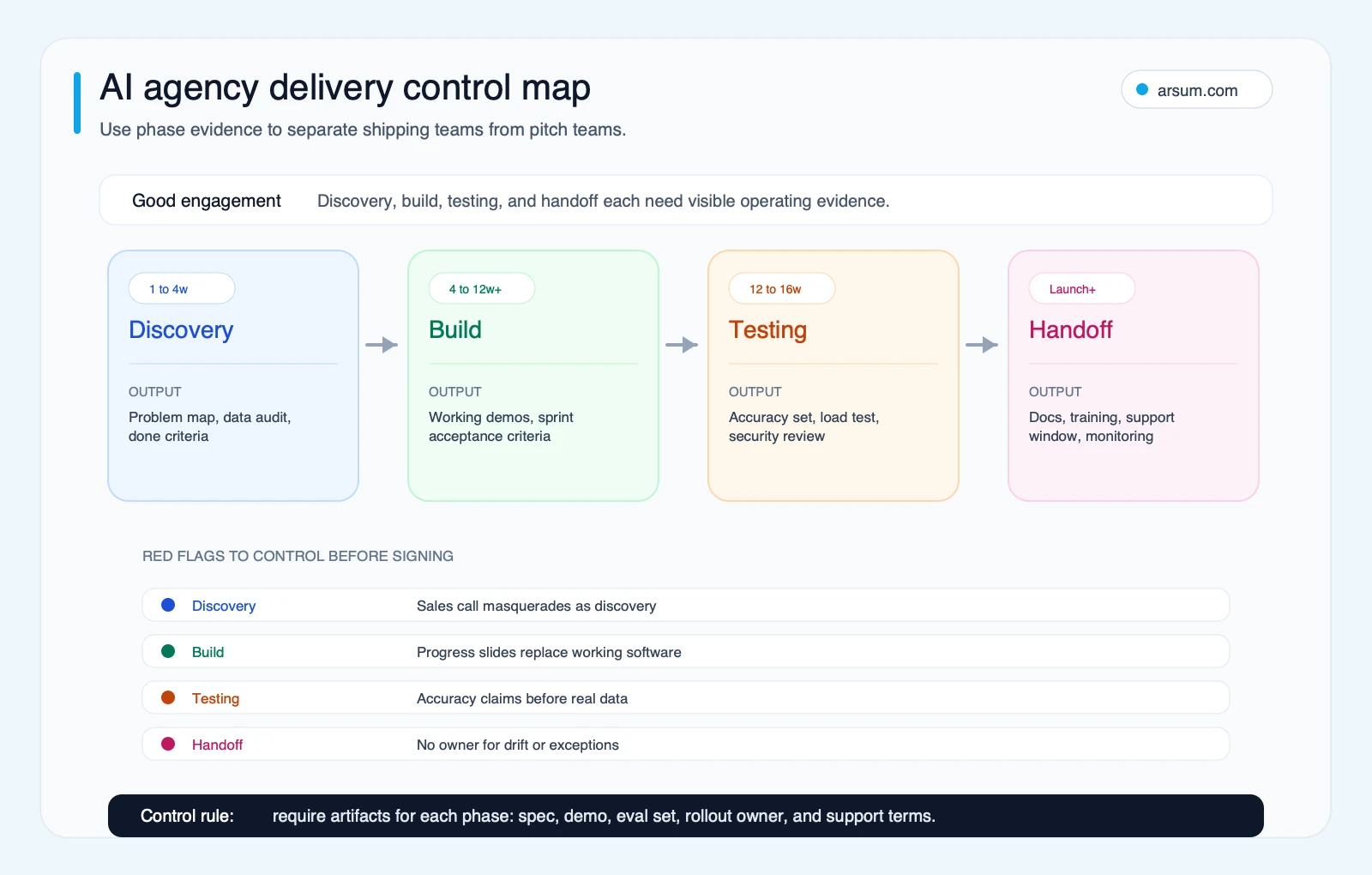
What good phased delivery looks like
A phased engagement should make risk visible before it becomes expensive:
- Discovery: map the workflow, baseline, systems, data, permissions, exceptions, and acceptance tests.
- Build: demonstrate working components against agreed scope, with decisions recorded as requirements change.
- Testing: evaluate representative cases, test security and tool boundaries, exercise failed integrations, and validate the rollback path.
- Launch and handoff: use a controlled rollout, name operators, provide runbooks and documentation, and agree on monitoring and change ownership.
Vendor call script
Use these questions to keep a first call concrete:
- Show a comparable production workflow, including a failure or exception you had to design around—not only the interface.
- What workflow artifact will we receive before build, and who signs the acceptance criteria?
- What representative data will be used for evaluation, and who owns the evaluation set after handoff?
- Which actions can the system take automatically, which require approval, and which are prohibited?
- How do you test prompt injection, sensitive data handling, output safety, and tool permissions?
- When an integration fails or output quality changes, who receives the alert, who can pause the workflow, and how are records reconciled?
- What code, documentation, environments, evaluation assets, and operating responsibilities transfer at launch?
The right agency may not have an instant answer to every question. It should be willing to turn unanswered questions into scoped discovery work, explicit assumptions, and named owners.
Methodology and limits
This guide uses the validated editorial research pack for the query, including exact-query search review, qualitative community discussions, and official guidance from OpenAI, NIST, OWASP, and Google Cloud reviewed on 2026-06-20. Community material is used only to surface buyer questions and implementation failure modes; it is not evidence of market size, adoption, cost, or outcomes.
The scorecard and pilot example are buyer decision tools. They help make evidence, ownership, and unresolved risk visible. They do not predict project cost, timeline, realized savings, adoption, or delivery success.
An AI development agency is worth considering when it can help you turn a qualified workflow into a controlled operating system: clear inputs, accountable owners, representative evaluation, bounded autonomy, an exception queue, retained evidence, and a practical rollback path. If a proposal cannot make those elements explicit, it has not yet earned production authority.
Ready to Automate Your Business?
Stop wasting time on repetitive tasks. Let AI handle the busywork while you focus on growth.
Schedule a Free Strategy Call →Written by:Arsum editorial team
- Reviewed by
- Arsum editorial team
- Published
- April 28, 2026
- Updated
- July 3, 2026
- How this was produced
- Arsum uses research packs, source checks, and human editorial review to prepare and update blog articles. Editors are responsible for the final page.
- Source policy
- Sources are linked in the article when used. Methodology and source notes are included on higher-risk or high-visibility pages and are being rolled out across the archive. Editorial policy.
- Why this page exists
- Help B2B operators evaluate AI automation, implementation scope, cost, risk, and build-vs-buy decisions with practical context.