AI development services should turn one defined business workflow into a controlled production system—not merely connect a model to a demo. The right engagement scopes the trigger, data sources, integrations, acceptance criteria, human review, owner, and rollback path before it promises automation.
AI Development Services: Buyer Guide
Explore ai development services: compare workflow fit, costs, risks, evidence, and practical next steps before you build, buy, or hire.

AI development services cover a defined process – not just a technology handoff
Table of Contents
- What most guides miss: you are buying a workflow boundary
- Start by choosing the right engagement
- What AI development services should include
- Definition of done: the pre-contract checklist
- A worked pilot scorecard
- The deliverables ladder
- Choose a use case with a measurable operating change
- Build, buy, or partner?
- Failure gates and disqualifying conditions
- How to evaluate a provider proposal
- Source note and practical next step
- Frequently asked questions
What most guides miss: you are buying a workflow boundary
Many pages describe AI development services as a menu of capabilities: generative AI, agents, machine learning, custom software, or integrations. That is not enough to buy well.
A useful scope starts with a workflow boundary:
- What event starts the work?
- Which source systems and records can the system use?
- What output may it draft, classify, extract, or route?
- Which outputs require approval?
- Who owns exceptions and changes after launch?
- What evidence must be retained?
- What condition disables the workflow safely?
This distinction changes the buying decision. A vendor can build a convincing prototype without resolving permissions, edge cases, operational ownership, or acceptance testing. A production engagement must resolve those items.
The exact-query market is crowded with provider pages listing broad capabilities. The more useful buyer question is whether the provider can convert your operating problem into a testable delivery plan. That is also the distinction between a narrow AI automation service engagement and a custom build that needs engineering, integration, and ongoing controls.
Start by choosing the right engagement
Before requesting proposals, decide whether your current constraint is discovery, implementation, or live ownership.
| Current situation | Best next move | What you should receive |
|---|---|---|
| Stakeholders cannot agree on the workflow, data, or metric | Discovery | Workflow map, data and permission audit, risk register, acceptance plan |
| The workflow is clear but the team needs evidence before funding a full build | Narrow prototype or pilot | Working slice, representative test set, measured results, decision to harden or stop |
| Integrations, approvals, and launch metrics are known | Production build | Software, integrations, evals, security review, deployment, handoff |
| A version is live but quality, costs, or behavior need active management | Operations retainer or internal owner | Monitoring, issue handling, controlled updates, support, change records |
AI consulting usually answers “what should we do?” AI development services should answer “what will be built, how will it be accepted, and who operates it?” An internal team provides durable ownership when the workflow becomes core product or operating capability. For a deeper comparison of delivery models, see AI consulting services and consulting and software development.
Turn a vague request into a service brief
A request such as “we need AI for support” is not yet a build specification. A production-ready brief might look like this:
| Scope layer | Vague request | Scoped brief |
|---|---|---|
| Workflow | Use AI in support | Classify inbound tickets, prepare draft replies, and route defined exceptions |
| Sources | Use our help center | Use approved help-center content, selected solved tickets, and CRM context; exclude private billing notes |
| Output | Answer customers | Produce a draft with cited source records and a confidence or routing signal |
| Authorization | Let it respond | Require agent approval for customer-facing sends; prohibit automated refunds or account changes |
| Acceptance | Make support faster | Compare drafting time and review outcomes against a documented baseline on a representative test set |
| Rollback | Pilot it | Disable the workflow flag and return the queue to the existing manual process |
If a proposal cannot get to the right-hand column, it is too early to price a production build.
What AI development services should include
A serious engagement may not need every deliverable below, but it should explicitly state which are included, excluded, or owned by your team.
Discovery, data, and permissions
Discovery defines the current process, input quality, system access, decisions, and exception path. It should identify whether the system will read from a document store, CRM, ERP, ticketing platform, warehouse, or internal application—and what permissions apply to each connection.
This is not paperwork for its own sake. The NIST AI Risk Management Framework frames AI risk management across design, development, use, and evaluation. For a buyer, that means the design should identify the people accountable for high-impact actions before a model is connected to them.
Architecture and build
The build may include application logic, model access, retrieval, structured outputs, business rules, user interface work, audit logs, integrations, and deployment configuration. Architecture choices extend beyond the model call: retrieval strategy, infrastructure, identity, observability, and operational design all affect the system that users receive. Google Cloud’s generative AI architecture guidance is a useful primary-source reference for that broader architecture layer.
For agent-oriented work, keep business rules and authorization outside the model wherever possible. A model can propose an action; deterministic application logic should decide whether the action is permitted. Compare this with the patterns in AI agent architecture before approving broad tool access.
Evaluation, security, and launch controls
Generative outputs vary, so acceptance testing cannot be limited to a few successful demonstrations. OpenAI’s evaluation guidance recommends designing evaluations around the behavior needed in production. Your vendor should therefore define a representative test set, expected output format, review method, pass conditions, and failure classification.
Safety and security are deliverables, not an afterthought. OpenAI’s safety guidance covers measures such as constrained inputs, adversarial testing, moderation, human review, and user reporting. For LLM applications, the OWASP Top 10 provides a practical checklist of risks including prompt injection, sensitive-information disclosure, insecure output handling, excessive agency, and overreliance.
Handoff and operating ownership
A launch should identify the business owner, technical owner, support path, monitoring location, change approval process, and rollback method. OpenAI’s production best practices can help frame the work needed to move from an experiment toward a robust production system.
The core deliverable is not “an AI feature.” It is a workflow your team can operate, inspect, and change without losing control.
Definition of done: the pre-contract checklist
Ask the provider to show how each item below will be evidenced before launch.
- The target workflow and current baseline are documented.
- A representative test set includes normal inputs and known messy or ambiguous cases.
- Inputs, source lineage, and allowed data access are defined.
- The expected output, confidence treatment, and exception categories are written down.
- A human escalation path has a named owner and service expectation.
- Latency and model-cost scenarios are estimated from stated volume assumptions.
- Security review covers permissions, data handling, output handling, and risky actions.
- Monitoring, issue reporting, and retained evidence are live before launch.
- The rollback action is documented and tested.
- A named business owner accepts the workflow after pilot review.
This checklist reflects the production, evaluation, safety, and risk-management guidance above; it is not a claim that every workflow needs the same technical stack. A read-only internal drafting tool needs different controls from a system that writes to customer records.
A worked pilot scorecard
Use this as an illustrative planning tool, not a predictive model or a universal vendor benchmark. Its purpose is to make assumptions visible before a larger commitment.
Example: supervised document-intake routing
Assume a team receives incoming documents that must be classified and assigned to a queue. The AI system may read an uploaded document, extract specified fields, propose a category, and route it only when the output meets agreed conditions. It does not approve the underlying business decision.
| Pilot element | Illustrative planning entry |
|---|---|
| Workflow | Classify and route one document type |
| Baseline | Measure current median handling time, manual rework, and routing corrections for the selected queue |
| Test set | A representative historical sample chosen by the workflow owner, including missing fields, duplicates, and unusual formats |
| Target | A target agreed by the owner before testing, such as reduced handling time while maintaining an acceptable review outcome |
| Quality measure | Correct category, required-field completeness, and rate of reviewer correction |
| Exception rule | Low-confidence, missing-source, or policy-sensitive items go to manual review |
| Owner | Operations lead owns workflow acceptance; technical lead owns system changes |
| Review cadence | Review pilot outcomes on a defined weekly cadence with a sample of accepted and escalated items |
| Evidence retained | Input identifier, source references, output, routing decision, reviewer correction, and workflow version |
| Stop condition | Pause if errors create unacceptable harm, review burden rises materially, source access is unreliable, or the owner cannot resolve recurring exceptions |
| Rollback | Disable automated routing and return all items to the existing manual queue |
The point is not a fixed accuracy threshold. Acceptable error depends on reversibility, review cost, volume, customer impact, and the harm of a wrong action. A draft that an experienced reviewer can correct quickly may be useful; an incorrect compliance action may require manual approval regardless of model confidence.
Illustrative planning arithmetic
If you want to estimate whether a pilot deserves funding, label every input as an assumption:
monthly task volume × minutes avoided per accepted task × loaded cost per minute
Then subtract:
review time + exception handling + software and model usage + implementation and operating costs
For example, do not claim that a workflow “saves” a given amount until you have measured accepted outputs, reviewer corrections, and live usage. Treat avoided rework, faster throughput, and redirected staff capacity as hypotheses to test—not labor-replacement promises.
The deliverables ladder
| Stage | Buyer question | Expected output |
|---|---|---|
| Workflow discovery | What exact work should change? | Workflow map, owner, baseline, exception map |
| Data and permission audit | What may the system see or use? | Source inventory, access boundaries, data-handling decisions |
| Technical architecture | How will the workflow be reliable and controllable? | Architecture, integrations, logging, authorization design |
| Prototype | Is the interaction or core task feasible? | Narrow demonstration with clearly stated limits |
| Production build | Can it run in the real environment? | Integrated application, controls, deployment configuration |
| Evaluation and security review | Does it meet defined conditions? | Test results, risk review, remediation decisions |
| Deployment | Can users adopt it safely? | Rollout plan, support route, rollback procedure |
| Handoff and maintenance | Who owns it after launch? | Documentation, ownership map, change process |
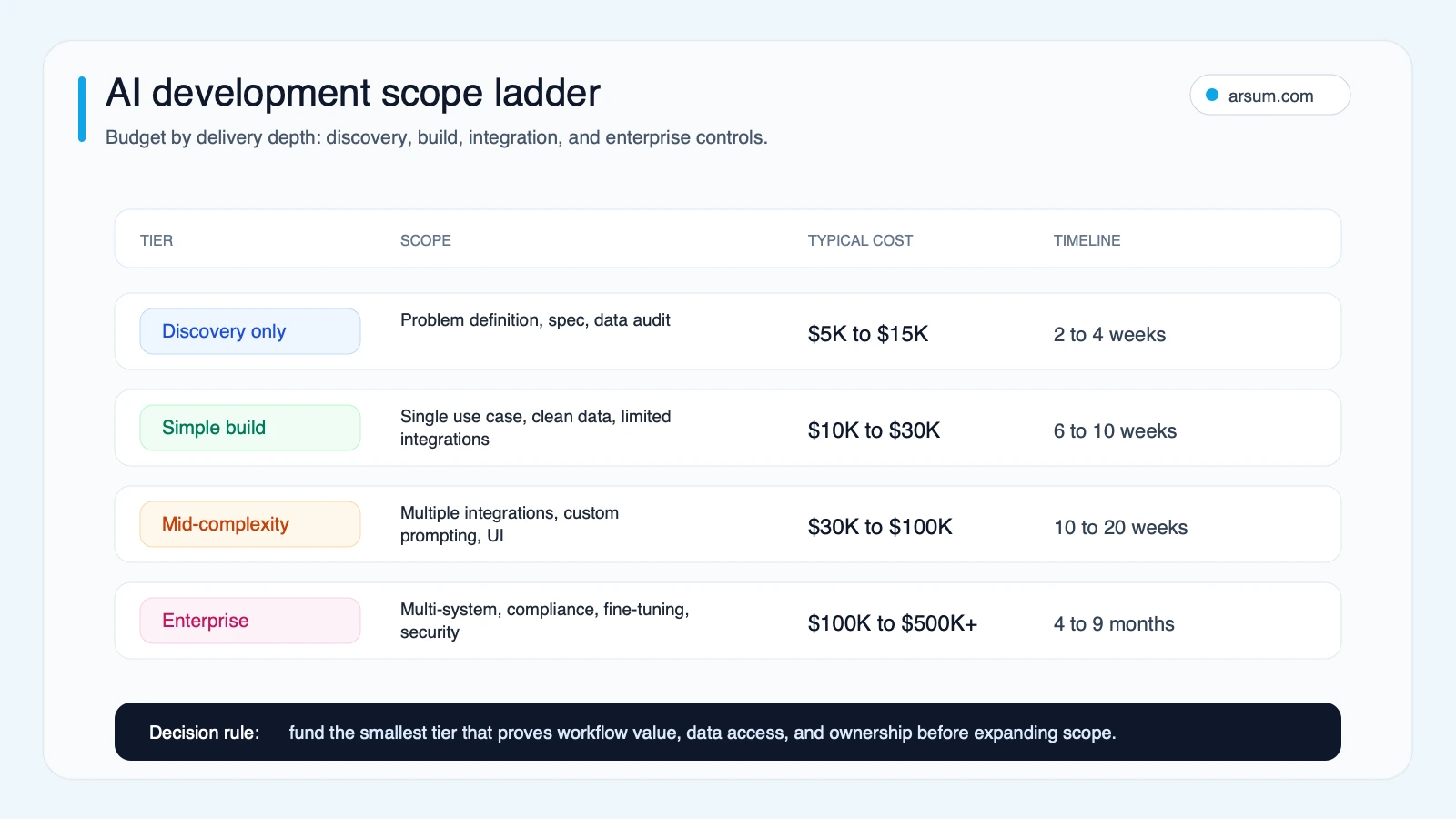
Use the ladder to compare delivery depth. Request a vendor quote against named deliverables and assumptions rather than a generic “AI project” tier.
Do not treat cost or duration ranges as market facts without a comparable scope, geography, team composition, security requirements, and support model. Ask vendors to separate discovery, build, integration, evaluation, deployment, and ongoing operations in their quote. That makes differences in proposed scope visible.
Choose a use case with a measurable operating change
Custom AI work is easier to evaluate when the before-and-after workflow is visible.
| Use case | Controlled first scope | Useful measures |
|---|---|---|
| Document processing | Extract specified fields and flag missing information for review | Handling time, extraction completeness, reviewer correction |
| Internal knowledge search | Answer bounded internal questions using approved sources with citations | Time to answer, source coverage, escalation rate |
| Workflow automation | Classify, draft, or route defined request types | Cycle time, routing correction, exception volume |
| Customer-facing feature | Offer a constrained search, recommendation, or drafting capability | User adoption, task completion, support issues |
| Agentic workflow | Propose multi-step work while approvals gate external actions | Completion quality, escalation, unauthorized-action prevention |
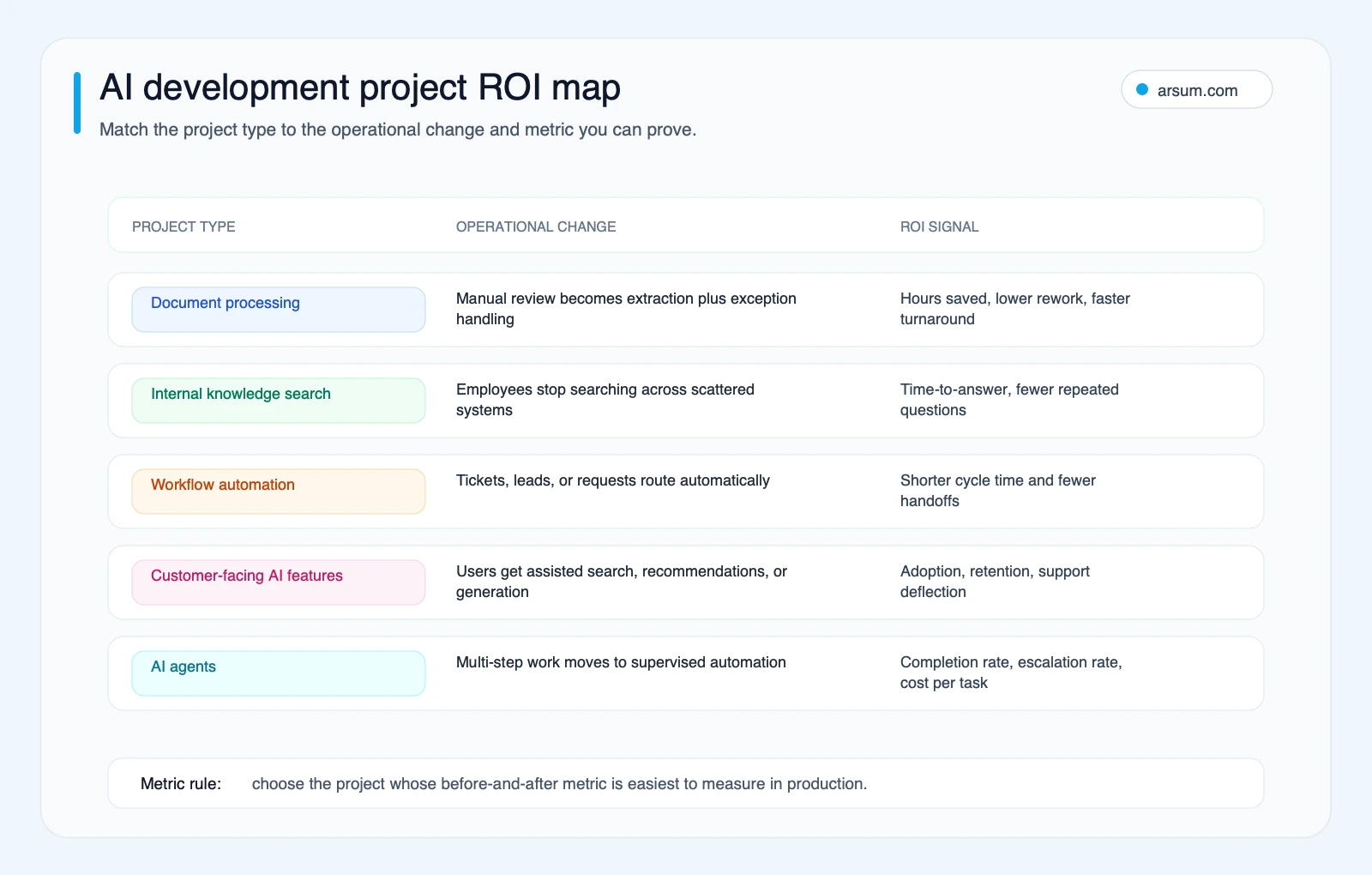
Choose the first project by measurability and control, not by novelty.
A knowledge-search system, for example, should disclose which sources are approved, how content is refreshed, how answers link back to sources, and what happens when retrieval is weak. A customer-facing assistant should have stricter approval and issue-reporting paths than an internal drafting tool. See AI integration services for the work required when the value depends on connecting existing systems.
Build, buy, or partner?
Custom development is appropriate when a valuable workflow depends on proprietary data, specific business rules, deep integrations, or controls that an existing product cannot provide. It is not automatically appropriate because a workflow involves AI.
| Situation | Decision |
|---|---|
| An established product covers the workflow and required controls | Buy it; measure the gaps before funding custom work |
| The gap is configuration, prompt design, or a limited integration | Use a focused implementation partner |
| The workflow requires proprietary rules, system connections, and controlled behavior | Scope custom AI development services |
| AI capability is core product IP and the roadmap is durable | Establish internal technical ownership; use specialists selectively |
| The workflow, owner, data access, or acceptance test is unresolved | Fund discovery, not a production build |
A custom build should not be justified by a universal error-rate rule or by claims that it will replace a full-time function. The question is whether supervised automation can improve throughput, reduce rework, or improve service while preserving an acceptable control boundary.
For agent-heavy cases, compare a narrow workflow against broader agent designs using agentic AI workflow automation and custom AI agent development services. More autonomy should mean more review, permission control, traceability, and rollback—not less.
Failure gates and disqualifying conditions
Do not expand from prototype to production until these gates have an owner and evidence.
- No workflow owner: there is no person authorized to decide which cases are accepted, escalated, or rejected.
- No representative test data: only clean examples are available, or the business cannot identify the exceptions that matter.
- No acceptance criteria: the project is described as “accurate,” “helpful,” or “better” without a reviewable definition.
- No integration access: required systems lack approved API, identity, or data-access paths.
- No safe exception queue: low-confidence or policy-sensitive outputs have nowhere reliable to go.
- No adoption plan: users are expected to change behavior without training, support, or a clear operational benefit.
- Irreversible high-harm actions: the proposed system can make legal, financial, customer, or compliance decisions without a suitable approval boundary.
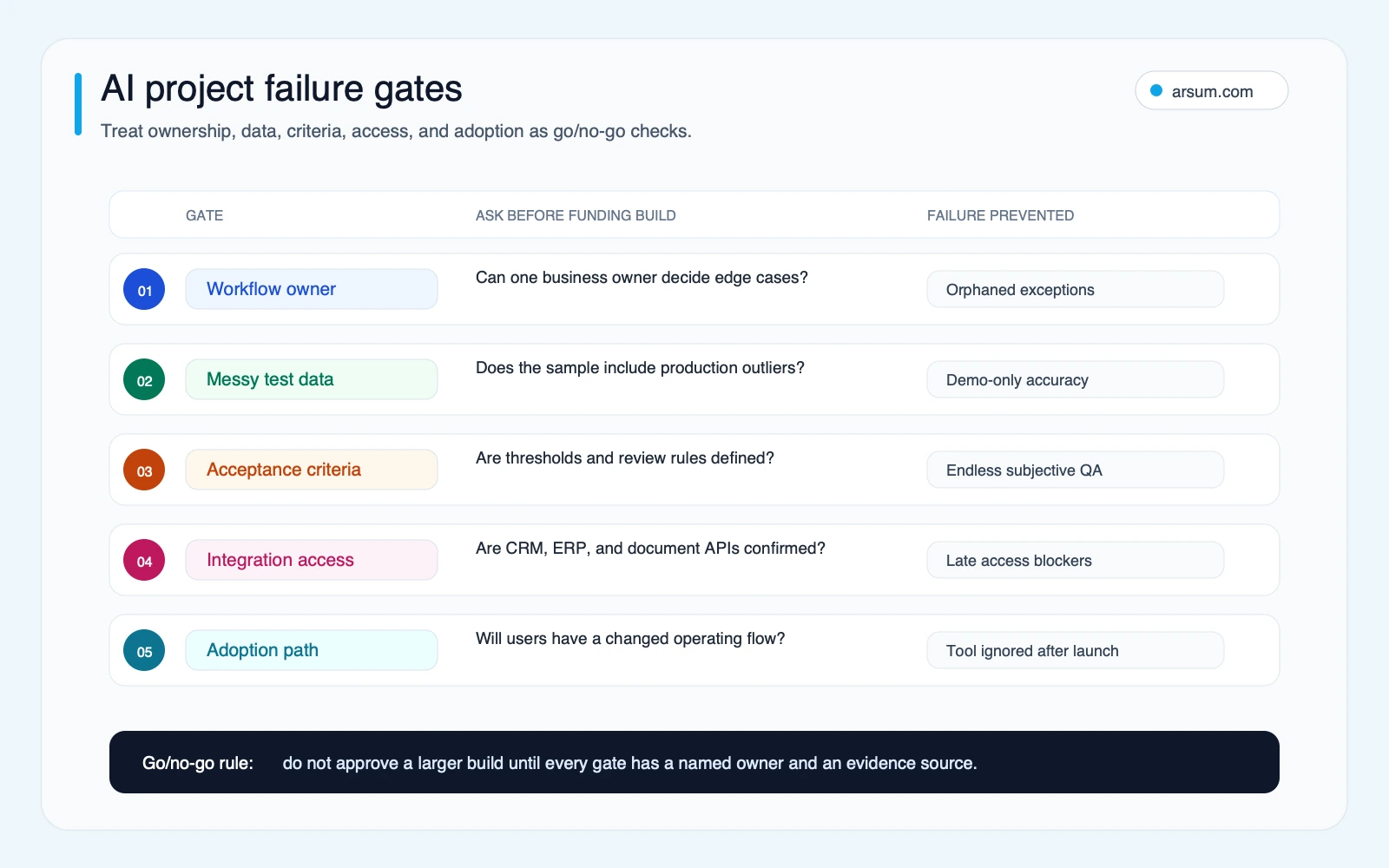
Each gate needs a named owner and evidence before the scope moves forward.
Adjacent practitioner discussions echo these concern patterns: vague customer requests, production reliability, cost behavior under repeated use, and security review. They are qualitative signals—not adoption data or performance benchmarks. See discussions on vague AI development requests, LLM application reliability, LLM cost management, and AI-generated-code security.
How to evaluate a provider proposal
Ask every provider for a response to the same questions:
- Which workflow and users are in scope—and explicitly out of scope?
- What data is needed, who authorizes access, and where does it reside?
- What does the system do automatically, propose for review, or refuse to do?
- What representative test set and acceptance criteria will determine launch readiness?
- How are prompts, model versions, tool calls, and reviewer corrections logged?
- What is the exception queue, who owns it, and what evidence is retained?
- How are cost scenarios modeled from your actual volume assumptions?
- What is the rollback method and who can trigger it?
- What changes after handoff, and who owns monitoring and updates?
The best response may be a discovery recommendation rather than a build proposal. That is a useful signal when the workflow is not ready. For vendor-selection considerations, see how to hire an AI developer and hiring an AI developer versus an agency.
💡 Arsum builds custom AI automation solutions tailored to your business needs.
Get a Free Consultation →Source note and practical next step
This guide uses an editorial research review of the exact-query SERP on June 20, 2026, adjacent practitioner discussions for qualitative failure-mode language, and primary guidance from OpenAI production, evaluation, and safety documentation; NIST AI RMF; OWASP’s LLM guidance; and Google Cloud architecture guidance. The scorecard and examples are editorial planning tools, not market data or claims about Arsum client outcomes.
If you have a workflow with a baseline, a likely owner, available test records, and an identified exception path, the next useful deliverable is a scoped assessment: workflow boundary, evidence requirements, control design, pilot economics, and a clear decision to build, buy, or stop.
Work With Arsum
We help businesses implement AI automation that actually works. Custom solutions, not cookie-cutter templates.
Learn more →Frequently asked questions
What is the difference between AI consulting and AI development services?
Consulting typically produces a roadmap, prioritization, or recommendation. AI development services should produce the build, integrations, evaluation, deployment, and handoff needed for a defined workflow. Use the engagement table above to decide which gap you actually have.
How do we know whether our data is ready?
You do not need perfect data. You need approved access, enough representative records to test the intended workflow, and a way to identify exceptions. If those are unavailable, discovery is the appropriate first engagement.
What should happen after launch?
Someone should own quality review, issue handling, permissions, model or prompt changes, and rollback decisions. The handoff should document that responsibility before the workflow is exposed to users.
When should AI remain supervised?
Keep human approval when an error is difficult to reverse, causes material harm, involves sensitive data, or depends on judgment that cannot be captured in the proposed rules and test set. Technical capability does not itself authorize autonomous action.
Ready to Automate Your Business?
Stop wasting time on repetitive tasks. Let AI handle the busywork while you focus on growth.
Schedule a Free Strategy Call →Written by:Arsum editorial team
- Reviewed by
- Arsum editorial team
- Published
- April 30, 2026
- Updated
- July 3, 2026
- How this was produced
- Arsum uses research packs, source checks, and human editorial review to prepare and update blog articles. Editors are responsible for the final page.
- Source policy
- Sources are linked in the article when used. Methodology and source notes are included on higher-risk or high-visibility pages and are being rolled out across the archive. Editorial policy.
- Why this page exists
- Help B2B operators evaluate AI automation, implementation scope, cost, risk, and build-vs-buy decisions with practical context.