AI DevOps automation starts with CI/CD failures that force engineers to search logs, recent changes, runbooks, and ownership before they can act. The first pilot should produce that change packet and shorten diagnosis, not bypass release control.
AI DevOps Automation: 28 Tasks Ranked
AI DevOps automation: compare 28 O*NET tasks, the 52.8/100 score, 2029 capability, human controls, task capacity, and a practical first pilot.
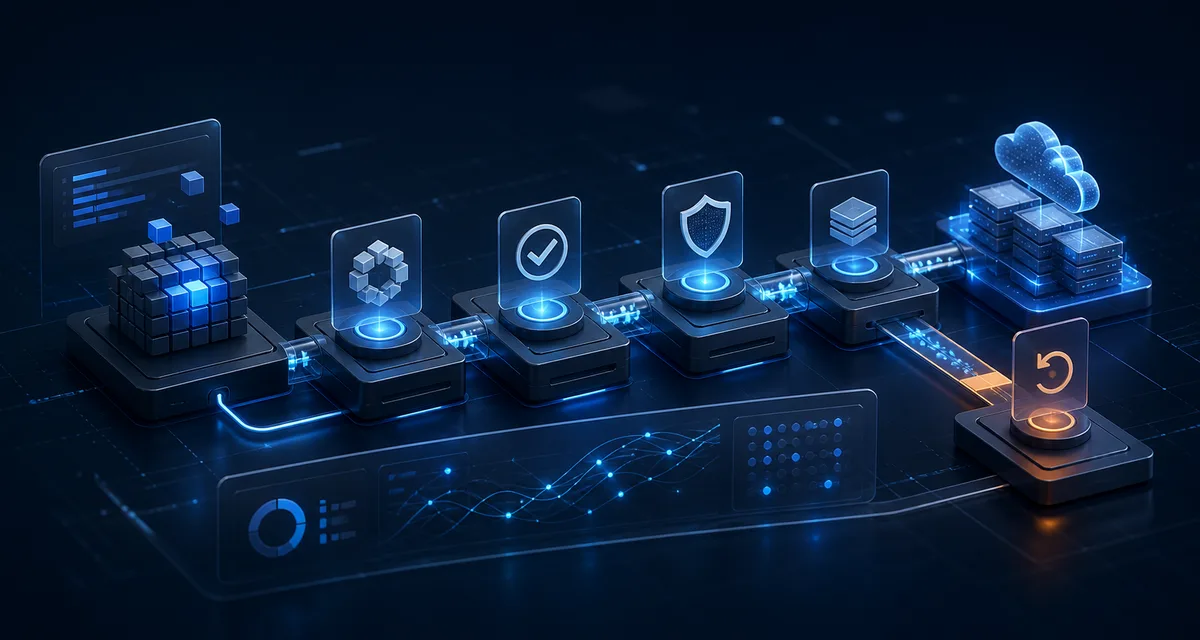
Table of Contents
- DevOps and systems engineering automation opportunity
- How the devops and systems engineering score is calculated
- Top devops and systems engineering tasks for automation support
- DevOps and systems engineering tasks that should remain human-led
- DevOps and systems engineering capability from 2026 to 2029
- Modeled hours and wage capacity for devops and systems engineering
- A controlled 30/60/90-day devops and systems engineering pilot
- What most devops and systems engineering automation guides miss
- Social listening: devops and systems engineering implementation questions
- Official control context for devops and systems engineering
- DevOps and systems engineering pilot evidence before expansion
- 30-day devops and systems engineering pilot acceptance scorecard
- Build, buy, or connect devops and systems engineering automation?
- Target operating design for devops and systems engineering
- Worked devops and systems engineering example: normal path, exception, and replay
- Worked devops and systems engineering pilot economics (illustrative, not a benchmark)
- What the 52.8/100 devops and systems engineering score means
- First pilot: CI/CD failure triage and deployment change packets
- DevOps and systems engineering pilot charter and release gate
- DevOps and systems engineering decision-rights matrix
- Why the 2029 devops and systems engineering scenario is secondary
- DevOps and systems engineering baseline and net-value worksheet
- Compare devops and systems engineering with adjacent engineering and IT workflows
- AI DevOps automation: concise buyer answers
DevOps and systems engineering teams can automate CI/CD failure triage, configuration evidence, documentation, change preparation, and reliability analysis. Architecture, credentials, deployment authority, and incident command remain human-owned. Arsum’s task-level model provides prioritization context: 52.8/100 today, a 65.9/100 capability scenario for 2029, and a modeled planning range of 11.9-19.9 hours/week.
Arsum Automation Opportunity Index · 2026-08-12
DevOps and systems engineering automation opportunity
DevOps and systems engineering teams can automate CI/CD failure triage, configuration evidence, documentation, change preparation, and reliability analysis. Architecture, credentials, deployment authority, and incident command remain human-owned.
Current score
52.8/100
Selective automation opportunity
Modeled task capacity
11.9-19.9 hours/week
P25-P75 planning range
2029 capability scenario
65.9/100
+13.1 points, not an adoption forecast
Recommended first pilot
CI/CD failure triage and deployment change packets
Start narrow, measure, then expand
Decision: Start with a read-only deployment evidence workflow before granting an agent production credentials.
How the devops and systems engineering score is calculated
For devops and systems engineering, Arsum assessed 28 of 28 O*NET tasks from Computer Systems Engineers/Architects (15-1299.08). The 52.8/100 result weights each task's current automation share by O*NET importance, relevance, and frequency. It measures technical workflow opportunity—not the percentage of devops and systems engineering jobs that disappear and not the share of a team that should be removed.
Platform and service owners should approve architecture, infrastructure policy, credentials, production deployment, rollback, SLO trade-offs, and incident command. The weighted supervision estimate is 27.6%, which is why the practical design is an exception-and-approval system rather than unsupervised autonomy.
Top devops and systems engineering tasks for automation support
O*NET task 14667
Provide advice on project costs, design concepts, or design changes.
60/100
Llm
AI assists; review exceptions and material outputs
O*NET task 14668
Document design specifications, installation instructions, and other system-related information.
70/100
Vision
AI assists; review exceptions and material outputs
O*NET task 14669
Verify stability, interoperability, portability, security, or scalability of system architecture.
60/100
Hybrid
AI assists; review exceptions and material outputs
O*NET task 14670
Collaborate with engineers or software developers to select appropriate design solutions or ensure the compatibility of system components.
60/100
Llm
AI assists; review exceptions and material outputs
O*NET task 14671
Evaluate current or emerging technologies to consider factors such as cost, portability, compatibility, or usability.
55/100
Llm
AI assists; review exceptions and material outputs
O*NET task 14673
Identify system data, hardware, or software components required to meet user needs.
70/100
Hybrid
AI assists; review exceptions and material outputs
O*NET task 14675
Monitor system operation to detect potential problems.
65/100
Hybrid
AI assists; review exceptions and material outputs
These are ranked for practical opportunity: task exposure and current capability are discounted when implementation is complex, supervision is heavy, or live human interaction dominates. The recommended pilot above is an editorial choice among these signals, not simply the highest raw percentage.
DevOps and systems engineering tasks that should remain human-led
- 30/100 current capability: Investigate system component suitability for specified purposes, and make recommendations regarding component use. AI prepares; human approval is required.
- 45/100 current capability: Define and analyze objectives, scope, issues, or organizational impact of information systems. Decision support only; human owns the conclusion.
- 30/100 current capability: Train system users in system operation or maintenance. AI assists; review exceptions and material outputs.
- 60/100 current capability: Verify stability, interoperability, portability, security, or scalability of system architecture. AI assists; review exceptions and material outputs.
DevOps and systems engineering capability from 2026 to 2029
2026 current
52.8/100
52.8/100
2028 midpoint
61.5/100
61.5/100
2029 scenario
65.9/100
65.9/100
The scenario adds 13.1 score points by 2029-08-12 under the same task mix. It assumes better reliability and integration in the tasks already identified as technically assistable. It does not assume that employers deploy those systems, that every normal case becomes autonomous, or that employment changes by the same amount.
The largest weighted capability gains come from:
- O*NET task 14677, Investigate system component suitability for specified purposes, and make recommendations regarding component use. 30→50.
- O*NET task 14666, Communicate with staff or clients to understand specific system requirements. 45→60.
- O*NET task 14676, Direct the analysis, development, and operation of complete computer systems. 45→60.
Modeled hours and wage capacity for devops and systems engineering
The devops and systems engineering model assigns 30 hours of a reference 40-hour week across rated tasks and leaves 10 hours unmodeled. On that explicit assumption, current automation capability represents 11.9-19.9 hours/week. At the May 2025 BLS national mean wage of $59/hour, the gross devops and systems engineering planning range is $36,330-$60,550/year per worker.
BLS national employment435,370
Mean annual wage$122,230
Tasks with full score inputs28/28
Assessment coverage100%
Gross wage capacity is not net savings. A business case must subtract implementation, software and model usage, review time, exception handling, maintenance, and risk reserves. BLS employment excludes self-employed workers. The wage and employment figures here use the broader 15-1299 parent occupation, not a standalone count for this O*NET specialization.
A controlled 30/60/90-day devops and systems engineering pilot
- Days 0-30: baseline CI/CD failure triage and deployment change packets. Capture volume, handling time, rework, error rate, source systems, permissions, and the exception owner before changing the workflow.
- Days 31-60: run in review mode. Let the system prepare or route work, keep logs, and require human approval at the boundary described above. Measure accepted outputs and review cost, not generated volume.
- Days 61-90: expand only after evidence. Increase scope when accuracy, cycle time, exception rate, and net capacity beat the baseline without weakening customer, employee, financial, legal, or operational controls.
Sources, formula, and limitations
Occupation and task facts come from O*NET O*NET 30.3. Employment and wage inputs come from BLS OEWS May 2025 national estimates. Arsum adds the task-level current capability, supervision, implementation, time-allocation, and 2029 scenario assessments.
The occupation score is the exposure-weighted mean of task automation shares. Exposure combines normalized O*NET importance, relevance, and a log-scaled transformation of frequency. The time range applies a ±25% planning band around the modeled task capacity. Read the full Automation Opportunity Index methodology for formulas, QA gates, version history, and reproducible queries.
- The task inventory comes from O*NET 30.3; Arsum supplies the automation assessment and transformation.
- The time model allocates 30 hours of a reference 40-hour week across rated O*NET tasks, leaving 10 hours unmodeled for context switching and work not represented by task statements.
- Hours and wage capacity are planning ranges, not measured savings. Net ROI must subtract software, implementation, review, exception handling, maintenance, and risk costs.
- The 2029 value is a capability scenario, not a forecast of adoption, employment, layoffs, or autonomous operation.
- All 28 tasks have the O*NET inputs needed for score weighting and were assessed.
- BLS wage and employment data use the broader 15-1299 parent occupation and should not be interpreted as a count for this O*NET specialization alone.
Version: aoi-v0.4-software-it · run 10 · capability date 2026-08-12 · forecast horizon 2029-08-12.
What most devops and systems engineering automation guides miss
The safe automation boundary is before execution: collect failure evidence, connect it to the exact artifact and recent changes, propose a replayable fix, and require normal policy. Autonomous remediation is not the first pilot.
That is the first decision rule for this page: a technical capability score identifies where to investigate, while production acceptance depends on source evidence, exception cost, reversibility, and decision authority. Platform teams need a way to prove that AI reduces time to a correct, replayable change without weakening artifact identity, approvals, secrets, or rollback.
How well the public occupation data fits this workflow
O*NET does not publish a standalone DevOps occupation. The score uses Computer Systems Engineers/Architects as a transparent proxy for systems, testing, maintenance, and architecture tasks, and BLS uses the broader Computer Occupations, All Other parent.
Decision tree: automate, assist, or keep human-led
| Operating mode | Use it when | Accountable owner |
|---|---|---|
| Automate the normal path | Use only when inputs are complete, rules are stable, the output is reversible, and none of these conditions apply: the diagnosis omits an affected service or environment; untrusted build output changes agent instructions; production deployment or rollback occurs without service-owner authority. | the platform engineering lead and affected service owner approves the rule, permissions, threshold, and sampled quality review. |
| Assist, then review | Use when software can prepare a source-linked failure diagnosis and change packet with affected services, confidence, proposed checks, approvers, and rollback reference, but an exception, uncertainty, customer impact, or material judgment remains. | the platform engineering lead and affected service owner accepts, corrects, or rejects the prepared output before the consequential action. |
| Keep human-led | Platform and service owners should approve architecture, infrastructure policy, credentials, production deployment, rollback, SLO trade-offs, and incident command. | The accountable human records the decision and rationale; the system may collect evidence but cannot silently complete the action. |
This decision tree prevents a high score on a preparation task from being mistaken for permission to automate the final devops and systems engineering decision. Start the pilot in shadow mode, compare the prepared output with the approved outcome, and expand permissions only for a stable normal path.
Social listening: devops and systems engineering implementation questions
These source-linked discussions are qualitative workflow signals. They identify objections and exception patterns to test; they do not establish adoption, accuracy, ROI, or legal requirements.
- DevOps practitioners see current value in log parsing, change correlation, and draft remediation—not unrestricted production actions. Reddit r/devops discussion on practical AI use is treated as qualitative evidence, not a market-wide statistic. For this pilot, keep the first pilot read-only and proposal-based.
- Pipeline delay often comes from infrastructure, dependency, and integration failures rather than missing code generation. Reddit r/devops discussion on CI reliability is treated as qualitative evidence, not a market-wide statistic. For this pilot, segment failure families before estimating value.
- Enterprise pipelines depend on artifact promotion, approvals, secrets, environment configuration, and collaboration controls. Reddit r/devops discussion on enterprise CI/CD is treated as qualitative evidence, not a market-wide statistic. For this pilot, require the same artifact and existing gates in the pilot.
The repeated signal is operational: teams want fewer touches, but not at the cost of hidden review work or untraceable decisions. A useful vendor demonstration should therefore use the organization’s own difficult cases and show the reviewer exactly what happened to every exception.
Official control context for devops and systems engineering
- O*NET 30.3 database: O*NET supplies the occupation task statements, task ratings, work context, and related descriptors used by the Arsum model.
- BLS Occupational Employment and Wage Statistics: BLS supplies the employment and wage snapshot used to translate modeled task capacity into a gross wage-capacity planning range.
- NIST Secure Software Development Framework: NIST organizes secure software development around preparation, software protection, well-secured production, and vulnerability response.
- Google SRE Incident Management Guide: Google SRE emphasizes reliable alerting, clear incident roles, communication, practice, and learning.
- OWASP LLM06 Excessive Agency: OWASP identifies excessive functionality, permissions, and autonomy as causes of damaging agent actions.
These sources establish the task, wage, governance, or control context. They do not endorse Arsum’s score or a specific product. The organization’s legal, compliance, risk, and process owners must translate them into its own requirements.
DevOps and systems engineering pilot evidence before expansion
| Pilot gate | Evidence to collect | Stop or narrow when | Owner |
|---|---|---|---|
| Workflow value | Baseline and post-pilot correct failure classification plus time to owner-ready context | Review and rework consume the apparent capacity gain | the platform engineering lead and affected service owner |
| Output quality | Accepted outputs, corrections, source links, and review correction minutes | The diagnosis omits an affected service or environment | the platform engineering lead and affected service owner |
| Control safety | Permission logs, model or rule version, reviewer, exception, and rollback evidence | Untrusted build output changes agent instructions | the platform engineering lead and affected service owner |
| Expansion readiness | Stable results across normal and difficult cases, including deployment rollback or incident rate | Production deployment or rollback occurs without service-owner authority | the platform engineering lead and affected service owner |
30-day devops and systems engineering pilot acceptance scorecard
The percentages and sample floors below are illustrative starting thresholds, not industry benchmarks. the platform engineering lead and affected service owner should replace them with thresholds based on baseline error severity, case mix, risk appetite, and required statistical confidence before the pilot starts.
| Acceptance gate | Illustrative evidence threshold | Continue, narrow, or stop rule |
|---|---|---|
| Representative workflow sample | Use at least 100 completed CI/CD failure triage and deployment change packets cases or one full operating cycle when volume is lower, including every known exception class. | Narrow the pilot when the sample omits a material system, permission state, failure mode, or reviewer group. |
| Accepted output quality | Compare correct failure classification and time to owner-ready context with the pre-pilot baseline; count only outputs accepted by the platform engineering lead and affected service owner. | Stop or redesign when the diagnosis omits an affected service or environment. |
| Net operating value | Track review correction minutes and deployment rollback or incident rate after review, correction, model usage, integration, and exception-handling time are included. | Continue only when accepted capacity improves and downstream rework or incident exposure does not increase. |
| Approval and rollback safety | Require a named the platform engineering lead and affected service owner, a recorded source and output version, permission logs, and a tested rollback for every consequential action. | Stop immediately when untrusted build output changes agent instructions or production deployment or rollback occurs without service-owner authority. |
Build, buy, or connect devops and systems engineering automation?
| Delivery path | Choose it when | Disqualifying condition |
|---|---|---|
| Buy and configure | A product already supports CI/CD failure triage and deployment change packets, the required source systems, approval queue, evidence export, and rollback path. | The vendor cannot reproduce an output, isolate permissions, export evidence, or pass the buyer’s difficult cases. |
| Connect existing systems | The system of record and execution tools are trusted, but evidence retrieval, routing, or reviewer handoffs create the backlog. | There is no stable identity, version, environment, or case key across the source, review, and final systems. |
| Build a narrow workflow | CI/CD failure triage and deployment change packets is proprietary, recurring, measurable, and valuable enough to fund integration, validation, monitoring, and maintenance. | The organization cannot fund the platform engineering lead and affected service owner, exception ownership, security review, regression tests, and ongoing change control. |
This is an operating-model choice, not a preference for custom software. The selected path still needs a funded owner for integration, access, validation, change control, monitoring, and exception resolution after launch.
Target operating design for devops and systems engineering
CI/CD, artifact registry, source control, policy, observability, incident, and runbook systems remain authoritative. AI prepares a failure timeline and proposed change in an isolated branch; deterministic CI, policy, and security checks run; a platform owner approves the same immutable artifact through staged deployment and rollback.
This design deliberately separates source systems, preparation, deterministic rules, probabilistic assistance, approval, and the final system of record. The pilot should test one normal case and every material exception path end to end, including permission failure and rollback.
Worked devops and systems engineering example: normal path, exception, and replay
A deployment fails after a base-image update. The assistant links the artifact digest, changed dependency, failing step, and prior successful run, then drafts a pinned fix. CI passes, but policy blocks an unsigned image, so the platform owner corrects provenance before promotion.
Worked devops and systems engineering pilot economics (illustrative, not a benchmark)
For an illustrative 30-day cohort of 100 CI/CD failures, assume 140 platform and developer diagnosis hours plus six delayed releases. If evidence-first triage removes 52 hours but review and correction add 16, net capacity is 36 hours. At $120/hour, gross capacity is $4,320; subtract $1,400 for observability, integration, model, and maintenance allocation. Continue only when wrong-owner routing, unsafe remediation proposals, failed releases, and recovery time do not rise.
Methodology and freshness note
Reviewed the exact keyword and close commercial variants, three source-linked qualitative practitioner patterns, official control sources, and Arsum’s ONET 30.3/OEWS May 2025 task model on 2026-08-12. Practitioner discussions are used to identify buyer questions and failure modes, not as prevalence, ROI, accuracy, or legal evidence. The practitioner sources above are paraphrased and labeled because they are useful for discovering buyer questions, not for proving performance. The ONET/BLS model assumptions and limitations remain visible in the data module and scoring methodology.
What the 52.8/100 devops and systems engineering score means
Start with a read-only deployment evidence workflow before granting an agent production credentials. The score supports selective workflow investment, not a broad replacement program. Concentrate budget in the few repeatable tasks that clear the control and integration gates.
For a startup, DevOps automation can recover scarce senior-engineer attention, but the blast radius is larger than the queue. The first useful agent should explain and prepare; permissions should expand only after replay, rollback, and owner routing are measured.
The task distribution matters more than the occupation average. “Provide advice on project costs, design concepts, or design changes.” scores 60/100 today; “Document design specifications, installation instructions, and other system-related information.” scores 70/100; and “Verify stability, interoperability, portability, security, or scalability of system architecture.” scores 60/100. Those tasks show where current software can prepare, validate, or route work. They do not transfer accountability for the whole role.
The contrast is equally important. “Investigate system component suitability for specified purposes, and make recommendations regarding component use.” carries a 30/100 capability estimate and 80% modeled supervision. “Define and analyze objectives, scope, issues, or organizational impact of information systems.” is 45/100 with 45% supervision. That spread is why the recommendation is selective automation, not a claim that every devops and systems engineering responsibility can follow the same operating model.
First pilot: CI/CD failure triage and deployment change packets
The first implementation candidate is CI/CD failure triage and deployment change packets. The representative O*NET task closest to that workflow is task 14686: “Research, test, or verify proper functioning of software patches and fixes.” Its current capability estimate is 65/100, with 15% modeled supervision. That combination indicates whether the pilot should use straight-through processing, review-first assistance, or decision support.
This pilot is narrower than “automate devops and systems engineering.” It should have one trigger, a known source of truth, an observable output, an exception owner, and a before-and-after baseline. The pilot task is an editorial choice based on coherence and controllability; it is not simply whichever O*NET statement has the largest raw percentage.
DevOps and systems engineering pilot charter and release gate
The 30-day scorecard above is the pilot charter. Use one trigger and the workflow states received → source validated → eligible normal path or exception → reviewed → accepted or returned → reconciled and replayable. the platform engineering lead and affected service owner owns release under the decision-rights matrix below. The workflow returns to review-only mode for any material failure mode, missing authoritative source, unauthorized action, or failed rollback.
💡 Arsum builds custom AI automation solutions tailored to your business needs.
Get a Free Consultation →DevOps and systems engineering decision-rights matrix
| Decision | Accountable owner |
|---|---|
| Failure family, source access, and runbook eligibility | Platform engineering owner |
| Proposed pipeline or infrastructure change | Service code owner and platform reviewer |
| Policy, provenance, secrets, and security exception | Security or software-supply-chain owner |
| Artifact promotion, deployment, and rollback | Existing release authority |
The modeled 27.6% weighted supervision estimate is a prioritization signal. The matrix—not that occupation average—defines authority for the selected pilot.
Why the 2029 devops and systems engineering scenario is secondary
The 65.9/100 scenario changes technical-capability assumptions while holding today’s O*NET task mix constant. It does not predict adoption, employment, regulation, or authorized autonomy. For this buyer decision, local source coverage, citation/version fidelity, reviewer effort, error severity, integration cost, and controlled-action boundaries take precedence.
DevOps and systems engineering baseline and net-value worksheet
For each failure, capture pipeline and artifact ID, environment, failure family, recent changes, time to correct owner, diagnosis minutes, proposed fix, review and correction minutes, reruns, deployment result, recovery time, and tool cost. Compute first-correct-routing rate as cases sent to the right owner without reassignment / cases triaged; net hours as baseline diagnosis - automated preparation - review - correction - failed-rerun cost; and net value as net hours × loaded rate + avoided release-delay cost - integration - model - maintenance. Evaluate immutable-artifact, secret, policy, and rollback controls separately from diagnosis speed.
The published 11.9-19.9 hours/week and $36,330-$60,550/year figures remain gross portfolio-planning ranges based on a disclosed 30-hour task budget and BLS wage input. They are not realized savings and cannot replace this local worksheet.
Work With Arsum
We help businesses implement AI automation that actually works. Custom solutions, not cookie-cutter templates.
Learn more →Compare devops and systems engineering with adjacent engineering and IT workflows
Do not apply the 52.8/100 score to an entire department. Compare devops and systems engineering with Software development (58.3/100), Systems administration (59.8/100), Cybersecurity analysis (51/100), Website administration (61.9/100) because those pages use different task inventories, control boundaries, and first pilots. The Software Engineering & IT Automation Index supports portfolio prioritization; the scoring methodology documents the formula, denominator, and forecast limitations.
AI DevOps automation: concise buyer answers
What should a buyer use the score for?
The current 52.8/100 score is a task-weighted prioritization aid, not a replacement or savings prediction. Use it to decide where to investigate, then replace portfolio assumptions with local volume, acceptance, review, error-severity, integration, and maintenance evidence.
What is the first funding decision?
Start with CI/CD failure triage and deployment change packets only when authoritative sources, scope, owners, volume, and a measurable baseline exist. Buy and configure when a platform meets the evidence and control contract; connect trusted systems when handoffs are the problem; build narrowly only when organization-specific rules and integrations justify ongoing validation and maintenance.
Ready to Automate Your Business?
Stop wasting time on repetitive tasks. Let AI handle the busywork while you focus on growth.
Schedule a Free Strategy Call →Written by:Arsum editorial team
- Reviewed by
- Arsum editorial team
- Published
- August 12, 2026
- Updated
- Same as published date
- How this was produced
- Arsum uses research packs, source checks, and human editorial review to prepare and update blog articles. Editors are responsible for the final page.
- Source policy
- Sources are linked in the article when used. Methodology and source notes are included on higher-risk or high-visibility pages and are being rolled out across the archive. Editorial policy.
- Why this page exists
- Help B2B operators evaluate AI automation, implementation scope, cost, risk, and build-vs-buy decisions with practical context.