AI for SEO works best when it automates a bounded, repeatable part of search operations—not when it is treated as permission to publish more pages. Start with workflows that are revenue-linked, easy to review, and reversible: content-refresh briefs, keyword clustering, internal-link suggestions, technical-issue triage, and performance reporting. Keep strategy, factual claims, final publishing approval, and commercial prioritization with named people.
AI for SEO: Complete 2026 Guide
Explore ai for seo: compare workflow fit, costs, risks, evidence, and practical next steps before you build, buy, or hire.

Table of Contents
- What Most Guides Miss About AI for SEO
- What AI Can Automate—and What It Should Not Own
- Choose the First Workflow With an Automation-Readiness Score
- A 30–60 Day Content-Refresh Pilot
- Build vs Buy for AI SEO
- Design One Control System, Not Repeated Warnings
- Disqualifying Conditions and Failure Modes
- Practitioner Signals: Useful Questions, Not Market Statistics
- Sources and Limits
- The Practical Decision
- Related Arsum Guides
What Most Guides Miss About AI for SEO
Most AI for SEO guides begin with tool features. That skips the decision that determines whether a tool, managed service, or custom workflow will help: can your team describe the workflow before it automates it?
A useful workflow has:
- A recurring trigger, such as a monthly refresh queue or weekly technical audit.
- Defined inputs, including Search Console data, approved product claims, page templates, CMS fields, and internal-link rules.
- A reviewable output, such as an editor-ready brief or a prioritized issue list.
- A named owner who can approve, reject, or pause the work.
- A measurable business outcome beyond publishing volume.
- A reversal path if quality, traffic, or conversion quality deteriorates.
This matters because AI can accelerate research and production without solving unclear positioning, weak source discipline, unavailable subject-matter reviewers, or a disconnected CMS. If those constraints remain, faster output often creates a larger editorial backlog.
Google’s published guidance supports a fundamentals-first approach. Its guidance for generative AI features in Search says the same foundational SEO practices remain relevant, while its guidance on using generative AI for site content warns against using automation to create low-value content at scale. AI use itself does not guarantee visibility in AI features, AI Overviews, or conventional results.
What AI Can Automate—and What It Should Not Own
AI is useful when it turns structured data and rules into work a specialist can inspect. It is less useful when the decision depends on unrecorded customer knowledge, original expertise, regulatory interpretation, or an executive point of view.
| Workflow | AI can accelerate | Human owner retains |
|---|---|---|
| Keyword research | Query expansion, clustering, intent labels, backlog drafts | Topic priorities, ICP fit, commercial relevance |
| Content briefs | SERP summaries, outline proposals, internal-link candidates | Point of view, evidence requirements, page intent |
| Content refreshes | Change summaries, draft revisions, metadata variants | Factual validation, examples, final editorial approval |
| Technical SEO | Crawl issue grouping, ticket drafts, duplicate-pattern detection | Engineering prioritization, deployment decisions |
| Reporting | Anomaly summaries, page/query trend summaries, action prompts | Diagnosis, budget decisions, commercial interpretation |
| CMS handoff | Formatting checks, field completion, draft preparation | Publication approval and rollback authority |
An agentic SEO workflow can connect several of these steps. It may retrieve performance data, prepare a brief, draft changes from approved context, suggest internal links, package a CMS draft, and route it to review. That does not make it the strategy owner.
The difference between a prompt and an operational workflow is control design. A prompt produces text. A workflow has input permissions, approval states, logs, exceptions, and a defined person who can stop it. Teams evaluating this distinction may also find agentic AI workflow automation useful.
Choose the First Workflow With an Automation-Readiness Score
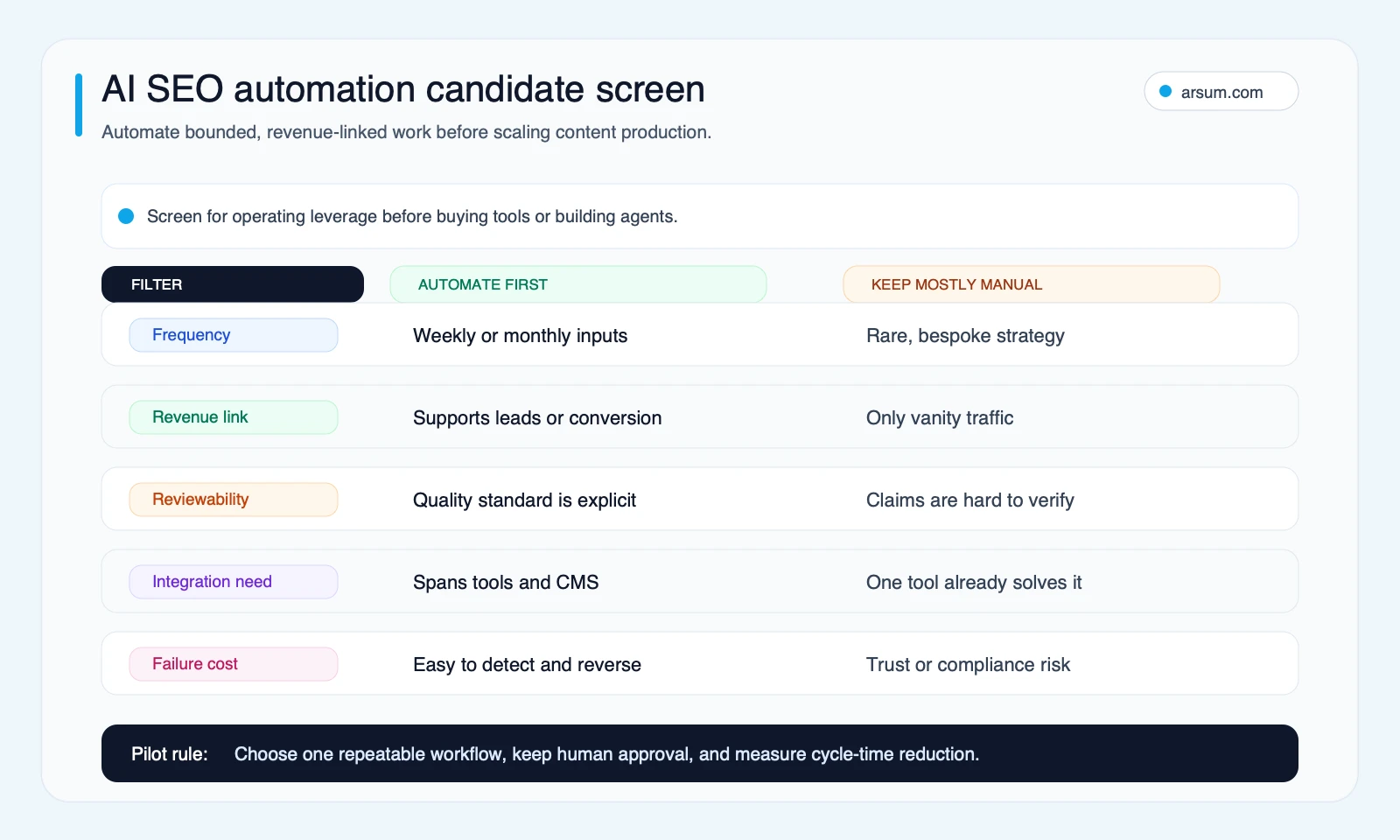
Score each candidate workflow from 0 to 2 on the seven criteria below. Use documented evidence, not optimism.
| Criterion | 0 points | 1 point | 2 points |
|---|---|---|---|
| Frequency | Less than monthly | Monthly | Weekly or more |
| Commercial connection | No measurable commercial path | Indirect traffic value | Linked to qualified traffic, leads, or conversion action |
| Input quality | Inputs are scattered or unavailable | Inputs need manual cleanup | Inputs are structured and accessible |
| Reviewability | No agreed quality standard | Review depends heavily on one person | Checklist-based review is practical |
| Source traceability | Claims cannot be traced | Some sources are retained | Claims and approved source set are available |
| Reversibility | Error is hard to unwind | Manual correction is possible | Output can be paused, revised, or rolled back quickly |
| Measurement | No baseline exists | Traffic data exists | Cycle time and Search Console/commercial measures exist |
Interpret the result this way:
- 12–14: Suitable for a controlled pilot.
- 9–11: Review the missing controls before automation.
- 0–8: Keep it mostly manual; fix the operating model first.
A high score does not authorize autonomous publishing. It means the workflow is a reasonable candidate for a supervised pilot. Low reversibility or high failure cost should reduce autonomy even when the workflow is frequent.
Good first candidates are usually content refreshes, keyword clustering, internal-link suggestions, title and meta alternatives, and technical-audit triage. Weak first candidates include executive thought leadership, claims-heavy service pages, regulated content, original research interpretation, and programmatic page expansion without strong evidence and editorial capacity.
A 30–60 Day Content-Refresh Pilot
A content-refresh pilot is a useful first test because the team starts with existing pages, known performance history, and an established publication process. The following is an illustrative planning model, not an observed result or a promised outcome.
Pilot scope and controls
Choose one page cluster with a common intent and one accountable owner. For example, select 10–20 aging B2B articles that already have impressions in Search Console and require updated examples, links, or sections.
| Pilot field | Illustrative planning assumption |
|---|---|
| Workflow | Refresh existing articles with declining or stagnant qualified organic traffic |
| Executive owner | Marketing or growth lead |
| Operating owner | SEO lead or content operations manager |
| Final approver | Assigned editor; subject-matter reviewer for claims-heavy pages |
| Data inputs | Search Console page/query exports, approved claims library, current internal-link inventory, CMS draft workflow |
| AI output | Refresh brief, suggested sections, source checklist, internal links, draft metadata, editor-ready revision |
| Pilot duration | 30–60 days |
| Review cadence | Weekly workflow review; end-of-pilot go/no-go review |
| Publication rule | No direct publishing; editor approval remains required |
| Retained evidence | Source links, prompt/workflow version, reviewer decision, revision record, publication date |
Search Console can provide page- and query-level performance data for this baseline. Review the Performance report documentation before defining fields and comparisons, and use the Search Console overview to confirm access and reporting scope.
Define acceptance measures before launch
Record the baseline before any AI-assisted work begins. Then use clear thresholds rather than “looks good” judgments.
| Measure | Baseline | Pilot target | Owner | Go/no-go rule |
|---|---|---|---|---|
| Editor cycle time per refreshed page | Measure current median hours from brief to approval | Reduce against that baseline without lowering quality | Content operations manager | Go only if reduction is documented and review burden remains manageable |
| Editorial acceptance rate | Percentage approved without substantial rewrite | Set an internal threshold before launch | Editor | Review workflow if substantial rewrites rise above the agreed threshold |
| Factual correction rate | Corrections found in review or after publication | Zero unresolved factual issues | Editor and SME reviewer | Stop and correct if a material unsupported claim is published |
| Rollback rate | Pages reverted because the update is wrong, off-brand, or technically broken | No recurring rollback pattern | SEO lead | Pause automation if more than the agreed tolerance needs reversal |
| Qualified organic clicks | Define qualified page/session action before launch | Monitor against a comparable pre-pilot window | Growth lead | Do not claim success from impressions or page count alone |
| Conversion signal | Form start, demo request, assisted conversion, or another defined event | Observe during an agreed attribution window | Revenue operations or growth lead | Scale only if commercial signal and quality controls both hold |
The exact thresholds should reflect your traffic volume and editorial capacity. A small site may not have enough data for a fast conversion read; in that case, pilot acceptance should rely first on cycle time, editorial acceptance, source quality, and qualified-click direction. Do not use publishing volume as the final score.
Worked approval and rollback path
For each page, the workflow should follow a simple chain:
- The SEO owner selects a page from a documented queue and records its baseline.
- The workflow retrieves permitted data and prepares a revision brief.
- AI proposes changes, but factual claims must point to a reviewable source.
- The editor accepts, requests revision, or rejects the draft.
- Claims-heavy changes route to the subject-matter reviewer before publication.
- The approved revision is published with a version record.
- The SEO owner checks Search Console, page behavior, and conversion signals at the scheduled review.
- If factual quality fails, the page is corrected or restored from the prior version; the related workflow step is paused until fixed.
This is where AI automation ROI examples can help frame internal economics: calculate value from documented reviewable hours, quality cost, and commercial measures—not a generic productivity multiplier.
If you have one repeatable, revenue-linked, reviewable workflow but need help mapping inputs, owners, and a safe pilot, an Arsum workflow assessment can scope the integration and acceptance criteria before you commit to a larger system.
💡 Arsum builds custom AI automation solutions tailored to your business needs.
Get a Free Consultation →Build vs Buy for AI SEO
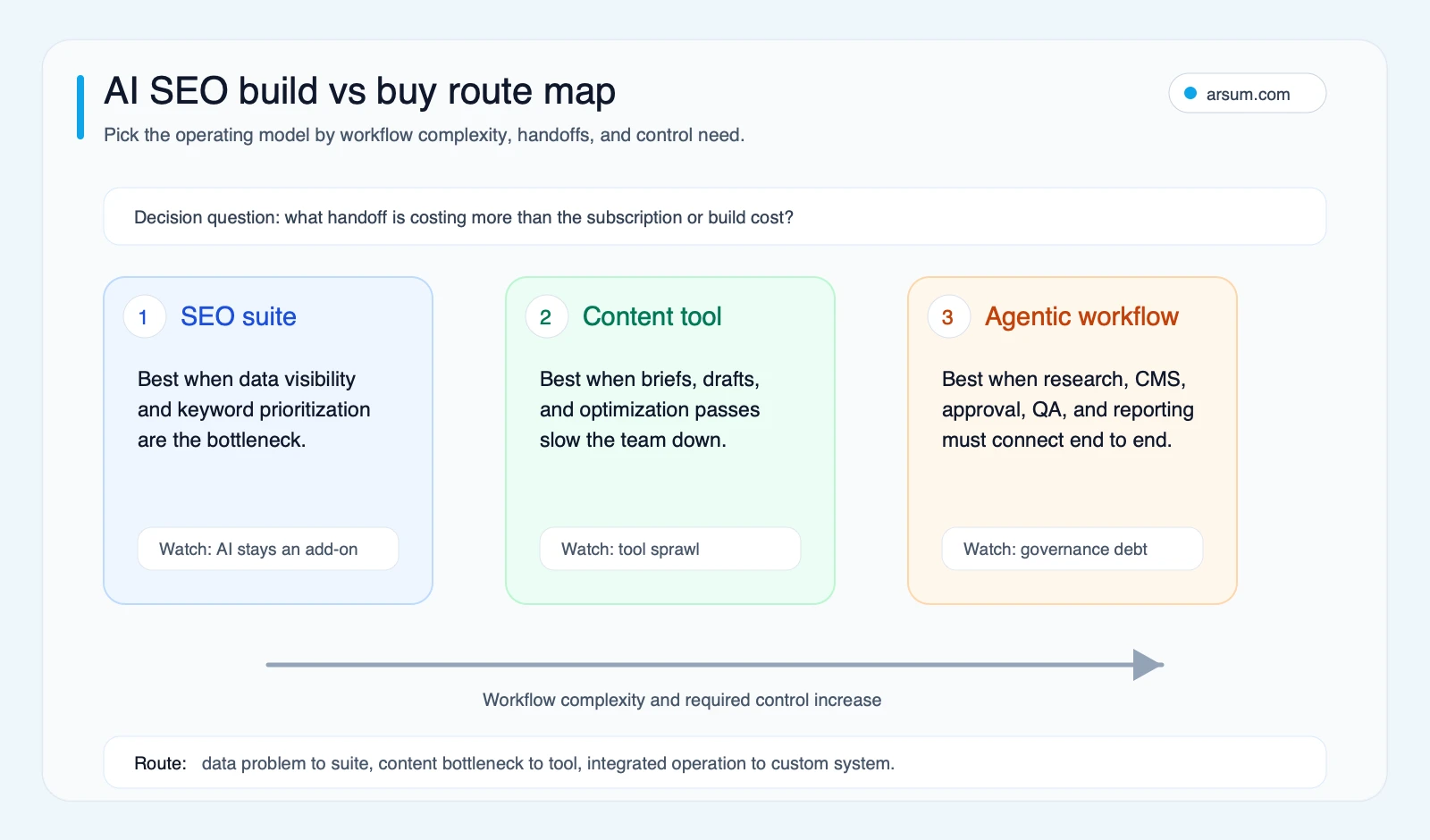
There is no universal “best AI SEO tool.” Product capabilities, terms, integrations, and pricing change, so verify each vendor’s current documentation and commercial terms before purchase. The more durable decision is which operating problem you are solving.
| Route | Best fit | Prerequisites | Internal owner | Ongoing burden | Common failure mode | Selection threshold |
|---|---|---|---|---|---|---|
| Manual, AI-assisted work | Infrequent or strategic work | Clear editor and source standard | SEO or content lead | Prompt, review, and documentation discipline | Treating drafts as finished work | Choose when the workflow is not frequent enough to integrate |
| SEO suite | Search-data visibility and prioritization | Tool access, analysts who can interpret output | SEO lead | Data hygiene, reporting review, vendor management | Buying data without changing decisions | Choose when research and reporting are the core bottleneck |
| Content-focused tool | Faster briefs, drafts, refresh preparation | Editorial process and final approver | Content lead | Source checks, editorial QA, tool coordination | Tool sprawl and generic output | Choose when the strategy exists but production handoffs are slow |
| Managed service | Team needs execution capacity but not system ownership | Clear scope, approvals, and reporting access | Marketing lead | Vendor governance and review | Outsourcing strategy and accountability | Choose when internal capacity is the constraint |
| Custom agentic workflow | Frequent, cross-system workflow with meaningful coordination cost | Accessible data, CMS/API permissions, versioning, clear exception rules | Cross-functional operational owner | Monitoring, workflow updates, access controls, QA | Automating an unclear or unmeasured process | Choose only after a bounded workflow proves its value |
When an SEO suite is enough
Choose an established SEO platform when the bottleneck is access to search, keyword, competitor, or technical-audit data. The system may improve prioritization, but your team still needs to decide what the data means and who fixes the issue.
This route is usually preferable when you do not need a workflow to cross multiple systems. For example, a weekly opportunity review may only need data access, a shared backlog, and an SEO lead who can turn findings into action.
When a content tool is enough
Content-oriented AI tools can help create briefs, outline drafts, metadata alternatives, and content-gap prompts. They are useful when your positioning, claim standards, internal linking conventions, and editorial approval process already exist.
Do not confuse faster drafting with a complete SEO operating model. If the work moves from a research tool to a content tool to a document to a CMS and then to reporting, the handoffs may become the real constraint. Read AI SEO services explained when deciding whether software alone addresses that operational gap.
When a custom workflow is justified
A custom workflow becomes reasonable when the same handoffs recur often enough that manual coordination is expensive and error-prone. Typical requirements include:
- Approved knowledge and claim sources.
- Permissioned access to analytics, content inventory, and CMS draft states.
- A workflow owner across SEO, content, engineering, and revenue teams.
- Human approval requirements by page type.
- Logging of inputs, outputs, reviewer decisions, and publication versions.
- A way to pause publishing or revert a change.
Custom development is not automatically better. It adds operational burden: integration maintenance, access control, monitoring, workflow changes, and ownership after launch. Teams considering this route should understand AI agent architecture patterns and weigh custom AI solutions for business against the simpler alternative.
Design One Control System, Not Repeated Warnings
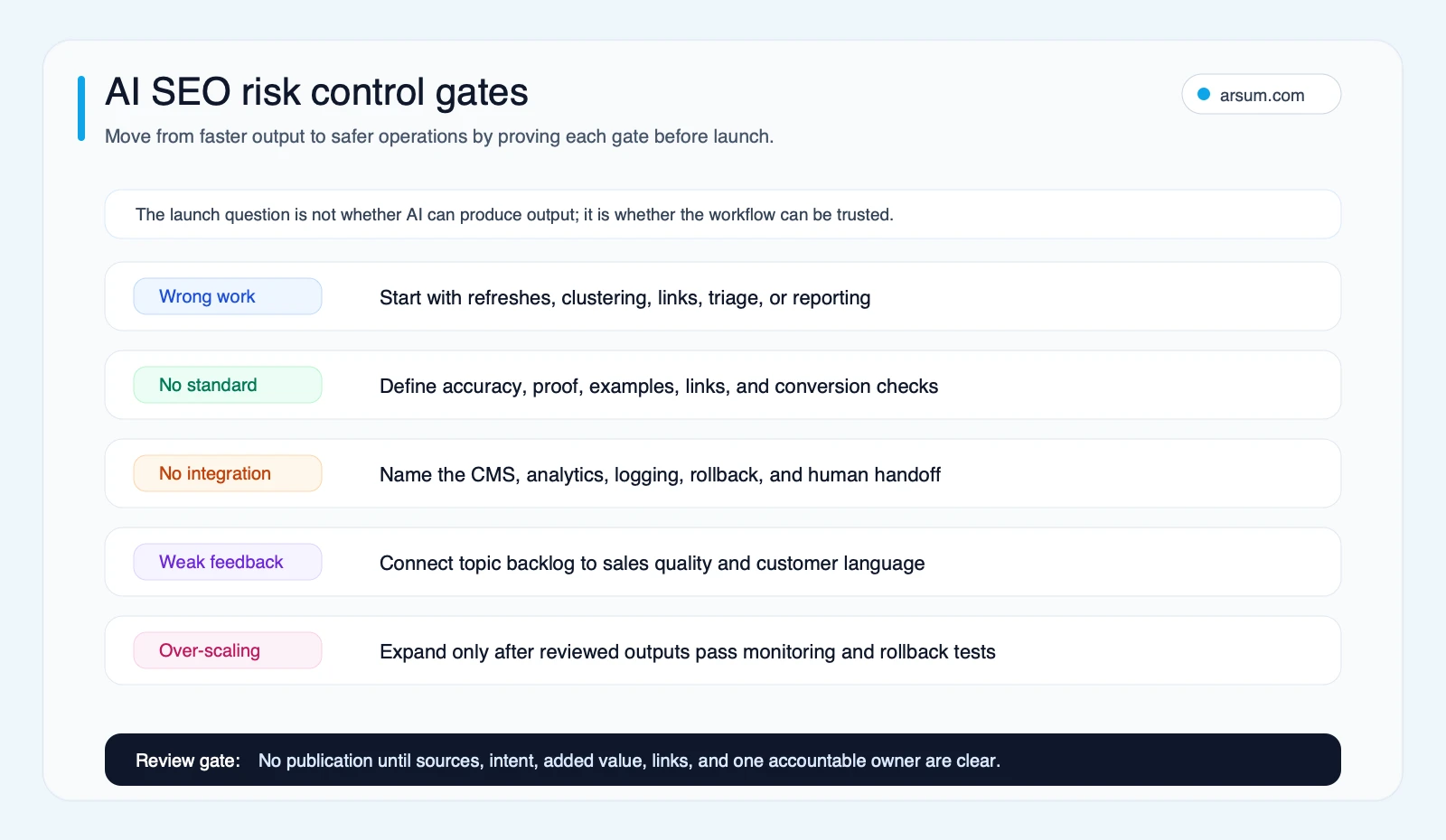
Human review is necessary, but “keep a human in the loop” is not a control design. Define what reviewers examine, when they intervene, what evidence they retain, and who has authority to stop a workflow.
Minimum controls for AI-assisted SEO
| Control | Required decision |
|---|---|
| Source gate | Which source types may support factual claims, and where are they retained? |
| Brand and positioning gate | Who verifies that the page reflects approved commercial language and audience intent? |
| Technical gate | Who checks links, canonicalization, structured data, CMS fields, and publish status? |
| Approval gate | Which page types require editor, SME, legal, or leadership approval? |
| Exception path | What happens when sources conflict, inputs are missing, or the model produces uncertain output? |
| Monitoring gate | Which signals trigger review: corrections, traffic anomaly, conversion-quality issue, or duplicate-content concern? |
| Rollback gate | Who can unpublish, revert, or pause the workflow, and from which version? |
Google’s AI-generated content guidance and its guidance on AI features and your website are useful references for setting expectations. They do not provide a shortcut for visibility; crawlability, indexability, useful content, and compliance with Search policies still matter.
Disqualifying Conditions and Failure Modes
Do not automate a workflow yet if any of these conditions apply:
- No one can name the final approver.
- Factual claims cannot be traced to a source.
- The team cannot restore a prior page version quickly.
- Search performance is available, but qualified-click or conversion quality is not defined.
- The workflow is too rare to justify setup and maintenance.
- The output is governed by legal, regulatory, medical, financial, or contractual interpretation without an authorized reviewer.
- The intended result is high-volume publishing rather than a measurable improvement to a known workflow.
The most common failure is automating visible work instead of valuable work. Broad draft generation feels productive because it creates pages. A refresh queue, internal-link workflow, or technical triage system may be less glamorous but more measurable and easier to control.
A second failure is weak feedback. Search visibility is not the same as commercial value. Use the measurement ladder: documented hours per task, pages improved, indexing and impressions, qualified clicks, assisted conversions, then pipeline or revenue where attribution is practical. Each layer is evidence for a different decision; none should be substituted for the next.
Practitioner Signals: Useful Questions, Not Market Statistics
Practitioner discussions often reinforce the same operational questions: how do teams fact-check drafts, separate outlining from rewriting and review, and avoid expecting one product to “do SEO” end to end? Examples include discussions about reviewing AI-generated content, tool-assisted SEO workflows, and QA before publishing at scale.
These are qualitative, practitioner-language signals—not adoption rates, performance proof, or evidence that a named tool is better. Their value is in surfacing the questions your implementation must answer before you scale.
Sources and Limits
This guide was reviewed against Google Search Central and Search Console documentation on 2026-06-22, including Google’s guidance on AI optimization, AI-generated content, and Search performance reporting.
The operating recommendations are editorial judgment based on those sources and the workflow requirements described here. Vendor capabilities, integrations, and commercial terms require current verification. Community material is used only to identify recurring questions and failure modes. This article does not claim benchmark savings, ranking outcomes, adoption rates, or guaranteed AI-feature visibility.
The Practical Decision
Start with a single workflow that scores at least 12 on the readiness worksheet, has a named owner, and can run for 30–60 days without autonomous publishing. Define the baseline, acceptance threshold, exception handling, measurement window, and rollback path before the first output is generated.
Choose a tool when it solves one bounded bottleneck. Choose a managed service when execution capacity is the constraint. Consider a custom workflow only when repeated handoffs across data, content, CMS, review, and reporting are costly enough to justify ownership and maintenance.
For teams ready to move from a scored candidate to a controlled implementation plan, Arsum can help assess the workflow, define the operating controls, and scope the integration around a measurable pilot.
Ready to Automate Your Business?
Stop wasting time on repetitive tasks. Let AI handle the busywork while you focus on growth.
Schedule a Free Strategy Call →Related Arsum Guides
Written by:Arsum editorial team
- Reviewed by
- Arsum editorial team
- Published
- February 13, 2026
- Updated
- July 3, 2026
- How this was produced
- Arsum uses research packs, source checks, and human editorial review to prepare and update blog articles. Editors are responsible for the final page.
- Source policy
- Sources are linked in the article when used. Methodology and source notes are included on higher-risk or high-visibility pages and are being rolled out across the archive. Editorial policy.
- Why this page exists
- Help B2B operators evaluate AI automation, implementation scope, cost, risk, and build-vs-buy decisions with practical context.