
A representative implementation pattern looks like this: six months into what was supposed to be a 90-day AI deployment, the project still has not touched production. The pilot runs perfectly in the vendor’s sandbox. Connecting it to your CRM requires OAuth credentials that IT locked behind a change request. The data your team described as “structured and ready” turns out to contain substantial duplicates and inconsistent field values. The executive who signed the contract has moved to the next initiative. The vendor account rep is pitching phase two.
This is not an edge case. The pattern shows up across buyer research and implementation-failure reporting: the model demo works, but production value disappears in the handoff to data quality, integration permissions, exception handling, and post-launch ownership.
AI implementation services are the work that closes this gap: converting a proof of concept into a system that runs in production, connects to your actual stack, and delivers output that someone acts on. This guide covers what that work actually involves, where it breaks, what it costs, and how to evaluate a partner before you sign anything.
Want to automate this for your business? Let's talk →
Operator Note: Most buyers do not need “more AI strategy” by default. They need to name the blocker accurately. If the workflow is still fuzzy, buy discovery. If the workflow is clear but the systems, permissions, or data are messy, buy implementation. If version one can launch but nobody will own monitoring, cost drift, or exception handling afterward, buy a managed support period instead of pretending handoff is done on day one.
What Buyers Need to Decide First
Most pages about AI implementation services explain the service category. The more useful buyer question is whether you need advice, implementation, or ongoing ownership.
Use a simple split before you talk to vendors:
- Advice problem: the team is unsure which workflow deserves budget.
- Implementation problem: the workflow is clear, but the systems, data, and approvals are not connected.
- Ownership problem: the first version can launch, but someone must monitor quality, cost, permissions, and edge cases.
That distinction prevents a common mistake: buying strategy when the blocker is delivery, or hiring delivery when the blocker is still workflow definition.
A quick routing rule keeps the first vendor conversation honest:
| If this is your real situation | Buy first | Why |
|---|---|---|
| The workflow is still fuzzy | Discovery or advisory | You need a success metric, a workflow owner, and a narrower target before build work starts |
| The workflow is clear but data is messy | Data remediation plus implementation | Model work slips fast when source data and permissions are still unstable |
| The prototype works but nobody owns exceptions | Managed support or stabilization | Monitoring, escalation, and cost drift need a named operator before handoff is real |
| Customer or regulated data is in scope | Security and logging review before go-live | Data controls and auditability become part of implementation, not an afterthought |
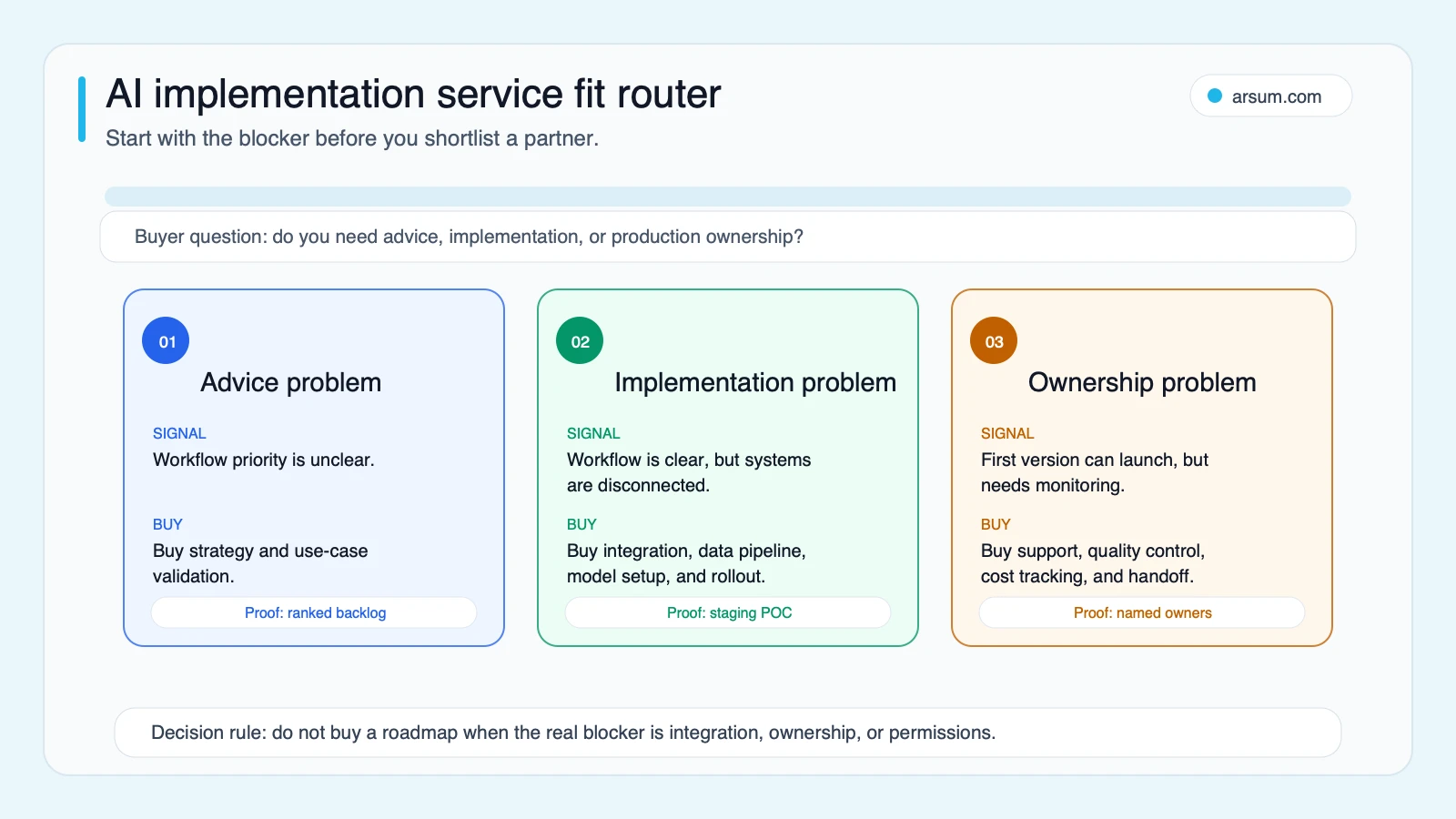
Start vendor conversations by naming the blocker: unclear workflow priority, disconnected systems, or missing production ownership.
Original Data Lens: AI Implementation Readiness Scorecard
Use this scorecard before approving an implementation SOW. It is Arsum’s editorial decision framework, not a benchmark dataset, and it helps separate projects that are ready for delivery from projects that still need discovery or data cleanup first.
| Readiness area | Green light | Yellow light | Red light |
|---|---|---|---|
| Workflow value and owner | One workflow, one owner, one measurable outcome | Multiple stakeholders, but ownership is still workable | No one owns the workflow after launch |
| Data source quality | Clean source data is already available | Known cleanup work exists, but the scope is bounded | Data quality is unknown or disputed |
| Integration surface and permissions | APIs and credentials are accessible | Some approvals or middleware are still pending | Key systems or permissions are still blocked |
| Evaluation and acceptance threshold | The team can define what good output looks like | Example outputs exist, but pass/fail is still fuzzy | No one can say what “good enough” means |
| Human approval boundary | Humans know when they must review or override | Review exists, but ownership is informal | The workflow assumes the AI can act without a fallback |
| Security and logging | Logging, retention, and access controls are defined | Controls exist, but implementation details are incomplete | Sensitive data is in scope with no agreed controls |
| Post-launch monitoring owner | A named owner will watch quality, cost, and drift | Shared ownership exists, but escalation is still unclear | No one owns production after handoff |
If two or more rows are still red, discovery usually creates more value than rushing into implementation.
A simple before-and-after test helps here too:
- Before: a ticket-routing pilot scores well in a sandbox, but nothing changes in production because CRM mapping, approval rules, and exception routing were never designed.
- After: the same workflow writes back to the right system, holds low-confidence cases for human review, logs each step, and has a named owner for drift and incidents.
What Most Guides Miss About AI Implementation
The hard part is not model setup. It is turning a promising prototype into a production workflow that survives messy source data, permission bottlenecks, human exceptions, security review, and ownership transfer. A vendor can absolutely demo a smart assistant in a sandbox. That does not mean the same system is ready to touch your CRM, route customer-facing work, or keep behaving once upstream data changes.
What Buyers Keep Saying When Pilots Stall
Across buyer-facing search results and practitioner reporting, the recurring complaints are not about a model refusing to answer. They are about the work around the model:
- the data was called ready until duplicates, missing fields, and unclear ownership hit the build
- the API existed, but production permissions, logging, or security review were still blocked
- the demo worked, but nobody owned exception handling once live traffic arrived
Treat that language as a discovery warning, not a postmortem surprise. If a partner cannot explain how they test against real data, real permissions, and real exception paths, the pilot is still closer to a demo than a production system.
Strategy vs Implementation: What’s the Actual Difference?
Most large consulting firms sell AI strategy. They deliver a roadmap, a maturity assessment, and a set of recommendations. The document is usually excellent. The problem is that EY, Gartner, Huron, or RSM are not going to build the webhook that connects your Salesforce instance to a fine-tuned classification model running in your cloud environment.
AI strategy answers: “What should we automate, and in what order?”
AI implementation answers: “Here is the integration spec, the data pipeline, the rollout plan, and the monitoring dashboard.”
This distinction matters more than most buyers realize. Strategy firms dominate the AI consulting SERP because they have strong brand presence, but what they typically don’t sell is implementation at the systems level: the engineering work that connects models to operational tools and business workflows. Buyers comparing the two models side by side should also review this broader AI automation service guide, which breaks down where advisory ends and delivery begins across common engagement types.
For buyers with a budget and a deadline, the distinction is critical. A strategy deliverable is a starting point. An implementation deliverable is a shipped system.
The best partners can do both, but most are stronger at one than the other. Knowing which you need determines which vendor type to shortlist. For a full breakdown of how the two service categories compare, see our guide to AI consulting services.
What Has to Be in Place Before Implementation Starts
Before any AI model runs in production, several preconditions need to exist. A credible implementation partner surfaces them during discovery rather than mid-build.
Data access and quality. AI systems need training data, inference data, or both. That data usually lives in a CRM, ERP, data warehouse, or some combination. In practice, this is where many implementations slow down: duplicate records, inconsistent fields, missing permissions, and undocumented handoffs all expand scope fast. A capable partner runs a data audit before quoting a timeline so you learn that early rather than after the build starts.
Integration surface. The AI system has to connect to something: a REST API call from your CRM, an event trigger from a workflow tool, or a database read from a data warehouse. The integration surface defines implementation complexity:
| System type | Integration complexity | Typical timeline impact |
|---|---|---|
| Modern SaaS (HubSpot, Salesforce, ServiceNow) | Low to medium | Baseline |
| Modern ERP (SAP S/4HANA, NetSuite) | Medium | +2 to 4 weeks |
| Legacy ERP or CRM | High | +4 to 8 weeks |
| Proprietary or flat-file systems | Very high | +6 to 12 weeks |
| Data warehouses (Snowflake, BigQuery) | Low to medium | Baseline |
Compute and hosting environment. Cloud-hosted AI services (OpenAI, Anthropic, AWS Bedrock, Azure OpenAI) reduce infrastructure overhead but introduce API cost and latency considerations. Self-hosted models offer more control but require GPU infrastructure and DevOps capacity. The right choice depends on data privacy requirements, request volume, and budget.
Internal ownership. Someone on your side needs to own the output. Implementations without an internal champion – someone who can escalate decisions, coordinate with IT, and operate the system after go-live – drift after launch. For organizations weighing whether to build internal AI capacity or engage externally, see our breakdown of hiring an AI developer vs. an agency.
Integration Architecture: How Production Systems Actually Connect
A useful mental model: think of AI implementation as three layers.
Data layer. Where data comes from, how it is cleaned and formatted, and how it flows into the model. This includes ETL pipelines, data validation, and transformation logic that shapes inputs into a form the model can process. Data layer failures are the most common and most predictable source of production problems.
Model layer. The AI itself: a commercial API, a fine-tuned open-source model, or a custom-trained system. Includes inference logic, prompt engineering where applicable, output parsing, and confidence thresholds that determine when output can be acted on automatically versus surfaced for human review. The model layer is where buyers focus. It is rarely where implementation fails.
Application layer. How the output gets used: an action taken automatically (an email sent, a record updated, a document routed), a decision surfaced via a UI or Slack notification, or a report generated on a schedule. Application layer design determines whether the system creates actual workflow change or just produces output nobody acts on.
Most implementation failures happen at the connections between layers, not within them. A model that works in isolation produces unreliable results if the data feeding it is inconsistent. It fails to create value if the application layer doesn’t route its output to anyone who can act on it.
For a broader view of how these systems fit into business process redesign, see our guide to AI process automation.
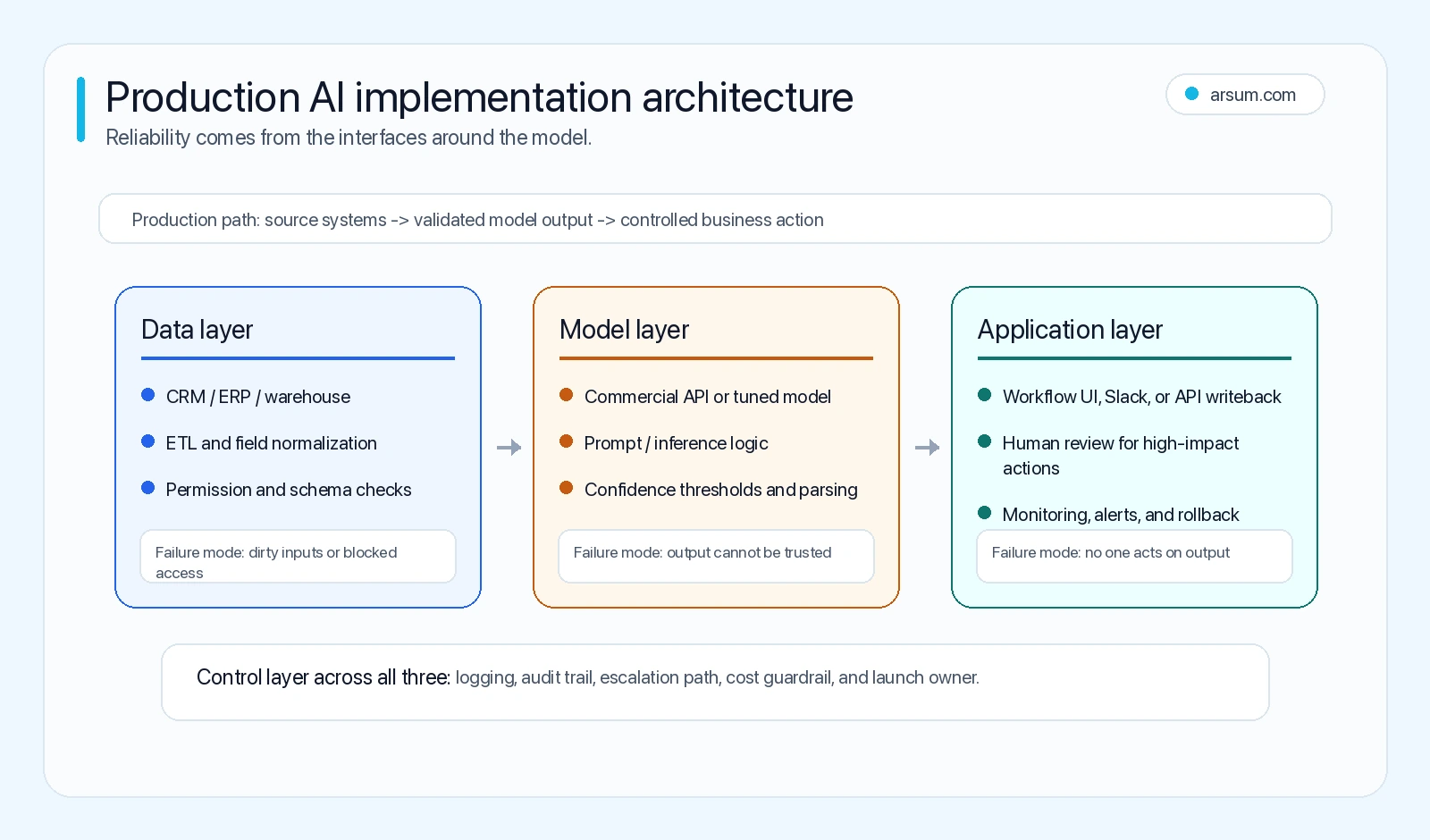
Production reliability comes from the interfaces around the model: data validation, output controls, application routing, and an operating control layer.
What AI Implementation Actually Costs
The honest answer is that cost expands or contracts with the same four variables that determine whether the rollout will work at all: data cleanup, integration complexity, risk controls, and post-launch ownership. That is why responsible partners scope implementation in layers instead of pretending every “AI implementation” project fits the same price band.
| Implementation shape | Budget posture | What usually drives the bill |
|---|---|---|
| Single workflow on a modern SaaS stack | Lightest scope | Connecting the workflow, testing output quality, and defining review gates |
| Multi-workflow rollout across several systems | Mid to high scope | Data cleanup, multiple integrations, monitoring, and change management |
| Enterprise rollout with legacy or regulated systems | High scope | Middleware, security review, logging, approvals, and handoff design |
| Self-hosted or deeply customized model stack | High and ongoing scope | Infrastructure, evaluation, performance tuning, and MLOps ownership |
A more useful buyer question than “what is the average cost?” is “which part of this project is still undefined?” Undefined data cleanup, blocked permissions, or missing post-launch ownership nearly always cost more than model access itself.
The variables that move spend most are still consistent:
- Data remediation scope. Messy records, inconsistent schemas, and unclear ownership add work before any model output can be trusted.
- Integration surface complexity. Modern SaaS is usually easier than legacy ERP, homegrown systems, or file-based processes.
- Compliance and security requirements. Sensitive data adds architecture review, access controls, logging, and sign-off cycles.
- Post-launch support model. Somebody still has to own monitoring, escalation, and iteration after go-live.
For buyers comparing agency implementation against internal builds, the cost structure differs meaningfully. See AI automation ROI examples for how measurable value gets structured across different automation types.
From Pilot to Production: A Realistic Timeline
A credible implementation partner structures work in phases rather than delivering everything at once. Treat the ranges below as planning guidance, not universal benchmarks. Official source material is clearer on the need for staged rollout, controls, and handoff than on one fixed implementation timeline.
| Phase | What happens | Typical duration |
|---|---|---|
| Discovery and scoping | Data audit, integration mapping, use case validation | 2 to 4 weeks |
| Proof of concept | Working prototype against real data in staging | 3 to 6 weeks |
| Production build | Full integration, security review, error handling, monitoring | 4 to 10 weeks |
| Stabilization | Live system with human oversight, feedback collection, tuning | 2 to 4 weeks |
Total for a mid-complexity implementation: 3 to 6 months from kickoff to stable production.
Projects that promise faster timelines without a real discovery phase are usually compressing the part of the process where data gaps, access blockers, and ownership confusion get caught early, then paying for that shortcut later in rework.
The discovery phase is also where ROI validation happens. Many projects look compelling at the use case level but don’t survive contact with real data, where the AI’s actual accuracy, the integration’s actual cost, and the workflow change’s actual adoption rate can be measured. If your main blocker is process mapping before any model choice, our guide to business process automation consulting shows what that discovery work should produce before implementation starts.
💡 Arsum builds custom AI automation solutions tailored to your business needs.
Get a Free Consultation →The 30-60-90 Day Reality Check
Most implementation timelines look clean on a Gantt chart. The operational reality is messier. Understanding what actually happens at each milestone helps buyers set expectations and catch problems early.
Days 1 to 30: Discovery almost always surfaces surprises.
The data audit is where the project’s real scope becomes visible. What was described as “clean CRM data” is often 15 to 40% inconsistent. APIs marked as “available” require change request approval to access in production. Stakeholders listed as available for decision escalation are unavailable due to competing initiatives.
The output of a good discovery phase is a revised scope document, an updated timeline, and a data remediation plan with ownership assigned. If your implementation partner delivers only a project plan at day 30 without addressing data quality and integration complexity, that signals how the rest of the project will go.
Days 31 to 90: The POC phase should produce something testable against real data.
Not a demo. Not a sandbox walkthrough. A working prototype that ingests data from your actual sources, runs inference, and produces output that at least one person on your team can evaluate for accuracy and usefulness.
This is also where application layer design gets real: who receives the output, in what format, and what action is expected. If nobody on your team has been designated as the person who acts on the AI’s output, no workflow change follows from a technically successful POC.
Days 90 to production: The handoff period is where most value leaks.
Systems that go live without a defined post-launch support period tend to degrade. The data schema upstream changes and the ETL pipeline breaks. The model’s accuracy drops as real-world inputs drift from the training distribution. A rate limit on the commercial LLM API gets hit at three times the projected request volume.
A 2 to 4 week stabilization period with live system oversight, defined escalation paths, and documented monitoring responsibilities is often the difference between a system that becomes part of the workflow and one that quietly degrades after launch.
One practical success test: if the workflow is ticket routing, production value means a named operations owner can act on the routed output, low-confidence items are held for review, and manual re-sorting drops enough that the team can measure time saved each week. “The model answered” is not the metric. “The workflow moved with fewer exceptions and clear ownership” is.
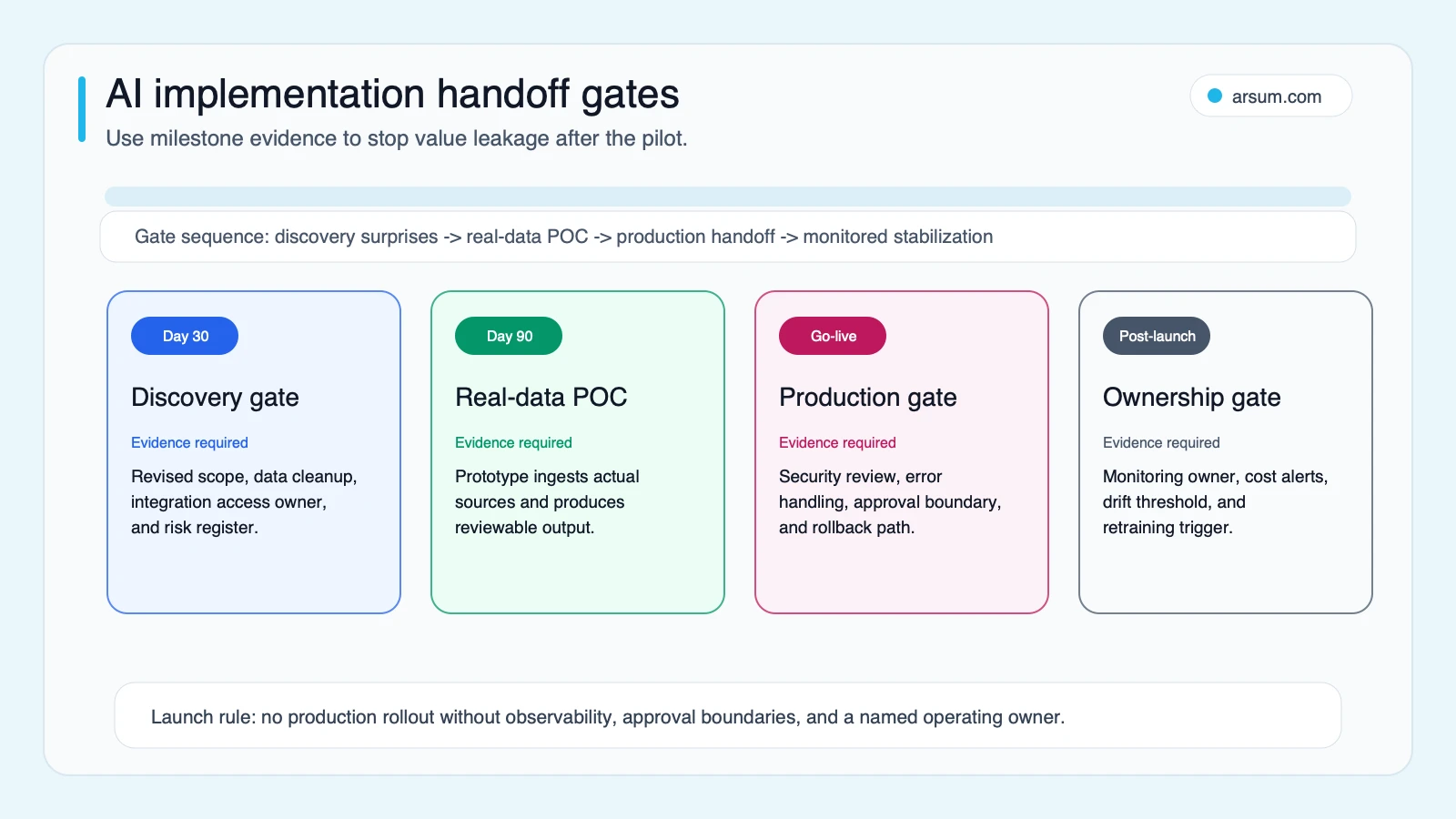
Use milestone evidence gates to stop pilot momentum from turning into production rework or silent post-launch drift.
What Causes AI Implementation Projects to Fail
The causes are consistent enough to be predictable, especially when a pilot is asked to act like a production system before the workflow around it is ready:
1. Scope creep from undiscovered data complexity. The data audit reveals that source data is cleaner in documentation than in practice. A CRM that looks implementation-ready in a kickoff deck can still contain duplicate records, missing fields, and inconsistent formatting that force a remediation workstream that was never priced into the original SOW.
2. Integration underestimation. The API that was supposed to accept webhook payloads requires OAuth 2.0 authentication, returns paginated results with rate limits, and has a sandbox environment that doesn’t match production behavior. A week of integration becomes four.
3. Missing internal champion. The executive who approved the project is unavailable for decision escalations. IT won’t grant the service account the permissions needed for the integration. The workflow the AI was supposed to support has been redesigned by a team outside the original project scope.
4. Output that nobody acts on. The model runs, inference is accurate, but output goes into a dashboard that intended users don’t check. No behavior change, no business outcome.
5. No post-launch governance. The system runs well for 60 days. Then the data upstream changes format, model accuracy drops, and there is no monitoring alert and no owner. The system degrades silently.
Commodity vs Non-Commodity Implementation Work
Some implementation work is now relatively standardized. Some is still highly specific to your workflow and where the real risk lives.
| Workstream | More commodity | Non-commodity, buyer should inspect closely |
|---|---|---|
| Model or API wiring | Basic API setup on well-known platforms | Custom orchestration where model behavior directly affects operations |
| Connector setup | Standard SaaS integrations with documented APIs | Legacy systems, brittle middleware, or permission-heavy environments |
| Data preparation | Predictable field mapping and cleanup | Ambiguous source-of-truth problems or politically messy ownership |
| Evals and approval thresholds | Reusing a familiar test pattern | Defining pass/fail for a workflow with real business consequences |
| Monitoring and handoff | Standard alerting and runbooks | Deciding who owns drift, cost spikes, and exception handling after launch |
This split matters because buyers often overpay for the standardized parts and under-scope the risky parts that actually decide whether production value holds.
Risks, Security, and Governance
Implementation carries risks that don’t appear in vendor demos. Official guidance from OpenAI, NIST, and AWS is consistent on this point: guardrails, logging, access control, and operating ownership belong in the production design, not as cleanup work after go-live.
Data privacy and compliance. If the AI system processes customer data, employee data, or anything subject to GDPR, HIPAA, or SOC 2, the architecture needs a security review before anything goes to production. This means understanding where data is stored, how it is transmitted, and whether any of it crosses into a third-party model’s training pipeline. Many commercial LLM API providers have specific data handling agreements for enterprise customers. Understanding what is and is not covered is part of implementation scoping, not an afterthought.
Audit trails. Regulated industries need to know what the AI decided and why. Implementations in finance, healthcare, or legal contexts usually require logging at the inference level: every input, output, and confidence score stored and queryable. This has infrastructure cost implications and needs to be designed in, not added later.
Model drift. AI systems degrade over time as real-world data shifts away from the distributions the model was trained or tuned on. A monitoring plan needs to define who watches accuracy metrics, what thresholds trigger a retraining or re-prompting cycle, and who owns that process. Most implementations don’t include this until something breaks.
Access controls. The system that connects to your CRM or ERP is a potential attack surface. Implementation should include role-based access, API key rotation policies, and an incident response plan for integration failures.
A practical source-layer check lines up with that. OpenAI’s guide to building agents stresses use-case fit, tool access, and human approval boundaries. OpenAI’s enterprise privacy and platform data guidance push buyers to verify retention, control settings, and who can access business data before rollout. NIST’s AI Risk Management Framework and AWS’s ML guidance both treat governance, monitoring, reliability, and security as production requirements, not cleanup work for later.
Google Risk Box: The fastest route to thin AI implementation is treating a sandbox demo like a finished workflow. If the project launches without real-data tests, explicit review boundaries, logging, and a named post-launch owner, the likely outcome is a system that still needs manual babysitting long after the pilot celebration ends.
Work With Arsum
We help businesses implement AI automation that actually works. Custom solutions, not cookie-cutter templates.
Learn more →How to Evaluate an AI Implementation Partner
When evaluating AI implementation partners, these are the questions that separate operators from advisors:
- Can you show me an integration architecture diagram from a recent project? Not a sales deck: a real diagram with data flows, API connections, and hosting setup.
- How do you handle data quality issues found during discovery? A good answer describes a specific process. A weak answer is “we work through it with your team.”
- What does your post-launch handoff look like? Specifically: who owns monitoring, what is the retraining or re-tuning process, and what SLA applies to production issues?
- Who owns model monitoring and retraining after deployment? This is a governance question. If the answer is “your team,” you need internal capacity to support it.
- What is your escalation path when an integration breaks in production? Breaks will happen. The question is response time and ownership.
- Do you offer fixed-price or time-and-materials engagements, and what determines which? Fixed-price projects require a tight scope and a completed discovery phase. Time-and-materials is appropriate when integration complexity is unknown.
- Have you implemented against the specific systems in our stack? Prior integration experience with your CRM, ERP, or data warehouse meaningfully compresses timeline.
Partners who answer these with specifics have done the work before. Partners who respond with process language at a high level probably have not.
Partner Evaluation Matrix
| What to inspect | Strong signal | Weak signal |
|---|---|---|
| Proof of shipped production work | Real architecture diagrams, monitored workflows, and handoff examples | Strategy decks or sandbox screenshots only |
| Integration approach | Specific systems, permissions, and failure paths discussed | “We integrate with anything” without system detail |
| Security process | Clear answers on data handling, retention, access, and logging | Privacy and control questions deferred until after kickoff |
| Evals and monitoring | Acceptance thresholds, low-confidence routing, and alerts are defined | “We’ll tune it after launch” |
| Handoff documentation | Runbooks, rollback steps, and ownership transfer are included | Handoff is assumed once go-live happens |
| Support model | Stabilization window and escalation path are named | Support is ad hoc or undefined |
| Pricing risk | Discovery separates unknowns from the build scope | Flat pricing hides unresolved data or integration unknowns |
Agency vs. Internal Team: What Each Side Should Own
| Function | Agency strength | Internal team strength |
|---|---|---|
| Integration architecture | High | Low to medium |
| Data pipeline design | High | Medium |
| Model selection and configuration | High | Low |
| Production deployment | High | Medium |
| Post-launch monitoring | Medium | High |
| Data stewardship | Low | High |
| User adoption and change management | Low | High |
| Retraining trigger decisions | Medium | High (with guidance) |
The cleanest handoff model defines both sides explicitly in the SOW, with a documented post-launch support period before full internal ownership transfers. For a structured view of the build vs. buy and internal vs. agency tradeoffs, see our guide to custom AI solutions for business.
AI Implementation SOW Checklist
Before you sign an implementation proposal, confirm that it names the operational details most projects leave fuzzy:
- exact workflow and success metric
- systems and data sources in scope
- data cleanup work that is explicitly scoped
- approval points and exception rules
- security and privacy review owner
- monitoring and alerting plan
- rollback path if output quality drops
- post-launch owner and support window
Methodology Note
This guide was refreshed using buyer-facing SERP review plus qualitative practitioner signals about failed pilots, blocked integrations, and data-control concerns. Official source material from OpenAI, NIST, and AWS was used for factual grounding on guardrails, data handling, risk management, and production operations. Social and practitioner signals were treated as directional evidence, not universal benchmarks.
Frequently Asked Questions
How long does AI implementation take?
A mid-complexity implementation – one integration target, one primary workflow, a commercial LLM API – typically runs 3 to 6 months from kickoff to stable production. This includes 2 to 4 weeks of discovery, 3 to 6 weeks of proof of concept, 4 to 10 weeks of production build, and 2 to 4 weeks of stabilization. Higher integration complexity, legacy systems, or regulated data requirements add to each phase.
What systems can AI integrate with?
AI systems can integrate with virtually any platform that has an API or supports data export: Salesforce, HubSpot, ServiceNow, SAP, Oracle, NetSuite, Snowflake, BigQuery, Microsoft 365, Slack, and most modern SaaS tools. Legacy systems without API coverage require middleware or ETL pipelines that add implementation time. The integration surface is always assessed during discovery.
What causes AI implementation projects to fail?
The five most common causes are: data quality issues discovered too late, integration complexity underestimated in scoping, no internal champion to drive adoption and escalation, model output that reaches no one who can act on it, and no post-launch monitoring or governance. All five are preventable with a proper discovery phase and clear post-launch ownership assignments.
What should be handled by an agency versus an internal team?
Agencies are better suited for: initial integration architecture, data pipeline design, model selection and configuration, and production deployment. Internal teams are better positioned for: ongoing monitoring, data stewardship, user adoption, and triggering retraining when performance degrades. The cleanest model defines both sides in the SOW with a documented post-launch support period before full internal ownership transfers.
Ready to Automate Your Business?
Stop wasting time on repetitive tasks. Let AI handle the busywork while you focus on growth.
Schedule a Free Strategy Call →Related Arsum Guides
Continue with these closely related guides: