AI integration consulting is implementation work: it turns a chosen AI use case into a controlled workflow connected to the systems your team already uses, with defined data inputs, approval rules, monitoring, exception handling, and an owner after launch.
AI Integration Consulting: Buyer Guide
Explore ai integration consulting: compare workflow fit, costs, risks, evidence, and practical next steps before you build, buy, or hire.

AI integration consulting bridges the gap between a strategy roadmap and a workflow that runs in production
Table of Contents
- What most AI integration guides miss
- Strategy consulting versus implementation consulting
- Assess readiness before selecting tools
- What the production architecture should contain
- Security, privacy, and action governance
- A worked pilot scorecard
- Roll out through evidence gates
- Commodity connector work versus integration consulting
- Disqualifying conditions and common failure modes
- Scope-review checklist for an RFP or statement of work
- Methodology
The distinction matters because a roadmap can identify a promising use case without answering whether it can run safely in production. Before signing a scope, a buyer should be able to see the system of record, access method, data cleanup required, decision authority, fallback process, and handoff plan. If those elements are absent, the proposal may be strategy or connector setup—not a production integration plan.
What most AI integration guides miss
The hard part is rarely making a model return an answer. The hard part is deciding what that answer is allowed to do once it reaches a CRM, ERP, ticketing system, inbox, document repository, or internal database.
A useful buyer rule is simple: the closer an AI output gets to changing a consequential record, communicating externally, or committing money, the more explicit the controls must be. Technical capability does not grant business authorization.
That changes how to evaluate AI integration consulting. Ask whether the proposed work covers:
- The authoritative source for each input and output
- The access method: API, webhook, export, queue, or manual handoff
- Data normalization and validation before a model sees the data
- Rules for accepting, rejecting, or escalating model output
- Human approval thresholds for live actions
- Logs, alerts, and a way to reconstruct a decision
- A manual fallback and a tested rollback
- A named internal workflow owner
This is especially important in legacy environments. A practitioner post on Hacker News describes small teams dealing with messy workflows and aging databases while trying to add API and AI capabilities; that is a useful signal about implementation friction, not evidence of market-wide prevalence. The original discussion reinforces the buyer question: what happens when the source system is not integration-ready?
For broader context on the operating model around automation, see AI business process automation and AI implementation services.
Strategy consulting versus implementation consulting
Both are legitimate purchases, but they should produce different artifacts.
| If you are buying strategy | If you are buying AI integration consulting |
|---|---|
| Use-case inventory and prioritization | Workflow and system-of-record map |
| Business case and risk framing | Data-access, authentication, and event-flow design |
| Vendor shortlist | Integration architecture and build plan |
| Roadmap | Pilot, shadow-mode, and rollout gates |
| Governance recommendations | Approval policy, audit trail, alerting, and fallback design |
| Executive decision materials | Handoff documentation and named operating ownership |
Strategy work answers: “Which workflow should we address first?” Integration work answers: “How will this specific workflow operate every day, including exceptions?”
A proposal can include both, but the boundary should be visible. A roadmap does not substitute for API discovery, and a demo does not substitute for a production rollout plan. If you are deciding whether an agent is warranted at all, compare the workflow design with the tradeoffs in agentic AI workflow automation before committing to an autonomous pattern.
Assess readiness before selecting tools
Model selection should follow workflow requirements, not lead them. Anthropic’s platform documentation separates model capabilities from tools, tool infrastructure, context management, files, and governance features—an appropriate reminder that a production system is more than a model call. See Anthropic’s platform overview.
Score one proposed workflow from 1 to 5 across all eight dimensions below. This is an original buyer-side planning tool, not a prediction of implementation cost, timeline, or business value.
| Dimension | 1: low readiness | 3: partial readiness | 5: high readiness |
|---|---|---|---|
| API quality | Export-only, scraping, or undocumented access | Usable API with known gaps | Stable, documented, versioned API |
| Data consistency | Missing, conflicting, or unstructured fields | Cleanup rules are known but incomplete | Documented schema and reliable required fields |
| Authentication | Shared credentials or manual tokens | Service access exists but needs redesign | Scoped service account or OAuth permissions documented |
| Event triggering | Manual export or uncertain polling | Scheduled polling is acceptable | Webhooks, event bus, or reliable queue |
| Approval design | No decision authority defined | Some reviewers identified | Named approver, threshold, and escalation path |
| Observability | No useful logs or alerts | Partial logging exists | Structured logs, dashboard, alerts, and access owner |
| Rollback and fallback | No manual recovery path | Fallback exists but is untested | Revert process and manual path are documented and testable |
| Internal ownership | No post-launch owner | Owner is likely but not committed | Named business and technical owners accept responsibilities |
The maximum score is 40.
| Total | Readiness interpretation | What to require in the proposal |
|---|---|---|
| 32–40 | Good pilot candidate | Fixed discovery outputs, a shadow-mode plan, acceptance metrics, and a production gate |
| 24–31 | Cleanup or governance work needed | A separate remediation workstream, explicit dependencies, and no production commitment until gaps close |
| 8–23 | Stop before rollout | Source-system, ownership, or control remediation before an AI build is scoped |
A high API score does not cancel out a low approval or rollback score. Treat those as gates, not averages: if the workflow can make consequential changes and lacks a defined approval owner or reversible fallback, it should remain in assistive or shadow mode.
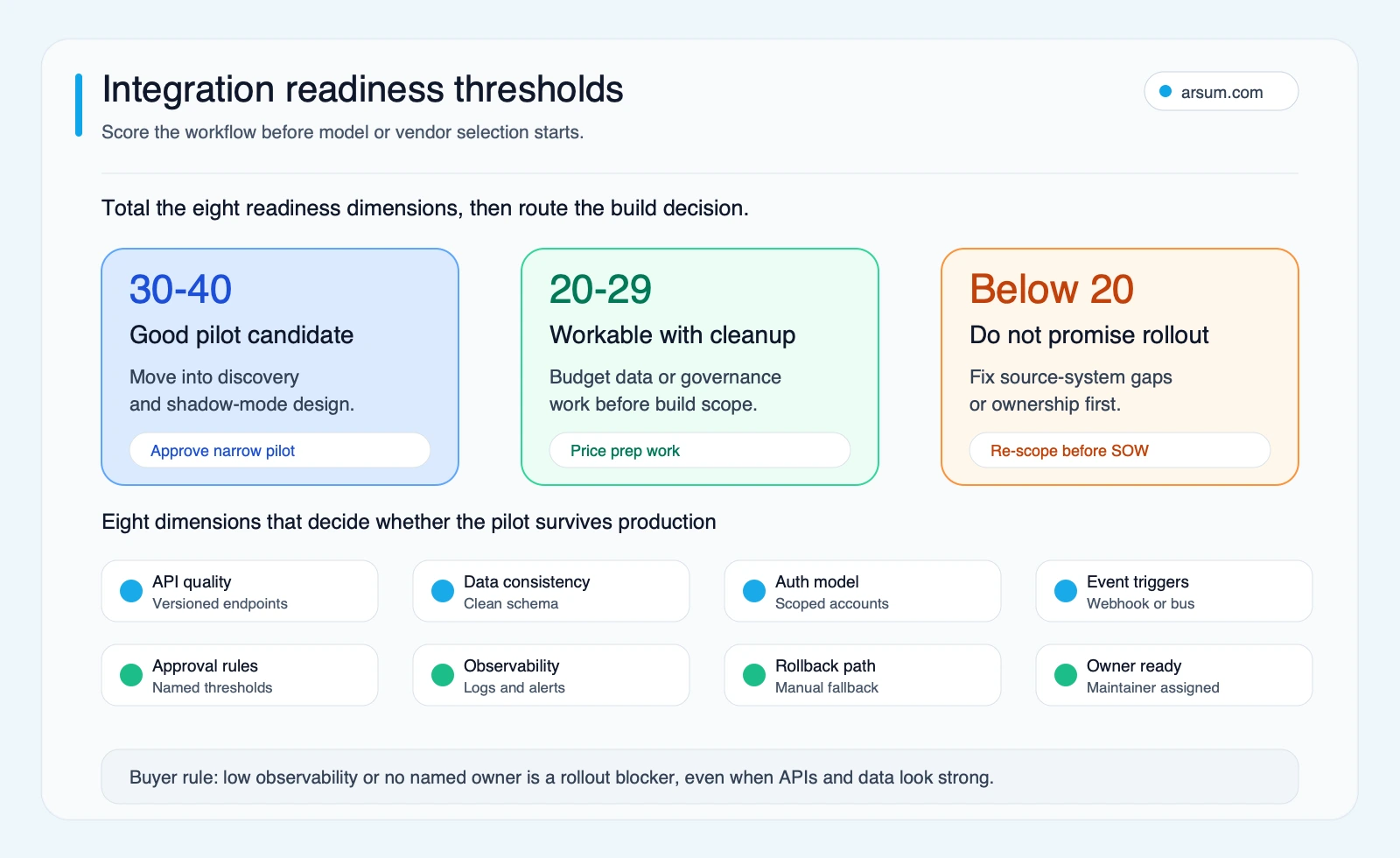
Use the score before debating vendors. It makes the hidden implementation work visible: data cleanup, identity design, operating ownership, or control design may be the real first scope.
What the production architecture should contain
A credible integration architecture makes the workflow inspectable from input through outcome.
- Extraction: retrieve records or documents from an approved source system.
- Normalization: clean fields, resolve schema differences, and label missing or stale inputs.
- Model invocation: send only the necessary context to the selected model.
- Validation: parse output into expected fields and test it against deterministic business rules.
- Routing: send accepted results to a queue, reviewer, downstream system, or notification channel.
- Audit and monitoring: retain the information needed to investigate an outcome, alert on failures, and assess quality over time.
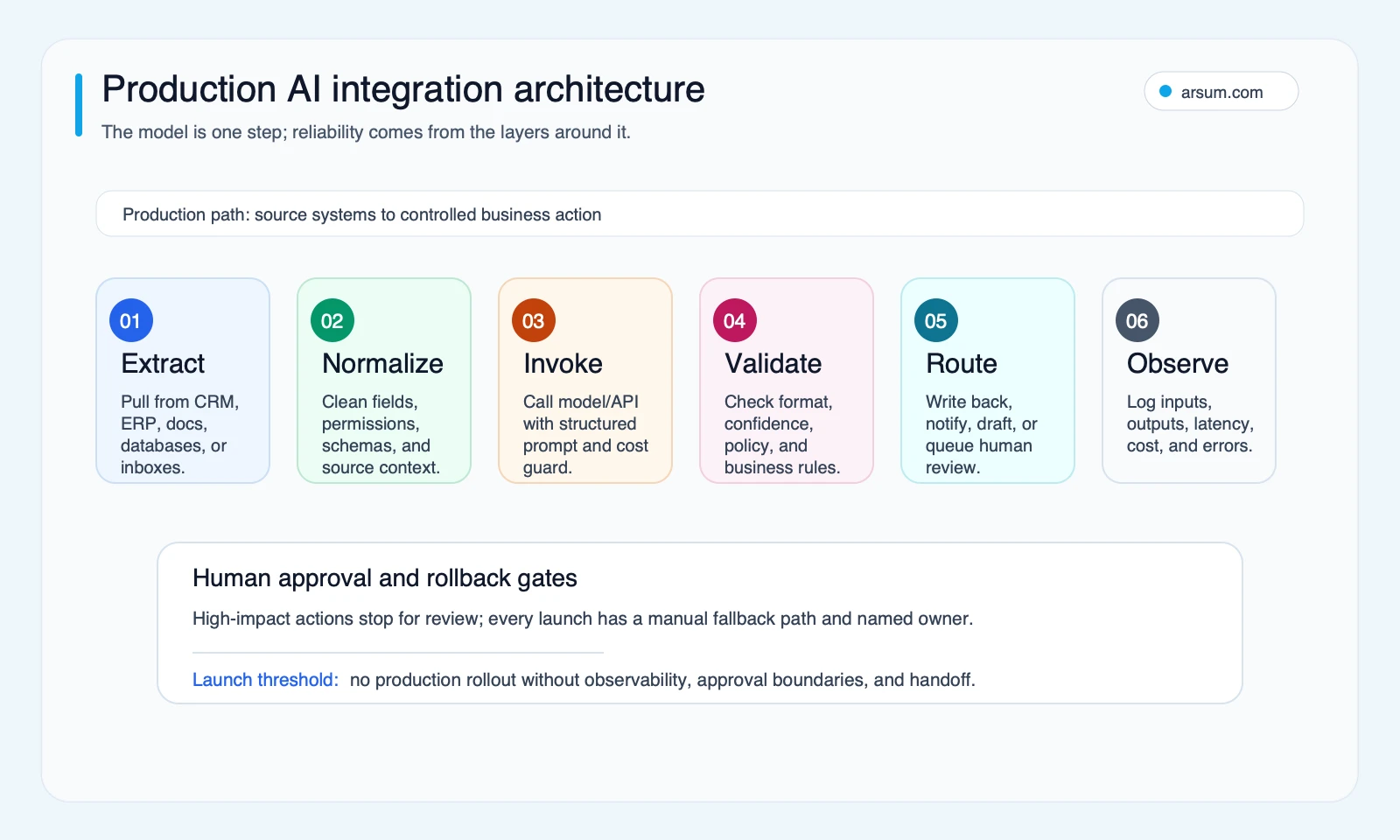
The model should not be the sole validator of its own output. Use deterministic checks where possible: required fields, allowed values, amount limits, record-state rules, duplicate checks, and permission checks. Use human review where the consequence or ambiguity exceeds the workflow’s authorized autonomy.
This is where simple workflows can be the better design. A predefined pipeline with narrow branching may be easier to inspect and maintain than an agent allowed to choose tools freely. The relevant comparison is not “agentic” versus “not advanced”; it is whether additional autonomy changes the business result enough to justify its control burden. AI agent architecture patterns provides useful patterns for making that boundary explicit.
Security, privacy, and action governance
Connecting a model to business systems changes the threat model. The OWASP Top 10 for Large Language Model Applications identifies risks including prompt injection, insecure output handling, sensitive-information disclosure, insecure plugin design, excessive agency, and overreliance.
For a buyer, those categories translate into practical scope questions:
Protect the trust boundary
Treat user-provided text, email content, uploaded documents, and retrieved web content as untrusted data. They may inform a model’s analysis, but they should not override system instructions or trigger unrestricted downstream actions.
Tool access should be narrow and policy-driven. An AI workflow that drafts a response may need permission to create a draft; it does not automatically need permission to send it. A workflow that classifies an invoice may need to route an exception; it does not automatically need permission to alter payment instructions.
A builder-authored Hacker News discussion about approval-gated tool use argues for deterministic allow, deny, and approval policies with audit-first logs. It is qualitative practitioner evidence with product-positioning incentives, but it points to a sound evaluation question: are controls enforced outside the prompt, at the action boundary?
Document vendor data handling
Require the implementation partner to document the model and service providers, data flows, retention settings, regional requirements, and contractual or compliance implications for your use case. OpenAI’s Enterprise Privacy page describes ownership and control features for business data, but that documentation is not a blanket approval for any architecture. Review the specific product, account configuration, and your organization’s obligations.
Design for accountability
The NIST AI Risk Management Framework is intended to help organizations incorporate trustworthiness into the design, development, use, and evaluation of AI systems. In an integration, that translates to named decision owners, transparent escalation rules, and evidence retained for review.
At minimum, log workflow version, source record identifier, input provenance, validation outcome, model output, reviewer decision where applicable, downstream action, and error or refusal state. Avoid retaining sensitive content unnecessarily; retention design should be deliberate.
A worked pilot scorecard
Use a narrow, hypothetical pilot rather than a production promise. The following is an illustrative planning scenario, not an observed client result.
Workflow: classify incoming supplier documents and route them to an accounts-payable review queue.
Baseline: for two weeks, record the current manual process: total documents received, time from receipt to queue assignment, number requiring clarification, and number routed to the wrong queue.
Pilot target: the AI workflow produces a proposed document type and queue assignment in shadow mode. It does not update the accounting system or send any external communication.
Quality and exception metric: reviewers record whether the proposed category and route were accepted, corrected, or escalated. Track both the acceptance rate and the error types; a single aggregate “accuracy” figure can hide a costly error category.
Owner: the accounts-payable operations lead owns business acceptance criteria. The technical owner owns integration reliability, access controls, logs, and rollback testing. A finance or risk owner approves any transition from proposal to automated routing.
Review cadence: review results twice each week during shadow mode. Examine a sample of accepted outputs and every material exception. Include source-data failures separately from model-output failures.
Stop condition: pause the pilot if outputs cannot be reconstructed from logs, if a validation rule is bypassed, if access exceeds approved permissions, or if reviewers identify an error category whose potential consequence is unacceptable.
Rollback path: disable the routing action, preserve the existing manual intake queue, and route all new items to human review. Do not rely on a prompt edit as the rollback plan.
Exit criteria: move to a limited rollout only after owners sign off on the observed exception patterns, validation coverage, alert routing, and manual fallback. The decision is not based only on whether a demo looks convincing.
💡 Arsum builds custom AI automation solutions tailored to your business needs.
Get a Free Consultation →Roll out through evidence gates
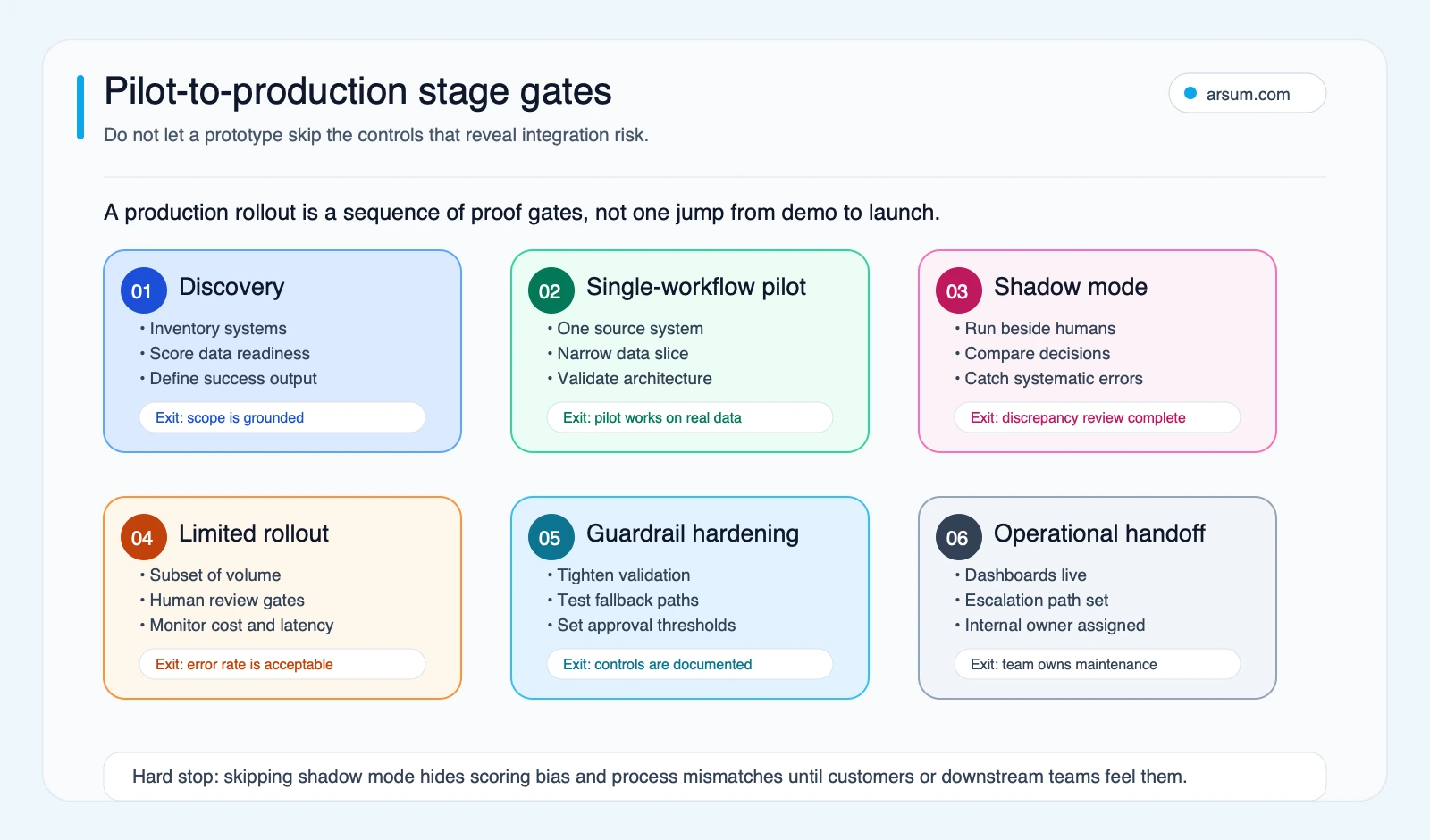
A rollout should make authorization increase only when evidence supports it.
| Stage | What runs | Required evidence to proceed |
|---|---|---|
| Discovery | Process and system mapping | Source of record, access constraints, owners, and disqualifying conditions documented |
| Pilot | Narrow build against limited data | Validation rules, test cases, logs, and fallback path operating |
| Shadow mode | Output compares with current human process | Quality review, exception taxonomy, security review, and owner sign-off |
| Limited rollout | Small, authorized slice of live volume | Alerting works, approvals are honored, and manual recovery has been tested |
| Hardening and handoff | Controlled production operation | Runbook, change-control process, monitoring access, and maintenance owner accepted |
Practitioner discussions also emphasize circuit breakers, refusals, and audit trails when AI systems touch production actions. This Hacker News post is not independent prevalence research, but its concern is useful: a workflow that reports technical success can still produce an operationally wrong result. Your monitoring should capture both.
Commodity connector work versus integration consulting
Basic connector work can be appropriate. It is often the right answer for a low-risk, reversible workflow using well-supported SaaS tools. Problems begin when a simple connector is sold as though it resolves the operating model around it.
| Connector-oriented scope | Production integration scope |
|---|---|
| Configure a standard SaaS connection | Map source authority, permissions, and failure behavior |
| Send text to a model and return output | Normalize data and validate output against business rules |
| Build a demo path | Define shadow mode, approvals, alerts, and rollback |
| Hand over configuration | Hand over runbooks, dashboards, ownership, and change controls |
| Optimize a prompt | Design the trust boundary around prompts and tools |
For a more detailed view of service boundaries, compare AI integration services with AI consulting services. If your workflow is primarily document or transaction handling, accounts receivable automation is also a useful example of why source data and approval rules matter before automation depth.
Disqualifying conditions and common failure modes
Do not promise a live rollout yet when any of these conditions apply:
- The source system cannot provide authorized, stable access and no safe intermediary is planned.
- No business owner can define what a correct outcome is.
- The workflow has no manual fallback or a change cannot be reversed.
- Sensitive data handling has not been approved by the appropriate security, privacy, or compliance owner.
- A proposed action can materially affect a customer, payment, legal position, or regulated decision without an approval design.
- The internal team has not accepted post-launch ownership.
Other common failures are scope commitments before data discovery, selecting a model before defining quality requirements, treating logging as an afterthought, and confusing an output-generation prototype with a system that may act on records. These are controllable scope risks, not reasons to avoid AI altogether.
Scope-review checklist for an RFP or statement of work
Attach this checklist to the proposal review. A credible scope should identify the artifact, accountable owner, and evidence for each item.
| Requirement | Required artifact | Accountable owner | Evidence before next stage |
|---|---|---|---|
| Workflow boundary | Process map and source-of-record list | Business owner | Approved inputs, outputs, and exceptions |
| System access | API/auth inventory and permission model | Technical owner | Least-privilege access tested |
| Data readiness | Schema, quality issues, and remediation plan | Data owner | Required fields and known limitations documented |
| Safety controls | Validation, approval, and refusal policy | Risk or process owner | High-consequence actions cannot bypass policy |
| Observability | Log fields, alert routes, and dashboard access | Technical owner | A test incident can be reconstructed |
| Shadow mode | Comparison protocol and review sample | Business owner | Quality and exception findings reviewed |
| Rollback | Disable/revert instructions and manual process | Operations owner | Fallback exercised in a test |
| Handoff | Runbook, change-control terms, and maintenance plan | Client sponsor | Named owners accept responsibilities |
The right partner may be an internal team, a specialist implementation firm, or a combination of both. The decision should follow the workflow’s readiness and control needs—not the most impressive demo. If you want an outside team involved, ask for a workflow-readiness assessment that produces the scorecard, dependency map, ownership matrix, and pilot gate criteria before you authorize a broader build.
Methodology
This guide uses an editorial buyer framework for AI integration consulting, supported by direct documentation from Anthropic, NIST, OWASP, and OpenAI. Hacker News material is included only as qualitative practitioner language about legacy systems, tool permissions, observability, and audit trails; it is not treated as a survey or market statistic.
Ready to Automate Your Business?
Stop wasting time on repetitive tasks. Let AI handle the busywork while you focus on growth.
Schedule a Free Strategy Call →Written by:Arsum editorial team
- Reviewed by
- Arsum editorial team
- Published
- June 4, 2026
- Updated
- July 4, 2026
- How this was produced
- Arsum uses research packs, source checks, and human editorial review to prepare and update blog articles. Editors are responsible for the final page.
- Source policy
- Sources are linked in the article when used. Methodology and source notes are included on higher-risk or high-visibility pages and are being rolled out across the archive. Editorial policy.
- Why this page exists
- Help B2B operators evaluate AI automation, implementation scope, cost, risk, and build-vs-buy decisions with practical context.