This guide evaluates ai integration services through workflow fit, ownership, implementation risk, and measurable ROI. You have probably already seen the same pitch twice: a transformation roadmap, a demo on clean data, and a timeline that makes everything sound manageable. The part that gets left out is what happens after the demo, the source system audit that uncovers messier data than expected, the production hardening work that was never in scope, and the monitoring layer your team is expected to build after handoff.
AI Integration Services
Explore ai integration services: compare workflow fit, costs, risks, evidence, and practical next steps before you build, buy, or hire.

Table of Contents
- Operator Note
- Quick Self-Qualification: Which Path Fits Your Situation?
- What Most Guides Miss
- What AI Integration Services Actually Cover
- Before vs After: What Actually Changes Operationally
- Strategy vs Implementation: Why the Distinction Matters
- Commodity vs Non-Commodity AI Integration
- The Systems and Data Reality Check
- What Practitioners Keep Reporting in Production
- Integration Architecture in Practice
- The Phase Map: Discovery to Production
- Reusable Artifact: Production Hardening Checklist
- Original Data: Buyer Decision Tree and Vendor Filters
- Risks, Security, and Governance
- Google Risk Box: Thin Automation vs Production-Ready Integration
- How to Decide: Agency, Internal Build, or Software-First
- Vendor Evaluation: Scorecard and Red-Flag Checklist
- Freshness Note
- Methodology Note
- Frequently Asked Questions
That gap between a polished pilot and a production-ready system is where many AI integration projects stall. When they do, the cost is not just the vendor invoice. It is the internal time consumed, the opportunity cost of the delayed workflow, and the technical debt of a half-built system someone has to maintain or tear down. In practice, stalled integration work often consumes meaningful budget and months of timeline before the scope is renegotiated, especially when the organization lacks the internal capacity to identify what went wrong.
This article covers what AI integration work actually involves, where vendors consistently under-scope, how to decide whether to build internally, use a platform, or engage a specialist, and what to ask before signing anything.
Operator Note
Most failed AI integration conversations sound impressive right up until the buyer asks who owns the messy middle: source-system cleanup, approval boundaries, rollback, and post-launch monitoring. That is the point where strategy language stops helping. If a vendor cannot explain those operating details in plain English, you are not looking at an integration plan yet. You are looking at a prototype pitch.
At a Glance: AI Integration Services
What it is: AI integration is the work of connecting AI components to the live business systems where data originates and actions have real consequence, CRM, ERP, databases, customer-facing platforms, and the approval and monitoring layers that govern what the AI is allowed to do.
Timeline expectations: A scoped, single-workflow integration typically runs 4 to 12 weeks from discovery to production. Proposals quoting under four weeks often scope the prototype phase only, while production hardening, rollout, and monitoring are unbundled or absent.
Budget risk: The phases most commonly omitted from low-cost proposals, production hardening, monitoring, and approval logic, are also the phases most responsible for post-launch failures. Buyers who do not scope these upfront often end up paying for them later.
Decision framing: Provider types span four categories, strategy consultancy (no delivery), implementation boutique (production systems with handoff), software platform plus internal team (tool-configured, moderate governance), and enterprise systems integrator (managed delivery, highest governance fit). Matching to the right category depends on workflow complexity, internal capacity, and compliance requirements.
Source-backed: IBM’s AI integration documentation warns that disconnected agents from different vendors can create confusion, security risks, and operational inefficiency. Anthropic’s guidance on building effective agents recommends starting with the simplest workable solution, so a credible partner should sometimes recommend a scoped automation over a more complex build.
Quick Self-Qualification: Which Path Fits Your Situation?
Most buyers land in one of three situations. Map yourself before reading further:
| Your situation | The right path |
|---|---|
| You want AI features already built into tools you use (Salesforce Einstein, HubSpot AI, Microsoft Copilot) | Software configuration, your existing vendor’s enablement team, not an integration partner |
| You have a single well-defined workflow, no custom system connections required, and an internal team available to own the output | Internal build or a scoped automation platform |
| You have a workflow that crosses two or more systems, requires custom connections, approval logic, monitoring, compliance documentation, or a defined post-handoff ownership model | Integration specialist, the rest of this article is written for this category |
If the third row describes your situation, an integration specialist is the appropriate choice. If you are in the first or second row, an external engagement will likely over-scope and over-charge the actual problem.
What Most Guides Miss
Most AI integration pages spend their time on model capability, connector names, or vendor lists. The expensive delivery work usually sits in the messy middle between a successful demo and a system your operators will trust in production. That middle includes data cleanup, permission scoping, approval routing, retry and cost guardrails, observable logs, rollback planning, and a named owner after handoff.
If a proposal pushes those items into a vague later phase, the vendor is not reducing risk. They are moving risk downstream, where your team pays for it under schedule pressure.
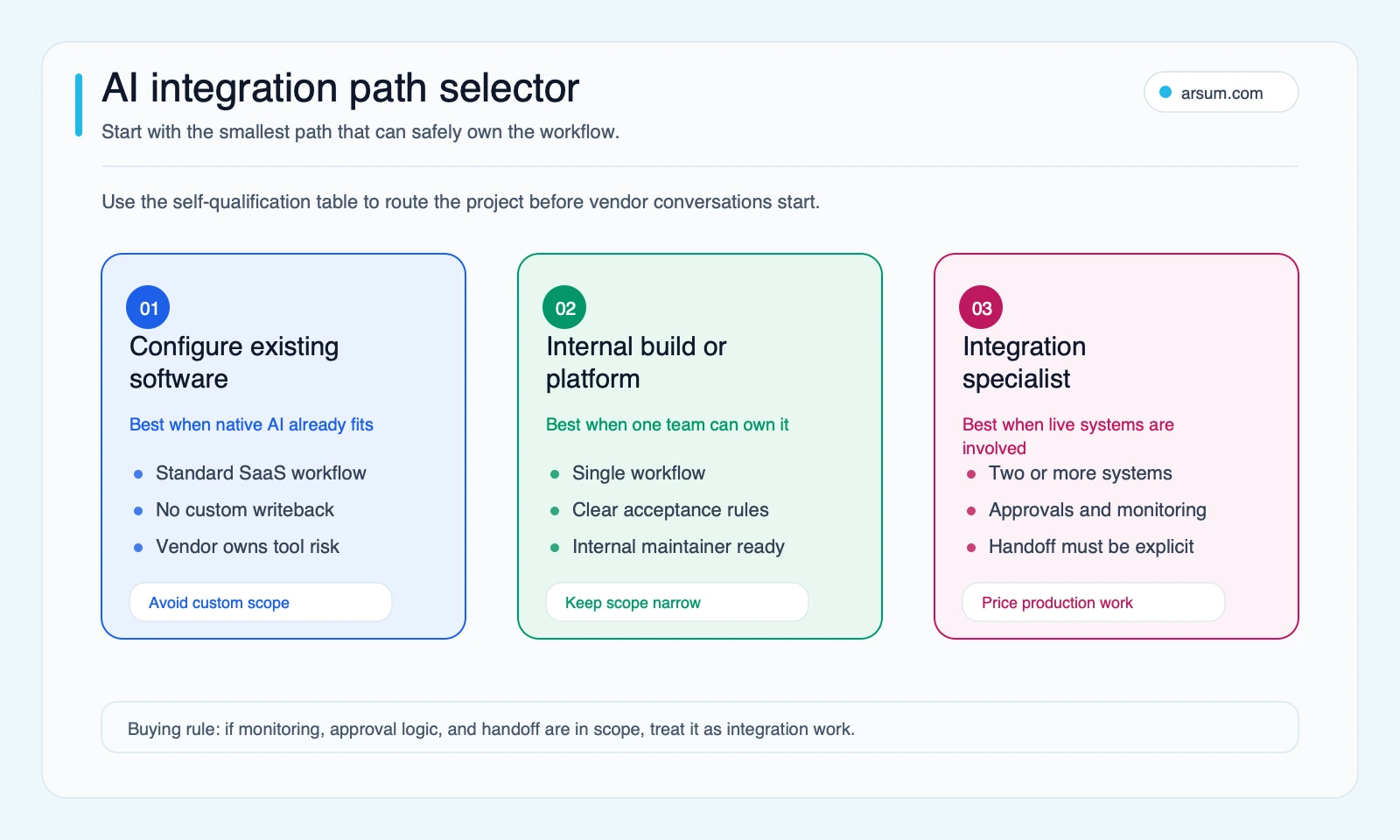
Use this selector to match the integration path to workflow risk before vendor conversations start.
What AI Integration Services Actually Cover
AI integration is not the same as buying an AI tool and plugging it into a workflow. It refers to the work of connecting AI components, whether a language model, a classification system, or an orchestration layer, to the live business systems where data originates and actions have consequences. That includes your CRM, ERP, internal databases, customer-facing platforms, and the approval and monitoring layers that govern what the AI is allowed to do.
A realistic scope covers six areas that vendor pitches often compress into a single bullet:
- Source system mapping: Identifying where the data lives, in what format, and with what access constraints
- Data preparation and validation: Ensuring the inputs the AI receives are structured, clean, and traceable
- Integration architecture: Designing how the AI connects to systems, APIs, webhooks, database reads, or event streams
- Workflow and approval logic: Defining which AI outputs trigger autonomous action and which route to a human
- Observability and monitoring: Building the logging, alerting, and audit trail that makes production safer
- Rollout and ownership handoff: Moving from a working prototype to a production system your team can operate
A partner who omits items three through six is selling you a prototype. What you are buying at that point is the cost of discovering the gap yourself, usually in production.
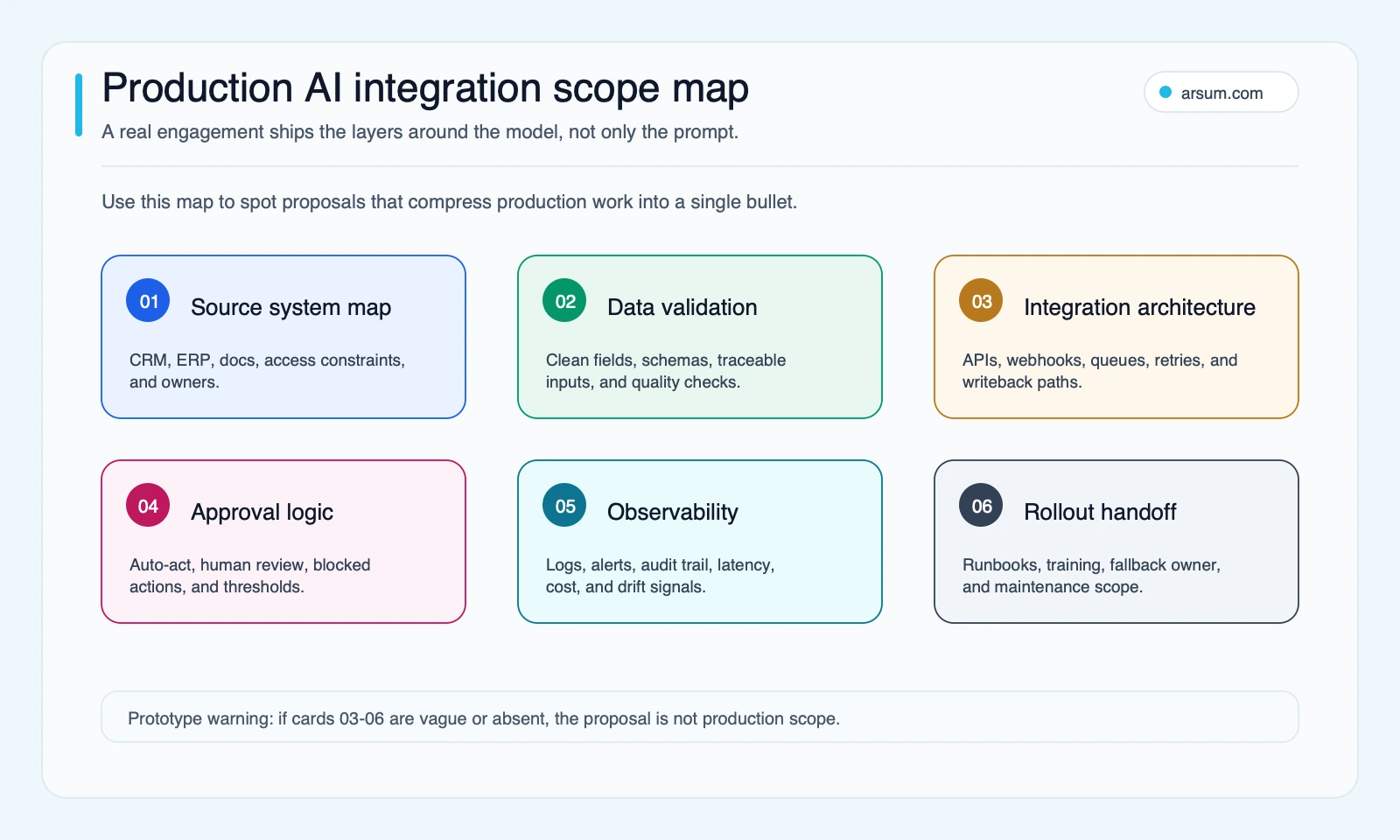
Use this scope map to check whether a proposal includes the production layers around the model call.
Before vs After: What Actually Changes Operationally
The following is an illustrative example constructed to show what a properly scoped integration delivers and what it requires. It reflects common patterns across B2B sales workflows, not a specific client engagement.
Workflow: inbound lead qualification for a B2B sales team
| Before AI integration | After AI integration | |
|---|---|---|
| Lead scoring | Manual, rep-by-rep, 2 to 3 hours per intake batch | Automated classification pipeline running within 90 seconds of intake |
| CRM updates | Reps enter notes manually, inconsistently | Record updated with score, context summary, and suggested next action |
| Lead response time | 4 to 8 hours average | Under 15 minutes for top-scored leads |
| Coverage consistency | Depends on individual rep criteria | Standardized scoring logic applied across every lead |
| Visibility | No log of scoring decisions | Full audit trail: input data, classification output, CRM write |
What this required: CRM API access, a structured intake webhook, a classification pipeline with approval routing for uncertain scores, and a monitoring layer to catch scoring drift over time.
What it did not require: an AI transformation engagement, a six-month roadmap, or replacing the CRM.
Why the gap matters: The same pattern holds across functions, accounts payable, support triage, contract review, inventory reordering. The operational change is always specific: a step that was manual becomes governed and traceable. The risk is consistent too: integrations that skip the monitoring and approval layer can reproduce the same problems at scale they were supposed to solve.
Strategy vs Implementation: Why the Distinction Matters
Not all AI services firms do the same thing. The label “AI integration services” covers providers with very different scopes, from strategy consultancies that produce recommendations to systems integrators who own delivery end to end.
Before shortlisting vendors, map where they actually operate:
| Provider type | Typical output | Governance fit | Hidden cost | Post-project ownership |
|---|---|---|---|---|
| Strategy consultancy | Frameworks, roadmaps, recommendations | Low: no delivery accountability | Opportunity cost of delayed implementation | Entirely yours |
| Implementation boutique | Shipped integrations, production systems | High when scoped correctly | Production hardening often excluded from initial quote | Shared during engagement, yours after |
| Software platform plus internal team | Configured automations using off-the-shelf tools | Moderate: depends on tool limits and internal capacity | Internal time, vendor lock-in risk | High internal burden |
| Enterprise systems integrator | Managed rollout, compliance-ready delivery | High: built-in governance and change management | Governance overhead, slower delivery timelines | Low: managed service options available |
The right category depends on your workflow complexity, internal capacity, and compliance requirements. For most mid-market companies running workflows across two or more connected systems with real business consequence, an implementation boutique or enterprise integrator is the relevant tier.
Commodity vs Non-Commodity AI Integration
Before scoping an engagement, determine whether your requirement is a commodity problem or one that genuinely requires integration depth. Treating a commodity problem as a custom build wastes budget. Treating a non-commodity problem as a plug-and-play configuration is how integrations fail in production.
Commodity AI integration covers well-solved, off-the-shelf problems:
- Adding AI features already native to your existing SaaS tools (Salesforce Einstein, HubSpot AI, Microsoft Copilot)
- Standard Zapier or Make automations using AI action blocks for summarization, classification, or routing
- Pre-built connectors between popular platforms with no custom system logic required
- Generic chatbot deployment with no CRM or backend connection
Non-commodity AI integration requires engineering depth and prior delivery experience:
- AI agents that read from, reason over, and write back to multiple live business systems with business consequence
- Custom LLM pipelines with source data governance, access controls, and audit requirements
- Approval routing that determines which AI outputs reach external systems before a human reviews them
- Production observability for AI systems touching financial data, customer records, or compliance-sensitive workflows
- Multi-system orchestration where agent failure has operational consequence and requires a rollback procedure
If your requirement is non-commodity, a software-first approach will not give you what you need. The integration engineering, governance layer, and production hardening work requires specialists who have shipped comparable systems before.
💡 Arsum builds custom AI automation solutions tailored to your business needs.
Get a Free Consultation →The Systems and Data Reality Check
Before any code gets written, a credible implementation engagement starts by auditing the systems the AI will touch. This is not a formality. The most common reason AI integrations stall or fail is that the source data is messier than expected, system access requires more engineering than the vendor scoped, or the workflow the AI is supposed to improve was never properly documented.
IBM, in its AI integration services documentation, explicitly flags that multiple disconnected agents from different vendors can create confusion, security risks, and operational inefficiency. The underlying risk is the same as undocumented system dependencies: when components are integrated without a unified architecture view, failure modes are harder to trace and harder to recover from.
Data and privacy risk that buyers underestimate: AI agents with write access to CRM or financial systems need documented permission scoping before they go live. An agent that can read and write without approval logic is an operational and compliance liability. The question of what the AI can access, and under what conditions, should be answered before the engagement begins, not after the first production incident.
The questions an integration partner should ask before scoping the work:
- Which systems hold the data the AI needs to read or act on?
- Are those systems accessible via documented APIs, or does extraction require custom connectors?
- What is the data quality and consistency in those systems today?
- Who in the business owns change approval for those systems?
- Are there compliance or data handling constraints that govern what the AI can access?
If the vendor skips these questions and goes straight to a demo environment built with generic data, treat that as a signal. The demo environment is not the hard part. Your source systems are.
What Practitioners Keep Reporting in Production
Builders describing live AI deployments keep repeating the same operational problems, even when the surface use cases look different. The recurring pattern is that production integrations fail less from prompt quality alone and more from the surrounding system design.
- Provider instability and silent retries can multiply cost. Teams report outages, partial degradation, and retry behavior that looks harmless in testing but becomes expensive once real traffic runs through a single provider path.
- Debugging shifts from prompt tuning to traceability. Once the workflow touches live systems, operators need logs, traces, tool outputs, and state-change visibility to understand why the AI behaved the way it did.
- Human approvals need architecture, not good intentions. Multi-step automations stall when escalation rules and approval boundaries are undefined, especially when consequential decisions are buried in dashboards or terminal output.
- Middleware and simplification often matter more than model choice. CRM and workflow integrations frequently need data normalization, alert-threshold tuning, and operator-friendly reporting before the system becomes usable.
Treat those signals as qualitative practitioner evidence, not market-wide measurement. They are still useful because they highlight the same hidden scope most glossy service pages skip.
Integration Architecture in Practice
The architecture of an AI integration depends on what the system needs to do. A read-and-summarize workflow that pulls from a data source and writes to a dashboard looks different from an agentic system that reads, reasons, and takes actions across multiple tools.
Anthropic’s guidance on building effective agents recommends starting with the simplest workable solution and distinguishing between predictable, rule-based workflows and more flexible agentic approaches. A well-scoped partner should sometimes recommend a structured automation over an agent-based build, and should be able to explain why. Partners who always propose the most complex architecture are optimizing for project size, not your outcome.
For a deeper look at how production agent systems are structured, AI agent frameworks covers the tradeoffs between single-agent, multi-agent, and orchestration-layer designs.
At a minimum, most production AI integrations include:
- An input layer that reads from a source system and formats data for the model
- A processing layer where the model or pipeline runs against the input
- An action or output layer that writes results back to a system, triggers a downstream step, or surfaces output to a human for review
- A logging layer that records what the AI received, what it decided, and what action was taken
The logging layer is frequently the first thing cut from a cheap implementation. It is also the first thing you need when something goes wrong.
The Phase Map: Discovery to Production
Most AI implementations begin with a pilot. A pilot is useful for validating whether the AI approach solves the problem. It is not a production system. The gap between the two is where many projects stall, and where cheap proposals most commonly omit the riskiest work.
| Phase | What it covers | What cheap proposals omit |
|---|---|---|
| Discovery | Source system audit, workflow mapping, data quality assessment, access confirmation | Rushed or skipped entirely |
| Prototype | AI approach validated against real source data, not synthetic samples | Built with clean demo data instead of actual records |
| Production hardening | Edge cases, error handling, approval routing, retry logic, monitoring | Unbundled, unscoped, or excluded entirely |
| Rollout | Phased go-live, runbooks, user training, escalation procedures | Treated as a single launch event |
| Maintenance | Monitoring, drift detection, model updates, upstream schema change handling | Outside contract scope |
When reviewing a vendor proposal, map each phase above against their statement of work. If production hardening and maintenance are absent or vague, ask for explicit pricing and scope before proceeding. The absence of a maintenance scope is often a signal that the vendor expects to renegotiate at go-live.
Reusable Artifact: Production Hardening Checklist
Use this as a proposal-review checkpoint before you approve implementation scope. If a partner cannot show how each line will be handled, the missing work is likely being pushed into change orders or post-launch cleanup.
| Production checkpoint | What good looks like |
|---|---|
| Source-system audit completed | The proposal names the systems in scope, data-quality constraints, and access dependencies. |
| Permission scope documented | The AI can only read or write what the workflow genuinely requires, with approval boundaries defined. |
| Fallback and retry policy defined | Error handling, model or provider failure behavior, and cost guardrails are specified up front. |
| Human approval points named | Consequential outputs have a clear review step, owner, and escalation path. |
| Monitoring and alerting specified | Logs, dashboards, and alert thresholds are part of the delivery scope, not a future add-on. |
| Rollback path tested | The team can disable or bypass the AI layer without breaking the underlying workflow. |
| Handoff owner named | An internal operator or managed-service owner is responsible after go-live. |
For context on how AI process automation projects are structured across different workflow types, that reference covers common patterns and where scoping gaps tend to appear.
Original Data: Buyer Decision Tree and Vendor Filters
Use this quick decision tree before you shortlist vendors. It is meant to stop teams from paying implementation prices for a software-configuration problem, or from treating a production integration as if it were a quick prototype.
| If your situation looks like this | Choose this path first | Why |
|---|---|---|
| The workflow stays inside one existing SaaS product and the AI feature is already native | Software-first configuration | You are buying setup and change management, not custom integration engineering |
| The workflow is clear, touches one or two systems, and your internal team can own monitoring after launch | Internal build or a tightly scoped implementation partner | The main risk is execution quality, not strategy discovery |
| The workflow crosses several systems, includes write actions, and needs approval logic or auditability | Integration specialist | The hard work is governance, orchestration, and failure handling |
| The workflow is still vague, the data is messy, or nobody owns operations after launch | Discovery before implementation | Shipping now will only turn scope uncertainty into production risk |
A second filter is proposal quality. Strong proposals name the systems in scope, describe how approvals work, show what will be logged, and explain who owns the system after handoff. Weak proposals stay at the promise level and bury the production detail in future phases or vague discovery language.
Risks, Security, and Governance
NIST’s AI Risk Management Framework states that the framework is intended to help organizations incorporate trustworthiness considerations into the design, development, use, and evaluation of AI systems. For buyers, that translates into a practical checklist: any production AI integration should have documented risk handling before it touches live business data.
OWASP’s Generative AI Security Project identifies prompt injection, tool misuse, insecure output handling, and excessive permissions as primary risks in deployed AI systems. These are not abstract concerns. An AI agent with write access to your CRM, email, or financial system, and without approval logic or permission scoping, is an operational liability.
Production Risk: Scaled AI Outputs Without Monitoring
AI integrations that touch customer-facing outputs, financial records, or communication channels can produce errors at scale. A misconfigured CRM update or a classification model that drifts over time does not fail once; it can fail across many records before anyone notices. The governance layer, including approval routing, logging, and monitoring, is what separates a working prototype from a production-safer system. If a vendor proposal does not explicitly scope this layer, that risk is not hypothetical.
Adoption risk is as common as technical risk. An integration that goes live without runbooks, without a documented rollback procedure, and without a team member designated to own it will degrade over time regardless of how well it was built. The question of who operates the system after handoff is as important as the question of who builds it.
What a governance-ready integration engagement should specify before go-live:
- Approval boundaries: which outputs require human review before action
- Permission scoping: which systems the AI can read, which it can write, and under what conditions
- Audit trail: what is logged, how long it is retained, and who can access it
- Rollback procedure: how to disable the AI component and revert to manual handling
- Incident response: who is notified when the system behaves unexpectedly
For a deeper look at security requirements for AI agents running in production, AI agent security covers permission models, access control patterns, and monitoring approaches relevant to integration work.
Google Risk Box: Thin Automation vs Production-Ready Integration
Google Risk Box: The thin version of an AI integration page sounds exactly like the thin version of an AI integration project: generic promises, no named systems, no approval model, and no explanation of who catches failures after launch. That is not just a content-quality problem. It mirrors the same shortcut behavior buyers should avoid in real vendor selection. If a proposal cannot show concrete workflow logic, monitoring expectations, and ownership boundaries, treat it as commodity automation language rather than delivery evidence.
Work With Arsum
We help businesses implement AI automation that actually works. Custom solutions, not cookie-cutter templates.
Learn more →How to Decide: Agency, Internal Build, or Software-First
Before engaging an external integration partner, confirm which option actually fits your situation. The decision depends on four factors: workflow clarity, system complexity, governance requirements, and internal ownership capacity.
Software-first is the right call when the workflow is standard (lead routing, email sequences, document summarization), no custom system connections are required, and your internal team has time to configure and maintain it.
Internal build is the right call when your team has ML or data engineering capacity, the workflow is proprietary or competitively sensitive, and you need full control over the model and data pipeline long term. Teams weighing that path against custom AI solutions for business should compare ownership burden as closely as they compare upfront build cost.
Fixed-scope implementation partner is the right call when the workflow crosses multiple systems, your team lacks integration engineering experience, you need production-ready output with governance and monitoring, and you want a defined engagement with a clear handoff. If you need a more architecture-first view of that delivery model, see AI integration consulting.
Broader integration engagement is the right call when you are running multiple concurrent automation initiatives, your system landscape is complex, compliance requirements raise the governance bar, or you need ongoing managed delivery rather than a project-based engagement.
ROI framing: The measurable return on an integration depends on the workflow. For manual-to-automated processes, organizations often look for meaningful reduction in processing time, fewer errors where manual data entry or judgment was the previous step, and redeployment of internal capacity toward higher-value work. The more important number is usually not the cost of the integration; it is the annualized cost of the manual process it replaces.
If you are still scoping which workflows to automate first, AI automation ROI examples shows where automation generates the most measurable business impact by function.
Vendor Evaluation: Scorecard and Red-Flag Checklist
Save this section as a working checklist. Bring it into vendor conversations before any scoping call.
Ask for specifics on a recent integration they shipped. A credible partner should be able to name the source systems, describe the architecture, explain how approval logic was handled, and describe what the monitoring setup looks like. If the answer is a demo environment and a case study PDF, keep looking.
Red flags to screen for before committing:
- Pitches that lead with AI transformation language and do not reference your specific source systems
- No named engineers who have shipped integrations at the system layer, not just the demo layer
- No explicit scope or pricing for production hardening
- No mention of rollback procedures or monitoring setup
- ROI claims stated as percentages with no underlying workflow data or assumption set
- Approval logic is not discussed at the scoping stage
- The demo was built with generic or synthetic data rather than real records from your environment
Vendor scorecard: what to assess before signing
| Evaluation area | What to ask | Green signal | Red signal |
|---|---|---|---|
| Workflow selection | How did they recommend which workflow to start with? | Prioritized by ROI, data readiness, and risk | Proposed the most impressive-sounding use case |
| Source system readiness | Did they audit your actual systems before scoping? | Yes, with documented findings | Scoped from a description alone |
| Integration depth | Can they connect to your specific systems? | Named your systems and explained the approach | Generic API/webhook language |
| Approval design | How is human review handled for uncertain outputs? | Approval routing is in scope | Not discussed |
| Observability plan | What monitoring is included? | Logging, alerting, and audit trail in scope | Dashboard only or excluded |
| Security and data handling | How is data access scoped and managed? | Permission model and data handling documented | Not addressed until legal review |
| Internal enablement | What does the team receive after handoff? | Runbooks, documentation, training | A final report |
| Post-launch ownership | Who handles issues after go-live? | Explicit SLA or maintenance scope | Escalation path unclear |
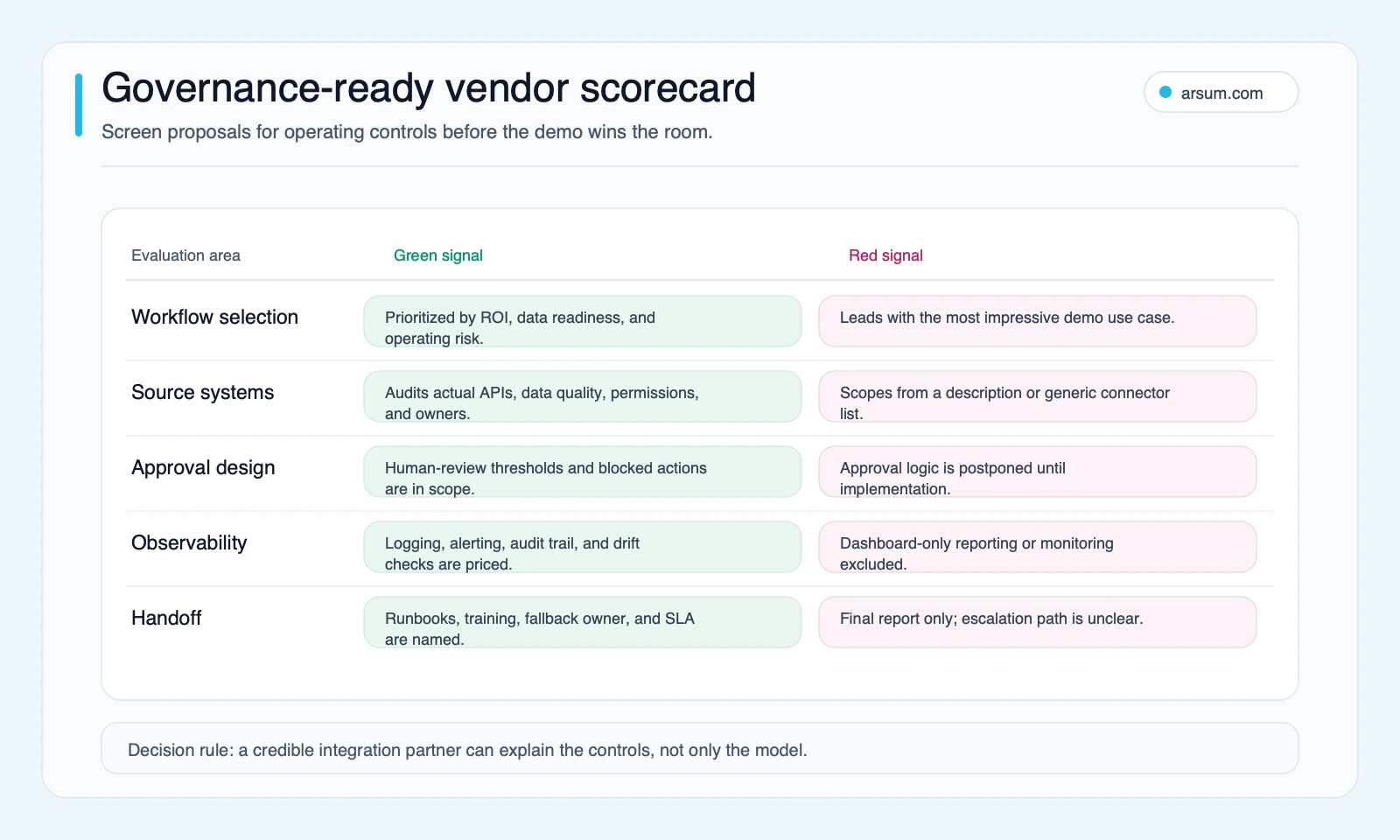
Use this scorecard to screen whether a vendor can explain operating controls, not only demo capability.
For a broader look at evaluating AI consulting services and what separates implementation-capable firms from strategy-only providers, that post covers evaluation criteria across the wider consulting market.
Freshness Note
This page was refreshed against live 2026 search results and current source material on agent reliability, approval design, observability, and governance. The goal was to keep the buyer guidance aligned with what teams are discussing now in production AI deployments, not just with generic integration marketing copy.
Methodology Note
This guide was refreshed using research reviewed on 2026-06-25. Buyer-side framing came from current search-result patterns for “ai integration services” plus qualitative practitioner discussion on Hacker News about provider outages, observability, approval routing, and CRM middleware. Factual grounding and governance guidance were checked against IBM, Anthropic, OpenAI, NIST, and OWASP documentation. Practitioner and forum evidence is used here as qualitative signal, not as market-wide measurement.
Frequently Asked Questions
How long does AI integration typically take?
A scoped, single-workflow integration with a defined source system and a clear approval model typically runs four to twelve weeks from discovery to production. Projects that require multi-system connections, compliance review, or internal process documentation before the AI work can begin take longer. Proposals that quote under four weeks for production delivery, including monitoring and handoff, are often scoping the prototype phase only.
What business systems can AI integrate with?
Most production AI integrations connect to CRM platforms (Salesforce, HubSpot), ERP systems, databases, document management tools, communication platforms, and customer-facing applications via APIs, webhooks, or direct database connections. The constraint is rarely the AI component. It is whether the source system has a documented API, what access credentials are required, and what the data quality looks like.
What are the most common reasons AI integration projects fail?
The most common failure patterns are workflow ownership being unclear before the project starts, production hardening not being scoped, source data quality being assumed rather than audited, monitoring being excluded from the engagement, and no rollback plan when something goes wrong in production. Adoption failure, a working system that no one owns or maintains after go-live, is as common as technical failure.
Should AI integration be handled by an agency or an internal team?
It depends on whether the workflow crosses multiple systems, how much integration engineering capacity the internal team has, and what the governance requirements are. Internal teams with data engineering experience can often build and own scoped integrations. Multi-system workflows with approval logic, security requirements, and post-launch monitoring obligations are often better suited to an external partner with relevant delivery experience.
What does production hardening mean, and why does it matter?
Production hardening is the phase between a working prototype and a system that can run safely in a live environment. It covers edge case handling, error and retry logic, approval routing for uncertain outputs, monitoring and alerting, and documentation for the team that will operate the system after handoff. It is the phase most commonly excluded from cheap proposals and one of the phases most responsible for post-launch failures.
How do you maintain security and governance in an AI integration?
A production-ready integration should have documented permission scoping for what the AI can read and write, an audit trail, approval logic for consequential outputs, and an incident response procedure. OWASP’s Generative AI Security Project and the NIST AI Risk Management Framework both provide frameworks that credible implementation partners should be able to reference when describing their security approach.
What should the handoff look like at the end of an integration engagement?
A complete handoff includes runbooks for operating and troubleshooting the system, documentation of the architecture and data flows, monitoring dashboards with documented alert thresholds, a rollback procedure, and at least one structured knowledge transfer session with the internal team who will own the system. Handoffs that consist only of a final report and a Slack channel are incomplete.
This article is part of Arsum’s implementation and integration content cluster. Related reading: AI Implementation Services and Business Process Automation Consulting.
Ready to Automate Your Business?
Stop wasting time on repetitive tasks. Let AI handle the busywork while you focus on growth.
Schedule a Free Strategy Call →Written by:Arsum editorial team
- Reviewed by
- Arsum editorial team
- Published
- June 4, 2026
- Updated
- July 4, 2026
- How this was produced
- Arsum uses research packs, source checks, and human editorial review to prepare and update blog articles. Editors are responsible for the final page.
- Source policy
- Sources are linked in the article when used. Methodology and source notes are included on higher-risk or high-visibility pages and are being rolled out across the archive. Editorial policy.
- Why this page exists
- Help B2B operators evaluate AI automation, implementation scope, cost, risk, and build-vs-buy decisions with practical context.