AI in IT project management is worth funding first for one narrow problem: reconciling Jira, release evidence, dependency records, decisions, and stakeholder updates into a status packet that shows what is known, what conflicts, and who must decide. A milestone can look on track because tickets are closed while the release artifact still lacks security approval and a handoff is unaccepted; AI should surface that contradiction, not turn it into a false commitment.
AI in IT Project Management: 21 Tasks Ranked
AI in IT project management: compare 21 O*NET tasks, the 43.1/100 score, 2029 capability, human controls, task capacity, and a practical first pilot.
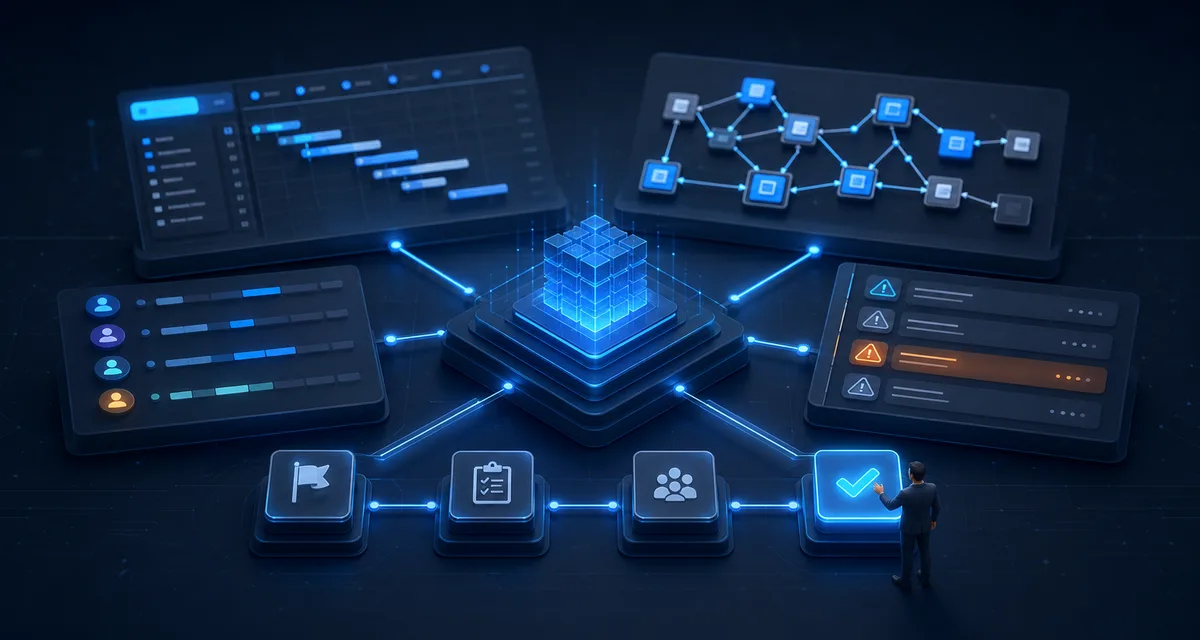
Table of Contents
- What most guides miss
- IT project management automation opportunity
- How the it project management score is calculated
- Top it project management tasks for automation support
- IT project management tasks that should remain human-led
- IT project management capability from 2026 to 2029
- Modeled hours and wage capacity for it project management
- A controlled 30/60/90-day it project management pilot
- Design the pilot around evidence reconciliation
- Worked example: closed tickets, unapproved release
- Approval model: who does what
- A pilot scorecard that can support a funding decision
- When to automate, assist, or stop
- Build, buy, or connect
- Failure modes that should disqualify expansion
- The practical next step
What most guides miss
Most guidance focuses on summaries, schedules, and meeting notes. The harder operational question is whether a generated status can be traced to current evidence.
A useful status claim needs a current owner, deliverable, date, dependency, decision, and source. If one of those is missing, the system should say so. It should not average conflicting documents into a confident-looking answer.
That distinction changes the funding decision. Fund AI when it can reduce the work of collecting and organizing evidence without increasing the cost of review, rework, or surprise blockers. Do not fund it as a substitute for scope decisions, delivery commitments, prioritization, staffing, escalation, acceptance, or executive judgment.
The first implementation candidate is therefore a source-linked status packet and dependency-risk queue, not “automated project management.” It gives delivery leaders a bounded input, a measurable output, visible exceptions, and a clear human approval boundary.
Arsum Automation Opportunity Index · 2026-08-12
IT project management automation opportunity
IT project managers can automate status evidence, dependency tracking, meeting follow-through, documentation, and risk-queue preparation. Scope, prioritization, negotiation, commitments, and team leadership remain human responsibilities.
Current score
43.1/100
Selective automation opportunity
Modeled task capacity
9.7-16.1 hours/week
P25-P75 planning range
2029 capability scenario
58/100
+14.9 points, not an adoption forecast
Recommended first pilot
status-evidence synthesis and dependency risk queues
Start narrow, measure, then expand
Decision: Automate the evidence behind status, not the stakeholder commitment or delivery judgment.
How the it project management score is calculated
For it project management, Arsum assessed 21 of 21 O*NET tasks from Information Technology Project Managers (15-1299.09). The 43.1/100 result weights each task's current automation share by O*NET importance, relevance, and frequency. It measures technical workflow opportunity—not the percentage of it project management jobs that disappear and not the share of a team that should be removed.
Project and engineering leaders should own scope, priorities, estimates, trade-offs, staffing, vendor commitments, escalation, acceptance, and executive communication. The weighted supervision estimate is 39.0%, which is why the practical design is an exception-and-approval system rather than unsupervised autonomy.
Top it project management tasks for automation support
O*NET task 16152
Submit project deliverables, ensuring adherence to quality standards.
65/100
Hybrid
AI assists; review exceptions and material outputs
O*NET task 16153
Monitor the performance of project team members, providing and documenting performance feedback.
60/100
Hybrid
AI assists; review exceptions and material outputs
O*NET task 16156
Schedule and facilitate meetings related to information technology projects.
65/100
Hybrid
AI assists; review exceptions and material outputs
O*NET task 16157
Monitor or track project milestones and deliverables.
60/100
Hybrid
AI assists; review exceptions and material outputs
O*NET task 16162
Identify need for initial or supplemental project resources.
60/100
Hybrid
AI assists; review exceptions and material outputs
O*NET task 16168
Prepare project status reports by collecting, analyzing, and summarizing information and trends.
65/100
Hybrid
AI assists; review exceptions and material outputs
O*NET task 16151
Perform risk assessments to develop response strategies.
50/100
Llm
AI assists; review exceptions and material outputs
These are ranked for practical opportunity: task exposure and current capability are discounted when implementation is complex, supervision is heavy, or live human interaction dominates. The recommended pilot above is an editorial choice among these signals, not simply the highest raw percentage.
IT project management tasks that should remain human-led
- 20/100 current capability: Manage project execution to ensure adherence to budget, schedule, and scope. AI prepares; human approval is required.
- 20/100 current capability: Develop and manage annual budgets for information technology projects. AI prepares; human approval is required.
- 30/100 current capability: Initiate, review, or approve modifications to project plans. AI prepares; human approval is required.
- 30/100 current capability: Confer with project personnel to identify and resolve problems. AI assists; review exceptions and material outputs.
IT project management capability from 2026 to 2029
2026 current
43.1/100
43.1/100
2028 midpoint
53/100
53/100
2029 scenario
58/100
58/100
The scenario adds 14.9 score points by 2029-08-12 under the same task mix. It assumes better reliability and integration in the tasks already identified as technically assistable. It does not assume that employers deploy those systems, that every normal case becomes autonomous, or that employment changes by the same amount.
The largest weighted capability gains come from:
- O*NET task 16163, Direct or coordinate activities of project personnel. 40→60.
- O*NET task 16171, Develop and manage work breakdown structure (WBS) of information technology projects. 25→50.
- O*NET task 16167, Assign duties, responsibilities, and spans of authority to project personnel. 25→50.
Modeled hours and wage capacity for it project management
The it project management model assigns 30 hours of a reference 40-hour week across rated tasks and leaves 10 hours unmodeled. On that explicit assumption, current automation capability represents 9.7-16.1 hours/week. At the May 2025 BLS national mean wage of $59/hour, the gross it project management planning range is $29,659-$49,431/year per worker.
BLS national employment435,370
Mean annual wage$122,230
Tasks with full score inputs21/21
Assessment coverage100%
Gross wage capacity is not net savings. A business case must subtract implementation, software and model usage, review time, exception handling, maintenance, and risk reserves. BLS employment excludes self-employed workers. The wage and employment figures here use the broader 15-1299 parent occupation, not a standalone count for this O*NET specialization.
A controlled 30/60/90-day it project management pilot
- Days 0-30: baseline status-evidence synthesis and dependency risk queues. Capture volume, handling time, rework, error rate, source systems, permissions, and the exception owner before changing the workflow.
- Days 31-60: run in review mode. Let the system prepare or route work, keep logs, and require human approval at the boundary described above. Measure accepted outputs and review cost, not generated volume.
- Days 61-90: expand only after evidence. Increase scope when accuracy, cycle time, exception rate, and net capacity beat the baseline without weakening customer, employee, financial, legal, or operational controls.
Sources, formula, and limitations
Occupation and task facts come from O*NET O*NET 30.3. Employment and wage inputs come from BLS OEWS May 2025 national estimates. Arsum adds the task-level current capability, supervision, implementation, time-allocation, and 2029 scenario assessments.
The occupation score is the exposure-weighted mean of task automation shares. Exposure combines normalized O*NET importance, relevance, and a log-scaled transformation of frequency. The time range applies a ±25% planning band around the modeled task capacity. Read the full Automation Opportunity Index methodology for formulas, QA gates, version history, and reproducible queries.
- The task inventory comes from O*NET 30.3; Arsum supplies the automation assessment and transformation.
- The time model allocates 30 hours of a reference 40-hour week across rated O*NET tasks, leaving 10 hours unmodeled for context switching and work not represented by task statements.
- Hours and wage capacity are planning ranges, not measured savings. Net ROI must subtract software, implementation, review, exception handling, maintenance, and risk costs.
- The 2029 value is a capability scenario, not a forecast of adoption, employment, layoffs, or autonomous operation.
- All 21 tasks have the O*NET inputs needed for score weighting and were assessed.
- BLS wage and employment data use the broader 15-1299 parent occupation and should not be interpreted as a count for this O*NET specialization alone.
Version: aoi-v0.4-software-it · run 10 · capability date 2026-08-12 · forecast horizon 2029-08-12.
The rendered task model assesses 21 O*NET tasks using Arsum’s disclosed assumptions about task importance, exposure, technical capability, and supervision. Its current 43.1/100 Automation Opportunity Index is a prioritization signal, not a prediction of job loss, adoption, savings, or authorized autonomy. The 9.7–16.1 weekly-hour planning range uses a disclosed 30-hour task budget; it is not a time-and-motion study of a particular delivery organization. See the Automation Opportunity Index methodology for the formula and limitations.
Design the pilot around evidence reconciliation
The target workflow
Use one delivery stream with a recurring status cadence. The workflow should retrieve evidence from the approved work tracker, repository, CI/CD or release records, plan, RAID log, decision log, incident records where relevant, and selected meeting records.
The output is not an executive-ready narrative alone. It is a dated packet containing:
- Completed work with source links and acceptance evidence.
- Blocked dependencies, their owner, due date, and last-confirmed state.
- Contradictions between systems or timestamps.
- Missing information and unresolved ownership.
- Decision requests requiring a named approver.
- Draft wording for confirmed commitments, clearly distinguished from unconfirmed statements.
This is a better first use case than meeting summarization because it tests whether the system handles the records that actually change delivery status. For adjacent engineering work, compare the distinct controls in AI for IT teams, AI DevOps automation, and AI automation for software developers.
A concrete reconciliation design
Before selecting a model or vendor, define the data contract.
| Design element | Pilot rule |
|---|---|
| Matching keys | Match work items using the tracker key; match code and deployment evidence using repository, pull-request, build, release, environment, and change identifiers. Do not infer a match solely from similar text. |
| Identity | Maintain an approved mapping between team members, service accounts, groups, and source-system identities. Unmapped identities enter the exception queue. |
| Freshness | Record retrieval time and source event time for every claim. Mark data stale when it exceeds the team’s agreed reporting window rather than presenting it as current. |
| Timestamp conflicts | Preserve each source timestamp. Use a documented hierarchy for evidence of completion: accepted release or handoff evidence outranks a closed ticket; a contradiction remains visible until a reviewer resolves it. |
| Source authority | Jira, the approved tracker, release systems, and decision records remain authoritative for their respective facts. The AI layer prepares a view; it does not rewrite a source record. |
| Permissions | Use least-privilege, read-only access for synthesis. Separate retrieval permissions from the ability to post, change status, or notify stakeholders. |
| Exceptions | Route missing keys, stale data, conflicting states, unavailable sources, low-confidence extraction, and unowned dependencies to a reviewer queue. |
| Auditability | Retain source references, retrieval times, generated output, model or rule version, reviewer action, and final disposition. |
A vendor demo that cannot show this with your difficult cases is not yet a product evaluation. It is a writing demonstration.
Worked example: closed tickets, unapproved release
A draft project update says a milestone is on track because the linked tickets are closed. The reconciliation workflow finds that the release artifact has not passed security approval, the production promotion record is absent, and the receiving team has not accepted the dependency handoff.
The correct output is not “at risk” by itself. It should show:
| Field | Prepared packet |
|---|---|
| Proposed status | At risk, pending reviewer confirmation |
| Supporting activity | Linked tickets are closed |
| Contradicting evidence | Security approval incomplete; no production promotion record |
| Dependency | Handoff acceptance not recorded |
| Required owner | Engineering owner for release evidence; dependency owner for acceptance |
| Required action | Confirm release path and handoff date, then approve or revise the status |
| Reviewer result | Project lead accepts, corrects, or rejects the proposed update |
This is the core distinction between synthesis and management. The system can collect evidence, identify the contradiction, and draft the packet. It cannot claim a team commitment, change priority, or silently convert activity into accepted delivery.
Approval model: who does what
Keep the approval model compact and explicit.
| Decision or action | AI workflow | Project lead | Engineering owner |
|---|---|---|---|
| Retrieve and organize permitted evidence | Prepares | Informed | Informed |
| Flag stale, conflicting, or missing evidence | Prepares | Reviews | Reviews technical evidence |
| Draft status packet and dependency queue | Prepares | Accepts or corrects | Confirms delivery evidence and commitments |
| Update a consequential status or external communication | Cannot finalize | Accountable | Consulted or accountable for technical facts |
| Scope, priority, estimate, staffing, escalation, or vendor commitment | May provide source-linked context | Accountable | Accountable for engineering trade-offs |
| Change source-system records or permissions | No default authority | Approves process need | Approves technical access and change path |
This aligns with the decision rule in agentic AI workflow automation: automation can be useful inside a controlled workflow without being authorized to make the consequential decision.
The approval boundary should be stricter when error cost is high or rollback is difficult. A high technical capability estimate does not justify more autonomy. It can justify better preparation and a more disciplined review queue.
A pilot scorecard that can support a funding decision
Run in shadow mode first: prepare the packet without changing the official report. Compare it with the approved human outcome. The thresholds below are illustrative planning assumptions, not observed benchmarks.
| Gate | Baseline and target | Owner | Review cadence | Stop condition | Rollback |
|---|---|---|---|---|---|
| Representative coverage | Baseline: document the normal path and known exception classes. Target: assess at least 100 completed cases, or one full operating cycle where volume is lower. | Project lead | Weekly | A material source, reviewer group, permission state, or failure mode is absent from the sample. | Return to manual preparation for omitted cases. |
| Status evidence coverage | Baseline: percentage of approved status claims with a current source link and acceptance evidence. Target: improve coverage without adding unmeasured review work. | Project lead | Each status cycle | Completed work is reported without acceptance evidence. | Suppress generated status and require manual evidence collection. |
| Dependency owner accuracy | Baseline: percentage of active dependencies with a correctly recorded accountable owner. Target: improve or maintain accuracy after review. | Project lead with dependency owners | Each status cycle | The queue assigns an owner incorrectly or leaves a material dependency unowned. | Restore the prior dependency register and correct mappings. |
| Net operating value | Baseline: preparation and review time per packet. Target: accepted handling time improves after review, corrections, exceptions, integration, and rework are included. | Delivery sponsor | Weekly | Review burden or downstream rework erases the accepted capacity gain. | Keep the system in draft-only mode or end the pilot. |
| Safety | Baseline: documented approval and rollback process. Target: complete source, output, permission, and reviewer logs. | Engineering owner | Weekly | A generated estimate or commitment is attributed to a team, or a people or priority decision is made without accountable leadership. | Disable posting and notifications; replay from retained evidence. |
For an illustrative arithmetic check, measure net capacity rather than generated output:
Net capacity = accepted preparation time avoided − reviewer time − exception handling − rework.
Net value = net capacity × the organization’s loaded labor rate − software − integration and maintenance − risk reserve.
Do not substitute the published modeled task-capacity range for these measurements. The pilot’s own accepted outputs and review burden should determine whether to expand.
When to automate, assist, or stop
Automate only the reversible normal path
Automation can run a normal preparation path only when the source set is complete, matching rules are stable, the output is reversible, and the system does not represent activity as accepted delivery without evidence.
Examples include assembling source links, detecting stale records, formatting a status packet, or routing an already-defined exception. The project lead and engineering owner should approve the rule, permissions, threshold, and sampled quality review before release.
Use review-first assistance for uncertainty
Use assisted review when the system can prepare a source-linked packet but records conflict, a dependency lacks an owner, an environment state is unclear, customer impact is possible, or a material judgment remains.
The reviewer should have three actions: accept, correct, or reject. Corrections should feed a visible rule, mapping, or retrieval improvement—not become hidden model behavior that nobody can inspect.
Keep leadership decisions human-led
Project and engineering leaders remain responsible for scope, priorities, estimates, trade-offs, staffing, vendor commitments, escalation, acceptance, and executive communication.
The ONET task model supports this boundary. It can identify tasks where software may assist with preparation; it does not transfer accountability for project execution, budgets, or people decisions. ONET supplies the task statements and descriptors used in the model, while the BLS Occupational Employment and Wage Statistics snapshot provides the broader wage context used in its planning translation. Neither source endorses a specific implementation or grants decision authority. O*NET’s database and BLS OEWS data should be treated as context, not a business case on their own.
Build, buy, or connect
| Path | Choose it when | Do not choose it when |
|---|---|---|
| Buy and configure | A product supports required source systems, evidence export, reviewer queues, permission boundaries, and replayable outputs. | It cannot reproduce an output, isolate access, expose source evidence, or pass difficult cases. |
| Connect existing systems | Your trackers and delivery systems are trusted, but retrieval, reconciliation, and handoffs create reporting friction. | No stable work-item, release, environment, or ownership keys exist across source systems. |
| Build a narrow workflow | The evidence-reconciliation pattern is proprietary, recurring, measurable, and valuable enough to fund validation and maintenance. | The organization cannot fund technical ownership, security review, regression testing, exception handling, and change control. |
This is not a preference for custom development. Often the value is in connecting existing systems with a controlled evidence layer. A narrow build is justified only if the organization can operate it after launch. For architecture choices, AI agent architecture patterns and AI integration services are useful adjacent references.
💡 Arsum builds custom AI automation solutions tailored to your business needs.
Get a Free Consultation →Failure modes that should disqualify expansion
Do not scale the workflow merely because its summaries read well. Stop, narrow, or return to draft-only operation when any of these occur:
- A closed activity is presented as completed delivery without acceptance evidence.
- A generated estimate, date, or commitment is attributed to a team without owner confirmation.
- Conflicting timestamps are silently resolved instead of displayed.
- A missing source, stale artifact, or identity mismatch is hidden from the reviewer.
- Permissions allow the system to alter a project record, send an external communication, or change a priority without an approved action path.
- Reviewers cannot retrieve the input, generated output, and final decision needed to explain an update.
- The pilot saves preparation time but increases surprise blockers, rework, or escalation load.
These conditions map well to the practical control disciplines in the NIST AI Risk Management Framework: govern the accountable roles, map the context, measure quality and failures, and manage the workflow when evidence changes. For delivery incidents, Google’s incident management guidance reinforces the need for clear roles, communication, and learning rather than ambiguous automated escalation.
The practical next step
Start with one recurring status cycle, one delivery stream, and a source-linked packet that makes contradictions visible. Establish the baseline before enabling automated output. Expand only when accepted handling time improves and evidence quality, dependency ownership, and surprise-blocker performance remain within approved thresholds.
The task model’s 43.1/100 current score and 58/100 capability scenario are useful because they point toward selective preparation work, not wholesale replacement. The capability scenario holds the assessed task mix constant while changing technical assumptions; it does not forecast adoption, headcount, regulation, or autonomous authority.
For leaders comparing implementation paths, the question is simple: can the proposed workflow prove every important status claim, route uncertainty to the right person, and return safely to the previous process? If not, keep it as a draft assistant until the data contract and operating controls are ready.
Ready to Automate Your Business?
Stop wasting time on repetitive tasks. Let AI handle the busywork while you focus on growth.
Schedule a Free Strategy Call →Written by:Arsum editorial team
- Reviewed by
- Arsum editorial team
- Published
- August 12, 2026
- Updated
- Same as published date
- How this was produced
- Arsum uses research packs, source checks, and human editorial review to prepare and update blog articles. Editors are responsible for the final page.
- Source policy
- Sources are linked in the article when used. Methodology and source notes are included on higher-risk or high-visibility pages and are being rolled out across the archive. Editorial policy.
- Why this page exists
- Help B2B operators evaluate AI automation, implementation scope, cost, risk, and build-vs-buy decisions with practical context.