AI layoffs reversed are an early warning about operating design, not proof that AI automation fails: when leaders remove a role after automating its visible tasks, they can also remove the judgment, exception capacity, and accountability that kept the workflow working. The decision is not whether AI can complete a task; it is whether the remaining work has a funded human owner, a controlled escalation path, and evidence that the workflow remains safe under representative production conditions.
AI Layoffs Reversed: Practical Guide
Explore AI layoffs reversed: compare workflow fit, costs, risks, evidence, and practical next steps before you build, buy, or hire.

Table of Contents
- What most guides miss: task reduction is not role elimination
- A one-screen decision tool before an AI headcount decision
- The three-layer operating model
- Worked pilot gate: finance or compliance workflow
- Proof gates before you change staffing
- Where these projects fail
- Commodity work is not low-accountability work
- Buy, connect, or build?
- A practical staffing sequence
- Methodology and limits
What most guides miss: task reduction is not role elimination
Reporting on AI-related rehiring often treats the issue as a labor-market story. For a founder, COO, or CFO deciding whether to change staffing, the useful lesson is narrower: automation can reduce routine workload without authorizing removal of the people who resolve the difficult remainder.
CNBC reporting described Ford, Commonwealth Bank of Australia, and IBM in a developing discussion about companies adding human expertise back after AI-led workforce changes exposed operational gaps. The reporting does not establish how common reversals are across the market, nor does it prove one cause for each outcome. It is directional evidence that a headcount decision can outrun workflow proof.
Orgvue reported that 39% of surveyed business leaders had made employees redundant because of AI deployment, and 55% of that subset said they had made wrong decisions. Those are survey respondent disclosures, not a prediction of job loss, adoption, or the failure rate of AI programs generally. They are still a reason to require operating evidence before a workforce decision. Read Orgvue’s release and survey framing.
| If the question is… | Weak decision | Stronger decision |
|---|---|---|
| Can the model answer routine requests? | Eliminate the whole support role | Define which requests may be resolved automatically and who owns every escalation |
| Can a workflow create a draft or recommendation? | Treat a draft as an authorized action | Keep approval with the role accountable for the decision |
| Can the system update a record? | Grant broad production access immediately | Limit permitted actions, log each change, and provide a reversal path |
| Can routine volume fall? | Assume staffing capacity falls by the same amount | Measure review, exception, and monitoring capacity before changing headcount |
The practical rule is simple: do not use a task-level capability demonstration as evidence that an entire role is redundant.
A one-screen decision tool before an AI headcount decision
Score the workflow on a 1–5 scale using observed production evidence, not a vendor demo or a quiet pilot. A higher score means the workflow is safer to automate, except for the red-flag overrides below.
| Input | 1 | 3 | 5 | Weight |
|---|---|---|---|---|
| Rule clarity | Outcomes depend on judgment not captured in policy | Some rules exist, with recurring interpretation | Rules and valid outcomes are explicit and stable | 25% |
| Exception predictability | Exceptions are novel or poorly categorized | Exceptions recur but need human diagnosis | Exceptions are rare, identifiable, and routable | 20% |
| Reversibility | A bad action is difficult to unwind | Some actions can be corrected with effort | Every action is reversible through a documented control | 20% |
| Consequence of error | Customer, legal, financial, or safety harm is plausible | Internal rework or delay is the usual impact | Error has limited, recoverable internal impact | 15% |
| Evidence and system control | No reliable source lineage or audit log | Partial logging and reconciliation | Inputs, outputs, approvals, and changes are retained | 10% |
| Human-owner capacity | No named escalation owner | Owner exists but capacity or SLA is unclear | Named owner, backup, SLA, and authority are funded | 10% |
Multiply each rating by its weight and add the results.
- 4.0–5.0: Automate a narrow permitted action after a controlled parallel run.
- 3.0–3.9: Use AI as an assistant or routing layer; retain human approval.
- 2.0–2.9: Parallel-run only. Improve the workflow and evidence before expanding autonomy.
- Below 2.0: Retain human ownership. The automation may still help with drafting, retrieval, or triage.
Two red flags override the total score:
If the workflow can create regulated, customer-harmful, legally consequential, or hard-to-reverse outcomes, do not permit autonomous final action without an explicitly authorized human approval step.
If there is no named escalation owner with the authority and capacity to intervene, do not reduce headcount on the basis of the automation.
This is an Arsum editorial decision tool, not an industry benchmark. Its value is making assumptions visible: teams can disagree about a rating, document why, and decide what proof is required to move from assist mode to a limited automation.
The three-layer operating model
Reversal risk often appears when three layers are mistakenly collapsed into one.
| Layer | What it does | Required control |
|---|---|---|
| AI layer | Classifies, extracts, drafts, summarizes, routes, or proposes an action | Version control, constrained inputs, output logging |
| Workflow layer | Connects systems, applies business rules, creates cases, and sends work to the right queue | System-of-record boundaries, permissions, reconciliation, rollback |
| Accountable human owner | Reviews exceptions, approves consequential actions, changes rules, and stops unsafe behavior | Named role, backup coverage, escalation SLA, authority to override |
The AI layer may perform a large share of routine work. That does not mean it owns the workflow. The workflow still needs a source of truth, permission boundaries, review rules, and a person accountable for outcomes.
This is the difference between isolated prompting and AI workflow automation: the latter designs handoffs, exceptions, and controls around the model. An AI agent architecture should likewise be evaluated as a system of tools, permissions, memory, and supervision—not as a model capability claim.
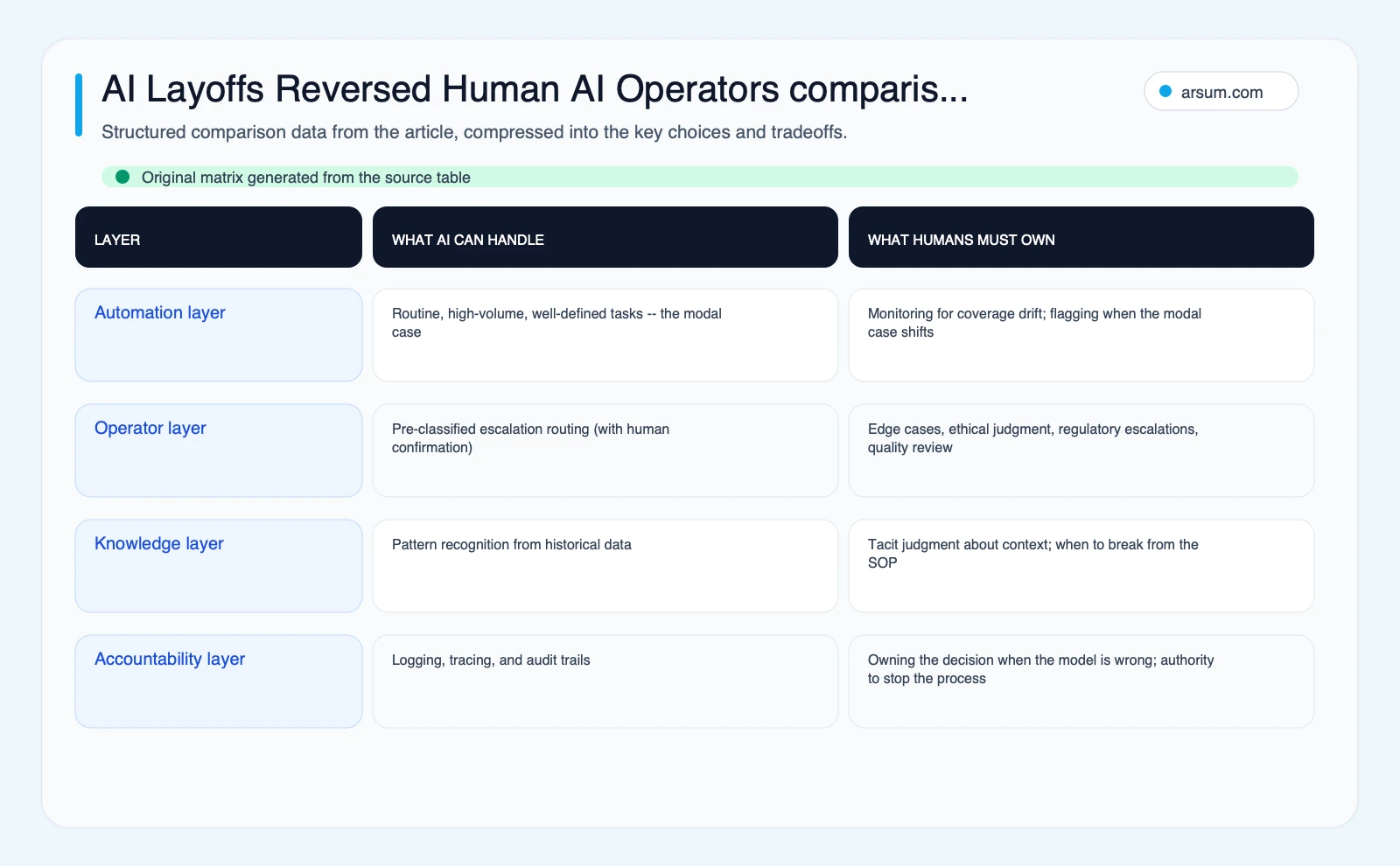
A useful boundary is this: AI can prepare, route, and perform pre-authorized low-consequence actions. A human owner must retain authority for ambiguous cases, material exceptions, policy interpretation, and actions that change a customer’s position or the system of record.
Worked pilot gate: finance or compliance workflow
Consider a hypothetical accounts-receivable workflow. This is an illustrative planning example, not an observed Arsum result or a claim about any client.
The system reads remittance documents, matches them to open invoices, and prepares proposed cash-application entries. A model may assist with extraction and matching, but it should not receive unlimited authority to post entries or resolve exceptions merely because it performs well on clean documents.
| Pilot gate | Defined control |
|---|---|
| Workflow | Extract remittance details, propose an invoice match, and create a reviewable work item |
| Baseline | Measure weekly document volume, current handling time per document, rework rate, unapplied-cash balance, and reviewer time |
| Permitted action | Auto-create a draft match only; posting remains a pre-authorized rules-engine or reviewer action |
| Normal path | Clear remittance, one matching invoice, within tolerance, complete source document: create a proposed match with source links |
| Ugly exception | One remittance covers several invoices, payer identity conflicts, discount terms differ, or payment affects a disputed balance: route to the AR specialist; do not post |
| Confidence and exception rule | Send low-confidence or rule-conflicting cases to review; retain why the system routed the item |
| Reviewer and authority | AR operations lead owns acceptance criteria; AR specialist reviews exceptions; controller approves changes to posting rules |
| Review sample | Review 100% of exceptions and a documented random sample of normal-path proposals during the pilot |
| SLA | Set a business-hours response target based on customer and close-cycle needs; escalate SLA misses to the workflow owner |
| Retained evidence | Original document, extracted fields, match candidate, model/version identifier, rule result, reviewer decision, timestamp, and final system-of-record entry |
| Stop condition | Pause expansion if errors breach the business-approved threshold, exception backlog exceeds the SLA, or reconciliation identifies unaccounted-for work |
| Rollback path | Disable automated draft creation, return work to the prior queue, and reconcile affected work items against the system of record |
| Headcount condition | No role-reduction decision until sustained capacity includes reviewer time, exception demand, monitoring work, and rollback readiness |
The economics must include review, reconciliation, and ownership cost—not only apparent time removed from initial handling.
For example, use this illustrative planning assumption:
- 1,000 documents per month
- 8 minutes of current handling time per document
- 60% routed through the automated normal path
- 2 minutes of human review for each normal-path proposal
- 100% human handling for the remaining 40%
- Additional weekly monitoring and exception-review time tracked separately
The comparison is not “1,000 documents automated.” It is the measured change in total operator minutes, plus quality and rework outcomes. If review time, exception queues, or reconciliation consume the expected capacity, the system may still be useful—but it has not justified a staffing change.
For a related workflow boundary, see accounts receivable automation. Finance leaders can also use AI use cases for finance to distinguish assisted analysis from authorized action.
💡 Arsum builds custom AI automation solutions tailored to your business needs.
Get a Free Consultation →Proof gates before you change staffing
A pilot becomes a staffing decision only when every proof gate has an owner and retained evidence.
| Proof gate | Minimum evidence | Decision if missing |
|---|---|---|
| Production coverage | Measured volume over representative operating conditions | Keep parallel-run; do not extrapolate from a demo |
| Quality | Defined error taxonomy, review results, and business-owner acceptance threshold | Retain human approval |
| Exception capacity | Queue volume, named owner, backup coverage, and response target | Add capacity or narrow the workflow |
| Source lineage | Link from output to source material and system-of-record state | Do not automate consequential actions |
| Change control | Approval for model, prompt, rule, integration, or permission changes | Freeze expansion until governance exists |
| Rollback | Tested procedure to disable the action and reconcile records | Do not enable production autonomy |
| Economics | Baseline and pilot labor, review, rework, tooling, and ownership costs | Do not claim savings or reduce staff |
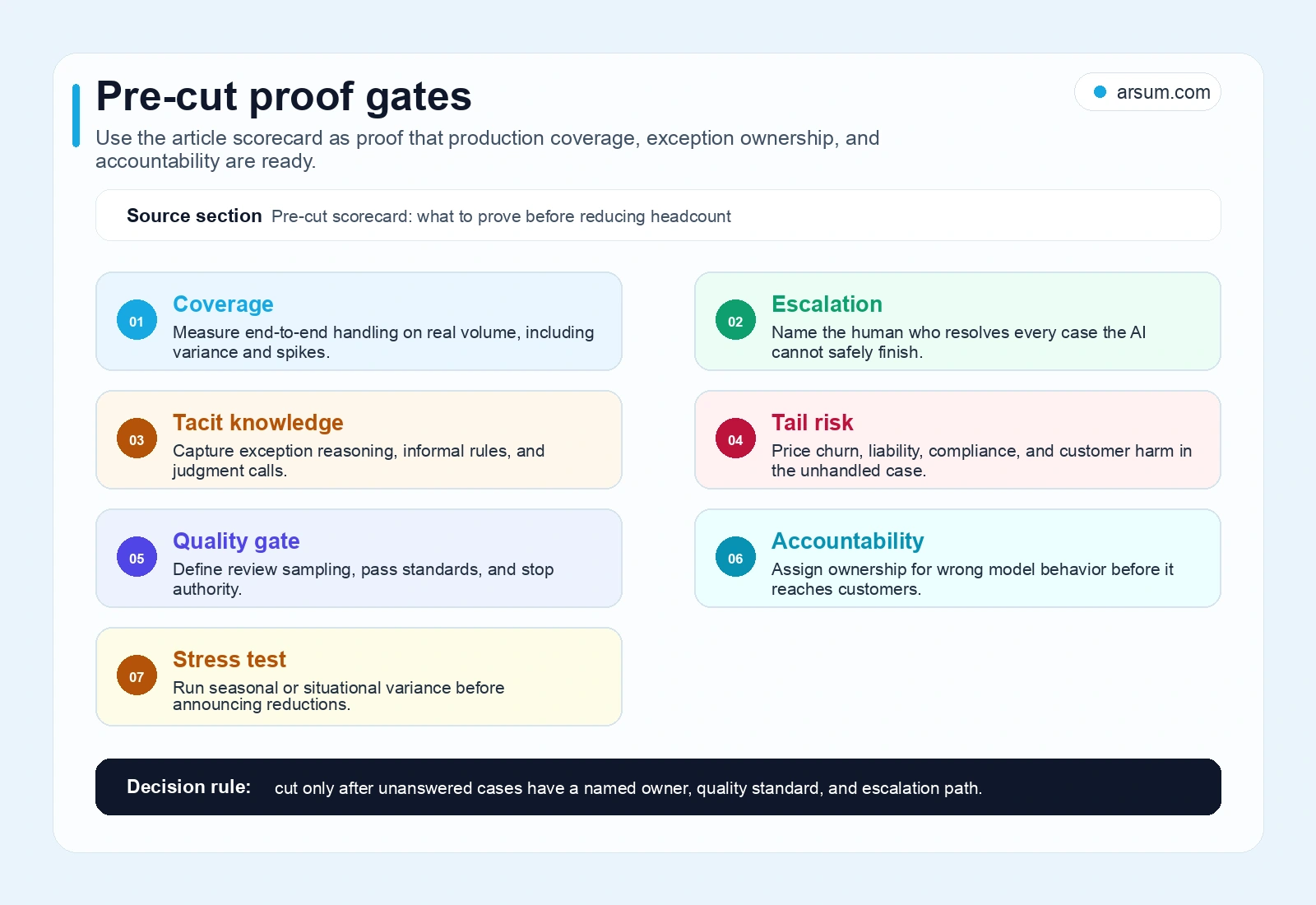
Use the gates as an approval sequence:
- Is a wrong output consequential or hard to reverse? If yes, route to human approval.
- Are exceptions frequent, ambiguous, or outside a stable taxonomy? If yes, use AI to assist or triage; keep an operator queue.
- Can the workflow safely access and update the system of record with retained evidence? If no, limit it to drafts, retrieval, and recommendations.
- Is there a named escalation owner with capacity and authority? If no, retain human ownership and fix the operating model first.
- Have quality and economics held through representative conditions? If yes, expand only the permitted action that was tested.
Where these projects fail
The common failure is not that a model returns an imperfect answer. It is that the organization has no designed response when it does.
The happy-path pilot
A pilot can look strong because it receives clean, repetitive work. Production introduces incomplete data, customers who do not fit the policy, seasonality, system outages, competing priorities, and cases whose correct outcome requires context. Measure the tail, not only the modal case.
Silent authority expansion
A system begins by drafting responses, then sends them. It begins by proposing updates, then posts them. Each expansion may feel minor, but it changes the risk profile. Record permitted actions explicitly and require business-owner approval for every step toward greater autonomy.
Unfunded review
Human review is often presented as temporary overhead. In consequential workflows, it is part of the service design. If quality depends on a reviewer, that reviewer needs capacity, an escalation SLA, access to source evidence, and authority to stop the process.
Lost tacit knowledge
Before changing a role, capture recurring exception decisions and the reasons behind them. Shadowing, case logs, and structured review are more useful than asking someone to write a generic procedure. The objective is not to encode every judgment into a model; it is to learn which judgments should remain human-owned.
Unsupported savings claims
A workflow can reduce routine effort while increasing reconciliation, customer remediation, or monitoring work. Use a full operating-cost view. AI automation ROI examples can help structure inputs and assumptions, while AI automation pricing explains why implementation cost alone is not the delivery decision.
Commodity work is not low-accountability work
Commodity tasks are usually rule-bound, repeatable, and reversible: standard-format data entry, status updates, scheduling, or form processing with clear validity rules. They are candidates for narrow automation, subject to monitoring for drift.
Non-commodity tasks often involve escalation judgment, regulatory interpretation, customer distress, exception approvals, quality sign-off, or decisions with legal or financial consequences. High volume does not make a judgment task a commodity task. The appropriate architecture is often AI-assisted human judgment, not human-free automation.
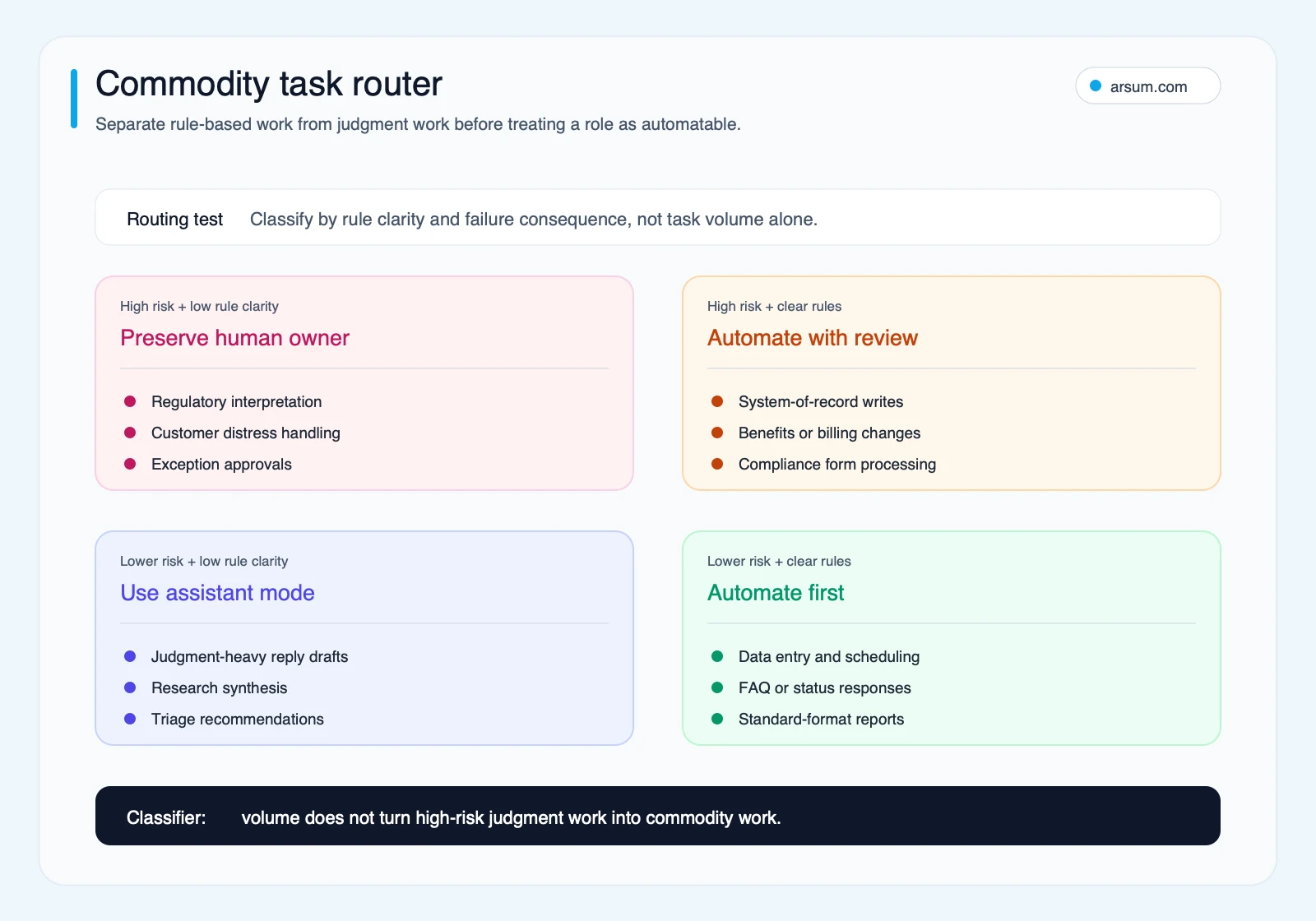
Use this route before changing roles: low-risk, high-rule-clarity work may be a candidate for limited automation; unclear rules or high consequence should preserve an accountable human owner and a review queue.
Buy, connect, or build?
The correct delivery choice depends less on model sophistication than on workflow specificity, controls, and integrations.
| Option | Best fit | Ownership question |
|---|---|---|
| Buy a platform | Common workflow, acceptable standard controls, limited differentiation | Who configures permissions, monitors quality, and owns vendor changes? |
| Connect existing tools | Stable systems of record and a narrow handoff problem | Who owns integration failures, retries, reconciliation, and credentials? |
| Build a narrow custom workflow | Proprietary rules, high-value exceptions, or unusual approval paths | Who owns requirements, testing, monitoring, model changes, and long-term maintenance? |
A narrow custom build is justified when the workflow boundary itself creates value or control: proprietary exception rules, a specific approval chain, or a critical reconciliation requirement that a generic platform cannot reliably represent. It is not justified simply because a general model can produce an impressive demonstration.
Before selecting a framework or vendor, compare the control model as carefully as features. These guides can help frame that work: agentic AI frameworks comparison, AI agent security, and AI integration services.
A practical staffing sequence
Do not start with “how many roles can we remove?” Start with a capacity plan.
- Map tasks, inputs, systems, permissions, exceptions, and decision authority.
- Classify each task as automate, assist, route, or retain under human ownership.
- Run the narrow workflow in parallel with the existing process.
- Track normal-path volume, exception volume, quality, reviewer minutes, backlog age, and rollback events.
- Assign a business owner, technical owner, and operational escalation owner.
- Approve a staffing change only after the measured remaining operator workload—including review and monitoring—is understood.
This approach may preserve more human capacity initially. That is not a failure of automation. It is how an organization avoids discovering too late that it removed the people who made the automation safe and useful.
Methodology and limits
This article uses CNBC’s July 1, 2026 reporting as evidence of reported AI-related workforce reversals and operational concerns. Claims about Ford, Commonwealth Bank of Australia, IBM, Robert Half, and ADP commentary are attributed to that reporting and should not be read as an independent prevalence study.
The Orgvue release supplies the 39% and 55% survey figures described above. The scorecard, pilot gates, operating model, and delivery guidance are Arsum’s editorial framework for evaluating workflow design. They are not survey findings, client results, or guarantees of savings.
This is early, directional evidence rather than proof that AI layoffs broadly fail. The durable lesson is to distinguish technical capability from authorized autonomy and to make exception ownership visible before workforce changes are announced.
Ready to Automate Your Business?
Stop wasting time on repetitive tasks. Let AI handle the busywork while you focus on growth.
Schedule a Free Strategy Call →Written by:Johnny Kartakov
- Reviewed by
- Arsum editorial team
- Published
- July 2, 2026
- Updated
- July 4, 2026
- How this was produced
- Arsum uses research packs, source checks, and human editorial review to prepare and update blog articles. Editors are responsible for the final page.
- Source policy
- Sources are linked in the article when used. Methodology and source notes are included on higher-risk or high-visibility pages and are being rolled out across the archive. Editorial policy.
- Why this page exists
- Help B2B operators evaluate AI automation, implementation scope, cost, risk, and build-vs-buy decisions with practical context.