AI marketing consulting is worth considering when a proposal promises AI content, lead routing, campaign analysis, or CRM automation but cannot name the workflow, baseline KPI, internal owner, review gates, handoff assets, or recurring run costs; the right engagement helps you implement a controlled operating model instead of buying generic AI strategy.
AI Marketing Consulting: Buyer Guide
Explore ai marketing consulting: compare workflow fit, costs, risks, evidence, and practical next steps before you build, buy, or hire.

Table of Contents
- What most guides miss: you are buying an operating model
- Choose the engagement model before choosing the provider
- Decide whether the workflow deserves custom work
- Use a proposal scorecard instead of a price range
- Run a pilot that can be stopped safely
- What credible delivery looks like
- Turn practitioner skepticism into hiring questions
- Content automation needs editorial and search controls
- Ownership and governance are procurement requirements
- Disqualifying conditions and proposal red flags
- Six questions to ask before signing
- Final decision
What most guides miss: you are buying an operating model
“AI marketing consulting” can mean a workshop, a strategy memo, a software configuration, a custom implementation, or a managed service. Those are different purchases with different staffing needs, risk profiles, and exit costs.
The buyer-side rule is simple: do not evaluate a proposal by its model names, tool list, or broad claims about efficiency. Evaluate whether your team can operate the workflow after delivery.
A credible proposal should identify:
- The first marketing workflow being changed
- The current baseline and measurement period
- Source systems, permissions, and data movement
- The client-side role accountable for decisions and exceptions
- The review path before output affects customers, campaigns, or published content
- Recurring model, tooling, and maintenance assumptions
- Handoff assets and the conditions for leaving the relationship
If those details are missing, the provider may still be suitable for early advisory. It is not yet an implementation commitment.
This distinction matters because consultancy pages commonly position AI work around readiness, targeting, segmentation, integration, and commercial outcomes. Chief Outsiders’ AI consulting overview and WSI’s AI consulting services page show that broad category framing. Procurement still has to convert it into a specific workflow, operating model, and acceptance decision.
Choose the engagement model before choosing the provider
Choose the route based on the work and your operating capacity—not the provider’s preferred packaging.
| Route | Use it when | Internal staffing need | Evidence to require before milestones | Exit and handoff burden |
|---|---|---|---|---|
| Specialist consultant | One workflow needs design, implementation, and transfer | Business owner plus marketing and technical stakeholders | Workflow map, integration design, acceptance criteria, handoff list | Moderate; clarify access, documentation, and credential transfer |
| AI agency / managed operator | You need continuous execution that the team cannot staff | Client-side owner who governs priorities and approvals | Service boundaries, reporting, operating model, transition plan | Higher; verify portability before committing |
| Embedded hire | The capability will be ongoing and broad | Hiring manager, budget, and clear mandate | Role scorecard and early operating plan | Lower vendor dependency, but slower capability formation |
| Software-first | The workflow is standard and the team can configure it | Internal administrator or operations owner | Configuration plan, permissions, support model | Often lower, though platform terms still matter |
| Short technical advisory | You can build internally but need independent scope review | Internal technical sponsor | Decision memo, assumptions, risks, next steps | Low if documentation is reusable |
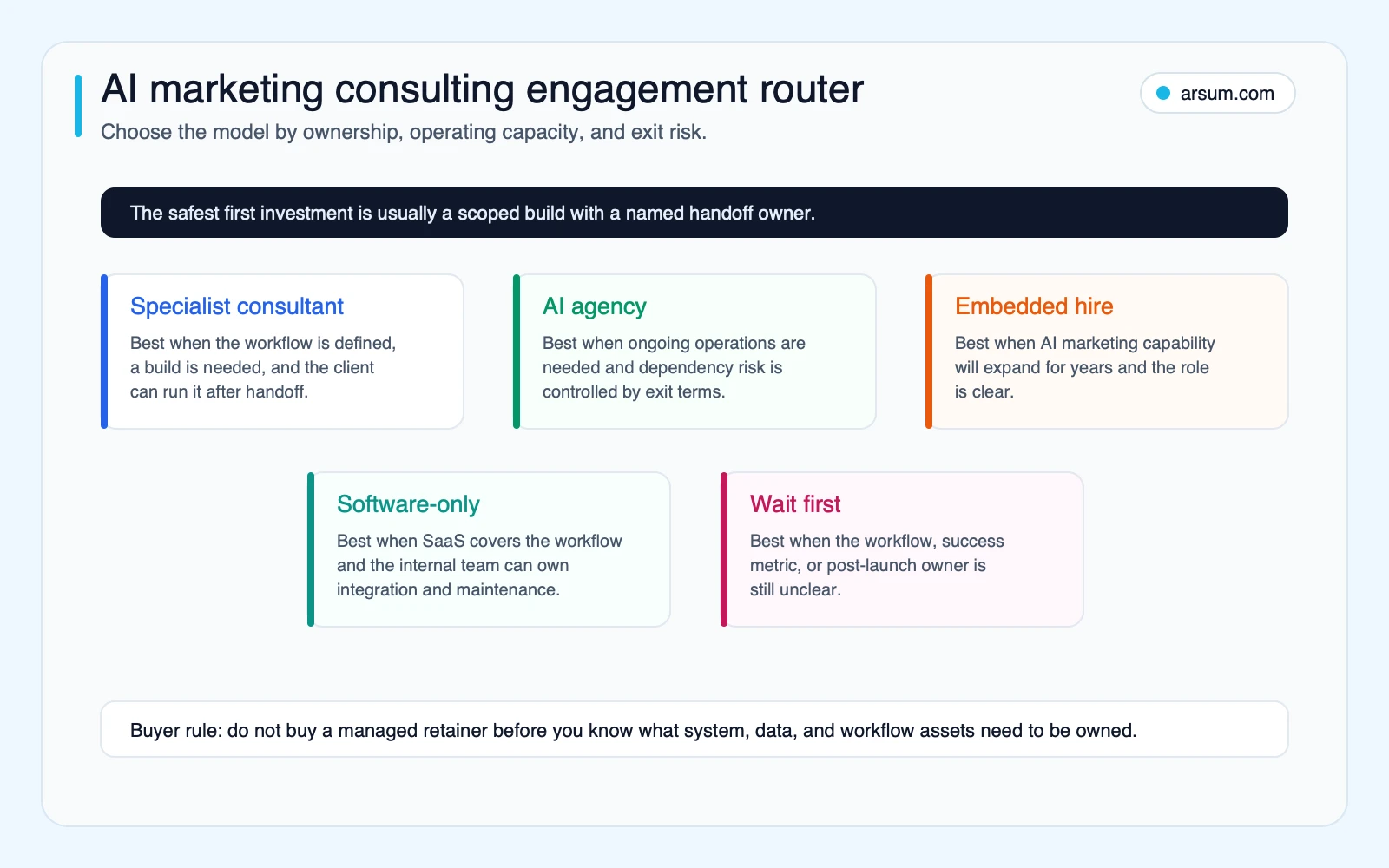
A scoped specialist build is a reasonable default hypothesis for a first custom workflow because it can test value without assuming that an open-ended managed service is necessary. It is not universal. If no one internally can operate the result, or the work truly needs ongoing external execution, a managed arrangement may fit better—provided its transition path is usable.
For a broader comparison of delivery routes, see AI automation consulting and AI implementation services.
Decide whether the workflow deserves custom work
Do not begin with “Where can we use AI?” Begin with “Which workflow is bounded enough to improve and control?”
A good first candidate normally has repeatable inputs, a measurable output, accessible systems, and a manageable exception path. Marketing examples include drafting content briefs from approved sources, routing leads against explicit criteria, preparing campaign-performance summaries for review, or enriching CRM records under defined rules.
A poor first candidate is a vague mandate to “automate content,” “improve growth,” or “make campaigns autonomous.” Those goals combine strategy, judgment, brand, data quality, and approval authority into one untestable scope.
Workflow selection gates
Before speaking with consultants, answer these questions in writing:
- What starts the workflow?
- Which systems provide the inputs?
- What output is produced, and who uses it?
- What is the current baseline: volume, turnaround time, review effort, or error rate?
- Which outputs can be reviewed before action, and which cannot?
- What exception requires human judgment?
- Who owns the decision when the system is wrong?
- Can the workflow be paused or rolled back without harming live operations?
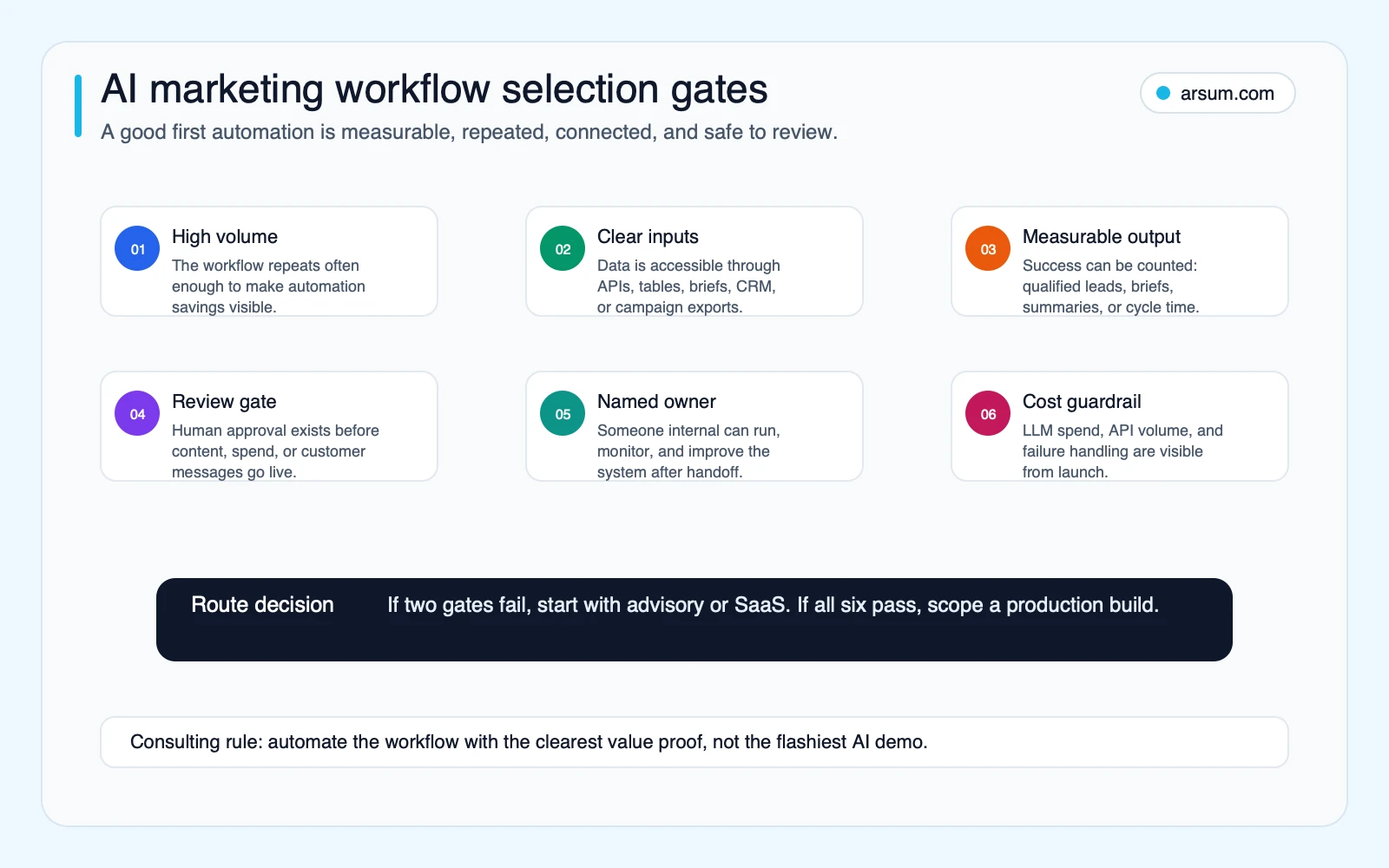
For workflow candidates within the function, see AI for marketing teams. If a proposal uses agents, ask why a deterministic workflow, existing SaaS feature, or conventional integration would not meet the need. Custom autonomy needs to be justified by the workflow—not by the availability of agent tooling.
💡 Arsum builds custom AI automation solutions tailored to your business needs.
Get a Free Consultation →Use a proposal scorecard instead of a price range
There is no defensible universal price range for AI marketing consulting. Budget depends on discovery depth, integrations, data condition, security constraints, model and tool usage, ongoing operations, and the acceptance standard you require.
Ask each provider to separate five budget components.
| Budget component | What the proposal should state |
|---|---|
| Discovery and design | Workflow studied, stakeholders involved, deliverables, and decisions made before build |
| Implementation | Integrations, interfaces, rules or prompts, testing, monitoring, and documentation |
| Run cost | Model/API usage, enrichment or search calls, hosting, subscriptions, and vendor fees |
| Maintenance | Who handles updates, breakages, policy changes, and workflow revisions |
| Acceptance and handoff | Test cases, training, access transfer, runbook, and final-payment criteria |
Model spend is a real operating input, not a footnote. OpenAI’s API pricing illustrates why a proposal should disclose the usage assumptions that drive model costs rather than bury them in a managed-services line item.
Compact consulting fit scorecard
Score each dimension from 0 to 2: 0 means vague or missing, 1 means partly addressed, and 2 means explicit enough to contract and verify.
| Dimension | A score of 2 means |
|---|---|
| Workflow specificity | One workflow has defined inputs, outputs, exception path, and success measure |
| Integration depth | Systems, permissions, data movement, and fallback behavior are identified |
| Internal ownership | A named client-side role owns decisions and post-launch operations |
| Approval design | Review gates are defined before publishing, spend, or customer-facing action |
| Cost visibility | One-time work, recurring tools, model assumptions, and maintenance are separated |
| Acceptance evidence | Test cases, baseline, target, measurement period, and reviewer are written down |
| Asset portability | Documentation, configurations, exports, credentials, and transition duties are specified |
| Complexity justification | The provider explains why a simpler route will not meet the requirement |
Interpret the total as a routing aid, not a market benchmark:
- 0–5: stay software-first or commission a short advisory.
- 6–10: consider a tightly scoped specialist engagement.
- 11–16: a build may be justified if governance and handoff terms are workable.
A provider should be comfortable with this scrutiny. If they cannot explain why a proposed build is preferable to configuring an existing platform, pause before treating custom AI as necessary.
Run a pilot that can be stopped safely
A pilot should test one operational hypothesis, not prove that AI can transform marketing in the abstract. The example below is an illustrative planning pattern, not a client result, market benchmark, or forecast.
Illustrative pilot scorecard
Suppose a team wants to improve preparation of weekly campaign-performance summaries.
| Field | Planning example |
|---|---|
| Workflow | Turn approved analytics and CRM inputs into a draft weekly performance summary |
| Baseline | Record current turnaround time, reviewer minutes, and corrections during a defined measurement period |
| Target | Set a team-approved improvement target before launch; do not use provider claims as the baseline |
| Quality threshold | A named reviewer confirms source traceability, reconciled calculations, and no automatic publication of recommendations |
| Exception metric | Track missing data, unsupported recommendations, incorrect attribution, and reviews needing material rewrite |
| Owner | Marketing operations lead owns the workflow; analytics lead validates source logic |
| Review cadence | Review results weekly and document exceptions, cost inputs, and unresolved risks |
| Stop condition | Pause if quality falls below the agreed threshold, sources cannot be traced, or review burden exceeds the existing process |
| Rollback path | Restore the existing reporting process, disable automations or credentials, and preserve logs needed for diagnosis |
| Go/no-go decision | Expand only if agreed business, quality, cost, and ownership criteria are met |
The important feature is not an ambitious target. It is a measurable baseline, an accountable reviewer, and a safe decision point. For related implementation choices, see agentic AI use cases in marketing and AI automation ROI examples.
What credible delivery looks like
A capable AI marketing consultant may offer strategy, implementation, or managed operations. Ask which one is actually included—and what is excluded.
Advisory should leave reusable decisions
A strategy engagement should produce more than a slide deck. Request a ranked workflow backlog, constraints and assumptions, a buy/build rationale, a data and risk map, and an explicit recommendation for what not to automate yet.
Advisory is appropriate when you have internal delivery capacity but need prioritization, architecture input, or an independent review of vendor proposals. It is not a substitute for a production build if no one has accepted responsibility for implementation.
Implementation should produce a controlled system
For a production build, require:
- A workflow map with source and destination systems
- Defined user roles and approval rights
- Test cases for normal and abnormal inputs
- Source lineage for generated summaries, recommendations, or content inputs
- Monitoring for failures, unexpected volume, and relevant operating costs
- Documentation and training for the internal operator
- A handoff plan identifying what transfers and how access is verified
The relevant question is not “Can the model produce this?” It is “Who is authorized to act on it, with what evidence, and what happens when it is wrong?”
For marketing work involving external actions or sensitive data, higher failure cost should reduce autonomy. Keep customer-facing publication, budget changes, and consequential record changes behind defined approval gates.
Managed operations should have an exit plan on day one
A managed agency can be appropriate when you need continuous execution and do not plan to staff the work immediately. The agreement should still distinguish client-controlled assets, vendor-managed components, and items governed by third-party terms.
Do not assume that “the client owns everything” is automatically true. Ownership of credentials, accounts, data retention, model configuration, logs, hosted code, and generated assets can depend on the agreement, service terms, and jurisdiction. Appropriate legal and security reviewers should assess the contract language.
Turn practitioner skepticism into hiring questions
The research behind this guide included a small set of search-snippet-only practitioner signals, not market-wide evidence. They are useful as qualitative prompts because they raise familiar buyer concerns: AI content can become generic without editorial judgment; a proposed tool may be commodity SaaS in a new wrapper; and “consultant” and “agency” labels can conceal different operating models.
Use those concerns as interview questions:
- What judgment remains human, and where is that review recorded?
- Which workflow is being redesigned rather than simply supplied with prompt templates?
- What would make you recommend standard SaaS configuration instead of custom work?
- Which systems are connected, and what happens when an input is incomplete or contradictory?
- What can our team export, modify, and operate without you?
- Which recurring costs are controlled by us, and what usage assumptions drive them?
- What evidence must be accepted before each payment milestone?
A proposal that treats human review as an optional later phase is risky for brand-sensitive work. A proposal that treats a model as permission to publish, spend budget, or alter customer records without defined authorization is riskier still.
Content automation needs editorial and search controls
AI-assisted content workflows can help a team organize approved inputs, create drafts, surface research gaps, and accelerate repetitive production tasks. They are not justification for publishing scaled, low-value pages.
Google’s spam policies on scaled content abuse address content produced at scale primarily to manipulate rankings. The practical procurement implication is to ask how user value, editorial review, source checking, and subject-matter input enter the workflow before publication.
A content-automation proposal should state:
- Which source material is approved for drafting
- Who reviews factual claims and brand-sensitive language
- How original experience, expertise, or evidence enters each publication
- What prevents automatic publication of thin, inaccurate, or duplicated material
- Which quality signals the team reviews after launch
For a broader operating view, see AI content automation for business and AI SEO services explained.
Ownership and governance are procurement requirements
Governance needs to be designed before an automation connects to customer data, campaign operations, or publication workflows—not retrofitted after launch. Treat it as a procurement requirement alongside scope and acceptance.
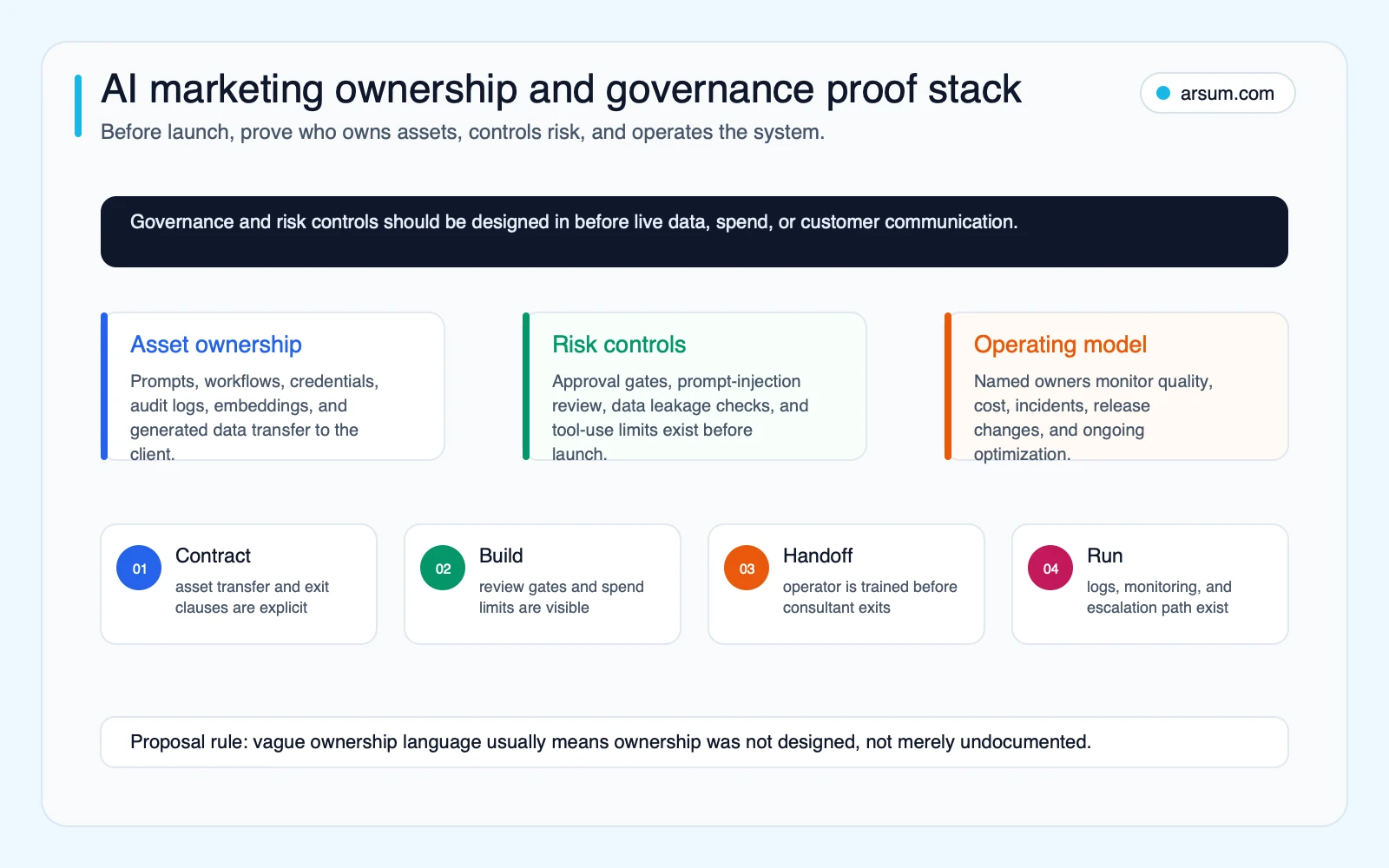
Use this contract-review checklist.
| Category | Questions to resolve |
|---|---|
| Client-controlled assets | Which accounts, data, documentation, configurations, and source materials remain under client control? |
| Vendor-managed assets | Which environments, monitoring tools, repositories, or operational services does the vendor run? |
| Third-party platform terms | Which items are controlled by CRM, ad, analytics, model, or automation-platform terms rather than either party’s contract? |
| Credentials | Who creates, stores, rotates, and receives access to API keys and service accounts? |
| Data and logs | What is retained, where, for how long, and how can the client retrieve it? |
| Handoff | Which artifacts transfer, how is access tested, and what training is included? |
| Failure response | Who can pause the system, who investigates, and who approves reactivation? |
OpenAI’s published platform materials make clear that production use involves more than prompt quality: usage, platform behavior, data handling, and operational decisions all matter. Review the OpenAI API pricing page and OpenAI’s API introduction alongside your own contract, security, and platform-term review.
Disqualifying conditions and proposal red flags
Do not proceed to a build until these conditions are resolved:
- No named internal owner can approve outputs or own operations after handoff.
- The workflow has no accessible baseline or measurable acceptance criterion.
- Sensitive, customer, or campaign data would move through systems without a reviewed data path.
- The provider cannot separate build work from recurring operation and maintenance.
- The proposed solution cannot be paused or reverted safely.
- The scope depends on autonomous action where errors are high-cost or difficult to reverse.
- The provider refuses to specify transfer rights, access, documentation, or transition support.
- A complex agent architecture is proposed before a simpler workflow or SaaS route has been assessed.
These are not accusations about a provider’s intent. They are procurement gaps that leave too much implementation risk with the buyer.
Work With Arsum
We help businesses implement AI automation that actually works. Custom solutions, not cookie-cutter templates.
Learn more →Six questions to ask before signing
- What exact workflow will be delivered, including inputs, outputs, systems touched, and exception path?
- What baseline, target, measurement period, and reviewer define acceptance?
- Who owns approvals, operational decisions, and incident response after launch?
- What data, credentials, prompts, configurations, logs, and documentation transfer at handoff?
- What one-time, recurring, and maintenance costs exist, and which assumptions drive them?
- Why is this a consultant-led custom build rather than software configuration, an in-house project, or a simpler automation?
A good AI marketing consulting engagement makes these answers clearer before you sign—not after the first invoice.
Final decision
Hire an AI marketing consultant when you have a specific workflow, a responsible internal owner, a measurable hypothesis, and a reason that ordinary software configuration cannot meet the need. Prefer a proposal that makes integration, review, cost governance, ownership, handoff, and rollback concrete.
Reject generic AI strategy when the provider cannot connect it to a controlled workflow. Treat a managed retainer as an operating choice with a transition plan, not the default next step.
Ready to Automate Your Business?
Stop wasting time on repetitive tasks. Let AI handle the busywork while you focus on growth.
Schedule a Free Strategy Call →Written by:Arsum editorial team
- Reviewed by
- Arsum editorial team
- Published
- June 10, 2026
- Updated
- July 4, 2026
- How this was produced
- Arsum uses research packs, source checks, and human editorial review to prepare and update blog articles. Editors are responsible for the final page.
- Source policy
- Sources are linked in the article when used. Methodology and source notes are included on higher-risk or high-visibility pages and are being rolled out across the archive. Editorial policy.
- Why this page exists
- Help B2B operators evaluate AI automation, implementation scope, cost, risk, and build-vs-buy decisions with practical context.