AI ML consulting services are worth considering when a workflow has enough business value, unstructured information, integration complexity, or control requirements that a standard tool or internal experiment cannot safely own it. A credible engagement should leave you with a measurable workflow, explicit controls, and a named operating owner—not merely a model demo or strategy deck.
AI ML Consulting Services: Buyer Guide
Explore ai ml consulting services: compare workflow fit, costs, risks, evidence, and practical next steps before you build, buy, or hire.

Table of Contents
- What most guides miss: the buying decision is about ownership
- What a credible engagement should cover
- Buy, build, or use a consulting partner
- A worked pilot acceptance scorecard
- How to compare proposals with weighted gates
- Cost and commercial ranges: evidence limits
- Disqualifying conditions and common failure modes
- Handoff checklist and next step
- Methodology and freshness
What most guides miss: the buying decision is about ownership
Most descriptions of AI/ML consulting services list strategy, model development, and deployment. That is not enough to evaluate a proposal.
The practical question is: who owns the workflow after the consultant leaves, and what evidence shows it can operate safely before then?
A model may classify a document, summarize a case, or draft a response. That technical capability does not authorize it to update records, trigger payments, send customer communications, or make consequential decisions. Production ownership requires a written workflow boundary:
- The source data and systems the workflow can access
- The actions it may take automatically
- The exception classes routed to people
- The approver for consequential actions
- The logs, evaluation method, and alert owner
- The rollback path when quality, cost, or control conditions fail
This boundary is the difference between a useful consulting engagement and an expensive prototype. For broader category context, see AI consulting services: a buyer’s framework.
Start with the workflow, not the model
A consulting partner should first determine whether AI or ML is the right implementation approach.
OpenAI’s practical guide to building agents recommends agentic designs for workflows involving complex decisions, difficult-to-maintain rules, or substantial unstructured data. That framing is useful because it also identifies when a simpler approach is preferable.
| Workflow condition | Usually start with | What to ask a consultant |
|---|---|---|
| Stable rules, structured inputs, limited exceptions | Deterministic automation | Can this be implemented without a model? |
| Unstructured documents or communications, but a person makes the final decision | Copilot or assisted review | What is extracted, what is suggested, and what remains human-approved? |
| Multiple tools, variable paths, and bounded decisions | Orchestrated AI or agent workflow | What tools can act, what is validated, and where does execution stop? |
| Vague process, unknown baseline, or no accountable owner | Internal discovery | What problem are we solving and how will acceptance be measured? |
A useful consultant is willing to recommend a simpler workflow when it is more controllable. For implementation patterns between rules-based automation and agentic execution, see agentic AI workflow automation.
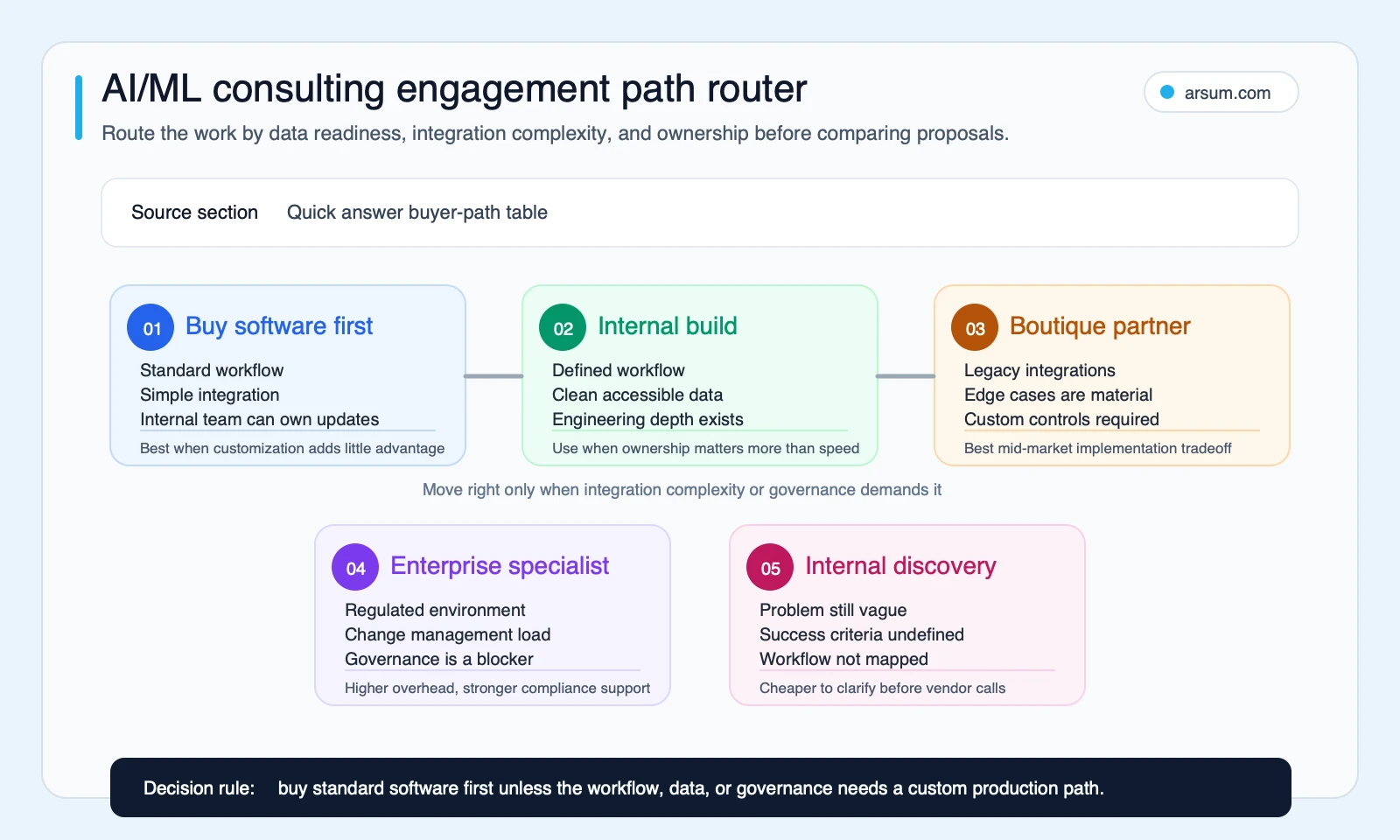
Choose the engagement path from workflow clarity, data readiness, integration complexity, and the team that will own operations after launch.
What a credible engagement should cover
The right scope depends on the workflow, but buyers should expect explicit treatment of the following work—not vague references to “end-to-end delivery.”
Workflow selection and data readiness
A consultant should map the current process from input to outcome: systems used, decisions made, exceptions handled, handoffs, approval points, and measurable baseline. This is where a team should eliminate poor candidates, not validate every proposed use case.
Data readiness is more than asking whether data exists. It includes access permissions, source lineage, missing fields, document variation, labeling needs, retention rules, and the operational implications of bad inputs. Require a discovery deliverable that names known gaps, assumptions, and the owner responsible for resolving each one.
Architecture, controls, and integration
A proposal should state where the model or service runs, which systems it reads and writes, and how outputs are validated before downstream use.
For LLM and agentic workflows, OWASP’s Top 10 for LLM Applications identifies risks including prompt injection, insecure output handling, excessive agency, overreliance, and access-control concerns. Translate those categories into project artifacts:
| Risk area | Evidence to request |
|---|---|
| Untrusted input or prompt injection | Input-handling rules, content boundaries, and test cases |
| Insecure outputs | Structured-output validation and downstream checks |
| Excessive agency | Tool permissions, approval gates, and action limits |
| Overreliance | Exception routing, review requirements, and independent checks |
| Access control | System permissions, secrets handling, and audit access |
| Operational failure | Retries, alerts, incident owner, and rollback procedure |
“Security considered” is not a deliverable. A credible proposal identifies the applicable controls, testing approach, and responsible owner.
Production operations and handoff
Production operations should be scoped once and clearly. They include live integration, monitoring, exception handling, access management, runbooks, and handoff to the client’s accountable owner.
Ask: “What happens at 10:00 a.m. on a Tuesday when the workflow produces a bad output, an integration fails, or an approver is unavailable?” If the answer is a future discussion, production ownership is not in scope.
💡 Arsum builds custom AI automation solutions tailored to your business needs.
Get a Free Consultation →Buy, build, or use a consulting partner
Vendor categories do not have universal governance, cost, or ownership profiles. Fit changes with the workflow, internal capability, procurement constraints, and willingness to maintain the system. Treat this table as a set of evaluation hypotheses, then test each one against the actual proposal.
| Path | Usually fits when | Validate before choosing | Common mismatch |
|---|---|---|---|
| Buy software | The workflow is standard and configuration is sufficient | Integration limits, data handling, administrative controls, and exit options | Paying for custom work around a tool that cannot handle core exceptions |
| Build internally | The workflow is defined and an internal team can maintain it | Engineering capacity, evaluation ownership, on-call responsibilities, and security review | Funding a build without a durable operator after launch |
| Independent specialist | The scope is narrow and the client can manage dependencies | Availability, documentation, knowledge transfer, and integration responsibility | One person becomes the only person who understands the workflow |
| Boutique implementation partner | The workflow crosses systems and needs tailored controls | Delivery-team depth, operating artifacts, handoff plan, and comparable constraints | Buying a polished prototype without operational scope |
| Larger consultancy or specialist firm | Change management, procurement, or formal governance is substantial | Named delivery team, subcontractors, implementation ownership, and decision speed | Paying for process without enough hands-on build capability |
A proposal should also state what the client must provide: system access, subject-matter reviewers, security decisions, data remediation, test cases, and post-launch ownership. Ambiguity here is a common source of scope disputes.
If you are comparing implementation capacity with direct hiring, use this guide to hiring an AI developer versus an agency. If the decision centers on connecting existing systems and data, review AI integration consulting.
A worked pilot acceptance scorecard
A pilot should test a narrow operating claim, not demonstrate that a model can produce plausible output. The following invoice-processing example is a hypothetical planning scorecard, not an observed client result.
Assume an accounts-payable team receives invoices from known vendors and currently reviews every invoice manually. The pilot tests whether an assisted extraction-and-routing workflow can reduce review effort for an eligible subset while preserving control.
| Scorecard item | Hypothetical pilot definition |
|---|---|
| Eligible work | Invoices from preapproved vendors, with required fields present and no payment, tax, or vendor-master change request |
| Baseline | Measure weekly volume, manual review minutes per eligible invoice, correction rate, and exception reasons for two to four weeks |
| Target | A planning target might be to route 80% of eligible invoices through automated extraction without removing required approval controls |
| Quality threshold | Required fields meet the finance team’s documented acceptance rule; any failed validation routes to review |
| Exception requirement | New vendors, missing fields, duplicate-risk signals, unusual totals, policy conflicts, and low-confidence outputs route to a named AP reviewer |
| Review-cost measure | Track reviewer minutes, corrections, and rework on automated and manual paths |
| Approval owner | The AP manager owns acceptance of workflow rules; a finance or risk owner approves changes to payment-related controls |
| Review cadence | Daily exception review during the pilot, followed by a 30-day operating review after controlled launch |
| Stop condition | Pause automation if quality falls below the agreed threshold, exceptions cannot be routed reliably, or a control breach occurs |
| Rollback path | Disable write actions and return work to the documented manual queue while retaining logs and samples for diagnosis |
This is deliberately specific about eligibility. An “80% automation” target without defining the population can conceal a workflow that excludes difficult work—or one that improperly automates it.
Use the same structure for accounts receivable automation, support triage, compliance document review, or onboarding: baseline first, eligible population second, acceptance controls third.
The decision rule
Advance from pilot to wider rollout only when all of these are true:
- The workflow meets the agreed quality threshold on eligible work.
- Exceptions reach the correct reviewer with retained context.
- The accountable owner can operate the workflow without the consulting team.
- The rollback procedure has been tested.
- The business metric improves enough to justify the added review, operating, and maintenance burden.
A technically successful demo that fails any of these conditions is not ready for broader autonomy.
How to compare proposals with weighted gates
Use a 1–5 score for each category:
- 1: assertion with no usable evidence
- 3: credible plan with named artifacts
- 5: workflow-specific evidence, owner, and acceptance method
Apply the suggested weights only after automatic disqualifiers are cleared.
| Evaluation gate | Weight | A score of 5 looks like | Automatic disqualifier |
|---|---|---|---|
| Workflow fit and baseline | 20% | Defined workflow, excluded cases, baseline metric, and acceptance criteria | No measurable business outcome or eligible-work definition |
| Data readiness and lineage | 15% | Named sources, access assumptions, quality gaps, and remediation owner | Vendor scopes delivery without reviewing relevant data or access constraints |
| Integration and implementation | 15% | Specific systems, interfaces, responsibilities, and test environment | “Client IT handles integration” with no coordinated plan |
| Controls and approvals | 15% | Permission boundaries, validation, escalation, and approval design | Consequential actions proposed without a clear approval or override path |
| Observability and evaluation | 15% | Logs, test cases, monitoring, alert ownership, and operating reviews | No production monitoring or quality measurement |
| Handoff and maintenance | 10% | Runbook, training, named client owner, change process, and support boundaries | No day-31 ownership model |
| Commercial clarity | 10% | Assumptions, exclusions, change-control process, and stage-specific deliverables | Price or timeline presented as certain while key dependencies remain unexamined |
Calculate the weighted score after disqualifiers. Do not advance a proposal with a disqualifier, and do not let a strong demo compensate for weak controls or handoff. The best proposal is the one with the clearest evidence for your workflow—not the most impressive generic capabilities list.
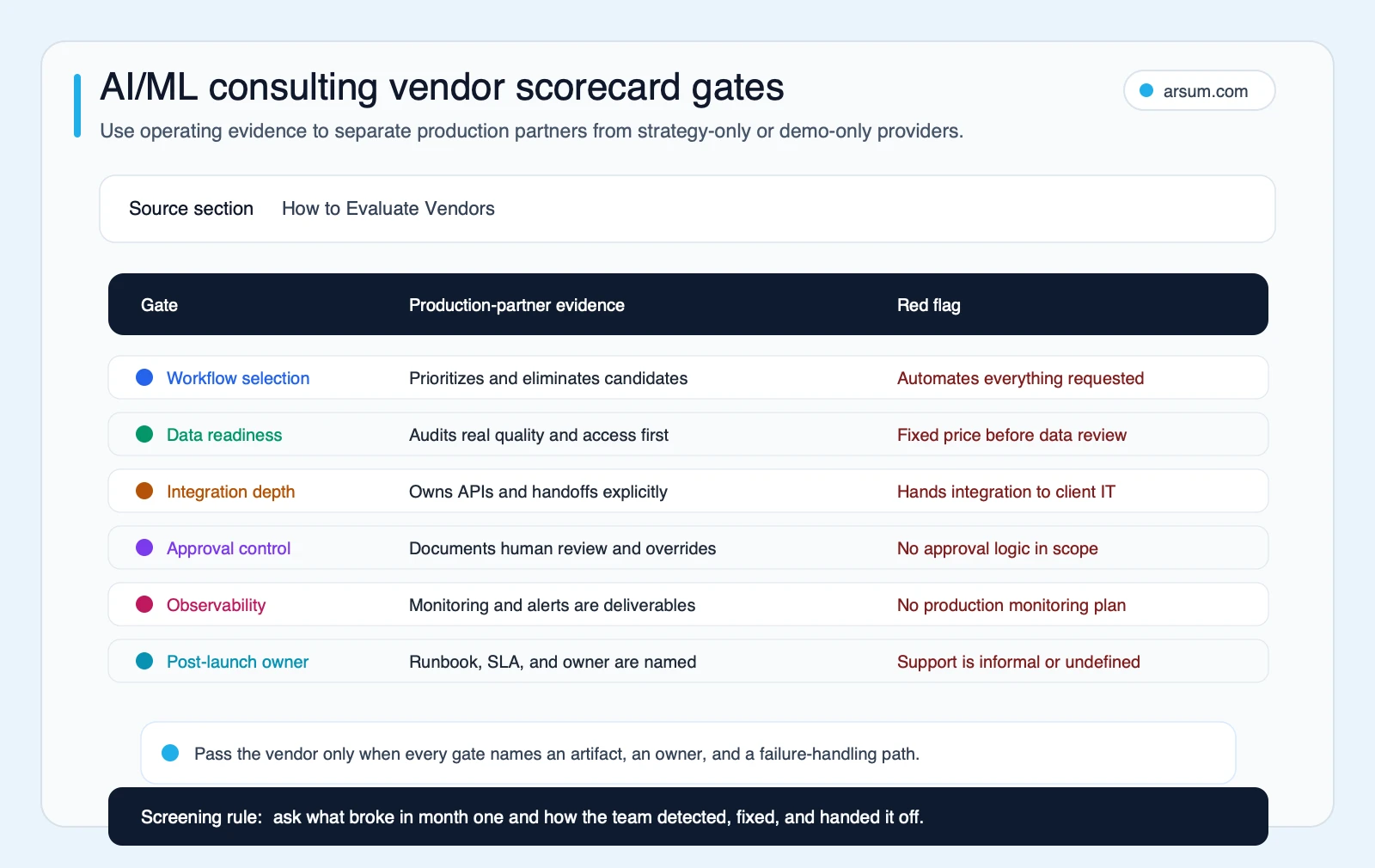
Score evidence, not confidence: each gate should identify an artifact, an owner, and the failure-handling path.
Proposal evidence-request template
Ask each shortlisted vendor to provide the same evidence package:
- A one-page workflow boundary covering inputs, tools, outputs, excluded cases, and approval points
- A data-readiness assumption list and discovery method
- A sample evaluation plan with failure cases, not only happy-path examples
- An integration responsibility matrix covering client, vendor, and third parties
- A control design for validation, access, escalation, and rollback
- A post-launch runbook outline and named operational owner
- A change-control process for prompts, tools, policies, and model updates
- A commercial proposal separating discovery, pilot, production rollout, and ongoing support
This gives you a consistent way to compare vendor types. For a related procurement lens, see AI automation consulting for business workflows.
Cost and commercial ranges: evidence limits
Commercial ranges for AI/ML engagements are not reliable buyer facts when detached from workflow scope, integrations, data condition, controls, client responsibilities, and support boundaries. This guide does not use generic project-price, schedule, maintenance, or data-preparation percentages as benchmarks.
Instead, require vendors to estimate work against named deliverables and assumptions.
| Stage | Ask the proposal to define |
|---|---|
| Discovery | Workflow map, data-access review, baseline, risks, and go/no-go decision |
| Pilot | Eligible work, test set, quality threshold, exceptions, approval owner, and rollback test |
| Production rollout | Integrations, permissions, monitoring, training, and staged-release criteria |
| Ongoing operation | Incident ownership, evaluation cadence, change control, support boundaries, and exit plan |
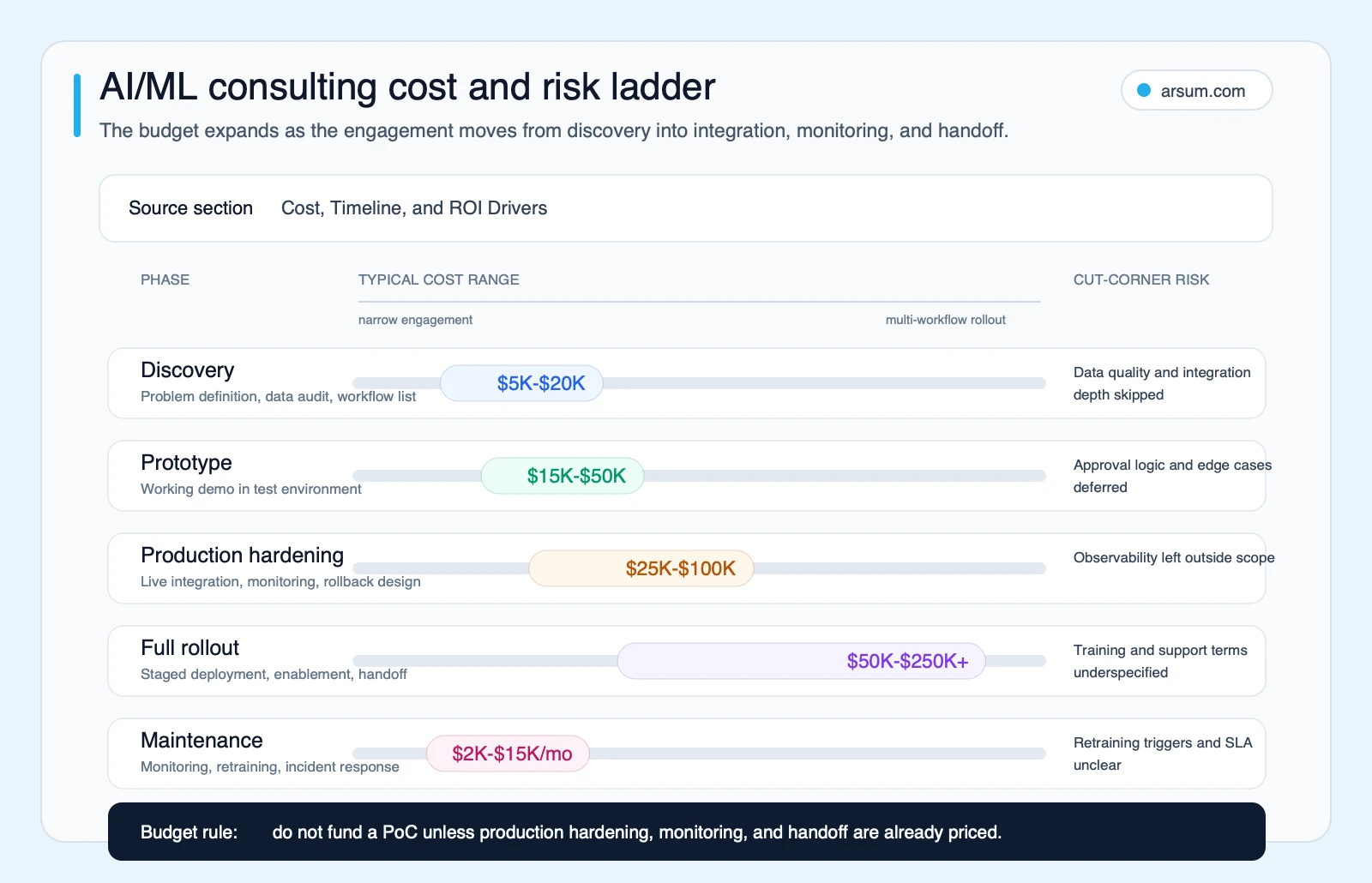
Use the ladder as a scope check: lower initial spend can still exclude the production controls and ownership needed to operate the workflow.
For an illustrative planning model, calculate economic potential from inputs you can verify internally:
eligible monthly volume × documented manual minutes per item × fully loaded cost per minute
Then subtract the expected cost of review, exceptions, system operation, and change management. This is planning arithmetic, not a realized-savings claim. It becomes decision-useful only when the baseline and exclusions are documented.
For more ways to define measurable workflow economics, see AI automation ROI examples.
Disqualifying conditions and common failure modes
Some workflows should not proceed beyond discovery until prerequisites change.
Disqualifying conditions
Pause or narrow the effort when:
- No operational owner will accept responsibility after launch.
- The process has no stable policy, baseline, or agreed definition of a correct outcome.
- Required data cannot be accessed lawfully, securely, or consistently.
- The proposed system would take consequential action without a review or override path proportionate to failure cost.
- The organization cannot provide subject-matter reviewers for exceptions and acceptance testing.
- A vendor will not identify assumptions, exclusions, or responsibilities in writing.
Failure modes to probe before signing
Practitioner discussions surfaced through public search-result snippets repeatedly point to a familiar pattern: the hard part is turning variable model output into dependable execution. This is qualitative, snippet-level operator signal—not survey evidence—but it supports concrete questions about validation, retries, structured outputs, and exception handling.
Watch for these proposal failures:
- A generic demo trained or tested on unusually clean examples
- A framework-heavy architecture where a simpler orchestration would be easier to control
- Scope that treats integration, security review, or training as client tasks without ownership coordination
- “Human in the loop” language that does not specify who reviews what, when, and with what authority
- A monitoring promise without alert thresholds, log access, or an incident owner
- Content or SEO automation proposals that promise scale without original, people-first value
On the last point, Google Search Central’s people-first content guidance emphasizes helpful, reliable content made for people rather than material designed primarily to manipulate rankings. If AI is proposed for customer-facing content, require an editorial owner, source policy, quality review, and a clear reason the output is useful beyond volume. See AI SEO services explained for a related evaluation lens.
Handoff checklist and next step
Before accepting an implementation, confirm that the following exist in writing:
- A named owner for prompts, tools, approval rules, and policy changes
- Access to operational logs, alerts, and workflow traces
- A retry policy, escalation path, and tested rollback procedure
- An evaluation method tied to a business baseline and quality threshold
- Approval gates for actions affecting records, money, or external communication
- A maintenance and incident process with clear client and vendor responsibilities
- A change log for material workflow, model, and permission updates
The right AI/ML consulting partner helps you reject weak use cases as readily as it helps you build strong ones. Select for workflow evidence, controls, and ownership—not for a model demo alone.
Methodology and freshness
This guide uses the validated editorial research pack for this page. Primary references are OpenAI’s agent-building guidance, OWASP’s LLM application risk guidance, and Google Search Central’s people-first content guidance. Public search-result snippets from practitioner discussions are included only as qualitative signals about recurring questions and failure modes; they are not treated as market-wide statistics or verified case studies.
Last reviewed: June 24, 2026.
Ready to Automate Your Business?
Stop wasting time on repetitive tasks. Let AI handle the busywork while you focus on growth.
Schedule a Free Strategy Call →Written by:Arsum editorial team
- Reviewed by
- Arsum editorial team
- Published
- June 14, 2026
- Updated
- July 4, 2026
- How this was produced
- Arsum uses research packs, source checks, and human editorial review to prepare and update blog articles. Editors are responsible for the final page.
- Source policy
- Sources are linked in the article when used. Methodology and source notes are included on higher-risk or high-visibility pages and are being rolled out across the archive. Editorial policy.
- Why this page exists
- Help B2B operators evaluate AI automation, implementation scope, cost, risk, and build-vs-buy decisions with practical context.