
AI mobile app development is one of those phrases that sounds self-explanatory until you try to buy it. Ask three vendors what it means and you will get three different answers: one will show you an app builder that generates a prototype in an hour, one will pitch a team that embeds machine learning models into a native iOS experience, and a third will quote you six months of backend work. They are all technically describing AI mobile app development. They are not describing the same thing.
This article separates those definitions, maps them to actual delivery contexts, and gives product teams and founders a framework for deciding which category fits their situation before they sign a contract.
Quick Answer: What Is AI Mobile App Development?
AI mobile app development covers three distinct delivery categories: using AI tools to build an app faster, building an app that contains AI features, and engineering a full custom AI system behind a mobile interface.
Key benchmarks:
- App-builder prototypes: under $10,000, days to first version
- Cross-platform MVP with AI features: $40,000 to $150,000, 4 to 8 weeks to testable build
- Production native AI mobile product: $150,000 or more, 8 to 16 weeks minimum before app store readiness
Decision framing: Choosing the wrong tier is the most expensive mistake in this category. App builders fail at native UX, compliance, and post-launch ownership. Custom builds fail when buyers treat them as one-time deliveries with no ongoing model maintenance budget.
Source-backed: Apple’s Core ML and Google’s ML Kit both provide mature on-device machine-learning frameworks that allow mobile teams to run AI features without routing user data through third-party cloud infrastructure. OpenAI’s own guidance on enterprise deployment frames success as workflow redesign and embedded delivery work, not just model API access.
What Most AI Mobile App Development Guides Miss
The market still mixes three different offers under one headline: AI used to generate an app, AI features inside a real mobile product, and a custom AI system exposed through mobile. That category confusion is why buyers get quotes that feel impossible to compare.
Before you judge price or speed, force every vendor to answer five things in plain language:
- Is this a web wrapper or a real mobile product? The user experience, offline behavior, and device integrations are not interchangeable.
- Where does inference run? On-device, cloud, or hybrid changes privacy, latency, and long-term cost.
- Who owns the backend and model behavior after launch? If the answer is vague, the maintenance bill is simply deferred.
- How are API keys and user data handled on mobile? OpenAI’s production guidance is clear that client-side keys are not a safe production pattern for mobile apps.
- What exactly is app-store ready? A clickable prototype, a cross-platform MVP, and a store-reviewed production release are three different deliverables.
What “AI Mobile App Development” Actually Means
Three categories fall under this phrase. They have almost nothing in common from a delivery, cost, or team-requirements perspective.
Using AI tools to build a mobile app faster. This is the app-builder category. Products like Lovable and similar no-code platforms let non-engineers produce mobile-style interfaces faster than traditional development. The AI is in the toolchain, not in the product the user installs.
Building a mobile app that contains AI features. This is the product engineering category. Teams build an app whose core functionality depends on AI: a vision classifier, a personalized recommendation engine, a voice interface, or a natural language query layer over structured data. The AI is in the user experience, not just the build process. If your team is still sorting out where embedded features belong versus a full AI-first product, the AI in app development guide gives a clearer scope filter.
Custom AI systems that power a mobile interface. This is the full-stack category: bespoke AI logic, proprietary data, or orchestrated multi-model pipelines surfaced through a mobile frontend. The mobile app is the access layer; the differentiated work is in the system behind it.
Most commercial guides conflate the first two categories. The distinction matters because the team requirements, costs, timelines, and post-launch obligations are almost entirely different across all three.
Where AI App Builders Fit (and Where They Break)
AI app builders have a legitimate role. For validating an idea, building an internal tool, or producing a prototype to show investors, they can reduce time-to-first-version from weeks to days. If the use case is simple enough that a web-first interface works, the data is not sensitive, and the team does not need native mobile capabilities, a builder may be all that is needed.
Practitioner and founder communities have been consistent about where the ceiling is. Developer and founder discussions reviewed in mid-2026 surface a recurring pattern: teams build something that looks like a mobile app quickly, but they hit real limits when the output needs to meet native mobile expectations around polish, platform constraints, and production stability. There is also growing concern among practitioners that AI-generated apps multiply simple app supply without solving the hard parts of product differentiation and post-launch maintenance.
The friction points become visible when any of the following apply:
Native mobile behavior is expected by users. App builders are predominantly web-first. They produce cross-platform outputs that run inside a browser container or a thin native wrapper. When users expect native scroll physics, gesture handling, camera integration, or background processing, the gap between a generated output and a real mobile app becomes apparent immediately.
Data sensitivity or compliance requirements exist. Healthcare, fintech, and enterprise tools that handle personal or regulated data need security architectures that app builders do not support. Cloud inference logging, prompt injection risks, and lack of custom data retention controls become real liability issues at this level.
The app needs to work offline or in low-connectivity environments. Cloud-dependent AI features fail in ways that users blame on the app, not the connectivity. On-device inference avoids this but requires a different engineering approach.
The team needs to own and update the AI behavior post-launch. App builders abstract away the model, the prompt chain, and the inference infrastructure. That abstraction is fast upfront and expensive when something needs to change.
What Founder and Developer Discussions Keep Surfacing
Across the accessible Reddit and Hacker News discussions reviewed for this topic, the same complaints keep showing up.
- Teams can get to a demo quickly, but they hit walls when the product needs native mobile polish, device-level behavior, or reliable app-store readiness.
- AI builders make it easier to multiply simple app supply, but they do not automatically solve differentiation, maintenance ownership, or production operations.
- Buyers often discover too late that the real hard part is not generating the first version. It is deciding who owns inference, security, analytics, and release maintenance after launch.
Treat those community patterns as qualitative signal, not survey data. They are still useful because they point to where real delivery pain starts.
Delivery Options: What Buyers Are Actually Comparing
Not all AI mobile app development engagements are interchangeable. The table below separates the three main delivery paths on dimensions that matter at budget and partner-selection time.
| Dimension | AI App Builder | Cross-Platform Custom Build | Native Mobile Engineering |
|---|---|---|---|
| Time to prototype | Days | 4-8 weeks | 8-16 weeks |
| Native UX fidelity | Low | Medium | High |
| On-device AI support | Limited/none | Partial | Full (Core ML, ML Kit) |
| Data privacy control | Low | Medium | High |
| App store readiness | Requires additional work | Achievable | Achievable |
| Post-launch model ownership | Vendor-controlled | Partial | Full |
| Maintenance complexity | Low initially, high at scale | Medium | Medium-high |
| Cost range | Under $10K | $40K-$150K | $150K+ |
| Best fit | Prototype, internal tools | MVP with AI features | Production AI product |
For teams asking whether to use a builder or hire a partner, this table is where the conversation usually ends. The builder path is not wrong; it is wrong for the wrong use case. See the AI app development cost breakdown for detailed budget framing across these tiers.
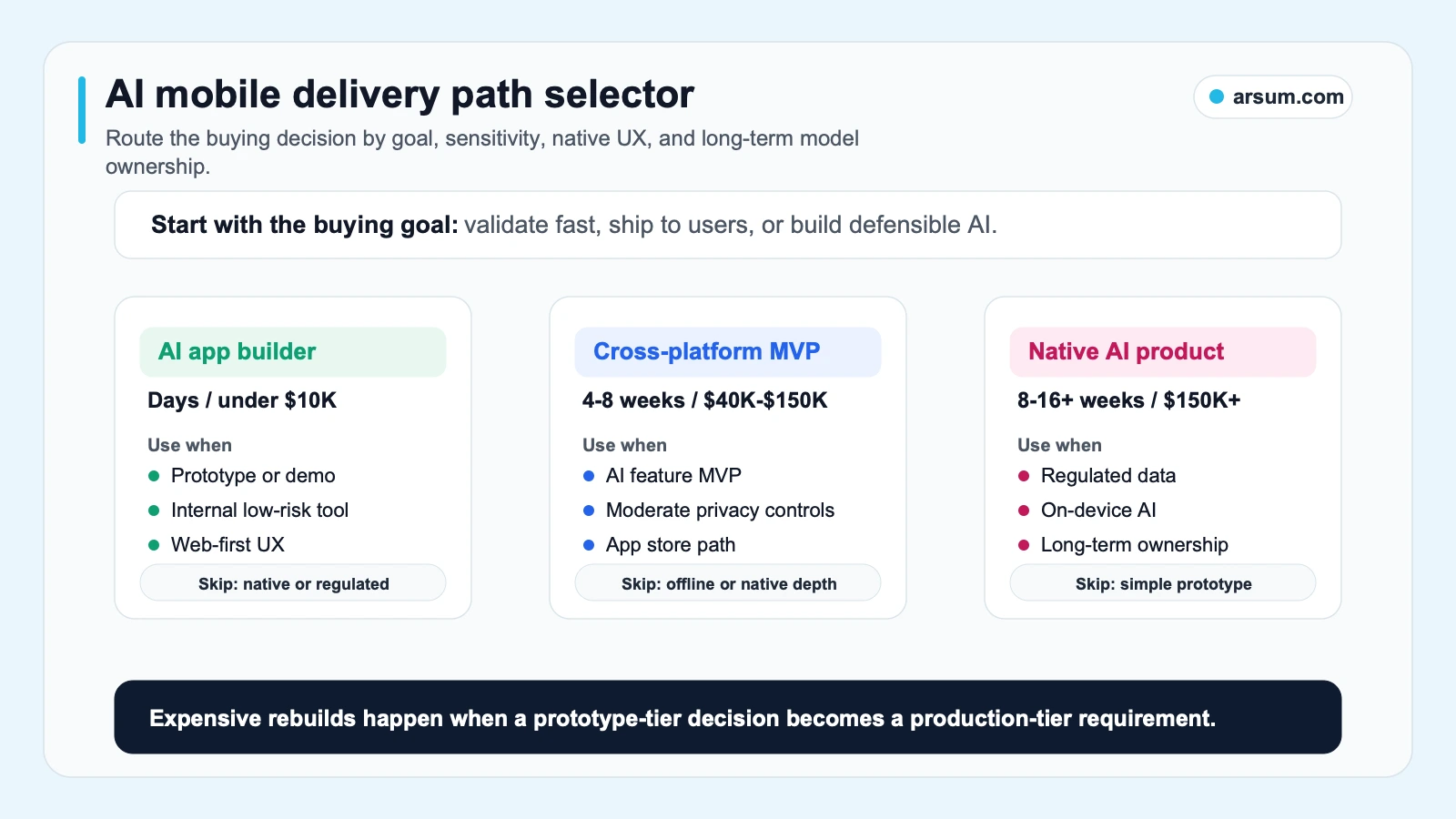
Use the selector as a quick routing layer before a vendor conversation. The right delivery path depends on goal, sensitivity, native UX needs, and whether the team must own AI behavior after launch.
Want to automate this for your business? Let's talk →
Decision Tree: Which Delivery Path Fits Your Situation
Use this routing logic before engaging any vendor or committing to a delivery model.
Start here: What is the primary goal?
→ Validate an idea or produce a prototype for investors
- Is data sensitivity low and native UX not required? → AI App Builder is sufficient.
- Does the concept require native device features or handle sensitive data? → Cross-platform custom build for MVP.
→ Ship to real users via the App Store or Google Play
- Is the AI feature central to the core user experience? → Cross-platform or native custom build (MVP tier).
- Is the app in a regulated vertical (healthcare, fintech, enterprise)? → Native mobile engineering with compliance architecture.
→ Build a defensible product that compounds over time
- Are you building on proprietary data, custom models, or multi-model pipelines? → Full-stack custom AI system with native mobile interface.
- Is long-term model ownership, inference architecture, and post-launch maintenance a requirement? → Custom engagement with an AI development partner, not a builder.
The most expensive mistake in this decision tree is entering one tier, discovering the requirements belong in another, and rebuilding. That rebuild cost is typically higher than the original investment.
On-Device vs. Cloud Inference: The Decision That Shapes Everything Else
Where inference runs, on the device or in the cloud, affects latency, privacy, cost at scale, offline availability, and how the app behaves when something changes on the provider’s side.
Both Apple and Google have mature on-device AI frameworks. Apple’s Core ML handles model deployment on iOS, supports model compression and optimization for mobile hardware, and keeps data on the device by default, eliminating cloud round-trips and per-request inference costs. Google’s ML Kit provides comparable functionality for Android, covering vision tasks, text processing, translation, smart reply, and Gemini Nano-backed generative AI APIs for supported hardware.
The practical implication: mobile teams can ship multiple machine-learning features without routing user data through a third-party server. That matters for privacy, latency, and cost modeling at scale. It also changes the vendor dependency profile significantly, since on-device features do not break when a cloud provider changes pricing or deprecates an endpoint.
| Factor | On-Device Inference | Cloud Inference |
|---|---|---|
| Latency | Low (no network round-trip) | Higher (network-dependent) |
| Privacy | High (data stays on device) | Requires trust in provider’s data handling |
| Cost at scale | Fixed (hardware cost only) | Per-call API costs compound |
| Offline availability | Yes | No |
| Model update path | Requires app release | Can update without app release |
| Engineering complexity | Higher (model optimization required) | Lower to start |
| Best for | Privacy-critical, latency-sensitive features | Complex generative tasks, features needing continuous improvement |
OpenAI’s own guidance on enterprise AI deployment frames success as workflow redesign and embedded delivery work, not just model access. The same principle applies at the mobile layer: choosing a cloud provider and calling an API is a starting point, not a deployment strategy. Most production AI mobile apps arrive at a hybrid approach, using on-device inference for latency-sensitive or privacy-critical features and cloud for complex generative tasks or features that benefit from continuous model improvement.
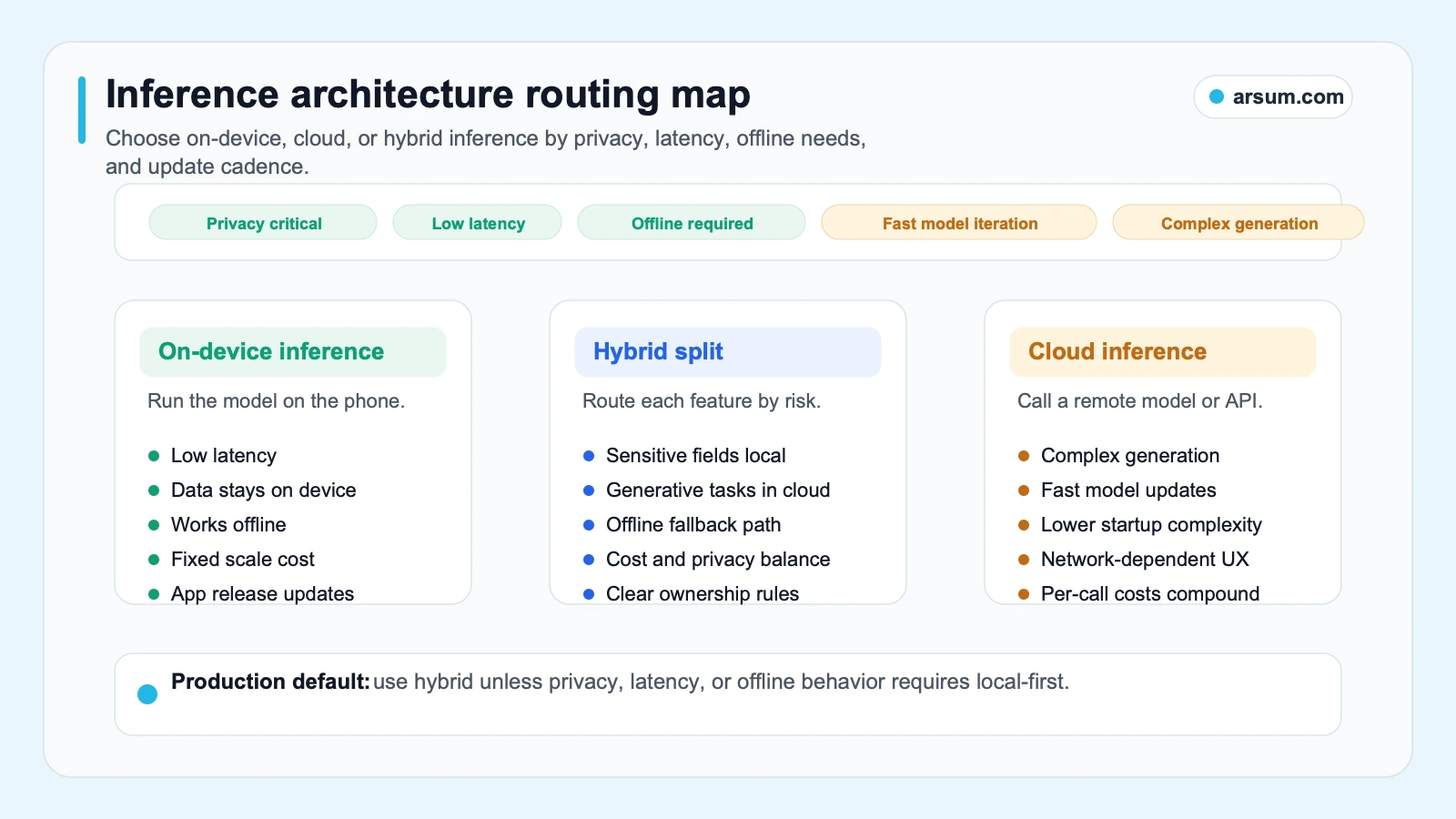
Route each AI feature by privacy, latency, offline behavior, model-update cadence, and complexity. Most production mobile products end up hybrid unless one constraint clearly forces local-first or cloud-first inference.
For teams evaluating what this looks like in practice, AI-driven app development patterns covers the architecture decisions in more detail.
Mini Experiment: What the Builder-to-Custom Rebuild Looks Like
A recurring pattern in the market illustrates why entry-point decisions matter so much.
Before: A team building a healthcare intake form used an AI app builder to generate a prototype in three days. The prototype showed well, validated the concept, and the team decided to ship it directly without a rebuild. The AI inference ran in the cloud through the builder’s shared infrastructure.
After: A compliance review six weeks post-launch flagged that all submitted form data was being logged by the builder’s inference provider with no documented retention limit, no BAA, and no mechanism for the team to request deletion. Remediation required rebuilding the entire data handling layer, migrating to on-device inference for sensitive fields, and delaying a planned feature release by ten weeks. The rebuild cost exceeded the original build cost by roughly three times.
The lesson is not that app builders are dangerous. It is that scope decisions made at the prototype stage carry operational consequences that compound at the production stage, and that compliance requirements are almost never visible at prototype time.
What Buyers Are Actually Paying For
Commodity vs. Non-Commodity Work in AI Mobile Development
The commodity layer in AI mobile app development is getting cheaper fast. Generating a component structure, wiring a basic API call, scaffolding a data model: these tasks are accelerating significantly with AI-assisted coding tools. Buyers who pay senior rates for commodity scaffolding are overpaying.
The non-commodity layer is where the value concentrates and where the real cost drivers live:
Architecture decisions: Deciding where inference should run and why, based on privacy, latency, and cost requirements specific to the use case.
Offline behavior and graceful degradation: Designing for what happens when connectivity is lost, when a model changes behavior, or when a provider deprecates an endpoint.
Security and compliance architecture: Building data handling that survives an audit in regulated verticals. This is not optional; it is the work that determines whether the product can be sold to enterprise buyers or healthcare organizations.
Release engineering: Structuring a process that allows model, prompt, or feature changes without requiring a full rebuild and resubmission cycle.
Feature scoping: Distinguishing what the AI feature actually needs to do from what sounds impressive in a demo but creates maintenance burden post-launch.
Post-launch model ownership: Who updates prompts, manages model versions, monitors output quality, and responds when AI behavior degrades.
Post-Launch Ownership: Where Budgets Usually Break Down
Most initial project scopes cover delivery to a working build. They do not cover what happens after the app is in users’ hands. A realistic post-launch ownership model for a production AI mobile app includes:
| Responsibility | Who Owns It | Typical Cadence |
|---|---|---|
| Prompt chain updates | AI engineer or agency | As needed, often monthly |
| Model version management | AI engineer | When provider releases new versions |
| Output quality monitoring | QA or product | Ongoing, ideally automated |
| Incident response (AI behavior degradation) | Partner or internal lead | On-call |
| App store release cycles | Mobile engineer | Every 4-8 weeks typically |
| Provider contract/pricing changes | Product or ops | Annual or on change |
Teams that do not budget for this layer consistently hit a wall six to nine months after launch. The app is live, users have expectations, and the team has no ongoing contract or internal capacity to handle model drift, provider changes, or release overhead. This is where many AI mobile products stall, not because the initial build was wrong, but because the operating model was never defined.
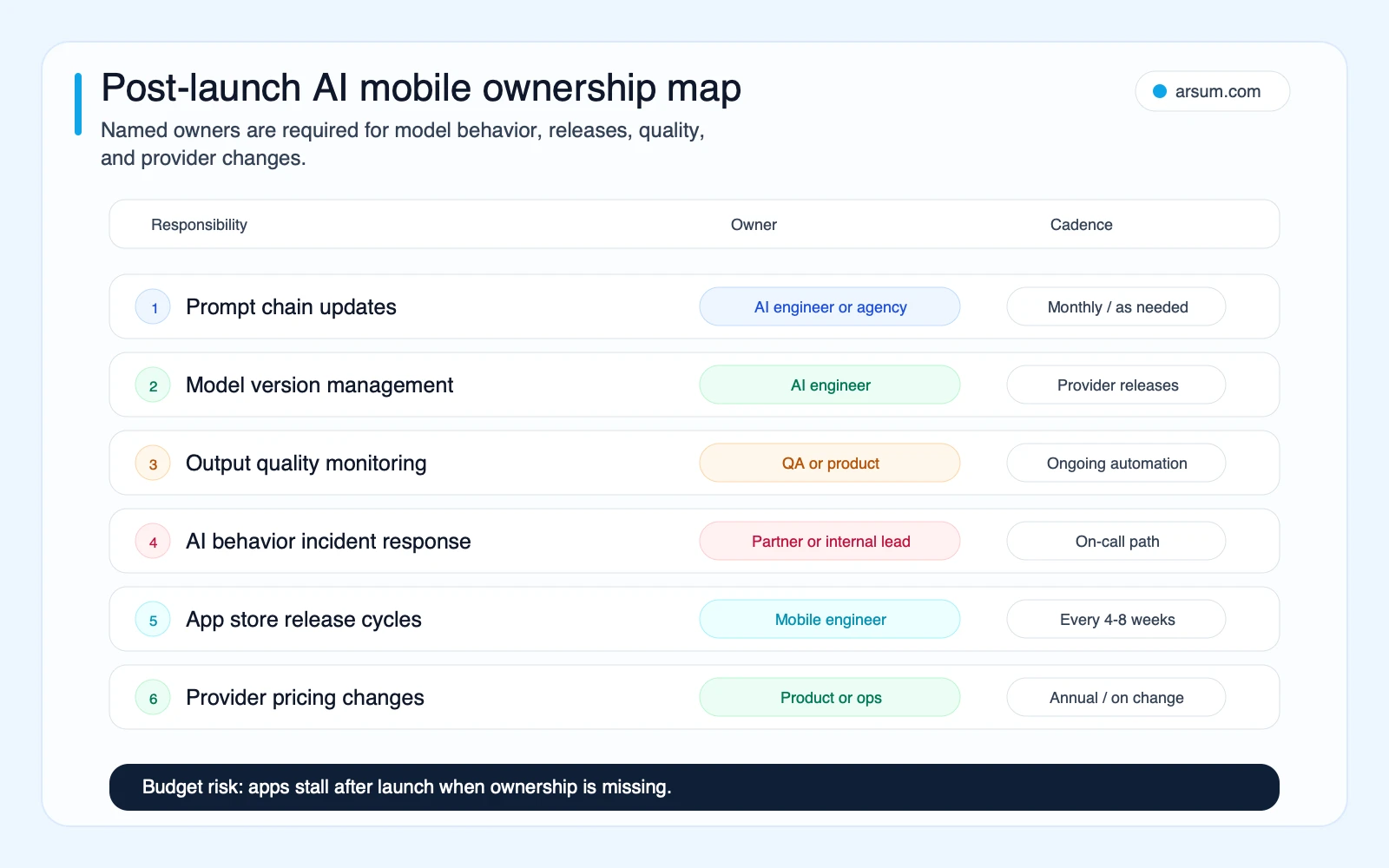
The post-launch budget is an ownership system, not a maintenance afterthought. Name the owner and cadence for each recurring AI, QA, release, and provider-management responsibility before the first app-store submission.
💡 Arsum builds custom AI automation solutions tailored to your business needs.
Get a Free Consultation →When evaluating AI app development companies or agencies, the right question is not which firm has the most AI experience on a website. It is which firm can credibly own the non-commodity layer: inference architecture decisions, security review, app store release engineering, and post-launch maintenance. If you are comparing delivery models before picking a partner, the AI-powered app development guide is a useful companion for separating prototype speed from production ownership. For teams where the hard work is in the system design, inference strategy, and operational ownership, Arsum is a strong fit for custom AI mobile engagements.
Operator Note: Teams that scope AI mobile projects as a build-and-hand-off engagement consistently underestimate ongoing maintenance. The model, the prompt chain, and the provider relationship all require active management after the first version ships. Budget for that before the contract is signed, not after the first post-launch incident.
Buyer Evaluation Checklist for AI Mobile App Development Partners
Use this before engaging any partner for an AI mobile app development project.
Delivery Scope
- Is the AI in the toolchain (builder category), in the user experience (product engineering), or powering a custom system behind a mobile interface (full-stack)?
- Does the use case require native mobile behavior, or will a web-first interface satisfy users?
- Is the delivery scope prototype, MVP, or production-grade? Is the budget matched to that scope?
Inference and Architecture
- Where will inference run: on-device, cloud, or hybrid? Is that decision documented with rationale?
- What happens to the app when the cloud provider changes pricing or deprecates an endpoint?
- Does the app need to function offline or in low-connectivity environments?
Privacy and Compliance
- Are there data sensitivity or compliance requirements that affect inference location?
- Has the partner documented their data handling approach for regulated verticals?
- Is there a clear audit trail for AI output and data transmission?
Post-Launch Ownership
- Who owns prompt chain updates, model version management, and output quality monitoring?
- Does the partner have a documented release engineering process for ongoing app store submissions?
- What is the escalation path if AI output degrades or the provider changes behavior?
- Is there a post-launch support contract, or does the engagement end at delivery?
Partner Credibility
- Can the partner show examples of production AI mobile apps they have shipped and maintained?
- Is their pricing model compatible with a long-term operational relationship, not just an initial build?
Reusable Artifact: Mobile AI Partner Scoring Model
If two vendors both sound credible, score each one from 0 to 2 on the criteria below before you compare price. This keeps the conversation tied to delivery risk instead of sales polish.
| Criterion | 0 points | 1 point | 2 points |
|---|---|---|---|
| Inference location fit | Cloud-only answer with no rationale | Hybrid or on-device is mentioned, but not tied to your use case | Clear on-device, cloud, or hybrid rationale tied to privacy, latency, offline behavior, and cost |
| Model and prompt ownership | Vendor keeps it opaque | Shared documentation, but handoff is vague | Documented handoff plus a named long-term owner after launch |
| Release maintenance | “Support if needed” language only | General maintenance promise | Explicit release cadence, QA process, and app-store ownership |
| Security and compliance path | Generic security claims | Some controls, no audit trail | Clear data handling, retention, and regulated-data review path |
| Vendor lock-in exit path | No migration answer | Partial export answer | Exit plan for prompts, models, analytics, and backend dependencies |
How to read the total:
- 8 to 10 points: Serious production conversation
- 5 to 7 points: Viable, but scope and ownership need cleanup before signing
- 0 to 4 points: Likely a prototype partner or builder path, not a production fit
Google Risk Box: As AI-generated mobile apps become easier to produce, apps that are simply thin wrappers around a foundation model face the same defensibility problem as thin AI-generated content. App stores are beginning to surface quality signals similar to search engines: engagement, retention, and genuine utility over raw output volume. If your AI mobile product does not have a proprietary data advantage, a differentiated user experience, or a compelling reason to exist beyond faster generation, it will compete on a commoditizing field. The non-commodity work described above is also your product moat.
Work With Arsum
We help businesses implement AI automation that actually works. Custom solutions, not cookie-cutter templates.
Learn more →Freshness note: Builder positioning, Apple Core ML, Google ML Kit, and OpenAI deployment guidance were rechecked in June 2026. Vendor feature lists and pricing move quickly, so confirm current limits before you sign a delivery contract.
Frequently Asked Questions
What is AI mobile app development? AI mobile app development covers three distinct delivery categories: using AI tools to build an app faster (the app-builder category), building a mobile app that contains AI features as part of its core user experience (the product engineering category), and custom AI systems that power a mobile interface (the full-stack category). Most commercial confusion comes from conflating all three, which leads buyers into the wrong delivery path, the wrong vendor conversation, and a rebuild they did not budget for.
When is an AI app builder good enough? App builders are a reasonable fit for prototypes, internal tools, and idea validation where native mobile behavior is not required and data sensitivity is low. They become a poor fit when users expect native UX, when data privacy or compliance requirements apply, or when the team needs to own and update AI behavior post-launch.
What is the difference between on-device and cloud AI inference in mobile apps? On-device inference runs the AI model on the user’s phone using frameworks like Apple Core ML or Google ML Kit. It is faster, preserves privacy by keeping data off third-party infrastructure, and eliminates per-call API costs. Cloud inference routes requests to a remote model, which is easier to update but introduces network dependency and data transmission risks. Most production apps use a hybrid of both, based on the sensitivity and latency requirements of each feature.
How much does AI mobile app development cost? Cost varies significantly by delivery path. App builder prototypes can cost under $10,000. Cross-platform MVP development with AI features typically runs $40,000 to $150,000. Full native AI mobile product engineering for production use cases often starts at $150,000 and scales with complexity, integrations, and compliance requirements. See the full breakdown in the AI app development cost guide.
What team does a serious AI mobile app require? A production AI mobile app typically requires mobile engineers (iOS or Android native), a machine learning or AI engineer who can own model selection and inference architecture, a product manager who can scope AI features realistically, and a QA process that tests AI output quality under real-world conditions. Most teams also need ongoing model maintenance capacity after launch, which is often not budgeted in the initial project scope.
What are the biggest risks in AI mobile app development? The most common risks are: building on cloud inference without planning for provider changes, underestimating the gap between a prototype and a production app store release, failing to account for post-launch maintenance costs, and choosing an app builder when the use case requires native mobile engineering. The builder-to-rebuild pattern is the most expensive version of this mistake.
How do I evaluate an AI mobile app development partner? Look beyond AI credentials on a website. Evaluate whether the partner can credibly own inference architecture decisions, security review, app store release engineering, and post-launch model maintenance. Ask for examples of production AI mobile apps they have shipped and maintained, not just prototypes. Ask specifically who owns the model and prompt chain after the initial build is delivered, and whether their post-launch support is scoped as a separate engagement or included.
Is Arsum a fit for AI mobile app development? Arsum is a strong fit for teams building AI mobile products where the hard work is in the system design rather than the scaffolding: custom inference architecture, on-device versus cloud strategy, integration with proprietary data, and post-launch ownership. For basic prototypes or internal tools where an app builder is sufficient, a lighter-weight option is usually more appropriate.
Methodology: This article draws on Apple Core ML and Google ML Kit official documentation for on-device AI capabilities, OpenAI’s published guidance on enterprise AI deployment, and practitioner signal from developer and founder community discussions reviewed in June 2026. The delivery options comparison, decision tree, post-launch ownership model, and buyer checklist are original frameworks developed from research into current SERP gaps and buyer decision patterns in the AI mobile development market. Cost ranges reflect current market observations and should be validated against current vendor quotes. Last reviewed: June 2026.
Ready to Automate Your Business?
Stop wasting time on repetitive tasks. Let AI handle the busywork while you focus on growth.
Schedule a Free Strategy Call →