This guide evaluates ai personal assistant founder view through workflow fit, ownership, implementation risk, and measurable ROI. I use AI assistants as leverage, but I do not confuse them with finished systems.
AI Personal Assistant Founder View: Practical Guide
Explore ai personal assistant founder view: compare workflow fit, costs, risks, evidence, and practical next steps before you build, buy, or hire.

Table of Contents
- What Most Guides Miss
- The Founder Use Case: Assistants Reveal Repetition
- My Line Between Assistant and Automation
- When a Personal Assistant Is Enough
- When the Assistant Should Become a System
- A Simple Decision Tree
- Before and After: One Habit Becoming a Workflow
- The Hiring Question Shows Up Fast
- Commodity vs. Non-Commodity Work
- The Founder Test I Use
- A Two-Week Assistant-to-Automation Audit
- What I Would Not Automate From an Assistant
- Why This Matters for Founders
- What Founders Are Actually Frustrated By
- Common Mistakes Founders Make
- Methodology
- Final View
That distinction matters for founders.
ChatGPT, Claude, Copilot, Gemini, and Perplexity can make one person faster. They can help with research, writing, synthesis, planning, meeting prep, code review, and decision memos. The best AI personal assistant is often the one that fits the work surface you already live in.
But a business does not scale because one founder has a better chat window. It scales when repeated work becomes a reliable workflow.
What Most Guides Miss
Most AI personal assistant content treats the model choice as the main decision. For founders, the harder decision is operational: when does a helpful prompt become a business workflow that needs permissions, approvals, monitoring, and a real owner?
That is the boundary most roundups skip. A strong assistant can absolutely make a founder faster, but speed alone does not create a dependable system. The moment the work touches CRM records, internal docs, task routing, finance data, or publishing surfaces, the conversation stops being about the best chat UI and starts being about workflow design.
Operator note: If the assistant is reading from or writing to a company system, treat it like an operational workflow, not a personal productivity hack.
The Founder Use Case: Assistants Reveal Repetition
The most useful thing an AI personal assistant does is show you where your work repeats.
If you ask an assistant for the same kind of sales research every week, that is a signal.
If you use it to rewrite meeting notes into CRM updates, that is a signal.
If you ask it to summarize customer issues, prepare investor updates, create content outlines, review support tickets, or draft follow-ups, that is a signal.
The first version can stay personal. The second or third repeated version should make you ask: should this become a workflow?
At Arsum, this is how many automation conversations start. The buyer does not always begin with “we need an AI agent.” They begin with “I keep doing this manually, and now the assistant helps, but the process still depends on me.”
That is the moment to map the workflow.
My Line Between Assistant and Automation
An assistant helps a person do work.
Automation changes where the work lives.
| Assistant behavior | Automation behavior |
|---|---|
| Waits for a prompt | Starts from a trigger |
| Uses context the human provides | Pulls context from approved systems |
| Produces a draft | Routes output into a workflow |
| Relies on the user to remember the next step | Creates tasks, updates records, or asks for approval |
| Helps one person | Creates repeatable operating leverage |
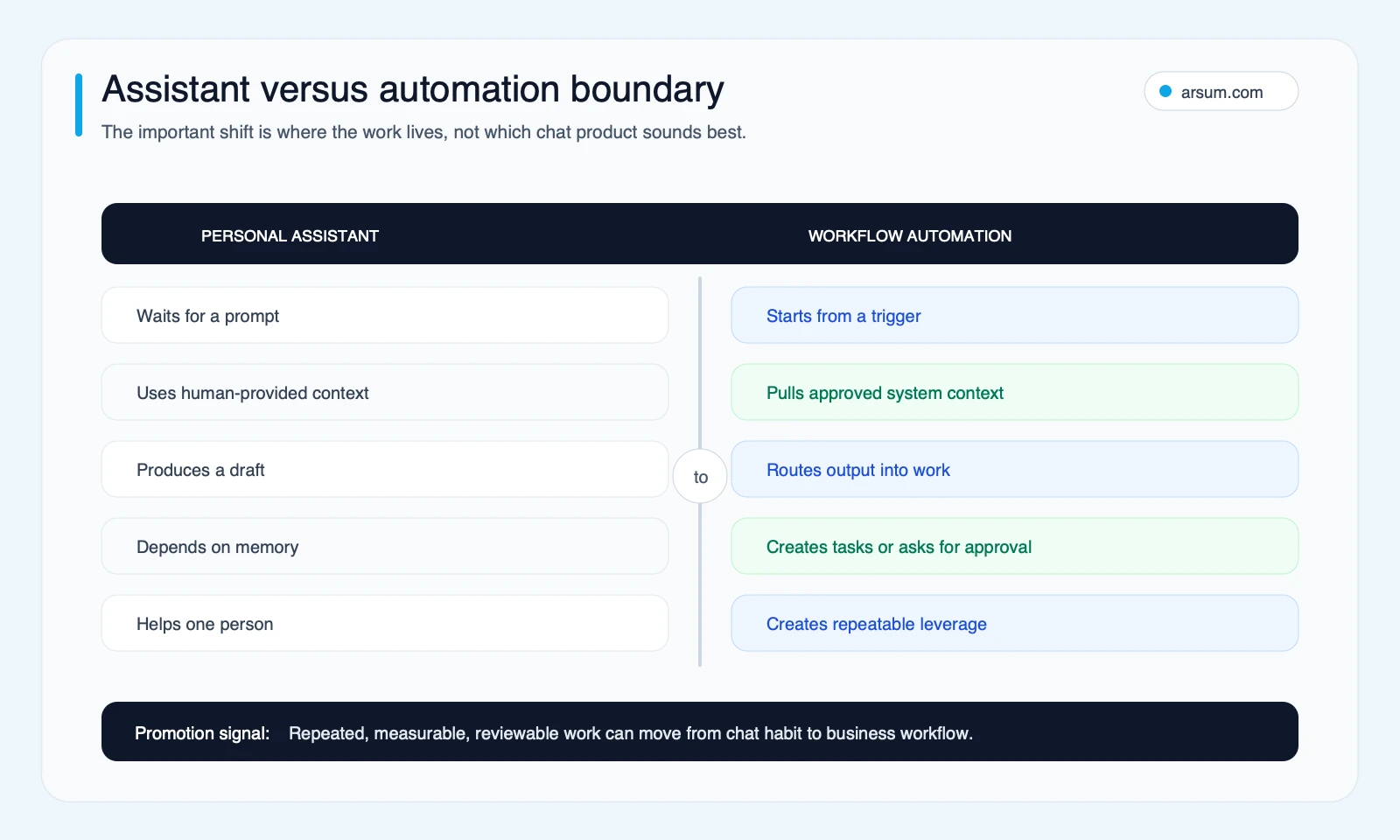
The boundary is operational: assistants help a person, while automation changes where repeated work lives.
This is why I do not recommend jumping straight from personal assistant usage to a full custom agent. First, identify the repeated work. Then define inputs, outputs, review, and value. Only then choose the system.
💡 Arsum builds custom AI automation solutions tailored to your business needs.
Get a Free Consultation →When a Personal Assistant Is Enough
Keep it simple when:
- one person owns the task
- the output is low-risk
- the assistant does not need sensitive internal access
- the work changes every time
- the business value is convenience, not throughput
Examples:
- drafting a founder memo
- summarizing public research
- brainstorming article angles
- polishing emails
- preparing for a call
- turning rough notes into a clearer plan
In those cases, a good assistant is a strong productivity tool. It does not need to become infrastructure.
When the Assistant Should Become a System
The assistant should become a system when the work has volume, repeatability, and a handoff.
Examples:
- every inbound lead needs research, qualification, and CRM context
- every support escalation needs a summary, category, and suggested response
- every content idea needs source collection, keyword mapping, draft creation, and review
- every executive meeting needs notes, decisions, tasks, and owner follow-up
- every weekly report needs data pulled from multiple tools and summarized consistently
At that point, you are no longer choosing between Claude and ChatGPT. You are designing an operating workflow.
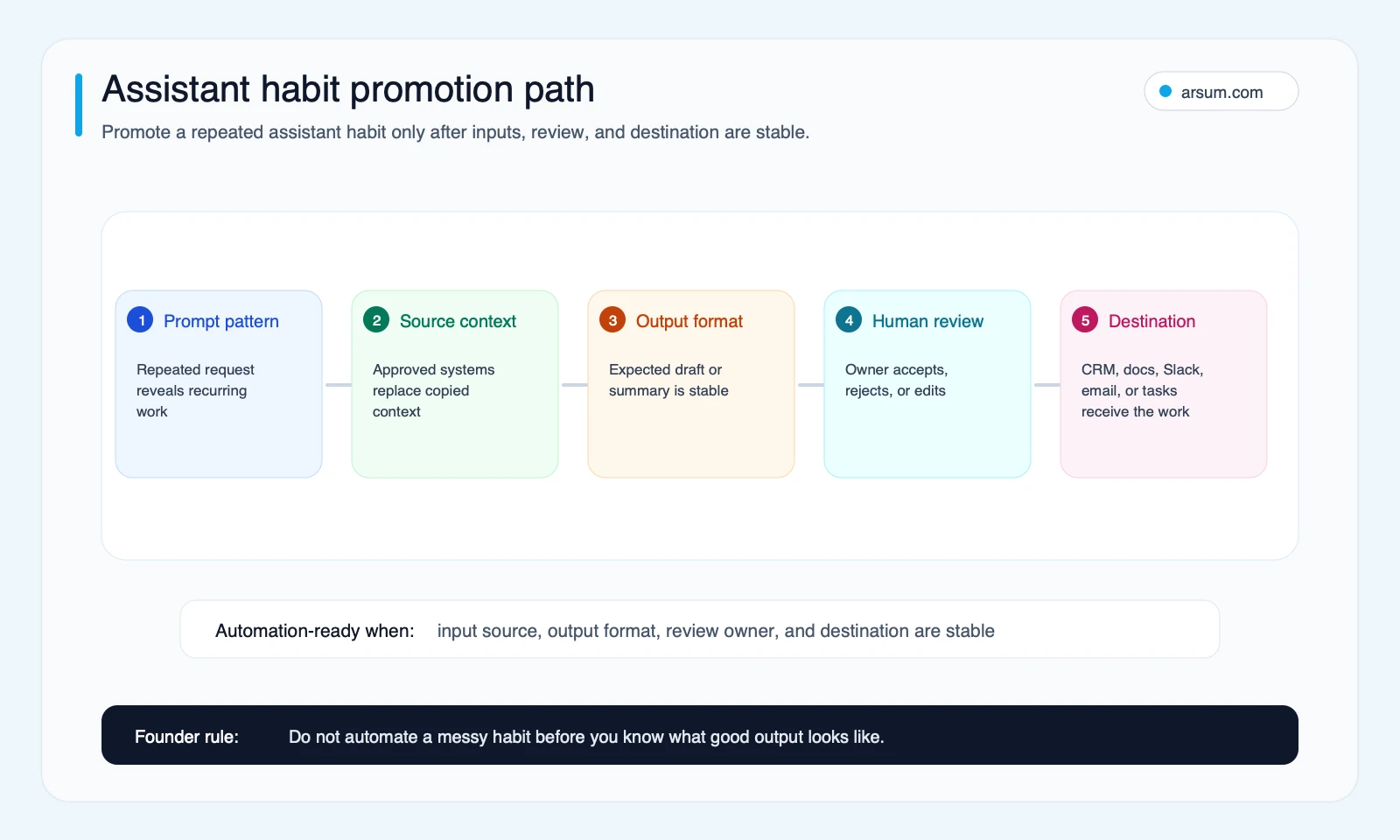
A repeated assistant habit becomes automation-ready when the input source, output format, review owner, and destination are stable.
That workflow may use an assistant, an agent framework, a workflow platform, or a custom build. The AI agent frameworks guide is useful once you know whether the system needs tools, state, memory, approvals, or orchestration. If the pattern is spreading beyond one founder and starting to touch multiple team handoffs, the AI agents for business guide is the better lens for deciding where autonomy creates ROI and where approvals still belong. If the next question becomes platform selection, use the AI agent platform comparison to evaluate governance, connectors, and operating burden before you build. If it is mainly a recurring content or growth workflow, SEO automation is a good example of how assistant-like work becomes a managed production loop: research, source mapping, drafting, QA, publishing, and iteration.
A Simple Decision Tree
Use this quick rule before you invest in a bigger build:
- Does the task start the same way most of the time? If no, keep it as assistant help.
- Does the assistant need context from an approved system? If yes, you are already moving toward workflow design.
- Does the output need to land somewhere specific, like a CRM, task board, or content pipeline? If yes, the destination needs to be designed, not improvised.
- Can a reviewer define what good and bad output look like? If no, the workflow is probably too fuzzy to automate safely.
- Is the failure cost low enough to tolerate iteration? If no, keep a human approval gate in place.
A good founder test is simple: prompts are flexible, workflows are explicit. When the trigger, context, destination, and approval rules become stable, the work is ready to graduate.
Before and After: One Habit Becoming a Workflow
A founder might start with a personal request like: “Research this inbound lead, summarize the company, and draft three discovery questions.”
That is still assistant territory.
The workflow version looks different:
| Stage | Personal assistant version | Workflow version |
|---|---|---|
| Trigger | Founder remembers to ask | New lead enters pipeline |
| Context | Pasted manually into chat | Pulled from approved CRM and website sources |
| Output | One-off summary in chat | Standard lead brief with fit, risks, and next-step suggestions |
| Review | Founder reads it inline | Sales owner approves before CRM update or outreach |
| Destination | Maybe copied into notes | Routed into CRM, Slack, or task system |
The prompt is not the expensive part. The expensive part is deciding what the workflow can trust, where it writes, who approves it, and how the team notices exceptions.
The Hiring Question Shows Up Fast
Once a personal assistant workflow becomes important, the next question is ownership.
Who builds it?
If the workflow is core product infrastructure, you may need a full-time technical owner. The hire AI engineer guide is useful when the system needs durable ownership around data, evaluation, monitoring, security, and deployment.
If the workflow is important but bounded, an agency or senior contractor can be the faster first move. That is where AI automation agency pricing becomes relevant: you are not paying for the model call; you are paying for workflow design, integration, QA, monitoring, and handoff.
The wrong move is hiring or outsourcing before you know which part of the assistant workflow actually creates value.
Commodity vs. Non-Commodity Work
This is where founders often misprice the problem.
| Usually commodity | Usually non-commodity |
|---|---|
| Model selection between top-tier tools | Defining workflow ownership |
| Prompt cleanup and formatting | Choosing approved systems and permissions |
| Simple summaries and rewrites | Designing approvals and exception handling |
| One-person drafting help | Routing output into CRM, finance, support, or publishing systems |
| Generic assistant usage | Monitoring failures and deciding what gets escalated |
If you only buy the commodity layer, you get a clever demo. If you solve the non-commodity layer, you get operating leverage.
Work With Arsum
We help businesses implement AI automation that actually works. Custom solutions, not cookie-cutter templates.
Learn more →The Founder Test I Use
Take one assistant habit and answer these questions:
- How often do I do this?
- What input do I give the assistant?
- Where does that input already live?
- What output do I accept or reject?
- Where does the approved output need to go?
- What happens if the output is wrong?
- Who else on the team does similar work?
- What business metric would improve if this ran reliably?
If the answers are clear, you may have a real automation candidate.
If the answers are not clear, keep using the assistant manually until the pattern is visible.
A Two-Week Assistant-to-Automation Audit
If a founder or operator wants to know whether personal assistant work should become automation, I would run a two-week audit.
Do not start with tools. Start with behavior.
For two weeks, track every repeated assistant request in a simple table:
| Field | Example |
|---|---|
| Prompt pattern | “Research this company before a discovery call” |
| Source context | Website, CRM notes, LinkedIn, previous emails |
| Output | Sales brief with risks and suggested questions |
| Destination | CRM, sales doc, Slack, email draft |
| Human judgment | Approve account fit and final message |
| Frequency | 15 times per week |
| Business value | Faster prep, better qualification, less missed context |
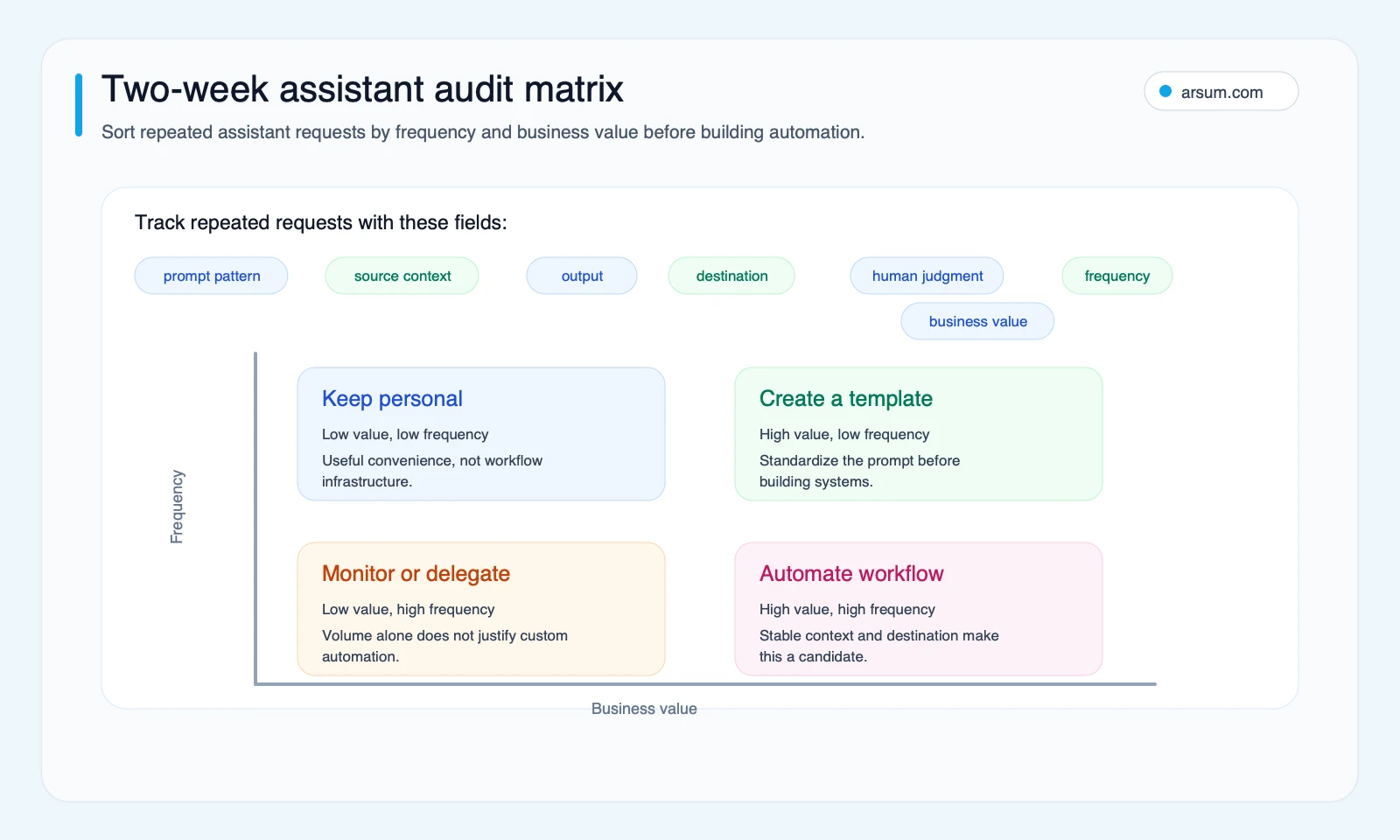
After two weeks, the best automation candidates are the repeated requests with stable context, clear destination, and business value.
After two weeks, sort the list by frequency and business value. The best automation candidates are rarely the most exciting prompts. They are the repeated prompts that already have a destination.
An assistant request becomes automation-ready when the input source, output format, review owner, and destination are stable enough to define. If the prompt changes completely every time, keep it personal. If the same pattern appears across a team, consider turning it into a workflow.
This is especially useful for content and growth operations. A founder might use an assistant to research topics, summarize community discussions, draft an article, check internal links, and prepare distribution notes. Once that pattern repeats, it starts to look like a content operating system. That is the same logic behind AI-assisted SEO and content workflows: the value is not the draft alone; it is the repeatable system from research to review to publishing to iteration.
The same applies to screenshots, source material, and internal examples. If the assistant only writes from generic memory, the output feels generic. When the workflow uses the company’s own research notes, screenshots, customer language, pricing evidence, and founder review, the article becomes harder to copy. The assistant is still useful, but the advantage comes from owned context and a repeatable review loop.
Original Data Scorecard
When I want a faster answer than “it depends,” I score the assistant habit from 1 to 5 across five dimensions:
| Dimension | 1 means | 5 means |
|---|---|---|
| Frequency | rare or inconsistent | shows up every week or every day |
| Source stability | context changes completely each time | context comes from the same systems or inputs |
| Destination clarity | no clear place for the output to go | output always lands in a known tool or workflow |
| Review clarity | hard to explain what good looks like | a reviewer can approve or reject quickly |
| Failure cost | wrong output creates serious damage | mistakes are visible and easy to catch |
A high score does not mean “fully automate it tomorrow.” It means the habit is structured enough to design responsibly.
A reusable promotion checklist
Before I promote any assistant habit into automation, I want a clear yes on most of these:
- the trigger is easy to define
- the context comes from approved sources
- the destination system is known
- a human reviewer can spot a bad output quickly
- the business value is repeated, not one-off
- the failure cost is understood
- someone owns the workflow after launch
If that checklist is weak, I keep the task manual a little longer.
Google risk for scaled content workflows
If this assistant habit touches content production, more throughput is not enough. Google explicitly rewards helpful, reliable, people-first pages, not mass-produced AI text that says the same thing as everyone else. Founder content workflows need owned inputs such as firsthand examples, customer language, internal screenshots, pricing context, or original analysis, plus review before publishing.
That is the founder-level difference I care about. A personal assistant can help me think. A business workflow should preserve the evidence, expose the assumptions, and make the next iteration easier for the team.
Three doc-backed signals that the assistant is now infrastructure
I use three practical signals before I treat an assistant workflow like real business infrastructure:
- It needs tools, state, or approvals to finish the job. Once the workflow depends on tool use, multi-step planning, or approval checkpoints, it has moved beyond a one-off chat and into application design territory.
- It touches internal company data. The moment the workflow reads from or writes into company systems, permission boundaries matter as much as model quality.
- It produces output at scale. If the assistant helps publish content, route customer communication, or update records in volume, the workflow needs owned inputs and human review, not just more tokens.
Those signals line up with the current product reality. OpenAI’s agent documentation centers tool use, state, and approvals once a workflow has to act. Microsoft’s Copilot architecture explains why assistant access inherits the importance of existing permissions. Google’s people-first content guidance makes the same point for scaled publishing: output quality depends on original value and trustworthy review, not just generation speed.
What I Would Not Automate From an Assistant
There are assistant habits I would deliberately leave manual.
I would not automate judgment-heavy decisions where the facts change every time and the consequence of being wrong is high. Hiring decisions, investor negotiations, sensitive customer escalations, legal interpretations, pricing exceptions, and strategic pivots can all use AI support, but I would keep a human firmly in control.
I would also avoid automating work where the assistant is compensating for unclear strategy. If the company does not know its ICP, offer, pricing, or source-of-truth system, automation will amplify confusion. The assistant might make the work feel faster, but the business remains structurally messy.
The best automation candidates are not the most complex. They are the ones where the company already knows what “good” looks like.
Why This Matters for Founders
Founders often live inside messy context. Customer conversations, product plans, investor updates, hiring decisions, support issues, marketing ideas, and financial constraints are all mixed together.
An assistant can help organize that context. But a company cannot depend on the founder’s chat history as an operating system.
That is the real danger of personal AI leverage. It can make one person feel much faster while the company stays structurally slow.
The better path is to treat assistant usage as discovery. Watch where the work repeats. Turn the valuable patterns into workflows. Keep humans where judgment matters. Automate the handoffs that drain time.
What Founders Are Actually Frustrated By
The visible conversation around AI personal assistants keeps circling the same gap: people do not just want a smarter chatbot. They want a system that can actually complete useful work across tools.
Snippet-level community discussions reviewed for this article showed the same pattern from different angles:
- personal-assistant communities describe the goal as an integrated helper that blends into daily work, not a standalone chat box
- technical threads question why strong models still do not turn into dependable cross-tool assistants on their own
- open-source assistant discussions often reveal the hidden maintenance burden behind self-hosted ownership
I treat that as qualitative signal, not hard proof. But it matches what founders usually discover firsthand: model quality gets attention, while permissions, tool access, maintenance, and review rules determine whether the assistant is actually useful.
Common Mistakes Founders Make
- assuming a better model will fix a broken workflow
- automating before the source-of-truth systems are clear
- letting the assistant write into production systems without approval rules
- treating prompt quality as the main moat instead of owned context and workflow design
- self-hosting too early, then inheriting maintenance work before the use case is stable
Methodology
This article was updated against current vendor documentation and visible practitioner discussion patterns. Direct claims about permissions, approvals, and workflow behavior are grounded in product documentation from sources such as OpenAI, Microsoft, Google, and workflow tooling. Community references are used only as qualitative signal about what operators are frustrated by, not as benchmark evidence.
Freshness note: reviewed and updated on 2026-07-01 to reflect current assistant-versus-workflow decision criteria and reader-visible examples.
Final View
The best AI personal assistant is not the final destination. It is often the first microscope.
It shows you where knowledge work repeats, where context is missing, and where the company still depends too much on one person’s memory.
My founder view: use assistants aggressively for personal leverage, but promote only the repeated, measurable, reviewable work into automation.
That is how you turn a better chat experience into a better business system.
Ready to Automate Your Business?
Stop wasting time on repetitive tasks. Let AI handle the busywork while you focus on growth.
Schedule a Free Strategy Call →Written by:Johnny Kartakov
- Reviewed by
- Arsum editorial team
- Published
- June 29, 2026
- Updated
- July 4, 2026
- How this was produced
- Arsum uses research packs, source checks, and human editorial review to prepare and update blog articles. Editors are responsible for the final page.
- Source policy
- Sources are linked in the article when used. Methodology and source notes are included on higher-risk or high-visibility pages and are being rolled out across the archive. Editorial policy.
- Why this page exists
- Help B2B operators evaluate AI automation, implementation scope, cost, risk, and build-vs-buy decisions with practical context.