AI research and development automation becomes a fundable project when a research lead has a reproducibility backlog: benchmark results are disputed, environment details are missing, or completed experiments cannot be replayed without reconstructing evidence by hand. The fund-or-wait question is whether one experiment family can produce a complete replay packet with less assembly effort while preserving failed runs, uncertainty, and independent scientific review.
AI Research and Development Automation: 15 Tasks
AI research and development automation: compare 15 O*NET tasks, the 53.6/100 score, 2029 capability, human controls, task capacity, and a practical first pilot.
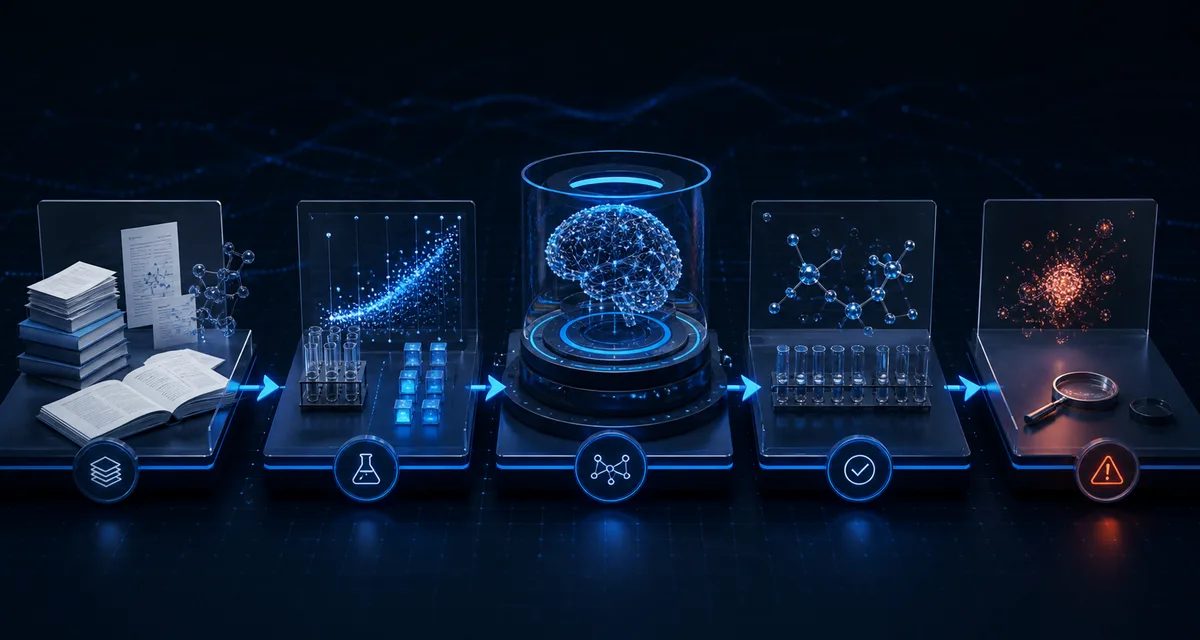
Table of Contents
- Computer research and development automation opportunity
- How the computer research and development score is calculated
- Top computer research and development tasks for automation support
- Computer research and development tasks that should remain human-led
- Computer research and development capability from 2026 to 2029
- Modeled hours and wage capacity for computer research and development
- A controlled 30/60/90-day computer research and development pilot
- The R&D leader decision: clear a reproducibility backlog
- Where R&D automation stops: execution evidence versus scientific judgment
- Reproducibility-pilot architecture and exception queue
- A 30-day reproducibility scorecard with stop conditions
- Worked benchmark dispute and visible pilot economics
- Research reproducibility RACI
- How the 53.6/100 task score maps to this pilot
- Buy, connect, or build the reproducibility workflow
- Evidence that changes the ai research and development automation buying decision
- Why the 2029 computer research and development scenario is secondary
- AI research and development automation: buyer questions
This page is for software and applied-research teams that already have a bounded protocol, versioned code and data, and an independent reviewer. It is not a proposal to automate hypothesis choice, novelty judgment, or the decision to publish a result. Arsum’s task model is a screening layer—not proof of savings or permission to automate—and this page turns it into a buyer test with explicit owners, thresholds, and stop conditions.
Arsum Automation Opportunity Index · 2026-08-12
Computer research and development automation opportunity
Computer R&D teams can automate literature and evidence retrieval, experiment code drafts, benchmark preparation, documentation, and result comparison. Research framing, methodological validity, novelty, and scientific claims remain expert responsibilities.
Current score
53.6/100
Selective automation opportunity
Modeled task capacity
12.1-20.1 hours/week
P25-P75 planning range
2029 capability scenario
65/100
+11.4 points, not an adoption forecast
Recommended first pilot
experiment evidence and reproducibility packets
Start narrow, measure, then expand
Decision: Automate reproducible research preparation while keeping the hypothesis, validity judgment, and claim with qualified researchers.
How the computer research and development score is calculated
For computer research and development, Arsum assessed 15 of 15 O*NET tasks from Computer and Information Research Scientists (15-1221.00). The 53.6/100 result weights each task's current automation share by O*NET importance, relevance, and frequency. It measures technical workflow opportunity—not the percentage of computer research and development jobs that disappear and not the share of a team that should be removed.
Research and engineering owners should define hypotheses, approve methods and data, interpret uncertainty, assess novelty and safety, accept results, and authorize productization. The weighted supervision estimate is 30.4%, which is why the practical design is an exception-and-approval system rather than unsupervised autonomy.
Top computer research and development tasks for automation support
O*NET task 14623
Analyze problems to develop solutions involving computer hardware and software.
60/100
Llm
AI assists; review exceptions and material outputs
O*NET task 14624
Assign or schedule tasks to meet work priorities and goals.
70/100
Hybrid
AI assists; review exceptions and material outputs
O*NET task 14625
Evaluate project plans and proposals to assess feasibility issues.
55/100
Llm
AI assists; review exceptions and material outputs
O*NET task 14626
Apply theoretical expertise and innovation to create or apply new technology, such as adapting principles for applying computers to new uses.
60/100
Llm
AI assists; review exceptions and material outputs
O*NET task 14627
Consult with users, management, vendors, and technicians to determine computing needs and system requirements.
55/100
Llm
AI assists; review exceptions and material outputs
O*NET task 14632
Develop performance standards, and evaluate work in light of established standards.
60/100
Llm
AI assists; review exceptions and material outputs
O*NET task 14633
Design computers and the software that runs them.
60/100
Llm
AI assists; review exceptions and material outputs
These are ranked for practical opportunity: task exposure and current capability are discounted when implementation is complex, supervision is heavy, or live human interaction dominates. The recommended pilot above is an editorial choice among these signals, not simply the highest raw percentage.
Computer research and development tasks that should remain human-led
- 40/100 current capability: Conduct logical analyses of business, scientific, engineering, and other technical problems, formulating mathematical models of problems for solution by computers. AI assists; review exceptions and material outputs.
- 60/100 current capability: Analyze problems to develop solutions involving computer hardware and software. AI assists; review exceptions and material outputs.
- 35/100 current capability: Meet with managers, vendors, and others to solicit cooperation and resolve problems. AI assists; review exceptions and material outputs.
- 45/100 current capability: Develop and interpret organizational goals, policies, and procedures. Decision support only; human owns the conclusion.
Computer research and development capability from 2026 to 2029
2026 current
53.6/100
53.6/100
2028 midpoint
61.2/100
61.2/100
2029 scenario
65/100
65/100
The scenario adds 11.4 score points by 2029-08-12 under the same task mix. It assumes better reliability and integration in the tasks already identified as technically assistable. It does not assume that employers deploy those systems, that every normal case becomes autonomous, or that employment changes by the same amount.
The largest weighted capability gains come from:
- O*NET task 14623, Analyze problems to develop solutions involving computer hardware and software. 60→70.
- O*NET task 14629, Conduct logical analyses of business, scientific, engineering, and other technical problems, formulating mathematical models of problems for solution by computers. 40→50.
- O*NET task 14626, Apply theoretical expertise and innovation to create or apply new technology, such as adapting principles for applying computers to new uses. 60→70.
Modeled hours and wage capacity for computer research and development
The computer research and development model assigns 30 hours of a reference 40-hour week across rated tasks and leaves 10 hours unmodeled. On that explicit assumption, current automation capability represents 12.1-20.1 hours/week. At the May 2025 BLS national mean wage of $74/hour, the gross computer research and development planning range is $46,424-$77,374/year per worker.
BLS national employment37,200
Mean annual wage$153,930
Tasks with full score inputs15/15
Assessment coverage100%
Gross wage capacity is not net savings. A business case must subtract implementation, software and model usage, review time, exception handling, maintenance, and risk reserves. BLS employment excludes self-employed workers.
A controlled 30/60/90-day computer research and development pilot
- Days 0-30: baseline experiment evidence and reproducibility packets. Capture volume, handling time, rework, error rate, source systems, permissions, and the exception owner before changing the workflow.
- Days 31-60: run in review mode. Let the system prepare or route work, keep logs, and require human approval at the boundary described above. Measure accepted outputs and review cost, not generated volume.
- Days 61-90: expand only after evidence. Increase scope when accuracy, cycle time, exception rate, and net capacity beat the baseline without weakening customer, employee, financial, legal, or operational controls.
Sources, formula, and limitations
Occupation and task facts come from O*NET O*NET 30.3. Employment and wage inputs come from BLS OEWS May 2025 national estimates. Arsum adds the task-level current capability, supervision, implementation, time-allocation, and 2029 scenario assessments.
The occupation score is the exposure-weighted mean of task automation shares. Exposure combines normalized O*NET importance, relevance, and a log-scaled transformation of frequency. The time range applies a ±25% planning band around the modeled task capacity. Read the full Automation Opportunity Index methodology for formulas, QA gates, version history, and reproducible queries.
- The task inventory comes from O*NET 30.3; Arsum supplies the automation assessment and transformation.
- The time model allocates 30 hours of a reference 40-hour week across rated O*NET tasks, leaving 10 hours unmodeled for context switching and work not represented by task statements.
- Hours and wage capacity are planning ranges, not measured savings. Net ROI must subtract software, implementation, review, exception handling, maintenance, and risk costs.
- The 2029 value is a capability scenario, not a forecast of adoption, employment, layoffs, or autonomous operation.
- All 15 tasks have the O*NET inputs needed for score weighting and were assessed.
- BLS wage and employment data use the matching detailed SOC occupation; employment excludes self-employed workers.
Version: aoi-v0.4-software-it · run 10 · capability date 2026-08-12 · forecast horizon 2029-08-12.
The R&D leader decision: clear a reproducibility backlog
The first deliverable is not an AI research conclusion. It is a versioned packet that lets another qualified person replay a completed benchmark run from the hypothesis and protocol through the environment, artifacts, metrics, exclusions, logs, negative results, and reviewer disposition.
Run this pilot when:
- One recurring benchmark or experiment family has a written protocol and a measurable evidence-assembly backlog.
- Dataset, code, model, dependency, hardware or runtime, seed, metric, exclusion, and result versions can be captured.
- A research lead defines the claim and acceptance rule before the run, and a separate reviewer can attempt replay.
- Sensitive data, models, tools, compute, and storage have named permission owners.
Do not fund it yet when:
- The experiment question or comparison cohort is still changing during evaluation.
- The team cannot freeze required data, code, environment, model, seed, metric, and exclusion identities.
- Only successful results are retained, or negative and contradictory runs can be silently discarded.
- A generated summary would be treated as accepted interpretation without independent replay and peer challenge.
The first commercial decision is therefore bounded: improve experiment evidence and reproducibility packets, not “automate computer research and development.” The source of truth, case definition, reviewer, exception queue, and rollback state must exist before a vendor demonstration counts as evidence.
Where R&D automation stops: execution evidence versus scientific judgment
R&D automation must preserve uncertainty and failed paths, not only generate plausible experiments. The output is a reproducible evidence packet; novelty, scientific interpretation, and the decision to continue remain human-owned.
| Workflow layer | Safe AI contribution | Human-owned boundary |
|---|---|---|
| Protocol and experiment preparation | Check required fields, assemble approved references, draft environment manifests, and surface missing controls or comparison assumptions. | Research lead chooses the hypothesis, protocol, cohort, acceptance metric, exclusions, and what would falsify the claim. |
| Approved execution and capture | Run pre-authorized steps; capture dataset, code, model, dependency, environment, seed, hardware, logs, metrics, cost, and failure state. | Research infrastructure and security/data owners define permissions, isolation, compute limits, and allowed tools. |
| Replay packet and comparison | Assemble versioned evidence, compare results to the frozen protocol, flag anomalies, and prepare unresolved validity questions. | Experiment owner and independent peer decide validity, uncertainty, novelty, continuation, and publication claims. |
This separation answers the ambiguity behind the keyword. A system may be capable of generating a plausible artifact while still being unqualified to choose the underlying model, scientific conclusion, or product truth. Permission follows the workflow layer and cost of error, not the fluency of the output.
Reproducibility-pilot architecture and exception queue
The hypothesis, protocol, dataset, code, environment, model, seed, metrics, and exclusions are versioned before execution. Automation runs approved steps and assembles evidence; independent checks reproduce results; a research owner records interpretation, uncertainty, and next decision.
- Register the claim before execution. Record the bounded question, protocol version, primary and guardrail metrics, cohort, exclusions, expected decision, and explicit falsification condition.
- Resolve immutable identities. Capture dataset snapshot and license, code commit, model and prompt or configuration, lockfile or container, runtime and hardware, seed policy, evaluator version, and authorized operator.
- Execute only approved steps. Automation invokes the registered workflow in an isolated environment, records every command and artifact, and preserves failed, aborted, contradictory, and successful runs under one experiment identity.
- Assemble the replay packet. Produce a source map, manifest, logs, metric calculations, comparison table, deviations, costs, negative results, and unresolved validity questions. Missing evidence is an exception, never inferred content.
- Replay independently. A reviewer who did not operate the first run executes the packet against the frozen protocol, records differences, and accepts, rejects, or requests correction before interpretation enters a decision record.
A mutable dataset, missing artifact, unlicensed source, undeclared exclusion, seed mismatch, evaluator change, environment drift, data leakage, warm-cache effect, irreproducible metric, or suppressed negative result blocks acceptance. The system records the failed path instead of rewriting it into a clean narrative.
A 30-day reproducibility scorecard with stop conditions
The following numbers are illustrative pilot gates, not industry benchmarks. Before kickoff, replace them with thresholds derived from a 60- to 90-day local baseline or one complete operating cycle. Keep the definitions fixed for the pilot so the team cannot improve the result by silently changing the denominator.
| Acceptance gate | Illustrative threshold | Stop or narrow rule |
|---|---|---|
| Critical-artifact completeness | 100% of accepted packets contain the frozen protocol, dataset, code, environment, model/configuration, seed, metrics, exclusions, logs, and negative-result record. | Reject any packet missing a critical identity or required failure artifact. |
| Independent replay | At least 95% of the agreed sample reproduces the acceptance disposition within the predeclared tolerance; all differences are classified. | Narrow the experiment family when replay failures share an unresolved environment, data, or evaluator cause. |
| Claim safety | Zero accepted packets with an unsupported result claim, undeclared exclusion, detected leakage, or generated conclusion presented as peer-approved. | Return to shadow mode on one material claim or leakage failure. |
| Operating value | At least 20% lower median assembly-plus-review-plus-failed-replay time, with evidence completeness and negative-result retention no worse than baseline. | Stop when correction and failed replay consume the assembly gain. |
Calculate complete-packet rate as accepted packets containing every required artifact / packets submitted; independent replay rate as packets reproduced inside the declared tolerance / packets replayed; unsupported-claim rate as material claims without protocol-linked evidence / material claims reviewed; and negative-result retention as failed or contradictory runs preserved / failed or contradictory runs observed.
Work With Arsum
We help businesses implement AI automation that actually works. Custom solutions, not cookie-cutter templates.
Learn more →Worked benchmark dispute and visible pilot economics
An optimization appears to improve latency. Replay on the frozen dataset fails because the first run used a warmed cache. The packet exposes the environment difference, the result is rejected, and the negative finding is retained instead of summarized away.
For 50 completed benchmark runs in 30 days, suppose evidence assembly and replay setup consume 90 research-engineering hours. A versioned replay-packet workflow removes 34 hours but adds 10 hours of protocol, security, and acceptance review, leaving 24 net hours. At $130/hour, gross capacity is $3,120; subtract $1,150 for environment capture, storage, integration, and maintenance. Continue only when independent replay rate and evidence completeness improve without suppressing negative or contradictory results.
The arithmetic is intentionally visible. It includes review, correction, integration, and maintenance rather than treating generated output as realized capacity. The example is a worksheet pattern; it is not a forecast for another organization.
Research reproducibility RACI
| Decision | Accountable owner |
|---|---|
| Hypothesis, protocol, cohort, and acceptance metric | Research lead or principal investigator |
| Environment, code, data, model, and seed capture | Research infrastructure owner |
| Sensitive data, model, and tool permission | Security and data owner |
| Result interpretation and continue/stop decision | Experiment owner with independent peer review |
The assistant may prepare evidence and propose a next action. It does not acquire authority from the occupation score. A material source gap, permission error, failed replay, severe factual error, or unavailable accountable owner returns the case to the human-led path.
How the 53.6/100 task score maps to this pilot
Arsum assessed 15 O*NET tasks for occupation 15-1221.00. The current 53.6/100 score combines task importance, frequency, modeled automatable share, and wage context. It is a directional capability index: it does not estimate job loss, adoption, realized ROI, or the share of cases a company will authorize.
| O*NET task ID | Public task statement | Current score | Treatment in this pilot |
|---|---|---|---|
| 14629 | Analyze technical problems and formulate mathematical models for computer solution. | 40/100 | Evidence support only: preserve protocol and comparison artifacts; research interpretation remains human-owned. |
| 14623 | Analyze problems to develop hardware and software solutions. | 60/100 | Assist with evidence retrieval, anomaly comparison, and replay preparation, not final validity judgment. |
| 14625 | Evaluate project plans and proposals for feasibility issues. | 55/100 | Prepare feasibility evidence and unresolved questions for research-lead review. |
| 14632 | Develop performance standards and evaluate work against them. | 60/100 | In scope when the standard and denominator are frozen before the run. |
This mapping is the practical derivation the occupation average cannot provide. The pilot includes tasks where inputs and acceptance evidence can be specified. It keeps consequential interpretation and final approval human-owned even when an adjacent drafting task receives a higher technical score.
The published 12.1-20.1 hours/week and $46,424-$77,374/year ranges use a disclosed 30-hour modeled task budget and the May 2025 BLS wage input. They are portfolio-planning ranges, not observed savings. Replace them with the local equation below:
net hours = baseline effort - automated effort - review - correction - failed-case rework
net value = net hours × loaded rate - tools - integration - validation - maintenance
Narrow the pilot to completed benchmark runs that trigger one output: a versioned replay packet containing protocol, dataset, code, environment, model, seed, metrics, exclusions, logs, and negative results. Record baseline assembly minutes, missing-artifact rate, independent replay result, reviewer corrections by severity, storage/compute cost, and decision outcome. Compute reproducible-packet rate as independently replayed accepted packets / packets prepared; net hours as baseline assembly - automated assembly - review - correction - failed replay; and net value as net hours × loaded rate - compute - storage - integration - maintenance.
Buy, connect, or build the reproducibility workflow
| Delivery path | Choose it when | Reject it when |
|---|---|---|
| Buy and configure | An experiment-tracking or evaluation platform captures all required identities, failed runs, permissions, evidence export, and independent replay. | It hides evaluator versions, cannot export a complete packet, or optimizes only for successful-run dashboards. |
| Connect existing systems | Version control, data registry, compute, tracking, and review systems are trusted but evidence assembly and handoffs create the backlog. | There is no stable experiment identity linking protocol, artifacts, execution, replay, and disposition. |
| Build narrowly | A proprietary experiment family has recurring capture rules and enough measured backlog to repay integration and validation. | The team cannot fund environment maintenance, evaluator regression tests, secure storage, and independent review. |
Whatever path wins, require the same difficult-case replay, evidence export, permission isolation, named approval, and rollback test. A polished demo on a clean normal case is not an acceptance test.
Evidence that changes the ai research and development automation buying decision
- O*NET 30.3 database: O*NET supplies the occupation task statements, task ratings, work context, and related descriptors used by the Arsum model.
- BLS Occupational Employment and Wage Statistics: BLS supplies the employment and wage snapshot used to translate modeled task capacity into a gross wage-capacity planning range.
- NIST AI Risk Management Framework: NIST frames AI risk management through govern, map, measure, and manage functions across the lifecycle.
- NIST Secure Software Development Framework: NIST organizes secure software development around preparation, software protection, well-secured production, and vulnerability response.
Three practitioner signals shaped the test design, and none is treated as a prevalence, accuracy, productivity, or ROI statistic:
- A discussion among experienced developers describes debugging costs when local assumptions are missing; the pilot therefore captures environment and correction paths.
- A quality-assurance discussion about day-to-day AI testing emphasizes grounding outputs in observed systems and accepted patterns; the pilot freezes its protocol and requires independent replay.
- A discussion about coding-assistant dependency raises the risk of losing the expertise needed to detect plausible errors; interpretation and peer challenge therefore remain human-led.
Evidence limits for this ai research and development automation decision
The O*NET task statements and May 2025 BLS wage table establish the public occupation context. Arsum’s score, task-to-pilot mapping, operating design, and illustrative economics are first-party analysis. Review the full scoring methodology before comparing roles.
Why the 2029 computer research and development scenario is secondary
The 65/100 scenario holds today’s O*NET task mix constant and changes technical-capability assumptions. It does not predict employment, demand, company adoption, regulation, or authorized autonomy. Greater technical capability can accelerate preparation and comparison, but a research buyer should expand only when independent replay, evidence completeness, and claim safety remain stable under the local protocol.
AI research and development automation: buyer questions
What is the first 30-day deliverable?
A replayable evidence packet for one registered experiment family: predeclared protocol, immutable artifact identities, commands, environment, metrics, exclusions, logs, costs, failed and negative runs, anomalies, replay result, reviewer, and final disposition.
What result justifies expansion?
Expand only when every critical artifact is present, the independent replay gate clears, unsupported claims and leakage remain at zero, failed paths are retained, and net assembly-plus-review time improves. A faster experiment summary does not qualify.
Which adjacent workflows should be compared?
Compare this pilot with Business intelligence (59.4/100), Software development (58.3/100), Technical writing (63.9/100). Use the Software Engineering & IT Automation Index to prioritize the portfolio rather than applying one occupation score to an entire engineering or IT department.
Ready to Automate Your Business?
Stop wasting time on repetitive tasks. Let AI handle the busywork while you focus on growth.
Schedule a Free Strategy Call →Written by:Arsum editorial team
- Reviewed by
- Arsum editorial team
- Published
- August 12, 2026
- Updated
- Same as published date
- How this was produced
- Arsum uses research packs, source checks, and human editorial review to prepare and update blog articles. Editors are responsible for the final page.
- Source policy
- Sources are linked in the article when used. Methodology and source notes are included on higher-risk or high-visibility pages and are being rolled out across the archive. Editorial policy.
- Why this page exists
- Help B2B operators evaluate AI automation, implementation scope, cost, risk, and build-vs-buy decisions with practical context.