The best ai saas ideas are not broad “AI for X” products; they are narrow workflows where a buyer can show repeated manual work, controlled data access, an accountable human reviewer, and a measurable decision within 30 to 90 days. Low competition is a hypothesis to test—not a promise that no vendors exist—and the strongest opportunities are usually language-heavy or document-heavy steps that current software leaves to inboxes, spreadsheets, and experienced operators.
AI SaaS Ideas: Low-Competition Workflow Categories
Explore five low-competition AI SaaS ideas in overlooked workflow categories, plus costs, ROI, and where custom automation still creates an edge.

Where first-mover advantage in operational AI still exists
Table of Contents
- What most guides miss: an idea is not a workflow business
- Design production controls before the first impressive demo
- The low-competition filter
- Five category hypotheses with bounded first pilots
- Compare categories by workflow, not by excitement
- Build, buy, or partner: use a representative-case test
- An illustrative pilot economics worksheet
- Disqualifying conditions and common failure modes
- A practical discovery sequence
- Methodology and next decision
What most guides miss: an idea is not a workflow business
Generic idea lists optimize for novelty. An operator or founder needs to decide whether a workflow is valuable enough to own, safe enough to automate, and specific enough that a generic platform will not solve it adequately.
Use this rule before treating a category as an opportunity:
Automate a bounded step, not a consequential business decision. The system may collect, classify, extract, draft, route, or flag; a named owner should retain approval wherever an error changes a payment, legal obligation, eligibility decision, price, clinical action, employment outcome, or customer commitment.
A viable opportunity has five elements:
- A repeated unit of work. The team can count cases per week or month.
- An observable baseline. You can measure cycle time, rework, missed cases, or delayed response before changing the process.
- Usable source lineage. Every output can be traced to a document, ticket, recording, system record, or approved knowledge source.
- A human exception path. The workflow stops when confidence is low, required inputs are missing, policy conflicts, or an authorized action is requested.
- A buying path. The sponsor knows who owns the budget, systems, security review, and ongoing operating responsibility.
This workflow-first view aligns with the vertical AI argument made by a16z, Bessemer, and Houlihan Lokey: domain interfaces, data, integrations, permissions, and operating context matter more than adding a generic model to an existing screen.
Design production controls before the first impressive demo
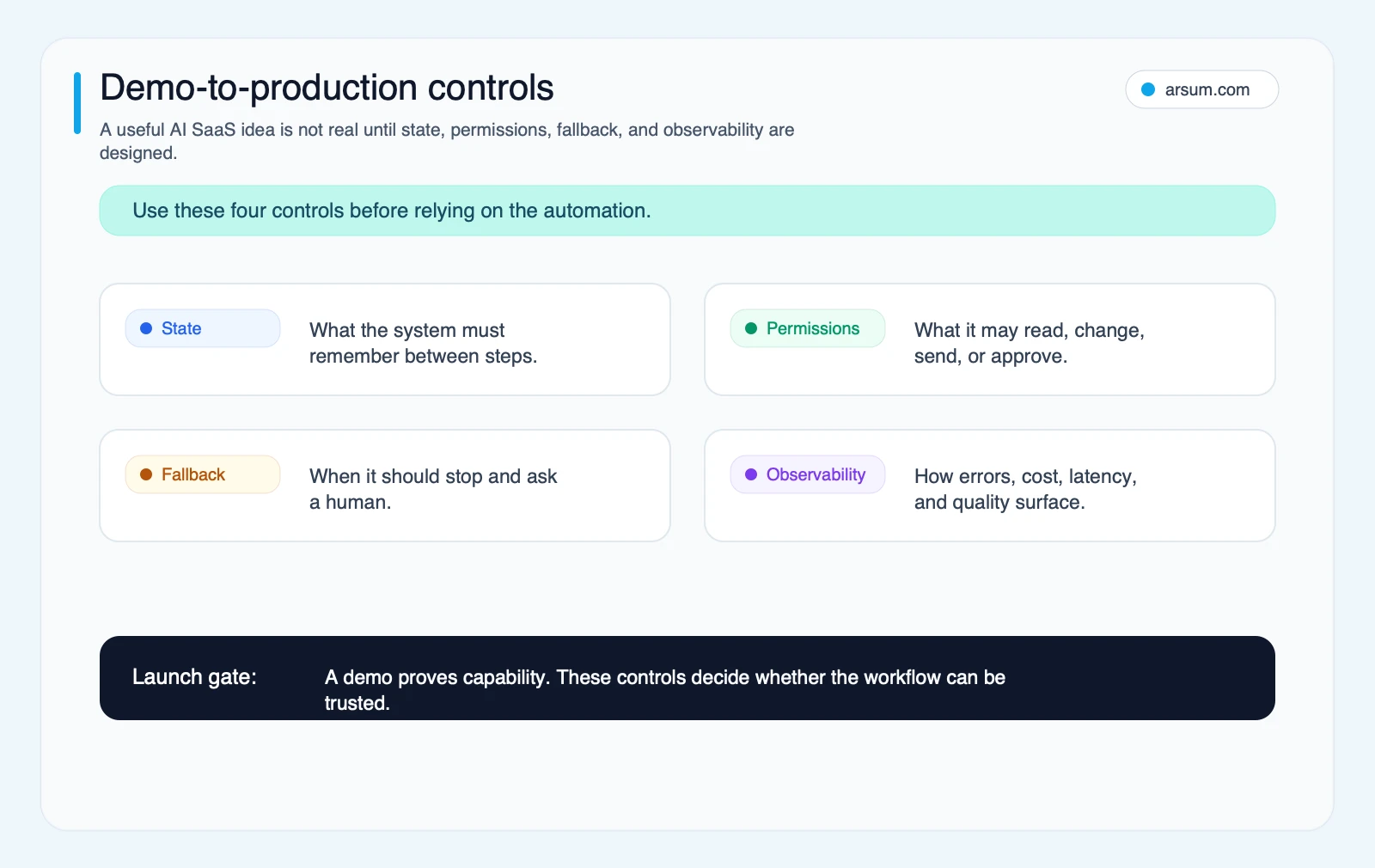
A demo can prove that a model can summarize a file or write a reply. It does not prove that the workflow is ready for production. Define the control design before adding autonomous actions.
- State: Which case details, prior actions, and deadlines must persist between steps?
- Permissions: What may the system read, draft, create, update, or send? What is always read-only?
- Fallback: Which missing field, policy conflict, low-confidence result, or tool failure requires human review?
- Observability: Which inputs, retrieved sources, generated output, user edits, integrations, latency, and errors are retained?
- Rollback: How will the team disable writes, return to the prior queue, and correct records created during a failed release?
For a deeper view of bounded tool access, approvals, and audit trails, see AI agent security and AI agent architecture patterns.
The low-competition filter
“Low competition” should mean that a team has tested the alternatives and found an unresolved workflow boundary—not that it has searched casually and found few ads.
Score each candidate from 0 to 2 on the following questions. A high score is a reason to investigate, not a forecast of revenue or savings.
| Filter | 0 | 1 | 2 |
|---|---|---|---|
| Repetition | Ad hoc | Monthly | Weekly or daily |
| Pain visibility | No baseline | Anecdotal delay or rework | Measured time, misses, or error cost |
| Input quality | Scattered or inaccessible | Some usable examples | Historical cases with source systems |
| Workflow boundary | Broad transformation | Several unclear tasks | One repeatable step with defined handoff |
| Authorization | High-stakes autonomous action | Review requirements unclear | Human approval retained and documented |
| Integration readiness | No system owner | APIs or exports uncertain | Named systems and owners are available |
| Incumbent response | Strong product solves the workflow | Partial fit | Alternatives leave a material, verified gap |
A category is worth a pilot when it scores well on repetition, pain, source access, and bounded scope. It is not ready when the buyer cannot produce examples, nobody owns the system of record, or the proposed automation would make a high-consequence decision without an authorized reviewer.
Validate the market claim separately
Review the relevant system-of-record vendor, horizontal automation platforms, specialized workflow products, and service alternatives. Then write down:
- the exact workflow each alternative covers;
- the integration or data boundary it cannot meet;
- whether the gap is configuration, implementation capacity, price, policy, or product capability;
- the likely platform response if the workflow becomes valuable; and
- the defensibility lever: proprietary corpus, historical outcomes, domain rules, integrations, or operational know-how.
This turns “low competition” into a falsifiable discovery hypothesis. It also prevents teams from mistaking an expensive but adequate vendor for an empty market.
Five category hypotheses with bounded first pilots
The categories below are starting points for discovery. They are not claims that each market lacks vendors or that automation will produce a particular commercial outcome. Each first pilot intentionally stops short of autonomous, consequential action.
1. Freight invoice variance review
Workflow boundary: Extract carrier invoice line items, compare them with approved rate cards and shipment records, and route possible variances to an accounts-payable reviewer.
Source systems: Invoice inbox or document repository; transportation-management system; approved carrier contract or rate-card repository; accounts-payable queue.
System output: A source-linked comparison showing matched fields, missing data, and variance flags. It must not approve payment, create a dispute, alter a contract, or contact a carrier without human authorization.
Human approver: AP manager or designated transportation finance reviewer.
Evidence retained: Original invoice, shipment reference, rate-card version, extracted fields, variance logic, reviewer disposition, and any correction made to the source data.
Exceptions: Illegible documents, unmatched shipment IDs, conflicting rates, accessorial charges outside the rate card, multiple currencies, and disputed contract versions.
Candidate value mechanism: More complete review coverage, less time spent assembling comparisons, and earlier identification of questionable invoices. Measure these against the current process; do not assume recovery or savings.
Provisional incumbent risk: Medium. This must be tested against the company’s transportation and AP platforms, plus any existing freight-audit service. The relevant question is whether they already support the organization’s carriers, documents, exception rules, and reviewer workflow.
| Pilot scorecard | Planning measure |
|---|---|
| Baseline | Count monthly invoices, median review minutes per invoice, percentage sampled, and variance cases found |
| Target | Increase reviewed coverage while preserving the AP team’s required evidence standard |
| Quality metric | Reviewer agreement with extraction and variance disposition |
| Review threshold | No payment-impacting recommendation proceeds without AP review |
| Owner | AP manager |
| Review cadence | Weekly calibration on a sample of accepted and rejected flags |
| Stop condition | Material source-lineage failures, repeated incorrect variance flags, or reviewer burden exceeds the baseline process |
| Rollback | Disable automated queue routing; return invoices to the existing review queue with original files intact |
| 30/60/90-day gate | 30: source mapping works; 60: exception taxonomy is stable; 90: sponsor decides whether measured coverage and reviewer effort justify expansion |
This is closely related to the controls needed for accounts receivable automation, even though the payment-side workflow, systems, and approval owner differ.
2. After-hours service inquiry qualification
Workflow boundary: A system receives a web form, email, or call transcript; identifies intent; asks approved qualification questions; and proposes a booking slot or hands the inquiry to an on-call employee.
Source systems: Website form or telephony transcript; CRM; scheduling platform; service-area and availability rules; approved service catalogue.
System output: Draft responses, structured lead fields, and a proposed appointment. It must not quote nonstandard prices, waive policies, promise availability outside configured rules, or resolve complaints autonomously.
Human approver: Service manager or on-call dispatcher for exceptions, complaints, special pricing, and any request outside the approved catalogue.
Evidence retained: Original inquiry, transcript, selected knowledge source, questions asked, customer responses, booking action, and human override.
Exceptions: Emergency language, unsafe work requests, out-of-area customers, special pricing, unavailable staff, incomplete contact data, and customer complaints.
Candidate value mechanism: Faster response to existing inbound demand and more consistent lead capture. Conversion improvement is a hypothesis to test using the organization’s own baseline, not an expected outcome.
Provisional incumbent risk: Medium to high. Review the current CRM, field-service, scheduling, call-answering, and chat vendors before building. The gap may be an integration or configuration problem rather than a product opportunity.
| Pilot scorecard | Planning measure |
|---|---|
| Baseline | Inquiries by channel, first-response time, booked appointments, abandoned leads, and manual handling minutes |
| Target | Meet a sponsor-defined response-time window for eligible inquiries while logging every handoff |
| Quality metric | Manager review of classification, response accuracy, and booking correctness |
| Review threshold | All pricing exceptions, complaints, and nonstandard service requests require human review |
| Owner | Service manager |
| Review cadence | Daily review during launch; weekly policy and prompt calibration afterward |
| Stop condition | Incorrect booking, unapproved commitment, poor escalation reliability, or customer confusion above the team’s tolerance |
| Rollback | Turn off automated replies and bookings; preserve CRM records and route new inquiries to the existing inbox or answering process |
| 30/60/90-day gate | 30: reliable capture; 60: qualified routing meets review standard; 90: compare response and booking metrics with the pre-pilot baseline |
For broader system design choices, see automating customer onboarding and AI workflow automation.
3. Internal policy and ticket triage
Workflow boundary: Classify employee requests, retrieve approved policy or knowledge sources, draft a response, and route the case to the accountable team.
Source systems: Helpdesk, HRIS or internal policy repository, identity and access system, departmental queue, and approved knowledge base.
System output: Category, urgency recommendation, source-linked draft, and routing recommendation. It must not make employment decisions, change access permissions, create disciplinary records, or provide unreviewed legal or benefits determinations.
Human approver: IT service-desk lead for technical cases; HR operations owner for people-policy cases.
Evidence retained: Original ticket, retrieved policy version, classification, draft response, routing history, approver edits, and resolution code.
Exceptions: Sensitive employee data, legal or benefits questions, security incidents, access changes, threats, and tickets with missing identity or system context.
Candidate value mechanism: Lower manual sorting effort and more consistent routing. Any faster resolution claim must be demonstrated by comparing like-for-like case cohorts.
Provisional incumbent risk: High for generic routing; potentially lower for a narrow workflow that must use a company’s policy hierarchy, ownership map, and review rules. Check existing helpdesk and HR systems first.
| Pilot scorecard | Planning measure |
|---|---|
| Baseline | Ticket volume, median assignment time, reassignment rate, unresolved queue age, and staff review minutes |
| Target | Reduce avoidable reassignment without increasing inappropriate routing |
| Quality metric | Routing agreement with the accountable team and source correctness in drafted replies |
| Review threshold | HR-sensitive, security, access, and legal-policy cases remain human-assigned |
| Owner | Service-desk lead or HR operations lead |
| Review cadence | Weekly sample review by the receiving teams |
| Stop condition | Sensitive-case misrouting, unsupported policy citations, or a rise in reassignment rate |
| Rollback | Disable auto-routing; retain classification as a nonbinding tag only |
| 30/60/90-day gate | 30: taxonomy agreed; 60: routing quality reviewed; 90: expand only if receiving teams accept the measured quality |
This category is often more useful when connected to a broader AI business process automation program rather than launched as an isolated chatbot.
4. Regulated document preparation with review
Workflow boundary: Assemble a source-linked draft package from approved documents and checklist rules—for example, insurance-policy processing, loan-file completeness review, or regulatory submission preparation.
Source systems: Document repository, policy/checklist library, case-management system, approved templates, and identity/access controls.
System output: Completeness checklist, extracted facts, missing-evidence flags, and a draft package. It must not underwrite, approve a loan, bind coverage, file a regulatory submission, make a clinical determination, or decide eligibility.
Human approver: Compliance officer, licensed reviewer, underwriter, or designated business owner, depending on the workflow.
Evidence retained: Source documents, document versions, checklist version, extraction record, exceptions, reviewer approval, and final filing or decision reference.
Exceptions: Missing consent, inconsistent identity data, conflicting documents, policy changes, expired forms, ambiguous language, and jurisdiction-specific requirements.
Candidate value mechanism: Better package preparation and more visible missing evidence before review. It does not authorize autonomous decisions in a regulated process.
Provisional incumbent risk: Must be assessed case by case. Existing vertical platforms may handle standardized forms well but leave organization-specific evidence assembly and exception routing unresolved. That distinction needs vendor demonstrations, not assumption.
| Pilot scorecard | Planning measure |
|---|---|
| Baseline | Packages per month, preparation minutes, incomplete-package rate, reviewer rework, and turnaround time |
| Target | Improve completeness detection while retaining licensed or authorized review |
| Quality metric | Reviewer-confirmed extraction and checklist accuracy |
| Review threshold | 100% human approval before any external filing, decision, or commitment |
| Owner | Compliance officer or licensed operations owner |
| Review cadence | Weekly error review; immediate escalation for policy or privacy incidents |
| Stop condition | Source mismatch, missing evidence presented as complete, unauthorized data exposure, or policy-version error |
| Rollback | Remove write and submission permissions; revert to manual checklist and document assembly |
| 30/60/90-day gate | 30: data access approved; 60: controlled shadow review; 90: authorization owner accepts or rejects limited production use |
For finance-specific boundaries, AI use cases in finance and credit decision automation help separate assistive workflow automation from decision authority.
5. RFP evidence assembly and approval routing
Workflow boundary: Search approved past proposals, case studies, policies, and technical materials; assemble a source-linked first draft; identify unanswered questions; and route each section to the correct reviewer.
Source systems: Proposal repository, document-management system, CRM account context, approved capability library, security-questionnaire materials, and version-control or collaboration tools.
System output: Draft sections with citations to internal sources, a gap list, and an approval checklist. It must not invent customer claims, certify compliance, accept contractual terms, submit a proposal, or make commercial commitments.
Human approver: Proposal lead, legal reviewer, security owner, and commercial sponsor according to section type.
Evidence retained: Source references, draft versions, reviewer edits, approval history, unresolved claims, and final submitted version.
Exceptions: Expired case studies, unsupported outcomes, client-confidential material, contradictory positioning, legal terms, security claims, and requests beyond the approved knowledge base.
Candidate value mechanism: Less time locating reusable material and more consistent evidence capture. Faster production or higher win rates are hypotheses that require a baseline and controlled measurement.
Provisional incumbent risk: Medium. Proposal tools may cover document workflow but not an organization’s approval matrix, evidence requirements, or source governance. A buy-versus-build assessment should start with representative RFPs rather than feature checklists.
| Pilot scorecard | Planning measure |
|---|---|
| Baseline | RFPs per quarter, hours by contributor role, late sections, unsupported-claim corrections, and approval delays |
| Target | Reduce time spent locating approved evidence without lowering review standards |
| Quality metric | Reviewer acceptance of source citations and draft completeness |
| Review threshold | Legal, security, pricing, and customer-outcome claims remain human-approved |
| Owner | Proposal operations lead |
| Review cadence | Review every pilot draft; monthly analysis of recurring content gaps |
| Stop condition | Unsupported claim reaches a reviewer late, confidential data is surfaced incorrectly, or reviewers spend more time correcting than drafting |
| Rollback | Remove access to sensitive repositories and return to manual evidence assembly |
| 30/60/90-day gate | 30: source library mapped; 60: shadow drafts reviewed; 90: decide whether measured authoring and review effort supports rollout |
💡 Arsum builds custom AI automation solutions tailored to your business needs.
Get a Free Consultation →Compare categories by workflow, not by excitement
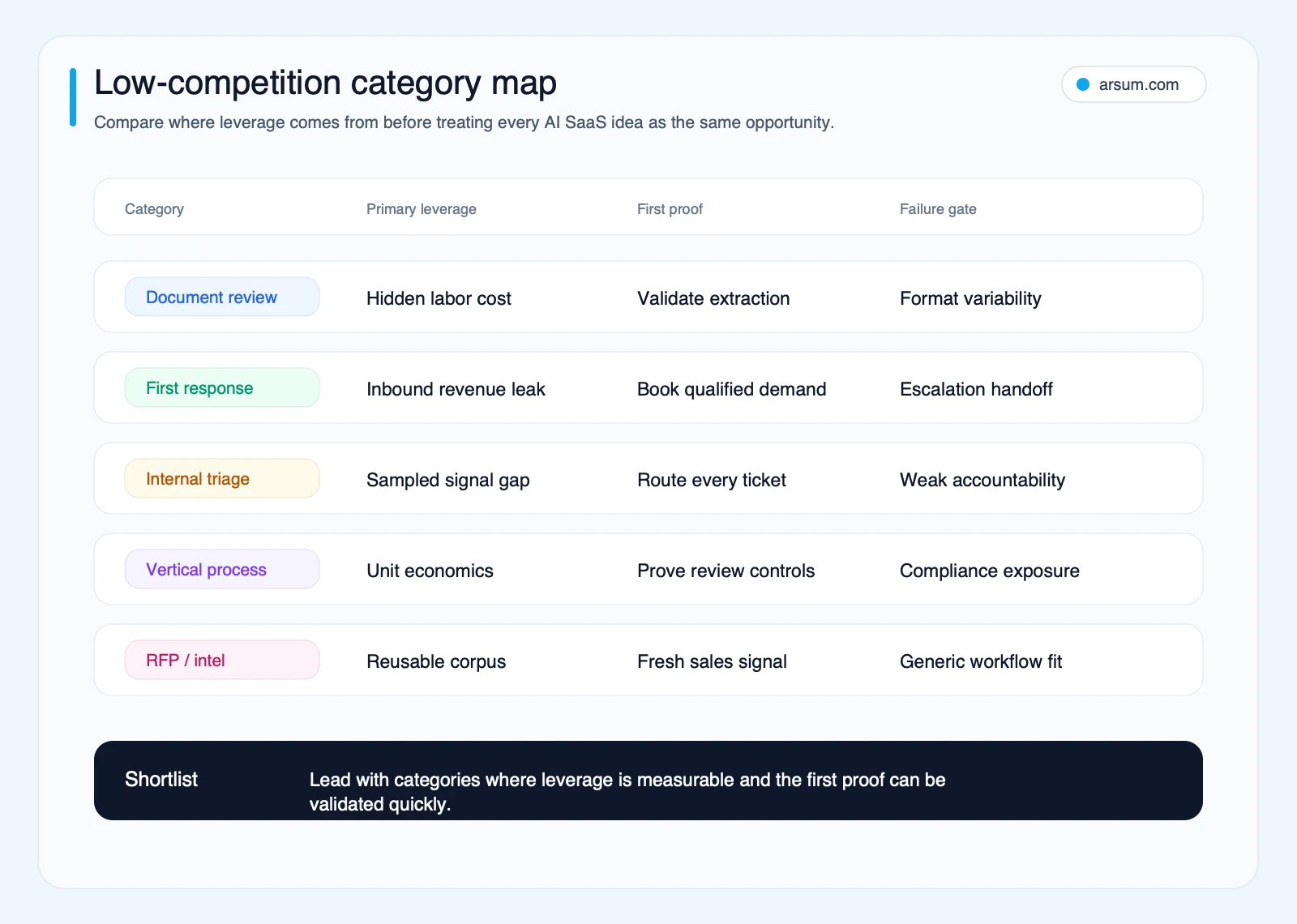
| Category | First proof | Main failure gate | Likely owner | Defensibility lever |
|---|---|---|---|---|
| Freight invoice review | Reviewer-confirmed variance flags | Source and rate-card mismatch | AP manager | Exception history and system mapping |
| Inquiry qualification | Reliable capture and handoff | Unauthorized commitments | Service manager | CRM, scheduling, and escalation logic |
| Internal triage | Fewer avoidable reassignments | Sensitive-case misrouting | IT or HR operations | Policy hierarchy and ownership map |
| Regulated preparation | Reviewer-confirmed completeness | Unauthorized decision or filing | Compliance or licensed owner | Evidence lineage and controlled workflow |
| RFP evidence assembly | Accepted, cited draft sections | Unsupported or confidential claims | Proposal lead | Approved corpus and approval routing |
Build, buy, or partner: use a representative-case test
Do not make this decision from a roadmap, pricing page, or model demo. Give each option the same ten representative cases: normal cases, ugly exceptions, missing inputs, sensitive-data cases, and required approvals.
| Question | Buy | Build | Partner for a scoped workflow |
|---|---|---|---|
| Does a vendor handle most representative cases with acceptable controls? | Strong option | Usually unnecessary | Useful for integration or validation support |
| Is the unresolved gap mainly configuration? | Prefer buy | Avoid custom product work | Use implementation help if internal capacity is limited |
| Does value depend on proprietary data, workflow rules, and multiple internal systems? | Test carefully | More plausible | Often useful for bounded delivery and knowledge transfer |
| Who will maintain prompts, policies, integrations, and exceptions? | Vendor plus internal owner | Internal product/engineering owner | Shared transition plan required |
| What is the total cost? | Subscription, configuration, integration, review operations | Delivery, infrastructure, security, maintenance, review operations | Assessment, implementation, operating handoff, review operations |
A vendor is not disqualified because it is generic; it is disqualified only if it cannot meet the documented workflow, control, and evidence requirements at an acceptable total cost. Custom work is not justified because a workflow is interesting; it is justified when the organization-specific integration, source lineage, and approval logic create measurable value that a configured product cannot provide.
For a fuller ownership comparison, read hiring an AI developer versus an agency and custom AI solutions for business.
An illustrative pilot economics worksheet
Use planning arithmetic, not promised ROI. The inputs below must come from the target team’s own baseline.
| Input | Illustrative planning assumption |
|---|---|
| Cases per month | 800 |
| Current handling time | 12 minutes per case |
| Fully loaded labor cost | $45 per hour |
| Eligible cases after exclusions | 60% |
| Human review time after automation | 4 minutes per eligible case |
| Monthly operating cost | $2,000 |
Under these assumptions, the model is:
- Current monthly effort:
800 × 12 / 60 = 160 hours - Eligible automated effort reduction:
800 × 60% × (12 - 4) / 60 = 64 hours - Illustrative gross capacity value:
64 × $45 = $2,880 per month - Illustrative net before implementation cost:
$2,880 - $2,000 = $880 per month
This is not a result, savings claim, or budget. It excludes implementation, security review, management time, exception handling, and any value from faster response or improved coverage. Its purpose is to show which inputs a sponsor must validate before approving a pilot.
Disqualifying conditions and common failure modes
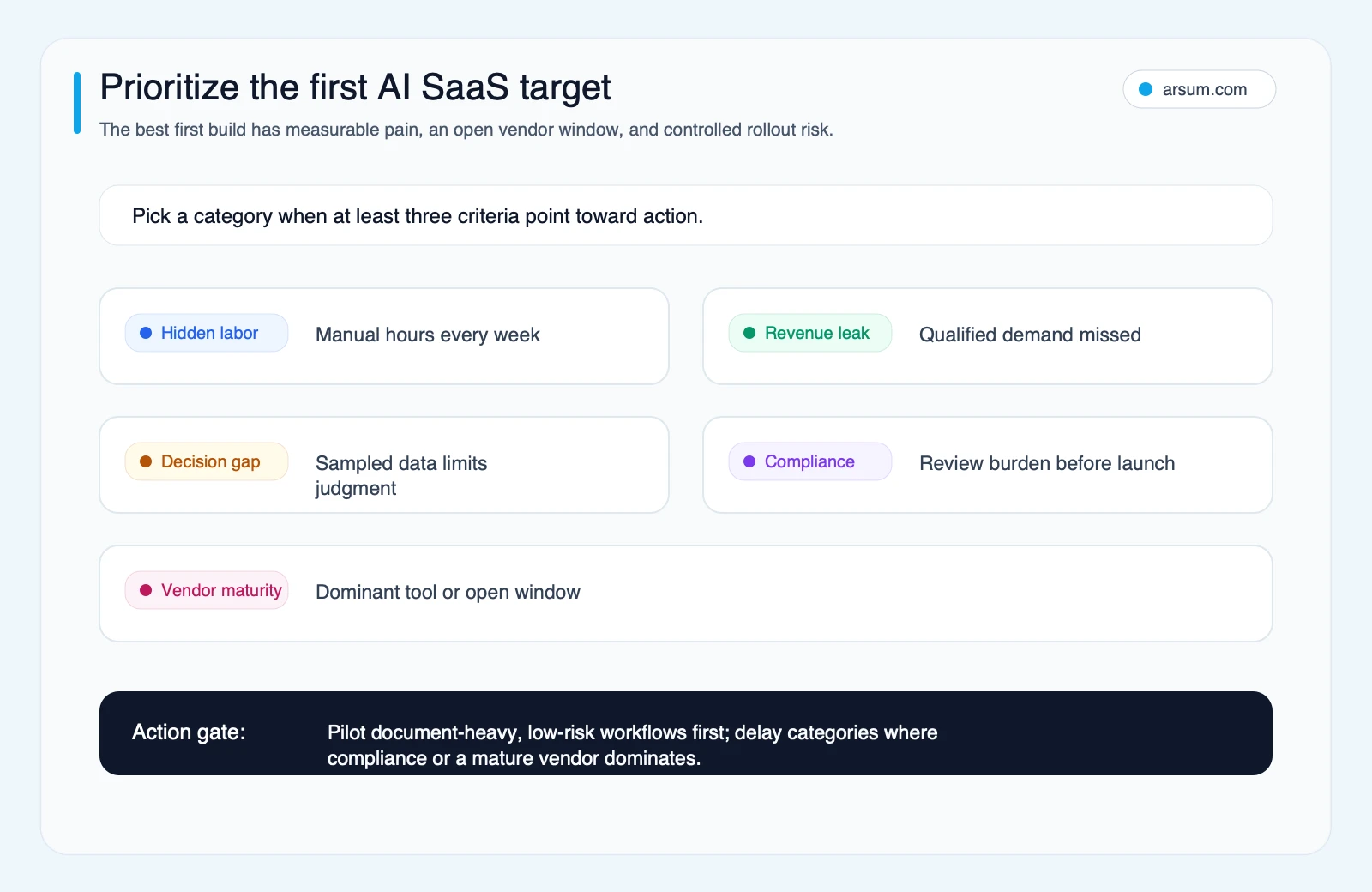
Skip or defer the workflow when:
- the sponsor cannot provide real historical cases and exception examples;
- the system of record has no accountable owner or usable export/API path;
- the proposed value depends on autonomous payment, eligibility, clinical, legal, employment, or pricing decisions;
- the baseline is too small or irregular to measure within a pilot;
- the team cannot retain source lineage and reviewer actions;
- a credible existing product already satisfies the requirements with reasonable configuration; or
- no operating team will own exceptions after launch.
The recurring failure pattern is not “the model was imperfect.” It is launching without policy boundaries, clean source access, reviewer capacity, or a way to revert safely. A smaller workflow with a real owner is usually a better first product than a broad agent that touches many systems.
A practical discovery sequence
- Observe the work or review recent completed cases with the operator.
- Map every source, handoff, approval, and exception.
- Measure volume, time, error, misses, and review burden for a defined baseline period.
- Test vendors on representative cases, including failures—not just happy-path demonstrations.
- Design a shadow-mode pilot that drafts, flags, or routes while humans retain authority.
- Hold the 30-, 60-, and 90-day gates defined in the scorecard.
- Expand only after the accountable owner accepts the measured quality, exception burden, and rollback controls.
Community discussions about AI SaaS ideas, tools that mine complaints for ideas, and domain immersion before vertical SaaS are useful qualitative signals: founders want pain-first discovery. They are not evidence of market size, willingness to pay, vendor absence, or expected returns.
Methodology and next decision
This is an editorial framework based on workflow qualification, not a market-share ranking. The category examples identify candidate workflows; they do not assert that a market is empty, that a vendor cannot serve it, or that a given outcome will occur. Before investment, validate the baseline, available alternatives, integration dependencies, authorization boundaries, and operating owner with the target team.
If your team has one candidate workflow, a useful assessment deliverable is concrete: a baseline measurement plan, system and data map, exception taxonomy, control design, vendor shortlist, illustrative economics worksheet, and written pilot acceptance and rollback criteria. That gives a sponsor enough information to approve, buy, build, or reject the work without relying on an AI trend narrative.
Ready to Automate Your Business?
Stop wasting time on repetitive tasks. Let AI handle the busywork while you focus on growth.
Schedule a Free Strategy Call →Written by:Arsum editorial team
- Reviewed by
- Arsum editorial team
- Published
- May 8, 2026
- Updated
- July 4, 2026
- How this was produced
- Arsum uses research packs, source checks, and human editorial review to prepare and update blog articles. Editors are responsible for the final page.
- Source policy
- Sources are linked in the article when used. Methodology and source notes are included on higher-risk or high-visibility pages and are being rolled out across the archive. Editorial policy.
- Why this page exists
- Help B2B operators evaluate AI automation, implementation scope, cost, risk, and build-vs-buy decisions with practical context.